 by Tom Gurney
Tom Gurney BSc (Hons) is an art history expert with over 20 years experience
Published on June 19, 2020 / Updated on October 27, 2026
Email: tomgurney1@gmail.com / Phone: +44 7429 011000
Cascade Falls, Yosemite by Thomas Moran: Introduction
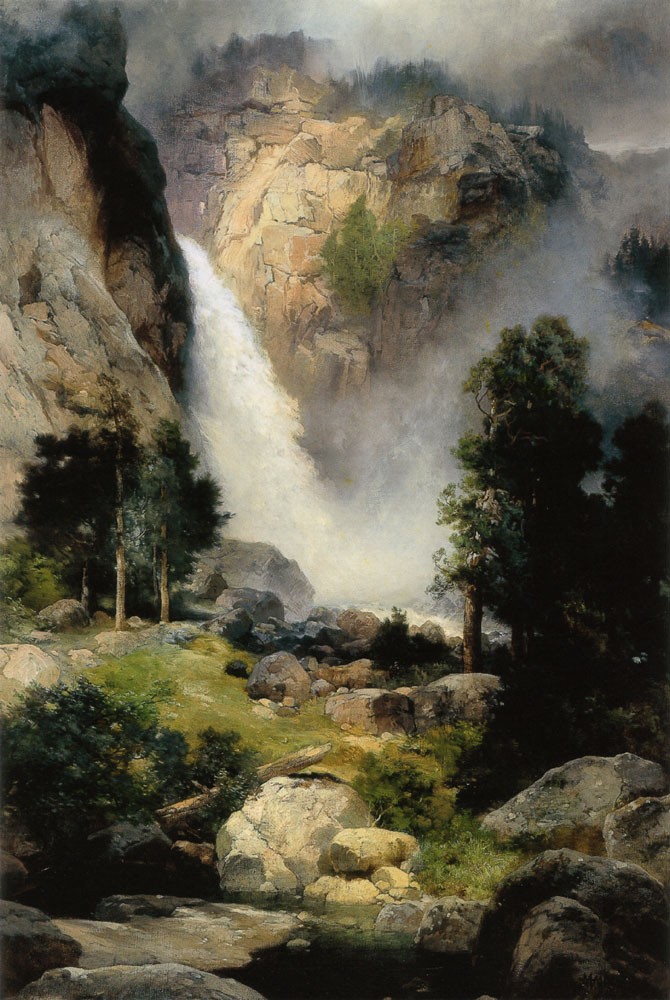
Thomas Moran’s Cascade Falls, Yosemite sets a bright waterfall between steep rocks and dark trees. The water descends from a narrow opening on the left into an expanding area of mist, while boulders and vegetation fill the lower half. The painting is commonly catalogued as an oil on canvas of 1905 in a private collection; the faithful reproduction record does not identify a present owner. [1]
Its upright format turns the waterfall into a connecting line between different levels of the landscape. Yet the descent is only part of the subject. Moran gives substantial space to the foreground, where stones, patches of light and an interrupted stream make the viewer’s position feel close to the ground. The falls are encountered beyond these nearer forms rather than displayed as an isolated spectacle.
At a Glance
- ArtistThomas Moran.
- TitleCascade Falls, Yosemite.
- DateCommonly catalogued as 1905.
- MediumCatalogued as oil on canvas.
- SubjectA waterfall within a rocky Yosemite landscape.
- CollectionPrivately owned in the reproduction record; present ownership not established.
Where this work sits in Moran’s career
The Chasm of the Colorado
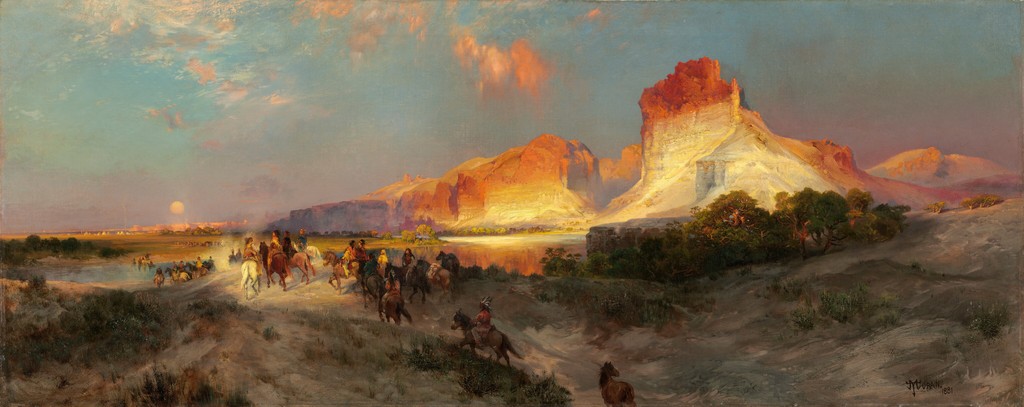
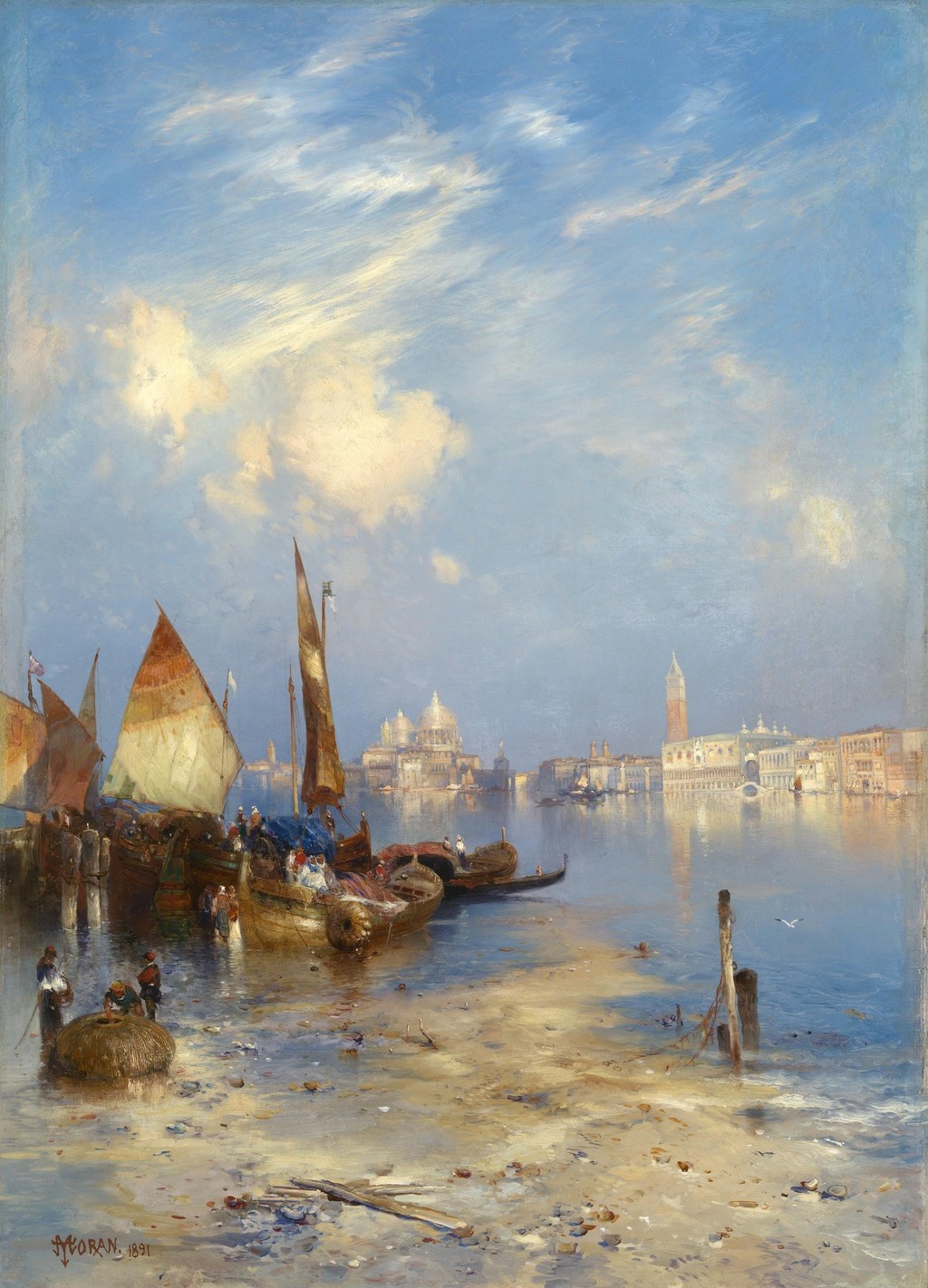
1873–1874; completed in 1874A View of Venice
1891Point Lobos, Monterey, California
1912, signed and datedCascade Falls, Yosemite
Commonly catalogued as 1905Contents
- A waterfall enclosed by rock
- Beginning with the foreground
- Trees and atmospheric distance
- Yosemite across Moran’s career
- Comparing other waterfall compositions
A waterfall enclosed by rock
The falling water enters the composition slightly left of centre. Its upper course is confined between dark rock and the larger, warmer cliff beyond it. As it descends, the white passage broadens and becomes less sharply bounded. At the base, water and mist occupy a pale interval whose edges partly dissolve against the surrounding landscape.
The cliff behind the fall has a contrasting character. Its angular divisions and broken ledges make it appear solid, even where softer atmospheric effects interrupt the view. The water therefore reads through its relationship to the rock: bright against dark near the upper opening, and increasingly diffuse lower down.
The height of the scene is reinforced by the stacked forms. Rock rises above trees; further trees appear along the upper ridges; mist crosses between them. The viewer cannot trace every surface continuously from bottom to top. These interruptions make the view feel extensive without providing a diagram of the cliff’s geology.
Beginning with the foreground
The waterfall is the brightest conspicuous feature, but the foreground occupies a large share of the canvas. Pale boulders stand beside darker stones, and a fallen length of wood lies among the vegetation. A narrow dark stretch of water appears near the lower edge, partly obscured by surrounding rock.
These nearer objects change the experience of scale. The boulders can be understood as relatively close forms, whereas the upper cliff is separated from them by trees and atmospheric distance. The painting moves between those two registers rather than presenting every part of the scene with equal sharpness or prominence.
Small differences of lighting also help connect the foreground to the fall. Brighter patches run across stones and vegetation, echoing the luminous water without matching its intensity. Dark areas break those connections. They prevent the viewer from travelling through the scene along one uninterrupted bright line.
The stream is similarly interrupted. The eye recognises water at the bottom and the large descent beyond, but rocks and vegetation stand between them. Moran makes the relationship perceptible while leaving parts of the route concealed. This gives the landscape a sense of depth that depends on obstruction as well as openness.
Trees and atmospheric distance
The darker trees on the right provide an especially strong frame. Their irregular silhouette stands against a lighter, mistier background, making their position comparatively easy to grasp. Smaller trees further left occupy the space before the waterfall. They interrupt the pale descent while also supplying a visible measure between the foreground stones and the cliffs.
Trees higher in the picture have a different function. Along the upper rock, they appear as small, dark marks whose reduced scale reinforces the distance. They also prevent the cliff from becoming one uninterrupted block. Growth follows its irregular edges and breaks across some of its shelves.
Mist softens several of these relationships. It gathers around the waterfall’s lower course and extends towards the right, where further formations become less distinct. The contrast between solid nearer shapes and these less accessible passages is central to the composition. It allows Moran to suggest depth without fixing every feature within an evenly described space.
The effect is atmospheric, but it is not evidence of a particular hour, weather forecast or water-flow measurement. The painting’s visible contrasts are enough to explain how it operates: harder rock surfaces, darker trees and softer pale intervals are made to work together.
Watch: Thomas Moran
Choose a film to explore the artist’s work, its interpretation and its wider setting.
The painting that inspired a National Park
A close discussion of Moran’s landscape and its relationship to the idea of Yellowstone.
Watch on YouTubeYosemite across Moran’s career
Yosemite was not simply a late addition to Moran’s travels. The National Gallery of Art’s catalogue chronology records that Thomas and Mary Nimmo Moran travelled there in August 1872 and returned in October. It also records his own account of making pencil, ink and watercolour sketches on that journey. [2]
The same chronology documents renewed Yosemite activity in 1904, including a dated sketch of the North and South Domes, and lists Yosemite subjects in later exhibitions. These records place the commonly assigned 1905 date within a period of continuing interest. They do not establish which drawing, journey or commission produced this particular Cascade Falls. [2]
Repeated visits and repeated subjects make that distinction valuable. A title describes a place or motif, but it does not automatically supply the history of an individual canvas. The waterfall’s appearance can be examined closely while its exact route from sketch to finished painting remains undocumented.
Comparing other waterfall compositions
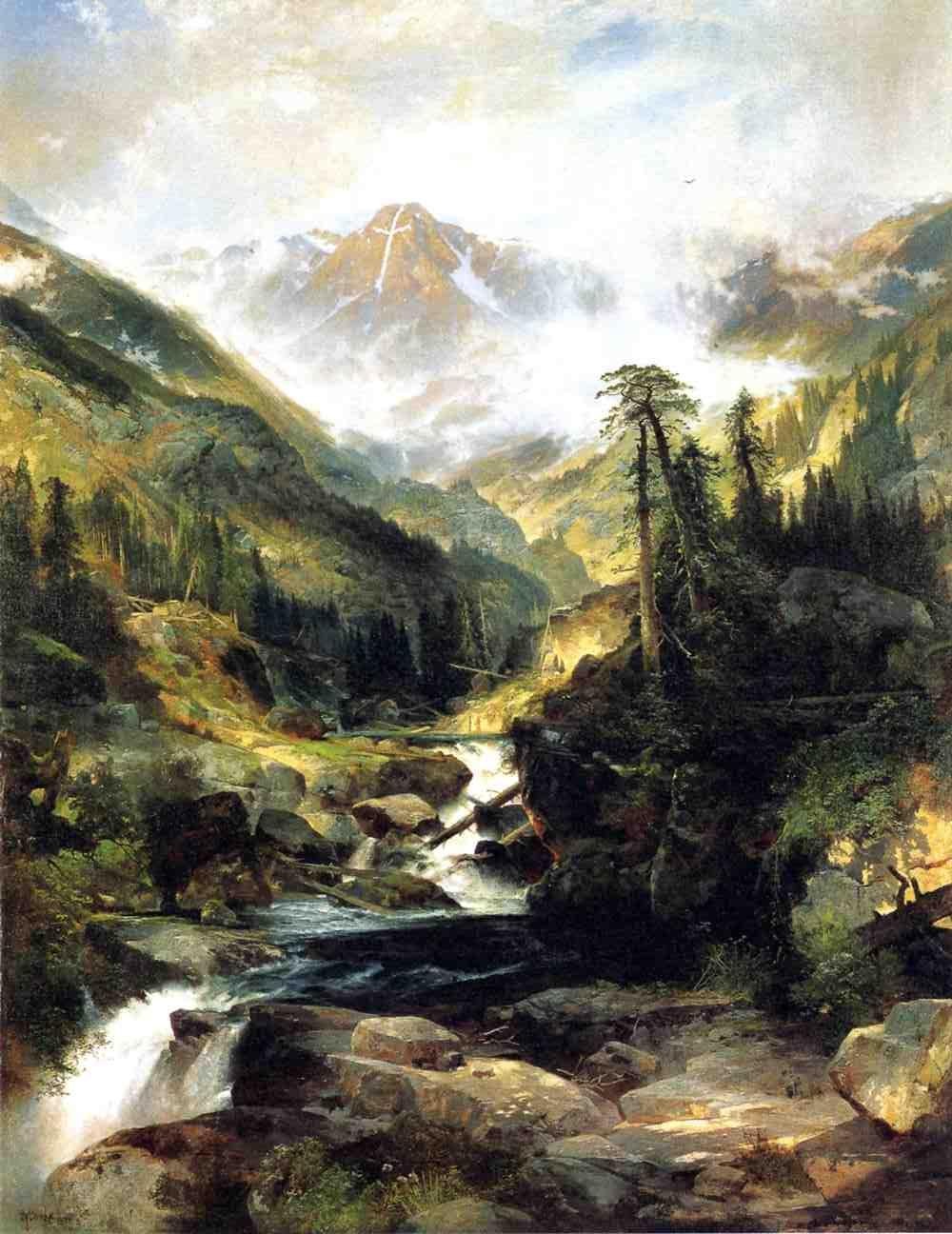
Mountain of the Holy Cross also uses falling water within an upright mountain landscape. In that painting, the stream leads attention towards a distant summit, and Moran’s documented explanation describes his freedom in arranging the foreground. Cascade Falls concentrates more closely on a waterfall enclosed by cliffs. The comparison highlights the difference between water used to lead towards a mountain and water made into the principal event within the rocks. [2]
Tower at Tower Falls, Yellowstone, the National Gallery of Art’s 1872 paper study, supplies another contrast. Its title identifies a rock formation at the falls, and its focus is the tower rather than a complete panoramic waterfall view. The two subjects show why a place-name should not make different media and compositions interchangeable. [3]
In Cascade Falls, the combination of nearby stones, framing trees and mist produces a particularly layered encounter. The water provides the dominant movement, but the surrounding landscape determines how that movement is seen. Moran’s scene becomes more legible as the viewer follows the changing relationships between its solid and less sharply bounded forms.
Artworks directory
Selected documented works and distinct versions. This directory is not a comprehensive catalogue raisonné. Dates and media retain the distinctions explained in the articles and museum records.
| Name | Date | Medium |
|---|---|---|
| An Arizona Sunset near the Grand Canyon | Date not securely established | Oil painting |
| Autumn Afternoon, the Wissahickon by Thomas Moran | 1864 | Oil on canvas |
| Cascade Falls, Yosemite | Commonly catalogued as 1905 | Catalogued as oil on canvas |
| The Chasm of the Colorado | 1873–1874; completed in 1874 | Oil on canvas, currently mounted on aluminium |
| Children of the Mountain | 1866 in the current museum title; 1867 in the 1997 National Gallery catalogue | Oil on canvas |
| Cliffs of Green River | 1874 | Oil on canvas |
| Cliffs of the Upper Colorado River, Wyoming Territory | 1882 | Oil on canvas |
| East Hampton, Long Island , also captioned Easthampton, L.I | 1897 | Oil on canvas laid on board, according to the reproduction record |
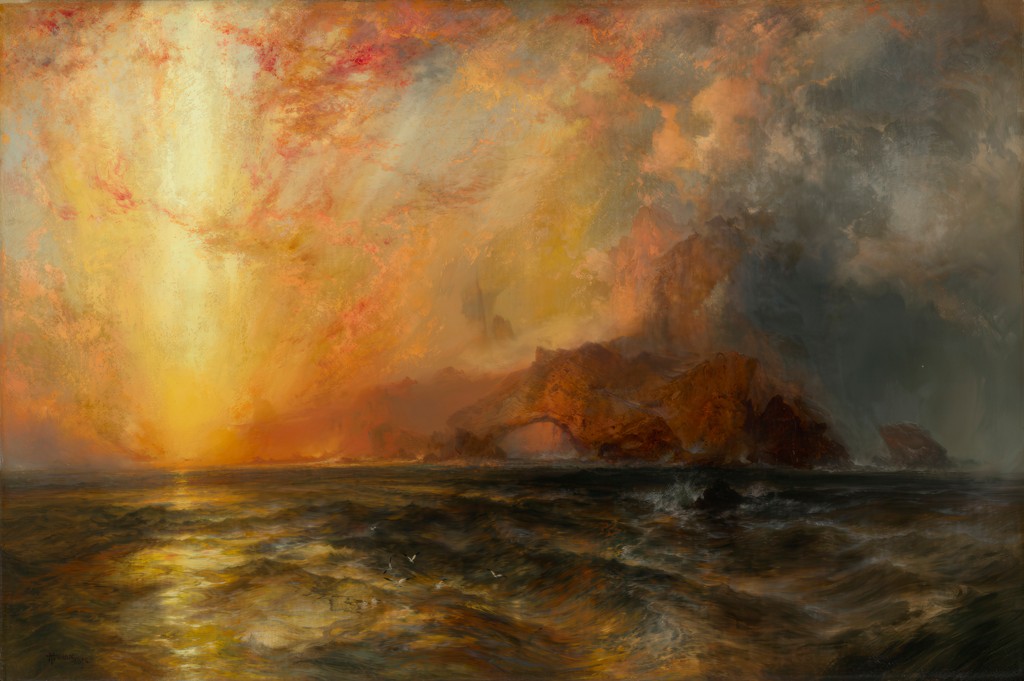
| Fiercely the red sun descending, Burned his way along the heavens | 1875–76 | Oil on canvas |
| Forest Scene | 1870 | Oil on canvas |
| Grand Canyon of the Colorado River | 1892 and 1908 | Oil on canvas |
| Green River Cliffs, Wyoming | 1881 | Oil on canvas |
| Green River, Wyoming | 1878 | Oil on panel |
| The Juniata, Evening | 1864 | Oil on canvas |
| Mosquito Trail, Rocky Mountains of Colorado | 1875 in the 1997 National Gallery exhibition catalogue | Watercolour |
| Mountain of the Holy Cross | 1875 | Oil on canvas |
| The Much Resounding Sea | 1884 | Oil on canvas |
| Point Lobos, Monterey, California | 1912, signed and dated | Oil on canvas |
| Shoshone Falls on the Snake River | 1900 | Oil on canvas |
| Summit of the Sierras | 1872/75, as catalogued by the Art Institute of Chicago | Gouache over graphite on cream laid paper |
| The Teton Range | 1897 | Oil on canvas |
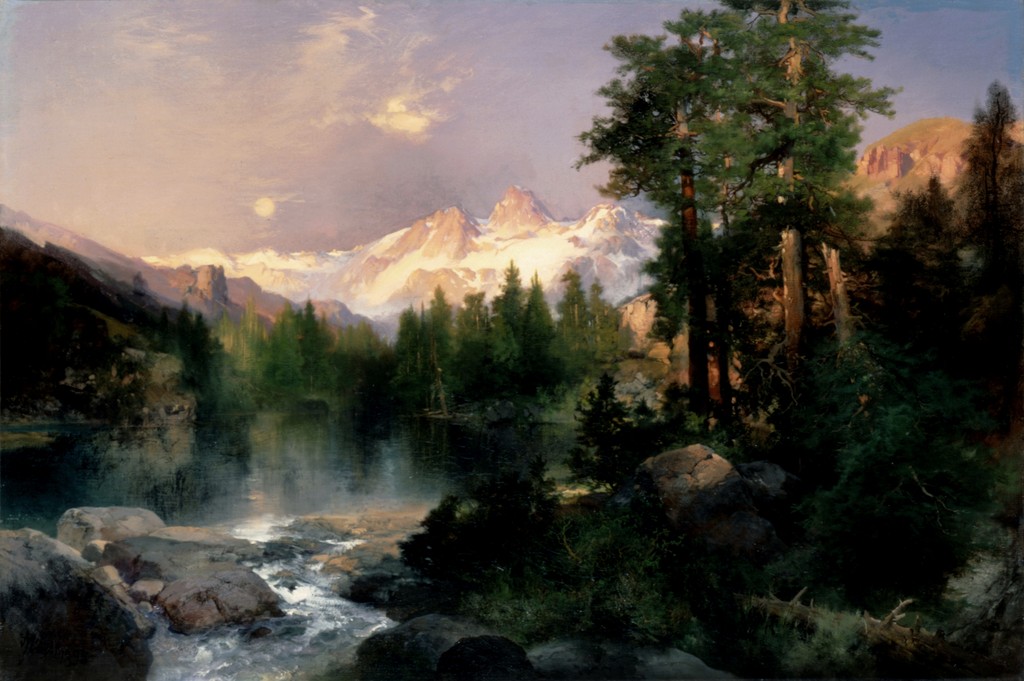
| The Three Tetons | 1895 | Oil on canvas |
| Tower Falls, Yellowstone | 1872 | Watercolour and gouache over graphite on blue laid paper |
| A View of Venice | 1891 | Oil on canvas |
| The Grand Canyon of the Yellowstone | 1872 | Oil on canvas, currently recorded as mounted on aluminium |
| Mountain of the Holy Cross, Colorado (etching) | 1888 | Etching, roulette and aquatint |
| The Resounding Sea (etching) | 1880 | Etching |
| The Much Resounding Sea (later etching) | 1886 in heading; 1888 on plate | Etching, drypoint and roulette |
| Tower Falls (Prang print) | c. 1875; portfolio issued 1876 | Chromolithograph |
| Shoshone Falls (early watercolour) | 1874 | Watercolour |
| Venice (watercolour) | 1888 | Watercolour over graphite |
Frequently Asked Questions
It is commonly catalogued as 1905. A current owning-museum object record has not been established, so that date is retained with a qualification. [1]
No. His catalogue chronology records a journey with Mary Nimmo Moran in 1872, as well as later Yosemite activity. [2]
No. The Yosemite painting depicts a waterfall within cliffs. The National Gallery’s 1872 Yellowstone study is a different work on paper focused on a rock formation. [3]
The reproduction record lists a private collection. It does not establish a present public display location. [1]
Discussion
Begin at the lower stream and follow the scene upwards. Which rocks or trees most strongly interrupt that movement? Does the mist make the waterfall seem larger, more distant, or less accessible?
Reader Insights
Editorial prompts for close looking and discussion.
- Begin at the lower stream and follow the scene upwards. Which rocks or trees most strongly interrupt that movement?
- Does the mist make the waterfall seem larger, more distant, or less accessible?
How does this page compare with the related works linked above?
Join the Conversation
Share your reading of this page below.
References
- Cascade Falls, Yosemite, faithful public-domain reproduction and secondary catalogue details preserved by Wikimedia Commons, with Art Renewal Center as the recorded source. Image record.
- Nancy K. Anderson, Thomas P. Bruhn, Joni L. Kinsey and Anne Morand, Thomas Moran, National Gallery of Art, 1997, chronology pp.205, 268–269 and Holy Cross entry pp.107–109. Exhibition catalogue.
- National Gallery of Art, Tower at Tower Falls, Yellowstone, 1872. Collection record.
- Splash image source.
Cascade Falls, Yosemite, commonly catalogued 1905. Private collection; faithful reproduction via Wikimedia Commons / Art Renewal Center. Image source. Public Domain Mark; faithful reproduction of a two-dimensional public-domain work. Resized only; complete source image retained.
- Splash image source.
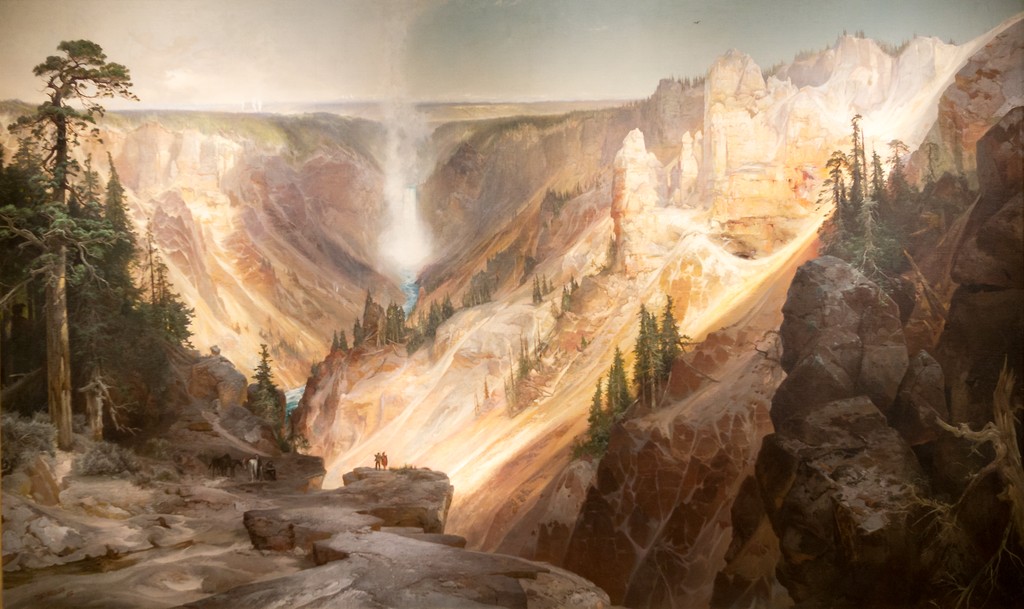
The Grand Canyon of the Yellowstone, 1872. Wuselig / Wikimedia Commons, CC BY-SA 4.0; U.S. Department of the Interior Museum painting. Image source. CC BY-SA 4.0; also marked PD-Art. Outer museum frame cropped; resized. Painted composition retained; photographic perspective unchanged. This image derivative is available under the same licence.
- Splash image source.
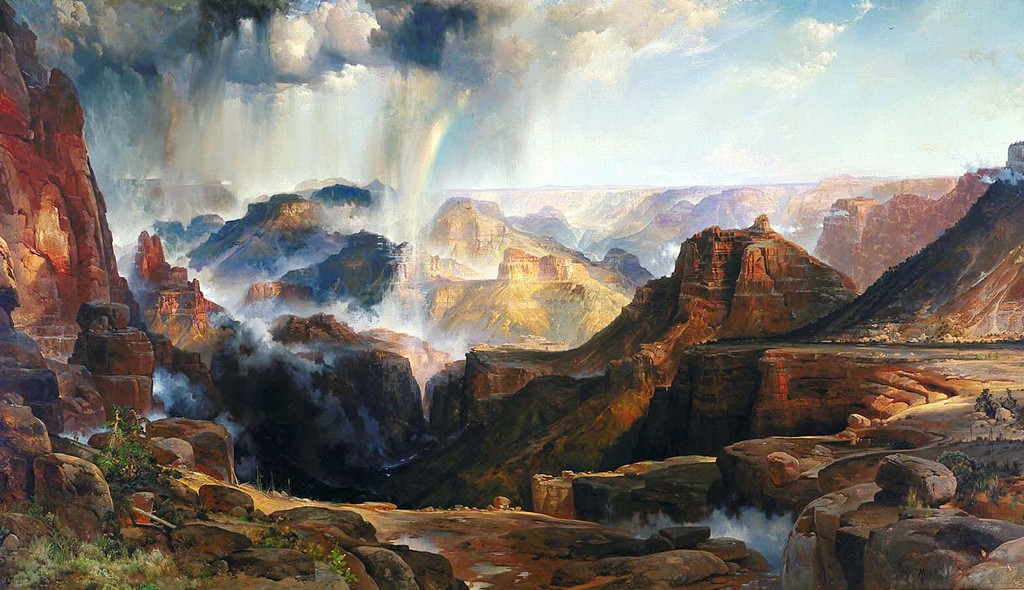
The Chasm of the Colorado, 1873–1874. U.S. Department of the Interior Museum; faithful reproduction via Smithsonian American Art Museum / Wikimedia Commons. Image source. Public Domain Mark; faithful two-dimensional reproduction. Resized only; complete source image retained.
- Splash image source.
Mountain of the Holy Cross, 1875. Autry Museum of the American West; faithful reproduction via Wikimedia Commons. Image source. Public Domain Mark; faithful two-dimensional reproduction. Resized only; complete source image retained.
- Splash image source.
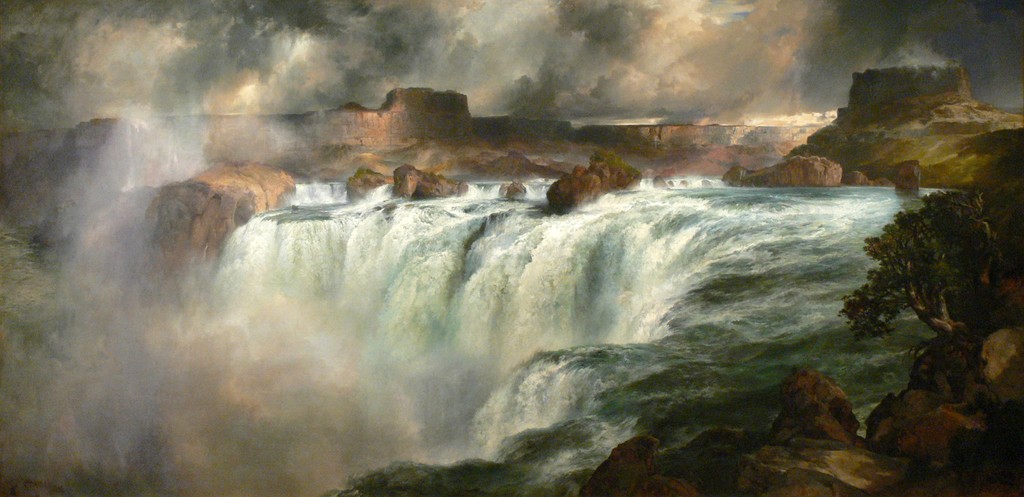
Shoshone Falls on the Snake River, 1900. Wolfgang Sauber / Wikimedia Commons, CC BY-SA 3.0; Gilcrease Museum painting. Image source. CC BY-SA 3.0; also marked PD-Art. Resized only; complete source image retained. This image derivative is available under the same licence.
- Splash image source.
Green River Cliffs, Wyoming, 1881. National Gallery of Art, Gift of the Milligan and Thomson Families. Image source. Public domain; NGA Open Access. Resized only; complete source image retained.
- Splash image source.
A View of Venice, 1891. Smithsonian American Art Museum, Transfer from the U.S. Department of the Interior, National Park Service, 1968.120.1. Image source. Free to use; Smithsonian Open Access. Resized only; complete source image retained.
- Splash image source.
The Three Tetons, 1895. The White House Collection, Gift of C. R. Smith; faithful reproduction via Wikimedia Commons. Image source. Public Domain Mark; faithful reproduction of a two-dimensional public-domain work. Resized only; complete source image retained.