 by Tom Gurney
Tom Gurney BSc (Hons) is an art history expert with over 20 years experience
Published on June 19, 2020 / Updated on October 27, 2026
Email: tomgurney1@gmail.com / Phone: +44 7429 011000
Thomas Moran Paintings: Introduction
Thomas Moran's paintings offer more than one image of America. His famous canyons belong beside Pennsylvania woodland, Long Island water, mountain lakes, literary landscapes and Venice. The subjects differ, yet many pictures share a concern with how a spectator enters a view: a nearby tree or rock establishes position, light draws attention farther away, and atmosphere makes the distance partly elusive.
The selection below provides routes into that range. It includes oils and original coloured works on paper, whose material identities remain attached to their individual records. The paintings can be explored by subject, date, medium or comparison. A familiar title is a useful starting point, but identifying a particular object matters when Moran returned to a place or used related titles across different works. Look at the whole composition before deciding which smaller detail to investigate.
Explore Moran’s works




The retained selection includes original coloured works on paper as well as oils. Medium and version distinctions are explained in the individual articles.
Artworks directory
Selected documented works and distinct versions. This directory is not a comprehensive catalogue raisonné. Dates and media retain the distinctions explained in the articles and museum records.
| Name | Date | Medium |
|---|---|---|
| An Arizona Sunset near the Grand Canyon | Date not securely established | Oil painting |
| Autumn Afternoon, the Wissahickon by Thomas Moran | 1864 | Oil on canvas |
| Cascade Falls, Yosemite | Commonly catalogued as 1905 | Catalogued as oil on canvas |
| The Chasm of the Colorado | 1873–1874; completed in 1874 | Oil on canvas, currently mounted on aluminium |
| Children of the Mountain | 1866 in the current museum title; 1867 in the 1997 National Gallery catalogue | Oil on canvas |
| Cliffs of Green River | 1874 | Oil on canvas |
| Cliffs of the Upper Colorado River, Wyoming Territory | 1882 | Oil on canvas |
| East Hampton, Long Island , also captioned Easthampton, L.I | 1897 | Oil on canvas laid on board, according to the reproduction record |
| Fiercely the red sun descending, Burned his way along the heavens | 1875–76 | Oil on canvas |
| Forest Scene | 1870 | Oil on canvas |
| Grand Canyon of the Colorado River | 1892 and 1908 | Oil on canvas |
| Green River Cliffs, Wyoming | 1881 | Oil on canvas |
| Green River, Wyoming | 1878 | Oil on panel |
| The Juniata, Evening | 1864 | Oil on canvas |
| Mosquito Trail, Rocky Mountains of Colorado | 1875 in the 1997 National Gallery exhibition catalogue | Watercolour |
| Mountain of the Holy Cross | 1875 | Oil on canvas |
| The Much Resounding Sea | 1884 | Oil on canvas |
| Point Lobos, Monterey, California | 1912, signed and dated | Oil on canvas |
| Shoshone Falls on the Snake River | 1900 | Oil on canvas |
| Summit of the Sierras | 1872/75, as catalogued by the Art Institute of Chicago | Gouache over graphite on cream laid paper |
| The Teton Range | 1897 | Oil on canvas |
| The Three Tetons | 1895 | Oil on canvas |
| Tower Falls, Yellowstone | 1872 | Watercolour and gouache over graphite on blue laid paper |
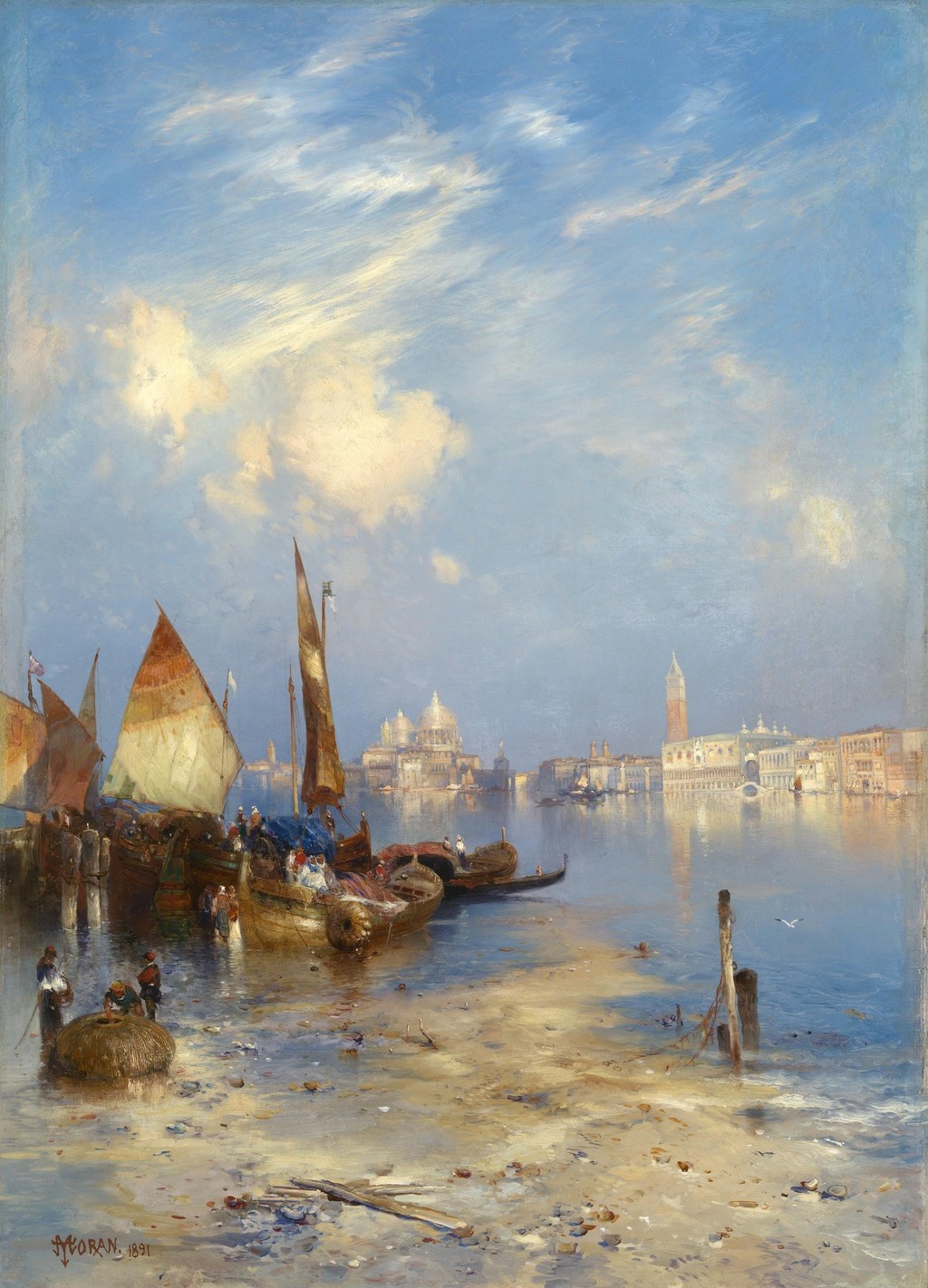
| A View of Venice | 1891 | Oil on canvas |
| The Grand Canyon of the Yellowstone | 1872 | Oil on canvas, currently recorded as mounted on aluminium |
| Mountain of the Holy Cross, Colorado (etching) | 1888 | Etching, roulette and aquatint |
| The Resounding Sea (etching) | 1880 | Etching |
| The Much Resounding Sea (later etching) | 1886 in heading; 1888 on plate | Etching, drypoint and roulette |
| Tower Falls (Prang print) | c. 1875; portfolio issued 1876 | Chromolithograph |
| Shoshone Falls (early watercolour) | 1874 | Watercolour |
| Venice (watercolour) | 1888 | Watercolour over graphite |
At a Glance
- ArtistThomas Moran, 1837–1926
- ScopeSelected landscapes, marine pictures and original coloured works on paper
- Western landmarksYellowstone, Green River, the Colorado canyon, Holy Cross, the Tetons and Shoshone Falls
- Other subjectsPennsylvania, East Hampton, the sea, literary scenes and Venice
- Related mediaDrawings, Watercolours and Prints
- A useful comparisonNear forms, distant light and the different roles of water
Contents
- How to explore the paintings
- Pennsylvania before the western journey
- Woodland and the scale of an opening
- Imagination and literary subjects
- Yellowstone and the monumental canvas
- Works on paper belong to the view of his art
- Green River as a repeated subject
- The Colorado canyon and a companion picture
- A later Grand Canyon canvas
- Holy Cross and the recognition of a landmark
How to explore the paintings
Begin with the largest relationship within a picture. A dark wood opening towards a pale sky works differently from a cliff occupying an extensive horizontal field. Before identifying every tree or rock, notice where the strongest light falls and which shape gives it a measure. These decisions determine how the landscape first reaches the spectator.
Then look for changes of scale. Small figures, horses or boats can make a natural formation seem vast. Their presence may also give a scene a narrative. A person at a riverbank and a survey figure on a canyon ledge belong to different kinds of encounter, even when both provide a recognisable human proportion.
The individual pages develop these questions through the exact work illustrated and its collection record. Read the object label before comparing two images. Date, medium and collection help distinguish a repeated subject from a repeated reproduction of the same painting. They also allow a coloured paper work to be appreciated without quietly converting it into an oil.
Pennsylvania before the western journey
Moran already had a substantial interest in landscape before travelling to Yellowstone in 1871. The Juniata, Evening, dated 1864, places a person near the water within a broader river scene. The NGA describes the figure's possible relationship with the artist cautiously. The landscape remains worth looking at without turning that possibility into a confirmed portrait. [1]
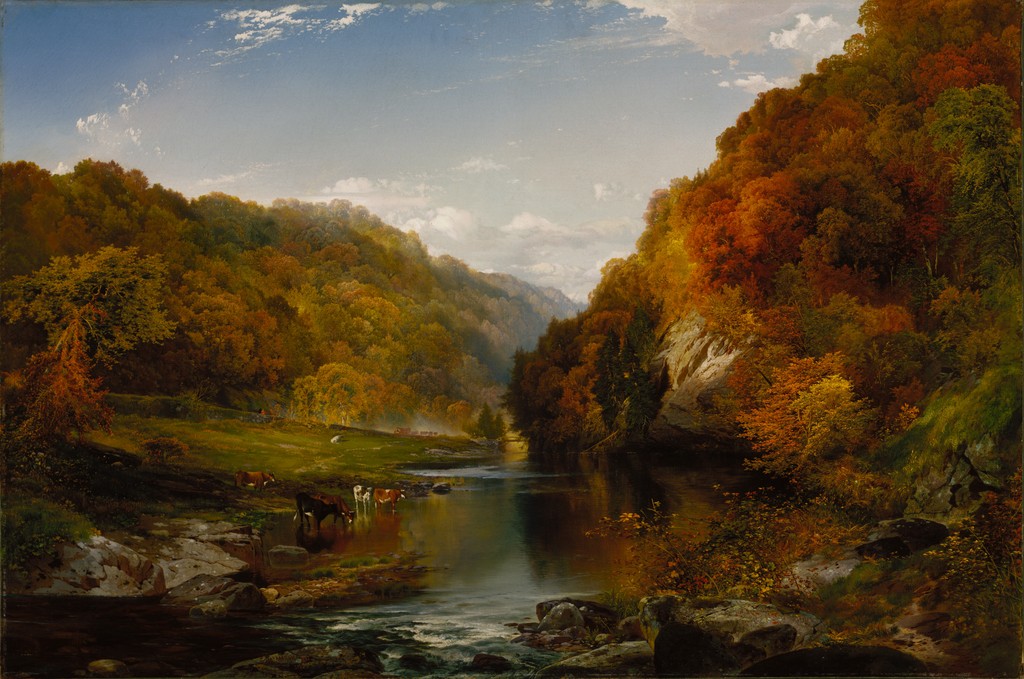
In Autumn Afternoon, the Wissahickon, also dated 1864, trees and water organise a more enclosed space. The Terra Foundation's current title differs from the older title Autumn on the Wissahickon. Both identify the work discussed on its individual page; the difference should not create two imaginary paintings. [2]
Comparing them brings variety within the early career into focus. The Juniata opens along water towards a wider distance, while the Wissahickon asks the eye to move through closer foliage and reflections. The subject is not simply scenery waiting for the artist's western transformation. These pictures already investigate the relation between a near environment and a more extensive view.
Woodland and the scale of an opening
Forest Scene, dated 1870 in the NGA's 1997 catalogue, makes trunks and foliage the principal enclosure. Its brighter opening gains force through the surrounding shade. The spectator does not begin with an unobstructed panorama; the wood places something close between the eye and the distance. [3]
That experience provides a revealing comparison with Yellowstone. In the later large canyon picture, nearby trees help frame a much greater illuminated space. A woodland device changes its role when it becomes the threshold to an extensive gorge. The comparison concerns how forms organise looking, without requiring a direct preparatory relationship between the paintings.
Woodland detail also rewards a slower pace. A trunk can separate two areas of light, a branch can interrupt the sky and a small reflection can repeat an opening in the water. These incidents remain part of a larger structure. Moran's ability to describe a tree matters partly because he can make it control the spectator's access to what lies beyond.
Imagination and literary subjects
Children of the Mountain belongs to another strand of the early work. The catalogue's chronology records its completion in December 1866, correcting the inherited 1867 dating on older descriptions. Its title and imaginative character should remain distinct from an assumption that it depicts a single documented western site. [3]
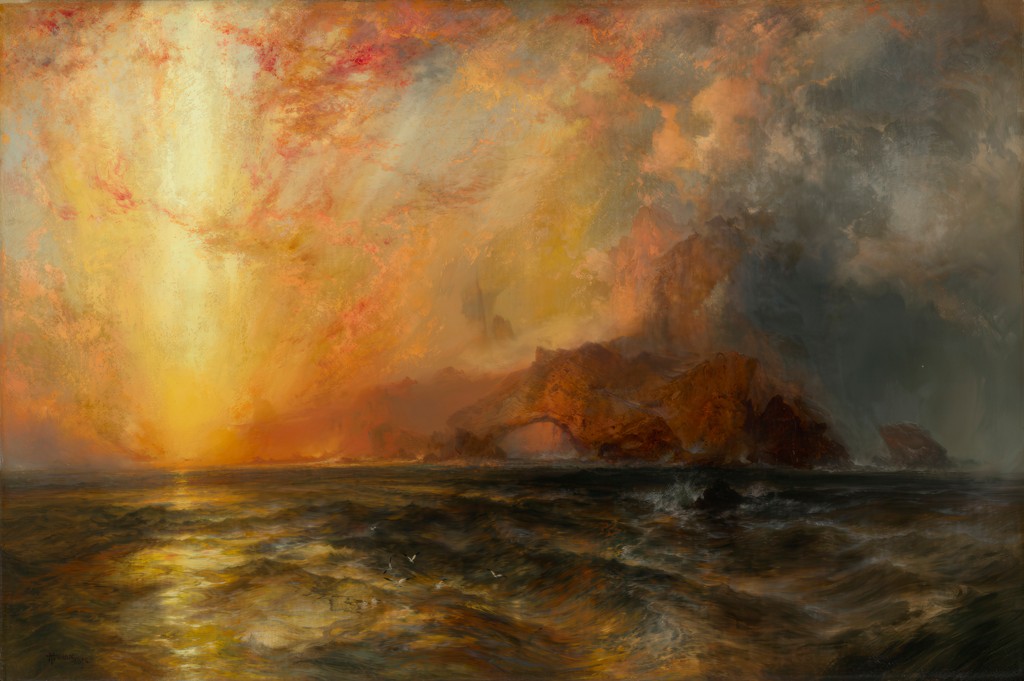
The NCMA's Fiercely the red sun descending Burned his way along the heavens, dated 1875–76, takes its title from Longfellow's The Song of Hiawatha. The museum's wording retains “along”. The literary connection supplies a setting for interpretation, while the painted sky, water and dark shore provide their own visual structure. [4]
Such works show why subject labels need care. A landscape can respond to literature without illustrating every action in a passage. Equally, an imagined arrangement can use forms studied in nature. The relation between observation and invention runs through Moran's career; it does not divide neatly into early fantasy followed by exclusively factual western reporting.
Yellowstone and the monumental canvas
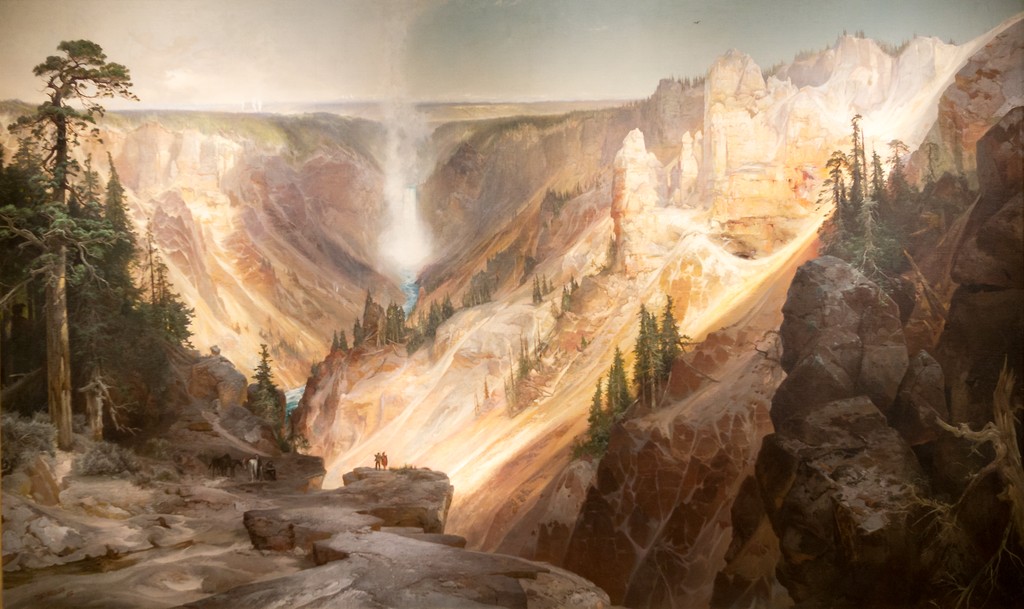
The Grand Canyon of the Yellowstone, completed in 1872, turns the canyon and distant falls into a public spectacle. The Interior Museum records the canvas at approximately seven feet high and twelve feet wide. Congress purchased it that year for $10,000. [5]
Near rocks and trees give access to a much larger space. The illuminated walls direct attention towards the falls, while small figures establish scale on the ledge. A reproduction can show those relationships, although it compresses the encounter with the very large original. The painting's breadth and height were part of its ambition.
The date also matters to its public history. Yellowstone's park act was signed on 1 March 1872, before the large canvas was completed. The finished painting's purchase and the park's establishment were separate events. Moran's expedition images belonged to a wider circulation of evidence and advocacy, rather than one completed masterpiece alone explaining the law. [6] [3]
Works on paper belong to the view of his art
The NGA's Tower at Tower Falls, dated 1872, is watercolour and gouache over graphite on blue laid paper. Its upright composition concentrates on the tall rock formation, with water below and a pale wall opposite. It should not be described as an oil or as a full view of the waterfall merely because of the familiar place name. [7]
Chicago's Summit of the Sierras, dated 1872/75, is gouache over graphite on cream laid paper. Foreground rocks and a dark tree lead towards successive pale mountains. Its finished arrangement demonstrates how a coloured sheet can offer a developed image rather than only a preliminary notation. [8]
Keeping such works alongside the oils makes Moran's range more intelligible. The medium labels distinguish their physical identities; comparisons reveal recurring concerns with depth, light and scale. The dedicated watercolour page gives these objects more space, while their individual pages remain part of the wider selection of his art.
Green River as a repeated subject
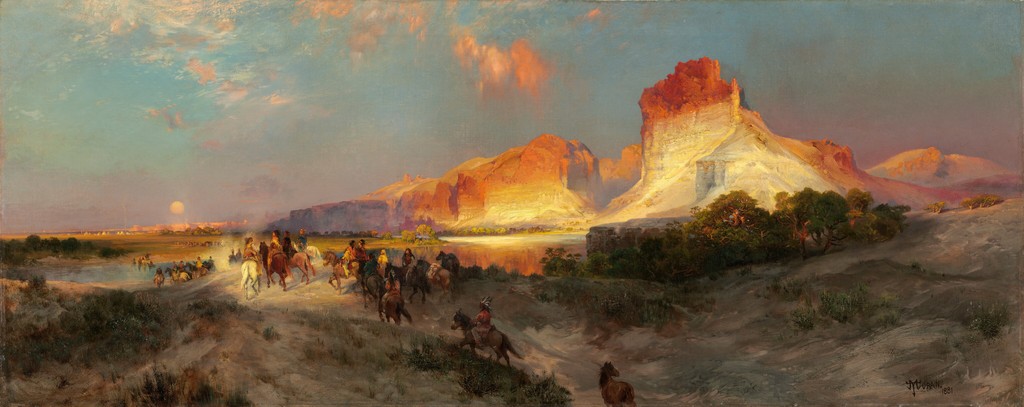
Green River offered Moran material he returned to across separate pictures. The Amon Carter's Cliffs of Green River is an oil dated 1874. The NGA's Green River Cliffs, Wyoming is a different oil, dated 1881. Collection and date keep the objects distinct even when shortened titles sound similar. [9] [10]
The 1881 composition gives a brilliantly lit cliff a commanding position in a long, low field. Smaller riders travel below it, helping establish the rock's size. The NGA interprets the scene as an imagined pre-industrial West, pointing out the omission of the railway town and the historical circumstances of Indigenous displacement. That interpretation challenges a straightforward documentary reading. [10]
Repetition therefore offers more than a list of dates. Compare the relation of cliff to sky, the prominence of people and the distribution of light. The region provided a recurring subject, but each object supplied a new arrangement. Two separate oils should not become stages in the reworking of one canvas without evidence.
The Colorado canyon and a companion picture
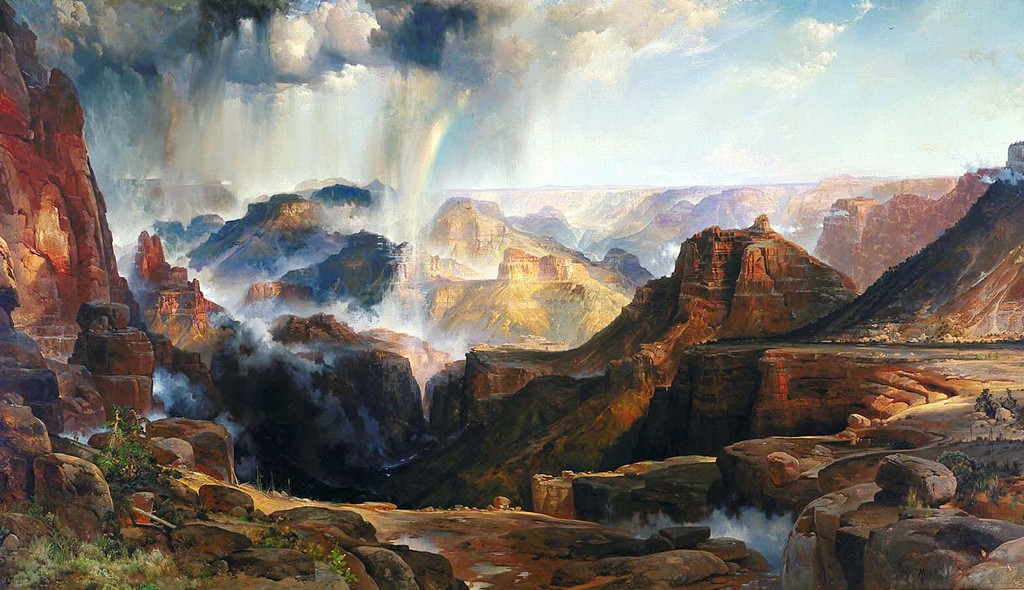
The Interior Museum's The Chasm of the Colorado is dated 1873–1874. Moran visited the Grand Canyon with part of Powell's survey in 1873 and completed the companion to his Yellowstone painting in 1874. The two works share a monumental public ambition, while representing different canyons. [5]
The Colorado picture gives broken rock, deep openings and unsettled atmosphere a stronger role. Its water lies far below within a much more dispersed field of forms. Comparing it with Yellowstone's distant falls shows two ways to make depth compelling: a more concentrated destination in one, and repeated interruptions and recesses in the other.
The word canyon is therefore insufficient identification. Yellowstone's canyon belongs to a different river and region. The Colorado subject itself also returned in later pictures. A title should connect the reader with the particular image and date under discussion, rather than allow every large canyon landscape to merge into Moran's most familiar masterpiece.
A later Grand Canyon canvas
The Philadelphia Museum of Art records Grand Canyon of the Colorado River as 1892 and 1908. Those dates concern one painting, rather than two interchangeable originals. The museum's educational record supplies the dimensions and collection identity, while the later date should not be used to invent precisely which passages changed. [11]
Its broad arrangement extends across repeated ridges and ravines. The spectator has several possible routes into the view, and changing light makes one formation advance while another seems more remote. The subject remains related to the earlier Chasm, but the object and its history are separate.
The 1997 catalogue places Moran's later canyon work alongside his renewed western travel and arrangements for railway promotion. Artistic production and the circulation of scenic images could serve overlapping purposes. Recognising that setting adds another question to close looking: how did an extensive landscape become an image that could invite an audience to imagine a journey? [3]
Watch: Thomas Moran
Choose a film to explore the artist’s work, its interpretation and its wider setting.
The painting that inspired a National Park
A close discussion of Moran’s landscape and its relationship to the idea of Yellowstone.
Watch on YouTubeHoly Cross and the recognition of a landmark
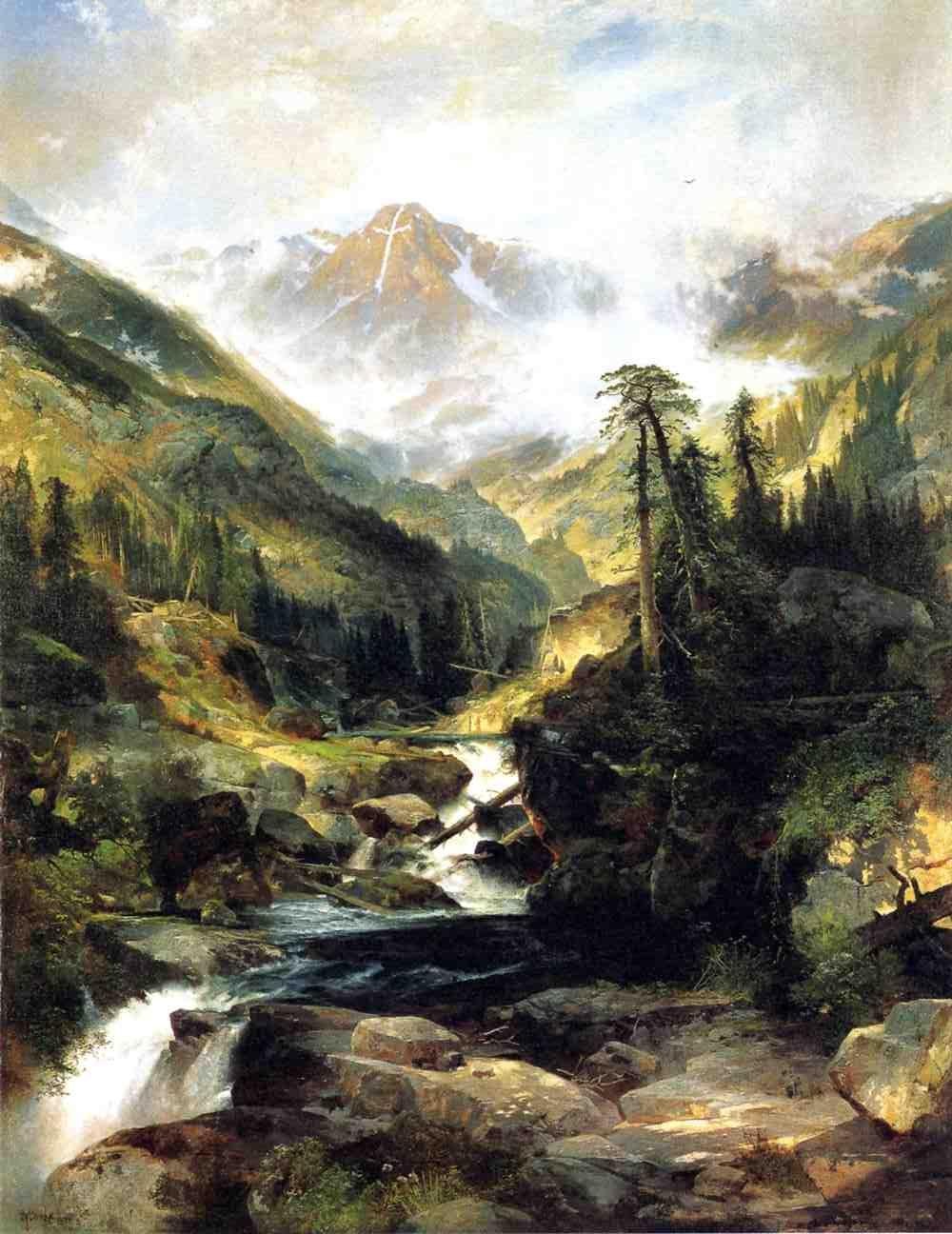
Mountain of the Holy Cross centres on a mountain whose snow formation supplies a recognisable cross. Moran's 1875 oil gives foreground rocks, water and trees a substantial role before the eye reaches the peak. The distant sign becomes more effective because the approach has its own depth and texture. [3]
The subject also exists in print. Comparing the oil with the 1888 etching shows how colour can give way to tonal marks without eliminating the snow formation's importance. Their differences belong to separate media and compositions, rather than to an assumption that the print is simply a photograph of the canvas.
The mountain example provides a useful counterpoint to the wide canyon pictures. An upright field can give one summit prominence, while a panoramic field distributes attention across many formations. Neither format determines a single meaning. It gives the artist a particular set of relations through which to make the place available to the spectator.
Long Island, shore and the open sea
Moran's eastern marine subjects resist treating the West as his only serious interest. East Hampton, Long Island places water within a coastal setting, while The Much Resounding Sea, dated 1884, gives breaking surf a more forceful presence. The NGA records the latter as a distinct oil, accession 1967.9.1. [3] [12]
The sea picture's dark wave bodies and pale crests divide the surface into repeated stages of motion. A narrow shore provides something comparatively stable against which to judge them. Unlike a river that carries attention quietly towards the distance, the surf continually breaks and redirects the eye.
These differences make water a useful thread through the selection. Compare river reflections, a distant canyon fall and a nearby breaking wave. Each changes the spectator's route through a picture. The substance recurs, while its movement, scale and relation to land produce different experiences of the landscape.
Venice and a different distant skyline
The Smithsonian's A View of Venice, dated 1891, is an upright oil. Boats and figures occupy the foreground water, while the architecture forms a more distant setting. Its city subject retains Moran's concern with movement from near forms towards light and atmosphere. [13]
The NGA's 1888 A View of Venice is instead a horizontal watercolour and gouache on laid paper. Similar naming should not erase the difference in medium, date and composition. Its boats, reflections and light architecture belong to another field, whose whole sheet includes a margin around the image. [14]
Looking across the pair makes format part of the comparison. The upright oil gives foreground activity a different proportion to the city; the wider sheet opens lateral relations among boats and buildings. Neither is a substitute for the other. Each shows how an urban waterscape could become material for Moran's treatment of space.
Late western pictures and continuing variety
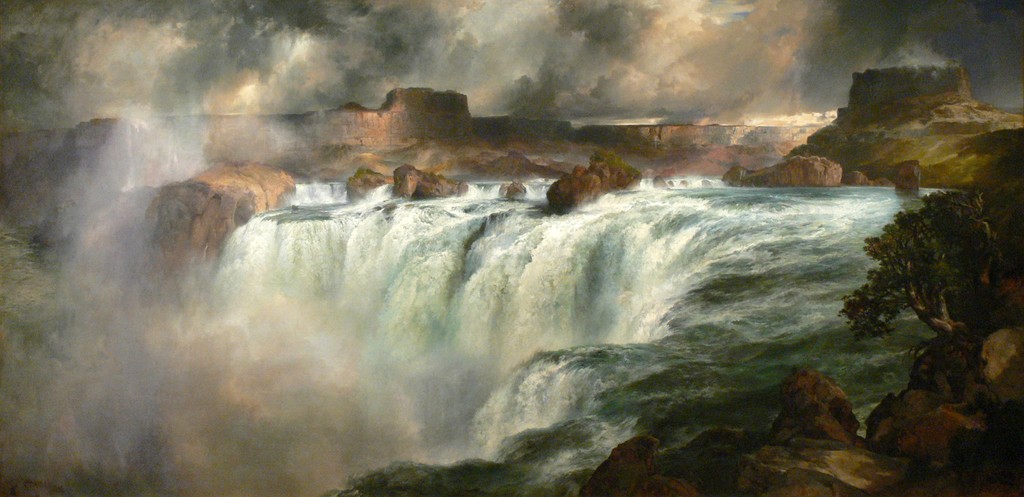
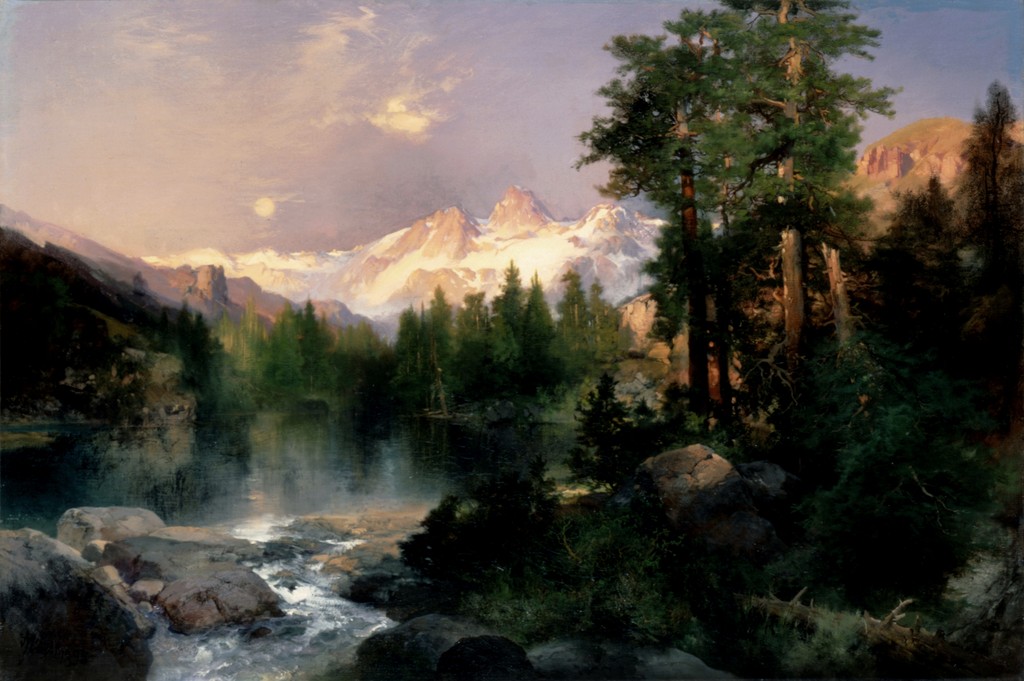
The Tetons and Shoshone Falls demonstrate the continuing importance of western subjects. The Three Tetons makes the mountain group a destination beyond foreground land and water. Shoshone Falls on the Snake River, dated 1900 in the Gilcrease record, presents a different natural force through a great descending body of water. [3] [15]
They do not form a simple sequence from calm to drama. A mountain can gain force through stillness and distance; falling water can gain scale through enclosing rock. Compare what stays stable in each image and what leads the eye into movement. The distinction is more revealing than assuming that a late date explains the effect.
The selection offers many such routes. Move from a wood to a canyon through the changing role of a tree, or from Venice to Green River through the relation between small people and a distant setting. Follow the object records as you go. Moran's range becomes clearest when the connections preserve the particular character of each picture.
A panel offers another kind of panorama
The Crystal Bridges record identifies Green River, Wyoming as an oil on panel dated 1878. Its support and date distinguish it from both the Carter and NGA canvases. The museum's promised-gift credit also has its own meaning; it should not become an invented account of a completed acquisition. [16]
The panel's exceptionally low field puts water, riders and illuminated cliffs into a concentrated horizontal arrangement. Open water on the left balances a more enclosed route on the right. The viewer can follow the procession while repeatedly returning to the brighter skyline. Comparing all three Green River objects makes format, support and human movement part of the enquiry. Their shared subject allows those differences to stand out, rather than removing the need to identify each work carefully.
Historical names and apparent geography
The Smithsonian's Cliffs of the Upper Colorado River, Wyoming Territory, dated 1882, represents the Green River, historically also called the Upper Colorado. The title's territorial wording matters. It does not place the scene in the modern state of Colorado or make it another Arizona canyon view. [17]
Bright rock, a darker unsettled sky and blue water give the canvas its particular contrasts. The mounted group is small beneath the cliffs, allowing a comparatively modest picture to suggest a much larger landscape. Historical naming and visual analysis thus answer different questions: one identifies the subject's geographical language, while the other explains its pictorial scale. Reading both prevents a familiar word from sending the spectator towards the wrong comparison.
A late coast with an enclosed foreground
Point Lobos, Monterey, California, signed and dated 1912, returns the eye to a rocky shore. The faithful reproduction record identifies the White House Art Collection. Trees and an illuminated rock face enclose a passage of breaking water before it reaches a more level, open horizon. [18]
Compare this inlet with the extensive waves of the 1884 sea oil. Here the shoreline continually changes the water's direction. Branches add another set of irregular lines, while the distant horizon supplies a stable measure. The late date does not make the image a simple repetition of the earlier marine work. Its coast creates different relations among movement, obstruction and openness, extending the range of comparisons through which Moran's landscapes can be explored.
Frequently Asked Questions
The 1872 Grand Canyon of the Yellowstone is the large canvas purchased by Congress that year and recorded by the Interior Museum.
No. Original coloured works on paper have their media identified, including the NGA Tower sheet and Chicago Summit.
The Amon Carter's 1874 Cliffs of Green River and the NGA's 1881 Green River Cliffs, Wyoming are separate oils.
The museum records one canvas as 1892 and 1908. That does not establish which individual passages changed.
Yes. Pennsylvania, Long Island, the sea, literary landscapes and Venice belong to the selected works discussed here.
Discussion
Choose two works with different subjects. Compare their nearest large form, strongest light and use of water. Which relationship helps you recognise Moran's approach, and which gives each picture its own character?
Reader Insights
Editorial prompts for close looking and discussion.
Choose two works with different subjects. Compare their nearest large form, strongest light and use of water. Which relationship helps you recognise Moran's approach, and which gives each picture its own character?
Which source or image helps you assess the interpretation?
How does this page compare with the related works linked above?
Join the Conversation
Share your reading of this page below.
References
- National Gallery of Art, The Juniata, Evening, 1864.
- Terra Foundation for American Art, Autumn Afternoon, the Wissahickon, 1864.
- Nancy K. Anderson and contributors, Thomas Moran, National Gallery of Art, 1997, selected object entries, chronology and western career discussion.
- North Carolina Museum of Art, Fiercely the red sun descending Burned his way along the heavens, 1875–76.
- U.S. Department of the Interior Museum, Thomas Moran and the Big Picture, records for Yellowstone and the Colorado companion.
- National Archives, Act Establishing Yellowstone National Park (1872), dated 1 March 1872.
- National Gallery of Art, Tower at Tower Falls, Yellowstone, 1872.
- Art Institute of Chicago, Summit of the Sierras, object metadata, 1872/75.
- Amon Carter Museum of American Art, Cliffs of Green River, 1874.
- National Gallery of Art, Green River Cliffs, Wyoming, 1881.
- Philadelphia Museum of Art, Do We Control Nature or Does Nature Control Us?, object label for Grand Canyon of the Colorado River, 1892 and 1908.
- National Gallery of Art, The Much Resounding Sea, 1884 oil.
- Smithsonian American Art Museum, A View of Venice, 1891 oil.
- National Gallery of Art, A View of Venice, 1888 work on paper.
- Gilcrease Museum, Shoshone Falls on the Snake River, 1900, with Thomas W. Pauly's 2021 interpretation.
- Crystal Bridges Museum of American Art, Green River, Wyoming, 1878, oil on panel, A2002-006.
- Smithsonian American Art Museum, Cliffs of the Upper Colorado River, Wyoming Territory, 1882.
- White House Art Collection reproduction, Point Lobos, Monterey, California, image and record, signed and dated 1912, preserved at Wikimedia Commons.
- Splash image source.
Autumn Afternoon, the Wissahickon, 1864. Terra Foundation for American Art, Daniel J. Terra Collection, 1999.99. Image source. Public Domain Mark; faithful two-dimensional reproduction. Resized only; complete source image retained.
- Splash image source.
The Grand Canyon of the Yellowstone, 1872. Wuselig / Wikimedia Commons, CC BY-SA 4.0; U.S. Department of the Interior Museum painting. Image source. CC BY-SA 4.0; also marked PD-Art. Outer museum frame cropped; resized. Painted composition retained; photographic perspective unchanged. This image derivative is available under the same licence.
- Splash image source.
Green River Cliffs, Wyoming, 1881. National Gallery of Art, Gift of the Milligan and Thomson Families. Image source. Public domain; NGA Open Access. Resized only; complete source image retained.
- Splash image source.
A View of Venice, 1891. Smithsonian American Art Museum, Transfer from the U.S. Department of the Interior, National Park Service, 1968.120.1. Image source. Free to use; Smithsonian Open Access. Resized only; complete source image retained.
- Splash image source.
The Grand Canyon of the Yellowstone, 1872. Wuselig / Wikimedia Commons, CC BY-SA 4.0; U.S. Department of the Interior Museum painting. Image source. CC BY-SA 4.0; also marked PD-Art. Outer museum frame cropped; resized. Painted composition retained; photographic perspective unchanged. This image derivative is available under the same licence.
- Splash image source.
The Chasm of the Colorado, 1873–1874. U.S. Department of the Interior Museum; faithful reproduction via Smithsonian American Art Museum / Wikimedia Commons. Image source. Public Domain Mark; faithful two-dimensional reproduction. Resized only; complete source image retained.
- Splash image source.
Mountain of the Holy Cross, 1875. Autry Museum of the American West; faithful reproduction via Wikimedia Commons. Image source. Public Domain Mark; faithful two-dimensional reproduction. Resized only; complete source image retained.
- Splash image source.
Shoshone Falls on the Snake River, 1900. Wolfgang Sauber / Wikimedia Commons, CC BY-SA 3.0; Gilcrease Museum painting. Image source. CC BY-SA 3.0; also marked PD-Art. Resized only; complete source image retained. This image derivative is available under the same licence.
- Splash image source.
Green River Cliffs, Wyoming, 1881. National Gallery of Art, Gift of the Milligan and Thomson Families. Image source. Public domain; NGA Open Access. Resized only; complete source image retained.
- Splash image source.
A View of Venice, 1891. Smithsonian American Art Museum, Transfer from the U.S. Department of the Interior, National Park Service, 1968.120.1. Image source. Free to use; Smithsonian Open Access. Resized only; complete source image retained.
- Splash image source.
The Three Tetons, 1895. The White House Collection, Gift of C. R. Smith; faithful reproduction via Wikimedia Commons. Image source. Public Domain Mark; faithful reproduction of a two-dimensional public-domain work. Resized only; complete source image retained.