 by Tom Gurney
Tom Gurney BSc (Hons) is an art history expert with over 20 years experience
Published on June 19, 2020 / Updated on October 27, 2026
Email: tomgurney1@gmail.com / Phone: +44 7429 011000
Point Lobos, Monterey, California by Thomas Moran: Introduction
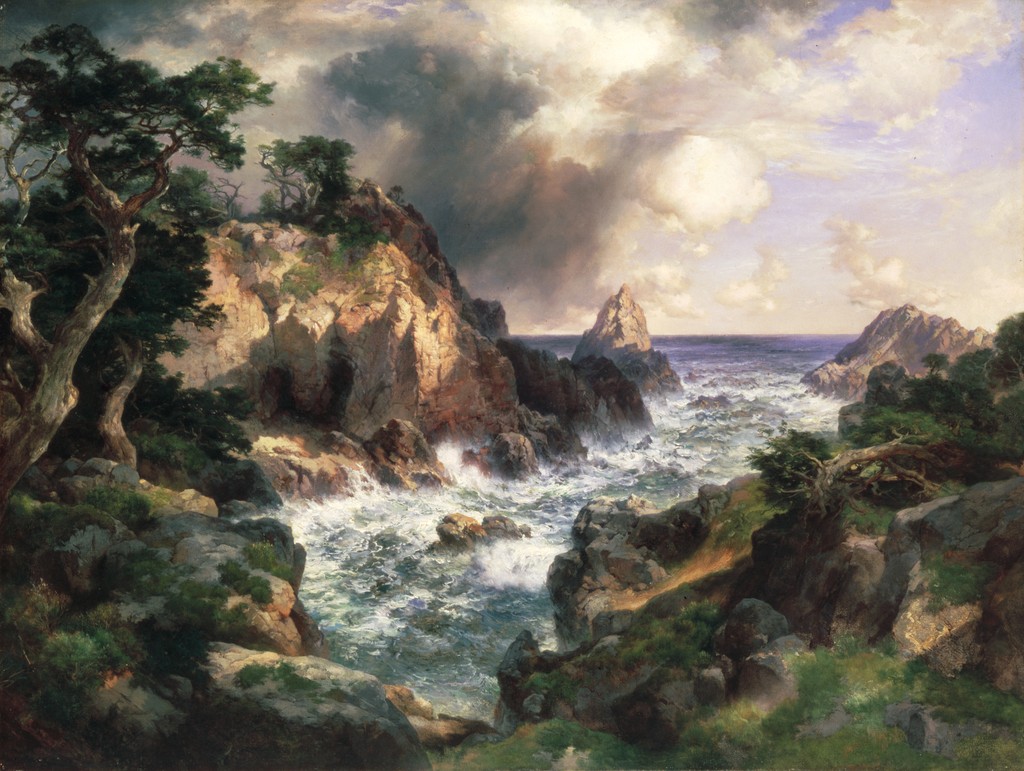
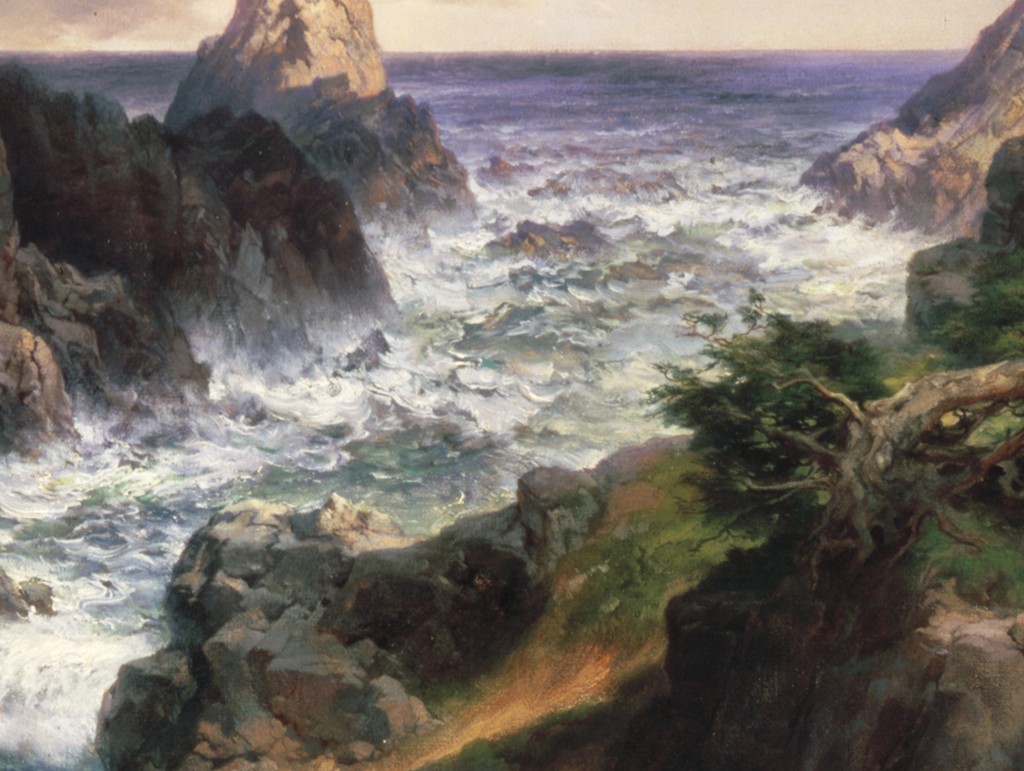
In Point Lobos, Monterey, California, Thomas Moran brings the Pacific coast close to the viewer. Branching trees rise beside a sunlit rock face, waves run through a narrow opening, and a pointed formation stands against the distant sea. The painting is signed and dated 1912. Its faithful reproduction record identifies it with the White House Art Collection. [1]
This is a landscape in which different kinds of movement meet. The sea breaks into bright, irregular foam, while the trees bend and spread above the cliffs. Beyond them, a level horizon supplies a quieter measure of distance. Moran balances these forces around an inlet whose shape carries the eye from the foreground towards the open water.
At a Glance
- ArtistThomas Moran.
- TitlePoint Lobos, Monterey, California.
- Date1912, signed and dated.
- MediumOil on canvas.
- SubjectA rocky California coastline.
- Collection recordWhite House Art Collection; no current display room specified.
Where this work sits in Moran’s career
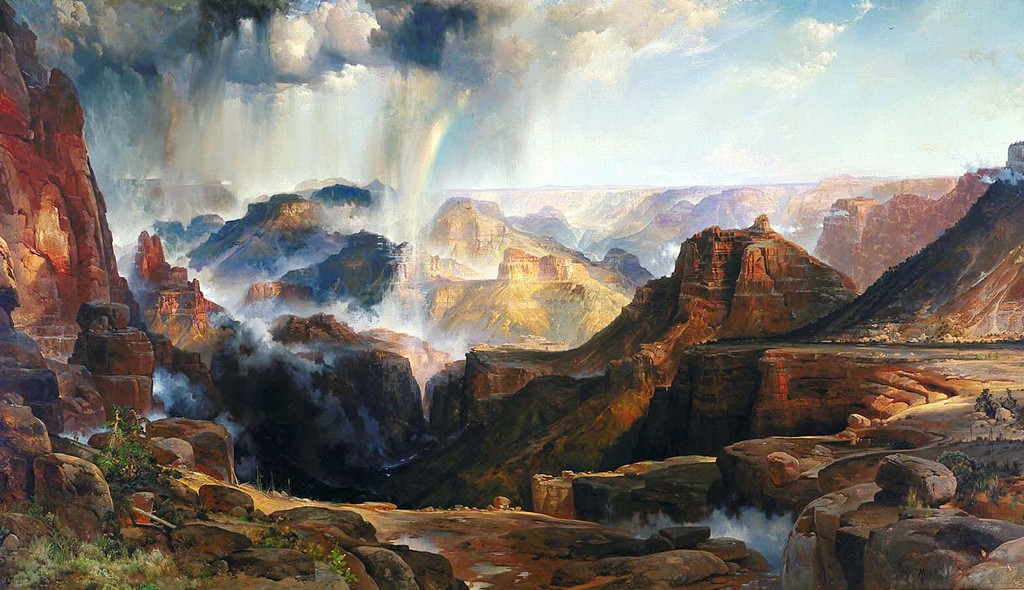
The Chasm of the Colorado
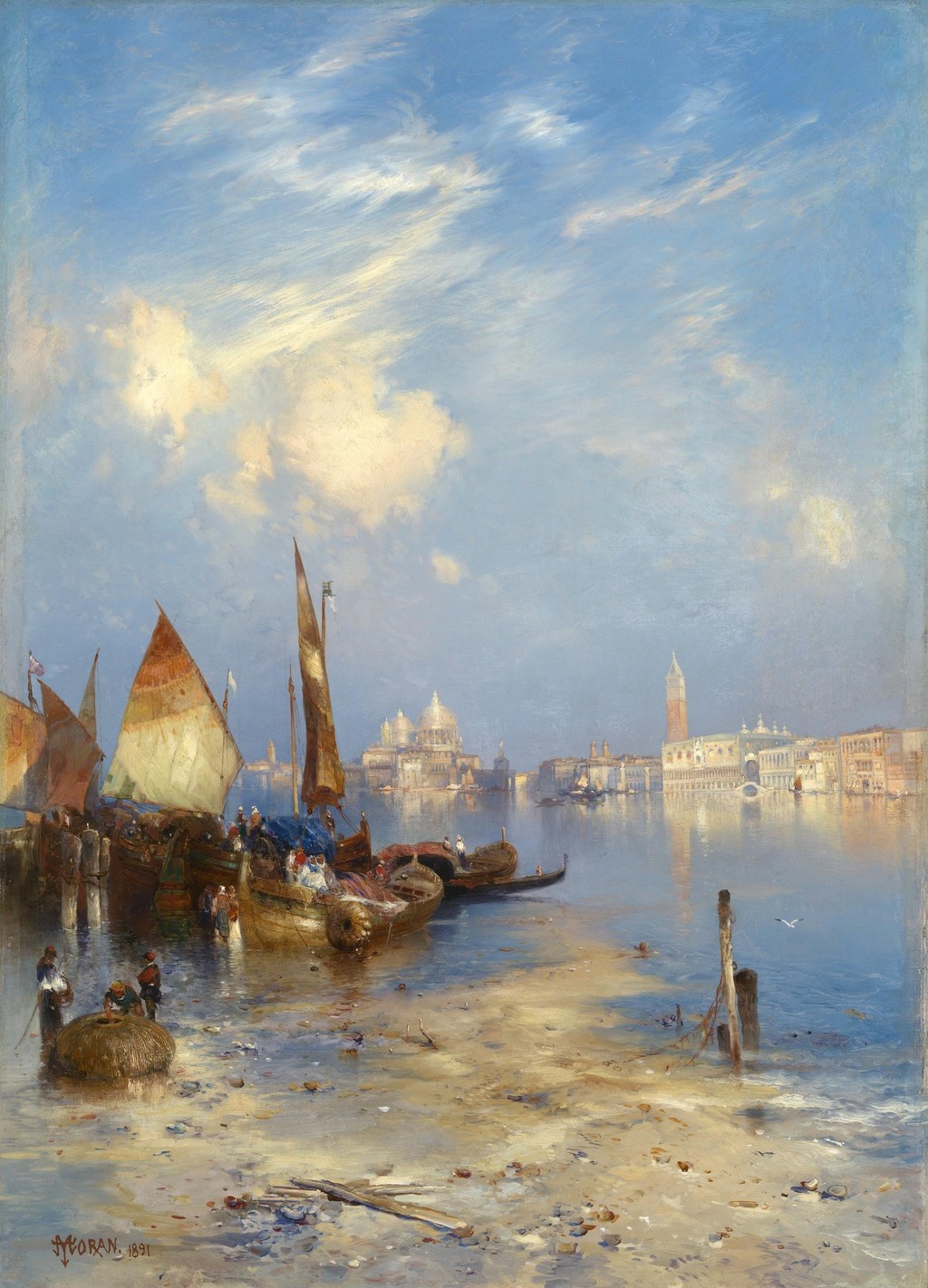
1873–1874; completed in 1874A View of Venice
1891Point Lobos, Monterey, California
1912, signed and datedContents
- Following the water into the picture
- Trees, cliffs and uneven light
- Painting the meeting of land and sea
- A subject in Moran’s later career
- Comparing Moran’s marine paintings
Following the water into the picture
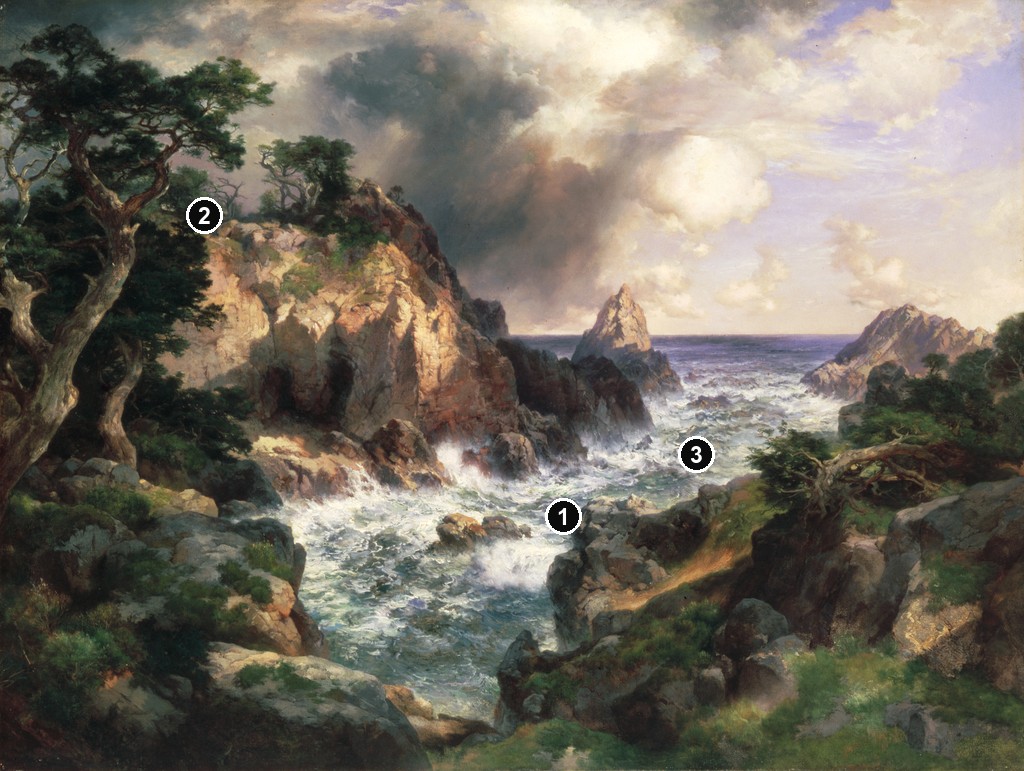
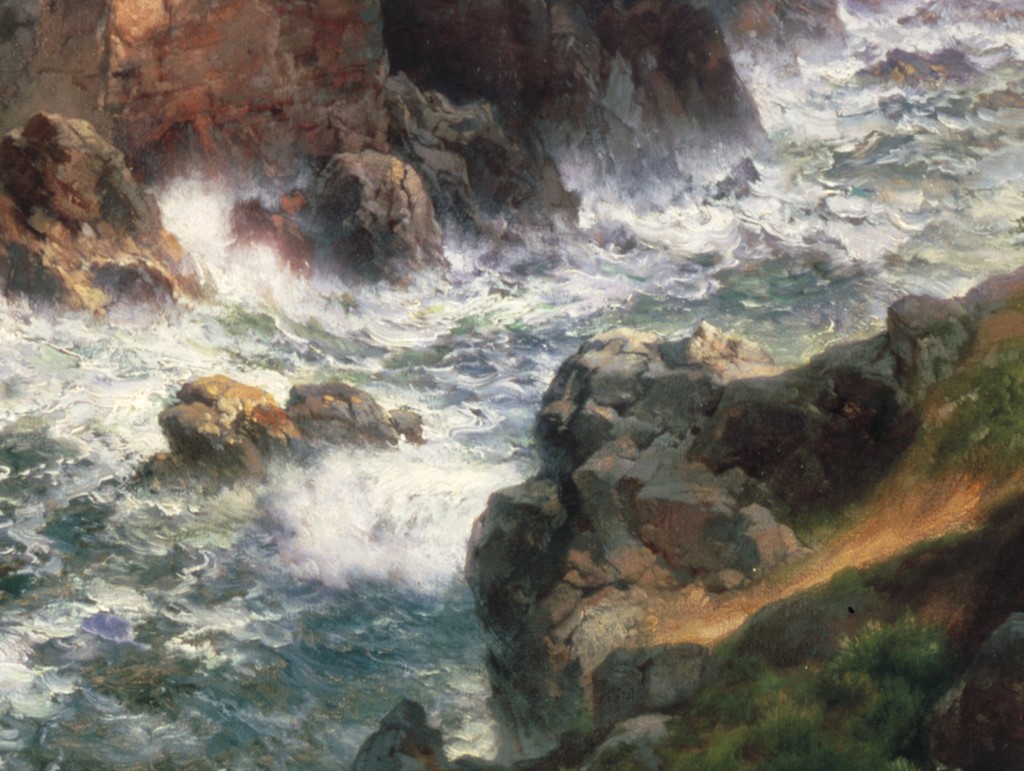
The foreground is divided by water. Dark rocks and vegetation occupy both sides, leaving an irregular passage between them. White foam makes this channel conspicuous, but it does not run as a single smooth stripe. Its direction changes around projecting stones, becoming broken and turbulent before opening towards the sea.
The eye can follow that passage backwards from the lower edge, or begin with the brighter distance and return towards the shore. The two movements have different effects. Looking outwards creates a sense of escape from the enclosing rocks; looking towards the foreground makes the waves appear to press further into the inlet. The composition supports both without depicting a single isolated breaking wave as its sole event.
A pointed rock near the centre provides another way to organise the view. It rises above the lower formations and cuts into the horizontal division between sea and sky. Its lighter surface distinguishes it from the darker rocks below. As a result, it marks the transition between the narrow, obstructed foreground and the more extensive water beyond.
Annotated Details from Point Lobos, Monterey, California
Compare these details with the full composition. The numbered overview and crops come from the same original image.
Details from POINT LOBOS, MONTEREY, CALIFORNIA
Open a detail to see it more closely.
Following the water into the picture
The foreground is divided by water. Dark rocks and vegetation occupy both sides, leaving an irregular passage between them. White foam makes this channel conspicuous, but it does not run as a single smooth stripe. Its direction changes around projecting stones, becoming broken and turbulent before opening towards the sea.
Trees, cliffs and uneven light
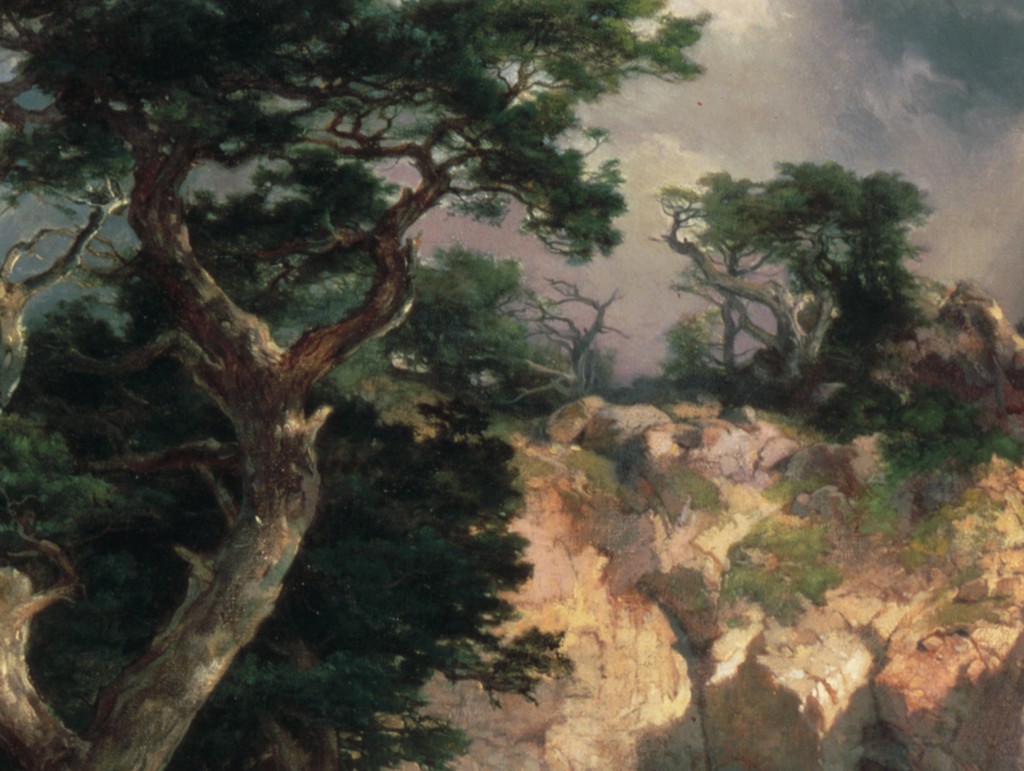
The largest trees stand on the left. Their trunks turn and divide, with branches reaching across a substantial part of the upper foreground. Dark foliage makes their silhouettes legible against the sky. Although their forms suggest exposure to a demanding coastal environment, the painting does not establish a botanical identification or a history of any individual tree.
Painting the meeting of land and sea
Much of the picture’s energy comes from contact. Waves break against rock faces, spray rises at the edges, and the moving water appears to find its way between obstacles. The hard formations provide resistance; the sea reveals that resistance through its changing surface.
Trees, cliffs and uneven light
The largest trees stand on the left. Their trunks turn and divide, with branches reaching across a substantial part of the upper foreground. Dark foliage makes their silhouettes legible against the sky. Although their forms suggest exposure to a demanding coastal environment, the painting does not establish a botanical identification or a history of any individual tree.
Beneath and beside them, the cliff face supplies a different texture. Warm orange and yellow passages are broken by darker fissures and irregular ledges. The rock is more brightly illuminated than much of the foreground vegetation. This difference gives the left side a combination of dark branching forms and comparatively luminous solid surfaces.
On the right, lower rock masses and vegetation frame the water without matching the left side’s height. The asymmetry is important: two equal cliffs would make the opening more rigid. Here the heavier left side and the lower right side allow the scene to feel balanced while retaining the unevenness of an actual shore.
Along the right-hand bank, a long, low branch extends across the darker vegetation. It partly echoes the movement of the water but belongs to the enclosing land. Such smaller directional relationships connect the sides of the picture to its central movement; the cliffs and trees do more than serve as a frame.
The broad sky reinforces that distribution of weight. Darker clouds gather above the left-centre, while lighter cream and pale violet passages occupy much of the right. The painting’s contrasts are therefore carried through several levels: trees against sky, shadow against illuminated stone, and white foam against blue-green water.
Painting the meeting of land and sea
Much of the picture’s energy comes from contact. Waves break against rock faces, spray rises at the edges, and the moving water appears to find its way between obstacles. The hard formations provide resistance; the sea reveals that resistance through its changing surface.
The foam is especially useful for understanding depth. Nearer passages are broad and conspicuous, while more distant marks become smaller and less individually dominant. Darker stretches of water interrupt the white. These changes keep the inlet from becoming a flat decorative pattern, connecting its bright surface to a recession through the rocks.
The distant horizon offers a contrasting visual experience. It is considerably more stable than the broken lines nearer the shore. Its level appearance helps the viewer recognise how much activity is concentrated within the inlet. Even the central pointed formation becomes more emphatic because it interrupts such a restrained boundary.
Moran does not need a shipwreck or a group of figures to make the shore dramatic. The opposition between solid land and mobile water is sufficient. The trees add another register of movement, but they also anchor the composition: rooted forms occupy the edges while the sea continues through the centre.
Watch: Thomas Moran
Choose a film to explore the artist’s work, its interpretation and its wider setting.
The painting that inspired a National Park
A close discussion of Moran’s landscape and its relationship to the idea of Yellowstone.
Watch on YouTubeA subject in Moran’s later career
The 1912 date places this painting well into Moran’s long career. His western work had begun decades earlier, with Yellowstone in 1871 and his first Grand Canyon journey in 1873. By the early twentieth century, he was continuing to travel and paint subjects that included coastal California as well as the canyon landscapes associated with his reputation. [2]
The 1997 exhibition catalogue’s chronology records a work titled Point Lobos, California at the Century Club in May 1912, and later lists Point Lobos and Cypress Point subjects again. These entries establish his sustained interest in the coast. A shared title alone does not prove that every exhibition mention refers to the particular painting reproduced here. [2]
That distinction matters for an artist who repeatedly returned to places and motifs. A subject could generate drawings, oils or prints, and similar titles could identify separate compositions. The signed date belongs to this canvas; the broader travel and exhibition chronology explains its place in Moran’s activity without supplying an undocumented commission or ownership history.
Comparing Moran’s marine paintings
The Much Resounding Sea, the National Gallery of Art’s 1884 painting, offers a revealing contrast. Its long, low format gives the waves a broad sweep across the canvas. Point Lobos draws water into a narrower space framed by trees and cliffs. One makes the sea’s extensive movement the dominant impression; the other makes that movement interact with a sharply articulated shore. [3]
The colours also organise attention differently. In Point Lobos, warm rock faces form a conspicuous counterweight to cooler water and shadows. Its trees introduce dark, branching shapes that the open marine view does not use in the same way. The comparison shows that a change of coastline also involves a change of pictorial structure.
Moran’s own description of his art, published in G. W. Sheldon’s American Painters in 1879, stressed that his tendencies were towards idealisation. That earlier statement does not identify which parts of this later shore he rearranged. It does, however, place his concern with a strongly organised landscape within a longer account of how he understood painting. [4]
The most distinctive achievement here is the connection between an enclosed foreground and an open horizon. Rocks, branches and cloud masses give the scene its particular character; the sea carries attention between them. The painting makes the coast feel both structurally firm and continually active.
Artworks directory
Selected documented works and distinct versions. This directory is not a comprehensive catalogue raisonné. Dates and media retain the distinctions explained in the articles and museum records.
| Name | Date | Medium |
|---|---|---|
| An Arizona Sunset near the Grand Canyon | Date not securely established | Oil painting |
| Autumn Afternoon, the Wissahickon by Thomas Moran | 1864 | Oil on canvas |
| Cascade Falls, Yosemite | Commonly catalogued as 1905 | Catalogued as oil on canvas |
| The Chasm of the Colorado | 1873–1874; completed in 1874 | Oil on canvas, currently mounted on aluminium |
| Children of the Mountain | 1866 in the current museum title; 1867 in the 1997 National Gallery catalogue | Oil on canvas |
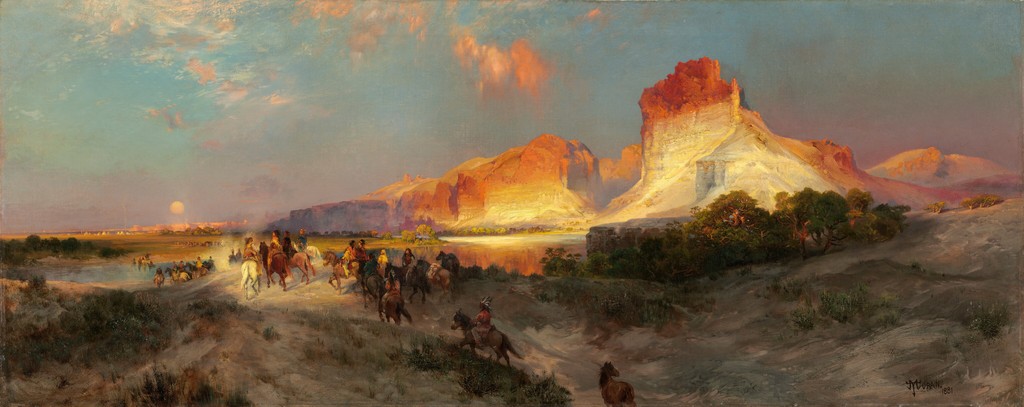
| Cliffs of Green River | 1874 | Oil on canvas |
| Cliffs of the Upper Colorado River, Wyoming Territory | 1882 | Oil on canvas |
| East Hampton, Long Island , also captioned Easthampton, L.I | 1897 | Oil on canvas laid on board, according to the reproduction record |
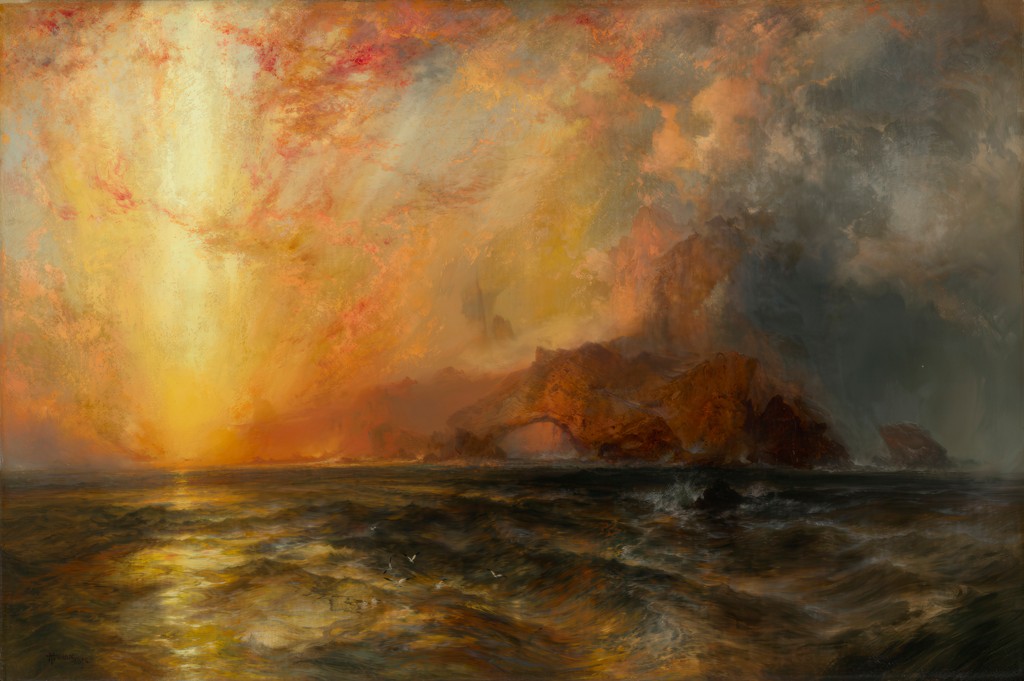
| Fiercely the red sun descending, Burned his way along the heavens | 1875–76 | Oil on canvas |
| Forest Scene | 1870 | Oil on canvas |
| Grand Canyon of the Colorado River | 1892 and 1908 | Oil on canvas |
| Green River Cliffs, Wyoming | 1881 | Oil on canvas |
| Green River, Wyoming | 1878 | Oil on panel |
| The Juniata, Evening | 1864 | Oil on canvas |
| Mosquito Trail, Rocky Mountains of Colorado | 1875 in the 1997 National Gallery exhibition catalogue | Watercolour |
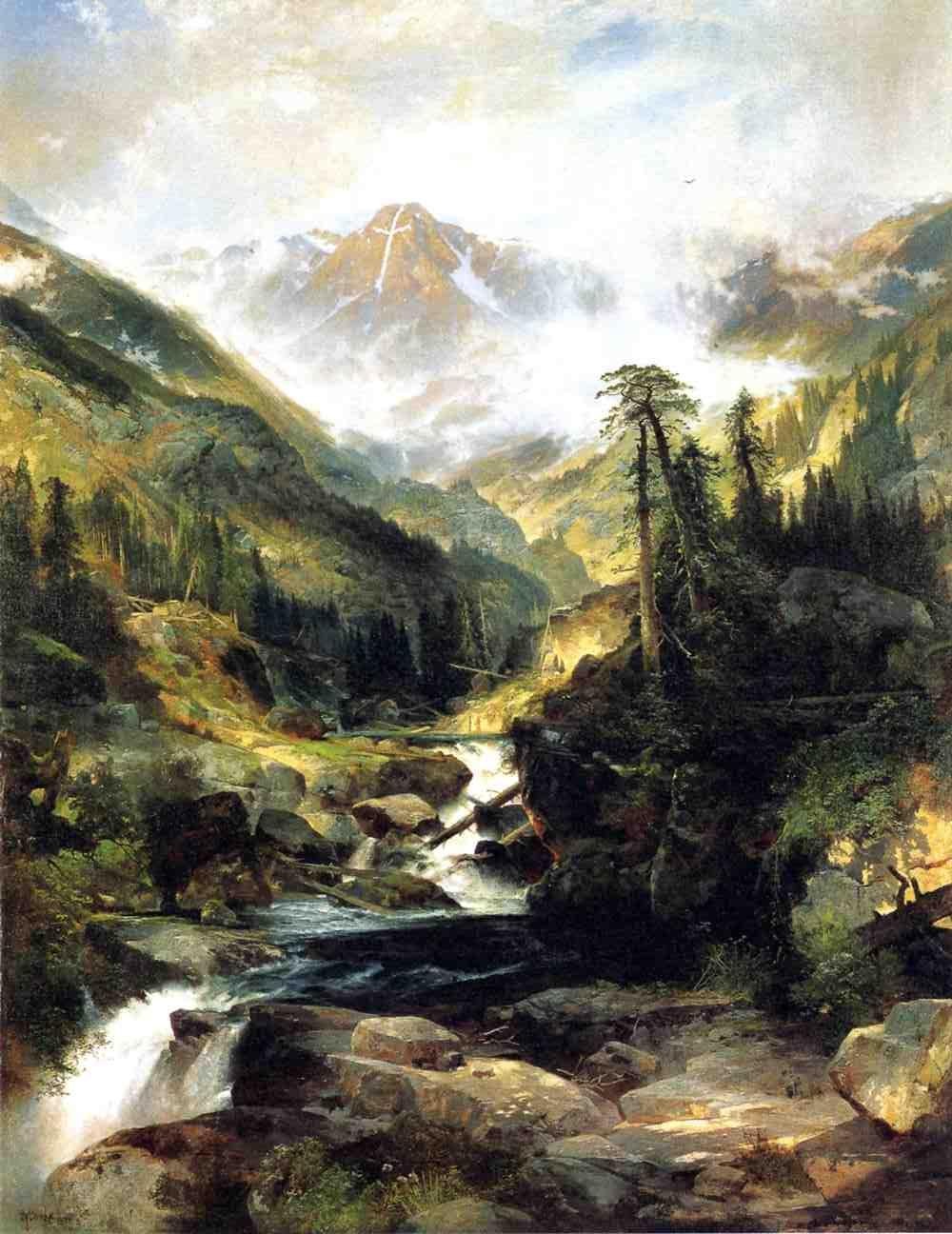
| Mountain of the Holy Cross | 1875 | Oil on canvas |
| The Much Resounding Sea | 1884 | Oil on canvas |
| Point Lobos, Monterey, California | 1912, signed and dated | Oil on canvas |
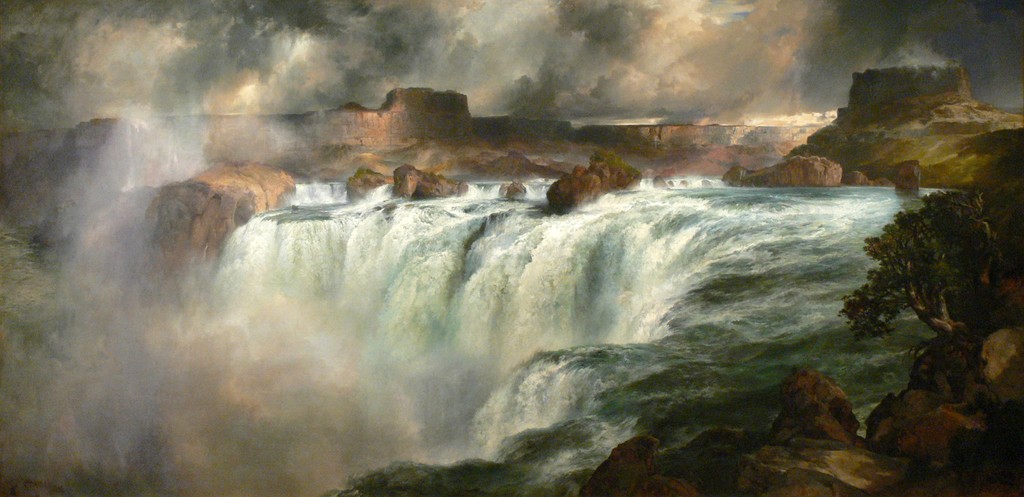
| Shoshone Falls on the Snake River | 1900 | Oil on canvas |
| Summit of the Sierras | 1872/75, as catalogued by the Art Institute of Chicago | Gouache over graphite on cream laid paper |
| The Teton Range | 1897 | Oil on canvas |
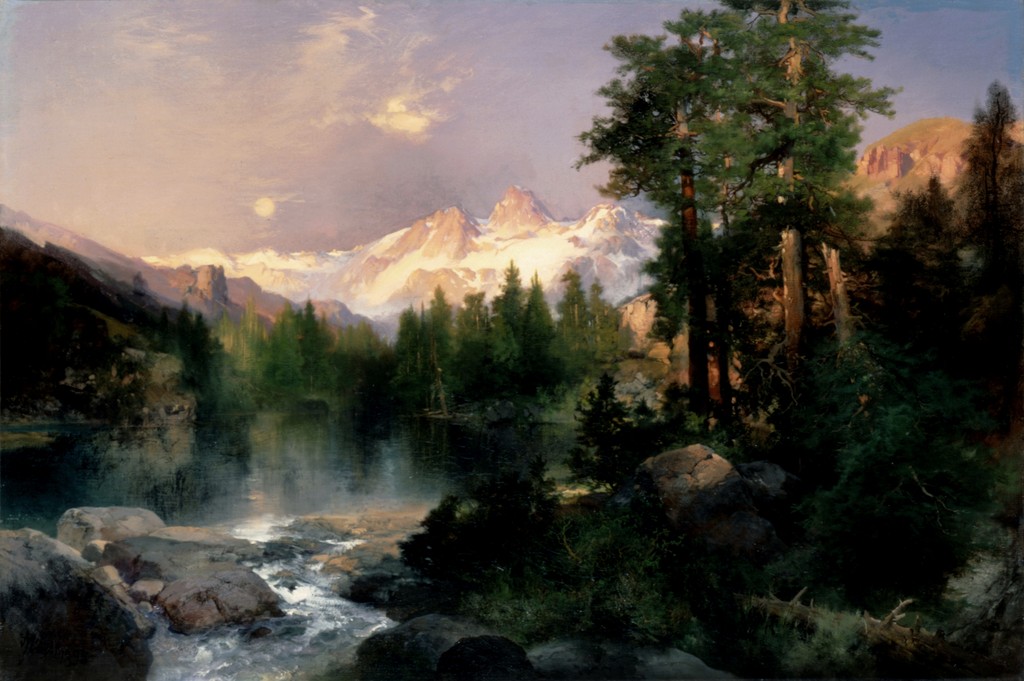
| The Three Tetons | 1895 | Oil on canvas |
| Tower Falls, Yellowstone | 1872 | Watercolour and gouache over graphite on blue laid paper |
| A View of Venice | 1891 | Oil on canvas |
| The Grand Canyon of the Yellowstone | 1872 | Oil on canvas, currently recorded as mounted on aluminium |
| Mountain of the Holy Cross, Colorado (etching) | 1888 | Etching, roulette and aquatint |
| The Resounding Sea (etching) | 1880 | Etching |
| The Much Resounding Sea (later etching) | 1886 in heading; 1888 on plate | Etching, drypoint and roulette |
| Tower Falls (Prang print) | c. 1875; portfolio issued 1876 | Chromolithograph |
| Shoshone Falls (early watercolour) | 1874 | Watercolour |
| Venice (watercolour) | 1888 | Watercolour over graphite |
Frequently Asked Questions
The selected painting is signed and dated 1912. [1]
No. Its subject is the rocky coast at Point Lobos, Monterey, California. The waves, inlet and trees distinguish it from Moran’s canyon subjects.
The faithful reproduction record identifies the White House Art Collection. A present display room is not specified here. [1]
Similar titles occur in his later exhibition chronology. They should not be assumed to identify one canvas without matching date, image and object details. [2]
Discussion
Follow the foam from the foreground to the horizon. Where does the painting most strongly change your sense of distance? How would the view feel different without the dark trees on the left?
Reader Insights
Editorial prompts for close looking and discussion.
- Follow the foam from the foreground to the horizon. Where does the painting most strongly change your sense of distance?
- How would the view feel different without the dark trees on the left?
How does this page compare with the related works linked above?
Join the Conversation
Share your reading of this page below.
References
- White House Art Collection reproduction, Point Lobos, Monterey, California, signed and dated 1912; faithful public-domain file and catalogue metadata preserved by Wikimedia Commons. Image and record.
- Nancy K. Anderson, Thomas P. Bruhn, Joni L. Kinsey and Anne Morand, Thomas Moran, National Gallery of Art, 1997, career narrative and chronology, pp.273–274. Exhibition catalogue.
- National Gallery of Art, The Much Resounding Sea, 1884, 1967.9.1. Collection record.
- G. W. Sheldon, American Painters, D. Appleton and Company, 1879, Thomas Moran chapter, especially p.125. Digitised book.
- Splash image source.
Point Lobos, Monterey, California, 1912. The White House Collection; faithful reproduction via Wikimedia Commons. Image source. Public Domain Mark; faithful reproduction of a two-dimensional public-domain work. Resized only; complete source image retained.
- Splash image source.
Point Lobos, Monterey, California, 1912. The White House Collection; faithful reproduction via Wikimedia Commons. Image source. Public Domain Mark; faithful reproduction of a two-dimensional public-domain work. Numbered circles added to the overview; details cropped from the original reproduction. No colour adjustment or sharpening.
- Splash image source.
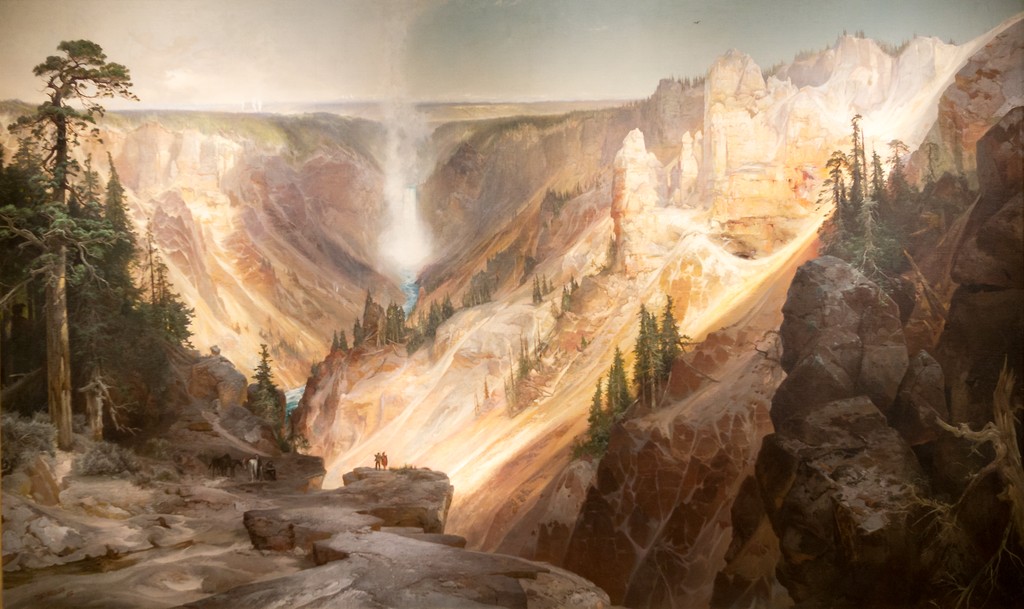
The Grand Canyon of the Yellowstone, 1872. Wuselig / Wikimedia Commons, CC BY-SA 4.0; U.S. Department of the Interior Museum painting. Image source. CC BY-SA 4.0; also marked PD-Art. Outer museum frame cropped; resized. Painted composition retained; photographic perspective unchanged. This image derivative is available under the same licence.
- Splash image source.
The Chasm of the Colorado, 1873–1874. U.S. Department of the Interior Museum; faithful reproduction via Smithsonian American Art Museum / Wikimedia Commons. Image source. Public Domain Mark; faithful two-dimensional reproduction. Resized only; complete source image retained.
- Splash image source.
Mountain of the Holy Cross, 1875. Autry Museum of the American West; faithful reproduction via Wikimedia Commons. Image source. Public Domain Mark; faithful two-dimensional reproduction. Resized only; complete source image retained.
- Splash image source.
Shoshone Falls on the Snake River, 1900. Wolfgang Sauber / Wikimedia Commons, CC BY-SA 3.0; Gilcrease Museum painting. Image source. CC BY-SA 3.0; also marked PD-Art. Resized only; complete source image retained. This image derivative is available under the same licence.
- Splash image source.
Green River Cliffs, Wyoming, 1881. National Gallery of Art, Gift of the Milligan and Thomson Families. Image source. Public domain; NGA Open Access. Resized only; complete source image retained.
- Splash image source.
A View of Venice, 1891. Smithsonian American Art Museum, Transfer from the U.S. Department of the Interior, National Park Service, 1968.120.1. Image source. Free to use; Smithsonian Open Access. Resized only; complete source image retained.
- Splash image source.
The Three Tetons, 1895. The White House Collection, Gift of C. R. Smith; faithful reproduction via Wikimedia Commons. Image source. Public Domain Mark; faithful reproduction of a two-dimensional public-domain work. Resized only; complete source image retained.