 by Tom Gurney
Tom Gurney BSc (Hons) is an art history expert with over 20 years experience
Published on June 19, 2020 / Updated on October 27, 2026
Email: tomgurney1@gmail.com / Phone: +44 7429 011000
Shoshone Falls on the Snake River: Introduction
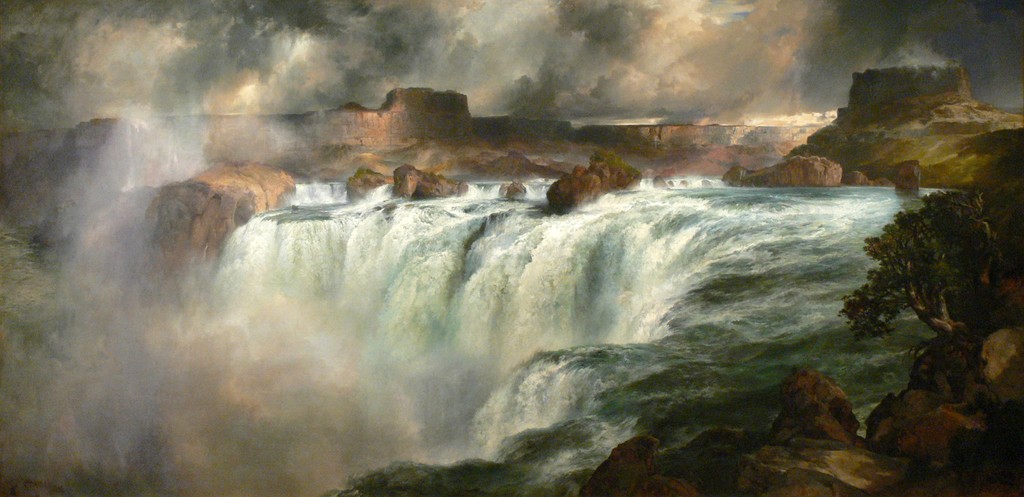
Thomas Moran's Shoshone Falls on the Snake River, painted in 1900 and held by the Gilcrease Museum, turns a waterfall into an immense encounter with moving water. The river sweeps across the foreground before disappearing over a broken lip; white spray rises against dark cliffs, and sunlight briefly penetrates the unsettled sky. Rock establishes the scale, but water supplies the action. [1]
The picture belongs to the later part of Moran's career, when the western landscapes that had made his reputation were already familiar to exhibition audiences. Its force comes from his renewed attention to a particular site. He had represented Shoshone Falls before visiting it, then travelled there in 1900 and made this monumental oil. The difference between an earlier image and an actual encounter is central to its history. [2]
At a Glance
- ArtistThomas Moran
- TitleShoshone Falls on the Snake River
- Date1900
- MediumOil on canvas
- CollectionGilcrease Museum, Tulsa
- Object number01.2339
- Related workShoshone Falls, Idaho, circa 1874–75, watercolour, Chrysler Museum of Art
- Exhibition historyNational Academy of Design and Pan-American Exposition, 1901
- DimensionsThe museum and 1997 catalogue report different measurements; see the object-record discussion below.
Where this work sits in Moran’s career
The Chasm of the Colorado
1873–1874; completed in 1874A View of Venice
1891Point Lobos, Monterey, California
1912, signed and datedContents
- A river approaching its fall
- Rock gives movement a measure
- Mist, cloud and a narrow rainbow
- The earlier watercolour
- Representing Shoshone before seeing it
- The journey of 1900
- A spectacle already on the tourist map
- Water diversion and the limits of an intention
- Reception in 1901
- The canvas and its measurements
A river approaching its fall
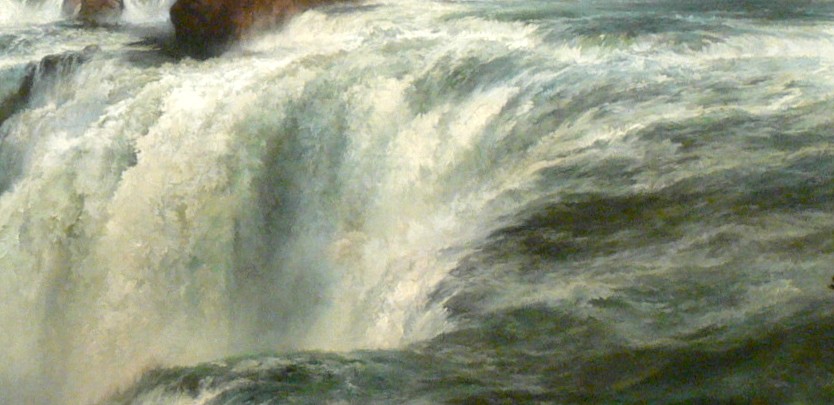
Moran places the spectator close to the river above the waterfall. The nearest water is dark, broad and broken by lighter streaks. It does not simply form a level platform leading to a distant spectacle. Its irregular surface already carries evidence of pressure and movement, preparing the viewer for the drop ahead.
The principal fall occupies the left side of the middle distance. Bright water pours over the edge in several adjoining passages, which join in a pale mass below. Smaller rocky interruptions divide the river above the brink. Those interruptions help explain how a broad flow becomes a sequence of falls rather than one smooth rectangular curtain.
The composition links these stages through changes in direction. Nearer water sweeps towards the left, while the cataract carries the eye downwards. The spectator follows the river across the canvas and then loses sight of its destination in the spray. That incomplete view gives the fall an imagined continuation beyond what can be clearly seen.
The width matters as much as the height. A tall, narrow waterfall can be understood as a single descending line; Moran's view requires the eye to travel sideways through several competing currents. The picture seems to extend the event rather than isolate one spectacular instant. Falling water is the centre of a much larger system.
Annotated Details from Shoshone Falls on the Snake River
Compare these details with the full composition. The numbered overview and crops come from the same original image.
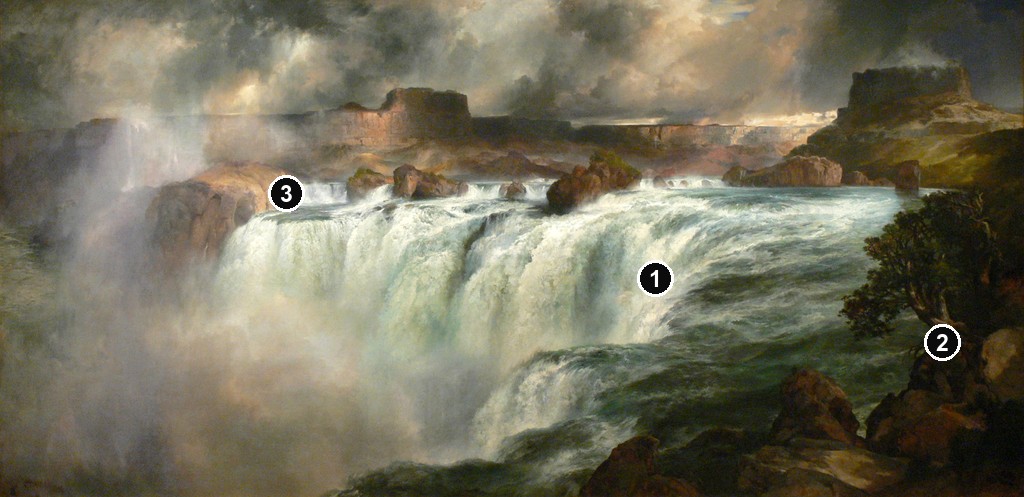
Details from SHOSHONE FALLS ON THE SNAKE RIVER
Open a detail to see it more closely.
A river approaching its fall
Moran places the spectator close to the river above the waterfall. The nearest water is dark, broad and broken by lighter streaks. It does not simply form a level platform leading to a distant spectacle. Its irregular surface already carries evidence of pressure and movement, preparing the viewer for the drop ahead.
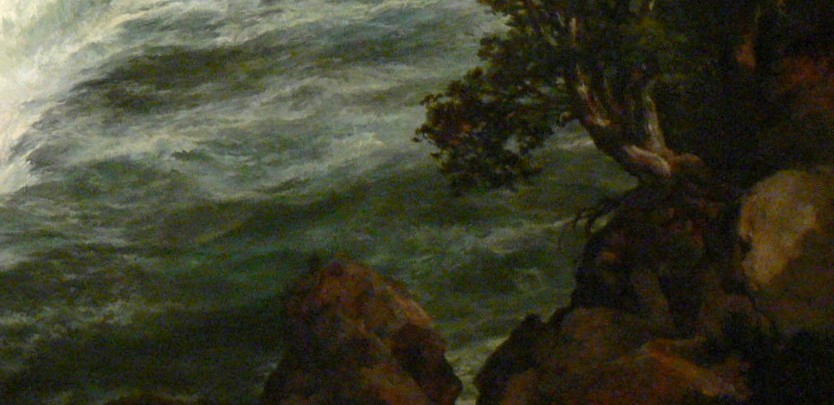
Rock gives movement a measure
The surrounding cliffs have comparatively stable outlines. Their broad, flat upper edges lie against the sky, while their darker faces descend towards the river. Layered ledges and broken surfaces provide a firm structure around the unstable water. The spectator can judge the scale of the cataract because it passes through an environment that appears resistant to change.
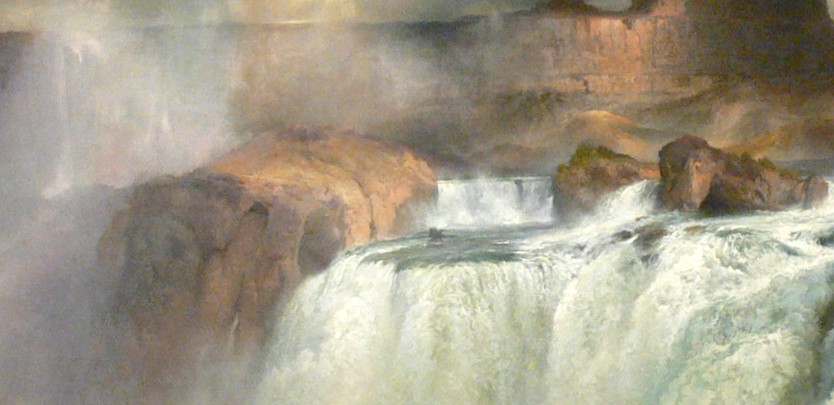
Mist, cloud and a narrow rainbow
The white fall is not equally definite throughout. Some passages show separate streams, while others merge into a pale cloud below. Spray hides the lower part of the event, making the cataract's full depth difficult to measure by sight. This concealment contributes to its power: the spectator sees the water entering an area whose contours cannot be firmly grasped.
Rock gives movement a measure
The surrounding cliffs have comparatively stable outlines. Their broad, flat upper edges lie against the sky, while their darker faces descend towards the river. Layered ledges and broken surfaces provide a firm structure around the unstable water. The spectator can judge the scale of the cataract because it passes through an environment that appears resistant to change.
On the far right, the cliff face is especially dark. Its mass helps contain the sweep of the river, which might otherwise seem to spill out of the composition. Across the distance, lighter rocks catch the changing illumination. Moran therefore avoids making the entire gorge one uniform enclosure: different parts emerge or recede as light changes.
The nearer right-hand bank contains rocks and a gnarled tree. Their uneven shapes interrupt the water's continuous surface and provide a close point of comparison with the distant walls. The tree's branches do not dominate the scene. Their modest scale instead makes the river's breadth and the surrounding stone appear more extensive.
The picture's physical weight comes from these differences. Rock is represented through edges, planes and dark masses; water through streaks, curves and dissolving boundaries. The two substances share the same space, yet seem to obey different rules. Moran makes their contact visible at the brink, where the river leaves its supported horizontal course and becomes spray.
Mist, cloud and a narrow rainbow
The white fall is not equally definite throughout. Some passages show separate streams, while others merge into a pale cloud below. Spray hides the lower part of the event, making the cataract's full depth difficult to measure by sight. This concealment contributes to its power: the spectator sees the water entering an area whose contours cannot be firmly grasped.
Above it, the sky introduces another form of uncertainty. Dark clouds stretch across the scene, interrupted by brighter openings towards the left. Light reaches some surfaces and leaves neighbouring ones subdued. The painting therefore combines a continuous physical process with illumination that appears temporary. The river keeps moving while the clouds determine what the viewer can distinguish.
A faint rainbow appears in the mist towards the left. Its delicacy contrasts with the heavy rock and forceful water. It is not the brightest or largest element, and a first glance can easily pass over it. Once noticed, it provides a softer connection between the cloud of spray and the sunlight entering from above.
These atmospheric effects also alter the spectator's sense of distance. A sharp foreground rock seems close and tangible; a form partly obscured by mist appears harder to reach. Moran uses both clear and dissolving boundaries within one view. The canyon is extensive, but its extent is experienced through changes in visibility rather than through a perfectly legible inventory of every feature.
The earlier watercolour
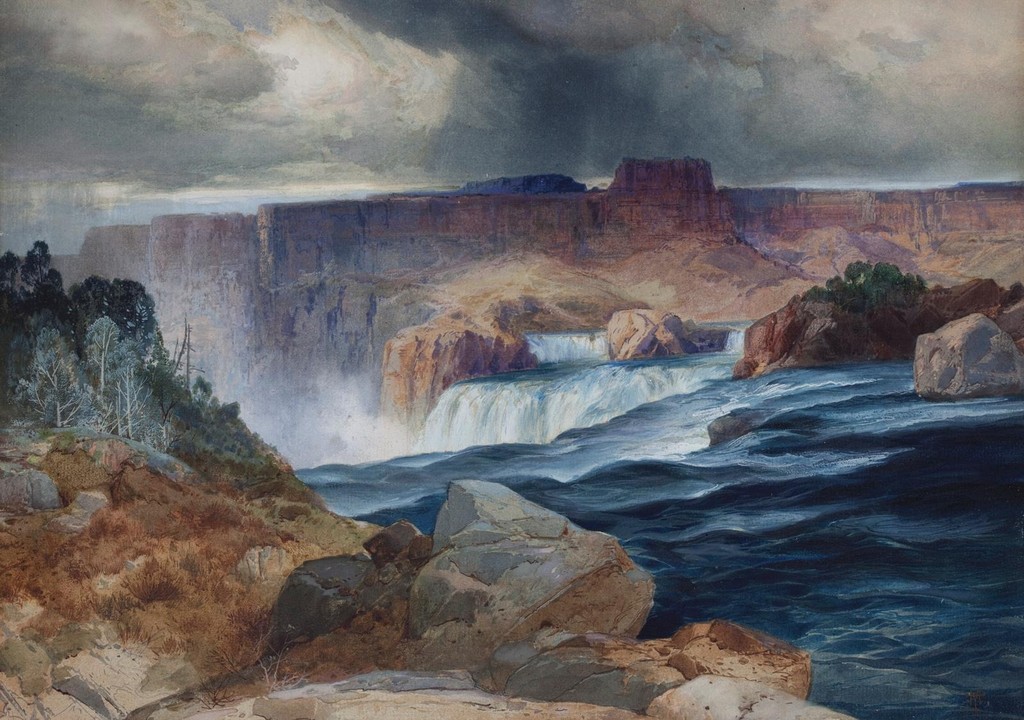
The smaller Shoshone Falls, Idaho in the Chrysler Museum of Art is a separate work. The 1997 catalogue dates it to circa 1874–75; the reproduced museum record gives circa 1875. It is a watercolour on paperboard, measuring 25.4 × 35.6 cm, accession 60.52.47, and was given by Hugh Gordon Miller. It should not be labelled as the 1900 oil or as a study made during the later visit. [3]
In that image, rocks and trees occupy the foreground left, and dark water leads towards a smaller white fall beyond them. A reddish cliff wall rises behind the river. The observer is given a clearer intervening bank from which to look into the scene. The waterfall is an important destination within the view, but does not occupy it with the same breadth as in the large oil.
The later painting moves attention towards the river's exposed surface and the point of collapse. Its darker right-hand foreground, wider spread of water and extensive spray make the spectator's position seem less sheltered. The earlier watercolour allows the falls to be approached through a succession of landscape features; the oil makes the current itself the main route through the picture.
The comparison also changes the experience of scale. A small work on paper rewards close examination of individual transitions between rock, foliage and water. The panoramic oil brings many such transitions into a sustained, encompassing field. That difference is visible in their formats without requiring an unsupported claim about which particular brush, wash or pigment produced each effect.
Representing Shoshone before seeing it
Moran's first images of the falls preceded his documented visit. An illustration appeared in The Aldine in June 1876, and the subject also entered Louis Prang's 1876 set of chromolithographs after Moran's paintings. Nancy Anderson's catalogue suggests that photographs, possibly those of Timothy O'Sullivan, helped inform these earlier representations. The proposed photographic source remains a possibility rather than a securely identified model. [2]
This history complicates a simple account of an artist seeing a natural wonder and immediately painting it. Shoshone existed for Moran as a subject in circulating images before it became a personally experienced place. His journey allowed him to reconsider something already available to readers and print purchasers. The 1900 canvas belongs to that longer sequence of representation.
For the viewer, the earlier watercolour and the later oil can therefore be read as two different ways of constructing familiarity. One offers a compact landscape that can be held at close range; the other gives a public exhibition audience an extended confrontation with water and stone. Their shared subject does not make their purposes or effects identical.
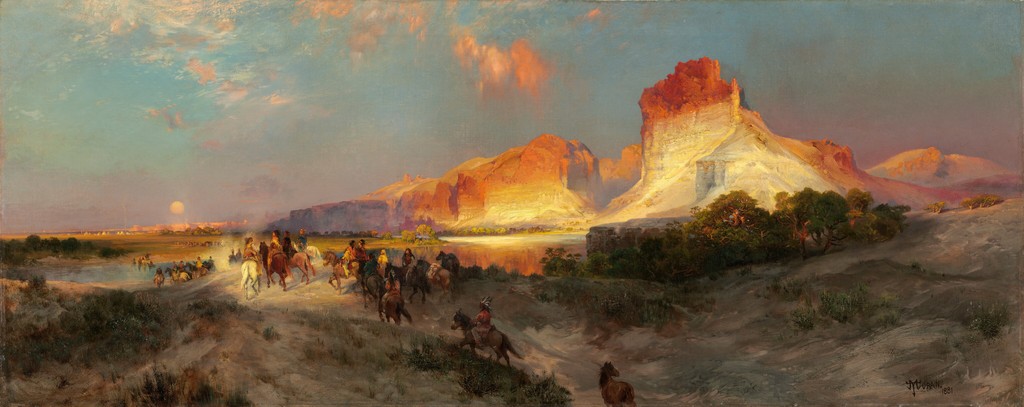
Moran's repeated treatment of Shoshone also places it beside his other returning western subjects. Green River Cliffs, Wyoming was made from a landscape he continued to transform over time. Repetition gave him opportunities to change the balance between land, sky and atmosphere. It did not require every new picture to reproduce an earlier composition.
The journey of 1900
The Gilcrease essay by Sandra Pauly connects the visit with a difficult moment in Moran's life. His wife, Mary Nimmo Moran, died in September 1899. He travelled to Idaho with their daughter Ruth the following year. Pauly places the resulting painting within both his renewed western travel and his response to bereavement. [1]
Ruth's later recollection, reproduced in the 1997 catalogue, describes her father's strong excitement on seeing the falls. Because it is a retrospective family account, it adds a remembered personal response rather than a day-by-day record of the painting's construction. It helps explain why the site remained important to the family without establishing every decision Moran made in his studio. [2]
Pauly interprets the rainbow as a possible sign of hope following Mary's death. This is a curator's reading, not a documented statement of Moran's intention. The distinction leaves room for the picture to carry more than one experience. A viewer may notice renewal in the light, concentrate on the water's violence, or feel the tension between those effects.
The small rainbow is particularly suited to such an interpretation because it appears within the forceful spray rather than above a quiet landscape. Brightness emerges from the very area that is hardest to see clearly. That visual relationship can support a reading of hope amid uncertainty, while the biographical explanation remains attributed rather than assumed.
Watch: Thomas Moran
Choose a film to explore the artist’s work, its interpretation and its wider setting.
The painting that inspired a National Park
A close discussion of Moran’s landscape and its relationship to the idea of Yellowstone.
Watch on YouTubeA spectacle already on the tourist map
The falls had attracted written descriptions and visitors well before Moran's arrival. Anderson's catalogue reproduces nineteenth-century accounts that compare Shoshone with Niagara and emphasise its sound, spray and imposing cliffs. These comparisons placed a western site within a vocabulary already familiar to readers who knew the better-publicised eastern waterfall. [2]
The catalogue also describes the visitor services developed by Charles Walgamott, including a stage connection and a tent hotel, and later railway promotion of excursions. Those facilities matter because the oil contains no conspicuous tourist infrastructure. Its absence from the picture cannot be treated as proof that the site was untouched by visitors or commercial activity in 1900.
The view directs attention towards a different experience of the place. Stone, water and weather fill the field, while the means by which visitors reached it are left outside. The spectator encounters a scene that seems to exceed ordinary human accommodation. That impression is an effect of the painting's selection, even though travel and tourism formed part of its historical setting.
The contrast does not require accusing the canvas of being a defective travel record. A painting can concentrate on the falls' grandeur while a historical account explains the surrounding infrastructure. Reading the two together makes the image more interesting: the apparently self-contained natural spectacle was also a destination reached through a developing network of transport and services.
Water diversion and the limits of an intention
The picture was made as irrigation development was changing the region's relationship with the Snake River. Anderson discusses a proposed diversion reported in October 1900 and the subsequent harnessing of the river. Pauly's Gilcrease essay also places the falls within that history and notes differing scholarly interpretations of Moran's relationship to it. [1] [2]
This context makes the abundant flow in the painting historically significant. Water appears here as a force crossing and shaping the landscape, rather than as a measured resource distributed among farms or settlements. The image preserves an expansive vision of that force. Its visual emphasis becomes more pointed when considered beside the developments described in the historical sources.
The painting alone, however, cannot settle Moran's position on every irrigation proposal. A dramatic waterfall is not automatically a written protest, and a commercial or personal connection does not supply a complete account of an artist's beliefs. The useful conclusion is narrower: the canvas emerged at a moment when the falls' appearance and the river's use were becoming contested subjects.
Nor does the painted volume of water provide a measurement of the river's present flow. It belongs to Moran's 1900 image and its historical setting. The work invites reflection on change because it offers such a sustained impression of power, while the causes and extent of later changes require their own evidence.
Reception in 1901
Moran exhibited the painting at the National Academy of Design in 1901. In a review reproduced by Anderson, Charles Caffin praised his treatment of the rock masses and falling water. Caffin argued that the effect depended on the organisation of large forms, rather than simply on the canvas's size. He also acknowledged that panoramic grandeur was not necessarily his own preference. [2]
That qualification is useful. The review recognises achievement without pretending that every contemporary critic wanted the same kind of landscape. Moran's established manner could be respected at a time when other approaches attracted attention. The painting therefore belongs to a changing exhibition culture as well as to the history of a particular waterfall.
The composition makes Caffin's distinction easy to understand. Enlarging a confused view would not give it coherence. Here, the strong horizontal breadth, dark enclosing cliffs, bright cataract and repeated currents work together. The fall remains legible within the surrounding spectacle, and small details contribute to a structure that can be grasped from a greater distance.
The work received a silver medal at the Pan-American Exposition in Buffalo in 1901. Anderson also records that it remained unsold at Moran's death. Recognition and sale were therefore separate parts of its reception. A medal confirms exhibition success; it does not establish a purchaser, a sale price or immediate acceptance into the collection where the painting is now held. [2]
The canvas and its measurements
The Gilcrease object record identifies this painting as accession 01.2339, dated 1900, in oil on canvas. Its image measurements are given as 191.1 × 376.6 cm. The 1997 exhibition catalogue reports 182.9 × 365.8 cm. These figures differ, and the available records do not explain why. Neither should be silently converted into a supposedly settled measurement. [1] [2]
Both records nevertheless describe an exceptionally broad, large work. The visual analysis depends on that panoramic proportion, rather than on resolving the discrepancy through guesswork. A framed measurement would describe another physical extent again. Keeping the records distinct prevents the frame, painted image and reported canvas dimensions from being treated as interchangeable.
The same care is needed with the earlier watercolour. Its small dimensions and separate accession identify an individual work on paper. The two images illuminate one another because their compositions differ, while their collection histories and physical supports remain separate. A title shared across versions is a connection, not a substitute for object identity.
Shoshone within Moran's western career
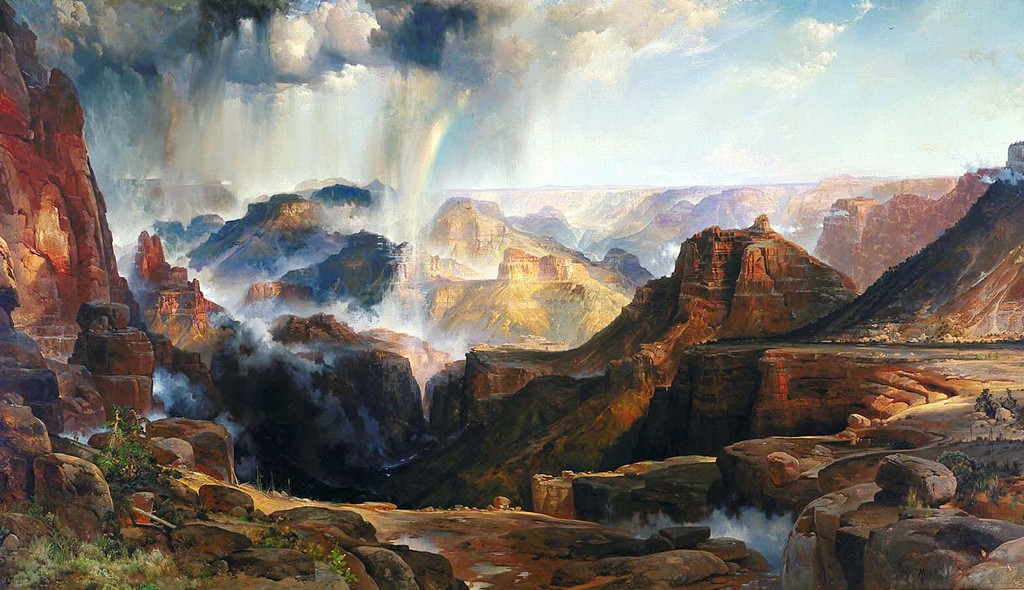
Beside The Chasm of the Colorado, Shoshone shifts the principal action from an immense expanse of rock and atmospheric distance to water close to the spectator. Both pictures make natural scale difficult to comprehend at once. In the later work, the spectator follows a current whose destination is obscured rather than looking chiefly into successive canyon depths.
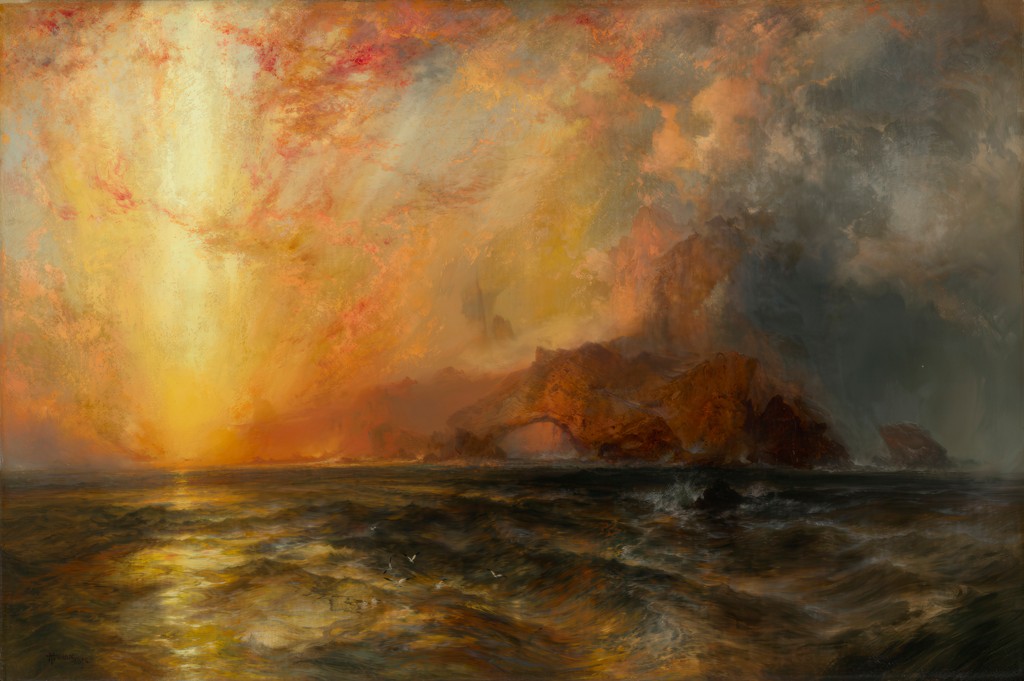
Beside The Much Resounding Sea, the waterfall gives movement a different physical limit. Sea waves rise and break across an open surface; the Snake River approaches a definite edge. The cliffs establish that edge and give the fall its enduring place, while the water continually renews the event.
Shoshone thus joins several of Moran's recurring concerns in one late canvas: repeated engagement with a western subject, the organisation of a panoramic view, atmospheric concealment and the visible force of water. The result is more than a large illustration of a famous site. It is a carefully directed encounter in which the eye can follow the river towards the brink but cannot hold the whole cataract still.
Artworks directory
Selected documented works and distinct versions. This directory is not a comprehensive catalogue raisonné. Dates and media retain the distinctions explained in the articles and museum records.
| Name | Date | Medium |
|---|---|---|
| An Arizona Sunset near the Grand Canyon | Date not securely established | Oil painting |
| Autumn Afternoon, the Wissahickon by Thomas Moran | 1864 | Oil on canvas |
| Cascade Falls, Yosemite | Commonly catalogued as 1905 | Catalogued as oil on canvas |
| The Chasm of the Colorado | 1873–1874; completed in 1874 | Oil on canvas, currently mounted on aluminium |
| Children of the Mountain | 1866 in the current museum title; 1867 in the 1997 National Gallery catalogue | Oil on canvas |
| Cliffs of Green River | 1874 | Oil on canvas |
| Cliffs of the Upper Colorado River, Wyoming Territory | 1882 | Oil on canvas |
| East Hampton, Long Island , also captioned Easthampton, L.I | 1897 | Oil on canvas laid on board, according to the reproduction record |
| Fiercely the red sun descending, Burned his way along the heavens | 1875–76 | Oil on canvas |
| Forest Scene | 1870 | Oil on canvas |
| Grand Canyon of the Colorado River | 1892 and 1908 | Oil on canvas |
| Green River Cliffs, Wyoming | 1881 | Oil on canvas |
| Green River, Wyoming | 1878 | Oil on panel |
| The Juniata, Evening | 1864 | Oil on canvas |
| Mosquito Trail, Rocky Mountains of Colorado | 1875 in the 1997 National Gallery exhibition catalogue | Watercolour |
| Mountain of the Holy Cross | 1875 | Oil on canvas |
| The Much Resounding Sea | 1884 | Oil on canvas |
| Point Lobos, Monterey, California | 1912, signed and dated | Oil on canvas |
| Shoshone Falls on the Snake River | 1900 | Oil on canvas |
| Summit of the Sierras | 1872/75, as catalogued by the Art Institute of Chicago | Gouache over graphite on cream laid paper |
| The Teton Range | 1897 | Oil on canvas |
| The Three Tetons | 1895 | Oil on canvas |
| Tower Falls, Yellowstone | 1872 | Watercolour and gouache over graphite on blue laid paper |
| A View of Venice | 1891 | Oil on canvas |
| The Grand Canyon of the Yellowstone | 1872 | Oil on canvas, currently recorded as mounted on aluminium |
| Mountain of the Holy Cross, Colorado (etching) | 1888 | Etching, roulette and aquatint |
| The Resounding Sea (etching) | 1880 | Etching |
| The Much Resounding Sea (later etching) | 1886 in heading; 1888 on plate | Etching, drypoint and roulette |
| Tower Falls (Prang print) | c. 1875; portfolio issued 1876 | Chromolithograph |
| Shoshone Falls (early watercolour) | 1874 | Watercolour |
| Venice (watercolour) | 1888 | Watercolour over graphite |
Frequently Asked Questions
The Gilcrease Museum dates Shoshone Falls on the Snake River to 1900, the year of his visit with Ruth Moran.
No. It is a separate small work on paperboard, dated circa 1874–75 in the 1997 catalogue, made before the documented 1900 visit.
Sandra Pauly proposes that interpretation in the Gilcrease essay. It is not established by a surviving statement of Moran's intention cited here.
The current museum record and 1997 catalogue give different measurements. The available evidence does not explain the discrepancy, so both are attributed to their sources.
It was exhibited at the National Academy of Design and awarded a silver medal at the Pan-American Exposition in 1901.
Discussion
Follow the dark river towards the white fall. Where does the picture allow you to judge its movement, and where does spray make that movement impossible to see fully? Compare the sheltered foreground of the early watercolour with the larger oil.
Reader Insights
Editorial prompts for close looking and discussion.
Follow the dark river towards the white fall. Where does the picture allow you to judge its movement, and where does spray make that movement impossible to see fully?
Compare the sheltered foreground of the early watercolour with the larger oil.
How does this page compare with the related works linked above?
Join the Conversation
Share your reading of this page below.
References
- Sandra Pauly, Shoshone Falls on the Snake River, Gilcrease Museum, object record and curator essay, 2021.
- Nancy K. Anderson and contributors, Thomas Moran, 1997, pp. 162–163 and catalogue no. 88, pp. 167–169; early watercolour, catalogue no. 49, p. 102. Includes transcribed historical accounts and Charles Caffin's 1901 review.
- Chrysler Museum of Art record reproduced at Wikimedia Commons, Shoshone Falls, Idaho, circa 1875, watercolour on paperboard, 60.52.47.
- Splash image source.
Shoshone Falls on the Snake River, 1900. Wolfgang Sauber / Wikimedia Commons, CC BY-SA 3.0; Gilcrease Museum painting. Image source. CC BY-SA 3.0; also marked PD-Art. Resized only; complete source image retained. This image derivative is available under the same licence.
- Splash image source.
Shoshone Falls, Snake River, Idaho, watercolour, circa 1874–1875. Chrysler Museum of Art, Gift of Mr. Hugh Gordon Miller, 60.52.47; via Wikimedia Commons. Image source. Public Domain Mark; faithful two-dimensional reproduction. Resized only; complete source image retained.
- Splash image source.
Shoshone Falls on the Snake River, 1900. Wolfgang Sauber / Wikimedia Commons, CC BY-SA 3.0; Gilcrease Museum painting. Image source. CC BY-SA 3.0; also marked PD-Art. Numbered circles added to the overview; details cropped from the original reproduction. No colour adjustment or sharpening. This image derivative is available under the same licence.
- Splash image source.
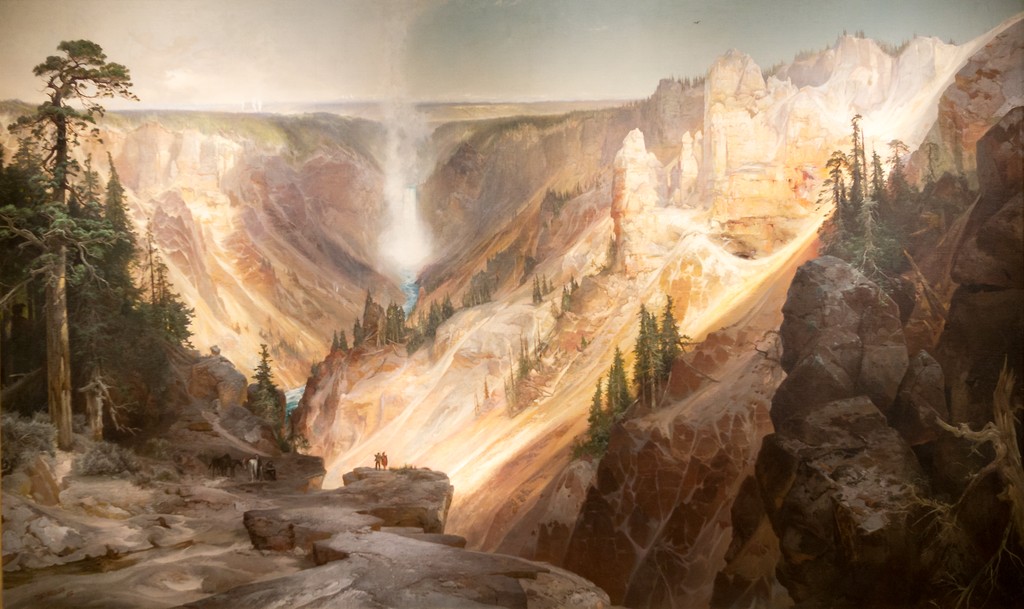
The Grand Canyon of the Yellowstone, 1872. Wuselig / Wikimedia Commons, CC BY-SA 4.0; U.S. Department of the Interior Museum painting. Image source. CC BY-SA 4.0; also marked PD-Art. Outer museum frame cropped; resized. Painted composition retained; photographic perspective unchanged. This image derivative is available under the same licence.
- Splash image source.
The Chasm of the Colorado, 1873–1874. U.S. Department of the Interior Museum; faithful reproduction via Smithsonian American Art Museum / Wikimedia Commons. Image source. Public Domain Mark; faithful two-dimensional reproduction. Resized only; complete source image retained.
- Splash image source.
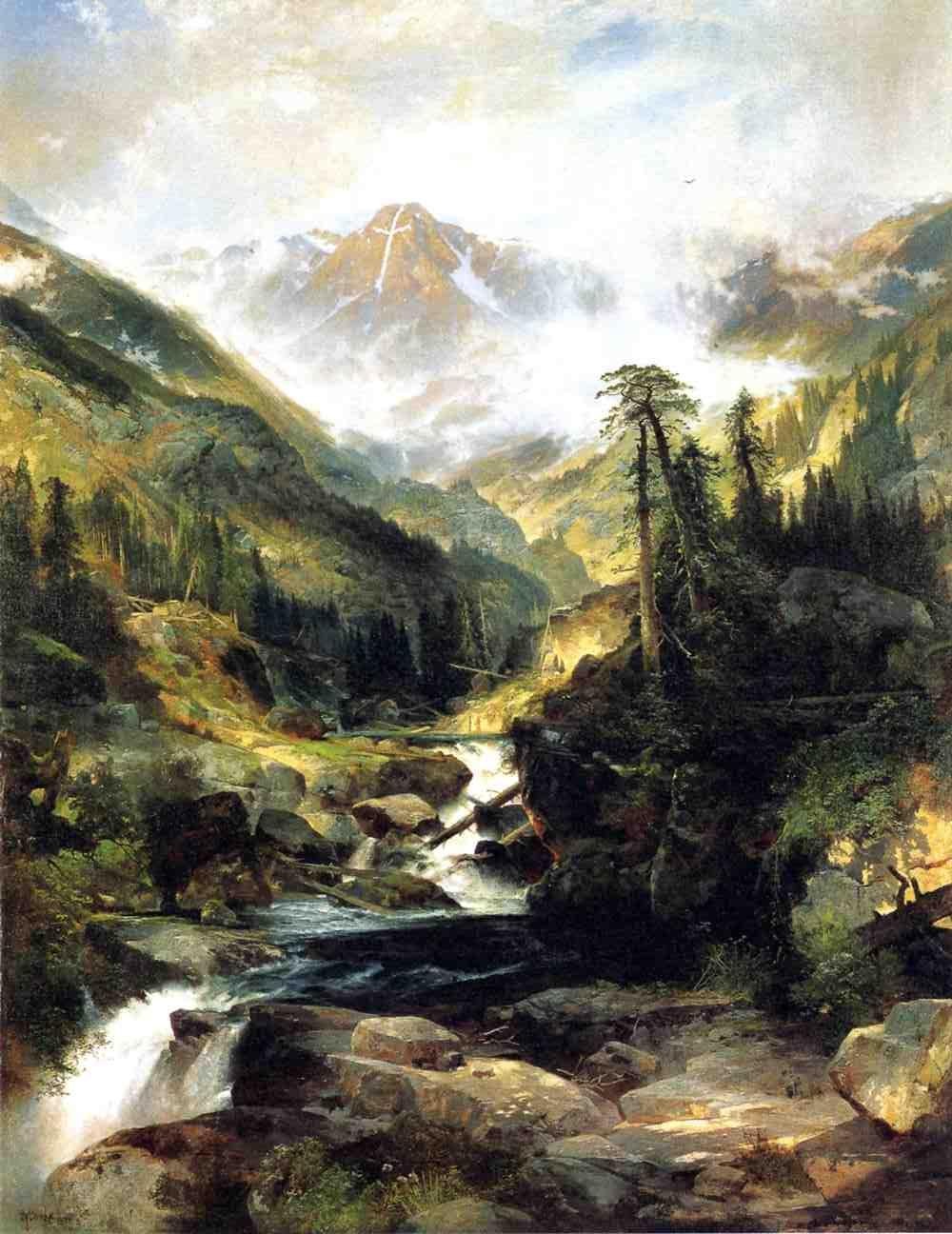
Mountain of the Holy Cross, 1875. Autry Museum of the American West; faithful reproduction via Wikimedia Commons. Image source. Public Domain Mark; faithful two-dimensional reproduction. Resized only; complete source image retained.
- Splash image source.
Shoshone Falls on the Snake River, 1900. Wolfgang Sauber / Wikimedia Commons, CC BY-SA 3.0; Gilcrease Museum painting. Image source. CC BY-SA 3.0; also marked PD-Art. Resized only; complete source image retained. This image derivative is available under the same licence.
- Splash image source.
Green River Cliffs, Wyoming, 1881. National Gallery of Art, Gift of the Milligan and Thomson Families. Image source. Public domain; NGA Open Access. Resized only; complete source image retained.
- Splash image source.
A View of Venice, 1891. Smithsonian American Art Museum, Transfer from the U.S. Department of the Interior, National Park Service, 1968.120.1. Image source. Free to use; Smithsonian Open Access. Resized only; complete source image retained.
- Splash image source.
The Three Tetons, 1895. The White House Collection, Gift of C. R. Smith; faithful reproduction via Wikimedia Commons. Image source. Public Domain Mark; faithful reproduction of a two-dimensional public-domain work. Resized only; complete source image retained.