 by Tom Gurney
Tom Gurney BSc (Hons) is an art history expert with over 20 years experience
Published on June 19, 2020 / Updated on October 27, 2026
Email: tomgurney1@gmail.com / Phone: +44 7429 011000
A View of Venice: Introduction
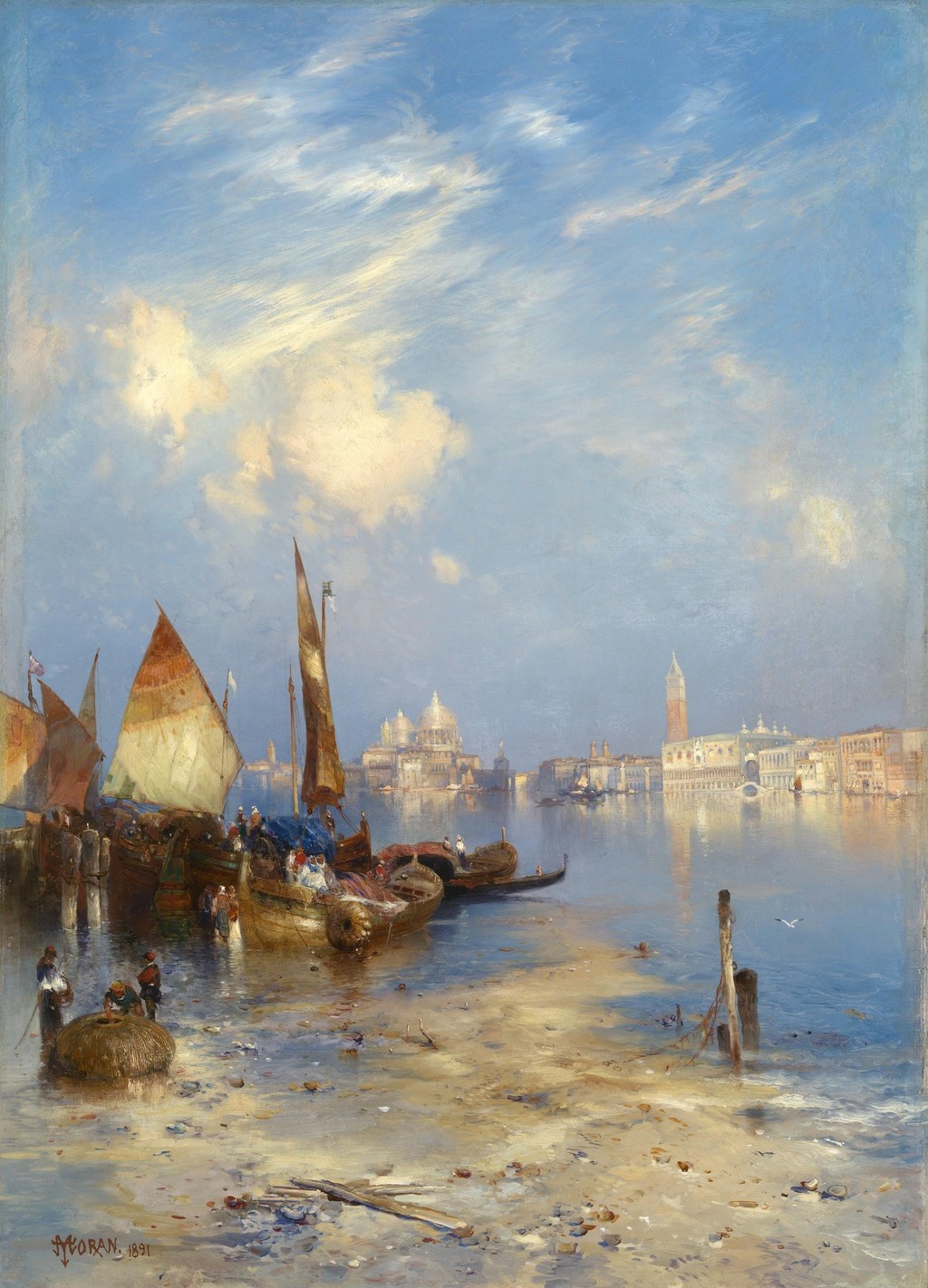
Thomas Moran's A View of Venice, dated 1891, is an oil on canvas in the Smithsonian American Art Museum. Boats and figures gather in the lower left, buildings stretch across the middle distance, and a generous sky rises above them. Reflected light joins the city's solid architecture with its less stable image in the water. [1]
The painting shows another side of an artist best known for western cliffs and canyons. Here, the foreground is crowded with vessels, materials and people, while the distance is softened by atmosphere. Its upright format makes Venice a view to enter from below and look through, rather than a long panorama scanned from side to side.
At a Glance
- ArtistThomas Moran
- TitleA View of Venice
- Date1891
- MediumOil on canvas
- Dimensions89.2 × 64.1 cm
- CollectionSmithsonian American Art Museum
- Object number1968.120.1
- CreditTransfer from the U.S. Department of the Interior, National Park Service
- First Venice visit1886
- Different paper workNGA's View of Venice, 1888
Where this work sits in Moran’s career
The Chasm of the Colorado
1873–1874; completed in 1874A View of Venice
1891Point Lobos, Monterey, California
1912, signed and datedContents
- The upright arrangement
- Boats, sails and a working foreground
- Architecture seen across water
- Reflection without a perfect mirror
- Venice before and after the first visit
- Turner and the organisation of a city view
- A separate Venetian watercolour
- Venice beside Moran's American waters
- The Smithsonian object and its continuing clarity
The upright arrangement
The canvas is taller than it is wide. Much of the upper half is sky, while buildings and vessels occupy a relatively narrow passage beneath. That division makes the city feel both inhabited and open to a much larger atmosphere. The skyline is recognisable without filling the whole picture.
At the lower left, boats overlap and project towards the spectator. Their hulls are warmer and darker than the water around them. Masts and sails rise above the group, carrying the foreground upwards into the sky. The vertical format makes those tall shapes important connections between its crowded and open areas.
On the right, the foreground is less densely occupied. Upright posts emerge from the water, but leave room for reflections and scattered small objects. This interval balances the heavier group of boats. It also allows a clearer passage from the lower edge towards the architecture beyond.
The centre does not behave like a rigid vanishing-point corridor. A boat projects across it, and reflections interrupt its surfaces. The eye moves between overlapping forms and changing patches of light. Space is created through successive differences in size and clarity, rather than one perfectly unobstructed route.
Annotated Details from A View of Venice
Compare these details with the full composition. The numbered overview and crops come from the same original image.
Details from A VIEW OF VENICE
Open a detail to see it more closely.
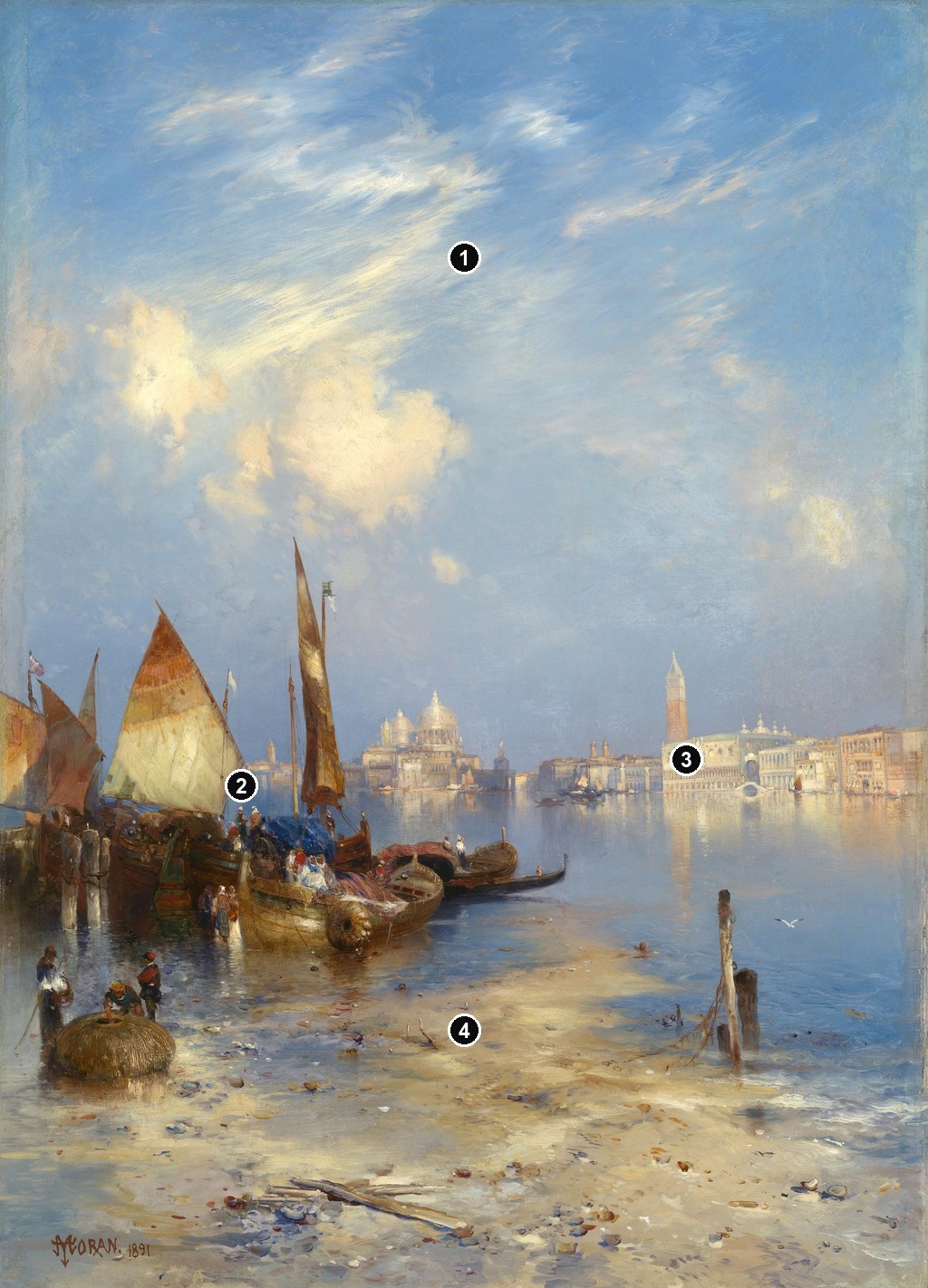
Sky above the boats
The sky occupies a large part of the upright field. Thin clouds and pale light give the crowded boats and distant architecture room beneath them.
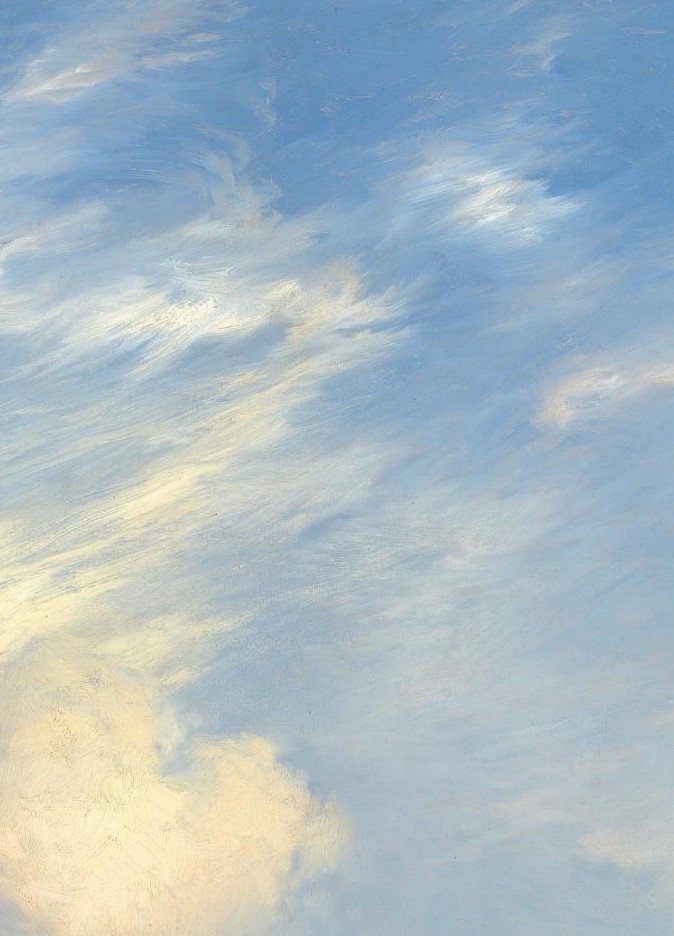
Boats, sails and a working foreground
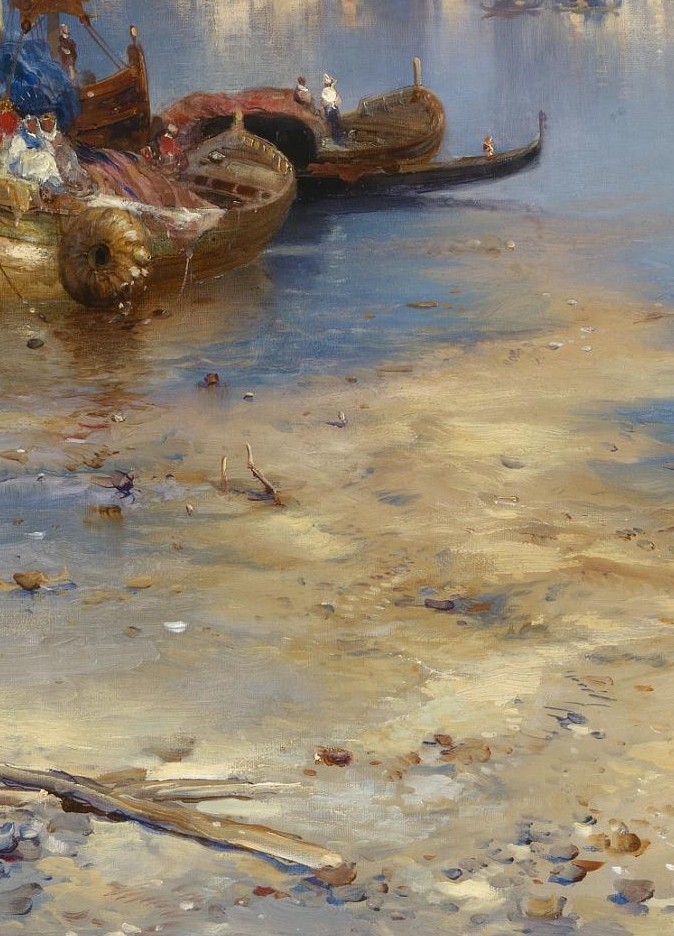
The boats supply several kinds of shape. Their hulls curve, masts stand upright and sails offer broad triangular surfaces. Those differences prevent the foreground from becoming an indistinct pile of brown forms. Moran gives it an internal structure that can be followed even where one vessel partly conceals another.
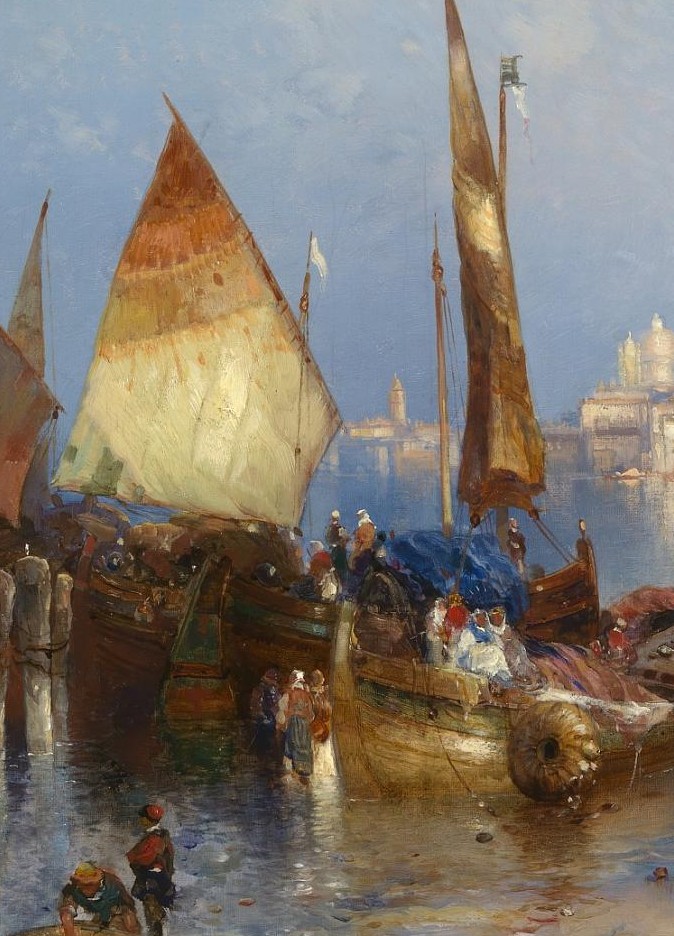
Architecture seen across water
The skyline contains domes, a tall tower and long lower buildings. Their pale surfaces are more softly described than the nearer boats. The distinction gives the foreground greater physical immediacy while keeping the architectural group legible across the water.
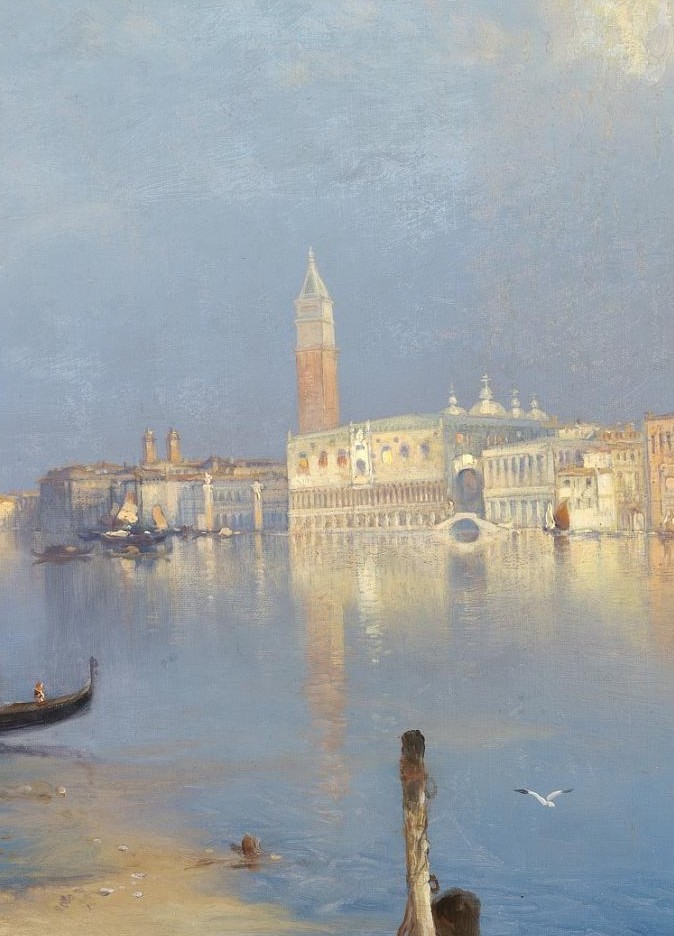
Reflection without a perfect mirror
The water receives long passages of warm light from the buildings. These reflections are broken and softened rather than sharply duplicating every architectural edge. The distinction makes the surface feel responsive to movement. The city acquires a second, less stable presence below its skyline.
Boats, sails and a working foreground
The boats supply several kinds of shape. Their hulls curve, masts stand upright and sails offer broad triangular surfaces. Those differences prevent the foreground from becoming an indistinct pile of brown forms. Moran gives it an internal structure that can be followed even where one vessel partly conceals another.
One pale sail catches a strong area of light. Its warmer upper passage and lighter lower surface stand against the cooler distance. A narrower, darker sail beside it creates another vertical accent. The pair carries attention upwards while retaining a connection with the boats and people below.
Figures occupy the vessels and the edge of the foreground. They appear as small groups of heads, clothing and gestures, rather than a single protagonist controlling the picture. Their activity helps establish the scale of the boats. It also makes the city a place of movement and work, even within a view shaped for beauty.
Objects and fragments scattered near the lower edge add a more irregular texture. They interrupt the bright water with small pieces of colour and line. Their exact identities are not all securely readable. Naming every item as a specific cargo or trade would make the description more precise than the reproduction allows.
Architecture seen across water
The skyline contains domes, a tall tower and long lower buildings. Their pale surfaces are more softly described than the nearer boats. The distinction gives the foreground greater physical immediacy while keeping the architectural group legible across the water.
The Smithsonian identifies the view with the entrance to the Grand Canal and describes adjustments to architecture and topography. Its interpretation specifically notes that the Bridge of Sighs is made visible through artistic licence. The picture should therefore not be treated as a photographically exact record from one fixed viewing station. [1]
The architecture still performs a clear pictorial function. Domes and tower give the city recognisable accents against the sky. Lower buildings connect those accents horizontally, while their reflections extend them into the water. The skyline is both a set of identifiable forms and a structure through which light can be distributed.
That double role helps explain why a painter might alter a view. The picture must hold together as an arrangement, not only identify individual buildings. A recognisable city can become the foundation for changes in distance, emphasis and foreground activity. Familiarity and invention need not operate in separate parts of the canvas.
Reflection without a perfect mirror
The water receives long passages of warm light from the buildings. These reflections are broken and softened rather than sharply duplicating every architectural edge. The distinction makes the surface feel responsive to movement. The city acquires a second, less stable presence below its skyline.
Nearer the spectator, bright areas widen and mix with cooler blue. Small marks interrupt them, and posts cast darker accents across the surface. The eye can still connect the foreground with the distant buildings, but the connection is made through changing colour rather than an exact reflected diagram.
The boats create another contrast. Their dark hulls have comparatively firm edges, while nearby reflections are less definite. Solid and fluid surfaces are placed close together, allowing each to make the other more apparent. The picture's physical world depends on those differences in how forms are described.
The large sky also participates. Warm clouds and pale blue passages are echoed below without becoming mechanically identical. Light belongs to the whole arrangement, connecting water, buildings and sails. It is one reason the varied foreground can feel part of a coherent view rather than a separate scene attached to a distant city.
Venice before and after the first visit
Moran first visited Venice in 1886, but had encountered the city through paintings and books before travelling there. The National Gallery catalogue follows his longstanding admiration for Turner and the influence of literary and artistic accounts. Venice was already a subject with a rich history of representation. [2]
A letter to Mary after his arrival gives a more immediate response. He expressed delight in the city and said he would tell her about it when he returned. The brief record confirms his enthusiasm without supplying a complete itinerary or a list of everyone he met. Proposed social encounters discussed in the catalogue remain proposals where direct evidence is lacking.
He returned to Venice in 1890 and brought a gondola back to East Hampton. Contemporary local reporting, transcribed in the catalogue, records its use on Hook Pond. Claims about its connection with Robert Browning belong to those accounts and should not become an independently verified provenance for every object associated with it.
The 1891 canvas follows those journeys, but the date alone does not establish where each passage was painted. Field sketches and observations could support later studio work. The relationship between travel and finished image is more useful when the two are distinguished, rather than compressed into one moment of seeing and painting.
Watch: Thomas Moran
Choose a film to explore the artist’s work, its interpretation and its wider setting.
The painting that inspired a National Park
A close discussion of Moran’s landscape and its relationship to the idea of Yellowstone.
Watch on YouTubeTurner and the organisation of a city view
Turner's Venetian paintings provided an important example for Moran. The catalogue connects their shared interest in luminous water, architecture and vessels. That context explains an artistic relationship, without making the Smithsonian oil a direct copy of a single Turner picture. [2]
Moran's own published outlook also helps. In Sheldon’s American Painters in 1879 he described his practice as directed towards idealisation. The statement predates his first Venetian journey and concerns a general priority. It can frame his willingness to organise observed forms, but is not a specific account of the making of this canvas. [3]
The visible arrangement makes that priority concrete. A bright sail, a dark hull, a pale tower and reflected light can cooperate even when they occupy different depths. The artist chooses which forms should be clear and which can dissolve into atmosphere. The view becomes expressive through the relationships among them.
A separate Venetian watercolour
The National Gallery of Art records View of Venice, dated 1888, as watercolour and gouache on laid paper. It belongs to the Corcoran Collection and has accession 2014.136.184. This is a distinct work, with a different date, medium, format and collection history. [4]
Its image is wider than it is high, unlike the Smithsonian oil. That difference alone changes the distribution of sky, skyline and foreground water. The measurements also distinguish the paper's image from its full sheet. Neither should replace the canvas dimensions of the 1891 painting.
Comparing the records shows why a shared geographical subject cannot establish object identity. A caption headed Venice may accompany an oil, a watercolour, another dated version or a reproduction. Date, support and collection make the comparison specific. They prevent the paper work from becoming an accidental substitute for the canvas discussed here.
Venice beside Moran's American waters
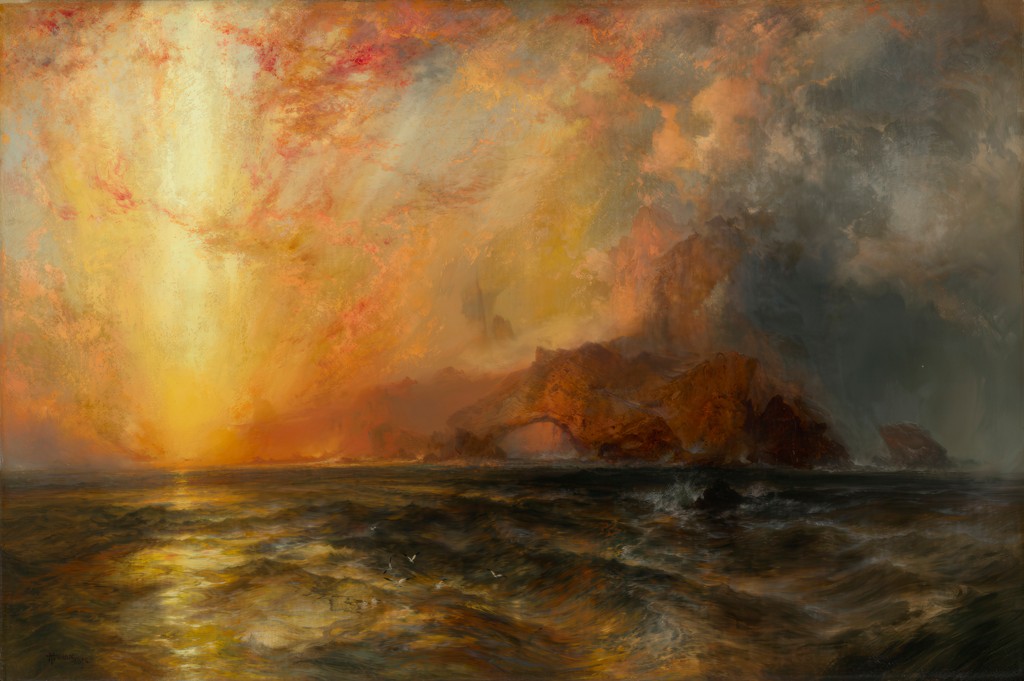
The city view can also be compared with The Much Resounding Sea. In that picture, waves and foam dominate a broad canvas with very little human action. Venice instead gives vessels, people and architecture substantial roles. Its water connects a built environment rather than confronting the spectator with an almost uninterrupted natural force.
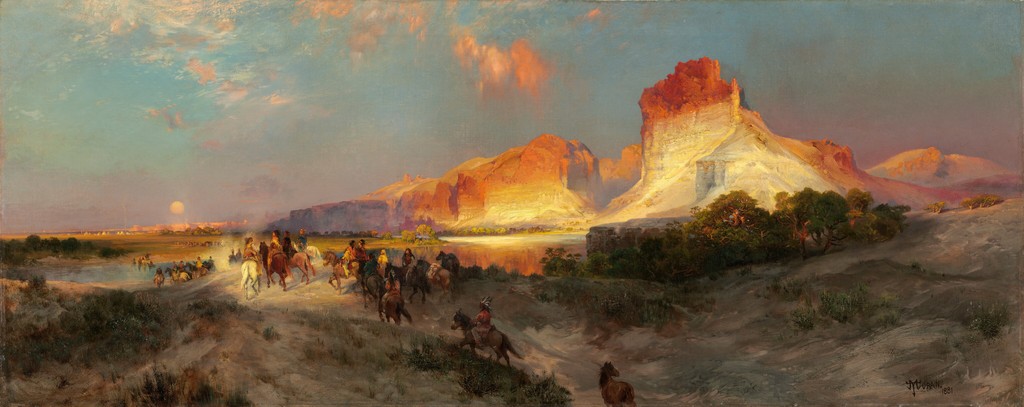
A Green River painting offers another comparison. There, a procession supplies movement beneath great cliffs. Here, boats and figures occupy the foreground beneath a recognisable skyline. The two scenes use different subjects to establish a relationship between smaller activity and larger forms.
Such comparisons need not turn every picture into one formula. The sea moves differently from a canal, and a cliff differs from a palace. Their value is in showing how Moran adapted recurring interests in scale, light and distance to subjects with their own physical and cultural character.
The Smithsonian object and its continuing clarity
The museum's record identifies the oil as object 1968.120.1 and credits its transfer from the Department of the Interior's National Park Service. That history belongs to this canvas. It does not supply an undocumented original commission or establish a permanent present-day display location. [1]
The painting remains particularly revealing when looked at from the lower edge upwards. Scattered objects and posts lead to hulls and sails; the sails connect with buildings; the buildings open onto a wide sky. Those transitions bring a crowded foreground and a luminous distance into one upright view. Venice becomes a place of overlapping activity and reflected light, shaped by an artist accustomed to making landscape both recognisable and imaginative.
Artworks directory
Selected documented works and distinct versions. This directory is not a comprehensive catalogue raisonné. Dates and media retain the distinctions explained in the articles and museum records.
| Name | Date | Medium |
|---|---|---|
| An Arizona Sunset near the Grand Canyon | Date not securely established | Oil painting |
| Autumn Afternoon, the Wissahickon by Thomas Moran | 1864 | Oil on canvas |
| Cascade Falls, Yosemite | Commonly catalogued as 1905 | Catalogued as oil on canvas |
| The Chasm of the Colorado | 1873–1874; completed in 1874 | Oil on canvas, currently mounted on aluminium |
| Children of the Mountain | 1866 in the current museum title; 1867 in the 1997 National Gallery catalogue | Oil on canvas |
| Cliffs of Green River | 1874 | Oil on canvas |
| Cliffs of the Upper Colorado River, Wyoming Territory | 1882 | Oil on canvas |
| East Hampton, Long Island , also captioned Easthampton, L.I | 1897 | Oil on canvas laid on board, according to the reproduction record |
| Fiercely the red sun descending, Burned his way along the heavens | 1875–76 | Oil on canvas |
| Forest Scene | 1870 | Oil on canvas |
| Grand Canyon of the Colorado River | 1892 and 1908 | Oil on canvas |
| Green River Cliffs, Wyoming | 1881 | Oil on canvas |
| Green River, Wyoming | 1878 | Oil on panel |
| The Juniata, Evening | 1864 | Oil on canvas |
| Mosquito Trail, Rocky Mountains of Colorado | 1875 in the 1997 National Gallery exhibition catalogue | Watercolour |
| Mountain of the Holy Cross | 1875 | Oil on canvas |
| The Much Resounding Sea | 1884 | Oil on canvas |
| Point Lobos, Monterey, California | 1912, signed and dated | Oil on canvas |
| Shoshone Falls on the Snake River | 1900 | Oil on canvas |
| Summit of the Sierras | 1872/75, as catalogued by the Art Institute of Chicago | Gouache over graphite on cream laid paper |
| The Teton Range | 1897 | Oil on canvas |
| The Three Tetons | 1895 | Oil on canvas |
| Tower Falls, Yellowstone | 1872 | Watercolour and gouache over graphite on blue laid paper |
| A View of Venice | 1891 | Oil on canvas |
| The Grand Canyon of the Yellowstone | 1872 | Oil on canvas, currently recorded as mounted on aluminium |
| Mountain of the Holy Cross, Colorado (etching) | 1888 | Etching, roulette and aquatint |
| The Resounding Sea (etching) | 1880 | Etching |
| The Much Resounding Sea (later etching) | 1886 in heading; 1888 on plate | Etching, drypoint and roulette |
| Tower Falls (Prang print) | c. 1875; portfolio issued 1876 | Chromolithograph |
| Shoshone Falls (early watercolour) | 1874 | Watercolour |
| Venice (watercolour) | 1888 | Watercolour over graphite |
Frequently Asked Questions
It is dated 1891 and identified as oil on canvas.
The Smithsonian records 89.2 × 64.1 cm and object 1968.120.1.
The museum describes artistic adjustments, including the visibility of the Bridge of Sighs. It should not be treated as an unaltered record from one viewing station.
His first visit was in 1886. He had already encountered Venetian subjects through art and literature.
No. It is a separate watercolour and gouache on laid paper, accession 2014.136.184.
Discussion
Follow one architectural form into its reflection, then compare it with a nearby hull or sail. Where does Moran make the image firm, and where does he allow it to dissolve?
Reader Insights
Editorial prompts for close looking and discussion.
Follow one architectural form into its reflection, then compare it with a nearby hull or sail. Where does Moran make the image firm, and where does he allow it to dissolve?
Which source or image helps you assess the interpretation?
How does this page compare with the related works linked above?
Join the Conversation
Share your reading of this page below.
References
- Smithsonian American Art Museum, A View of Venice, 1891, object record and interpretation.
- Nancy K. Anderson and contributors, Thomas Moran, 1997, selected Venice discussion, pp. 121–124, including transcribed letter and local newspaper accounts.
- G. W. Sheldon, American Painters, 1879, Moran chapter, especially p. 125.
- National Gallery of Art, View of Venice, 1888, watercolour and gouache, 2014.136.184.
- Splash image source.
A View of Venice, 1891. Smithsonian American Art Museum, Transfer from the U.S. Department of the Interior, National Park Service, 1968.120.1. Image source. Free to use; Smithsonian Open Access. Resized only; complete source image retained.
- Splash image source.
A View of Venice, 1891. Smithsonian American Art Museum, Transfer from the U.S. Department of the Interior, National Park Service, 1968.120.1. Image source. Free to use; Smithsonian Open Access. Numbered circles added to the overview; details cropped from the original reproduction. No colour adjustment or sharpening.
- Splash image source.
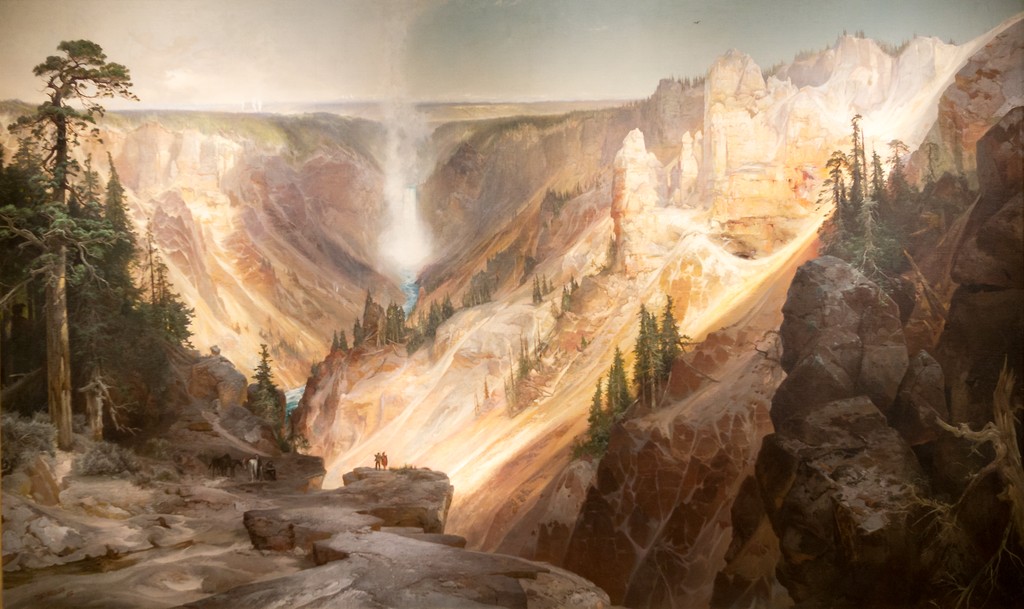
The Grand Canyon of the Yellowstone, 1872. Wuselig / Wikimedia Commons, CC BY-SA 4.0; U.S. Department of the Interior Museum painting. Image source. CC BY-SA 4.0; also marked PD-Art. Outer museum frame cropped; resized. Painted composition retained; photographic perspective unchanged. This image derivative is available under the same licence.
- Splash image source.
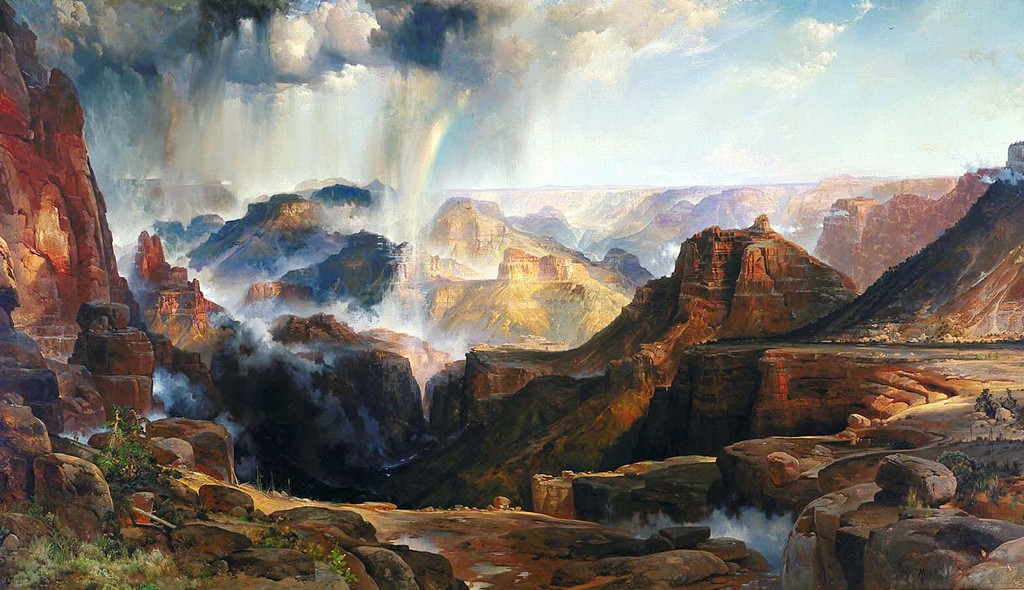
The Chasm of the Colorado, 1873–1874. U.S. Department of the Interior Museum; faithful reproduction via Smithsonian American Art Museum / Wikimedia Commons. Image source. Public Domain Mark; faithful two-dimensional reproduction. Resized only; complete source image retained.
- Splash image source.
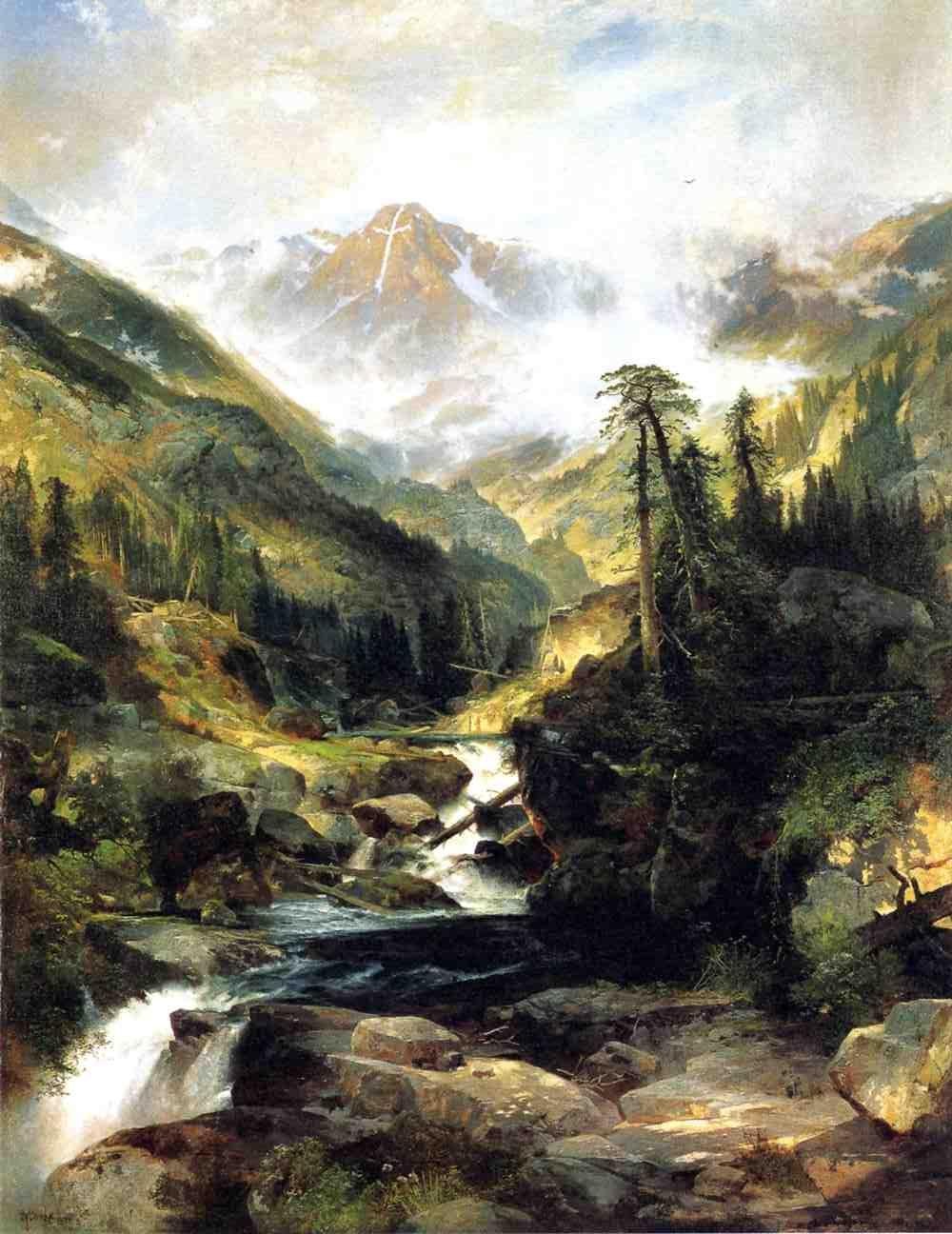
Mountain of the Holy Cross, 1875. Autry Museum of the American West; faithful reproduction via Wikimedia Commons. Image source. Public Domain Mark; faithful two-dimensional reproduction. Resized only; complete source image retained.
- Splash image source.
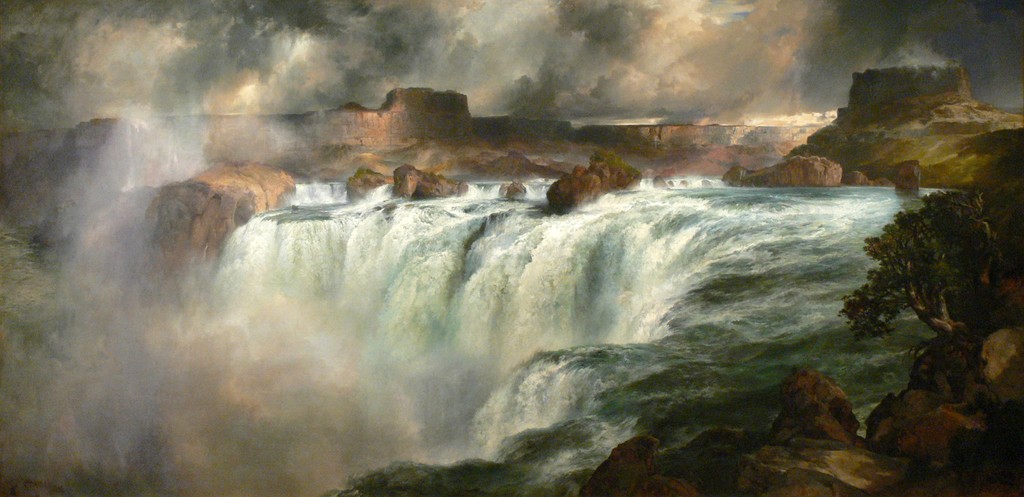
Shoshone Falls on the Snake River, 1900. Wolfgang Sauber / Wikimedia Commons, CC BY-SA 3.0; Gilcrease Museum painting. Image source. CC BY-SA 3.0; also marked PD-Art. Resized only; complete source image retained. This image derivative is available under the same licence.
- Splash image source.
Green River Cliffs, Wyoming, 1881. National Gallery of Art, Gift of the Milligan and Thomson Families. Image source. Public domain; NGA Open Access. Resized only; complete source image retained.
- Splash image source.
A View of Venice, 1891. Smithsonian American Art Museum, Transfer from the U.S. Department of the Interior, National Park Service, 1968.120.1. Image source. Free to use; Smithsonian Open Access. Resized only; complete source image retained.
- Splash image source.
The Three Tetons, 1895. The White House Collection, Gift of C. R. Smith; faithful reproduction via Wikimedia Commons. Image source. Public Domain Mark; faithful reproduction of a two-dimensional public-domain work. Resized only; complete source image retained.