 by Tom Gurney
Tom Gurney BSc (Hons) is an art history expert with over 20 years experience
Published on June 19, 2020 / Updated on October 27, 2026
Email: tomgurney1@gmail.com / Phone: +44 7429 011000
Green River, Wyoming: Introduction
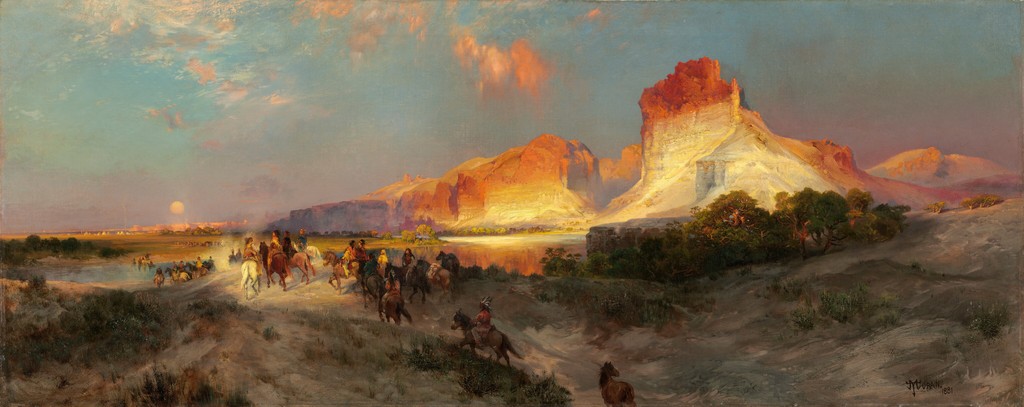
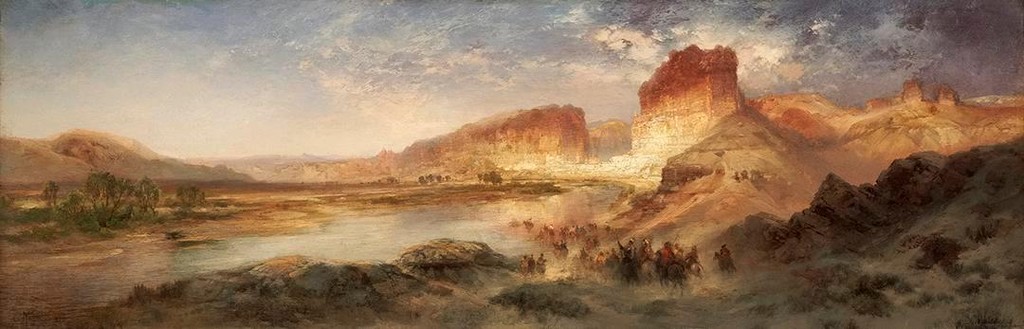
Green River, Wyoming is a panoramic landscape by Thomas Moran, dated 1878 in the Crystal Bridges Museum of American Art record. It is an oil on panel. The long view brings a river, illuminated cliffs and a procession of riders into a particularly low arrangement, where great rock masses dominate the smaller movement below. [1]
The date and medium distinguish this work from related paintings. It is not the Carter Museum's 1874 canvas or the National Gallery's 1881 Green River Cliffs, Wyoming. Its own distribution of water, figures and shadow offers another example of how Moran developed repeated geographical material into different pictorial structures.
At a Glance
- ArtistThomas Moran
- TitleGreen River, Wyoming
- Date1878
- MediumOil on panel
- Collection recordCrystal Bridges Museum of American Art
- Record identifierA2002-006
- Credit linePromised Gift to Crystal Bridges Museum of American Art
- Signature recordedLower left, TMoran 1878
- Related worksCarter's 1874 canvas and the National Gallery's 1881 canvas
Where this work sits in Moran’s career
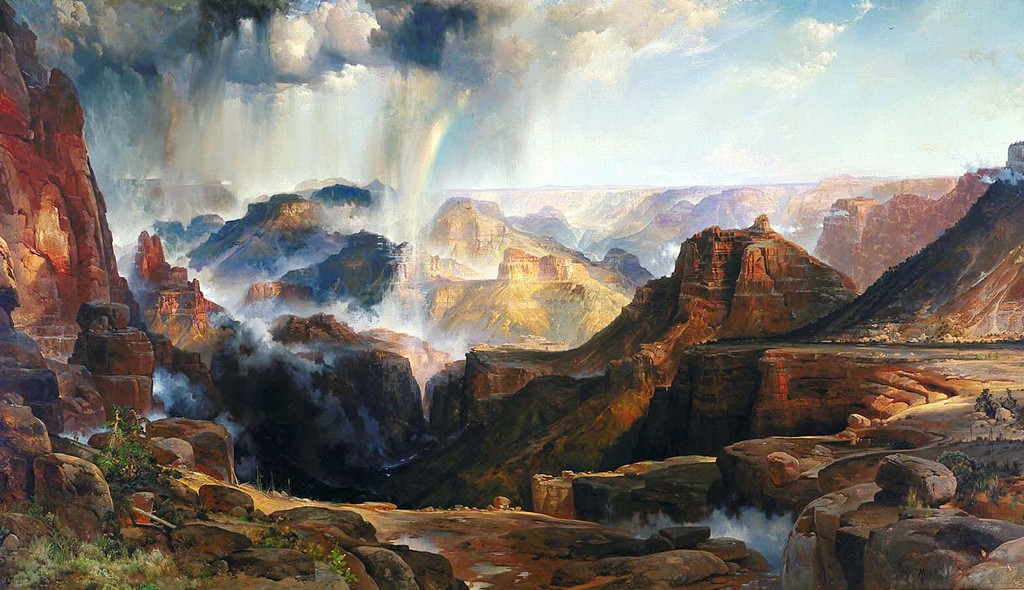
The Chasm of the Colorado
1873–1874; completed in 1874A View of Venice
1891Point Lobos, Monterey, California
1912, signed and datedContents
- The work identified by the museum
- An unusually compressed panorama
- Bright rock above a darker route
- Figures, dust and a movement away
- Green River and the journey of 1871
- A photograph with another foreground
- The other Green River paintings
- Looking beyond a repeated title
The work identified by the museum
Crystal Bridges records a dated signature at the lower left and identifies the support as panel. These facts should take precedence over older descriptions that call the painting an 1871 work or assign it another medium. The year of Moran's first western visit does not establish the date of every later Green River picture. [1]
The museum's dimensions include a third measurement, indicating that they are not a simple height and width for the painted surface alone. They should not be presented as the dimensions of an unframed canvas. The secure point for this article is the documented oil-on-panel identity, together with the 1878 inscription and the particular image.
The promised-gift wording also deserves precision. It is the museum's current credit line and should not become an invented account of a completed purchase or donation. Collection records supply specific evidence, while a more detailed ownership history would require additional documents. A familiar museum name does not answer every question about an object's past.
An unusually compressed panorama
The reproduced picture is much wider than it is high. Its river and skyline consequently carry the eye laterally before individual details are examined. A viewer can take in the whole arrangement quickly, then return to the riders and the irregular faces of the cliffs. The format gives broad land a concentrated presentation.
The principal rock stands towards the right, with a reddish summit and a bright lower face. A smaller mass sits nearer the centre. Their separation leaves room for further formations and sky between them. The result is a sequence of substantial shapes rather than one continuous wall cutting the picture in two.
At the left, the land drops and the river widens into a more open passage. Its cooler surface contrasts with the warmer rock above. On the right, rising ground and darker foreground stone partly enclose the riders. These unequal sides give the panorama movement: open water offers release, while land supplies a more confined route.
Compression does not mean the picture contains no depth. Nearer rocks overlap the view, smaller figures extend into the middle distance, and softer forms lie beyond the principal cliffs. Moran creates recession through these changes of scale and clarity. The long format spreads those cues across the picture instead of stacking them in a tall vertical sequence.
Bright rock above a darker route
Light concentrates on the faces of the major formations. Their brighter passages stand against the more subdued foreground and parts of the sky. The contrast makes the rock appear both solid and illuminated. It also keeps attention returning to the skyline after the eye has followed the human group below.
The cliffs contain pale horizontal bands and stronger reddish upper edges. Narrow shadowed breaks interrupt their mass. These marks supply a sense of irregular surfaces without requiring every line to be read as a geological measurement. The painting describes stone through a pattern of light, colour and division.
At the base, sloping ground leads down towards the river. The lighter faces do not terminate abruptly at a flat line, but join a network of smaller slopes and terraces. Those transitions make the formations belong to the same terrain as the foreground. Their height becomes more convincing because the eye can trace how they meet the land below.
The darker right-hand foreground offers a different kind of information. Uneven rocks frame the route without becoming as conspicuous as the lit cliffs. Shadows and muted earth give the riders an environment through which to move. The picture's large visual contrast is therefore also a contrast between a distant spectacle and a nearer passage.
Figures, dust and a movement away
The procession occupies the right foreground and travels away through the landscape. Nearer riders are more legible, while those further off become smaller and merge into a denser line. Overlap and changing scale allow the group to recede within the limited height of the picture.
A pale haze around parts of the route softens its edges. Rather than making every horse equally distinct, Moran allows some bodies to emerge clearly and others to disappear into the movement. The group can be understood as a continuous procession even when its individual members are not separately readable.
Its curve joins the foreground to the middle distance. That route is different from the lateral line of the river and the relatively still profiles of the cliffs. Human movement consequently adds another direction to the composition. The panoramic view becomes a place through which figures appear to travel.
This effect does not establish a witnessed event. The picture's clothing and arrangement represent people within Moran's chosen scene; they cannot identify a named Indigenous community from the reproduction alone. Crystal Bridges interprets the figures as an insertion shaped for eastern non-Native audiences, rather than a literal report of the population Moran encountered. [1]
Watch: Thomas Moran
Choose a film to explore the artist’s work, its interpretation and its wider setting.
The painting that inspired a National Park
A close discussion of Moran’s landscape and its relationship to the idea of Yellowstone.
Watch on YouTubeGreen River and the journey of 1871
Moran reached Green River while travelling west in 1871, before joining Hayden's Yellowstone party in Montana. The National Gallery catalogue records his first western study there and the continued usefulness of the subject afterwards. Cliffs seen during a relatively brief stop could become material for several finished paintings. [2]
That sequence separates the moment of observation from the 1878 panel. The finished work belongs to a career already transformed by major canyon pictures, exhibitions and public purchases. It is a return to an early western subject with years of further professional experience behind it.
Travel by rail was part of the opportunity. Green River's setting included railway infrastructure and settlement when Moran encountered it. The oil presents another arrangement, with water, rock and riders carrying the view. The means by which the artist reached the place is absent from the scene through which he later presented it.
A photograph with another foreground
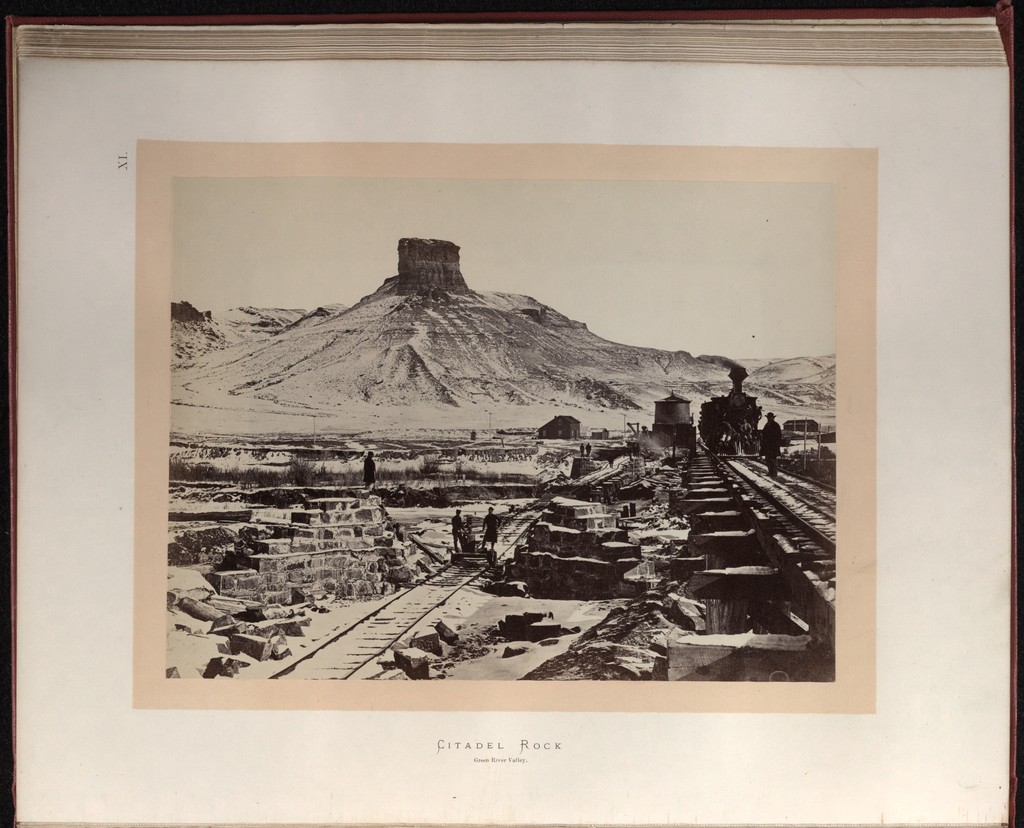
Andrew Joseph Russell's Citadel Rock, Green River Valley, dated about 1869 by the Library of Congress, records railway construction beneath a prominent formation. Track, bridge works, a locomotive and people occupy the lower half. The cleared historical photograph provides a useful companion to Moran's painted view. [3]
In the photograph, strong lines of track lead towards the train and buildings. The workers and unfinished structures give the foreground a practical purpose. The rock's height remains impressive, but it shares the image with a visible process of engineering. Landscape and industry coexist within the frame.
The panel supplies a route made by riders instead. Its river is open, and the foreground's rock and haze support movement without tracks or bridge construction. Comparing the images reveals a change in what guides the eye as well as a change in historical content. The painting's apparent remoteness is built through its selected forms.
The comparison concerns the Green River setting, not an assertion that camera and painter stood at precisely the same point. Russell also composed his photograph. Its value here is the visible railway activity it records, against which Moran's omissions can be considered. Neither image supplies every aspect of the region's history.
The other Green River paintings
The Amon Carter Museum's Cliffs of Green River is an oil on canvas dated 1874. A broad reflective river occupies much of its lower right, while a rider crosses the water away from the larger group. That individual crossing gives the water an immediate narrative role different from the procession in the 1878 panel. [4]
The National Gallery's Green River Cliffs, Wyoming, dated 1881, extends a procession through a more open foreground. Its particularly luminous right-hand cliff is balanced against a broad left horizon. The river lies further back than in the Carter version, and the figures supply a strong diagonal towards it. [5]
The 1878 panel brings its own compressed relationships to those comparisons. Foreground rock encloses the right-hand movement; illuminated cliffs create a repeated rhythm across the skyline; open water stretches towards the left. Similar subject matter supports several arrangements, with each version balancing spectacle and passage differently.
Looking beyond a repeated title
A repeated name can make these works seem simpler than they are. The three museum records distinguish dates, supports and images. Their pictures then reveal different positions for water, figures and the highest formations. The useful comparison begins with object identity and continues through close looking.
The panel's narrow view rewards attention to the intervals between large shapes. Open water, haze and sky prevent the scene from becoming an uninterrupted row of rocks. Those quieter passages allow the illuminated forms to acquire their force. Moran makes breadth feel substantial through differences in weight rather than equal detail everywhere.
The historical comparison remains part of that experience. A landscape reached through modern transport can be presented as a world without visible industrial structures. Recognising that selection does not erase the painting's skill. It makes clearer how colour, format and human movement cooperate to produce the particular West shown here.
Artworks directory
Selected documented works and distinct versions. This directory is not a comprehensive catalogue raisonné. Dates and media retain the distinctions explained in the articles and museum records.
| Name | Date | Medium |
|---|---|---|
| An Arizona Sunset near the Grand Canyon | Date not securely established | Oil painting |
| Autumn Afternoon, the Wissahickon by Thomas Moran | 1864 | Oil on canvas |
| Cascade Falls, Yosemite | Commonly catalogued as 1905 | Catalogued as oil on canvas |
| The Chasm of the Colorado | 1873–1874; completed in 1874 | Oil on canvas, currently mounted on aluminium |
| Children of the Mountain | 1866 in the current museum title; 1867 in the 1997 National Gallery catalogue | Oil on canvas |
| Cliffs of Green River | 1874 | Oil on canvas |
| Cliffs of the Upper Colorado River, Wyoming Territory | 1882 | Oil on canvas |
| East Hampton, Long Island , also captioned Easthampton, L.I | 1897 | Oil on canvas laid on board, according to the reproduction record |
| Fiercely the red sun descending, Burned his way along the heavens | 1875–76 | Oil on canvas |
| Forest Scene | 1870 | Oil on canvas |
| Grand Canyon of the Colorado River | 1892 and 1908 | Oil on canvas |
| Green River Cliffs, Wyoming | 1881 | Oil on canvas |
| Green River, Wyoming | 1878 | Oil on panel |
| The Juniata, Evening | 1864 | Oil on canvas |
| Mosquito Trail, Rocky Mountains of Colorado | 1875 in the 1997 National Gallery exhibition catalogue | Watercolour |
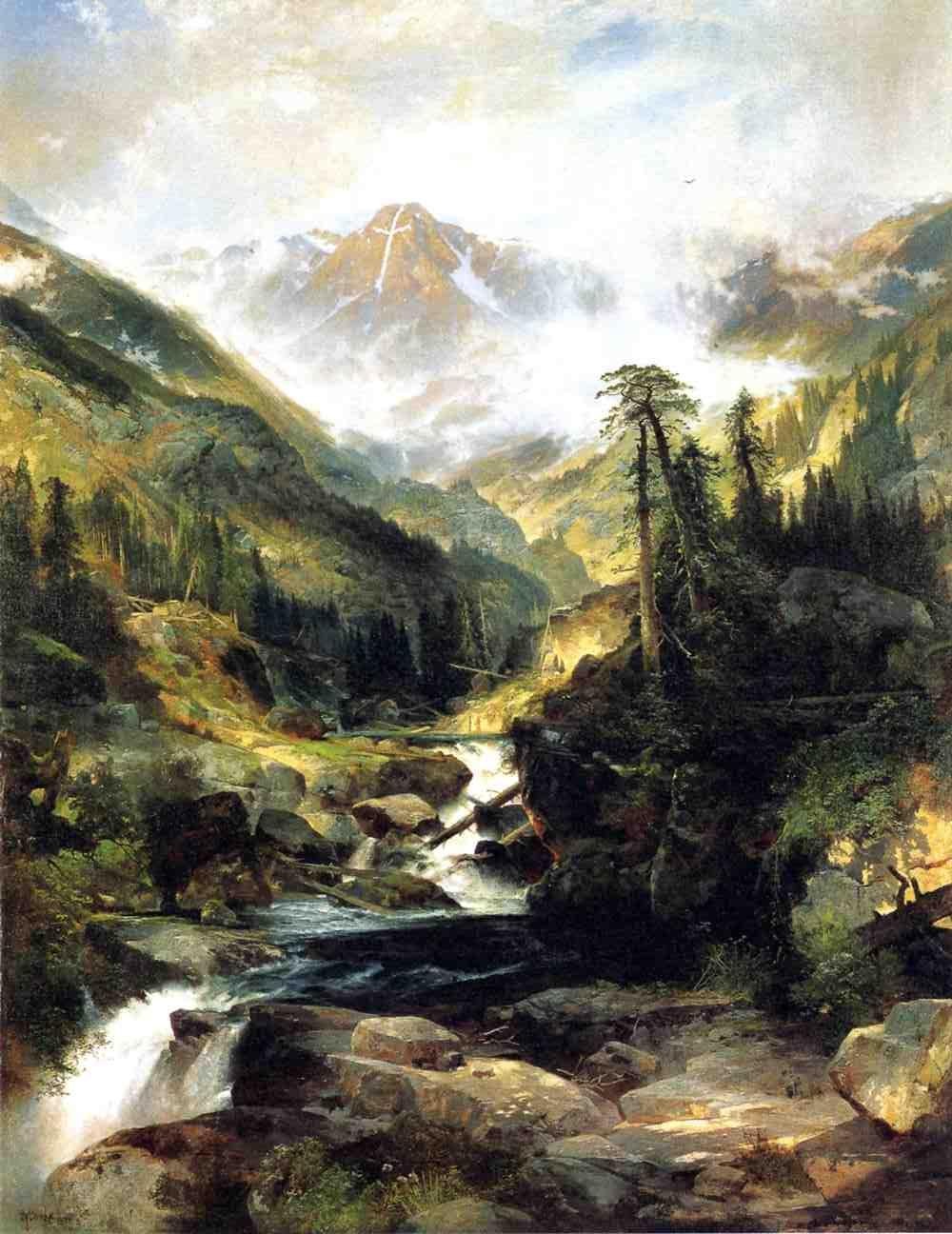
| Mountain of the Holy Cross | 1875 | Oil on canvas |
| The Much Resounding Sea | 1884 | Oil on canvas |
| Point Lobos, Monterey, California | 1912, signed and dated | Oil on canvas |
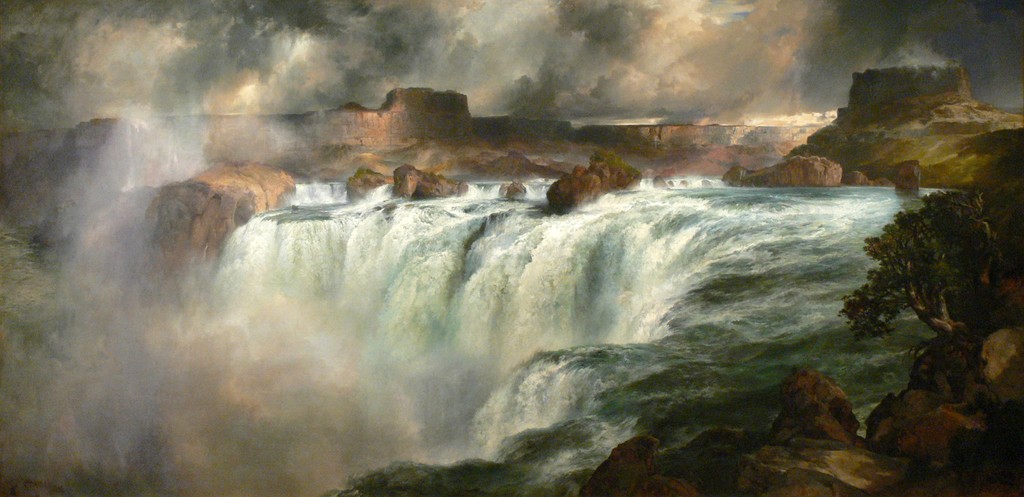
| Shoshone Falls on the Snake River | 1900 | Oil on canvas |
| Summit of the Sierras | 1872/75, as catalogued by the Art Institute of Chicago | Gouache over graphite on cream laid paper |
| The Teton Range | 1897 | Oil on canvas |
| The Three Tetons | 1895 | Oil on canvas |
| Tower Falls, Yellowstone | 1872 | Watercolour and gouache over graphite on blue laid paper |
| A View of Venice | 1891 | Oil on canvas |
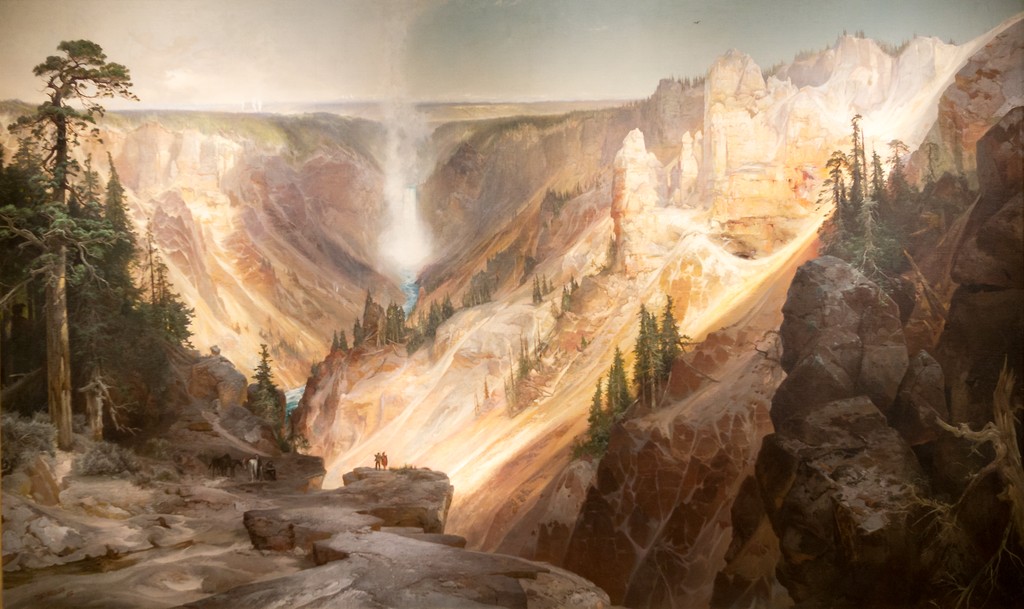
| The Grand Canyon of the Yellowstone | 1872 | Oil on canvas, currently recorded as mounted on aluminium |
| Mountain of the Holy Cross, Colorado (etching) | 1888 | Etching, roulette and aquatint |
| The Resounding Sea (etching) | 1880 | Etching |
| The Much Resounding Sea (later etching) | 1886 in heading; 1888 on plate | Etching, drypoint and roulette |
| Tower Falls (Prang print) | c. 1875; portfolio issued 1876 | Chromolithograph |
| Shoshone Falls (early watercolour) | 1874 | Watercolour |
| Venice (watercolour) | 1888 | Watercolour over graphite |
Frequently Asked Questions
Crystal Bridges records 1878 and oil on panel, with a dated signature at the lower left.
No. The National Gallery canvas has that title and is dated 1881. The Carter Museum holds another canvas dated 1874.
The first visit was in 1871. This panel is dated 1878, so the visit and the finished work belong to different stages.
It should not be treated that way. The record includes depth, and identifies the work as oil on panel.
The photograph visibly records railway activity within the Green River setting. It helps show the difference between that industrial foreground and Moran's selected scene.
Discussion
Compare the routes through the 1874, 1878 and 1881 paintings. Does the river or the procession do more to connect the foreground with the distant cliffs in each version?
Reader Insights
Editorial prompts for close looking and discussion.
Compare the routes through the 1874, 1878 and 1881 paintings. Does the river or the procession do more to connect the foreground with the distant cliffs in each version?
Which source or image helps you assess the interpretation?
How does this page compare with the related works linked above?
Join the Conversation
Share your reading of this page below.
References
- Crystal Bridges Museum of American Art, Green River, Wyoming, 1878, object record and interpretation.
- Nancy K. Anderson and contributors, Thomas Moran, 1997, selected Green River discussion, pp. 48–50, and chronology.
- Library of Congress, Andrew Joseph Russell, Citadel Rock, Green River Valley, c. 1869, photographic item record.
- Amon Carter Museum of American Art, Cliffs of Green River, 1874.
- National Gallery of Art, Green River Cliffs, Wyoming, 1881.
- Splash image source.
Green River, Wyoming, 1878. Crystal Bridges Museum of American Art; faithful reproduction via Wikimedia Commons. Image source. Public Domain Mark; faithful two-dimensional reproduction. Resized only; complete source image retained.
- Splash image source.
Citadel Rock, Green River Valley, circa 1869. Railway bridge construction shows the industrial landscape omitted from many Moran paintings. Andrew J. Russell / Library of Congress, LC-DIG-ppmsca-03147. Image source. No known restrictions on publication. Resized only; complete source image retained.
- Splash image source.
The Grand Canyon of the Yellowstone, 1872. Wuselig / Wikimedia Commons, CC BY-SA 4.0; U.S. Department of the Interior Museum painting. Image source. CC BY-SA 4.0; also marked PD-Art. Outer museum frame cropped; resized. Painted composition retained; photographic perspective unchanged. This image derivative is available under the same licence.
- Splash image source.
The Chasm of the Colorado, 1873–1874. U.S. Department of the Interior Museum; faithful reproduction via Smithsonian American Art Museum / Wikimedia Commons. Image source. Public Domain Mark; faithful two-dimensional reproduction. Resized only; complete source image retained.
- Splash image source.
Mountain of the Holy Cross, 1875. Autry Museum of the American West; faithful reproduction via Wikimedia Commons. Image source. Public Domain Mark; faithful two-dimensional reproduction. Resized only; complete source image retained.
- Splash image source.
Shoshone Falls on the Snake River, 1900. Wolfgang Sauber / Wikimedia Commons, CC BY-SA 3.0; Gilcrease Museum painting. Image source. CC BY-SA 3.0; also marked PD-Art. Resized only; complete source image retained. This image derivative is available under the same licence.
- Splash image source.
Green River Cliffs, Wyoming, 1881. National Gallery of Art, Gift of the Milligan and Thomson Families. Image source. Public domain; NGA Open Access. Resized only; complete source image retained.
- Splash image source.
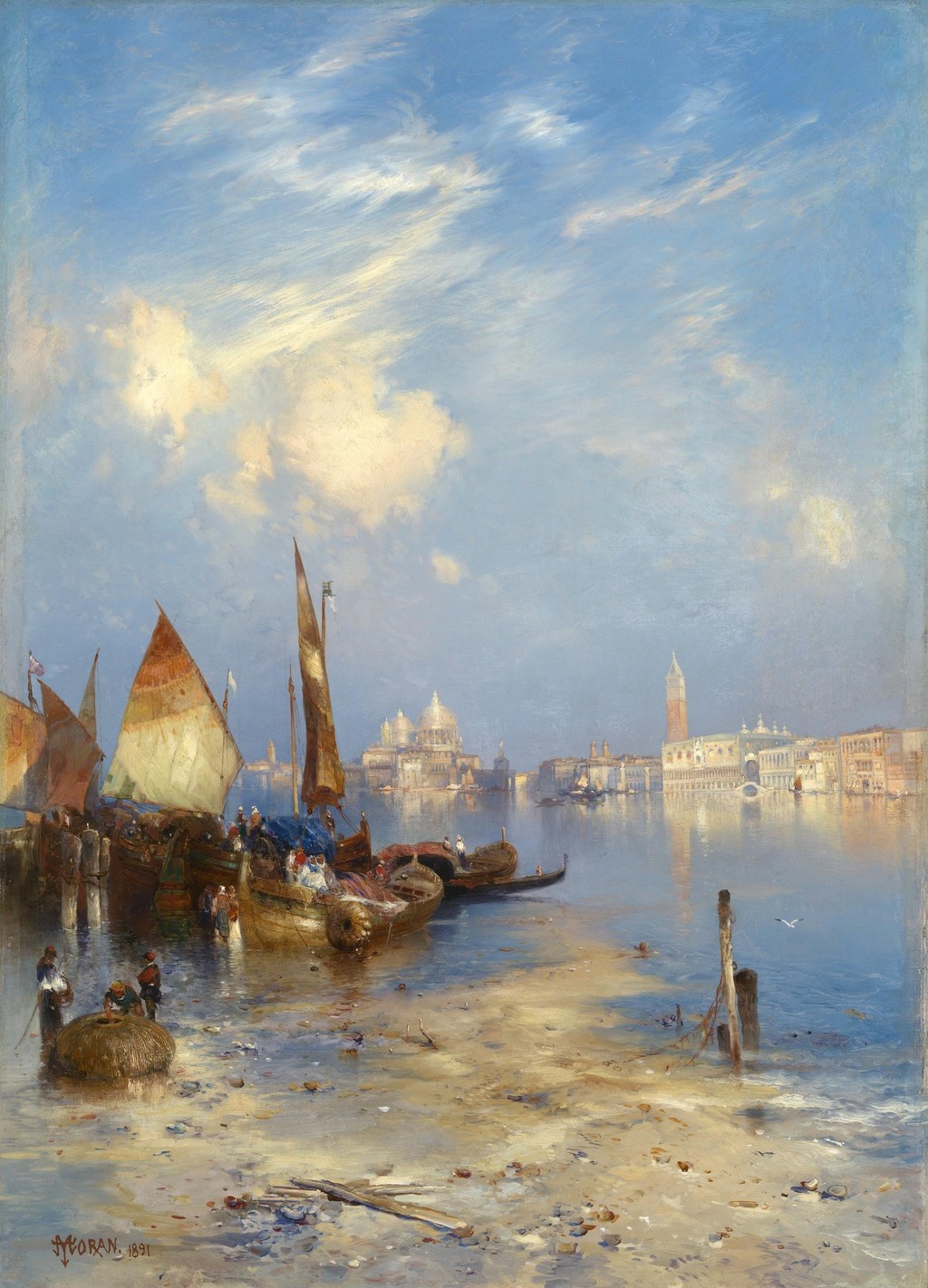
A View of Venice, 1891. Smithsonian American Art Museum, Transfer from the U.S. Department of the Interior, National Park Service, 1968.120.1. Image source. Free to use; Smithsonian Open Access. Resized only; complete source image retained.
- Splash image source.
The Three Tetons, 1895. The White House Collection, Gift of C. R. Smith; faithful reproduction via Wikimedia Commons. Image source. Public Domain Mark; faithful reproduction of a two-dimensional public-domain work. Resized only; complete source image retained.