 by Tom Gurney
Tom Gurney BSc (Hons) is an art history expert with over 20 years experience
Published on June 19, 2020 / Updated on October 27, 2026
Email: tomgurney1@gmail.com / Phone: +44 7429 011000
Cliffs of the Upper Colorado River, Wyoming Territory: Introduction
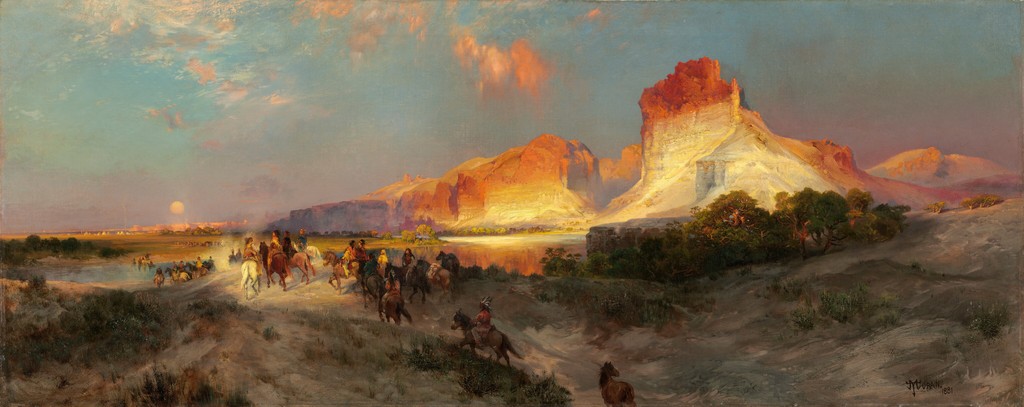
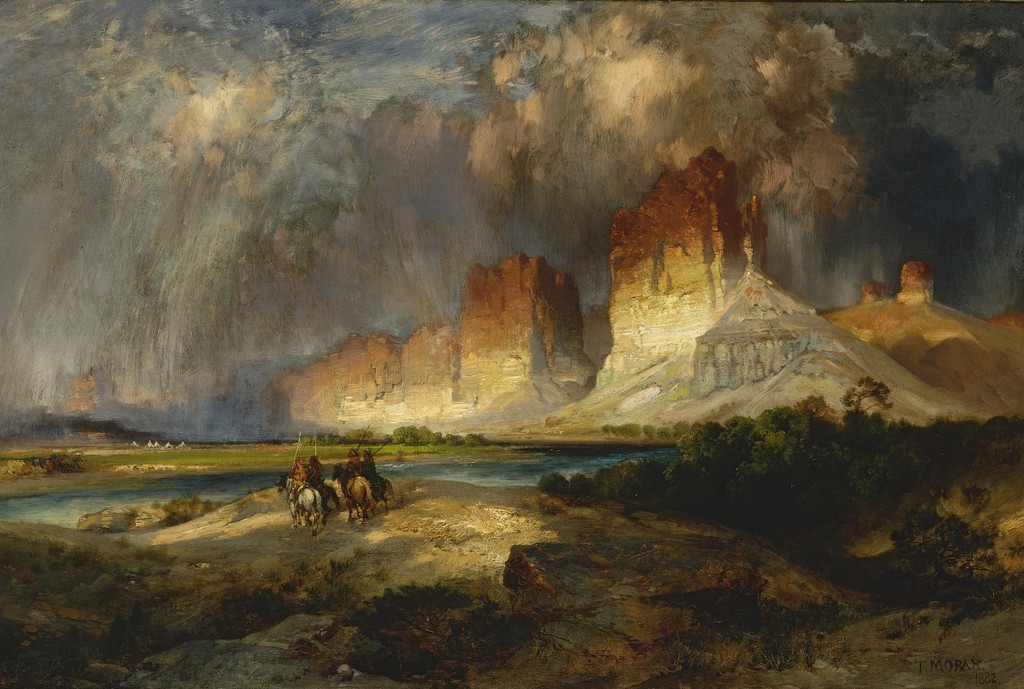
Thomas Moran's Cliffs of the Upper Colorado River, Wyoming Territory, dated 1882, is an oil on canvas in the Smithsonian American Art Museum. Warm, illuminated cliffs rise beneath a turbulent sky, while a blue river crosses the lower landscape. A small group of mounted figures occupies the nearer ground. [1]
The canvas is only 40.5 × 61.0 cm, yet the cliffs and weather suggest a much larger space. Moran creates that effect through contrasts: light against dark, warm rock against cool water, and small figures beneath immense-looking formations. The view is particularly revealing when its different kinds of scale are considered together.
At a Glance
- ArtistThomas Moran
- TitleCliffs of the Upper Colorado River, Wyoming Territory
- Date1882
- MediumOil on canvas
- Dimensions40.5 × 61.0 cm
- CollectionSmithsonian American Art Museum
- Object number1936.12.4
- CreditBequest of Henry Ward Ranger through the National Academy of Design
- River contextGreen River, historically also called the Upper Colorado
- Related worksMoran's other Green River cliff paintings
Where this work sits in Moran’s career
The Chasm of the Colorado
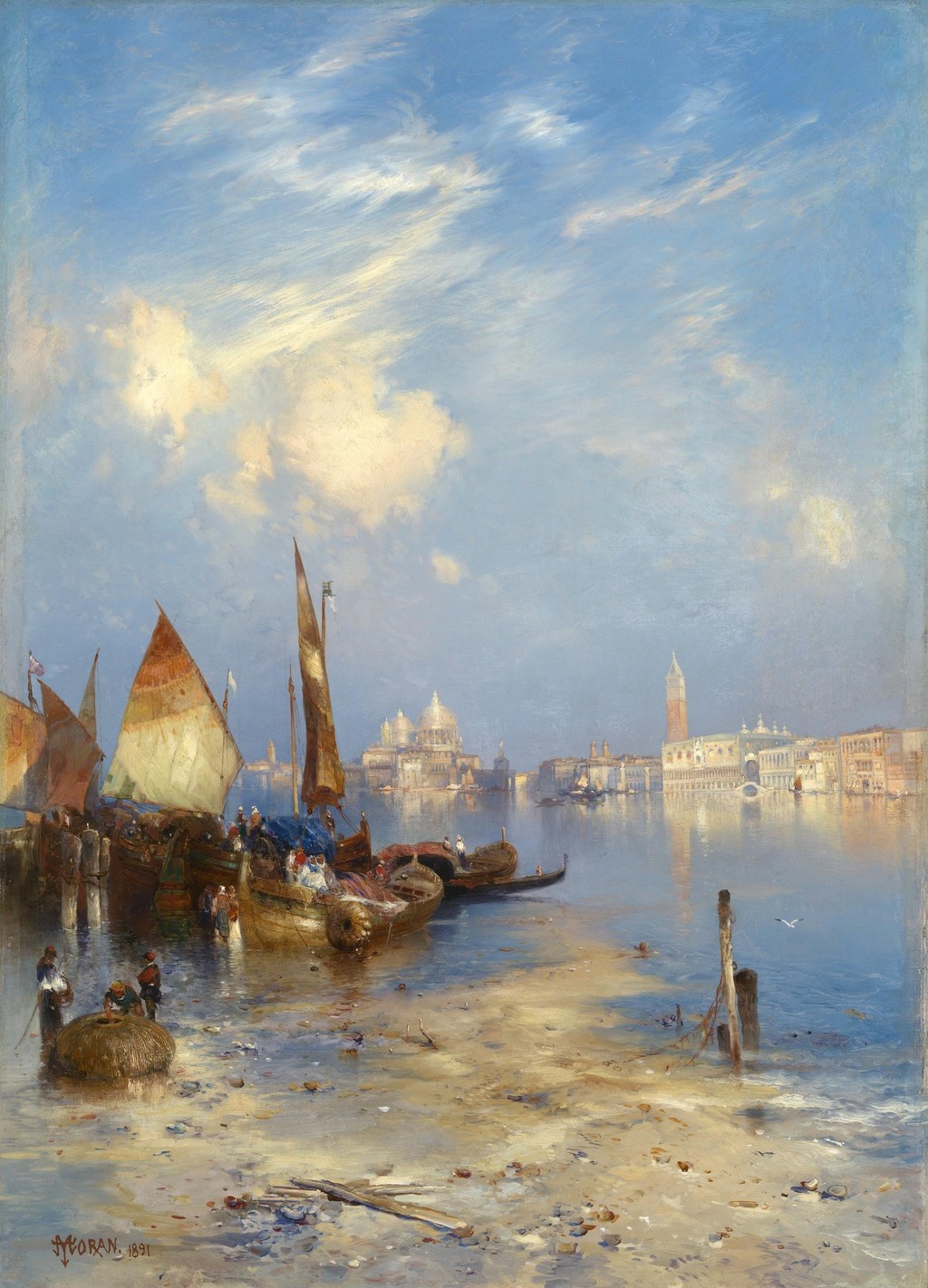
1873–1874; completed in 1874A View of Venice
1891Point Lobos, Monterey, California
1912, signed and datedContents
- The historical geography of the title
- A procession of cliffs
- Light on the rock beneath a storm
- The blue river
- Figures below the cliffs
- An imagined view of a changing valley
- Other Green River pictures
The historical geography of the title
The Smithsonian identifies the subject with the Green River, also called the Upper Colorado. “Wyoming Territory” is consequently an important part of the title. The word Colorado does not establish a location in the present-day state of Colorado, or turn this scene into an Arizona Grand Canyon view. [1]
The title preserves the way the subject was named, while the collection record establishes this particular canvas. Those two kinds of information work together. A familiar river name can connect several pictures, but date, dimensions and accession number prevent them from being treated as one interchangeable object.
That distinction is especially helpful within Moran's work. He returned to cliff subjects in different formats and at different dates. The geographical connection supplies a starting point for comparison; the arrangement of each picture explains what the artist chose to emphasise on that occasion.
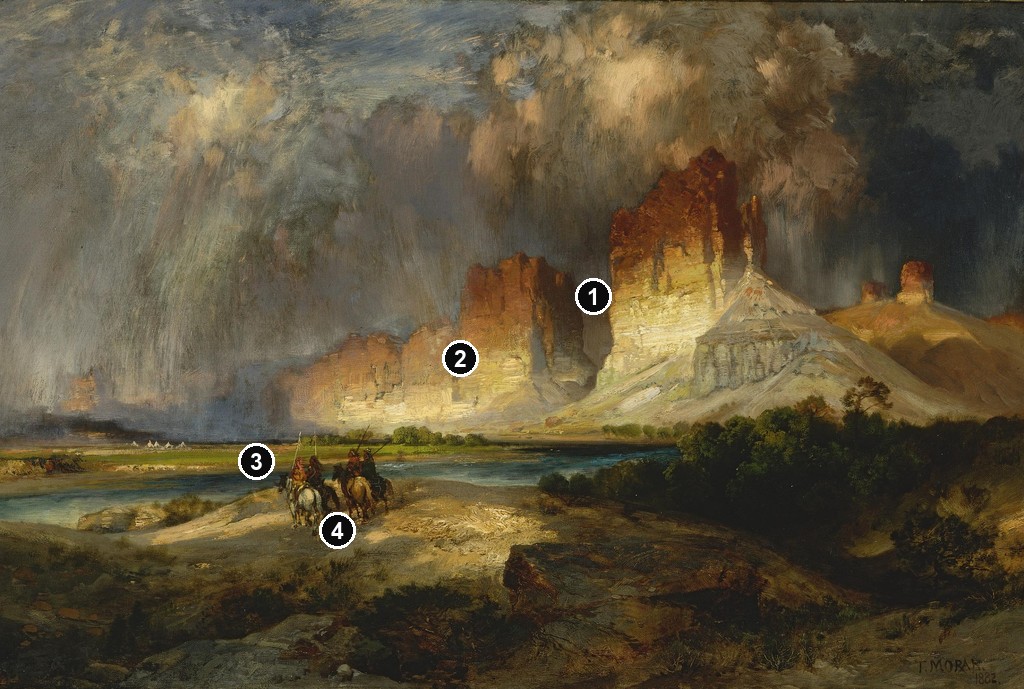
Annotated Details from Cliffs of the Upper Colorado River, Wyoming Territory
Compare these details with the full composition. The numbered overview and crops come from the same original image.
Details from CLIFFS OF THE UPPER COLORADO RIVER, WYOMING TERRITORY
Open a detail to see it more closely.
A procession of cliffs
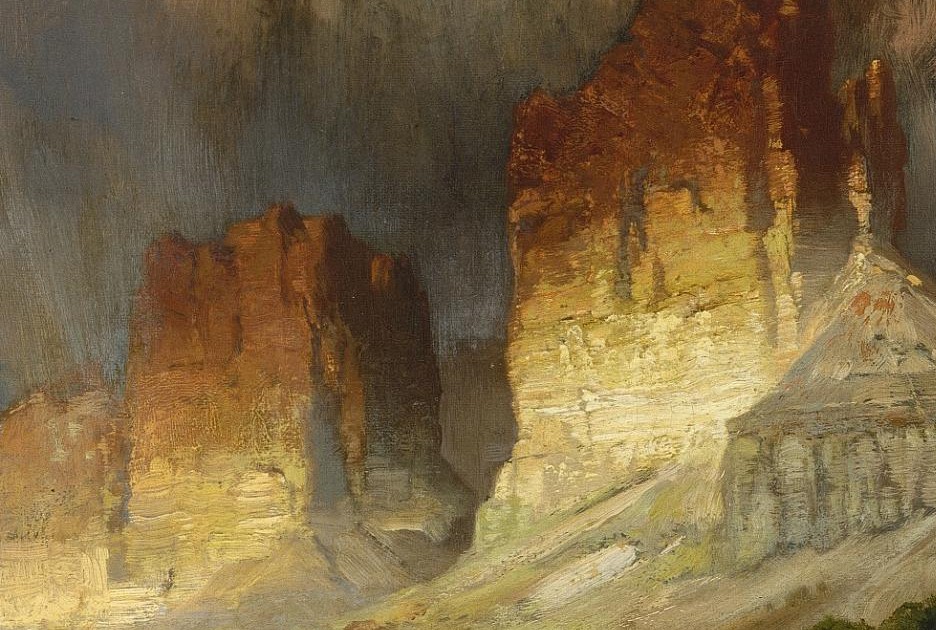
The most commanding cliff rises right of centre. Its upper surface is warm red-brown, while a much paler band runs through the lower face. Darker vertical divisions interrupt that brightness. The formation appears substantial because its broad illuminated surfaces meet abrupt areas of shadow.
Light on the rock beneath a storm
Much of the sky is dark, particularly above the prominent cliff and towards the right. Warm clouds mingle with cooler grey passages. Their edges are less stable than the cliffs below, producing a strong contrast between the changing atmosphere and the comparatively solid rock.
The blue river
The river runs across the lower middle of the picture, curving from the right towards the left. Its cool blue passages stand against warmer banks and rock. The colour makes the water a clear connecting feature even where it occupies a relatively narrow strip of the view.
Figures below the cliffs
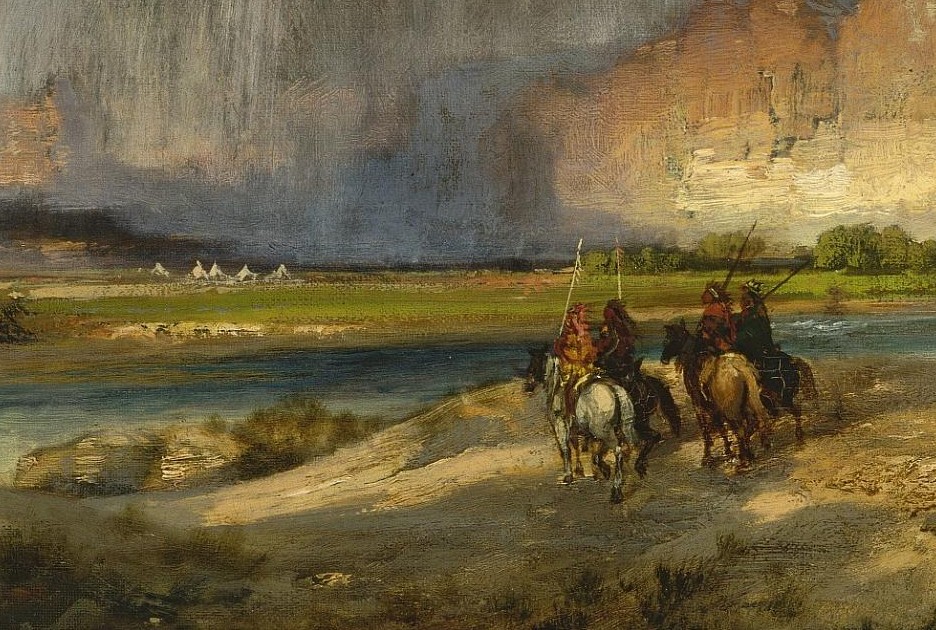
The mounted group occupies a bright interval left of centre. Riders and animals overlap, with narrow upright objects rising above them. Their darker and warmer colours make them visible against the paler ground. They introduce human movement into the composition without becoming its largest forms.
A procession of cliffs
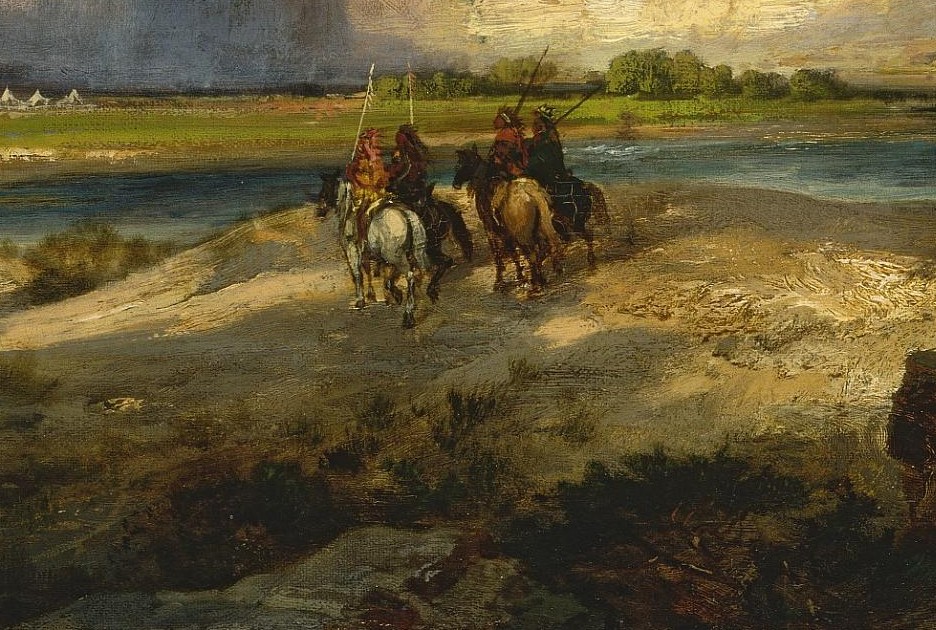
The most commanding cliff rises right of centre. Its upper surface is warm red-brown, while a much paler band runs through the lower face. Darker vertical divisions interrupt that brightness. The formation appears substantial because its broad illuminated surfaces meet abrupt areas of shadow.
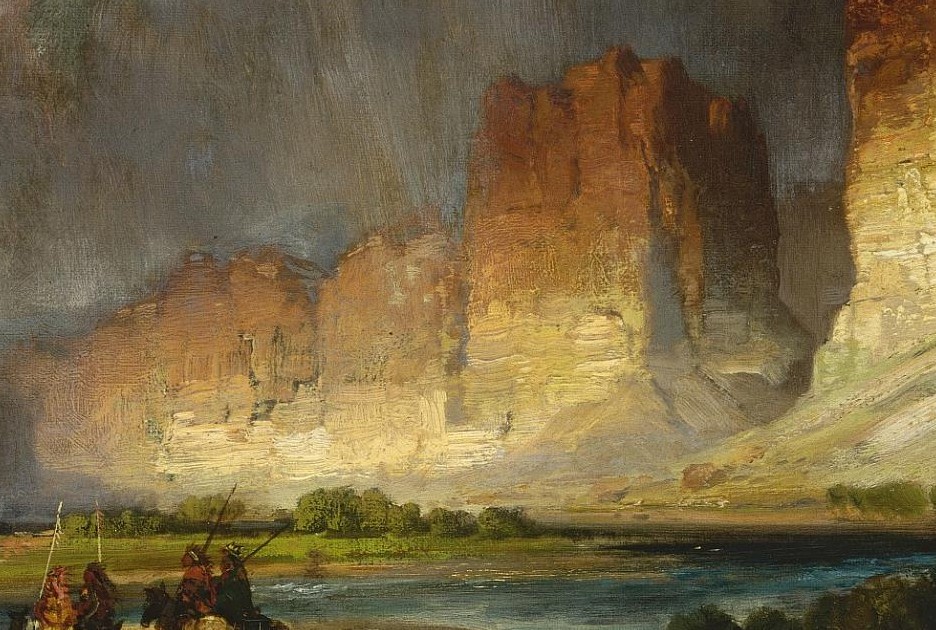
To the left, another bluff repeats the relationship between a warmer top and paler lower rock. It is smaller in the picture and further away. The repetition gives the landscape continuity, while the difference in apparent size creates a movement into depth. The cliffs form a sequence rather than a single isolated monument.
Further left, the forms become less definite. Their warm colours are subdued by darker atmosphere and a curtain-like passage of weather. The landscape continues into that uncertainty. Moran leaves enough visible structure for the eye to imagine additional formations beyond the clearest ones.
On the right, smaller upright rock shapes rise above long slopes. Their silhouettes answer the larger bluff without competing equally with it. This variation makes the range of forms more convincing. Repetition supplies coherence, but differences in height and clarity keep the scene from becoming a decorative row.
Light on the rock beneath a storm
Much of the sky is dark, particularly above the prominent cliff and towards the right. Warm clouds mingle with cooler grey passages. Their edges are less stable than the cliffs below, producing a strong contrast between the changing atmosphere and the comparatively solid rock.
Towards the left, broad streaks descend through the sky. Their direction suggests a curtain of rain or storm weather, while their softness makes the far landscape harder to separate. The picture does not need an identified storm date or a meteorological reconstruction for this passage to convey approaching disturbance.
The cliffs remain brightly lit beneath that threatening atmosphere. This is the painting's central visual contrast. Pale stone faces attract attention precisely because the surrounding sky is so much darker. The landscape appears caught between brightness and obscurity rather than evenly illuminated throughout.
Light also catches parts of the ground near the mounted group. The foreground has its own smaller patches of warmth, connecting it with the cliffs beyond. The relationship allows attention to move between two very different scales: the figures' immediate terrain and the much larger formations behind them.
The blue river
The river runs across the lower middle of the picture, curving from the right towards the left. Its cool blue passages stand against warmer banks and rock. The colour makes the water a clear connecting feature even where it occupies a relatively narrow strip of the view.
Near the left, the river widens into a paler surface. Further right, darker passages meet the wooded bank. These changes make the water respond to its surroundings rather than remain a flat band of identical blue. Light, vegetation and distance affect its appearance.
The near bank projects towards the river around the mounted figures. Its curves give the lower landscape a softer movement than the cliffs' steep edges. The contrast helps divide the picture into different kinds of form. Water and bank move horizontally, while the bluff faces repeatedly carry the eye upwards.
Trees and low vegetation gather on the right. Their dark mass gives the bank weight and partly conceals the water. The grouping balances the more open left-hand area. It also supplies an intermediate scale between small figures and towering rock, making the transition into the larger landscape less abrupt.
Watch: Thomas Moran
Choose a film to explore the artist’s work, its interpretation and its wider setting.
The painting that inspired a National Park
A close discussion of Moran’s landscape and its relationship to the idea of Yellowstone.
Watch on YouTubeFigures below the cliffs
The mounted group occupies a bright interval left of centre. Riders and animals overlap, with narrow upright objects rising above them. Their darker and warmer colours make them visible against the paler ground. They introduce human movement into the composition without becoming its largest forms.
The Smithsonian identifies the group as Native Americans on horseback. The picture does not securely identify individual people or establish a particular tribal affiliation. Its figures should be described at the level the evidence supports, with attention to the roles they play within the scene. [1]
One important role is scale. The group is near enough to be recognisable, yet small beneath the cliffs. The viewer can compare a human body with the surrounding land and then imagine the much greater extent of the formations beyond. A modest canvas acquires a sense of magnitude through those relationships.
Small pale tents are visible further away on the left. They extend the signs of occupation across another part of the valley. Their distant position differs from the nearer riders, making the landscape more layered. Human presence is distributed through the picture rather than concentrated in one foreground vignette.
An imagined view of a changing valley
The museum's interpretation contrasts Moran's image with the settled river town associated with the railway. It explains that he omitted houses and settlers in favour of an imagined earlier scene with mounted Indigenous figures. The interpretation addresses the picture's selective representation of a place undergoing substantial change. [1]
This context makes the absence of modern buildings significant. The cliffs, water, riders and tents are choices within a finished arrangement. The canvas should not be treated as an unaltered record of everything present in the valley in 1882. Its atmosphere and human scene belong to a constructed image of the landscape.
The riders nevertheless remain important to its visual experience. They make the near ground imaginable as a place crossed by people, while the storm and cliffs make the surrounding space appear powerful. Human activity and natural scale are brought together through the composition, with the museum's historical interpretation supplying a further layer of meaning.
Other Green River pictures
Moran's Green River Cliffs, Wyoming, dated 1881, is a much broader canvas in the National Gallery of Art. It also brings small mounted figures into relation with illuminated bluffs. Its proportions allow the landscape to spread further across the width. [2]
The Carter Museum's Cliffs of Green River, dated 1874, supplies a separate, earlier comparison. The museum identities and dates should accompany each image. Similar cliffs and river subjects do not make the paintings successive names for the Smithsonian canvas. [3]
The 1882 picture is especially forceful in its contrast of bright cliffs and dark weather. Its river offers a horizontal passage beneath repeated upright forms, while the small group helps establish scale. Looking at those relationships keeps the individual work clear within a subject Moran explored repeatedly.
Artworks directory
Selected documented works and distinct versions. This directory is not a comprehensive catalogue raisonné. Dates and media retain the distinctions explained in the articles and museum records.
| Name | Date | Medium |
|---|---|---|
| An Arizona Sunset near the Grand Canyon | Date not securely established | Oil painting |
| Autumn Afternoon, the Wissahickon by Thomas Moran | 1864 | Oil on canvas |
| Cascade Falls, Yosemite | Commonly catalogued as 1905 | Catalogued as oil on canvas |
| The Chasm of the Colorado | 1873–1874; completed in 1874 | Oil on canvas, currently mounted on aluminium |
| Children of the Mountain | 1866 in the current museum title; 1867 in the 1997 National Gallery catalogue | Oil on canvas |
| Cliffs of Green River | 1874 | Oil on canvas |
| Cliffs of the Upper Colorado River, Wyoming Territory | 1882 | Oil on canvas |
| East Hampton, Long Island , also captioned Easthampton, L.I | 1897 | Oil on canvas laid on board, according to the reproduction record |
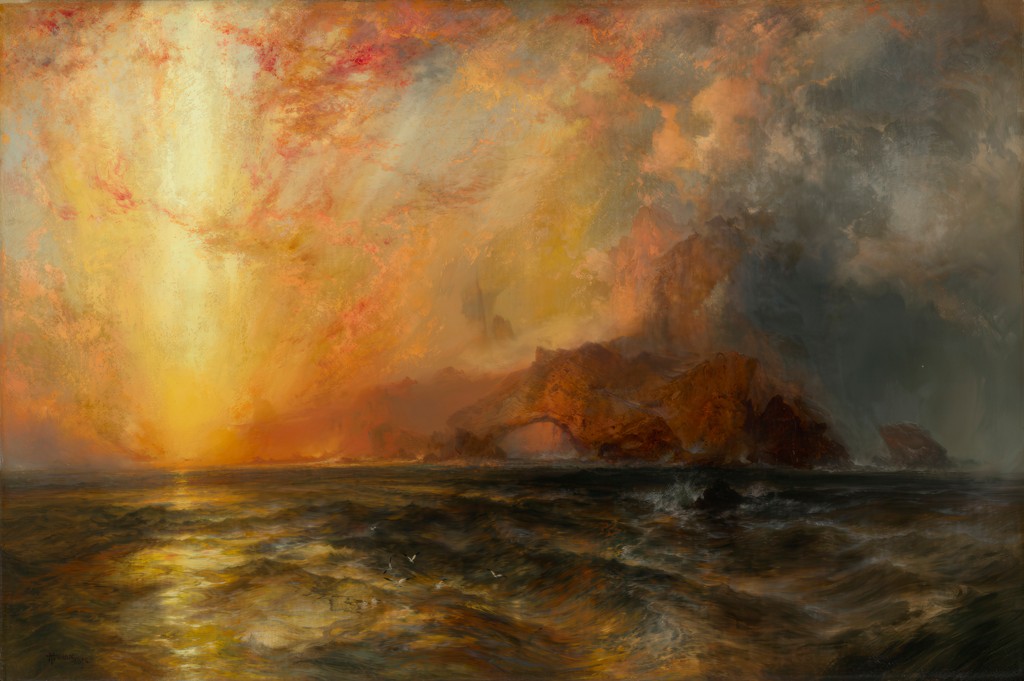
| Fiercely the red sun descending, Burned his way along the heavens | 1875–76 | Oil on canvas |
| Forest Scene | 1870 | Oil on canvas |
| Grand Canyon of the Colorado River | 1892 and 1908 | Oil on canvas |
| Green River Cliffs, Wyoming | 1881 | Oil on canvas |
| Green River, Wyoming | 1878 | Oil on panel |
| The Juniata, Evening | 1864 | Oil on canvas |
| Mosquito Trail, Rocky Mountains of Colorado | 1875 in the 1997 National Gallery exhibition catalogue | Watercolour |
| Mountain of the Holy Cross | 1875 | Oil on canvas |
| The Much Resounding Sea | 1884 | Oil on canvas |
| Point Lobos, Monterey, California | 1912, signed and dated | Oil on canvas |
| Shoshone Falls on the Snake River | 1900 | Oil on canvas |
| Summit of the Sierras | 1872/75, as catalogued by the Art Institute of Chicago | Gouache over graphite on cream laid paper |
| The Teton Range | 1897 | Oil on canvas |
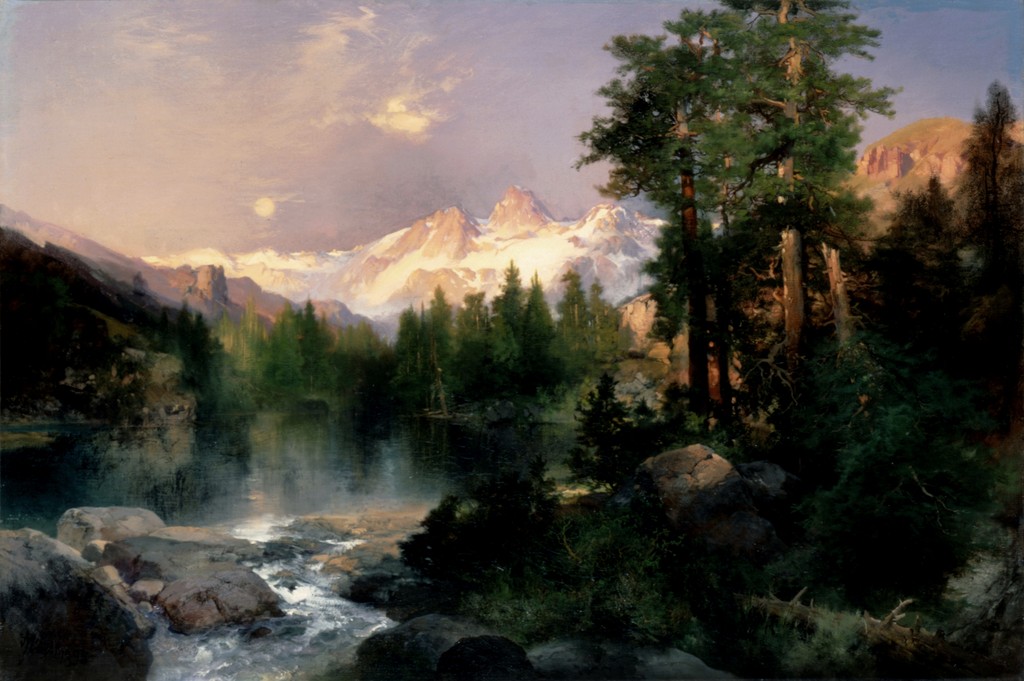
| The Three Tetons | 1895 | Oil on canvas |
| Tower Falls, Yellowstone | 1872 | Watercolour and gouache over graphite on blue laid paper |
| A View of Venice | 1891 | Oil on canvas |
| The Grand Canyon of the Yellowstone | 1872 | Oil on canvas, currently recorded as mounted on aluminium |
| Mountain of the Holy Cross, Colorado (etching) | 1888 | Etching, roulette and aquatint |
| The Resounding Sea (etching) | 1880 | Etching |
| The Much Resounding Sea (later etching) | 1886 in heading; 1888 on plate | Etching, drypoint and roulette |
| Tower Falls (Prang print) | c. 1875; portfolio issued 1876 | Chromolithograph |
| Shoshone Falls (early watercolour) | 1874 | Watercolour |
| Venice (watercolour) | 1888 | Watercolour over graphite |
Frequently Asked Questions
1882.
The Smithsonian identifies it with the Green River, historically also called the Upper Colorado.
40.5 × 61.0 cm.
The Smithsonian American Art Museum, accession 1936.12.4.
The museum identifies Native Americans on horseback. Individual or tribal identities are not securely established here.
Discussion
Compare the illuminated riders' ground with the brightest cliff face. How does Moran connect those patches of light across the river while keeping their scales so different?
Reader Insights
Editorial prompts for close looking and discussion.
Compare the illuminated riders' ground with the brightest cliff face. How does Moran connect those patches of light across the river while keeping their scales so different?
Which source or image helps you assess the interpretation?
How does this page compare with the related works linked above?
Join the Conversation
Share your reading of this page below.
References
- Smithsonian American Art Museum, Cliffs of the Upper Colorado River, Wyoming Territory, 1882, object record and museum interpretations, 1936.12.4.
- National Gallery of Art, Green River Cliffs, Wyoming, 1881, separate object record.
- Amon Carter Museum of American Art, Cliffs of Green River, 1874, separate object record, 1975.28.
- Splash image source.
Cliffs of the Upper Colorado River, Wyoming Territory, 1882. Smithsonian American Art Museum, Bequest of Henry Ward Ranger through the National Academy of Design, 1936.12.4. Image source. Free to use; Smithsonian Open Access. Resized only; complete source image retained.
- Splash image source.
Cliffs of the Upper Colorado River, Wyoming Territory, 1882. Smithsonian American Art Museum, Bequest of Henry Ward Ranger through the National Academy of Design, 1936.12.4. Image source. Free to use; Smithsonian Open Access. Numbered circles added to the overview; details cropped from the original reproduction. No colour adjustment or sharpening.
- Splash image source.
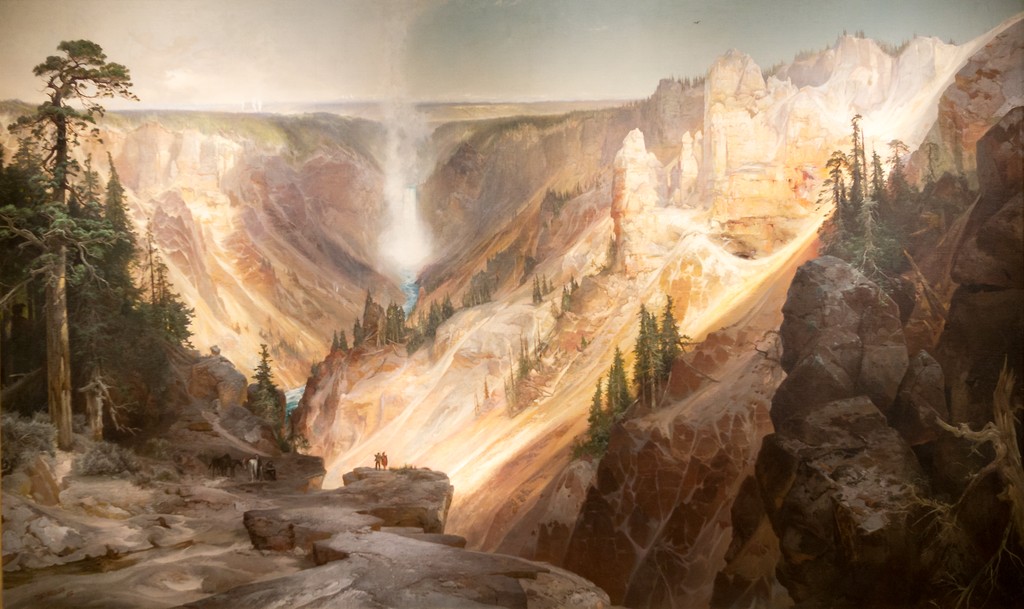
The Grand Canyon of the Yellowstone, 1872. Wuselig / Wikimedia Commons, CC BY-SA 4.0; U.S. Department of the Interior Museum painting. Image source. CC BY-SA 4.0; also marked PD-Art. Outer museum frame cropped; resized. Painted composition retained; photographic perspective unchanged. This image derivative is available under the same licence.
- Splash image source.
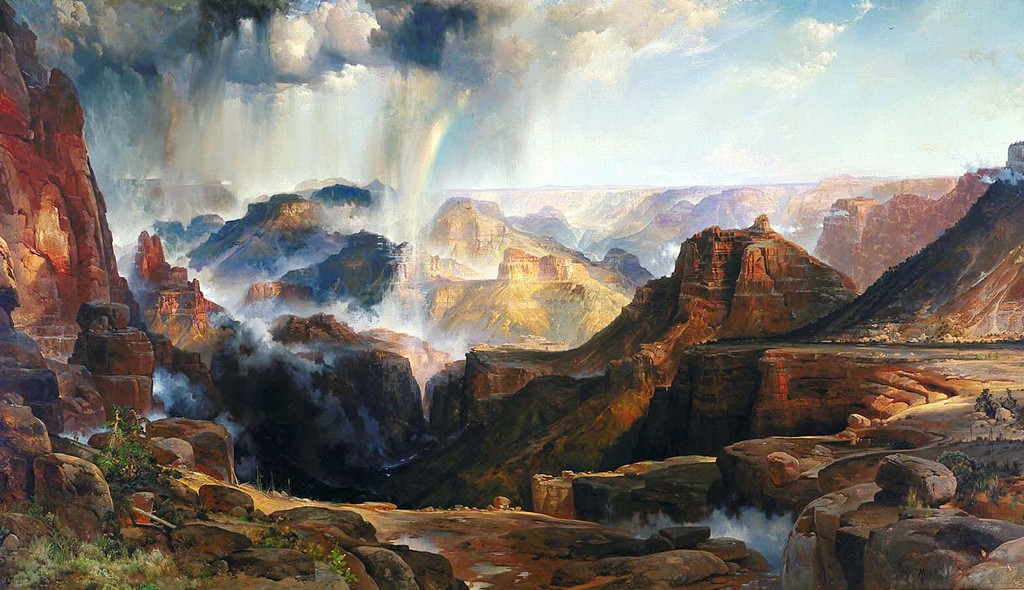
The Chasm of the Colorado, 1873–1874. U.S. Department of the Interior Museum; faithful reproduction via Smithsonian American Art Museum / Wikimedia Commons. Image source. Public Domain Mark; faithful two-dimensional reproduction. Resized only; complete source image retained.
- Splash image source.
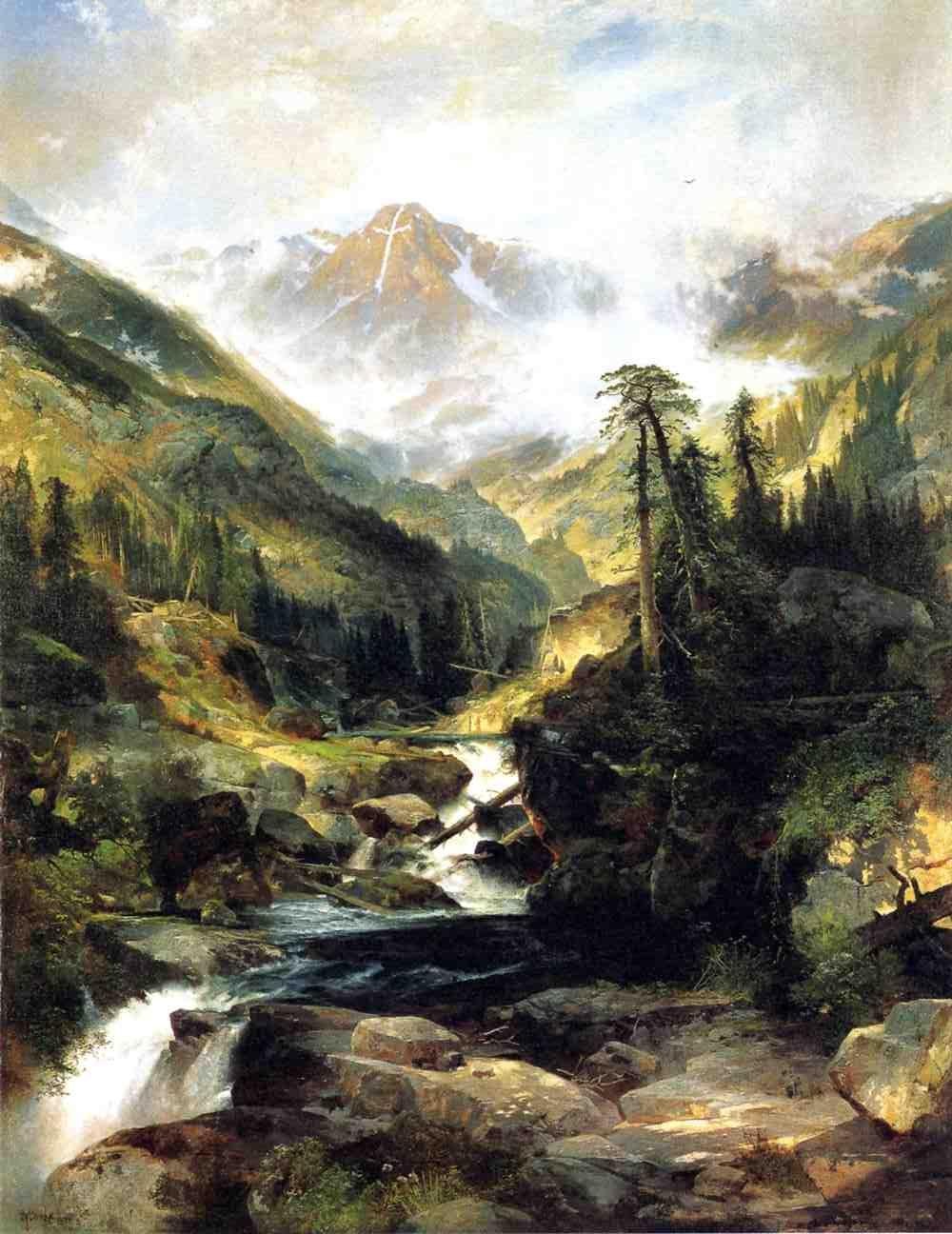
Mountain of the Holy Cross, 1875. Autry Museum of the American West; faithful reproduction via Wikimedia Commons. Image source. Public Domain Mark; faithful two-dimensional reproduction. Resized only; complete source image retained.
- Splash image source.
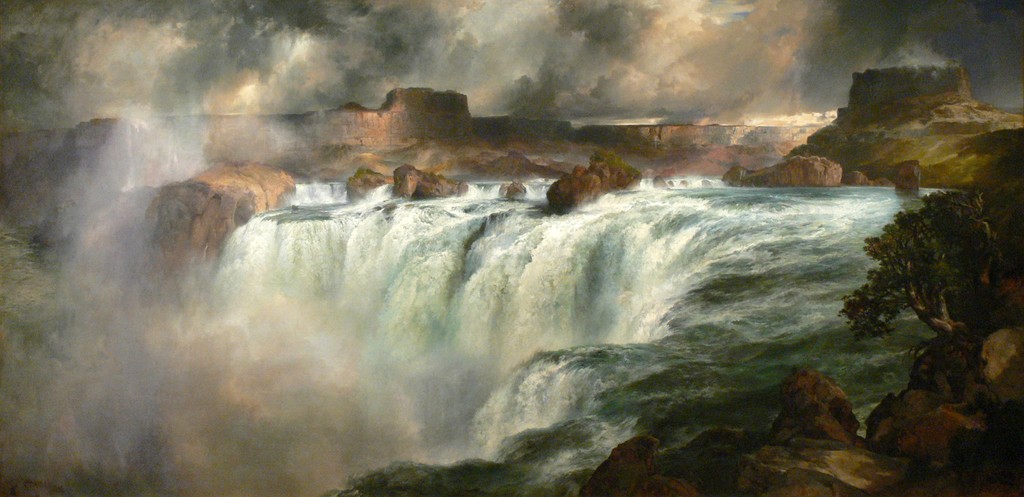
Shoshone Falls on the Snake River, 1900. Wolfgang Sauber / Wikimedia Commons, CC BY-SA 3.0; Gilcrease Museum painting. Image source. CC BY-SA 3.0; also marked PD-Art. Resized only; complete source image retained. This image derivative is available under the same licence.
- Splash image source.
Green River Cliffs, Wyoming, 1881. National Gallery of Art, Gift of the Milligan and Thomson Families. Image source. Public domain; NGA Open Access. Resized only; complete source image retained.
- Splash image source.
A View of Venice, 1891. Smithsonian American Art Museum, Transfer from the U.S. Department of the Interior, National Park Service, 1968.120.1. Image source. Free to use; Smithsonian Open Access. Resized only; complete source image retained.
- Splash image source.
The Three Tetons, 1895. The White House Collection, Gift of C. R. Smith; faithful reproduction via Wikimedia Commons. Image source. Public Domain Mark; faithful reproduction of a two-dimensional public-domain work. Resized only; complete source image retained.