 by Tom Gurney
Tom Gurney BSc (Hons) is an art history expert with over 20 years experience
Published on June 19, 2020 / Updated on October 27, 2026
Email: tomgurney1@gmail.com / Phone: +44 7429 011000
Cliffs of Green River: Introduction
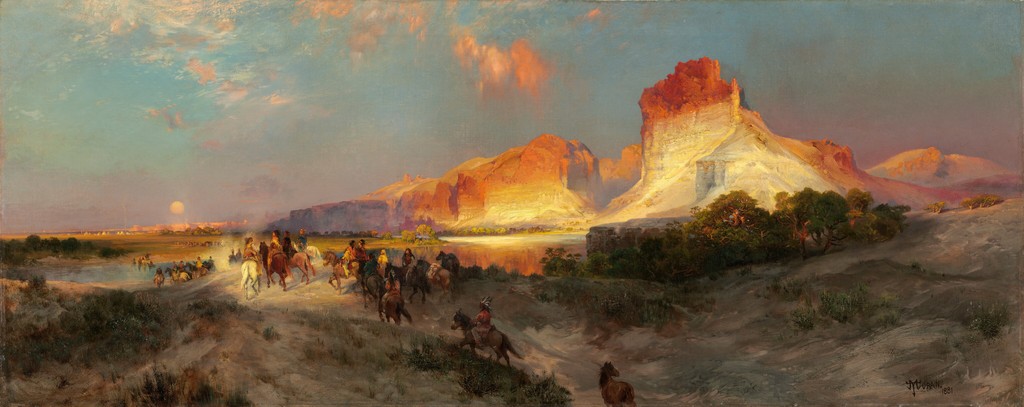
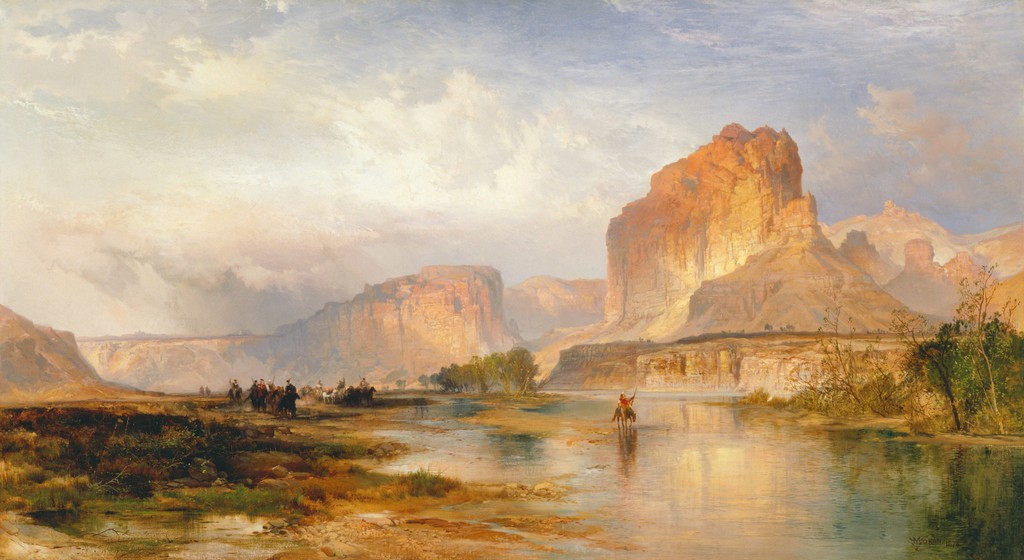
Thomas Moran’s Cliffs of Green River, dated 1874, is an oil on canvas in the Amon Carter Museum of American Art. A broad river reflects pale, illuminated rock, while riders gather on its left bank and a smaller figure crosses the water. The painting makes the cliffs imposing through their relationship with the river and the scale of human movement beneath them. [1]
This is a separate work from the National Gallery’s 1881 Green River Cliffs, Wyoming and Crystal Bridges’ 1878 Green River, Wyoming. The Carter canvas gives water an especially prominent foreground role. Its calm surface supplies both a route into the landscape and a quieter counterpart to the sharply broken rock above.
At a Glance
- ArtistThomas Moran
- TitleCliffs of Green River
- Date1874
- MediumOil on canvas
- Dimensions25⅛ × 45⅜ in.
- CollectionAmon Carter Museum of American Art, Fort Worth
- Accession1975.28
- InscriptionSigned and dated at lower right
Where this work sits in Moran’s career
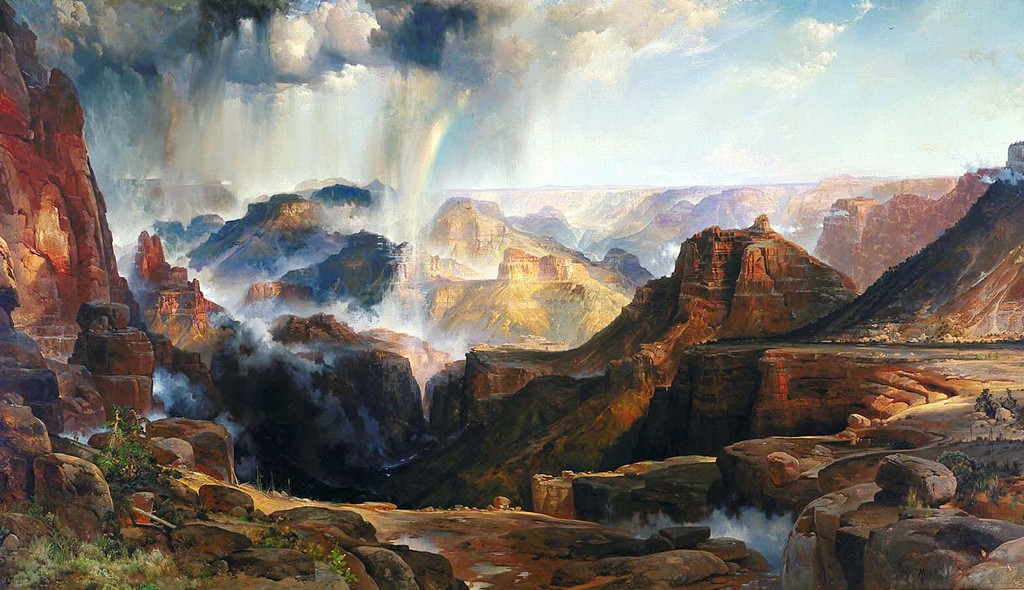
The Chasm of the Colorado
1873–1874; completed in 1874A View of Venice
1891Point Lobos, Monterey, California
1912, signed and datedContents
- The 1874 painting within Moran's career
- Water gives the foreground its shape
- A cliff built from planes and interruptions
- Riders on the bank and a crossing in the river
- Open sky and a changing light
- The railway setting outside the painted scene
- Idealisation as an artistic choice
- Identifying the object through its record
- Comparing the later Green River pictures
The 1874 painting within Moran's career
Moran first encountered the Green River landscape in 1871, travelling by rail towards the Yellowstone survey. The National Gallery catalogue records a field study inscribed as his first sketch made in the West. The cliffs offered material he could return to after the journey, rather than a subject confined to one day's observation. [2]
By 1874 he had completed the great Yellowstone canvas and was developing the companion Colorado painting. Green River belonged to this period of expanding western work. Its rock forms could be treated in a smaller format without requiring the monumental dimensions of the congressional pictures. The result offered a different kind of encounter for a viewer standing before it.
The date of this oil should not be replaced by 1871 simply because that was the year of the first visit. Fieldwork and the making of a finished canvas are separate events. Nor does the title establish that every feature was copied unchanged from one station. Surviving studies and the artist's repeated use of the subject make a history of selection more plausible than a single act of transcription.
Annotated Details from Cliffs of Green River
Compare these details with the full composition. The numbered overview and crops come from the same original image.
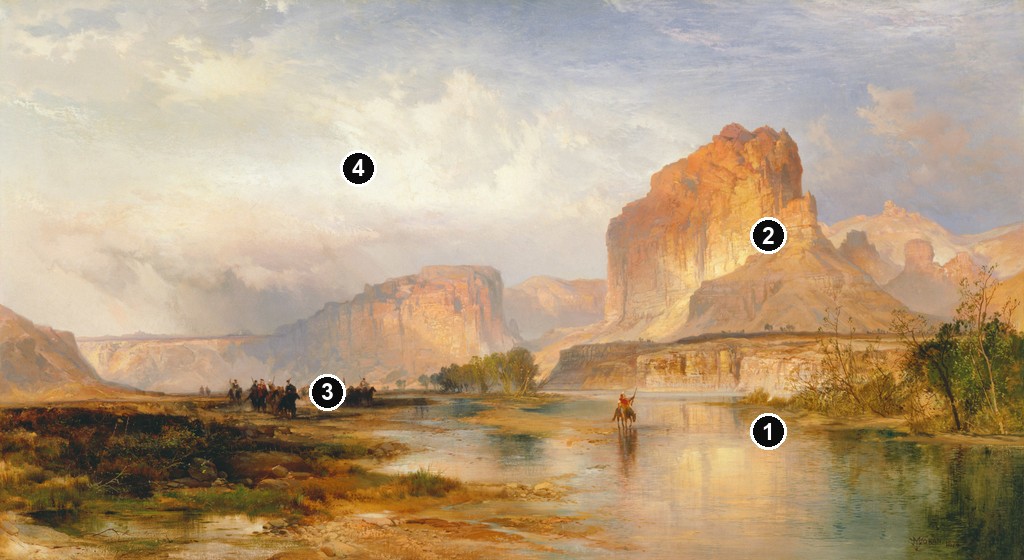
Details from CLIFFS OF GREEN RIVER
Open a detail to see it more closely.
Water gives the foreground its shape
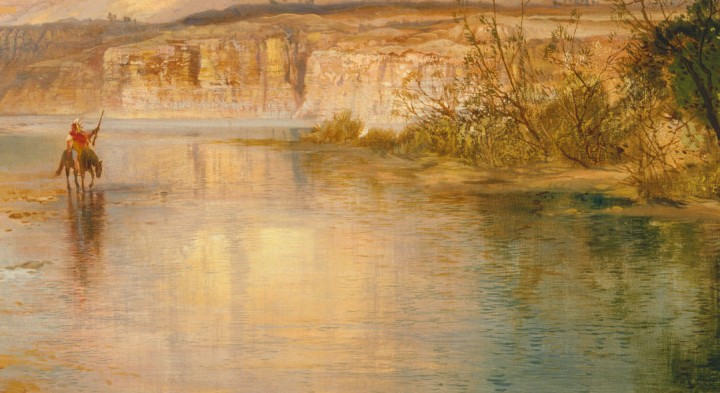
The river occupies much of the lower right half and extends towards the centre. Its edge curves rather than dividing the picture into a perfectly straight band. Pale shore, scattered stones and areas of vegetation make the boundary between land and water irregular. These details give the viewer several small points from which to enter the larger view.
A cliff built from planes and interruptions
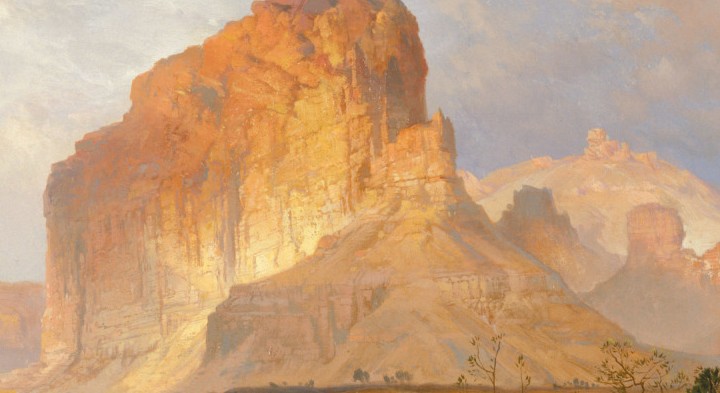
The principal formation stands on the right, rising above a long lower terrace. Its top is reddish and irregular; its face is paler, with shadows and narrow breaks interrupting the light. Those divisions make the rock appear layered and uneven. A large shape is held together while its surface remains varied.
Riders on the bank and a crossing in the river
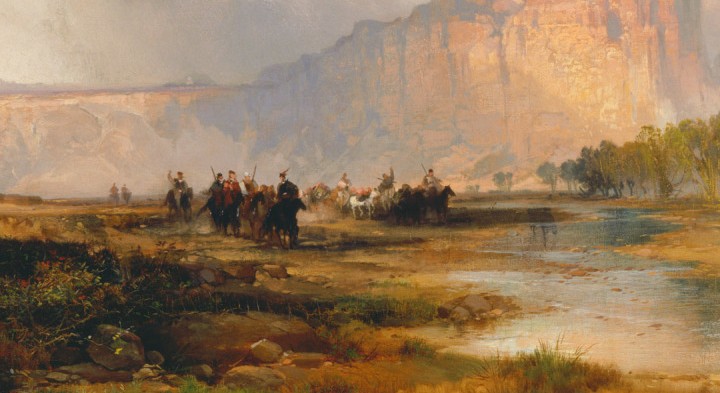
A group of riders gathers in the left middle ground. Some silhouettes are dark against the lighter distance, while pale horses and small coloured details break the group into individual accents. They are large enough to be recognised as people travelling through the landscape, but small enough for the cliffs to remain overwhelming.
Open sky and a changing light
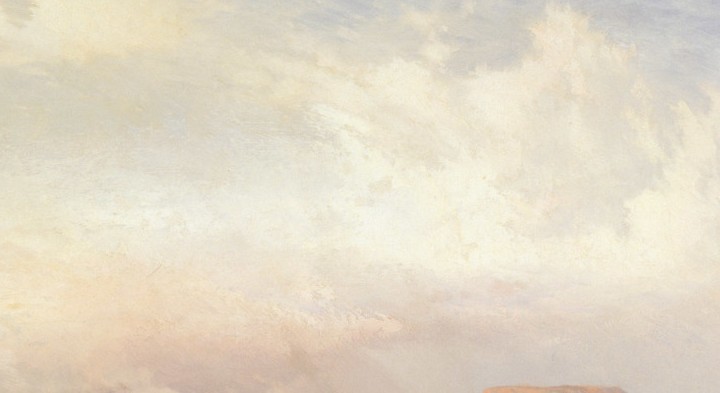
The upper left contains an extensive passage of sky. Pale clouds and slanting light lead towards the horizon, while the principal cliff remains clearer on the right. The different degrees of visibility make the landscape feel exposed to changing atmosphere. Rock appears durable, but the conditions under which it is seen are less fixed.
Water gives the foreground its shape
The river occupies much of the lower right half and extends towards the centre. Its edge curves rather than dividing the picture into a perfectly straight band. Pale shore, scattered stones and areas of vegetation make the boundary between land and water irregular. These details give the viewer several small points from which to enter the larger view.
The water's surface is quieter than the surrounding ground. It carries long reflections and relatively broad changes of tone, while the bank is broken by stones, earth and plants. That difference in texture helps the river read as a continuous space. The eye can move across it without having to negotiate the foreground's every small interruption.
A reflection of the main cliff stretches down through the water. It is less distinct than the rock itself, but preserves enough of its warm and pale colour to connect the two. The reflected mass makes the lower half participate in the landscape's grandeur. Water does more than occupy the place where terrain stops; it enlarges the presence of what stands above it.
The composition consequently has a strong vertical relationship inside a horizontal format. Cliff and reflection pull attention up and down, while bank and distant formations carry it sideways. Neither direction completely dominates. Their intersection supplies the picture with a centre that can be felt without a conspicuous geometric diagram.
A cliff built from planes and interruptions
The principal formation stands on the right, rising above a long lower terrace. Its top is reddish and irregular; its face is paler, with shadows and narrow breaks interrupting the light. Those divisions make the rock appear layered and uneven. A large shape is held together while its surface remains varied.
The slope at the foot of the formation matters as much as the summit. It connects the upright wall with the horizontal ledge below and the bank beside the river. Without that transition, the cliff could seem suspended above its setting. Moran gives its great height a base that the eye can follow towards the water.
Other formations extend to the left and into the distance. A lower, squared mass appears near the centre, while paler rocks soften towards the horizon. Their differences in height and clarity make a sequence rather than a row of identical objects. The highest cliff gains force because the neighbouring forms offer comparison.
The painting can evoke stratified rock without serving as a measured geological illustration. Visible bands and fractures justify discussion of how the artist describes surfaces. They do not identify the age or exact mineral composition of each passage. Close looking is most useful when it remains tied to what the picture actually makes available.
Riders on the bank and a crossing in the river
A group of riders gathers in the left middle ground. Some silhouettes are dark against the lighter distance, while pale horses and small coloured details break the group into individual accents. They are large enough to be recognised as people travelling through the landscape, but small enough for the cliffs to remain overwhelming.
One rider appears further right in the water. The figure's separation from the group gives the river a narrative function: it is a space being crossed. The eye connects the group on the bank with this smaller presence, then follows the water towards the illuminated rock. Human movement helps make the landscape legible.
The crossing also alters the sense of scale. A large expanse that might otherwise appear almost empty contains a small body and its reflection. The distance between that figure and the bank can be understood through ordinary experience, while the cliffs beyond remain far larger. Moran combines an accessible action with an extraordinary setting.
The figures are representations within a composed scene. Their appearance should not be used to identify a particular Indigenous nation or verify a specific historical crossing. The Carter's interpretation stresses the difference between the industrial Green River Moran encountered and the landscape he imagined. Its argument concerns artistic selection, not a census of the people visible on this painted bank. [1]
Open sky and a changing light
The upper left contains an extensive passage of sky. Pale clouds and slanting light lead towards the horizon, while the principal cliff remains clearer on the right. The different degrees of visibility make the landscape feel exposed to changing atmosphere. Rock appears durable, but the conditions under which it is seen are less fixed.
Light falls across the cliff and water in related tones. The reflection allows the bright area to descend into the foreground without repeating the same degree of sharpness. This produces a connection rather than a mirror image. The softer passage below prepares the eye for the more defined surface above.
Vegetation on the right interrupts that reflected light with darker vertical accents. Trees and shrubs partly frame the water while leaving its central passage open. The edge of the painting thus contains a nearer scale of detail against which the broad distance can be assessed. Foreground growth and distant stone perform different pictorial tasks.
The interplay of brighter and quieter areas is visible in the reproduction, but it cannot establish a particular pigment mixture or conservation treatment. Likewise, the sky should not be assigned a documented hour solely from its effect. The useful question is how the distribution of light shapes the experience of the view.
Watch: Thomas Moran
Choose a film to explore the artist’s work, its interpretation and its wider setting.
The painting that inspired a National Park
A close discussion of Moran’s landscape and its relationship to the idea of Yellowstone.
Watch on YouTubeThe railway setting outside the painted scene
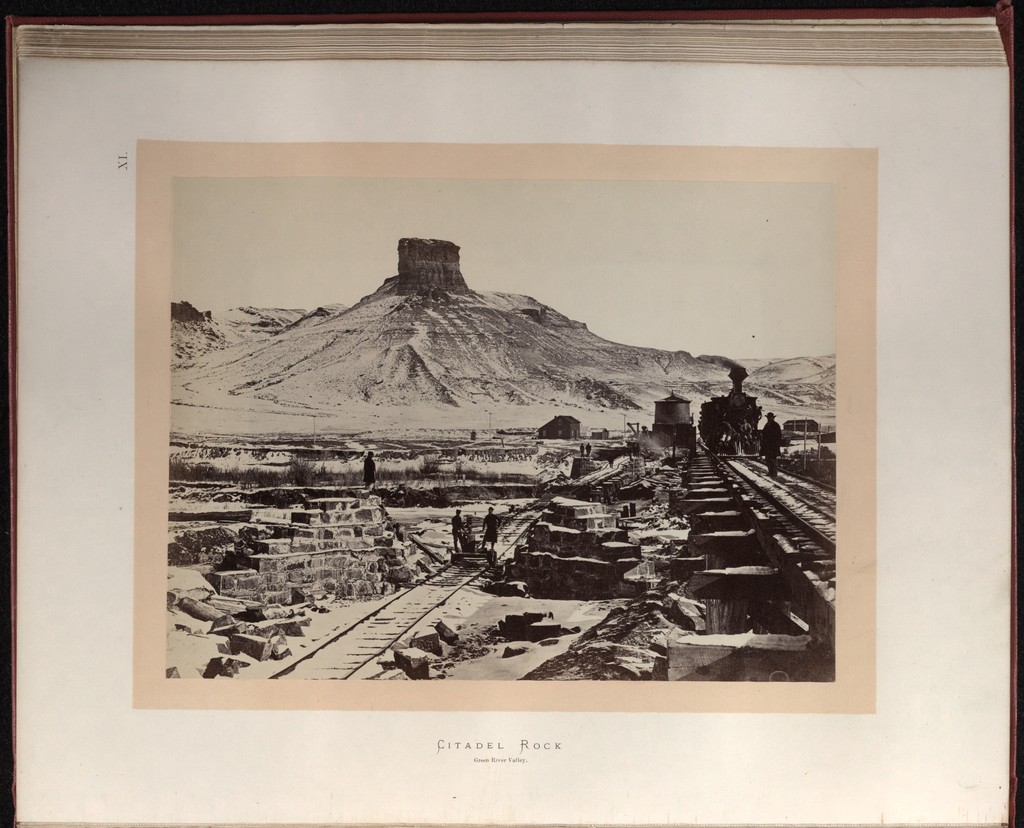
Green River's importance to Moran began with modern transport. Railway travel brought him to the cliffs on his way to another destination. A historical photograph by Andrew Joseph Russell shows the region through the work of railway construction: tracks, a locomotive, masonry, timber and workers beneath Citadel Rock. The Library of Congress dates the particular item used here to about 1869. [3]
In that photograph, the tracks pull the eye directly into the middle ground. People stand among the engineering structures, and the great rock rises behind them. The natural formation and the labour below occupy one image. It provides a concrete comparison with Moran's river, bank and riders.
The painting contains no comparable railway route or construction work. The difference is especially striking because its water gives the foreground an uninterrupted reflective space. A bridge would divide that space and introduce another kind of scale. Its absence contributes to the calm continuity of the river as Moran presents it.
The comparison does not require an identical viewpoint. Russell's photograph and Moran's painting select different arrangements within the Green River setting. Nor is a camera image free from composition: its station, framing and figures also shape the result. The photograph offers evidence of industrial activity, while the oil reveals how a landscape could be presented without it.
Idealisation as an artistic choice
Moran described his tendencies as directed towards idealisation in Sheldon’s American Painters, published in 1879. The statement came after this picture and explains a broader outlook, rather than the complete making history of the Carter canvas. He valued the organisation of a landscape into an expressive image, beyond the copying of visible particulars. [4]
That outlook helps frame the relationship between the river scene and its historical setting. An observation could supply rock forms, colours or spatial ideas without obliging the finished picture to contain every building and modern activity nearby. The painter chose what would make a coherent landscape for his intended audience.
Recognising that choice changes how the picture can be appreciated. Its impressive scale and tranquillity remain pictorial achievements, but cannot prove the absence of settlement or industry. The painting's appeal and its omissions belong to the same arrangement. Close looking and historical comparison make both easier to understand.
Identifying the object through its record
The Carter record lists the 1874 signature and date at the lower right. It also records a verso inscription on paper attached to the stretcher with the title Valley of the Rio Virgin. That differing wording is part of the object's documentation. It should not be silently substituted for the museum's current identification as Cliffs of Green River. [1]
An inscription can raise a question without immediately resolving it. The record does not, by itself, establish who attached the paper or why that title was used. The current title, accession and image provide a secure way to identify the work being discussed, while the historical wording remains visible as a separate piece of evidence.
Comparing the later Green River pictures
The National Gallery's Green River Cliffs, Wyoming is dated 1881. Its particularly long panorama places a larger procession in the foreground and the river further back. The glowing right-hand cliff is balanced against a broad left horizon. The Carter picture instead makes the reflective water and the isolated crossing central to its lower half. [5]
Crystal Bridges' Green River, Wyoming, dated 1878, is an oil on panel. Its low format distributes riders, rock and river differently again. Date and support distinguish it even when the same geographical name appears in captions. These are related paintings rather than interchangeable reproductions. [6]
Comparing them makes Moran's repeated subject an opportunity for close looking. Notice where water enters the foreground, how strongly figures direct movement and where the highest rock stands. The differences show an artist finding several pictorial structures within material first encountered during a journey. In the Carter canvas, the cooperation of river and cliff gives the landscape its distinctive balance of stillness and passage.
Artworks directory
Selected documented works and distinct versions. This directory is not a comprehensive catalogue raisonné. Dates and media retain the distinctions explained in the articles and museum records.
| Name | Date | Medium |
|---|---|---|
| An Arizona Sunset near the Grand Canyon | Date not securely established | Oil painting |
| Autumn Afternoon, the Wissahickon by Thomas Moran | 1864 | Oil on canvas |
| Cascade Falls, Yosemite | Commonly catalogued as 1905 | Catalogued as oil on canvas |
| The Chasm of the Colorado | 1873–1874; completed in 1874 | Oil on canvas, currently mounted on aluminium |
| Children of the Mountain | 1866 in the current museum title; 1867 in the 1997 National Gallery catalogue | Oil on canvas |
| Cliffs of Green River | 1874 | Oil on canvas |
| Cliffs of the Upper Colorado River, Wyoming Territory | 1882 | Oil on canvas |
| East Hampton, Long Island , also captioned Easthampton, L.I | 1897 | Oil on canvas laid on board, according to the reproduction record |
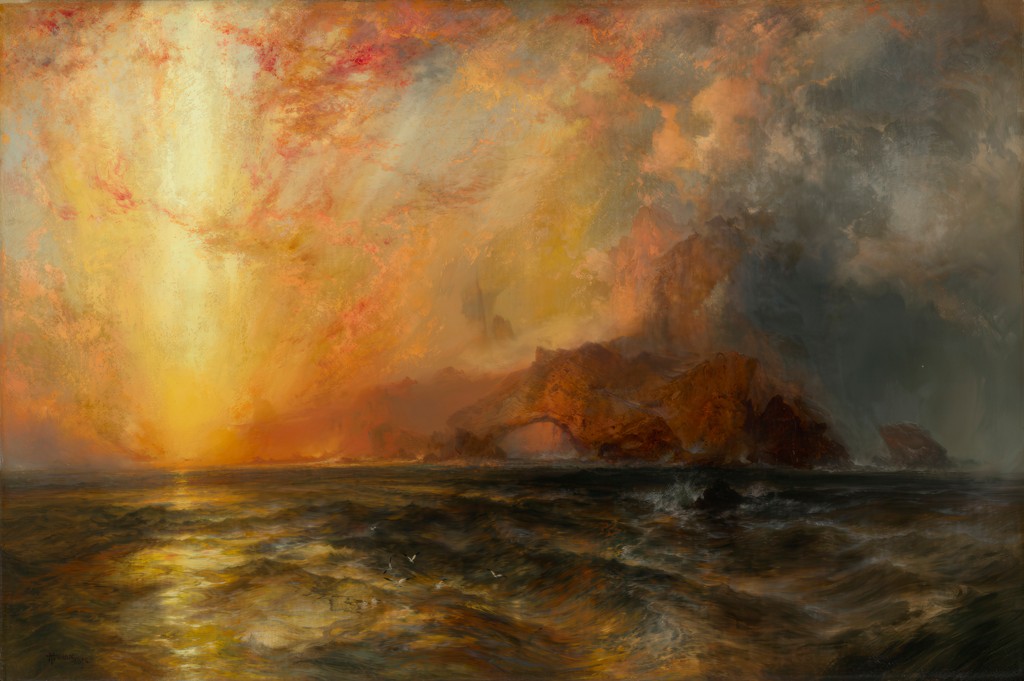
| Fiercely the red sun descending, Burned his way along the heavens | 1875–76 | Oil on canvas |
| Forest Scene | 1870 | Oil on canvas |
| Grand Canyon of the Colorado River | 1892 and 1908 | Oil on canvas |
| Green River Cliffs, Wyoming | 1881 | Oil on canvas |
| Green River, Wyoming | 1878 | Oil on panel |
| The Juniata, Evening | 1864 | Oil on canvas |
| Mosquito Trail, Rocky Mountains of Colorado | 1875 in the 1997 National Gallery exhibition catalogue | Watercolour |
| Mountain of the Holy Cross | 1875 | Oil on canvas |
| The Much Resounding Sea | 1884 | Oil on canvas |
| Point Lobos, Monterey, California | 1912, signed and dated | Oil on canvas |
| Shoshone Falls on the Snake River | 1900 | Oil on canvas |
| Summit of the Sierras | 1872/75, as catalogued by the Art Institute of Chicago | Gouache over graphite on cream laid paper |
| The Teton Range | 1897 | Oil on canvas |
| The Three Tetons | 1895 | Oil on canvas |
| Tower Falls, Yellowstone | 1872 | Watercolour and gouache over graphite on blue laid paper |
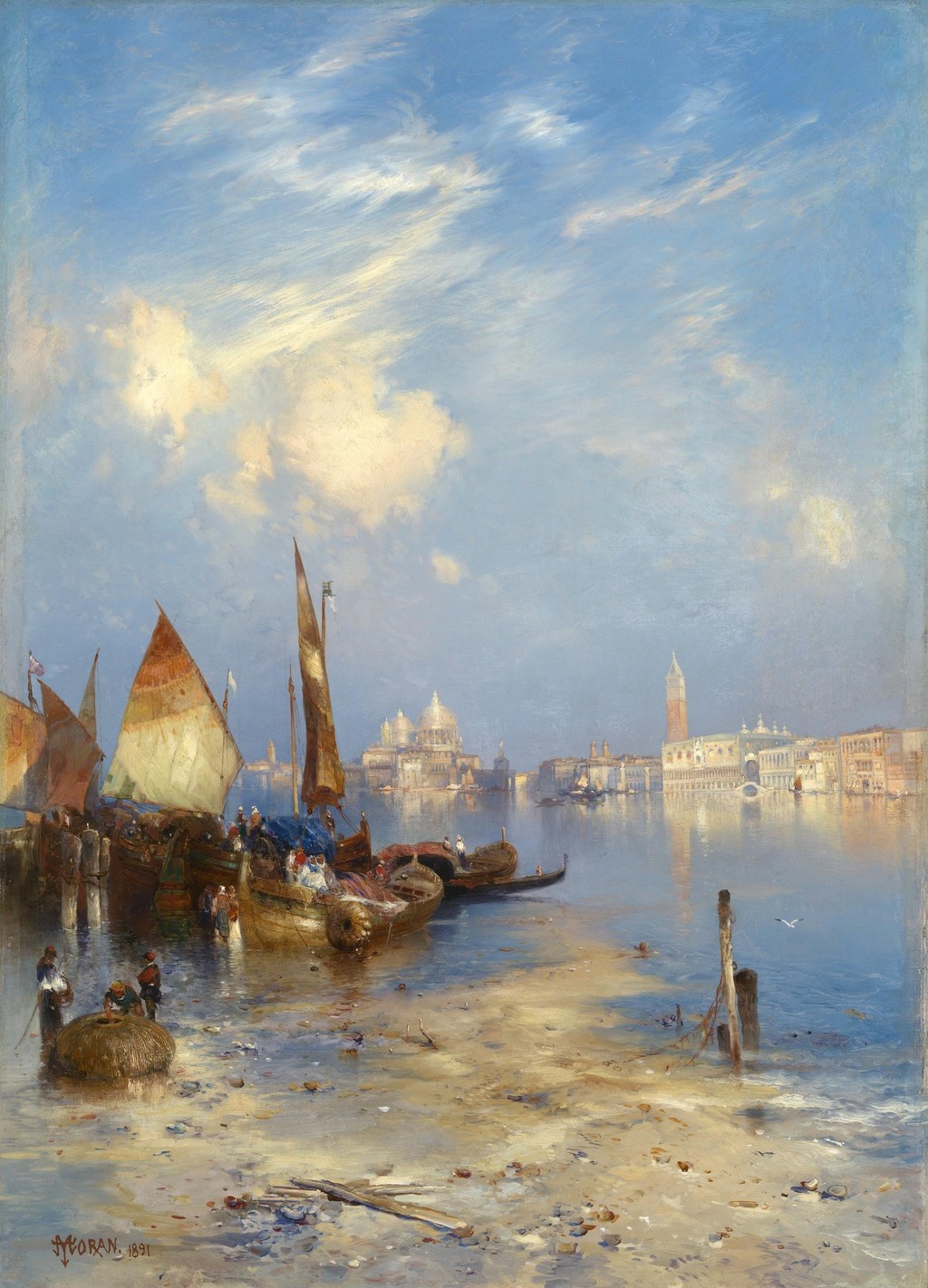
| A View of Venice | 1891 | Oil on canvas |
| The Grand Canyon of the Yellowstone | 1872 | Oil on canvas, currently recorded as mounted on aluminium |
| Mountain of the Holy Cross, Colorado (etching) | 1888 | Etching, roulette and aquatint |
| The Resounding Sea (etching) | 1880 | Etching |
| The Much Resounding Sea (later etching) | 1886 in heading; 1888 on plate | Etching, drypoint and roulette |
| Tower Falls (Prang print) | c. 1875; portfolio issued 1876 | Chromolithograph |
| Shoshone Falls (early watercolour) | 1874 | Watercolour |
| Venice (watercolour) | 1888 | Watercolour over graphite |
Frequently Asked Questions
The Amon Carter Museum dates it to 1874, matching the recorded signature and date.
It belongs to the Amon Carter Museum of American Art in Fort Worth, accession 1975.28.
Moran first encountered Green River in 1871. This finished canvas is dated three years later; the field encounter and the completed work are different stages.
It reflects the illuminated cliff, creates open foreground space and gives the small rider a crossing to make. Those effects connect movement with the landscape's scale.
Russell's photograph records railway structures and workers in the Green River setting. It helps reveal the industrial activity absent from Moran's selected scene.
Discussion
Follow the reflection from the river to the cliff, then compare the routes created by the riders and Russell's tracks. Which element most strongly controls your movement through each image?
Reader Insights
Editorial prompts for close looking and discussion.
Follow the reflection from the river to the cliff, then compare the routes created by the riders and Russell's tracks. Which element most strongly controls your movement through each image?
Which source or image helps you assess the interpretation?
How does this page compare with the related works linked above?
Join the Conversation
Share your reading of this page below.
References
- Amon Carter Museum of American Art, Cliffs of Green River, 1874, object record and inscriptions.
- Nancy K. Anderson and contributors, Thomas Moran, 1997, selected Green River discussion, pp. 48–50, and chronology.
- Library of Congress, Andrew Joseph Russell, Citadel Rock, Green River Valley, c. 1869, photographic item record.
- G. W. Sheldon, American Painters, 1879, Moran chapter, p. 125.
- National Gallery of Art, Green River Cliffs, Wyoming, 1881.
- Crystal Bridges Museum of American Art, Green River, Wyoming, 1878.
- Splash image source.
Cliffs of Green River, 1874. Amon Carter Museum of American Art, Fort Worth, Texas, 1975.28. Image source. Public domain stated on object page. Resized only; complete source image retained.
- Splash image source.
Citadel Rock, Green River Valley, circa 1869. Railway bridge construction shows the industrial landscape omitted from many Moran paintings. Andrew J. Russell / Library of Congress, LC-DIG-ppmsca-03147. Image source. No known restrictions on publication. Resized only; complete source image retained.
- Splash image source.
Cliffs of Green River, 1874. Amon Carter Museum of American Art, Fort Worth, Texas, 1975.28. Image source. Public domain stated on object page. Numbered circles added to the overview; details cropped from the original reproduction. No colour adjustment or sharpening.
- Splash image source.
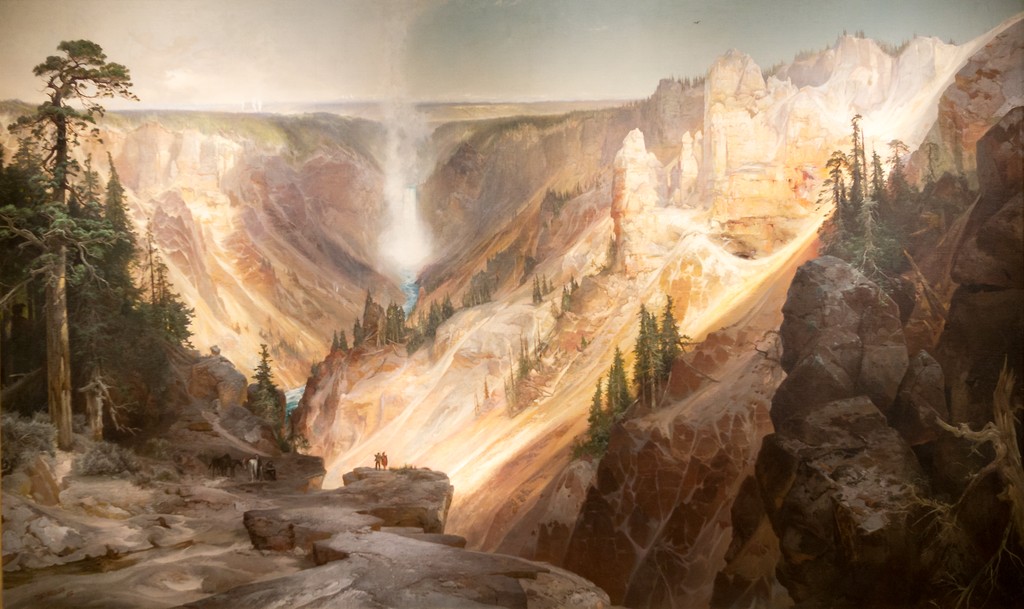
The Grand Canyon of the Yellowstone, 1872. Wuselig / Wikimedia Commons, CC BY-SA 4.0; U.S. Department of the Interior Museum painting. Image source. CC BY-SA 4.0; also marked PD-Art. Outer museum frame cropped; resized. Painted composition retained; photographic perspective unchanged. This image derivative is available under the same licence.
- Splash image source.
The Chasm of the Colorado, 1873–1874. U.S. Department of the Interior Museum; faithful reproduction via Smithsonian American Art Museum / Wikimedia Commons. Image source. Public Domain Mark; faithful two-dimensional reproduction. Resized only; complete source image retained.
- Splash image source.
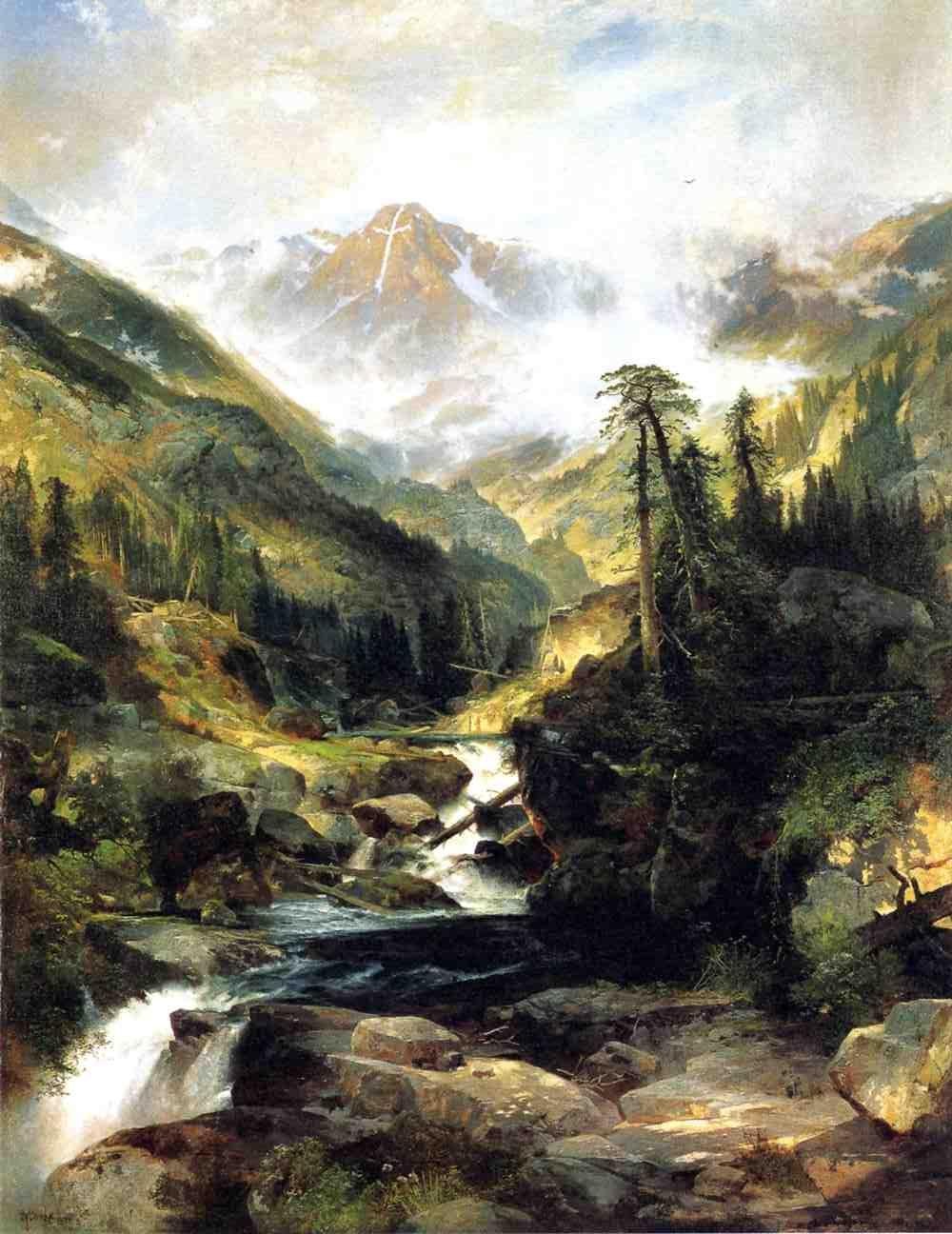
Mountain of the Holy Cross, 1875. Autry Museum of the American West; faithful reproduction via Wikimedia Commons. Image source. Public Domain Mark; faithful two-dimensional reproduction. Resized only; complete source image retained.
- Splash image source.
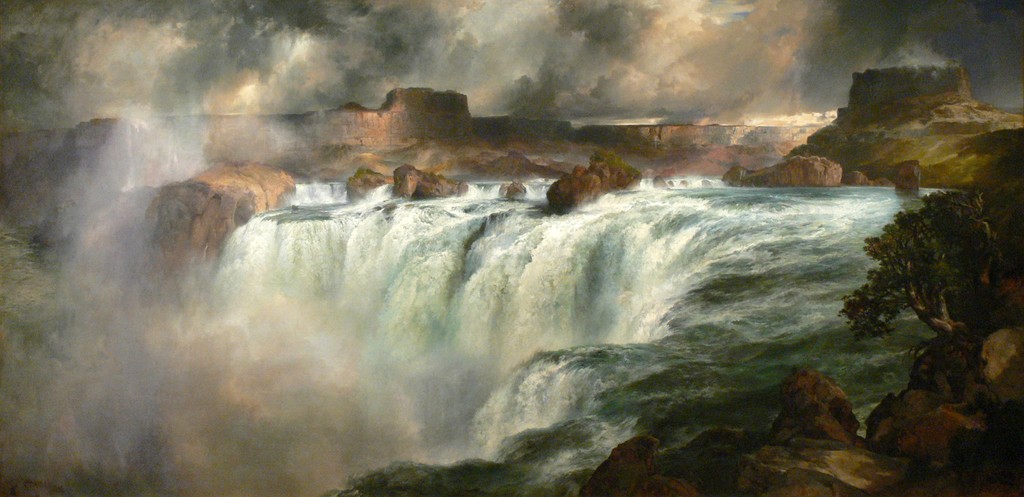
Shoshone Falls on the Snake River, 1900. Wolfgang Sauber / Wikimedia Commons, CC BY-SA 3.0; Gilcrease Museum painting. Image source. CC BY-SA 3.0; also marked PD-Art. Resized only; complete source image retained. This image derivative is available under the same licence.
- Splash image source.
Green River Cliffs, Wyoming, 1881. National Gallery of Art, Gift of the Milligan and Thomson Families. Image source. Public domain; NGA Open Access. Resized only; complete source image retained.
- Splash image source.
A View of Venice, 1891. Smithsonian American Art Museum, Transfer from the U.S. Department of the Interior, National Park Service, 1968.120.1. Image source. Free to use; Smithsonian Open Access. Resized only; complete source image retained.
- Splash image source.
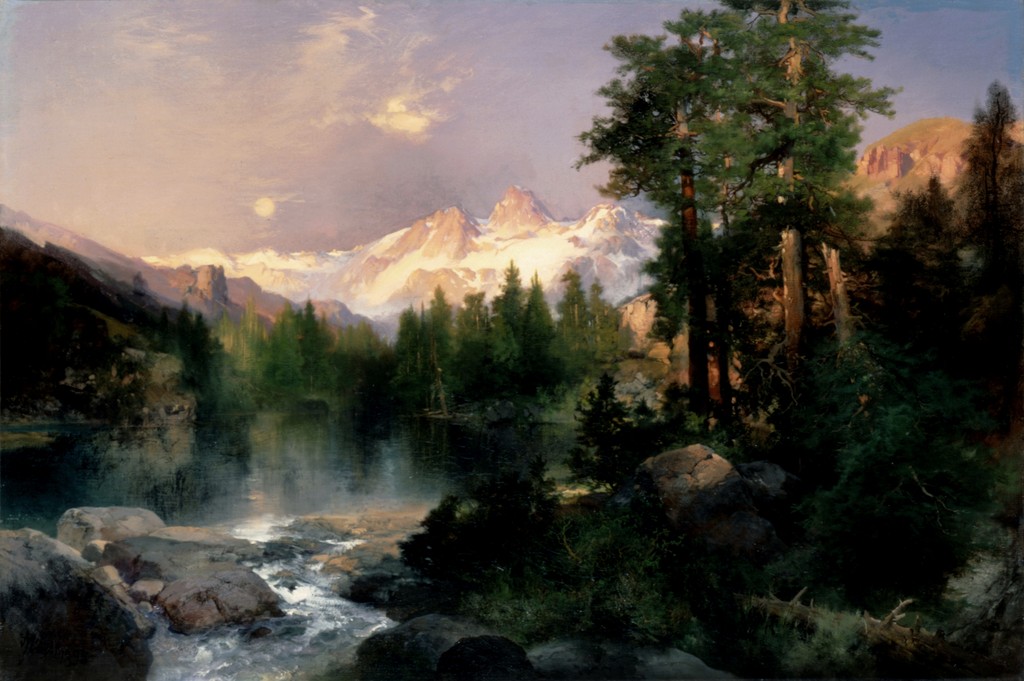
The Three Tetons, 1895. The White House Collection, Gift of C. R. Smith; faithful reproduction via Wikimedia Commons. Image source. Public Domain Mark; faithful reproduction of a two-dimensional public-domain work. Resized only; complete source image retained.