 by Tom Gurney
Tom Gurney BSc (Hons) is an art history expert with over 20 years experience
Email: tomgurney1@gmail.com / Phone: +44 7429 011000
Thomas Moran: Style and Technique: Introduction
Thomas Moran's landscapes combine study with deliberate arrangement. Rocks, trees, water and atmosphere provide material he could observe, draw and remember; the finished image organises that material into an experience for the spectator. His style is especially revealing where a closely described foreground opens towards a distance that seems difficult to grasp all at once.
Moran discussed that relationship in statements reported by G. W. Sheldon in 1879 and an interview excerpt published under his own name in 1903. The earlier account defends idealisation, while the later one stresses knowledge. Read together, they describe a practice in which familiarity with nature supports artistic decisions rather than determining one literal way to reproduce a view. [1] [2]
At a Glance
- Central relationshipObservation and deliberate composition
- Recurring meansStrong foreground forms, repeated distances, selective light and atmospheric concealment
- Working resourcesDrawing, colour notes, photographs and memory, with object-specific evidence needed for particular relationships
- MediaOil painting, watercolour, gouache, drawing and prints
- Primary statementsSheldon, 1879; Brush and Pencil interview excerpt, 1903
- Published material evidenceHistorical technical notes for The Much Resounding Sea in the NGA's 1998 collection catalogue
Contents
- Observation and idealisation
- Knowledge gives invention a basis
- Learning through other artists
- Drawings, reminders and memory
- Photographs and a selected landscape
- Foreground forms establish the spectator's position
- Material records and finished effects
- Format changes the experience of distance
- Colour, light and the organisation of rock
- What published technical evidence can add
Observation and idealisation
Sheldon reports Moran's statement, “I place no value upon literal transcripts from Nature.” The surrounding passage is more particular than the sentence alone suggests. Moran says that nature supplies the material for a picture, then explains how features in his Yellowstone canvas were rearranged to convey an impression of the region. [1]
He also describes close attention to rocks. The distinction allows an individual form to be carefully studied while its position serves a composed image. Accuracy of a particular feature and literal accuracy of the whole arrangement are different questions. A convincing foreground need not make the panorama a geographical plan.
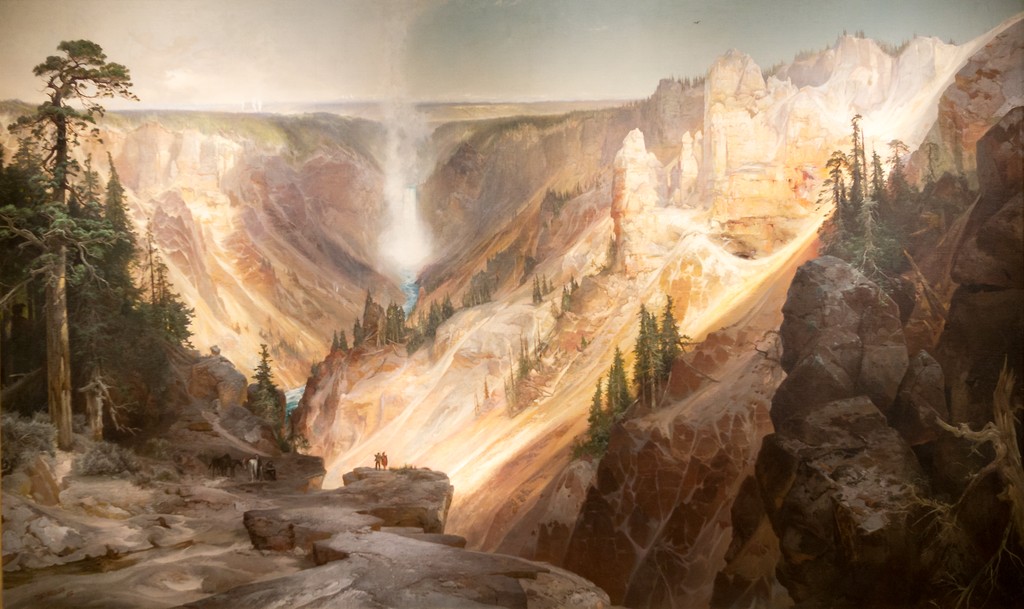
This is useful when looking at The Grand Canyon of the Yellowstone. The near rocks and trees provide strong points of entry, while the canyon extends through successive forms and changing light. The spectator encounters a region through an organised view, rather than through an equally detailed inventory of every visible feature.
The words do not settle every comparison with a photograph. Identifying a particular omission or altered relationship requires evidence concerning that work. Their value lies in explaining why composition mattered to Moran's own account of painting, alongside the observation from which the elements of a picture could be drawn.
Knowledge gives invention a basis
In the 1903 interview excerpt, Moran argues that an artist needs knowledge of rocks, trees, atmosphere, torrents and other aspects of a landscape. He connects that familiarity with the ability to take liberties intelligently. The argument places thinking behind the hand's work, rather than making invention independent of study. [2]
The distinction can be seen in the roles forms play. A rock has a structure that attracts observation; within a painting it may also establish scale or direct attention towards a distant peak. A cloud can describe weather and alter which part of the land receives emphasis. The subject supplies information, while composition determines how that information reaches the spectator.
Knowledge therefore concerns judgement as well as recognition. Naming a mountain would not, by itself, explain how to position it within an upright field or how much foreground darkness its light summit needs. Moran's published account makes room for these decisions as part of an informed response to nature.
Learning through other artists
Moran developed through his early engraving connection, work in his brother Edward's studio and study of reproduced art. The Frick presentation for The Poetry of Place places these experiences within his education. They provided opportunities to consider how another artist turned a subject into an image. [3]
The NGA's 1998 catalogue describes his 1862 journey to London with Edward to study and copy Turner's paintings. That encounter followed earlier attention to Turner in reproduction. It connects his education with both printed examples and original painted surfaces, which could reveal different aspects of an artist's handling. [4]
The comparison with Turner becomes most useful at the level of effects. Look at a bright opening surrounded by cloud, or a distant form that partly dissolves into atmosphere. Consider how light changes the apparent weight of a rock or building. Those questions make influence visible as a problem the artist addresses, rather than treating it as a complete explanation of every picture.
Drawings, reminders and memory
Kevin J. Avery's Colburn's Butte study provides a particular example of an image's development. The notebook record contains drawn forms and written information; a watercolour and a graphite-and-ink-wash design elaborate the subject before its appearance as a wood engraving. Avery also raises uncertainty about memory in the notebook image's making. [5]
A written colour reminder can preserve information absent from a graphite contour. A name or date can connect the subject with a journey. Such notes help explain what the artist wanted to retain, yet do not automatically establish that every mark was made directly before the landscape.
The later design changes the arrangement, including the introduction of a rider and stronger atmospheric emphasis. That sequence shows the practical relationship between recording and composing. Material gathered about a place can remain useful while proportions, framing and contrasts change to serve a new image.
It should remain a documented case, not a recipe imposed on every Moran work. A drawing with a similar rock is not necessarily the direct source for a particular oil. Establishing the connection involves the objects' records and surviving evidence, as well as visual resemblance.
Photographs and a selected landscape
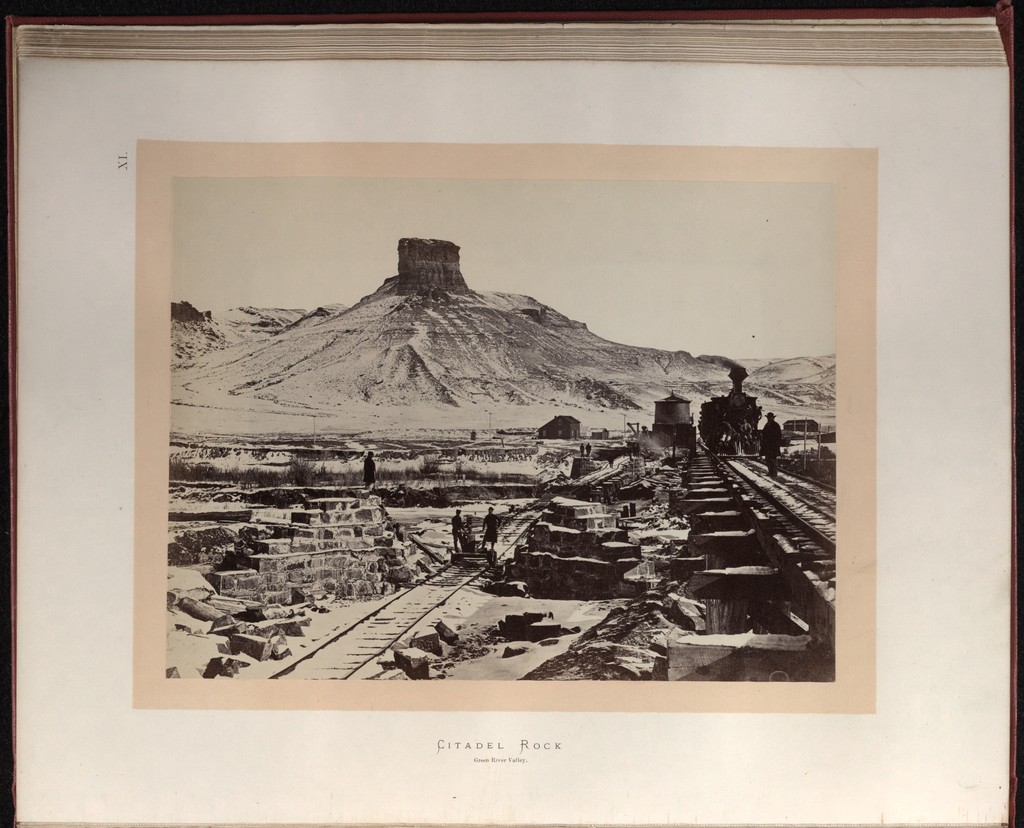
Andrew J. Russell's Citadel Rock, Green River Valley, dated circa 1869 in the Library of Congress item record, offers a photographic comparison with Moran's Green River views. The image includes railway bridge construction, showing a landscape connected with transport and engineering. It is a record of a related place, not a proven preparatory source for a particular later canvas. [6]
The comparison makes selection visible. A painting that gives cliffs, riders and sky the principal attention can create a different impression from a photograph in which infrastructure occupies an important position. The absence of those features from a painted view does not prove their absence from the region.
Photography can therefore illuminate Moran's practice without being treated as a transparent answer to every question. A photograph also has a viewpoint, framing and subject. Comparing images means asking what each emphasises and what evidence connects them, rather than assuming that one automatically measures the other.
Foreground forms establish the spectator's position
Moran often gives nearby rocks or trees a strong presence before the eye moves towards a more extensive view. In Summit of the Sierras, a dark tree and angular rocks occupy the foreground, while successive pale peaks extend beyond a deep opening. The near forms make the distance feel encountered from a position within the landscape.
That arrangement creates more than a frame. The foreground's weight provides a measure against which the farther mountain can seem luminous or remote. A sharply defined branch and a cloud-softened ridge belong to different distances and ask for different kinds of attention. Their relationship gives the space its structure.
The NGA's Tower at Tower Falls sheet produces another effect through a tall rock formation near the left, water below and a pale opposite wall. Its main mass can be apprehended quickly, while smaller stones and currents extend the experience. The upright format helps give the tower a commanding position. [7]
These examples show that foreground detail serves the whole composition. It offers the spectator a close scale and an entry into space. Its importance does not require every near object to receive equal emphasis or every distant feature to become equally clear.
Material records and finished effects
The Chicago Summit is recorded as gouache over graphite on cream laid paper, dated 1872/75. The NGA Tower work is watercolour and gouache over graphite on blue laid paper. These records identify combinations of materials, while their finished appearances show the effects produced together. [8] [7]
The distinction prevents an apparent outline from being assigned automatically to a visible pencil stage. Underlying drawing and coloured handling may become difficult to separate in a reproduction. A museum's material description can establish the foundation without claiming that the viewer can reconstruct every stage from the final surface.
The works also remind us that Moran's technique varied with medium. A coloured sheet has its own scale and support, while an oil canvas offers another physical field. Comparing them should preserve those differences. The same interest in mountain distance can lead to different arrangements rather than one method applied identically everywhere.
Format changes the experience of distance
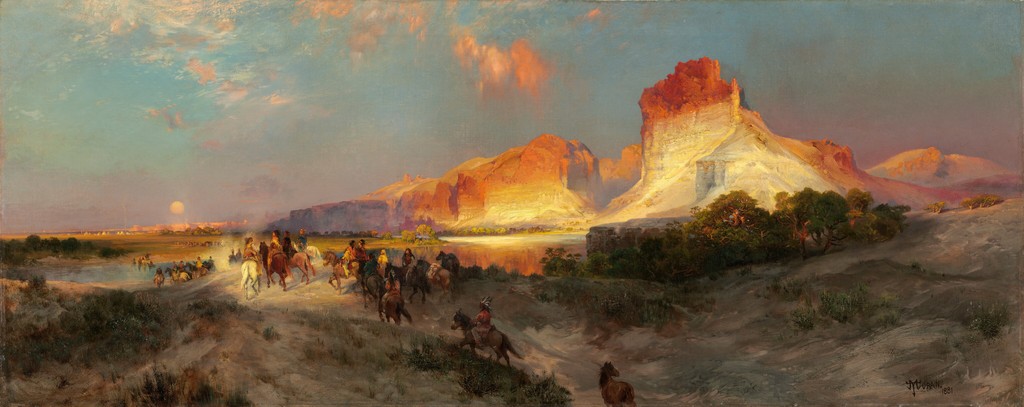
The Chicago Summit measures 36 × 25 centimetres. Its upright field stacks foreground, mountain opening and sky, making the spectator look past a nearby obstruction towards the peaks. The NGA's 1881 Green River canvas measures 63.5 × 157.5 centimetres. Its much wider field allows the eye to travel along the cliff and across neighbouring forms. [8] [9]
These proportions offer different ways to experience an extensive landscape. The sheet concentrates ascent and recession within a narrow space; the canvas gives lateral relationships more room. Scale and format help organise the encounter before the spectator examines the smaller details. The comparison concerns two separate works, and supplies no evidence for a particular enlargement process between drawing and painting.
Watch: Thomas Moran
Choose a film to explore the artist’s work, its interpretation and its wider setting.
The painting that inspired a National Park
A close discussion of Moran’s landscape and its relationship to the idea of Yellowstone.
Watch on YouTube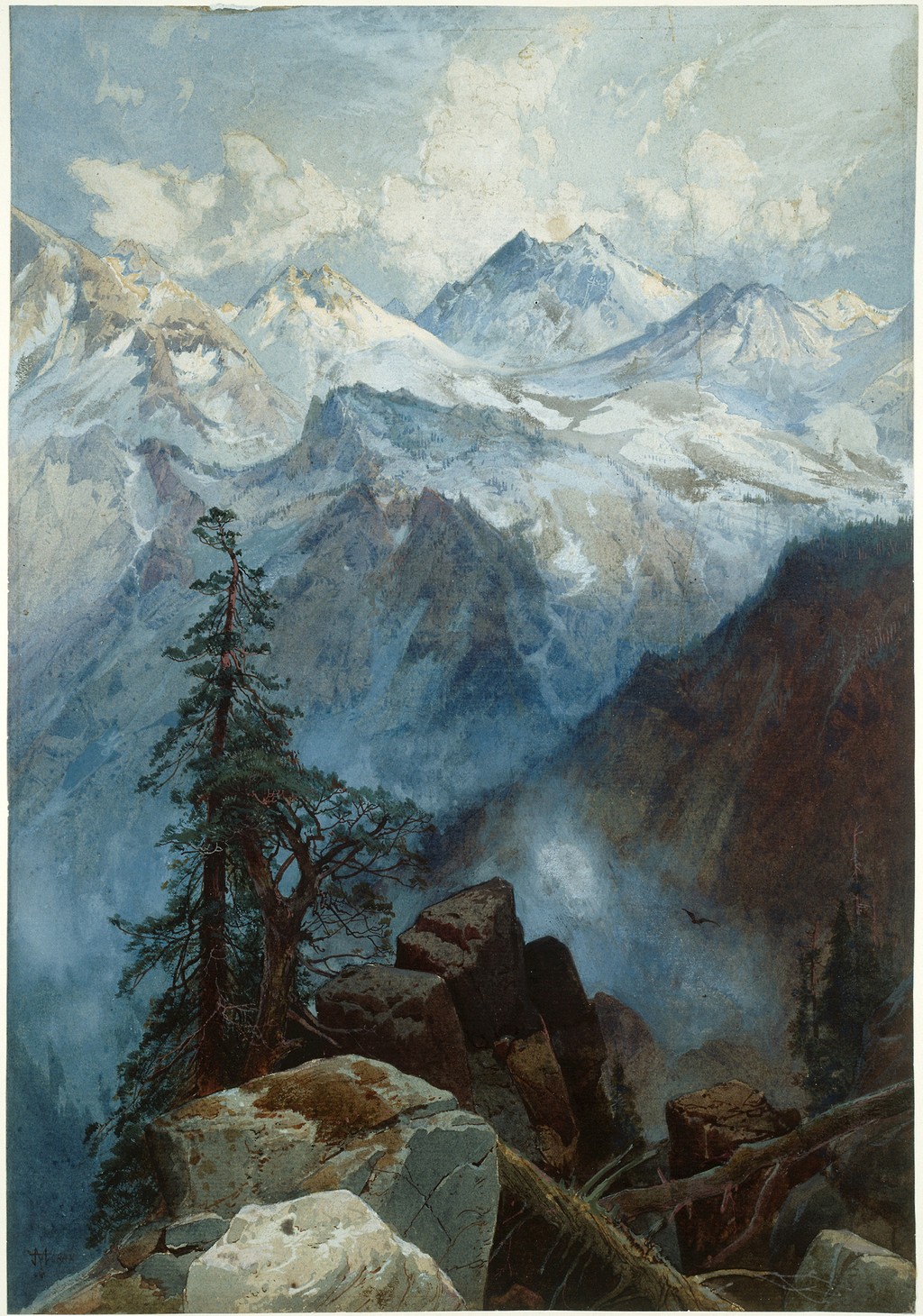
Colour, light and the organisation of rock
In Green River Cliffs, Wyoming, dated 1881, an illuminated central wall commands a long, low canvas. Much smaller riders and quieter surrounding passages help establish its scale. Colour and light make the rock appear forceful within a scene whose human activity remains comparatively modest. [9]
The darkest intervals matter because they allow the brighter areas to advance. A uniformly illuminated cliff would offer fewer internal distinctions. Changes in colour and shade make faces turn, ledges interrupt one another and adjacent forms occupy different positions. The spectator judges mass through those relationships.
Atmosphere can then alter that judgement. A distant formation may lose a hard boundary, while the main cliff retains clearer divisions. The painting combines substantial rock with a surrounding field that seems less fixed. Its sense of space depends partly on what light and air allow the viewer to distinguish.
These are visible effects within the image. They do not identify a chemical pigment recipe for each passage. A description of warm and cool, strong and subdued or sharp and softened relationships can explain how the composition works without pretending that a digital reproduction supplies a complete material analysis.
What published technical evidence can add
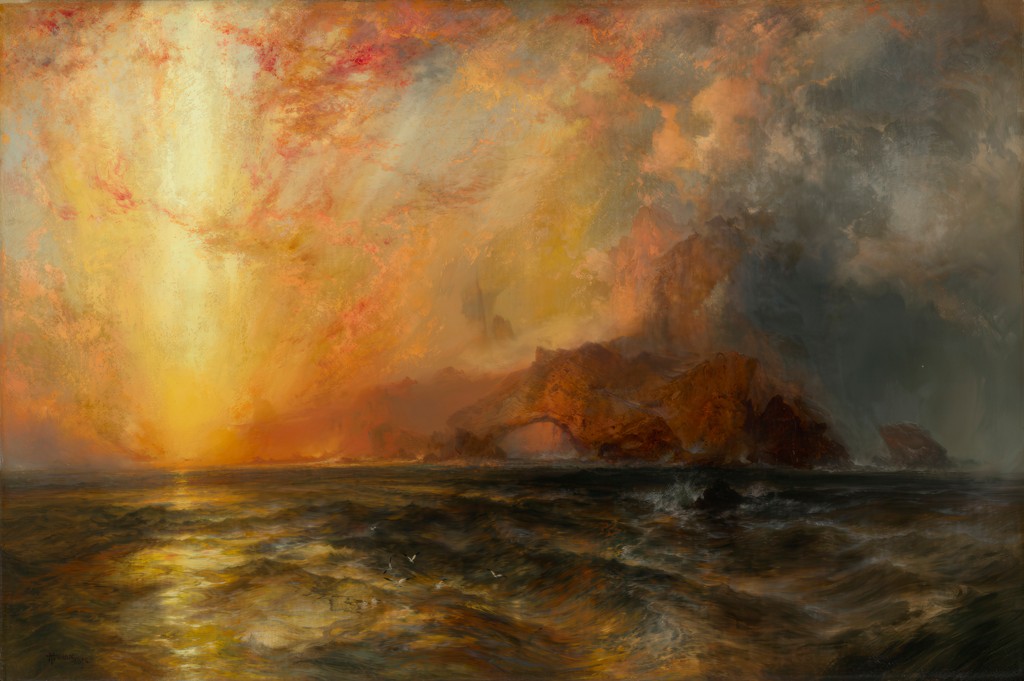
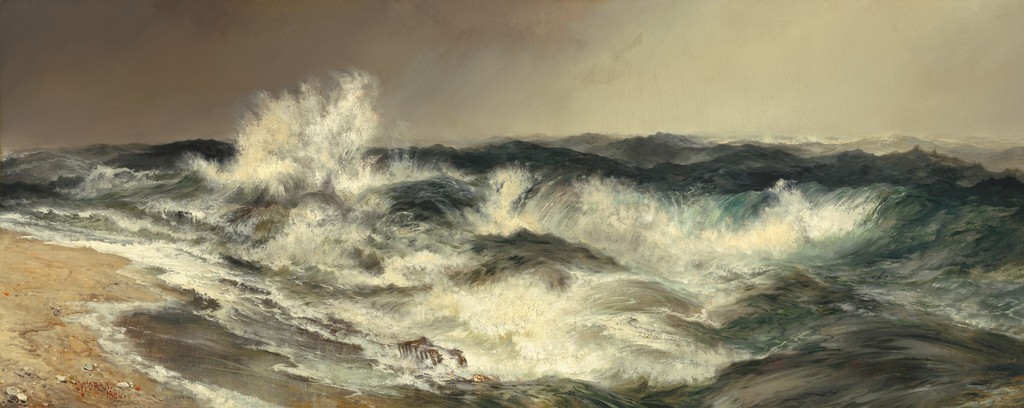
For the 1884 oil The Much Resounding Sea, the NGA's 1998 catalogue supplies historical technical notes. It records a twill-weave support with a tan ground, dark reddish-brown underpainting in the waves, wet-into-wet handling in the sky and low impasto in the white surf. It also records a lining treatment in 1967. [4]
Those findings give material substance to the contrast between waves, foam and sky. They concern this individual painting, rather than establishing that Moran prepared every canvas with the same ground or used identical handling for every cloud. Their publication date also matters: they are historical observations, not a newly performed examination of the painting's condition today.
The report and the image answer different questions. The report identifies aspects of support and paint handling; looking shows how dark hollows give weight to the waves and pale foam changes their edges. Combining them can deepen the analysis while leaving the boundary between material evidence and visual interpretation clear.
Water makes motion available in a still image
The sea oil distributes attention among several raised and breaking passages. A darker body gives a wave weight; its pale crest marks the point where that body changes form. Smaller surrounding disturbances connect the principal break with the rest of the surface. The spectator can imagine movement through the relations among these still forms.
Water also gives Moran different ways to organise a landscape. A reflective river can carry light towards the foreground, a cataract can lead the eye over a definite edge and surf can repeatedly interrupt an open horizon. The substance recurs, but its compositional role changes with the subject.
That variety makes comparison useful. Instead of asking only whether his water looks realistic, notice which stage of movement receives the strongest emphasis and what stable form gives it a measure. Rock, shore or tree can help the spectator judge a changing surface whose outline never appears fully secure.
Painting and print require different decisions
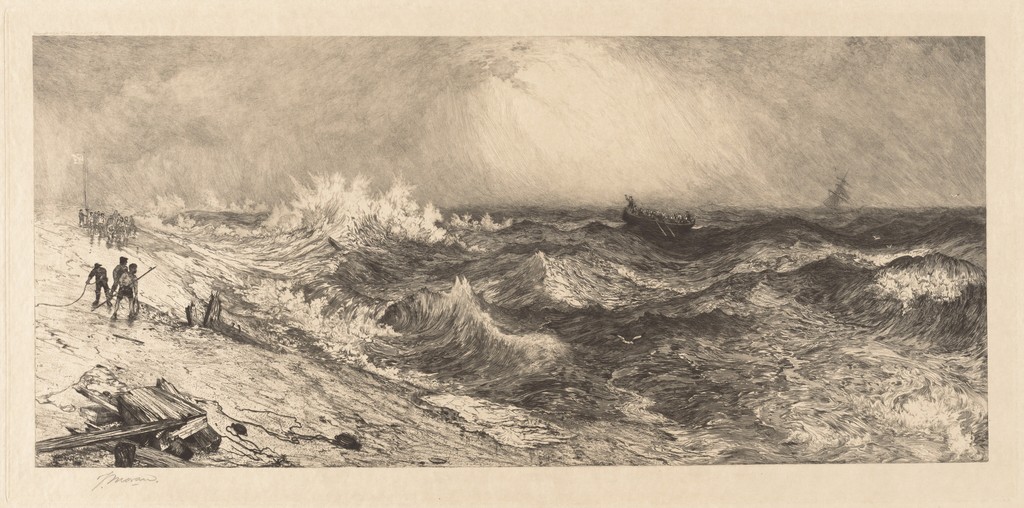
The later NGA Much Resounding Sea print is recorded as etching, drypoint and roulette on Japanese paper. Its shore contains figures, equipment and broken-looking timber, making human activity more explicit than in the 1884 oil. It is a distinct work whose image depends on graphic marks and tonal contrast. [10]
The comparison identifies a change in both medium and emphasis. Coloured foam in the oil gives way to closely organised marks; the print's figures introduce a more developed shore narrative. A shared subject does not mean that one is simply an unaltered monochrome version of the other.
Thinking across media therefore involves more than asking which process can imitate colour most closely. A print can give a familiar subject a different rhythm, texture or human focus. Moran's interest in atmosphere and natural force continued, while the means by which he presented them changed.
Repeated subjects and individual compositions
The Amon Carter's 1874 Cliffs of Green River and the NGA's 1881 Green River Cliffs, Wyoming are separate oils. They offer a clear opportunity to compare how a repeated landscape subject is arranged across individual objects. The titles and dates should remain attached to their respective works. [11] [9]
A change of format alters the relations among rock, sky and smaller foreground elements. One formation can receive more prominence, light can move attention to another area and human presence can become more or less conspicuous. Repetition supplies material for further decisions, rather than requiring an artist to reproduce one fixed design.
It also differs from reworking a particular canvas or printing plate. Two related paintings do not automatically represent stages of one object's making. A documented alteration concerns an individual work's history; comparison between separate versions concerns what the artist did differently across them.
An impressionist outside the accepted school
In 1903 Moran declared, “I am an impressionist, but I do not belong to the accepted school of impressionism.” The qualification belongs to the original sentence. His subsequent argument distances him from the contemporary movement while defending the communication of an impression produced by nature. [2]
The statement should be read as his position, not as evidence that he belonged to French Impressionism or as a neutral judgement of other artists. It reveals a disagreement over what an impression should mean in painting. For Moran, individual response, knowledge and an intelligible overall effect belonged together.
His pictures allow the viewer to test those priorities through looking. Examine a foreground rock, follow the distribution of light and notice where atmosphere prevents complete clarity. Style emerges through the relations among these choices. His published words help explain the aims, while the individual image shows how convincingly they take form.
Artworks directory
Selected documented works and distinct versions. This directory is not a comprehensive catalogue raisonné. Dates and media retain the distinctions explained in the articles and museum records.
| Name | Date | Medium |
|---|---|---|
| An Arizona Sunset near the Grand Canyon | Date not securely established | Oil painting |
| Autumn Afternoon, the Wissahickon by Thomas Moran | 1864 | Oil on canvas |
| Cascade Falls, Yosemite | Commonly catalogued as 1905 | Catalogued as oil on canvas |
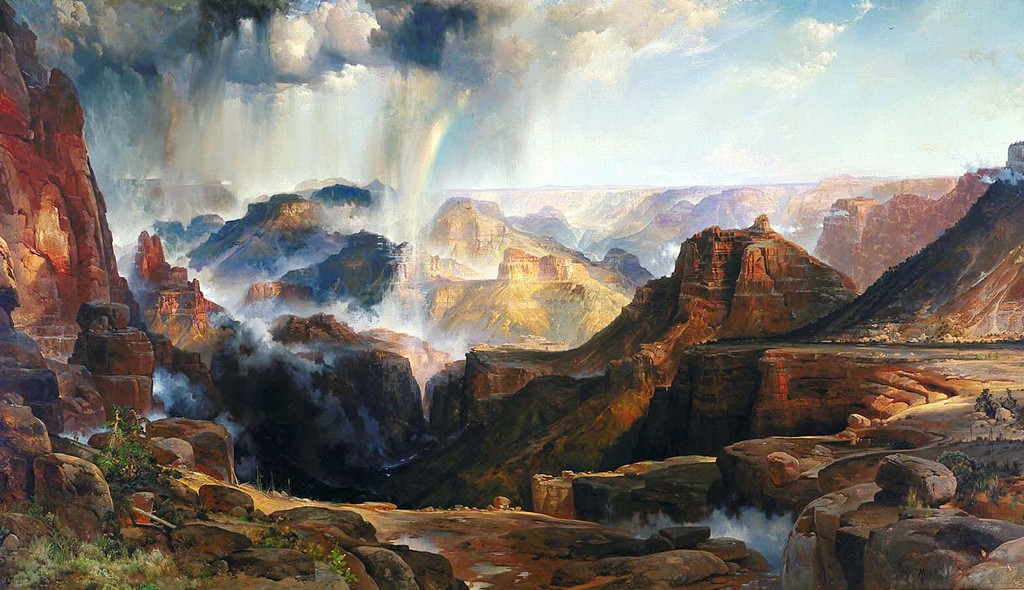
| The Chasm of the Colorado | 1873–1874; completed in 1874 | Oil on canvas, currently mounted on aluminium |
| Children of the Mountain | 1866 in the current museum title; 1867 in the 1997 National Gallery catalogue | Oil on canvas |
| Cliffs of Green River | 1874 | Oil on canvas |
| Cliffs of the Upper Colorado River, Wyoming Territory | 1882 | Oil on canvas |
| East Hampton, Long Island , also captioned Easthampton, L.I | 1897 | Oil on canvas laid on board, according to the reproduction record |
| Fiercely the red sun descending, Burned his way along the heavens | 1875–76 | Oil on canvas |
| Forest Scene | 1870 | Oil on canvas |
| Grand Canyon of the Colorado River | 1892 and 1908 | Oil on canvas |
| Green River Cliffs, Wyoming | 1881 | Oil on canvas |
| Green River, Wyoming | 1878 | Oil on panel |
| The Juniata, Evening | 1864 | Oil on canvas |
| Mosquito Trail, Rocky Mountains of Colorado | 1875 in the 1997 National Gallery exhibition catalogue | Watercolour |
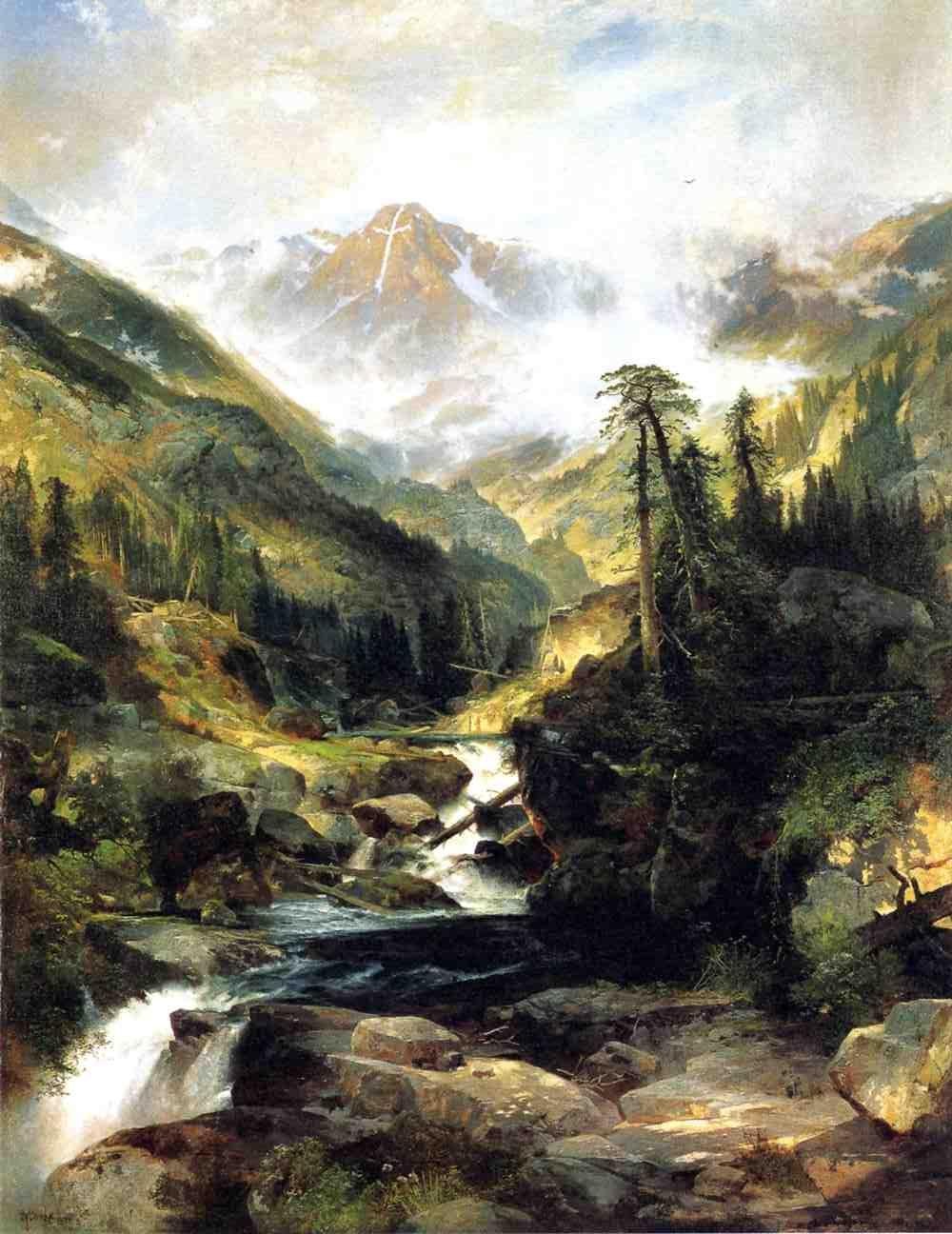
| Mountain of the Holy Cross | 1875 | Oil on canvas |
| The Much Resounding Sea | 1884 | Oil on canvas |
| Point Lobos, Monterey, California | 1912, signed and dated | Oil on canvas |
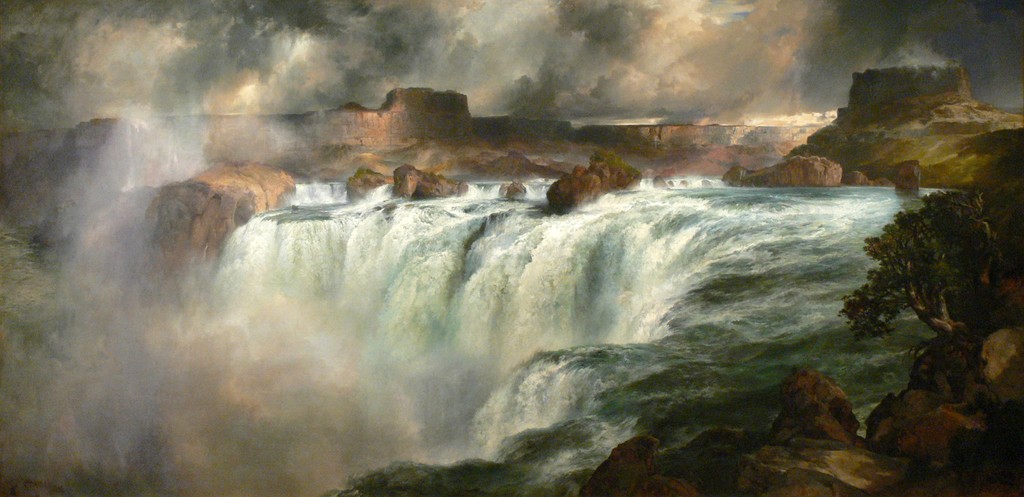
| Shoshone Falls on the Snake River | 1900 | Oil on canvas |
| Summit of the Sierras | 1872/75, as catalogued by the Art Institute of Chicago | Gouache over graphite on cream laid paper |
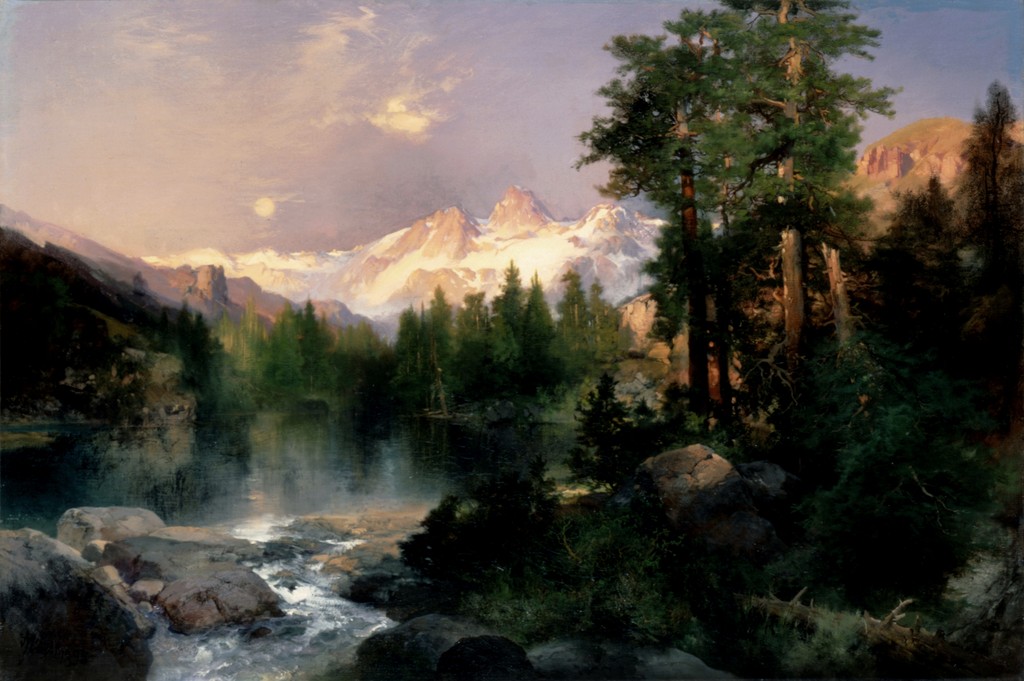
| The Teton Range | 1897 | Oil on canvas |
| The Three Tetons | 1895 | Oil on canvas |
| Tower Falls, Yellowstone | 1872 | Watercolour and gouache over graphite on blue laid paper |
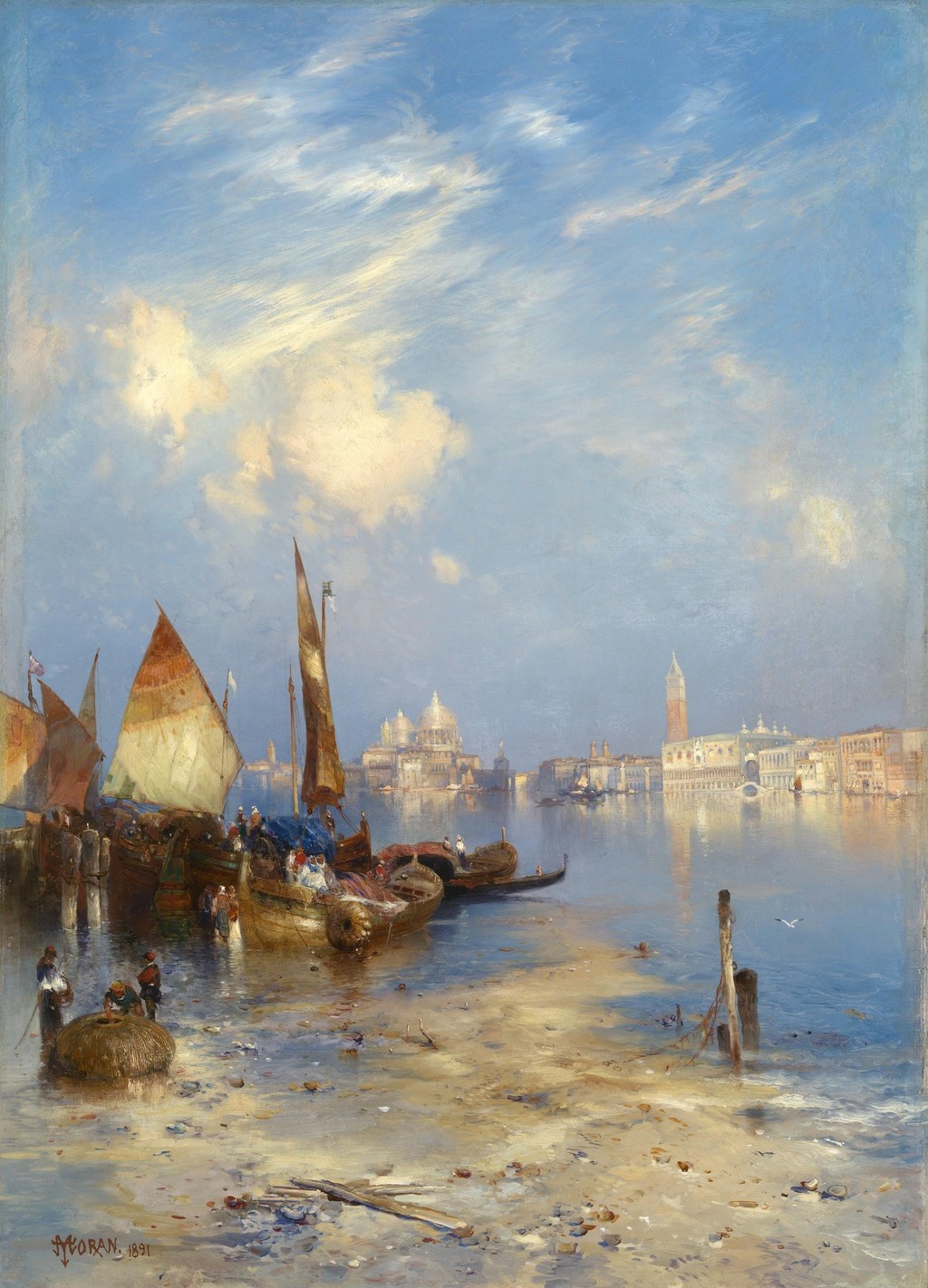
| A View of Venice | 1891 | Oil on canvas |
| The Grand Canyon of the Yellowstone | 1872 | Oil on canvas, currently recorded as mounted on aluminium |
| Mountain of the Holy Cross, Colorado (etching) | 1888 | Etching, roulette and aquatint |
| The Resounding Sea (etching) | 1880 | Etching |
| The Much Resounding Sea (later etching) | 1886 in heading; 1888 on plate | Etching, drypoint and roulette |
| Tower Falls (Prang print) | c. 1875; portfolio issued 1876 | Chromolithograph |
| Shoshone Falls (early watercolour) | 1874 | Watercolour |
| Venice (watercolour) | 1888 | Watercolour over graphite |
Frequently Asked Questions
His reported 1879 statements defend rearrangement and idealisation while retaining close study of nature.
Drawing and photographic relationships occur in the documented career. Particular claims that one image directly supplied another still need object-specific evidence.
The reproduction supports visual comparison. Material claims require documented examination, such as the published 1998 technical notes for the sea oil.
The museum records distinguish oils, coloured works over graphite and prints involving several graphic techniques. Their individual material identities matter.
His 1903 statement explicitly distinguishes his use of impressionist from the accepted school of Impressionism.
Discussion
Choose a painting and a related paper work or print. Compare foreground, light, atmosphere and format. Which choices carry the subject's character across media, and which give each object a different experience?
Reader Insights
Editorial prompts for close looking and discussion.
Choose a painting and a related paper work or print. Compare foreground, light, atmosphere and format. Which choices carry the subject's character across media, and which give each object a different experience?
Which source or image helps you assess the interpretation?
How does this page compare with the related works linked above?
Join the Conversation
Share your reading of this page below.
References
- G. W. Sheldon, American Painters, 1879, Moran chapter, pp. 122–126, especially pp. 125–126.
- Thomas Moran, Knowledge a Prime Requisite in Art, Brush and Pencil, April 1903, pp. 14–16, interview excerpt.
- The Frick Art & Historical Center, The Poetry of Place: Works on Paper by Thomas Moran from the Gilcrease Museum, 2001 presentation and Donna Gustafson essay excerpt.
- Nancy Anderson, Moran biography and sea-painting entry in American Paintings of the Nineteenth Century, Part II, National Gallery of Art, 1998, pp. 11–14, including historical technical notes.
- Kevin J. Avery, Thomas Moran's Colburn's Butte, South Utah: Forgotten Landmark of a Lost Friendship, Metropolitan Museum Journal 44, 2009, selected making discussion.
- Library of Congress, Andrew J. Russell, Citadel Rock, Green River Valley, circa 1869, item record.
- National Gallery of Art, Tower at Tower Falls, Yellowstone, 1872, 2012.93.1.
- Art Institute of Chicago, Summit of the Sierras, object metadata, 1872/75, 1965.852.
- National Gallery of Art, Green River Cliffs, Wyoming, 1881.
- National Gallery of Art, The Much Resounding Sea, print record, 2002.98.166.
- Amon Carter Museum of American Art, Cliffs of Green River, 1874.
- Splash image source.
Green River Cliffs, Wyoming, 1881. National Gallery of Art, Gift of the Milligan and Thomson Families. Image source. Public domain; NGA Open Access. Resized only; complete source image retained.
- Splash image source.
Citadel Rock, Green River Valley, circa 1869. Railway bridge construction shows the industrial landscape omitted from many Moran paintings. Andrew J. Russell / Library of Congress, LC-DIG-ppmsca-03147. Image source. No known restrictions on publication. Resized only; complete source image retained.
- Splash image source.
Summit of the Sierras, 1872/75, gouache over graphite on cream laid paper. Art Institute of Chicago, Gift of Mrs. Byron Harvey, 1965.852. Image source. Public Domain Mark; faithful reproduction; AIC record is_public_domain true. Resized only; complete source image retained.
- Splash image source.
The Much Resounding Sea, 1884. National Gallery of Art, Gift of the Avalon Foundation. Image source. Public domain; NGA Open Access. Resized only; complete source image retained.
- Splash image source.
The Much Resounding Sea, printcatalogued1886, with1888plateinscription recordedbymuseum. Etching,drypoint androulette onJapanese paper. NGA,2002.98.166. National Gallery of Art / Gift of Jacob Kainen. Image source. Public domain; NGA Open Access, exactobjectmedia declaration. Resized only; complete source image retained.
- Splash image source.
The Grand Canyon of the Yellowstone, 1872. Wuselig / Wikimedia Commons, CC BY-SA 4.0; U.S. Department of the Interior Museum painting. Image source. CC BY-SA 4.0; also marked PD-Art. Outer museum frame cropped; resized. Painted composition retained; photographic perspective unchanged. This image derivative is available under the same licence.
- Splash image source.
The Chasm of the Colorado, 1873–1874. U.S. Department of the Interior Museum; faithful reproduction via Smithsonian American Art Museum / Wikimedia Commons. Image source. Public Domain Mark; faithful two-dimensional reproduction. Resized only; complete source image retained.
- Splash image source.
Mountain of the Holy Cross, 1875. Autry Museum of the American West; faithful reproduction via Wikimedia Commons. Image source. Public Domain Mark; faithful two-dimensional reproduction. Resized only; complete source image retained.
- Splash image source.
Shoshone Falls on the Snake River, 1900. Wolfgang Sauber / Wikimedia Commons, CC BY-SA 3.0; Gilcrease Museum painting. Image source. CC BY-SA 3.0; also marked PD-Art. Resized only; complete source image retained. This image derivative is available under the same licence.
- Splash image source.
Green River Cliffs, Wyoming, 1881. National Gallery of Art, Gift of the Milligan and Thomson Families. Image source. Public domain; NGA Open Access. Resized only; complete source image retained.
- Splash image source.
A View of Venice, 1891. Smithsonian American Art Museum, Transfer from the U.S. Department of the Interior, National Park Service, 1968.120.1. Image source. Free to use; Smithsonian Open Access. Resized only; complete source image retained.
- Splash image source.
The Three Tetons, 1895. The White House Collection, Gift of C. R. Smith; faithful reproduction via Wikimedia Commons. Image source. Public Domain Mark; faithful reproduction of a two-dimensional public-domain work. Resized only; complete source image retained.