 by Tom Gurney
Tom Gurney BSc (Hons) is an art history expert with over 20 years experience
Published on June 19, 2020 / Updated on October 27, 2026
Email: tomgurney1@gmail.com / Phone: +44 7429 011000
The Teton Range: Introduction
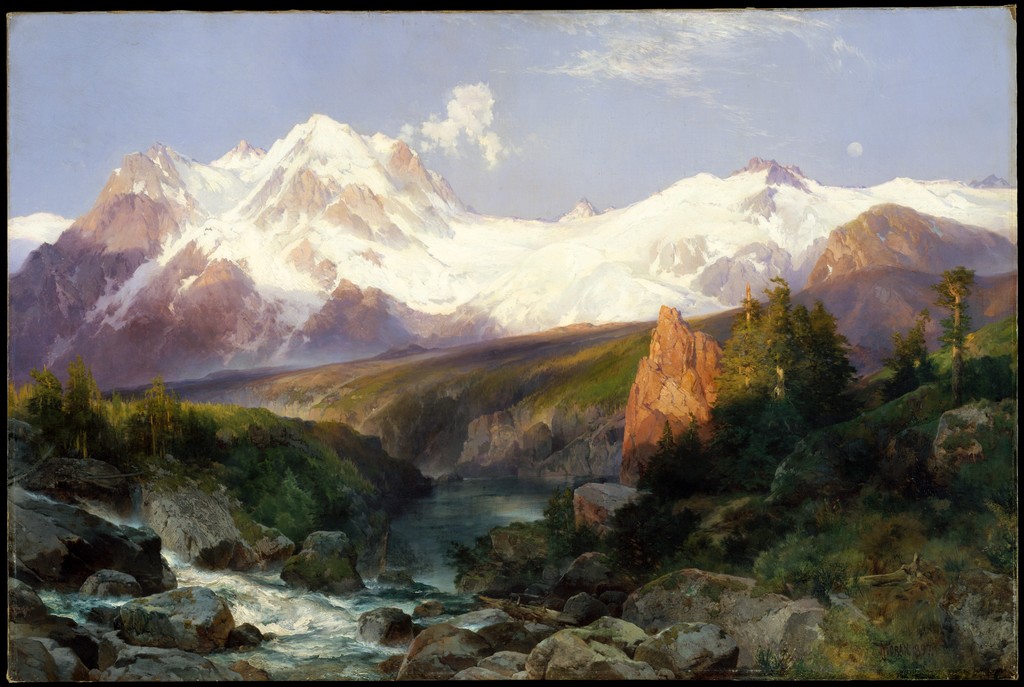
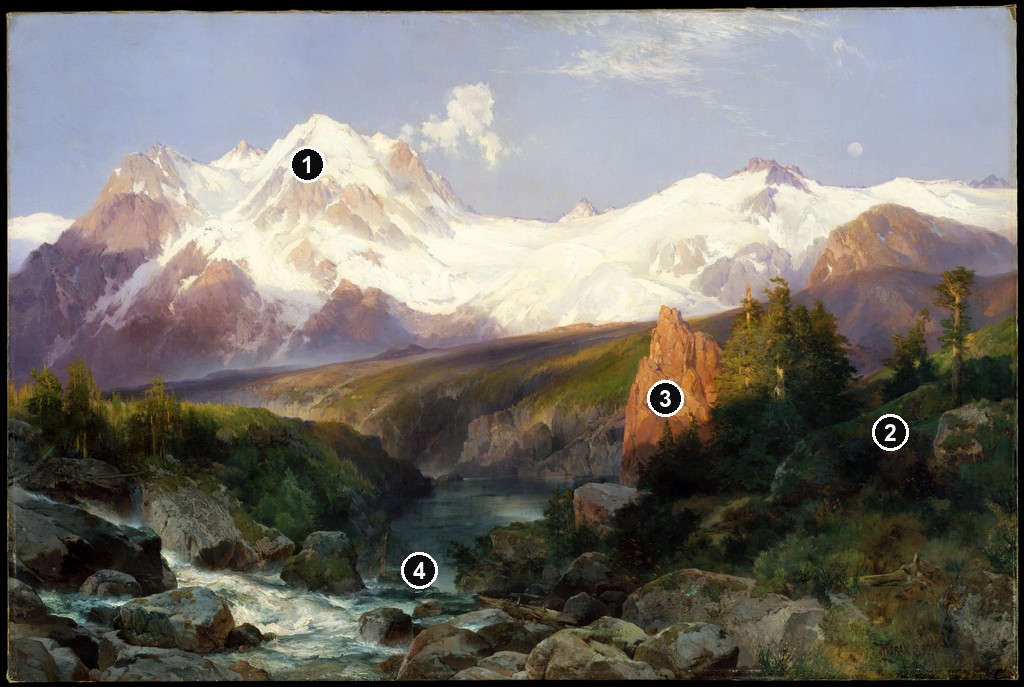
Thomas Moran's The Teton Range, dated 1897, is an oil on canvas in the Metropolitan Museum of Art. A bright, snow-covered mountain landscape rises beyond water, forest and a rocky foreground. The broad view is animated by a more immediate passage of white water moving between boulders near the lower edge. [1]
The painting offers several different ways of experiencing scale. Snow extends across a wide distance; trees stand nearer and break that distance into smaller intervals; rocks and rushing water come close to the spectator. Moran joins these relationships within a canvas that is 76.2 × 114.3 cm, much smaller than his monumental canyon paintings.
At a Glance
- ArtistThomas Moran
- TitleThe Teton Range
- Date1897
- MediumOil on canvas
- Dimensions76.2 × 114.3 cm
- CollectionMetropolitan Museum of Art
- Object number39.47.2
- CreditBequest of Moses Tanenbaum, 1937
- Documented Teton journey1879
- Different canvasThe Three Tetons, 1895, White House Collection
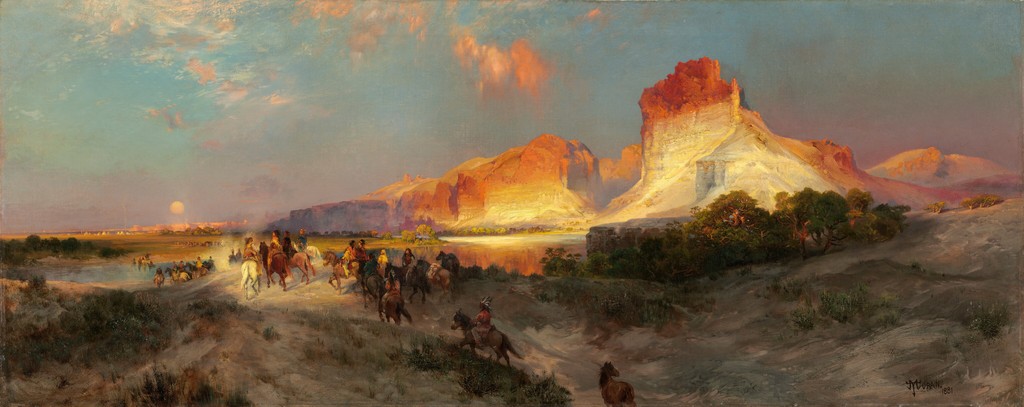
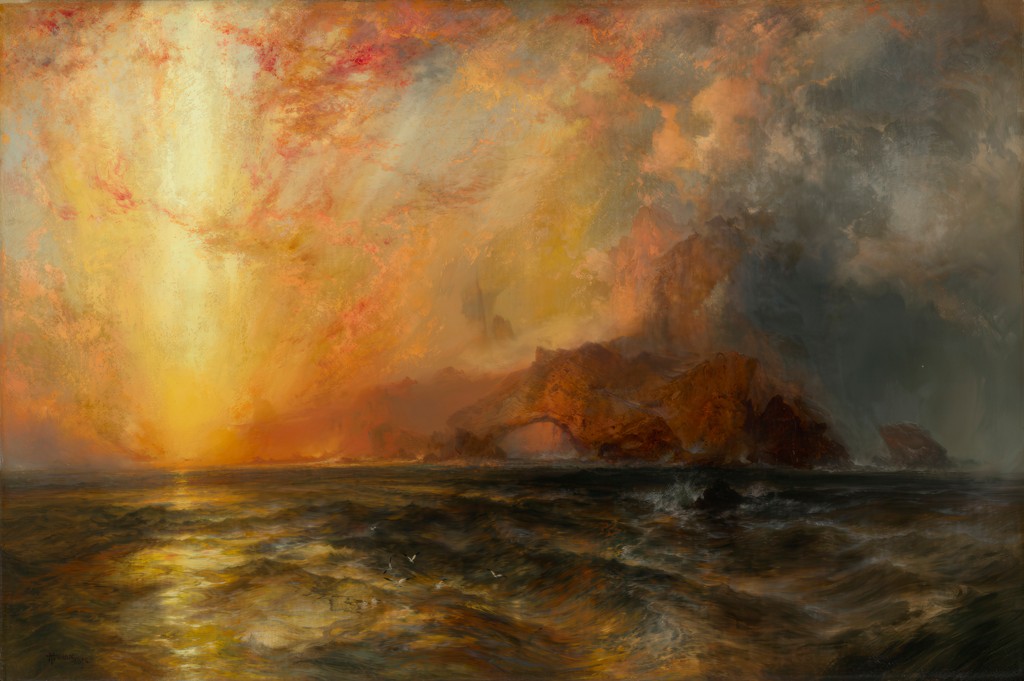
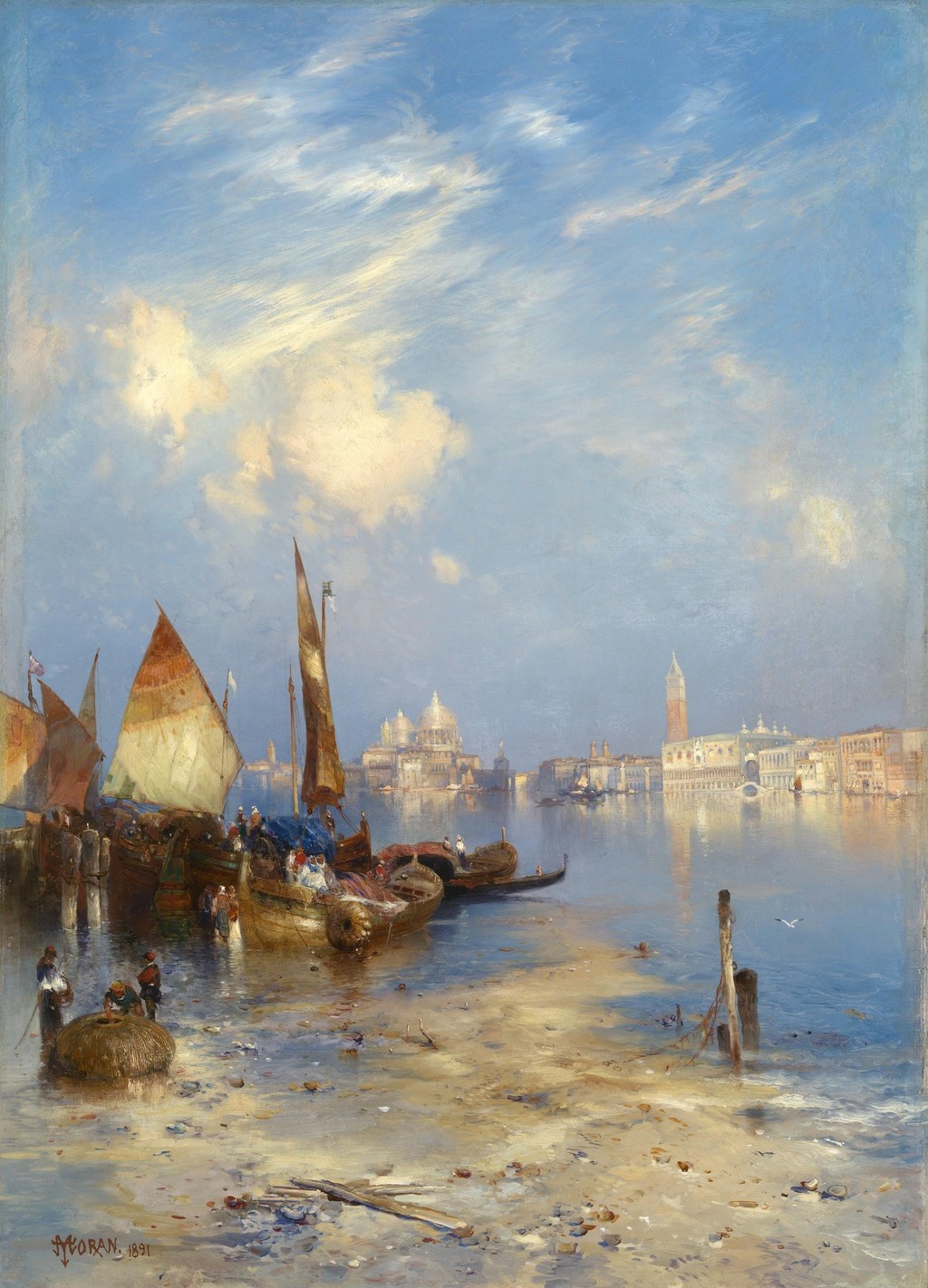
Where this work sits in Moran’s career
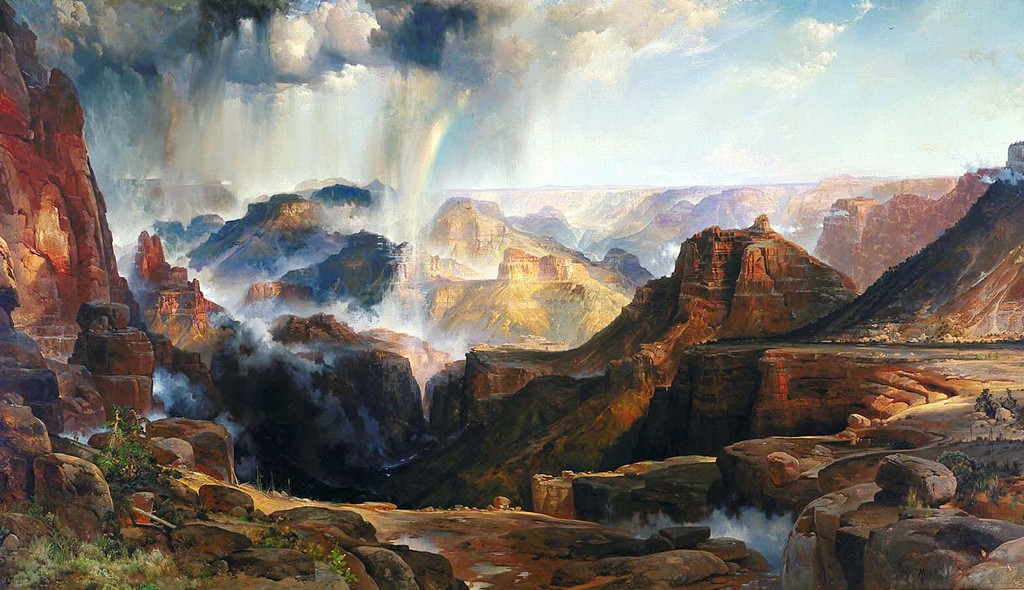
The Chasm of the Colorado
1873–1874; completed in 1874A View of Venice
1891Point Lobos, Monterey, California
1912, signed and datedThe Teton Range
1897Contents
- Mountains spread across the view
- Sky, cloud and a pale disc
- The nearer trees
- A warm rock among the forest
- Quiet water and rushing water
- The 1879 journey behind later Teton pictures
- The Met's interpretation of the landscape
- A different Teton canvas
Mountains spread across the view
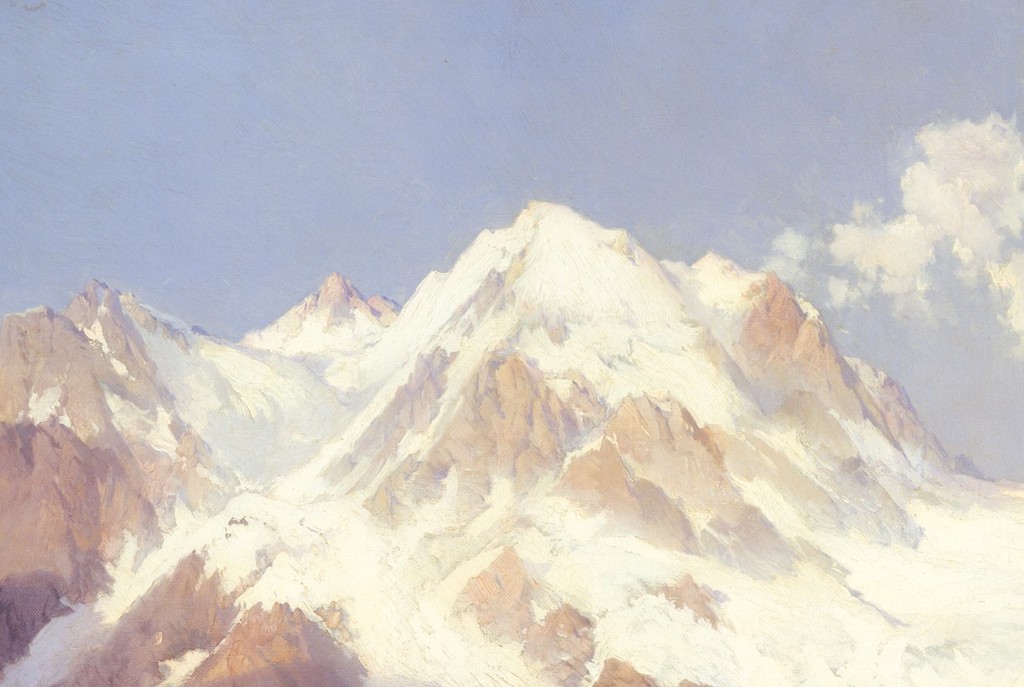
The snow-covered range occupies much of the middle and upper picture. The highest-looking group is towards the left, where pale slopes meet steep, warmer rock faces. Further right, the snow spreads more broadly across a lower-looking series of forms. Their different profiles give the range variety within a continuous expanse.
Snow creates many of the brightest passages. It lies beside exposed rock rather than concealing the whole mountain uniformly. Darker and warmer interruptions make its slopes easier to follow. A white area can indicate a surface receiving light, while a neighbouring coloured passage supplies a stronger sense of depth or steepness.
The peaks are not all equally isolated against the sky. Some have emphatic points; others merge into broad pale surfaces. This prevents the mountains from becoming a row of separate, identical symbols. They appear related through overlapping forms, changing heights and the light extending across them.
At the lower edge of the range, a darker ridge separates the distant snow from the nearer wooded landscape. Its long diagonal carries attention towards the right. That intermediate form helps organise depth: the snowy mountains, the ridge and the foreground occupy different parts of the view without being disconnected.
Annotated Details from The Teton Range
Compare these details with the full composition. The numbered overview and crops come from the same original image.
Details from THE TETON RANGE
Open a detail to see it more closely.
Mountains spread across the view
The snow-covered range occupies much of the middle and upper picture. The highest-looking group is towards the left, where pale slopes meet steep, warmer rock faces. Further right, the snow spreads more broadly across a lower-looking series of forms. Their different profiles give the range variety within a continuous expanse.
The nearer trees
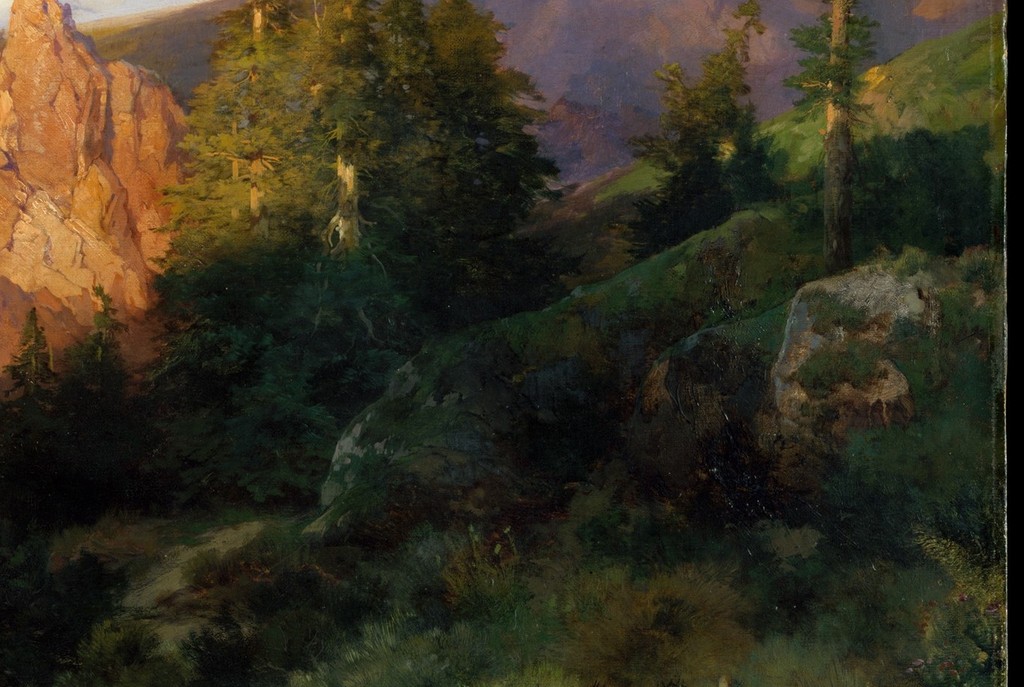
Conifers gather on both sides of the picture, with the larger and more prominent group on the right. Their dark green masses contrast with the snow. Warm light touches some trunks and branches, preventing the group from becoming one uniform silhouette.
A warm rock among the forest
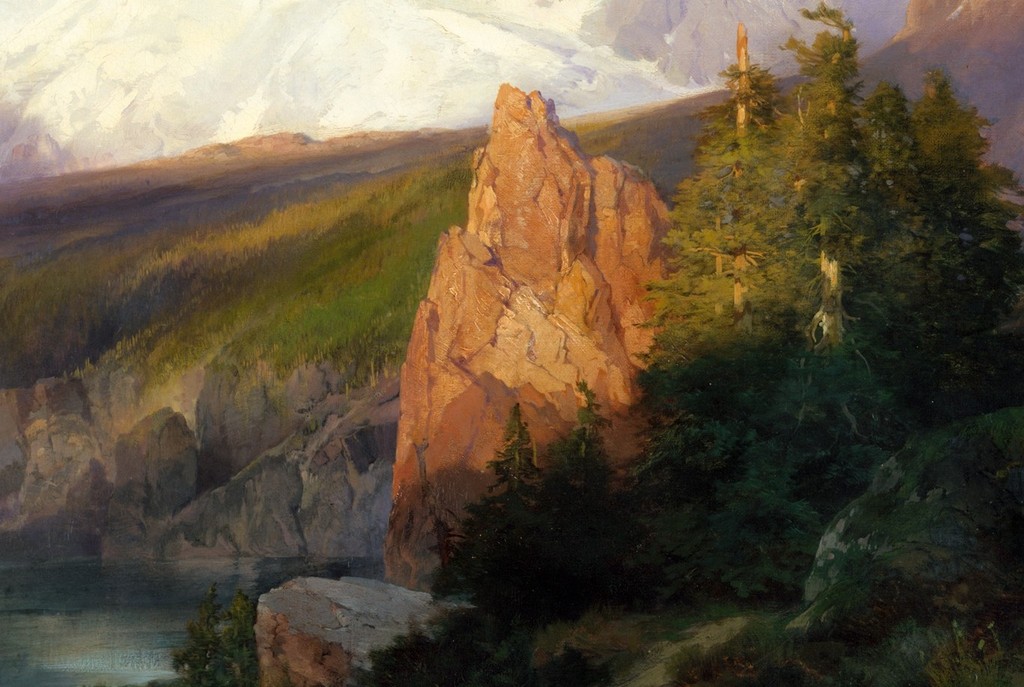
An orange-brown rock projection rises near the right of centre. Its broken summit and illuminated face distinguish it from the darker trees around it. The formation provides one of the strongest warm accents in the painting, answering the exposed rock passages among the distant snow.
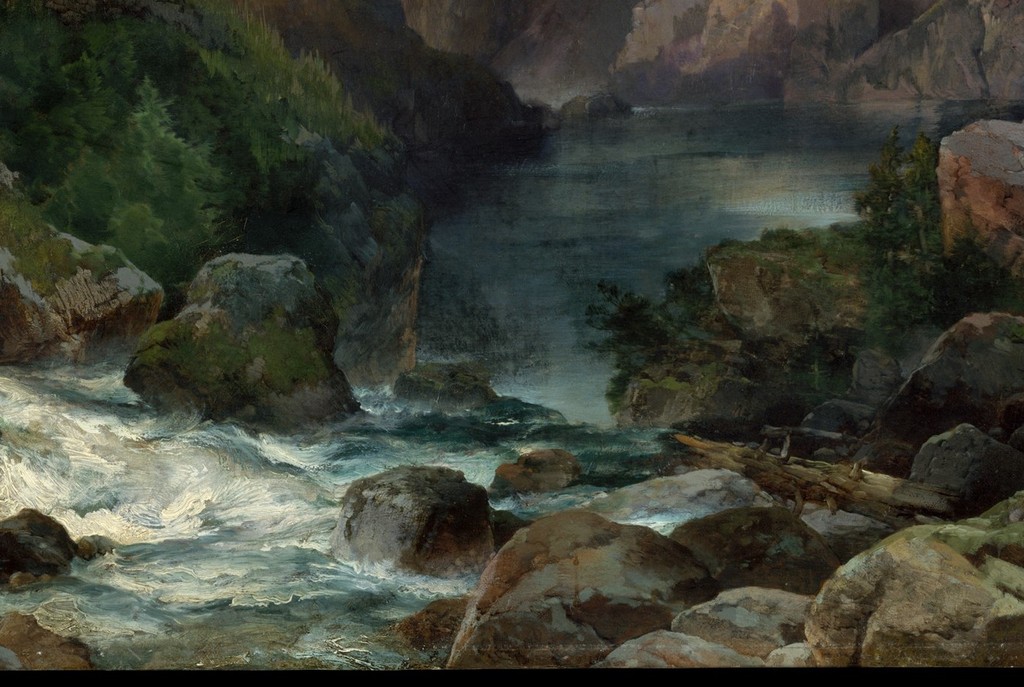
Quiet water and rushing water
The central water appears comparatively dark and calm. It occupies an opening between rock and wooded banks, receiving softened reflections from its surroundings. Its smooth-looking surface introduces a quieter interval beneath the extensive mountain range.
Sky, cloud and a pale disc
The sky is predominantly cool and pale. Small clouds gather above the left-hand mountain group, and a light circular disc appears higher on the right. These elements are much less forceful than the snow-covered range, yet they keep the sky from becoming an entirely empty background.
The light clouds near the peaks repeat the mountains' brightness in a softer form. Stone and snow have more strongly organised planes; cloud has less stable boundaries. Their proximity allows the eye to compare different kinds of pale surface. Brightness belongs to land and atmosphere, with a change of texture between them.
The circular disc has a quiet role. It draws attention to an interval above the right-hand part of the range without becoming the painting's principal centre. Its presence need not be converted into an exact astronomical time or a documented date of observation. The picture's effect can be understood through its placement and relative brightness.
The sky also supplies space above the mountains. The range seems elevated because its peaks have room around them. If the bright snow pressed continuously against the upper edge, the composition would feel more compressed. Moran allows a broad atmosphere to support the land's apparent extent.
The nearer trees
Conifers gather on both sides of the picture, with the larger and more prominent group on the right. Their dark green masses contrast with the snow. Warm light touches some trunks and branches, preventing the group from becoming one uniform silhouette.
The trees have varied heights. Some rise well above the nearby rock; others occupy lower ground or disappear into the deeper shadows. Their differences make the foreground forest appear extensive without requiring every tree to be described separately. The viewer can recognise a group while still finding distinct individual forms within it.
On the left, a smaller group stands against the lower mountain slopes. Its position creates another step into depth. The eye can move from the nearby boulders to trees, then towards the larger landforms. These intermediate shapes make the distant range feel connected with the spectator's ground.
The arrangement also keeps an opening near the centre. Trees provide substantial weight at the sides, but do not close the view completely. Through the interval, water and the lower cliffs remain visible. The forest gives the picture a near enclosure while allowing the mountain distance to retain its importance.
A warm rock among the forest
An orange-brown rock projection rises near the right of centre. Its broken summit and illuminated face distinguish it from the darker trees around it. The formation provides one of the strongest warm accents in the painting, answering the exposed rock passages among the distant snow.
Its position is crucial. The projection is much nearer than the mountains but high enough to overlap their lower slopes. It links different depths through a shared colour relationship. At the same time, its sharper outline makes it more physically immediate than the paler range beyond.
The rock does not occupy the geometric centre. Instead, it introduces an uneven emphasis within the broad view. The brighter mountain group on the left and the warm projection on the right attract attention in different ways. The eye moves between them rather than remaining fixed on one symmetrical arrangement.
Trees partly overlap its lower surface. Their darker marks break the warm colour into smaller passages, making rock and vegetation interact. This close relationship gives the foreground more complexity than a simple frame placed around the mountains. The nearer landscape has its own structure and centres of interest.
Watch: Thomas Moran
Choose a film to explore the artist’s work, its interpretation and its wider setting.
The painting that inspired a National Park
A close discussion of Moran’s landscape and its relationship to the idea of Yellowstone.
Watch on YouTubeQuiet water and rushing water
The central water appears comparatively dark and calm. It occupies an opening between rock and wooded banks, receiving softened reflections from its surroundings. Its smooth-looking surface introduces a quieter interval beneath the extensive mountain range.
Nearer the lower edge, water moves between large boulders. White foam and narrow, changing channels interrupt the darker stone. The stream's movement supplies another kind of line within the composition. Unlike a mountain ridge or tree trunk, it appears continuously divided and redirected by obstacles.
The boulders also give the spectator a close scale of observation. Their surfaces are broader and more detailed than the small forms in the distance. Some catch pale light; others contain deep shadow. The stream turns around them, making their positions intelligible through the water's course.
That course leads attention towards the central opening, even though its physical direction cannot be established solely by the viewer's eye movement. Pictorial movement and the flow of water are related but different things. The painting can guide us into depth through a stream whose visible foam also suggests immediate, restless activity.
The 1879 journey behind later Teton pictures
Moran's diary passages transcribed in the National Gallery's 1997 catalogue record his Teton journey in August 1879. He travelled with his brother Peter and described mountain views changing with distance, mist and smoke. The account provides a documented travel setting long before this 1897 canvas. [2]
One passage describes the distant range as an “exquisite blue”. Other entries explain that atmospheric conditions could obscure the peaks enough to prevent sketching. These observations show that the mountains were encountered through variable visibility, rather than as a permanently clear spectacle.
The later painting makes a remarkably legible range from such a subject. That does not prove which diary entry, field drawing or viewpoint supplied every form. Its date belongs to the finished canvas. Travel, observation and studio composition should be distinguished when considering how a landscape became a picture.
The 1879 record also prevents the work from being casually assigned to Moran's famous 1871 Yellowstone journey. Related regional subjects need not have identical travel histories. The biography follows the wider sequence; the painting gives one later expression of interests developed across it.
The Met's interpretation of the landscape
The Met's current interpretation draws attention to the Indigenous communities who lived on and cared for this land, and to their absence from the painted view. It places the image within the history of western settlement and colonisation. That interpretation concerns the choices through which the region was represented. [1]
The canvas contains no prominent human activity to interrupt its mountains, trees and water. That appearance is part of its pictorial arrangement. It should not be mistaken for evidence that the represented country had no human history. A landscape painting selects what a viewer is invited to see.
This context can sit beside close attention to the picture's beauty. Snow, light and flowing water remain powerful visual relationships, while the museum's interpretation asks how such relationships helped shape an image of the West. The painting is both a carefully organised view and a cultural object with a history of representation.
A different Teton canvas
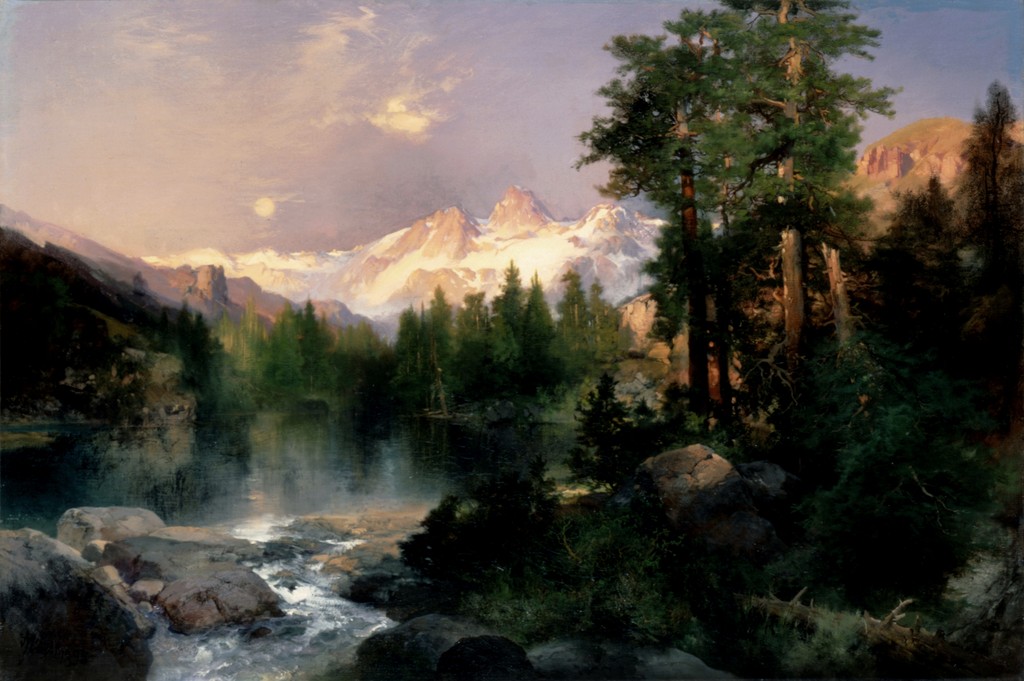
The Three Tetons, dated 1895, belongs to the White House Collection. The National Gallery catalogue records that canvas separately, with smaller dimensions of 52.4 × 77.5 cm. It is not another title for the Met's 1897 painting. [2]
In the 1895 view, tall trees dominate the right foreground and a narrower group of illuminated peaks appears beyond a wooded body of water. The 1897 canvas gives the snowy range more extensive space and places a warm rock projection nearer the centre. Comparing the two shows changes in emphasis within a related mountain subject.
The comparison is especially revealing at the lower edge. Both images include boulders and moving water, but their relationship with the distant mountains differs. The Met painting makes the range broad and commanding above a more open central interval. Its foreground activity brings the spectator close while its pale summits carry attention far beyond.
Artworks directory
Selected documented works and distinct versions. This directory is not a comprehensive catalogue raisonné. Dates and media retain the distinctions explained in the articles and museum records.
| Name | Date | Medium |
|---|---|---|
| An Arizona Sunset near the Grand Canyon | Date not securely established | Oil painting |
| Autumn Afternoon, the Wissahickon by Thomas Moran | 1864 | Oil on canvas |
| Cascade Falls, Yosemite | Commonly catalogued as 1905 | Catalogued as oil on canvas |
| The Chasm of the Colorado | 1873–1874; completed in 1874 | Oil on canvas, currently mounted on aluminium |
| Children of the Mountain | 1866 in the current museum title; 1867 in the 1997 National Gallery catalogue | Oil on canvas |
| Cliffs of Green River | 1874 | Oil on canvas |
| Cliffs of the Upper Colorado River, Wyoming Territory | 1882 | Oil on canvas |
| East Hampton, Long Island , also captioned Easthampton, L.I | 1897 | Oil on canvas laid on board, according to the reproduction record |
| Fiercely the red sun descending, Burned his way along the heavens | 1875–76 | Oil on canvas |
| Forest Scene | 1870 | Oil on canvas |
| Grand Canyon of the Colorado River | 1892 and 1908 | Oil on canvas |
| Green River Cliffs, Wyoming | 1881 | Oil on canvas |
| Green River, Wyoming | 1878 | Oil on panel |
| The Juniata, Evening | 1864 | Oil on canvas |
| Mosquito Trail, Rocky Mountains of Colorado | 1875 in the 1997 National Gallery exhibition catalogue | Watercolour |
| Mountain of the Holy Cross | 1875 | Oil on canvas |
| The Much Resounding Sea | 1884 | Oil on canvas |
| Point Lobos, Monterey, California | 1912, signed and dated | Oil on canvas |
| Shoshone Falls on the Snake River | 1900 | Oil on canvas |
| Summit of the Sierras | 1872/75, as catalogued by the Art Institute of Chicago | Gouache over graphite on cream laid paper |
| The Teton Range | 1897 | Oil on canvas |
| The Three Tetons | 1895 | Oil on canvas |
| Tower Falls, Yellowstone | 1872 | Watercolour and gouache over graphite on blue laid paper |
| A View of Venice | 1891 | Oil on canvas |
| The Grand Canyon of the Yellowstone | 1872 | Oil on canvas, currently recorded as mounted on aluminium |
| Mountain of the Holy Cross, Colorado (etching) | 1888 | Etching, roulette and aquatint |
| The Resounding Sea (etching) | 1880 | Etching |
| The Much Resounding Sea (later etching) | 1886 in heading; 1888 on plate | Etching, drypoint and roulette |
| Tower Falls (Prang print) | c. 1875; portfolio issued 1876 | Chromolithograph |
| Shoshone Falls (early watercolour) | 1874 | Watercolour |
| Venice (watercolour) | 1888 | Watercolour over graphite |
Frequently Asked Questions
1897.
Oil on canvas, 76.2 × 114.3 cm.
No. That is a separate 1895 canvas, recorded as 52.4 × 77.5 cm.
The diary passages used here record August 1879.
39.47.2; Bequest of Moses Tanenbaum, 1937.
Discussion
Move your attention from the foreground stream to the warm rock projection, then to the snow-covered range. Which contrasts make each stage feel nearer or further away?
Reader Insights
Editorial prompts for close looking and discussion.
Move your attention from the foreground stream to the warm rock projection, then to the snow-covered range. Which contrasts make each stage feel nearer or further away?
Which source or image helps you assess the interpretation?
How does this page compare with the related works linked above?
Join the Conversation
Share your reading of this page below.
References
- Metropolitan Museum of Art, The Teton Range, 1897, object record and current interpretation, 39.47.2.
- Nancy K. Anderson and contributors, Thomas Moran, 1997, selected diary transcriptions and The Three Tetons entry, catalogue no. 80, p. 151, and selected 1879 chronology, p. 226.
- Splash image source.
The Teton Range, 1897. The Metropolitan Museum of Art, Bequest of Moses Tanenbaum, 1937, 39.47.2. Image source. CC0 1.0; Met-donated file. Resized only; complete source image retained.
- Splash image source.
The Teton Range, 1897. The Metropolitan Museum of Art, Bequest of Moses Tanenbaum, 1937, 39.47.2. Image source. CC0 1.0; Met-donated file. Numbered circles added to the overview; details cropped from the original reproduction. No colour adjustment or sharpening.
- Splash image source.
The Three Tetons, 1895. The White House Collection, Gift of C. R. Smith; faithful reproduction via Wikimedia Commons. Image source. Public Domain Mark; faithful reproduction of a two-dimensional public-domain work. Resized only; complete source image retained.
- Splash image source.
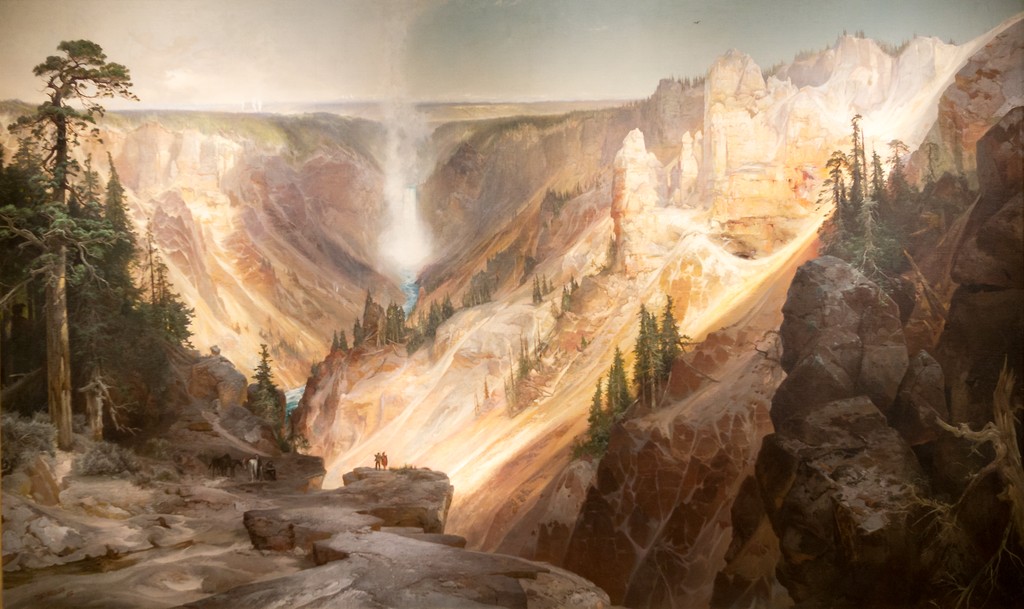
The Grand Canyon of the Yellowstone, 1872. Wuselig / Wikimedia Commons, CC BY-SA 4.0; U.S. Department of the Interior Museum painting. Image source. CC BY-SA 4.0; also marked PD-Art. Outer museum frame cropped; resized. Painted composition retained; photographic perspective unchanged. This image derivative is available under the same licence.
- Splash image source.
The Chasm of the Colorado, 1873–1874. U.S. Department of the Interior Museum; faithful reproduction via Smithsonian American Art Museum / Wikimedia Commons. Image source. Public Domain Mark; faithful two-dimensional reproduction. Resized only; complete source image retained.
- Splash image source.
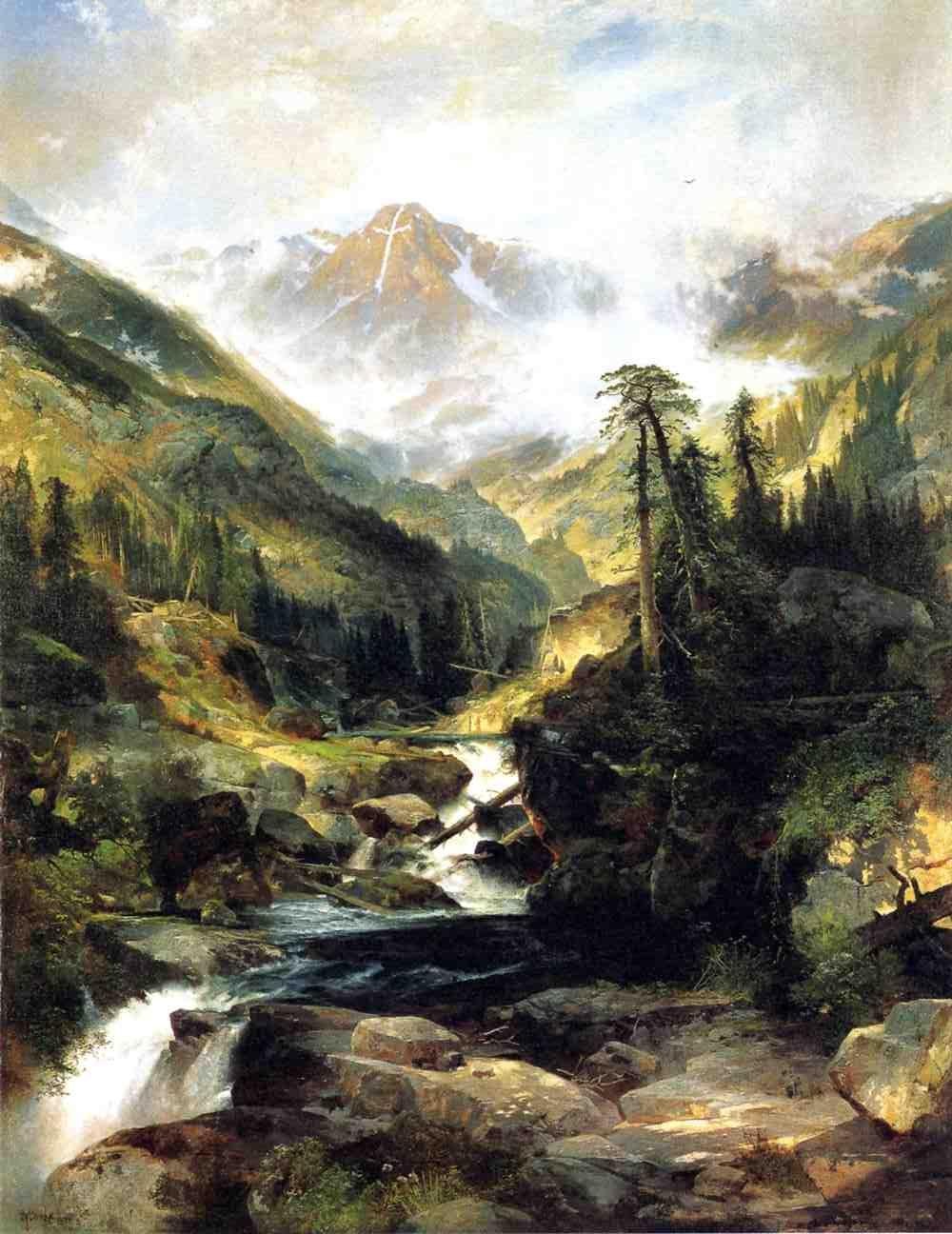
Mountain of the Holy Cross, 1875. Autry Museum of the American West; faithful reproduction via Wikimedia Commons. Image source. Public Domain Mark; faithful two-dimensional reproduction. Resized only; complete source image retained.
- Splash image source.
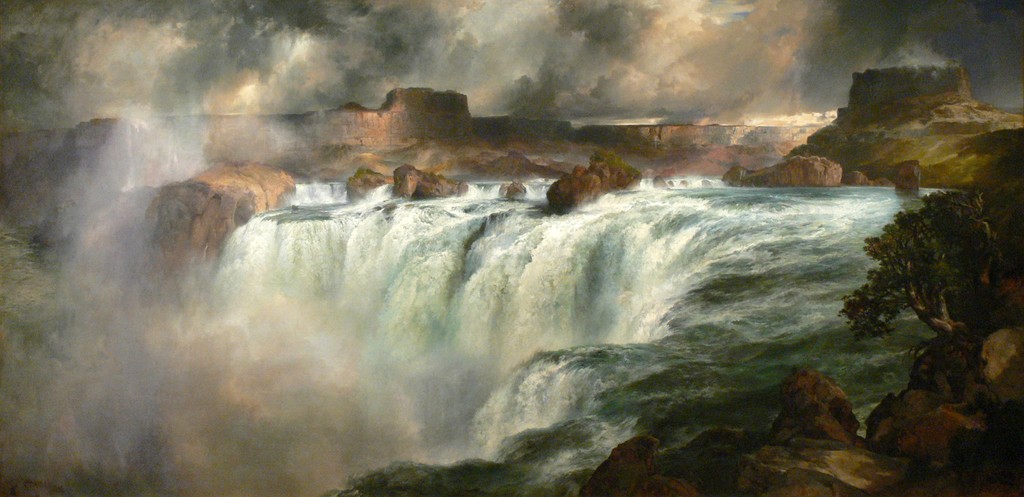
Shoshone Falls on the Snake River, 1900. Wolfgang Sauber / Wikimedia Commons, CC BY-SA 3.0; Gilcrease Museum painting. Image source. CC BY-SA 3.0; also marked PD-Art. Resized only; complete source image retained. This image derivative is available under the same licence.
- Splash image source.
Green River Cliffs, Wyoming, 1881. National Gallery of Art, Gift of the Milligan and Thomson Families. Image source. Public domain; NGA Open Access. Resized only; complete source image retained.
- Splash image source.
A View of Venice, 1891. Smithsonian American Art Museum, Transfer from the U.S. Department of the Interior, National Park Service, 1968.120.1. Image source. Free to use; Smithsonian Open Access. Resized only; complete source image retained.
- Splash image source.
The Three Tetons, 1895. The White House Collection, Gift of C. R. Smith; faithful reproduction via Wikimedia Commons. Image source. Public Domain Mark; faithful reproduction of a two-dimensional public-domain work. Resized only; complete source image retained.