 by Tom Gurney
Tom Gurney BSc (Hons) is an art history expert with over 20 years experience
Email: tomgurney1@gmail.com / Phone: +44 7429 011000
Thomas Moran, Yellowstone and the Hayden Expedition: Introduction
Thomas Moran travelled to Yellowstone in 1871 as a guest artist accompanying part of Ferdinand V. Hayden's government survey. The journey supplied drawings, colour information, photographs and experiences that he could develop into pictures for eastern audiences. It connected his work with scientific investigation, publishing, railway interests and the campaign for a national park.
Those connections require distinctions. Moran arranged private financial support rather than travelling as an employee paid to carry out the survey's scientific programme. His large Yellowstone oil was completed after the park law. The country he encountered also had a long Indigenous history. The expedition changed Moran's access to the region and its representation before particular audiences; it did not bring an unoccupied landscape into existence. [1]
At a Glance
- JourneyYellowstone, summer 1871
- Survey leaderFerdinand V. Hayden
- Moran's roleGuest artist on part of the expedition
- Close collaboratorPhotographer William Henry Jackson
- Financial distinctionPersonal support and obligations, rather than institutional sponsorship by Scribner's
- Park legislationSigned into law on 1 March 1872
- Large oilThe Grand Canyon of the Yellowstone, completed and purchased by Congress in 1872
- Historical mapSurvey-associated Yellowstone map bearing 1871; its date is distinct from legal park establishment
Contents
- Before the survey arrived
- Why Yellowstone attracted Moran
- Personal finance and railway connections
- Green River on the way west
- Joining Hayden as a guest artist
- Working beside William Henry Jackson
- Recording colour and material for pictures
- Tower Falls across distinct objects
- Returning east with observations
- Reading the historical map
Before the survey arrived
Yellowstone had been used by Indigenous people for thousands of years. The National Park Service describes hunting, fishing, plant gathering, obsidian quarrying, established trails and religious or medicinal uses of thermal waters. It identifies the Tukudika as Mountain Shoshone with a long relationship to the region. [2]
This history changes how expedition language should be read. What seemed unfamiliar to an eastern traveller could belong to other people's accumulated knowledge. Calling a place newly discovered confuses the experience of one audience with the history of the land. Moran's journey belongs to the history of representation and access alongside that much longer human presence.
The NPS also records early park superintendents discouraging Indigenous visits to hunt or gather resources. Protecting scenery and providing public access consequently did not mean that every community retained the same relationship with the place. The national park story needs room for both the preservation of natural features and the effects of federal authority on existing uses. [2]
Why Yellowstone attracted Moran
Nancy K. Anderson's 1997 catalogue discussion places Moran's interest beside Nathaniel Langford's published account of Yellowstone and the market for ambitious western landscape pictures. Stories of unusual natural phenomena offered an artist material that eastern readers were eager to encounter visually. Moran wanted firsthand resources from which he could make later work. [1]
Travel and making were therefore connected from the outset. A dramatic rock formation could supply a foreground, while a colour relationship could become important in a watercolour or canvas. The artist did not have to know the final form of every image before departure. He needed observations capable of supporting several kinds of production afterwards.
Albert Bierstadt had already demonstrated the audience for spectacular western paintings. Anderson discusses that professional setting, including the competition expressed in letters on Moran's behalf. Ambition belonged beside curiosity. The journey could offer artistic material and strengthen a painter's position within a market for large landscapes.
Personal finance and railway connections
Anderson distinguishes the support Moran obtained from a claim that Scribner's sponsored his expedition. Her account records a $500 loan from Roswell Smith, the magazine's publisher, with Children of the Mountain as collateral. It also records $500 from Northern Pacific financier Jay Cooke, to whom Moran promised Yellowstone watercolours. [1]
The details make the arrangement concrete. A personal loan associated with a publisher is not the same as a magazine paying for an institutional expedition. A promise of pictures creates an obligation attached to artistic production. The painting offered as collateral was an existing asset, linking the risk of the journey with work Moran had already made.
Railway interests also helped connect him with Hayden. Anderson reproduces A. B. Nettleton's letters requesting that the artist accompany the party. The correspondence describes Moran expecting to pay his own expenses and seeking the protection of the escort. These are catalogue transcriptions of historical letters, providing evidence of arrangements rather than a modern assumption that all participants held the same appointment. [1]
Green River on the way west
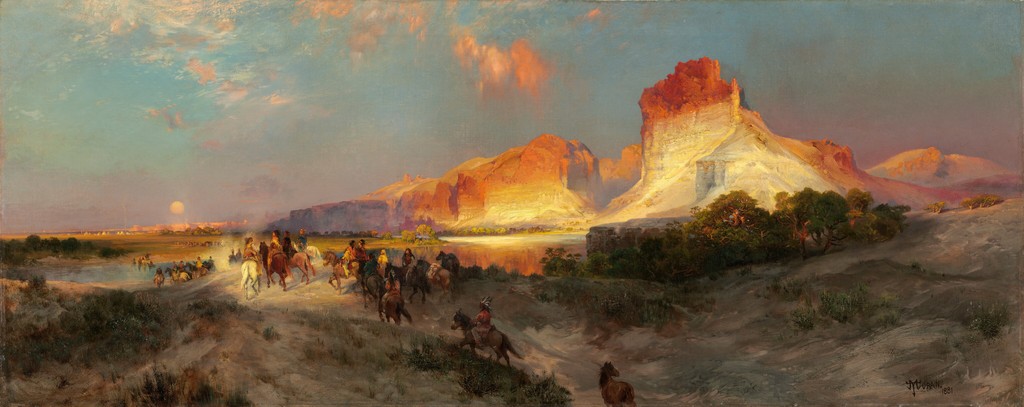
Before Yellowstone, Moran stopped at Green River, Wyoming. Anderson identifies the small study later inscribed “First sketch made in the West” and the continued usefulness of the cliffs he encountered there. A place seen on the approach became a subject he returned to across many later pictures. [1]
That sequence prevents every Green River painting from being dated to the journey. The Carter's 1874 canvas, Crystal Bridges' 1878 panel and NGA's 1881 oil are separate later objects. The stop supplied material; subsequent works gave it different arrangements. Travel dates and object dates perform different jobs when reconstructing the career.
The approach also involved modern transport and settlement. Green River was a railway town, although Moran's later pictures give cliffs, water and riders the main attention. The route by which he gained access to the region need not appear within the view he composed. That omission becomes particularly revealing when the paintings are compared with historical railway photographs on their individual pages.
Joining Hayden as a guest artist
From Green River Moran travelled through Corinne and Virginia City to join Hayden's party in Montana, according to Anderson's account. The survey brought him into a group whose work involved investigating, recording and describing western lands. His own participation concerned the gathering of artistic material within that shared journey. [1]
The Interior Museum's record calls him a guest artist on a portion of the government-sponsored geological and geographical survey. That wording gives a useful limit to the association. It does not turn him into the scientific recorder of every feature or a participant in every stage of the survey's work. [3]
Travelling together nevertheless mattered. Protection, logistics, shared observation and discussion affected what could be reached and recorded. Moran's eventual pictures were individual artistic works, while the circumstances enabling their source material involved many people. Preserving that distinction avoids both an isolated-genius account and an assumption that the survey dictated every compositional decision.
Working beside William Henry Jackson
Anderson describes Moran and Jackson working together for more than six weeks, choosing subjects and viewpoints for sketches and photographs. Her comparison of their Crystal Falls images supplies a particular case of work carried out side by side. Collaboration concerned the encounter with a subject as well as the later usefulness of its records. [1]
The two media could retain different information. A monochrome photograph offered forms and detail through a framed view. A coloured study could preserve relationships that would not be supplied by that tonal image alone. Neither should be treated as an automatic, complete substitute for the other.
The distinction also limits claims about a finished painting. General collaboration does not prove that a particular photograph was its sole direct source. That relationship needs evidence attached to the objects. The journey furnished several kinds of resource from which Moran could select and combine material, rather than one image that silently explains every later canvas.
Recording colour and material for pictures
The journal passages transcribed by Anderson describe rock formations, foliage and Yellowstone's extraordinary colours. One observation explicitly considers cliffs and peaks as foreground material for pictures. It shows Moran thinking about future composition while travelling, rather than simply compiling an inventory without artistic purposes. [1]
A useful note might preserve a feature's shape, a colour difference or a possible relationship between near and distant forms. These kinds of information need not all appear in one finished field study. They can become reminders whose value emerges later when the artist has more time to develop a design.
That process is easier to understand beside the dedicated drawings and watercolour pages. They distinguish recording from developed paper images and subsequent reproduction. A western subject does not establish that every coloured sheet was finished outdoors, or that every published image directly repeats an unchanged notebook entry.
Tower Falls across distinct objects
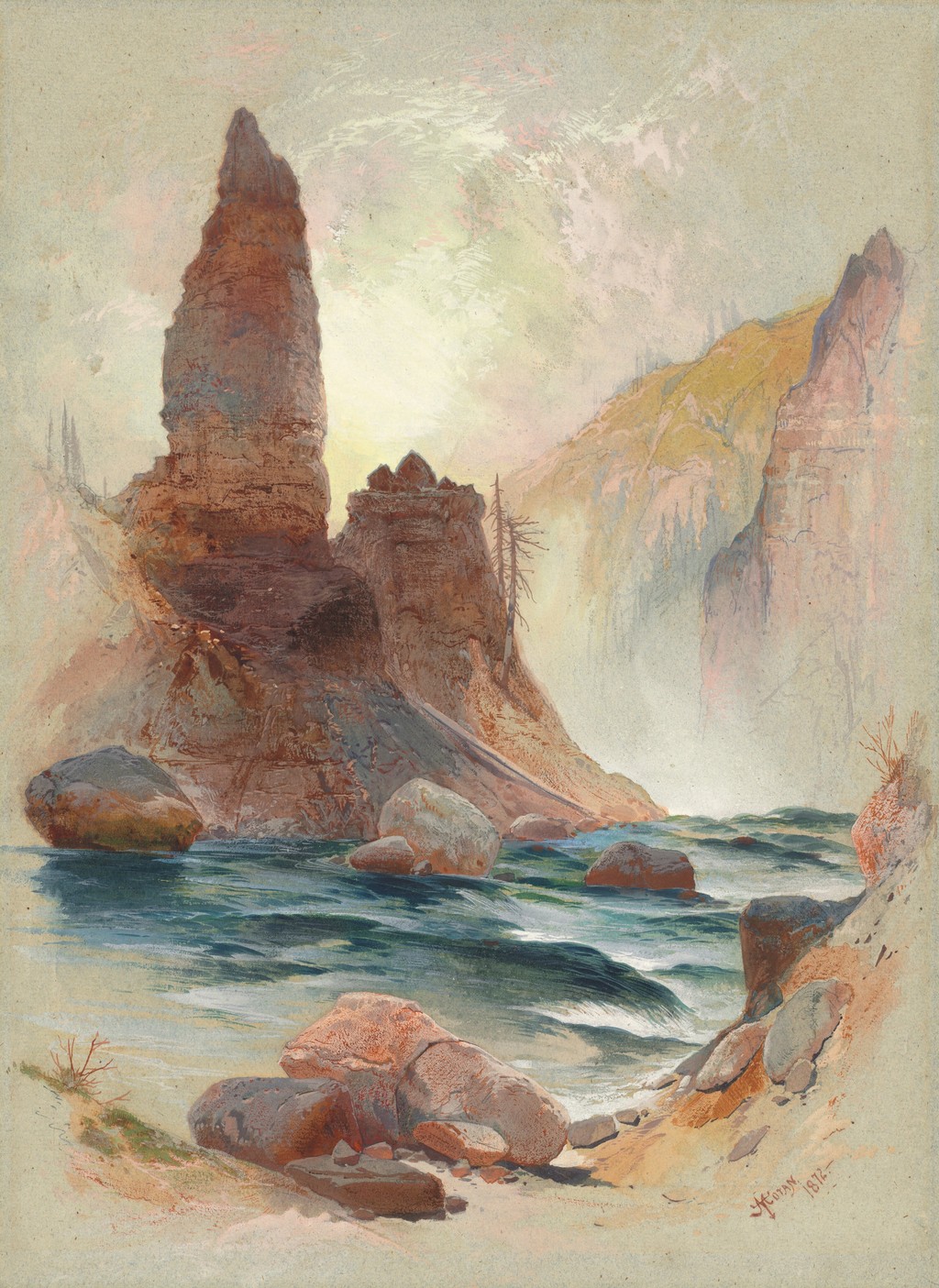
The NGA's Tower at Tower Falls, Yellowstone, dated 1872, provides a close example of a finished coloured work related to the region. It is watercolour and gouache over graphite on blue laid paper. A tall rock formation occupies the upright field, with water below and an opposing wall beyond. [4]
The object illustrates what can happen when attention concentrates on one relationship within an extensive landscape. The main rock supplies a commanding mass; smaller stones and currents establish a different scale. Its arrangement should not be mistaken for a complete depiction of the waterfall simply because of the place name.
Its 1872 date also belongs to the object, whereas the journey was in 1871. Related subject matter can connect the two without erasing the interval. The later Prang print supplies another Tower Falls image through publication. Each work needs its own date, medium and image before their relationship becomes informative.
Returning east with observations
Anderson records the decision to return after the party learned on 7 August that its military escort had been recalled. Moran, Jackson and others returned as well. The account places the end of his Yellowstone participation within practical circumstances, rather than assuming that he remained through every subsequent survey activity. [1]
Back east, the accumulated material could support commissions, illustrations and a major canvas. Moran moved with his family to Newark, where the large Yellowstone painting developed. Anderson discusses the proximity of magazine contacts while retaining uncertainty about the precise motive for the move. The artistic and professional opportunities should not become an invented single explanation.
The change of setting altered the work. A field record has to retain something under travelling conditions; a studio picture has to organise its elements for a spectator. Time, scale and purpose differ. The journey supplied access and information, while the finished painting depended on decisions made after the traveller returned.
Watch: Thomas Moran
Choose a film to explore the artist’s work, its interpretation and its wider setting.
The painting that inspired a National Park
A close discussion of Moran’s landscape and its relationship to the idea of Yellowstone.
Watch on YouTubeReading the historical map
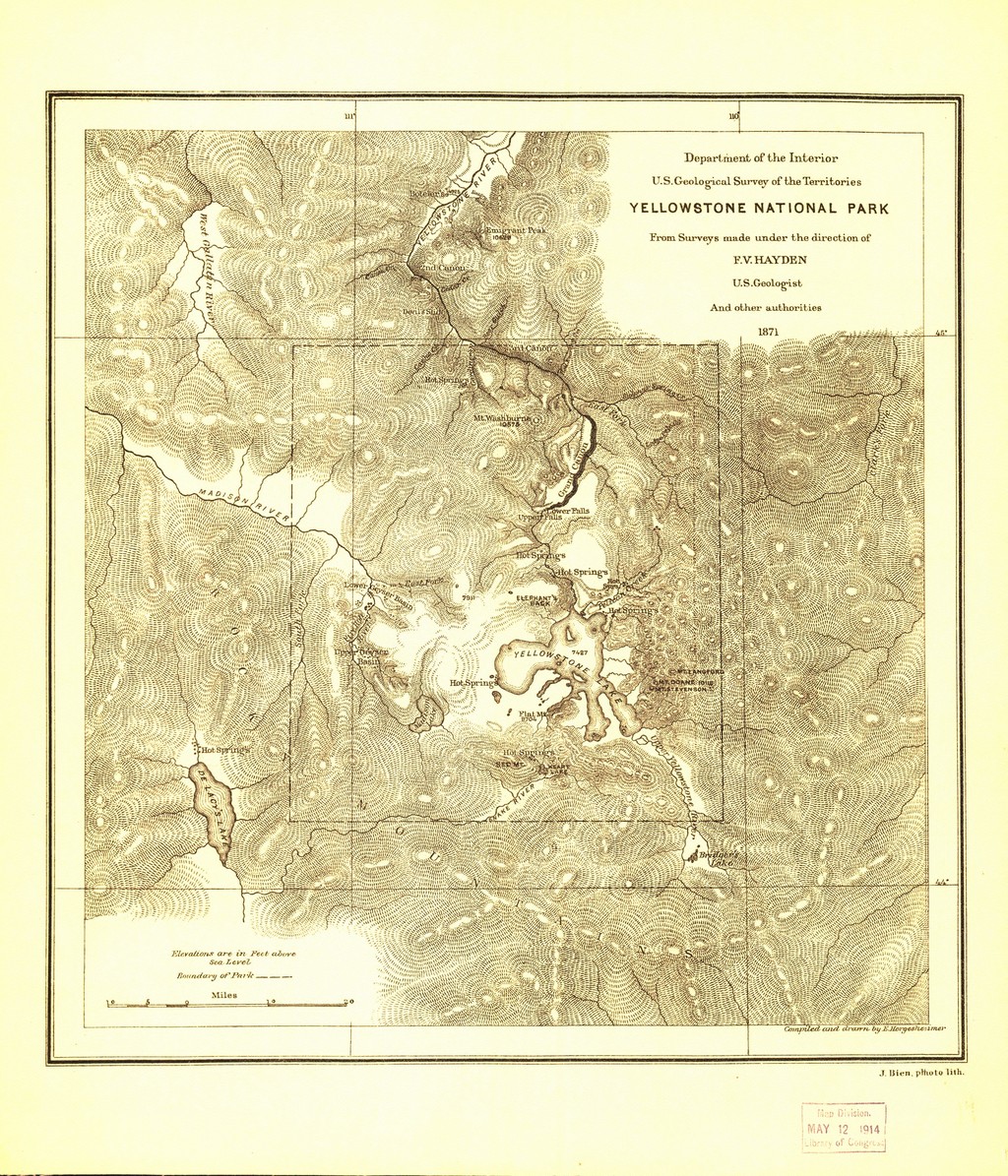
The survey-associated map titled Yellowstone National Park bears 1871 in its title panel and credits surveys under Hayden and other authorities. The cleared file is a restored version preserved through Wikimedia Commons from a Library of Congress source. The historical sheet and the date of the park law remain distinct. [5]
Its lines spread attention across a whole area. Rivers connect named features; Yellowstone Lake occupies a large irregular shape; relief marks describe the surrounding land. The title panel, boundary legend and scale make its purpose visibly different from a picture concentrating on one canyon.
The map does not mark Moran's exact route. Nor does every labelled feature establish that he visited it, sketched it or used it in a painting. Reading the sheet alongside an expedition account involves keeping those questions separate. It supplies historical geographical context, while the evidence for particular movements belongs to the travel records.
The park law and the order of events
The National Archives dates the act establishing Yellowstone National Park to 1 March 1872. Its explanatory account describes Hayden's advocacy, Jackson's photographs and Cooke's interest in future tourist travel. These connections place legislation within a wider campaign, rather than making one artist its sole cause. [6]
The large oil was still unfinished afterwards. Anderson reproduces Moran's March letter to Hayden reporting its progress, then describes its May exhibitions and June purchase. That sequence rules out the completed canvas as the single object that caused the earlier act. Expedition work, public advocacy and the later masterpiece are related, but they are not interchangeable events. [1]
The law itself combines preservation with provision for visitors, including limited building leases and roads. Its public purpose was therefore more particular than leaving every future use unchanged. The text helps explain why scenic appreciation, protection and anticipated tourism could appear within the same institutional project. [6]
Weighing later recollections against dated records
Anderson cites Jackson's later account of Moran's watercolours and the survey photographs as important exhibits during the park debate. It is evidence of how a participant remembered their contribution. Its retrospective character should remain visible, rather than making it a complete contemporary record of what every legislator saw or believed. [1]
Dated documents supply another kind of check. The act establishes the legal sequence; Moran's March letter places the large canvas in progress; exhibition notices concern later encounters with the finished work. These records can support a connected history without measuring an exact share of influence for each image.
That distinction keeps the familiar story useful while making its limits clear. Watercolours, photographs, testimony and publications could communicate the region in different ways. Their combined circulation deserves attention, while claims that one particular image decisively changed every vote would require evidence that the broad narrative does not supply.
The large painting and its public audience
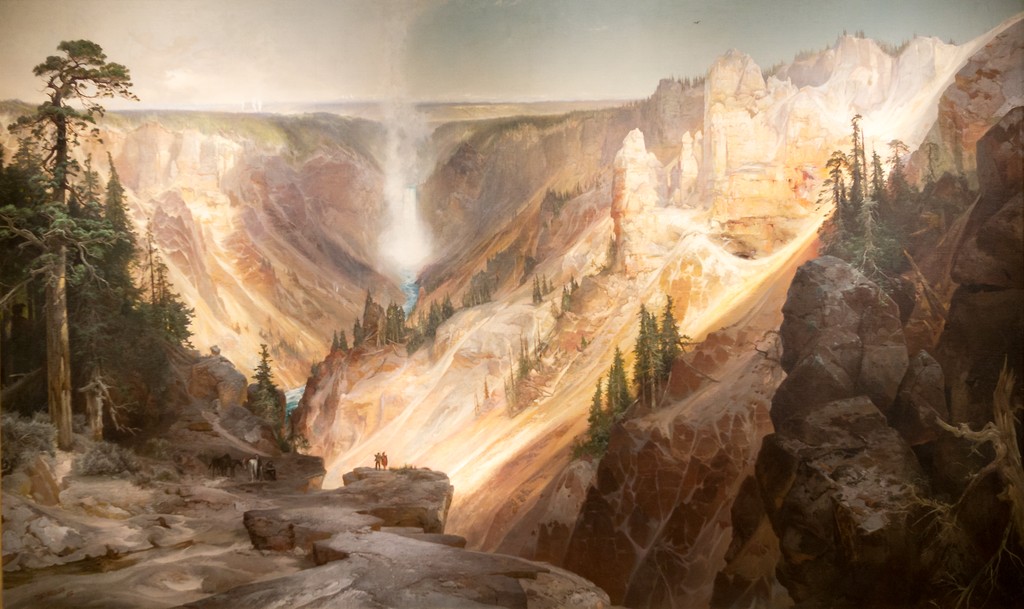
The Grand Canyon of the Yellowstone, completed in 1872, gave a canyon view monumental dimensions. The Interior Museum records approximately seven by twelve feet. Nearby trees and rock lead towards luminous walls and distant falls, allowing a spectator to move between detailed surfaces and a much larger impression. [3]
Anderson describes the New York viewing on 2 May, exhibition at the Smithsonian from 9 May and the subsequent campaign for congressional purchase. Hayden's presence and testimony connected the unfamiliar appearance with scientific authority. The painting was encountered through presentation, discussion and criticism, alongside its own visual effects. [1]
Congress bought it for $10,000 in June. The purchase confirmed the value of a work Moran had undertaken himself; it should not be rewritten as an advance commission initiating the canvas. The journey, making, exhibition and acquisition describe successive stages whose different purposes remain visible when the dates are kept in order.
Observation and deliberate arrangement
In Sheldon's 1879 account, Moran says, “I place no value upon literal transcripts from Nature.” The surrounding passage explains that nature provides material for the picture and discusses rearrangement in his Yellowstone canvas. The statement combines studied forms with artistic organisation, rather than denying the importance of looking. [7]
That distinction clarifies what the expedition made possible. A closely observed rock could contribute to a deliberately composed foreground. A colour note might inform a passage whose position served the whole image. The value of travel did not depend on every finished relation reproducing one moment from one viewpoint.
The canvas can consequently be understood as both a response to a real region and an organised experience of it. Neither a route map nor a photograph-like inventory describes its full purpose. Comparing the records remains useful when the different questions each answers are allowed to survive.
A modern photograph beside the painting
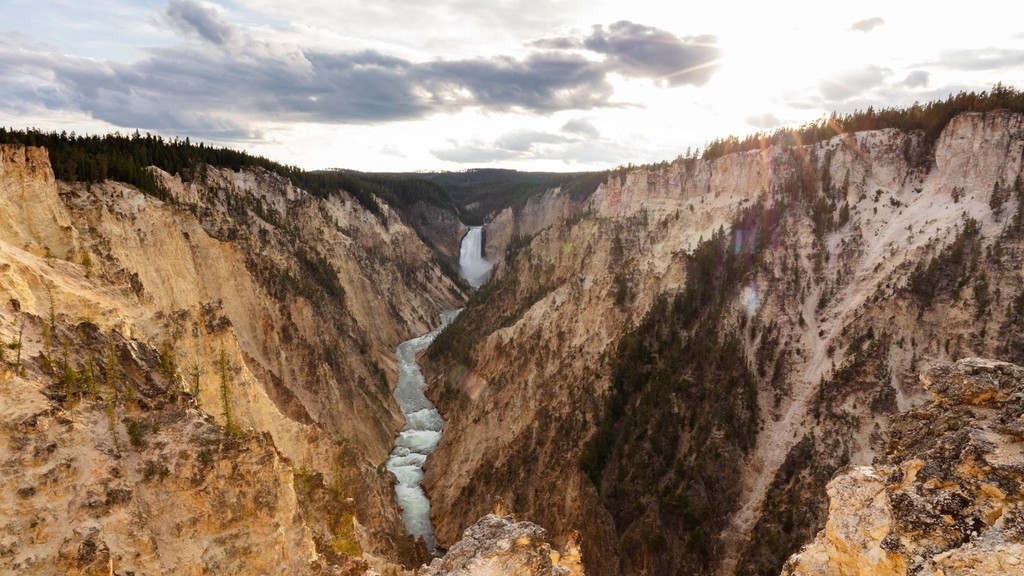
The NPS photograph by Jacob W. Frank shows a modern view from Artist Point. The falls lie within pale, steep walls, with rocks close to the spectator. Its caption identifies the photographic record; it is contextual evidence rather than proof of Moran's exact position or the canyon's identical appearance in 1871. [8]
Look at where the foreground interrupts the distance and how the water becomes a destination within the gorge. Then return to Moran's trees, illuminated wall and ledge figures. The comparison makes choices visible without requiring every difference to be explained as historical landscape change.
The photograph also returns the discussion to a place that can still be encountered through looking. Moran's image influenced how audiences imagined it, while a contemporary view has its own light, framing and conditions. The two can be appreciated together without turning one into a complete test of the other's truth.
Publication extends the encounter
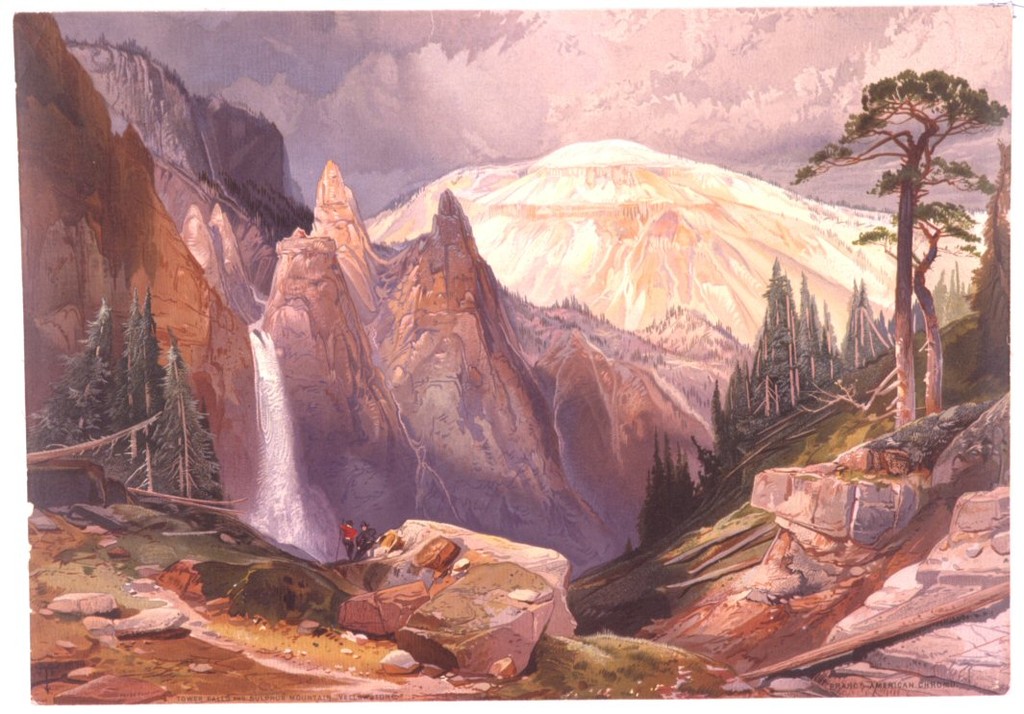
The Prang portfolio of 1876 contained fifteen chromolithographs after Moran's watercolours. Its full title extended beyond Yellowstone to other mountain regions. The LOC-associated Tower Falls and Sulphur Mountain print is separately dated circa 1875; that object date should remain distinct from the portfolio's issue. [1] [9]
Printed colour allowed these landscapes to circulate in another form. A purchaser could encounter a western view on a sheet without travelling to the place or standing before a monumental oil. The publication also involved printers and publishers whose roles mattered alongside Moran's designs.
The expedition's artistic consequences therefore extended through different objects and audiences. Study, studio painting, exhibition and printed reproduction all changed the setting in which a landscape was encountered. The fuller history holds those achievements beside their practical supports and the people whose prior relationship with the region lay outside the survey's principal narrative.
Artworks directory
Selected documented works and distinct versions. This directory is not a comprehensive catalogue raisonné. Dates and media retain the distinctions explained in the articles and museum records.
| Name | Date | Medium |
|---|---|---|
| An Arizona Sunset near the Grand Canyon | Date not securely established | Oil painting |
| Autumn Afternoon, the Wissahickon by Thomas Moran | 1864 | Oil on canvas |
| Cascade Falls, Yosemite | Commonly catalogued as 1905 | Catalogued as oil on canvas |
| The Chasm of the Colorado | 1873–1874; completed in 1874 | Oil on canvas, currently mounted on aluminium |
| Children of the Mountain | 1866 in the current museum title; 1867 in the 1997 National Gallery catalogue | Oil on canvas |
| Cliffs of Green River | 1874 | Oil on canvas |
| Cliffs of the Upper Colorado River, Wyoming Territory | 1882 | Oil on canvas |
| East Hampton, Long Island , also captioned Easthampton, L.I | 1897 | Oil on canvas laid on board, according to the reproduction record |
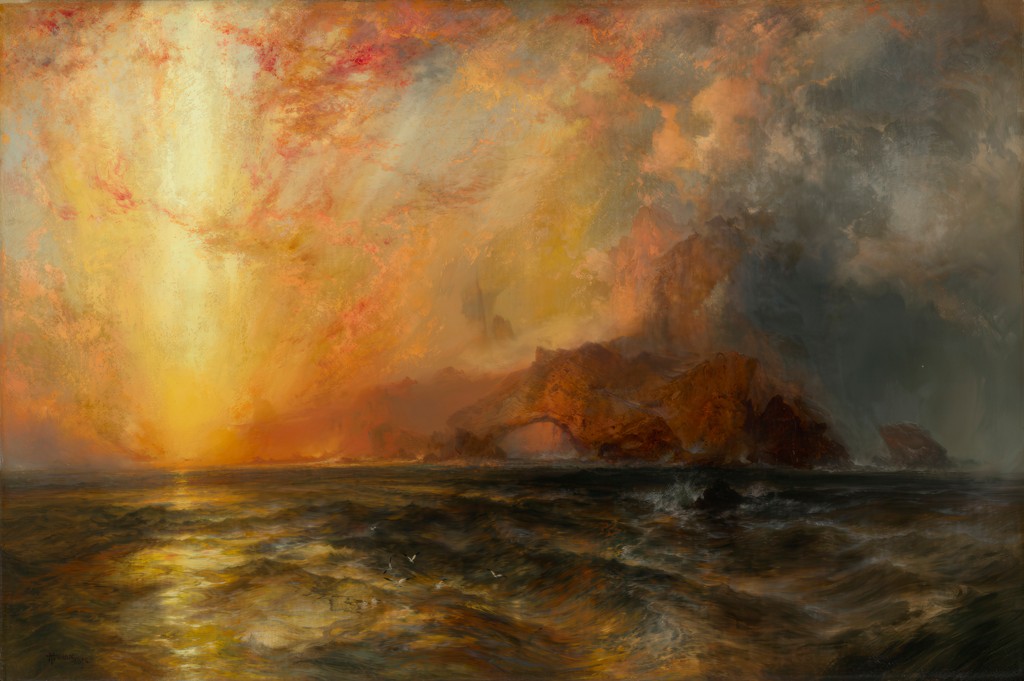
| Fiercely the red sun descending, Burned his way along the heavens | 1875–76 | Oil on canvas |
| Forest Scene | 1870 | Oil on canvas |
| Grand Canyon of the Colorado River | 1892 and 1908 | Oil on canvas |
| Green River Cliffs, Wyoming | 1881 | Oil on canvas |
| Green River, Wyoming | 1878 | Oil on panel |
| The Juniata, Evening | 1864 | Oil on canvas |
| Mosquito Trail, Rocky Mountains of Colorado | 1875 in the 1997 National Gallery exhibition catalogue | Watercolour |
| Mountain of the Holy Cross | 1875 | Oil on canvas |
| The Much Resounding Sea | 1884 | Oil on canvas |
| Point Lobos, Monterey, California | 1912, signed and dated | Oil on canvas |
| Shoshone Falls on the Snake River | 1900 | Oil on canvas |
| Summit of the Sierras | 1872/75, as catalogued by the Art Institute of Chicago | Gouache over graphite on cream laid paper |
| The Teton Range | 1897 | Oil on canvas |
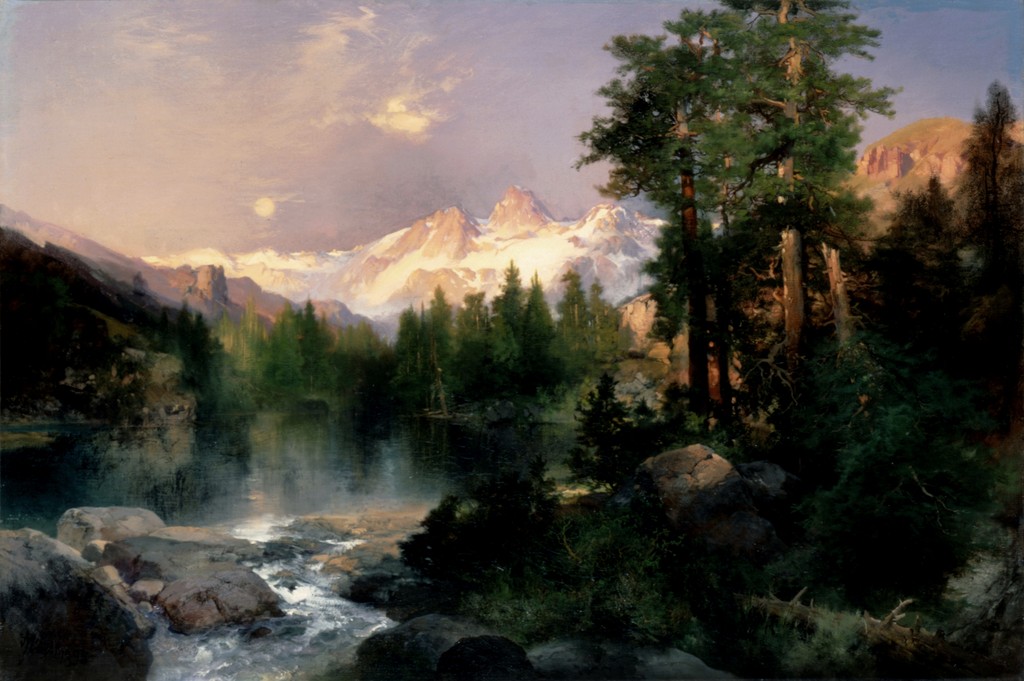
| The Three Tetons | 1895 | Oil on canvas |
| Tower Falls, Yellowstone | 1872 | Watercolour and gouache over graphite on blue laid paper |
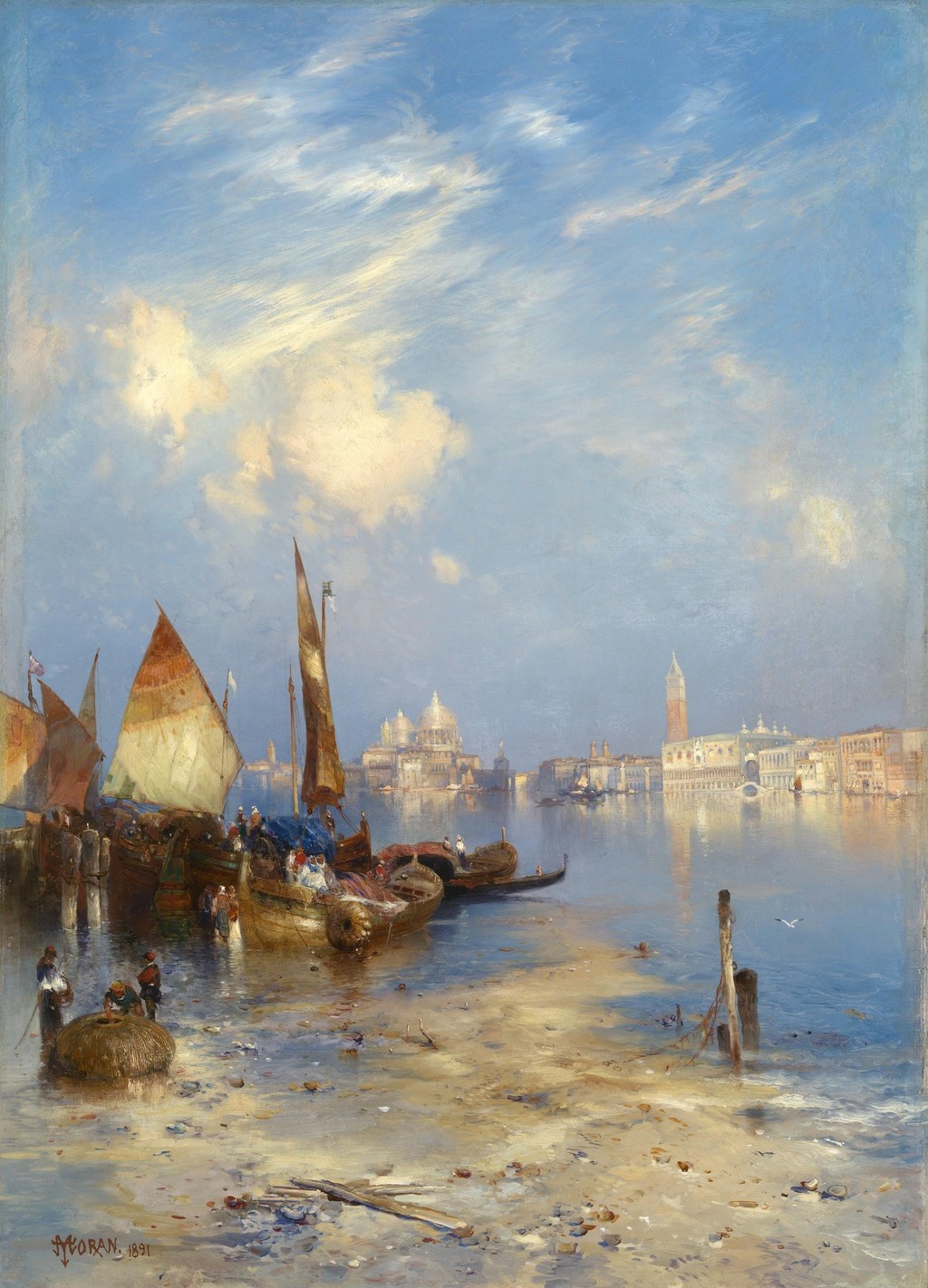
| A View of Venice | 1891 | Oil on canvas |
| The Grand Canyon of the Yellowstone | 1872 | Oil on canvas, currently recorded as mounted on aluminium |
| Mountain of the Holy Cross, Colorado (etching) | 1888 | Etching, roulette and aquatint |
| The Resounding Sea (etching) | 1880 | Etching |
| The Much Resounding Sea (later etching) | 1886 in heading; 1888 on plate | Etching, drypoint and roulette |
| Tower Falls (Prang print) | c. 1875; portfolio issued 1876 | Chromolithograph |
| Shoshone Falls (early watercolour) | 1874 | Watercolour |
| Venice (watercolour) | 1888 | Watercolour over graphite |
Frequently Asked Questions
The catalogue distinguishes his personal financial arrangements with Roswell Smith and Jay Cooke from institutional sponsorship by the magazine.
He accompanied part of the survey as a guest artist, with private support and artistic purposes.
The law was signed on 1 March 1872, before the large canvas was finished. Expedition images belonged to a wider campaign.
It supplies survey-associated geographical context. It does not establish his exact movements or visits to every labelled feature.
No. The National Park Service documents a long Indigenous history of use and knowledge of the region.
Discussion
Compare map, modern photograph and painting. What does each help you understand about the canyon, and which part of the expedition's human history remains outside its frame?
Reader Insights
Editorial prompts for close looking and discussion.
Compare map, modern photograph and painting. What does each help you understand about the canyon, and which part of the expedition's human history remains outside its frame?
Which source or image helps you assess the interpretation?
How does this page compare with the related works linked above?
Join the Conversation
Share your reading of this page below.
References
- Nancy K. Anderson and contributors, Thomas Moran, National Gallery of Art, 1997, selected western career discussion, pp. 48–56, and Prang publishing discussion, pp. 318–319; letters, journal passages and newspaper responses read through catalogue transcriptions.
- National Park Service, Historic Tribes, Yellowstone National Park, historical context.
- U.S. Department of the Interior Museum, Thomas Moran and the Big Picture, guest-artist participation and 1872 Yellowstone object record.
- National Gallery of Art, Tower at Tower Falls, Yellowstone, 1872, 2012.93.1.
- Library of Congress source preserved at Wikimedia Commons, Yellowstone 1871, map and file record, restored version uploaded by Durova, 2008.
- National Archives, Act Establishing Yellowstone National Park (1872), enrolled act dated 1 March 1872, transcript and explanatory account.
- G. W. Sheldon, American Painters, 1879, Moran chapter, especially pp. 125–126.
- National Park Service, Grand Canyon of the Yellowstone: Artist Point, modern site context and Jacob W. Frank photograph.
- Library of Congress record reproduced at Wikimedia Commons, Tower Falls and Sulphur Mountain, Yellowstone, Prang chromolithograph, circa 1875, LC-USZC4-3246.
- Splash image source.
The Grand Canyon of the Yellowstone, 1872. Wuselig / Wikimedia Commons, CC BY-SA 4.0; U.S. Department of the Interior Museum painting. Image source. CC BY-SA 4.0; also marked PD-Art. Outer museum frame cropped; resized. Painted composition retained; photographic perspective unchanged. This image derivative is available under the same licence.
- Splash image source.
Historical map catalogued as Yellowstone National Park, 1871. F. V. Hayden / Library of Congress; restored digital file by Durova via Wikimedia Commons. Image source. Public Domain Mark; historical map. Resized only; complete source image retained.
- Splash image source.
A modern view of the Grand Canyon of the Yellowstone from Artist Point; it is not documentary evidence of Moran’s exact painting vantage point. NPS / Jacob W. Frank. No claim to original U.S. Government works.. Image source. Public domain NPS photograph; no contrary credit or copyright symbol. Resized only; complete source image retained.
- Splash image source.
Tower at Tower Falls, Yellowstone, 1872. This is the rock-formation study, distinct from views centred on the waterfall. National Gallery of Art, Florian Carr Fund. Image source. Public domain; NGA Open Access. Resized only; complete source image retained.
- Splash image source.
Tower Falls and Sulphur Mountain, Yellowstone, chromolithograph, circa 1875. Thomas Moran / L. Prang & Co. / Library of Congress, LC-USZC4-3246. Image source. No known restrictions on publication; public-domain print. Resized only; complete source image retained.
- Splash image source.
The Grand Canyon of the Yellowstone, 1872. Wuselig / Wikimedia Commons, CC BY-SA 4.0; U.S. Department of the Interior Museum painting. Image source. CC BY-SA 4.0; also marked PD-Art. Outer museum frame cropped; resized. Painted composition retained; photographic perspective unchanged. This image derivative is available under the same licence.
- Splash image source.
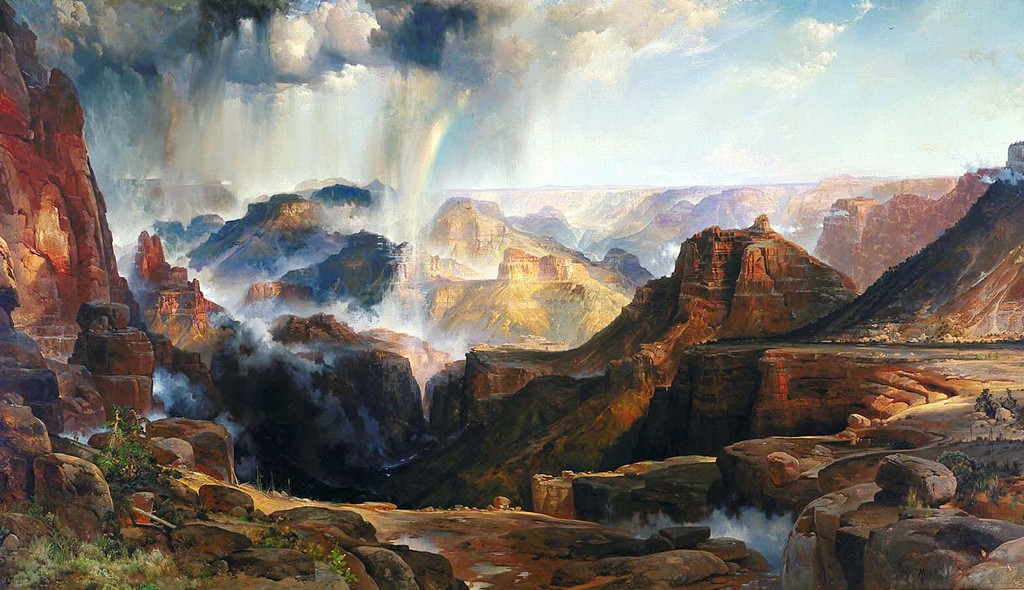
The Chasm of the Colorado, 1873–1874. U.S. Department of the Interior Museum; faithful reproduction via Smithsonian American Art Museum / Wikimedia Commons. Image source. Public Domain Mark; faithful two-dimensional reproduction. Resized only; complete source image retained.
- Splash image source.
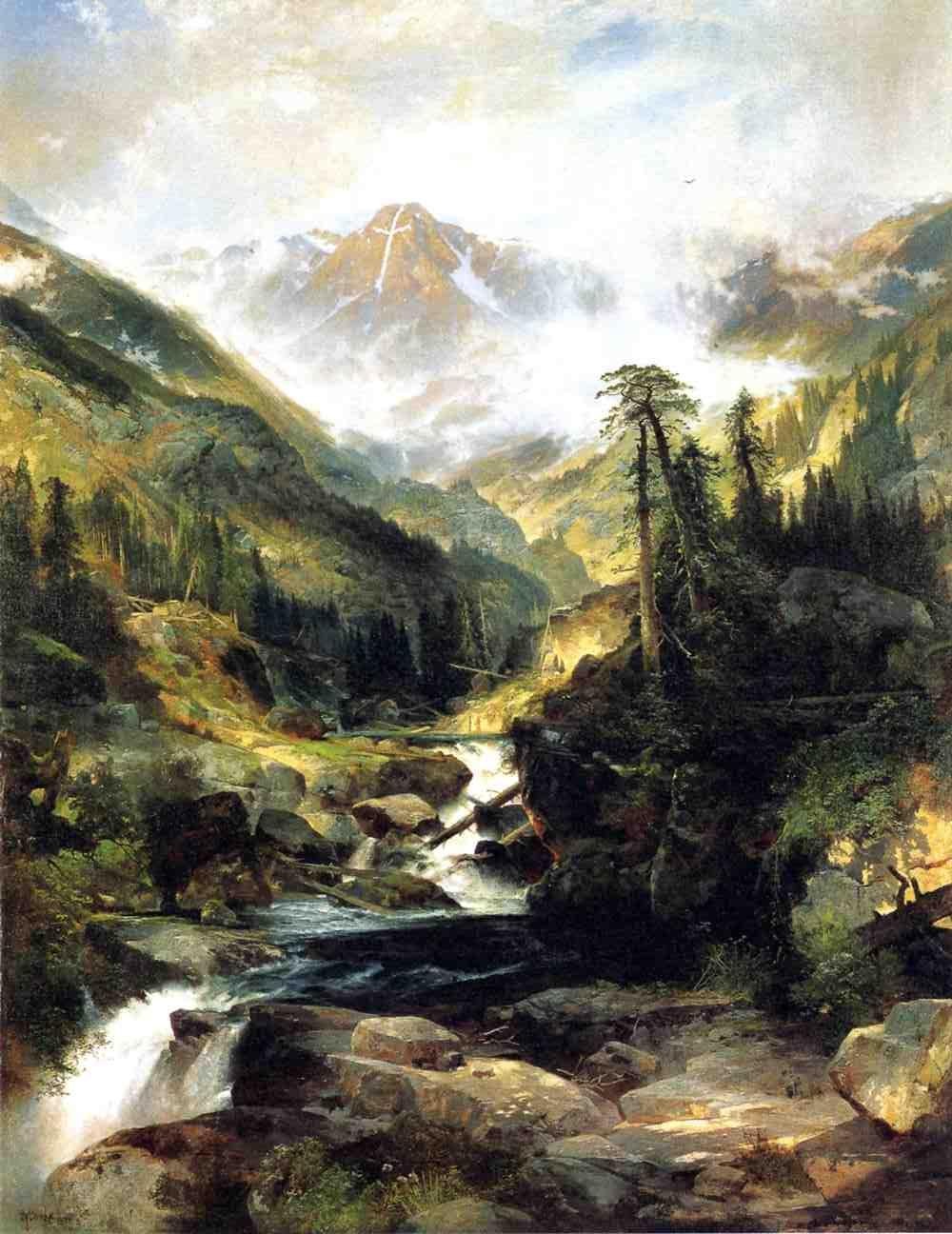
Mountain of the Holy Cross, 1875. Autry Museum of the American West; faithful reproduction via Wikimedia Commons. Image source. Public Domain Mark; faithful two-dimensional reproduction. Resized only; complete source image retained.
- Splash image source.
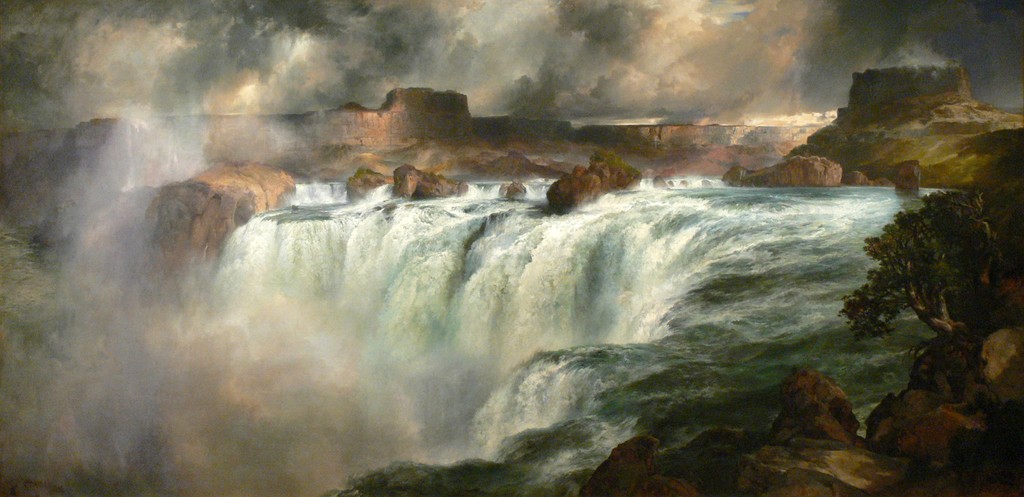
Shoshone Falls on the Snake River, 1900. Wolfgang Sauber / Wikimedia Commons, CC BY-SA 3.0; Gilcrease Museum painting. Image source. CC BY-SA 3.0; also marked PD-Art. Resized only; complete source image retained. This image derivative is available under the same licence.
- Splash image source.
Green River Cliffs, Wyoming, 1881. National Gallery of Art, Gift of the Milligan and Thomson Families. Image source. Public domain; NGA Open Access. Resized only; complete source image retained.
- Splash image source.
A View of Venice, 1891. Smithsonian American Art Museum, Transfer from the U.S. Department of the Interior, National Park Service, 1968.120.1. Image source. Free to use; Smithsonian Open Access. Resized only; complete source image retained.
- Splash image source.
The Three Tetons, 1895. The White House Collection, Gift of C. R. Smith; faithful reproduction via Wikimedia Commons. Image source. Public Domain Mark; faithful reproduction of a two-dimensional public-domain work. Resized only; complete source image retained.