 by Tom Gurney
Tom Gurney BSc (Hons) is an art history expert with over 20 years experience
Email: tomgurney1@gmail.com / Phone: +44 7429 011000
The Grand Canyon of the Yellowstone by Thomas Moran: Introduction
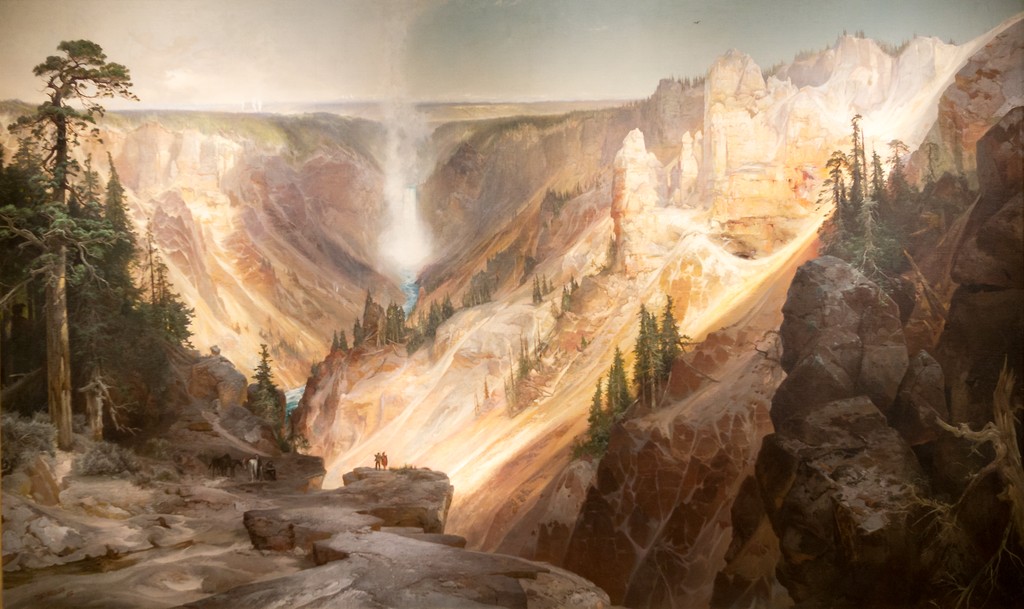
Thomas Moran’s The Grand Canyon of the Yellowstone makes a distant waterfall the centre of an immense, sunlit gorge. Painted in 1872 after his journey with Ferdinand V. Hayden’s survey party, it became one of the defining works of his career. Congress purchased the painting that year for $10,000; the Department of the Interior Museum now records it as part of its collection. Its broad canvas, about seven feet high and twelve feet wide, gives the canyon the scale of a public spectacle. [1]
The spectacle rests on carefully organised contrasts. Dark trees and a rocky foreground bring the spectator close to the edge; bright canyon walls draw the eye towards the falls. Tiny people establish a human scale without interrupting the landscape’s dominance. Moran gives us both a place to stand and something that seems almost too large to comprehend. The result combines field observation with the decisions of an artist working in a studio.
At a Glance
- ArtistThomas Moran
- TitleThe Grand Canyon of the Yellowstone
- Date1872
- MediumOil on canvas, currently recorded as mounted on aluminium
- Size84 × 144¼ inches, approximately seven × twelve feet
- CollectionU.S. Department of the Interior Museum
- PurchaseCongress, 1872, for $10,000
- SubjectYellowstone’s canyon and Lower Falls; distinct from Arizona’s Grand Canyon
Where this work sits in Moran’s career
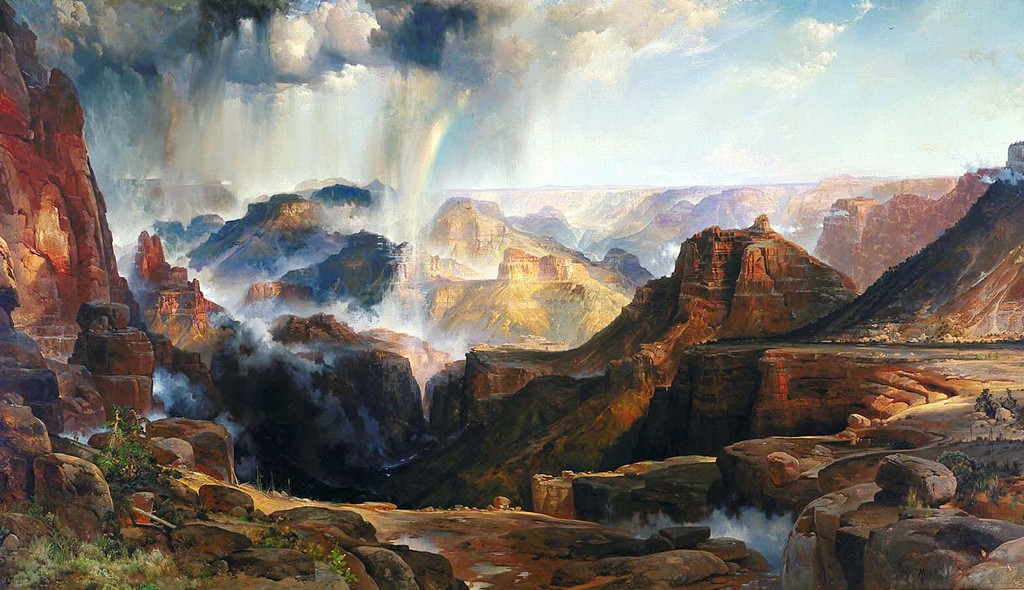
The Chasm of the Colorado
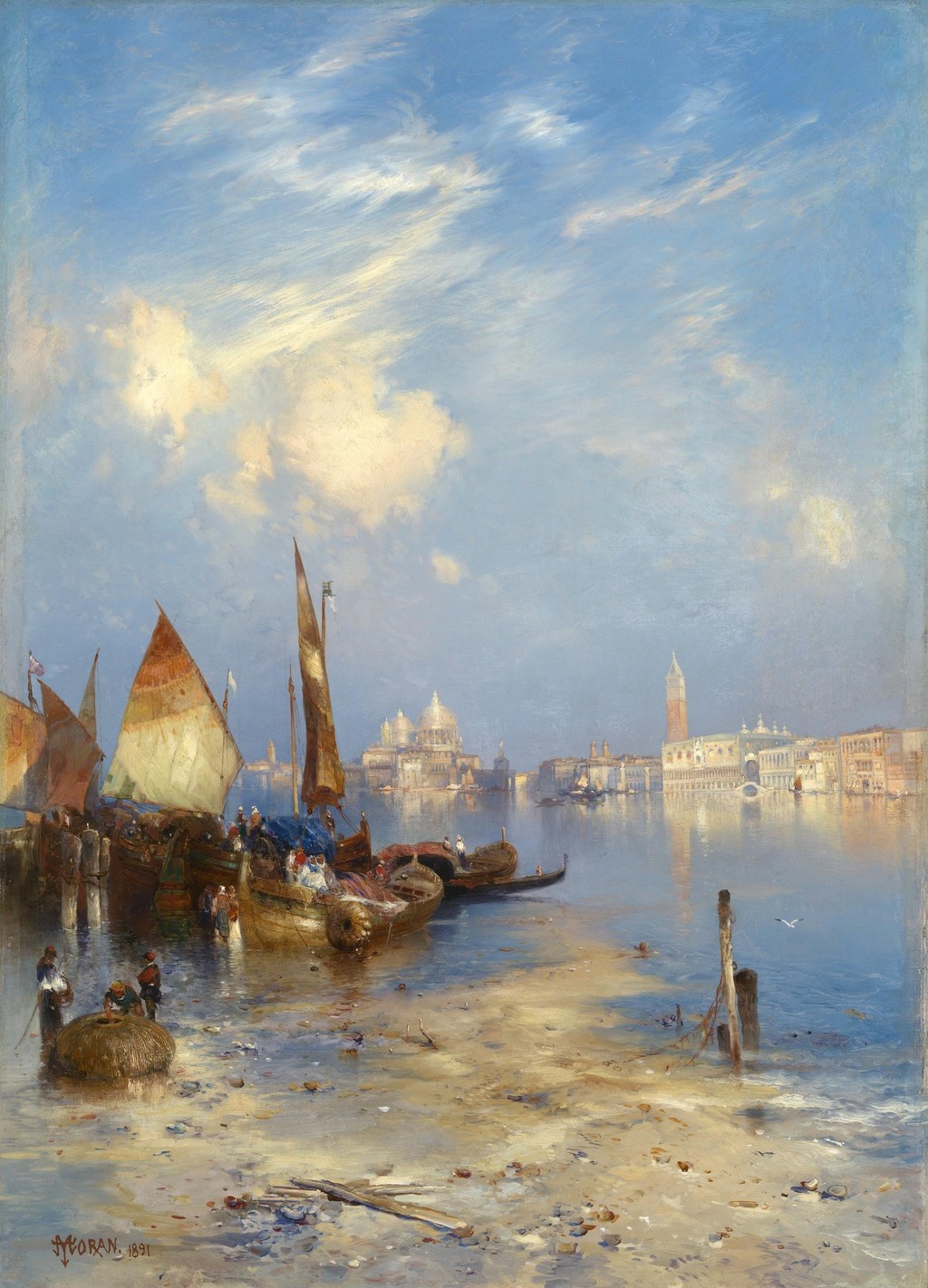
1873–1874; completed in 1874A View of Venice
1891Point Lobos, Monterey, California
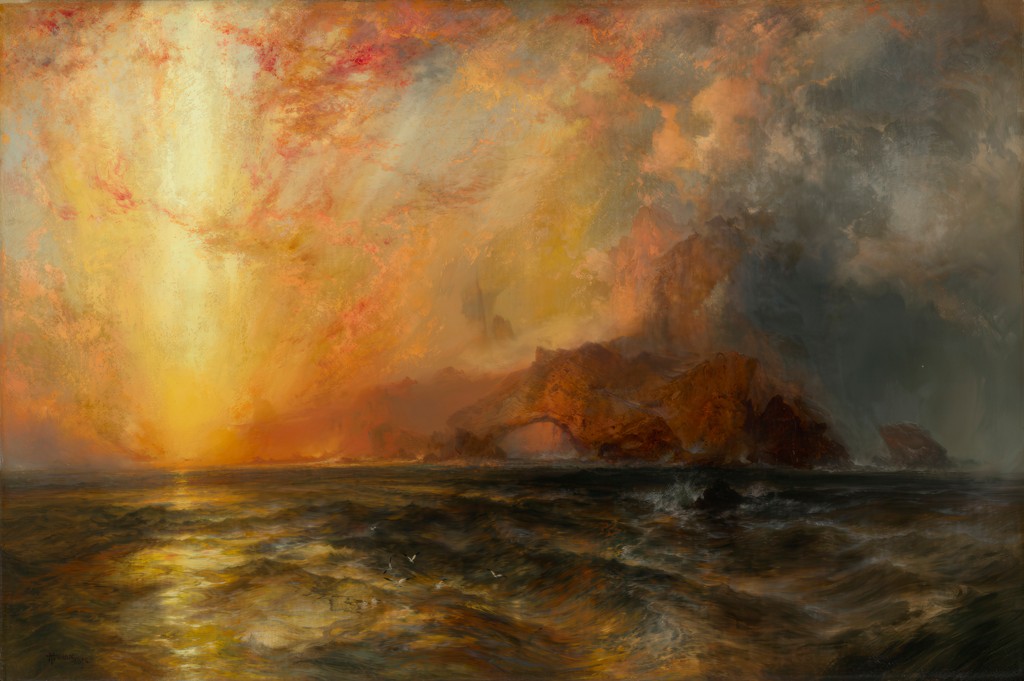
1912, signed and datedContents
- A public painting on a monumental scale
- The ledge, the trees and the spectator
- Following the water into the canyon
- Colour arranged through light and shadow
- Observation transformed in the studio
- A letter to Hayden while the painting was underway
- Exhibitions, praise and questions of credibility
- Congress, the park and the order of events
- Returning to the view today
- Moran’s later account of artistic knowledge
A public painting on a monumental scale
The painting belongs to the moment when Moran’s western subjects moved from illustrations and portable studies into large exhibition pictures. He had travelled to Yellowstone in 1871, accompanying part of Hayden’s expedition as a guest artist. Back east, the canyon offered a subject through which he could demonstrate the value of that journey. The 1872 painting was not simply a larger version of a field sketch. It brought together information, memory and pictorial design for viewers who might never visit the region. [2]
Its dimensions matter to that ambition. The horizontal format gives room for two great walls, a channel between them and a foreground from which to look down. At full size, the spectator can move between an overall impression and individual incidents: trees clinging to slopes, fractured rocks, figures on a ledge, a narrow strip of river. A small reproduction compresses these changes of attention. It can show the composition, but it cannot reproduce the encounter with a canvas that extends well beyond a person’s height and reach.
The title identifies a particular canyon. Yellowstone’s Grand Canyon is not the Grand Canyon of the Colorado River, the Arizona subject of Moran’s later The Chasm of the Colorado. Confusing them obscures both the geography and the paintings’ differences. Here the falls and luminous walls organise the view around a distant centre. In the Colorado painting, broken plateaux and a storm create a more dispersed and unsettled landscape.
The current Interior record specifies oil on canvas mounted on aluminium. That describes the object as catalogued today; it does not mean that Moran painted directly on an aluminium panel in 1872. The distinction separates the original medium from a present support description. Nor does a photograph of the painting establish its condition, pigment composition or restoration history. What the reproduction does allow is close attention to the visible relationships of form, colour and space. [1]
The ledge, the trees and the spectator
The foreground is a broad shelf of grey and brown rock. Its irregular surfaces extend across the bottom of the picture and lead towards an exposed projection near the centre. Unlike a neat viewing platform, this shelf has cracks, uneven steps and broken edges. It provides an apparent foothold while reminding us of the drop beyond. Moran makes the position of looking part of the subject: we are invited to approach, but the canyon remains physically imposing.
At the left, a tall pine rises above a cluster of darker trees. Its trunk and spreading branches create a vertical frame within the horizontal canvas. The branches partly screen the view, making the bright canyon seem to open beyond a nearer, shaded world. Smaller trees descend along the slope behind it. Their repeated, diminishing silhouettes carry the eye from the foreground towards areas that would otherwise be difficult to measure.
The right foreground works differently. A large rock mass occupies the corner and blocks part of the canyon wall. Its darker surface brings the spectator back from the brilliant middle distance. With the trees on one side and rock on the other, the scene gains depth through overlap rather than through a single straight line into the distance. We see around obstacles, as well as across open space.
People and horses appear on and near the foreground ledges. Their small scale makes the surrounding rocks seem enormous, yet they also establish the canyon as something being witnessed. Catalogue author Nancy K. Anderson discusses Hayden’s role in the picture, drawing on Moran’s correspondence. A March 1872 letter asked Hayden for a photograph to help include him in the foreground. That documentary intention is stronger evidence than trying to identify every tiny painted figure from a reproduction. [2]
The figures do not supply a complete history of the region’s people. Their prominence reflects the painting’s association with a particular survey and its intended eastern audience. Equally, the absence of other inhabitants from the image is a compositional choice, not evidence that the country had previously been unknown or unoccupied. A landscape painting can make the experience of one group visible while leaving much of a place’s history outside its frame.
Following the water into the canyon
The waterfall is far away, slightly left of the composition’s centre. A pale vertical descent emerges from the darker rim and dissolves into a rising cloud of spray. It is a comparatively small feature in the canvas, despite being the event towards which the canyon seems to converge. Moran does not make the falls fill the picture. Instead, their distance helps demonstrate the dimensions of the enclosing gorge.
Below the spray, the river reappears as a narrow blue-green ribbon. It passes between steep slopes and becomes partly hidden by projecting rock and trees. This interrupted visibility is effective: the eye has to reconstruct a continuous course from separate glimpses. The water becomes both a thread through the composition and a reminder that the canyon continues below surfaces we can see.
The two sides of the gorge create a broad funnel. On the left, reddish and pale slopes descend towards the river beneath a relatively level rim. On the right, towers and ridges rise in a sequence of illuminated steps. Their diagonals direct attention downwards, while the more distant horizon restores a sense of breadth. The canyon therefore opens in two directions at once, across the landscape and into its depths.
The spray has another role besides indicating falling water. Its soft outline contrasts with the hard edges of the rocks, creating a zone in which forms dissolve. The distant falls remain legible without becoming sharply detached from their surroundings. We can recognise the event while sensing its remoteness. Against the mass of the walls, that fragile, changing cloud gives the composition a different kind of movement.
This treatment can be compared with Moran’s Tower Falls images. The National Gallery’s 1872 study concentrates on a tall rock formation, while the later Prang print presents the waterfall subject through colour reproduction. Neither should be treated as a preparatory version of this entire panorama merely because it also belongs to Yellowstone. The canyon painting, a paper study and a published print answer different visual and practical demands.
Colour arranged through light and shadow
The brightest part of the painting lies across the right-hand wall. Cream, yellow and warm orange spread over slopes and rock faces, interrupted by reddish seams and small dark trees. Rather than distribute brilliance evenly, Moran concentrates it in a broad diagonal passage. The illuminated wall becomes a major structural element, pulling attention away from the shaded foreground and towards the distance.
Across the gorge, the left wall offers a quieter sequence of warm and cool changes. Pale rock catches light near the rim; deeper areas become reddish brown and purple. These shifts keep the canyon from reading as a single flat band of colour. Even where the hue is striking, changes in brightness and overlap distinguish one surface from another.
The dark trees sharpen the effect. Their narrow silhouettes interrupt the luminous slopes like marks of scale. A group near the right middle distance divides a broad, bright passage into smaller intervals, while the left foreground pines create a substantial area of shade. The painting’s brilliance depends on these darker shapes. Without them, the light would have fewer points against which to register its intensity.
The sky is relatively restrained: pale clouds and gentle tonal changes sit above the stronger contrasts below. Its openness allows the jagged walls to stand out without competing with another dramatic event overhead. The sky also makes the landscape feel extended beyond the canyon’s immediate enclosure. Moran’s greatest contrasts occur within the gorge rather than across the whole canvas.
His earlier Forest Scene, dated 1870 in the National Gallery catalogue, offers a revealing comparison. There, trunks and foliage enclose the view, and small openings admit light into a wooded interior. Yellowstone reverses the balance: a shaded cluster of trees frames a much larger illuminated space. The contrast shows how familiar landscape elements could take on different roles. A pine can belong to an intimate woodland scene or help a spectator grasp the scale of a canyon. [2]
These are relationships visible in the image, not a scientific account of Yellowstone’s minerals or Moran’s pigments. Nineteenth-century reviewers connected the colours with geological explanations, sometimes in language that should not be accepted as modern science. A viewer can recognise the painting’s yellow and reddish walls without using a digital photograph to identify either a mineral deposit in the landscape or a substance in the paint.
Observation transformed in the studio
The survey journey gave Moran access to a landscape whose forms and colours he could study directly. Sketches, colour notes, photographs and discussion with fellow travellers offered different kinds of information. They did not all perform the same job. A drawing might preserve an outline; a colour note could record a relationship that a monochrome photograph could not show; a photograph might retain details that were difficult to finish during a brief stop.
The large painting required those observations to be made coherent for a spectator. Its foreground, canyon walls, falls and sky must work together within a fixed rectangular field. Moran could not simply reproduce the experience of walking between viewpoints. He had to decide which features would remain visible, which would overlap and how the eye would move from one to another.
His own later explanation makes this distinction explicit. In George W. Sheldon’s American Painters, published in 1879, Moran is quoted as saying, “I place no value upon literal transcripts from Nature.” He goes on to describe an artistic practice directed towards idealisation. The passage concerns his general approach and discusses the Yellowstone picture; it is not a claim that he had dispensed with observation. [3]
Read beside the painting, that statement changes the question we ask. Instead of looking for a camera position that duplicates every relationship, we can ask how observed features have been organised to make the canyon intelligible and impressive. The broad foreground gives access, the dark trees supply contrast, and the converging walls lead to the distant falls. Each part can carry information about a real landscape while also serving the design of the picture.
Idealisation here should not be mistaken for an assurance that every feature is invented. The interest lies in the combination of recognisable place and constructed effect. Nor does the artist’s statement tell us exactly which rock was moved or which distance altered. Such claims require object-specific evidence. The visible composition and his published explanation establish a method without providing a complete diagram of its individual decisions.
A letter to Hayden while the painting was underway
Moran’s letter to Hayden of 11 March 1872, transcribed in the National Gallery catalogue, offers a more immediate view of the work. He described the picture as about half finished and expected it to make a strong impression. His confidence was accompanied by practical requests: he wanted Hayden’s help and drew attention to the scientist’s knowledge of the causes behind the landscape’s appearance. [2]
The letter brings artistic ambition and scientific authority together. Moran was concerned with the effect of the painting, but he also wanted access to informed observation. The two concerns were not mutually exclusive. A powerful design could make a remote region compelling, while the association with Hayden helped ground its unfamiliar forms and colours in the testimony of someone who had studied them.
The request for a photograph of Hayden also connects the making of the picture with its public meaning. The scientist was to become part of the image of the canyon. The foreground would thus present more than a convenient measure of scale: it would associate looking with the expedition that had helped bring Yellowstone before eastern audiences.
The correspondence records work in progress, not a retrospective legend of effortless inspiration. Moran was balancing this large project with other commissions and seeking the information necessary to finish it. The completed painting conceals those practical demands within a seemingly continuous view. Reading the letter restores some of the choices and exchanges behind that apparent unity.
Watch: Thomas Moran
Choose a film to explore the artist’s work, its interpretation and its wider setting.
The painting that inspired a National Park
A close discussion of Moran’s landscape and its relationship to the idea of Yellowstone.
Watch on YouTubeExhibitions, praise and questions of credibility
The painting’s public debut brought its extraordinary colour before viewers who often lacked firsthand knowledge of Yellowstone. Contemporary responses, collected and transcribed in the 1997 catalogue, show how important credibility became. Could a canyon really look like this? Was the brilliance an accurate response to a place, or an artist’s exaggeration? Those questions accompanied admiration for Moran’s skill. [2]
Clarence Cook’s May 1872 review described seeing the painting in the auction rooms at Clinton Hall in New York. Hayden spoke about the landscape during the viewing. The circumstances joined an exhibition picture with scientific testimony: visitors encountered both the image and an account from a traveller who could answer their doubts. The painting was not shown only within the quiet conditions of a modern museum gallery.
Other responses praised its colour and aerial perspective. Yet approval was not completely uniform. One contemporary account preferred the landscape without the foreground people, associating solitude with the power of the natural scene. Such a response tells us about a reviewer’s expectations of landscape art; it does not establish that human presence was historically absent from Yellowstone.
The range of responses is useful because it preserves the painting as a debated work. Some viewers concentrated on the strangeness of the subject, others on the organisation of distance or on the effects of light. Moran’s achievement was being tested against both reported nature and established ideas of what a landscape painting ought to do. Its later fame should not flatten those first encounters into a single unanimous verdict.
Congress, the park and the order of events
Congress acquired The Grand Canyon of the Yellowstone in June 1872 for $10,000. The purchase brought a monumental western landscape into the nation’s collection and confirmed the importance of Moran’s new subject. It followed the painting’s completion and exhibition, rather than paying in advance for an originally commissioned canvas. The distinction matters when considering the artist’s initiative and the work’s reception. [1] [2]
Yellowstone had already become a national park. The act preserved by the National Archives was signed into law on 1 March 1872. That date precedes both Moran’s March letter describing the canvas as unfinished and its subsequent public exhibition. The completed painting therefore cannot have been the sole image that persuaded Congress to enact the law. [4]
This chronology does not remove Moran from the park’s history. His expedition work belonged to a wider circulation of images and accounts, alongside William Henry Jackson’s photographs, Hayden’s publications and the efforts of advocates. It does prevent an appealing story about one masterpiece from standing in for a more complicated process. The painting’s later congressional purchase and the earlier establishment of the park are connected events, but they are not the same event.
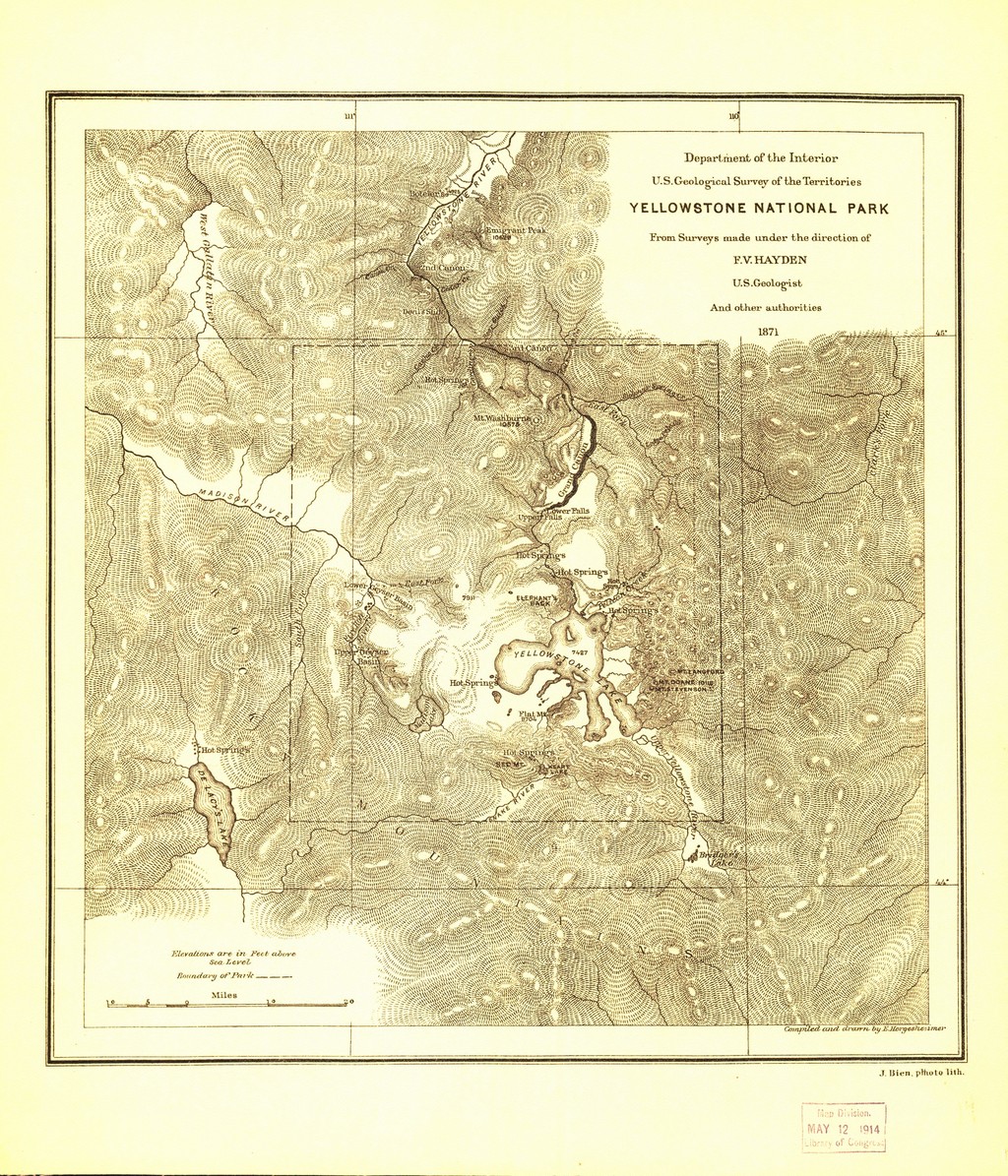
The Hayden map catalogued by the Library of Congress as Yellowstone National Park: 1871 offers another way to understand the survey’s work. It records names, rivers and a park boundary rather than one dramatic vista. Its inscribed survey year should be distinguished from the park’s later legal establishment. A historical map should not replace a current visitor map or be taken as proof of exactly where every painted feature belongs. [5]
Together, map and painting make the difference between information and presentation tangible. The map spreads attention across a surveyed area; the picture concentrates it on the canyon. Both help describe a place, but the canvas asks the spectator to experience its grandeur. That distinction explains why art could become influential without being a literal topographical record or an adequate account of all the region’s histories.
Returning to the view today
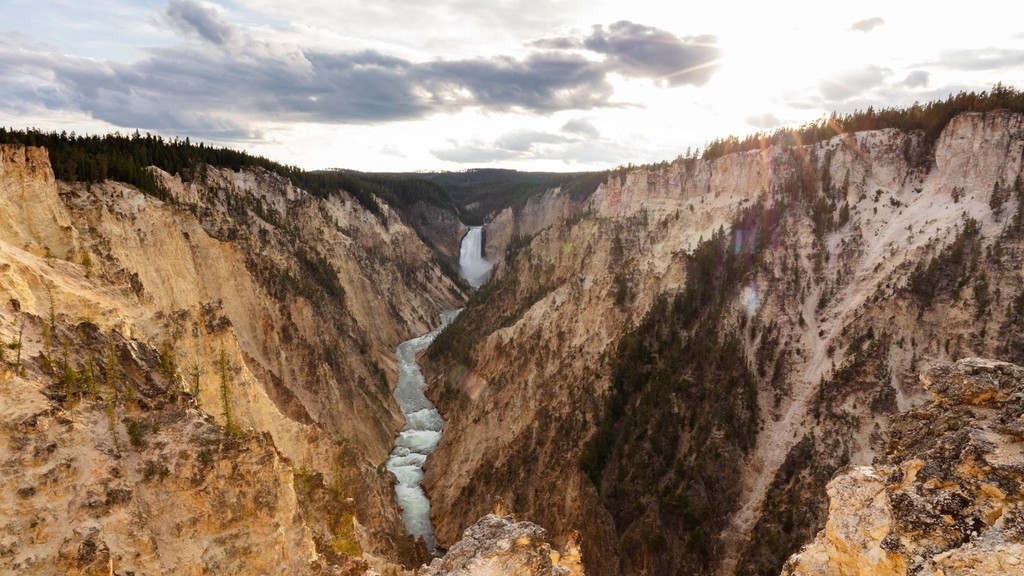
A modern photograph from Artist Point, published by the National Park Service, provides a useful comparison with Moran’s painted canyon. It shows the falls within enclosing walls and demonstrates why the site still invites a long view into the gorge. Its caption and credit identify a modern photographic record; it should not be presented as a photograph of Moran’s exact painting position. [6]
Comparing the two makes their different purposes clear. The photograph records one view under particular conditions. Moran’s canvas organises light, foreground access and distant detail for a large exhibition picture. Differences do not automatically prove that a landscape has changed since 1871, nor can resemblance prove that the artist copied a single view without alteration.
The Interior Museum records that the Yellowstone canvas and its Colorado companion transferred to the Department under legislation in 1950. Their shared institutional history gives substance to Moran’s intention to create related public pictures. It does not erase the distinctions between the two landscapes, or between these works and the many smaller western pictures he made over a long career. [1]
Moran’s later account of artistic knowledge
In an interview published in Brush and Pencil in April 1903, Moran returned to the relationship between seeing and knowing. He argued that an artist needed knowledge as well as eyesight, and that technical skill served a larger purpose. These remarks came more than thirty years after the Yellowstone journey. They are a later account of his outlook, rather than a surviving set of instructions for the 1872 canvas. [7]
They nevertheless offer a useful way of looking at the finished picture. Recognising a tree or waterfall is only the beginning of understanding what it contributes. The tall foreground pine has a branching structure, but it also frames the opening. The falls describe moving water, but their distant position helps establish space. A rock mass can look solid while also redirecting attention towards a brighter area. Observation and organisation operate together.
This distinction explains why detailed painting need not be a simple inventory. The foreground contains many separate surfaces, yet their larger arrangement guides the spectator towards the canyon. Conversely, the distant falls remain effective although we cannot inspect them with the same precision as the nearer ledge. Different degrees of detail serve different parts of the view. The painting offers an ordered encounter, not equal information about every object within it.
Moran’s later remarks also encourage a distinction between artistic effect and effortless transcription. The image seems to open a landscape before us, but that apparent immediacy is the result of decisions. We can admire its light and colour while attending to those decisions, just as we can recognise the value of the expedition without assuming that travel alone produced a masterpiece. The letter to Hayden, the exhibition responses and the artist’s subsequent explanation preserve different stages in that history.
Yellowstone remains a strong introduction to Moran’s paintings because its central tension is easy to see. A recognisable place is made into a carefully ordered experience of wonder. The expedition and its records supply one part of that history; the studio, exhibition and public purchase supply another. Looking closely at the canvas allows both to remain in view, without asking a single painting to carry the whole story of the park.
Artworks directory
Selected documented works and distinct versions. This directory is not a comprehensive catalogue raisonné. Dates and media retain the distinctions explained in the articles and museum records.
| Name | Date | Medium |
|---|---|---|
| An Arizona Sunset near the Grand Canyon | Date not securely established | Oil painting |
| Autumn Afternoon, the Wissahickon by Thomas Moran | 1864 | Oil on canvas |
| Cascade Falls, Yosemite | Commonly catalogued as 1905 | Catalogued as oil on canvas |
| The Chasm of the Colorado | 1873–1874; completed in 1874 | Oil on canvas, currently mounted on aluminium |
| Children of the Mountain | 1866 in the current museum title; 1867 in the 1997 National Gallery catalogue | Oil on canvas |
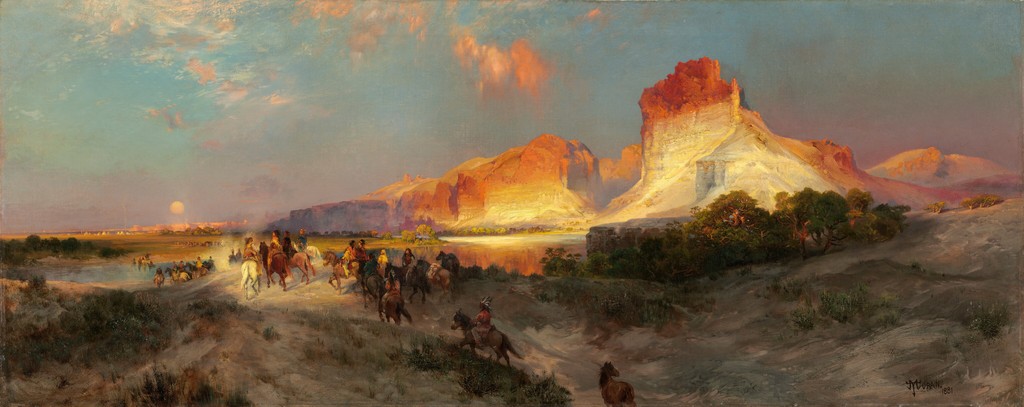
| Cliffs of Green River | 1874 | Oil on canvas |
| Cliffs of the Upper Colorado River, Wyoming Territory | 1882 | Oil on canvas |
| East Hampton, Long Island , also captioned Easthampton, L.I | 1897 | Oil on canvas laid on board, according to the reproduction record |
| Fiercely the red sun descending, Burned his way along the heavens | 1875–76 | Oil on canvas |
| Forest Scene | 1870 | Oil on canvas |
| Grand Canyon of the Colorado River | 1892 and 1908 | Oil on canvas |
| Green River Cliffs, Wyoming | 1881 | Oil on canvas |
| Green River, Wyoming | 1878 | Oil on panel |
| The Juniata, Evening | 1864 | Oil on canvas |
| Mosquito Trail, Rocky Mountains of Colorado | 1875 in the 1997 National Gallery exhibition catalogue | Watercolour |
| Mountain of the Holy Cross | 1875 | Oil on canvas |
| The Much Resounding Sea | 1884 | Oil on canvas |
| Point Lobos, Monterey, California | 1912, signed and dated | Oil on canvas |
| Shoshone Falls on the Snake River | 1900 | Oil on canvas |
| Summit of the Sierras | 1872/75, as catalogued by the Art Institute of Chicago | Gouache over graphite on cream laid paper |
| The Teton Range | 1897 | Oil on canvas |
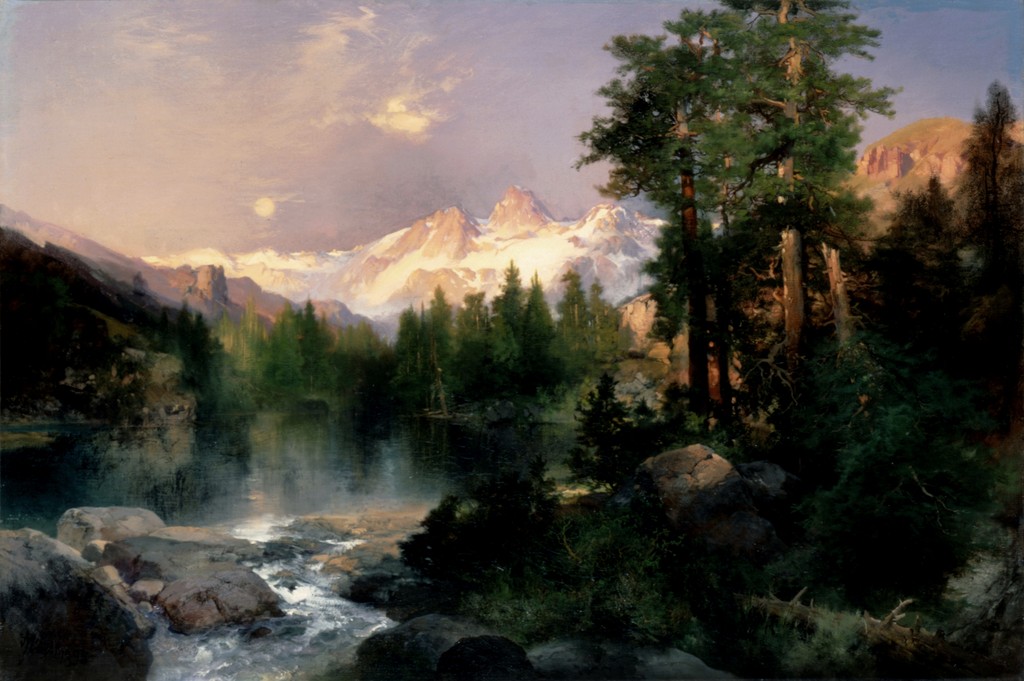
| The Three Tetons | 1895 | Oil on canvas |
| Tower Falls, Yellowstone | 1872 | Watercolour and gouache over graphite on blue laid paper |
| A View of Venice | 1891 | Oil on canvas |
| The Grand Canyon of the Yellowstone | 1872 | Oil on canvas, currently recorded as mounted on aluminium |
| Mountain of the Holy Cross, Colorado (etching) | 1888 | Etching, roulette and aquatint |
| The Resounding Sea (etching) | 1880 | Etching |
| The Much Resounding Sea (later etching) | 1886 in heading; 1888 on plate | Etching, drypoint and roulette |
| Tower Falls (Prang print) | c. 1875; portfolio issued 1876 | Chromolithograph |
| Shoshone Falls (early watercolour) | 1874 | Watercolour |
| Venice (watercolour) | 1888 | Watercolour over graphite |
Frequently Asked Questions
He completed it in 1872, following his 1871 journey with part of Ferdinand V. Hayden’s expedition. His March 1872 letter described the canvas as unfinished. [2]
It belongs to the U.S. Department of the Interior Museum. Congress purchased it in 1872, and it transferred to the Department in 1950. Collection ownership does not guarantee a particular current display location. [1]
No. This work represents Yellowstone’s canyon and falls. The Chasm of the Colorado, dated 1873–1874, concerns the Grand Canyon of the Colorado River. [1]
It should not be treated as a photograph-like record of one viewpoint. Moran’s published explanation emphasised idealisation, and a modern Artist Point photograph is a contextual comparison rather than proof of an exact match. [3]
Discussion
Which first draws your attention: the brilliant right-hand wall, the distant falls or the figures on the foreground ledge? How does your impression change when you follow the river back through the canyon?
Reader Insights
Editorial prompts for close looking and discussion.
Which first draws your attention: the brilliant right-hand wall, the distant falls or the figures on the foreground ledge?
How does your impression change when you follow the river back through the canyon?
How does this page compare with the related works linked above?
Join the Conversation
Share your reading of this page below.
References
- U.S. Department of the Interior Museum, Thomas Moran and the Big Picture, collection details for the 1872 Yellowstone canvas and its Colorado companion.
- Nancy K. Anderson and contributors, Thomas Moran, National Gallery of Art, 1997; targeted career narrative, Yellowstone entry, transcribed correspondence and contemporary reviews, and 1872 chronology. Historical newspaper responses cited here were read through the catalogue’s transcriptions.
- G. W. Sheldon, American Painters, D. Appleton and Company, 1879, Moran chapter, especially printed p. 125.
- National Archives, Act Establishing Yellowstone National Park (1872), enrolled act dated 1 March 1872 and accompanying transcript.
- Library of Congress, Yellowstone National Park: 1871, map associated with the Department of the Interior and Hayden’s survey.
- National Park Service, Grand Canyon of the Yellowstone: Artist Point, modern site context and photograph.
- Thomas Moran, Knowledge a Prime Requisite in Art, Brush and Pencil 12, April 1903, pp. 14–16; identified in the publication as part of an interview.
- Splash image source.
The Grand Canyon of the Yellowstone, 1872. Wuselig / Wikimedia Commons, CC BY-SA 4.0; U.S. Department of the Interior Museum painting. Image source. CC BY-SA 4.0; also marked PD-Art. Outer museum frame cropped; resized. Painted composition retained; photographic perspective unchanged. This image derivative is available under the same licence.
- Splash image source.
Historical map catalogued as Yellowstone National Park, 1871. F. V. Hayden / Library of Congress; restored digital file by Durova via Wikimedia Commons. Image source. Public Domain Mark; historical map. Resized only; complete source image retained.
- Splash image source.
A modern view of the Grand Canyon of the Yellowstone from Artist Point; it is not documentary evidence of Moran’s exact painting vantage point. NPS / Jacob W. Frank. No claim to original U.S. Government works.. Image source. Public domain NPS photograph; no contrary credit or copyright symbol. Resized only; complete source image retained.
- Splash image source.
The Grand Canyon of the Yellowstone, 1872. Wuselig / Wikimedia Commons, CC BY-SA 4.0; U.S. Department of the Interior Museum painting. Image source. CC BY-SA 4.0; also marked PD-Art. Outer museum frame cropped; resized. Painted composition retained; photographic perspective unchanged. This image derivative is available under the same licence.
- Splash image source.
The Chasm of the Colorado, 1873–1874. U.S. Department of the Interior Museum; faithful reproduction via Smithsonian American Art Museum / Wikimedia Commons. Image source. Public Domain Mark; faithful two-dimensional reproduction. Resized only; complete source image retained.
- Splash image source.
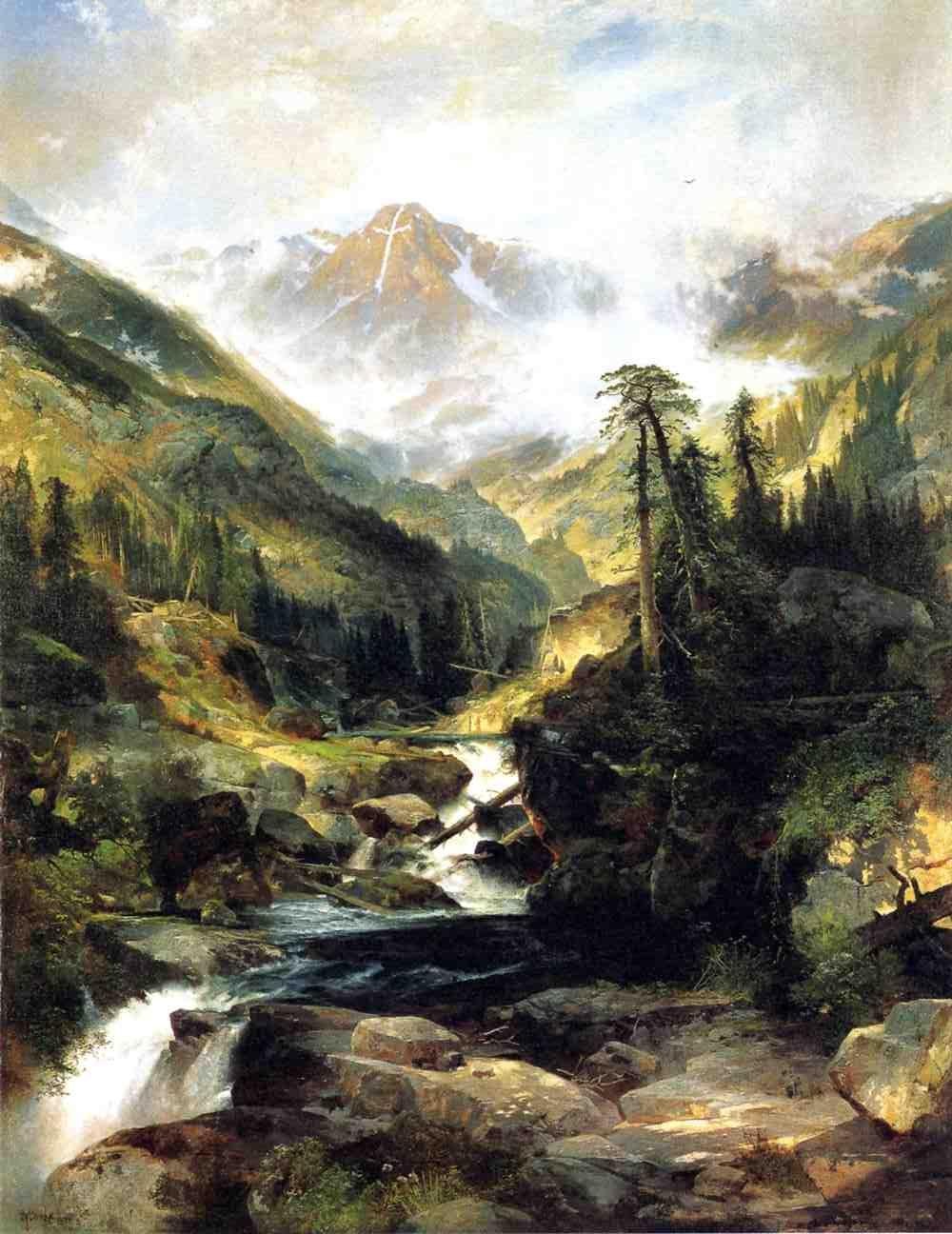
Mountain of the Holy Cross, 1875. Autry Museum of the American West; faithful reproduction via Wikimedia Commons. Image source. Public Domain Mark; faithful two-dimensional reproduction. Resized only; complete source image retained.
- Splash image source.
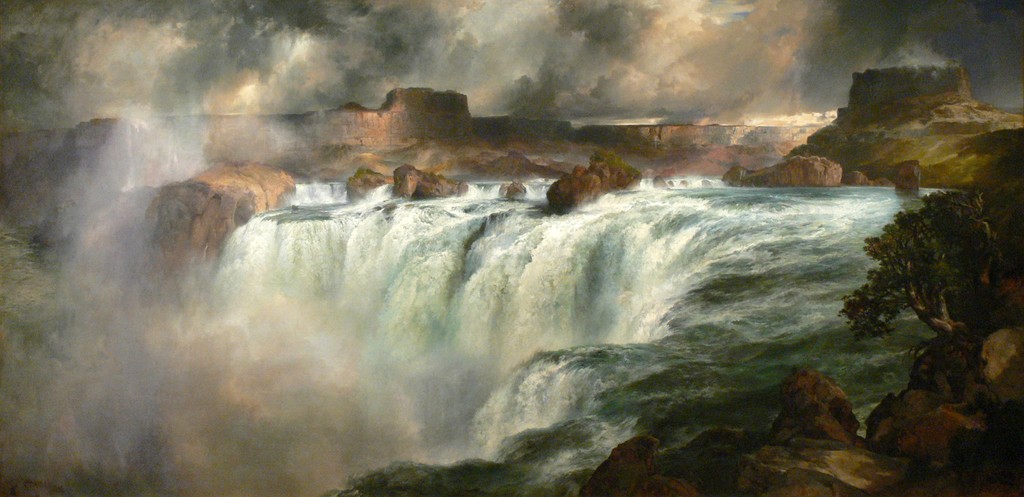
Shoshone Falls on the Snake River, 1900. Wolfgang Sauber / Wikimedia Commons, CC BY-SA 3.0; Gilcrease Museum painting. Image source. CC BY-SA 3.0; also marked PD-Art. Resized only; complete source image retained. This image derivative is available under the same licence.
- Splash image source.
Green River Cliffs, Wyoming, 1881. National Gallery of Art, Gift of the Milligan and Thomson Families. Image source. Public domain; NGA Open Access. Resized only; complete source image retained.
- Splash image source.
A View of Venice, 1891. Smithsonian American Art Museum, Transfer from the U.S. Department of the Interior, National Park Service, 1968.120.1. Image source. Free to use; Smithsonian Open Access. Resized only; complete source image retained.
- Splash image source.
The Three Tetons, 1895. The White House Collection, Gift of C. R. Smith; faithful reproduction via Wikimedia Commons. Image source. Public Domain Mark; faithful reproduction of a two-dimensional public-domain work. Resized only; complete source image retained.