 by Tom Gurney
Tom Gurney BSc (Hons) is an art history expert with over 20 years experience
Published on June 19, 2020 / Updated on October 27, 2026
Email: tomgurney1@gmail.com / Phone: +44 7429 011000
Forest Scene by Thomas Moran: Introduction
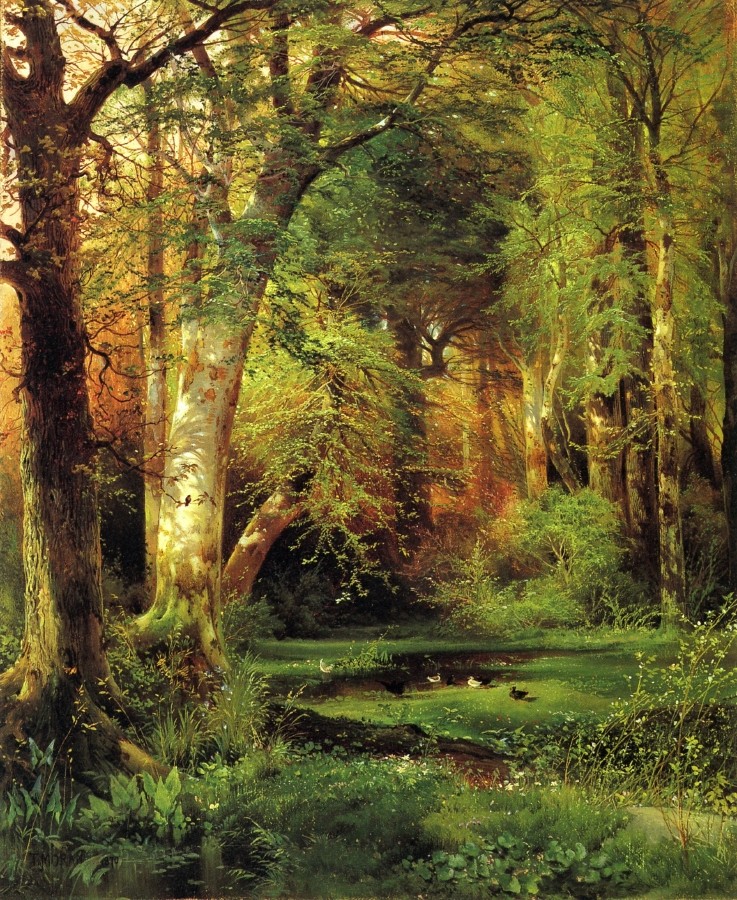
Thomas Moran’s Forest Scene draws the eye into a woodland rather than towards a distant mountain. A large trunk rises close to the left edge; smaller trees cross the middle of the picture, and light catches patches of vegetation beneath them. Painted in 1870, the work belongs to the period before Moran’s first Yellowstone journey. The National Gallery of Art’s 1997 exhibition catalogue identifies it as an oil on canvas measuring 50.8 × 40.6 cm and records it in a private collection. [1]
Its subject is modest beside the canyons for which Thomas Moran became famous. Yet the painting already makes light and shadow an active part of the landscape. Instead of supplying one uninterrupted prospect, it offers a succession of openings and obstacles. Looking into the wood means negotiating trunks, branches, foliage and dark intervals whose relationships emerge gradually.
At a Glance
- ArtistThomas Moran.
- TitleForest Scene.
- Date1870.
- MediumOil on canvas.
- Dimensions50.8 × 40.6 cm, according to the 1997 exhibition catalogue.
- CollectionRecorded as privately owned in that catalogue; a present owner is not identified here.
- Career contextBefore the 1871 Yellowstone expedition.
Where this work sits in Moran’s career
The Chasm of the Colorado
1873–1874; completed in 1874A View of Venice
1891Point Lobos, Monterey, California
1912, signed and datedForest Scene
1870Contents
- Looking into the woodland
- A structure made from branches
- Light without an open sky
- Before the western breakthrough
- Comparing the earlier landscapes
Looking into the woodland
The vertical format gives the nearest tree an immediate presence. Its trunk occupies much of the left side and continues beyond the upper boundary, making the woodland feel larger than the portion shown. The canopy cannot be taken in at a glance. Branches stretch across the opening, while other trunks stand further back, partly obscured by leaves.
The darker foreground provides the starting point for this movement into the picture. Greens collect around irregular brown surfaces and low vegetation. Beyond them, a lighter opening draws attention towards the centre. A more shadowed horizontal interval then interrupts the recession. The result is a space assembled from alternating bands rather than a straight, easily measured route.
This arrangement places the viewer close to the landscape. There is no detached survey of an entire forest and no high vantage point overlooking a valley. The nearer trees obstruct as much as they reveal. Their scale is established through overlap and proximity, so that a relatively small canvas can suggest the sensation of standing among substantial forms.
A structure made from branches
Several different directions operate at once. The principal trunk establishes a strong upright. Branches curve across it and into the upper half; smaller trees lean or bend beyond the opening. These lines hold the picture together without giving it the regularity of a building. They make the woodland legible while preserving its irregular growth.
The nearest trunk is especially useful as a comparison with the trees behind it. Its warmer brown surface and stronger contrasts give it greater visual weight. Further back, foliage and tree forms merge more readily. The shift does not require every leaf to be individually described. Changes in clarity are enough to distinguish the nearer structure from the less accessible interior.
One can follow the branches as a network, or concentrate on the spaces between them. The two ways of looking produce different impressions. The first stresses the solidity of the trees; the second reveals the small passages through which light enters. Moran’s composition depends on both. Without the dark framework, the bright patches would lose much of their force.
Light without an open sky
Light in Forest Scene is distributed unevenly. It brightens parts of the foliage and catches the rougher surfaces close to the central opening, while adjacent areas remain substantially darker. Rather than spreading a single illumination across the whole scene, Moran uses these variations to draw attention to particular places.
The restricted view of the sky matters. In a wide landscape, a sunset or bank of clouds can provide the most conspicuous event. Here the effects of light are discovered within the wood. They appear on tree surfaces and among the leaves, giving the enclosure a changing internal rhythm. The viewer encounters illumination through its consequences on the ground and vegetation.
The green colour is similarly varied. Warm yellow-green passages sit beside cooler, darker areas, and the brown trunk provides a distinct counterweight. These relationships prevent the foliage from becoming one continuous mass. They also show why a woodland subject gives a painter substantial colour problems even when its overall palette appears narrower than a spectacular western sunset.
Watch: Thomas Moran
Choose a film to explore the artist’s work, its interpretation and its wider setting.
The painting that inspired a National Park
A close discussion of Moran’s landscape and its relationship to the idea of Yellowstone.
Watch on YouTubeBefore the western breakthrough
Moran painted Forest Scene a year before joining Ferdinand Hayden’s 1871 Yellowstone expedition. His earlier career had already involved landscape painting, illustration and the study of other artists. Philadelphia and its surrounding scenery were important to that education, as were the example of his elder brother Edward and his study of J. M. W. Turner. Turner was an artistic model encountered through reproductions and paintings, rather than a teacher whom Moran personally studied under. [1]
The woodland should not therefore be treated as a preliminary failure to discover the West. It addresses a different kind of pictorial experience. Enclosure replaces the extensive horizon; overlapping trees replace the sharply separated masses of a canyon. The artist’s later interest in dramatic scenery developed alongside an established ability to make nearby forms and small variations of light compelling.
His own later account of artistic practice helps explain the value he placed on observation. In a published 1903 interview article, he wrote, “Eyesight is nothing unless backed by brains.” The statement belonged to a discussion of knowledge, judgement and the study of nature. It was not an explanation of this particular painting, but it cautions against treating landscape as a passive record of whatever happens to fall before the eye. [2]
Comparing the earlier landscapes
Autumn Afternoon, the Wissahickon, dated 1864 in the Terra Foundation’s collection, offers a useful comparison. Its river opens a more extensive route through the composition, and its autumn colours separate the banks from the water. Forest Scene confines attention more closely to the trees and undergrowth. The comparison shows how Moran could organise an early landscape around an open channel or around the interruptions of a woodland interior. [3]
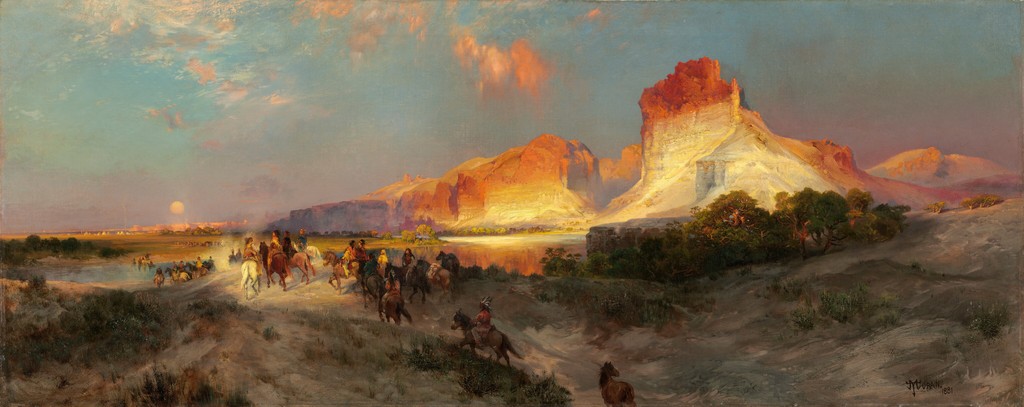
The contrast with Green River Cliffs, Wyoming is greater still. The later western painting uses a broad horizontal view and widely separated rock formations. Forest Scene asks the eye to work through an upright, densely occupied space. Their difference is more instructive than a simple claim that every early picture anticipates a canyon masterpiece.
What remains distinctive here is the balance between obstruction and invitation. The central light encourages the viewer to look further, but the surrounding growth prevents the woodland from becoming completely transparent. Moran gives the trees enough structure to guide attention while leaving enough obscurity for the interior to retain its depth.
Artworks directory
Selected documented works and distinct versions. This directory is not a comprehensive catalogue raisonné. Dates and media retain the distinctions explained in the articles and museum records.
| Name | Date | Medium |
|---|---|---|
| An Arizona Sunset near the Grand Canyon | Date not securely established | Oil painting |
| Autumn Afternoon, the Wissahickon by Thomas Moran | 1864 | Oil on canvas |
| Cascade Falls, Yosemite | Commonly catalogued as 1905 | Catalogued as oil on canvas |
| The Chasm of the Colorado | 1873–1874; completed in 1874 | Oil on canvas, currently mounted on aluminium |
| Children of the Mountain | 1866 in the current museum title; 1867 in the 1997 National Gallery catalogue | Oil on canvas |
| Cliffs of Green River | 1874 | Oil on canvas |
| Cliffs of the Upper Colorado River, Wyoming Territory | 1882 | Oil on canvas |
| East Hampton, Long Island , also captioned Easthampton, L.I | 1897 | Oil on canvas laid on board, according to the reproduction record |
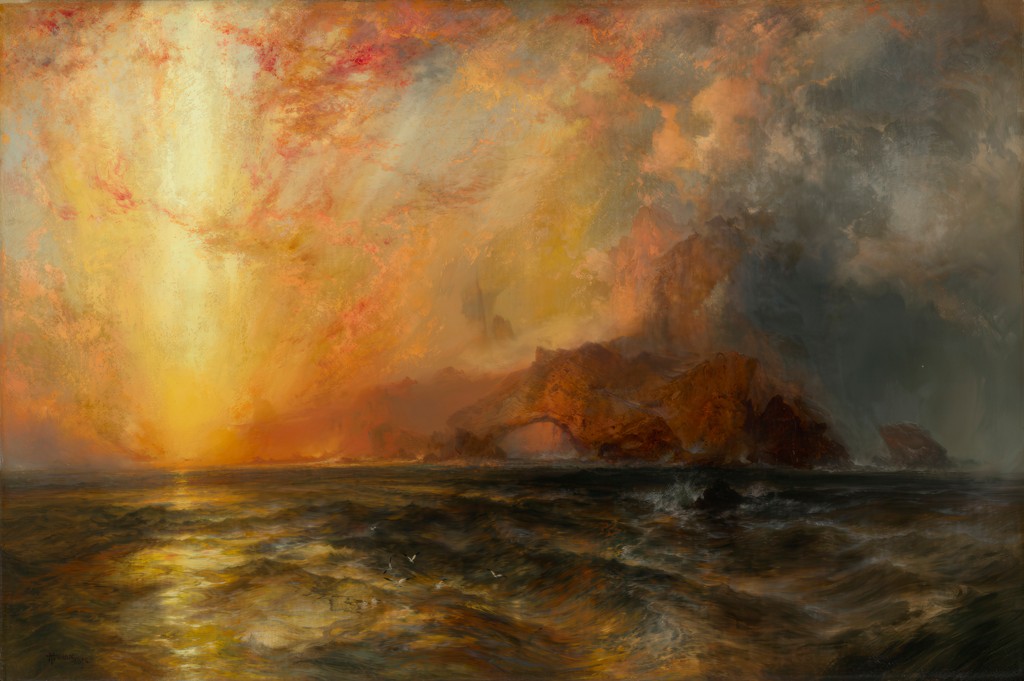
| Fiercely the red sun descending, Burned his way along the heavens | 1875–76 | Oil on canvas |
| Forest Scene | 1870 | Oil on canvas |
| Grand Canyon of the Colorado River | 1892 and 1908 | Oil on canvas |
| Green River Cliffs, Wyoming | 1881 | Oil on canvas |
| Green River, Wyoming | 1878 | Oil on panel |
| The Juniata, Evening | 1864 | Oil on canvas |
| Mosquito Trail, Rocky Mountains of Colorado | 1875 in the 1997 National Gallery exhibition catalogue | Watercolour |
| Mountain of the Holy Cross | 1875 | Oil on canvas |
| The Much Resounding Sea | 1884 | Oil on canvas |
| Point Lobos, Monterey, California | 1912, signed and dated | Oil on canvas |
| Shoshone Falls on the Snake River | 1900 | Oil on canvas |
| Summit of the Sierras | 1872/75, as catalogued by the Art Institute of Chicago | Gouache over graphite on cream laid paper |
| The Teton Range | 1897 | Oil on canvas |
| The Three Tetons | 1895 | Oil on canvas |
| Tower Falls, Yellowstone | 1872 | Watercolour and gouache over graphite on blue laid paper |
| A View of Venice | 1891 | Oil on canvas |
| The Grand Canyon of the Yellowstone | 1872 | Oil on canvas, currently recorded as mounted on aluminium |
| Mountain of the Holy Cross, Colorado (etching) | 1888 | Etching, roulette and aquatint |
| The Resounding Sea (etching) | 1880 | Etching |
| The Much Resounding Sea (later etching) | 1886 in heading; 1888 on plate | Etching, drypoint and roulette |
| Tower Falls (Prang print) | c. 1875; portfolio issued 1876 | Chromolithograph |
| Shoshone Falls (early watercolour) | 1874 | Watercolour |
| Venice (watercolour) | 1888 | Watercolour over graphite |
Frequently Asked Questions
The 1997 National Gallery of Art exhibition catalogue dates it to 1870, before his Yellowstone journey of 1871. [1]
The catalogue title does not establish a named forest. A precise location should not be inferred from the appearance of the trees.
The 1997 catalogue records a private collection. That entry does not establish a present owner or a current public display location. [1]
It concentrates on an enclosed woodland, overlapping trees and light within the foliage, rather than the wide horizons and large separated formations of his canyon subjects.
Discussion
Does the nearest tree draw your attention first, or does the illuminated opening behind it? Compare this woodland with Autumn Afternoon, the Wissahickon. How does the presence of an open river change the way you move through the scene?
Reader Insights
Editorial prompts for close looking and discussion.
- Does the nearest tree draw your attention first, or does the illuminated opening behind it?
- Compare this woodland with Autumn Afternoon, the Wissahickon . How does the presence of an open river change the way you move through the scene?
How does this page compare with the related works linked above?
Join the Conversation
Share your reading of this page below.
References
- Nancy K. Anderson, Thomas P. Bruhn, Joni L. Kinsey and Anne Morand, Thomas Moran, National Gallery of Art, 1997, early-career essay and catalogue entry 8, p.44. Exhibition catalogue.
- Thomas Moran, “Knowledge a Prime Requisite in Art,” Brush and Pencil, vol.12, April 1903, pp.14–16; quotation p.14. Digitised issue.
- Terra Foundation for American Art, Autumn Afternoon, the Wissahickon, 1864, Daniel J. Terra Collection, 1999.99. Collection record.
- Splash image source.
Forest Scene, 1870. Private collection; image via WikiArt. Image source. Public domain stated in image record; faithful reproduction. Resized only; complete source image retained.
- Splash image source.
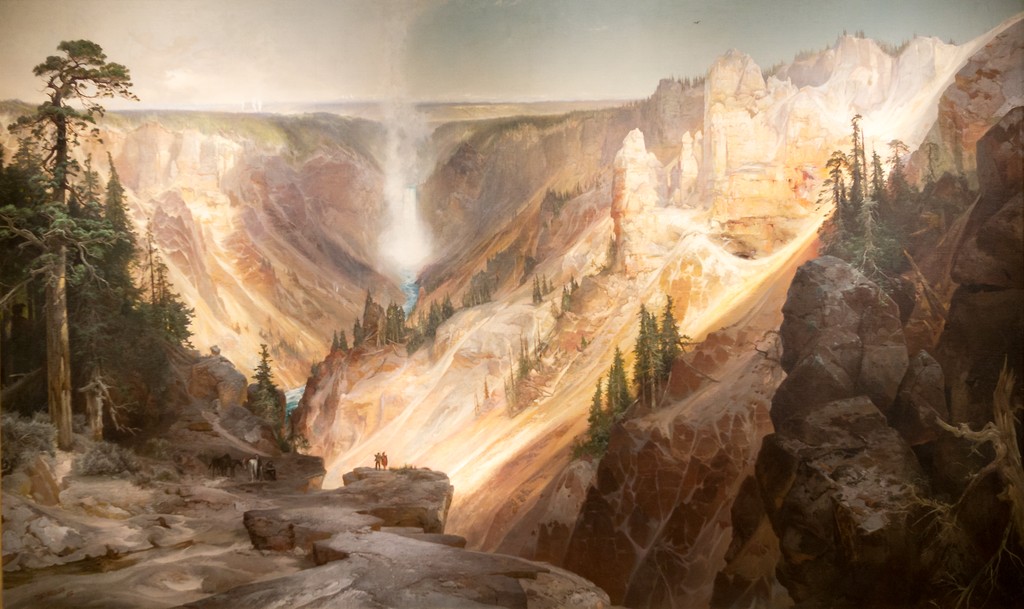
The Grand Canyon of the Yellowstone, 1872. Wuselig / Wikimedia Commons, CC BY-SA 4.0; U.S. Department of the Interior Museum painting. Image source. CC BY-SA 4.0; also marked PD-Art. Outer museum frame cropped; resized. Painted composition retained; photographic perspective unchanged. This image derivative is available under the same licence.
- Splash image source.
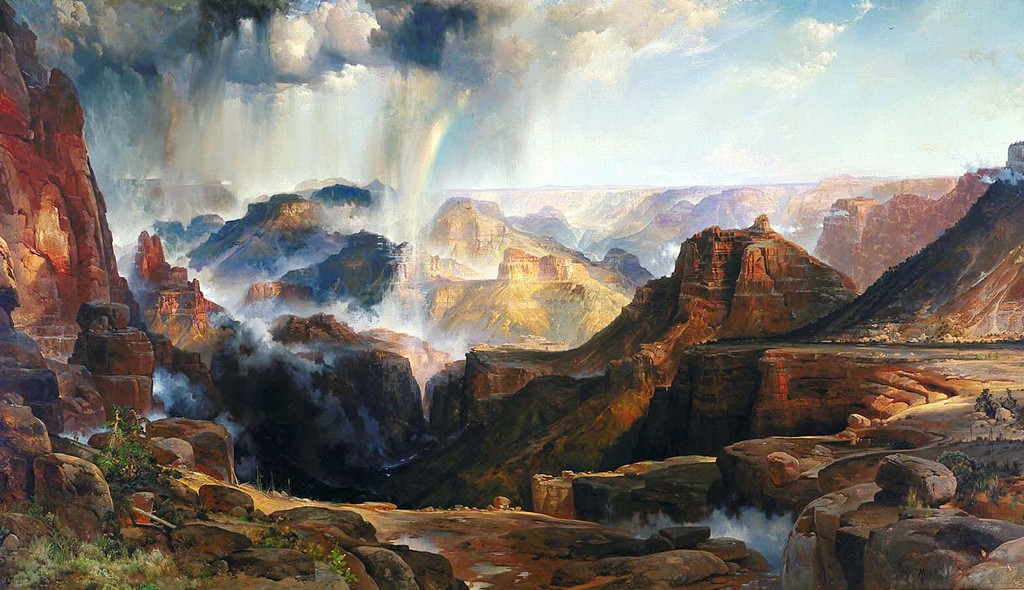
The Chasm of the Colorado, 1873–1874. U.S. Department of the Interior Museum; faithful reproduction via Smithsonian American Art Museum / Wikimedia Commons. Image source. Public Domain Mark; faithful two-dimensional reproduction. Resized only; complete source image retained.
- Splash image source.
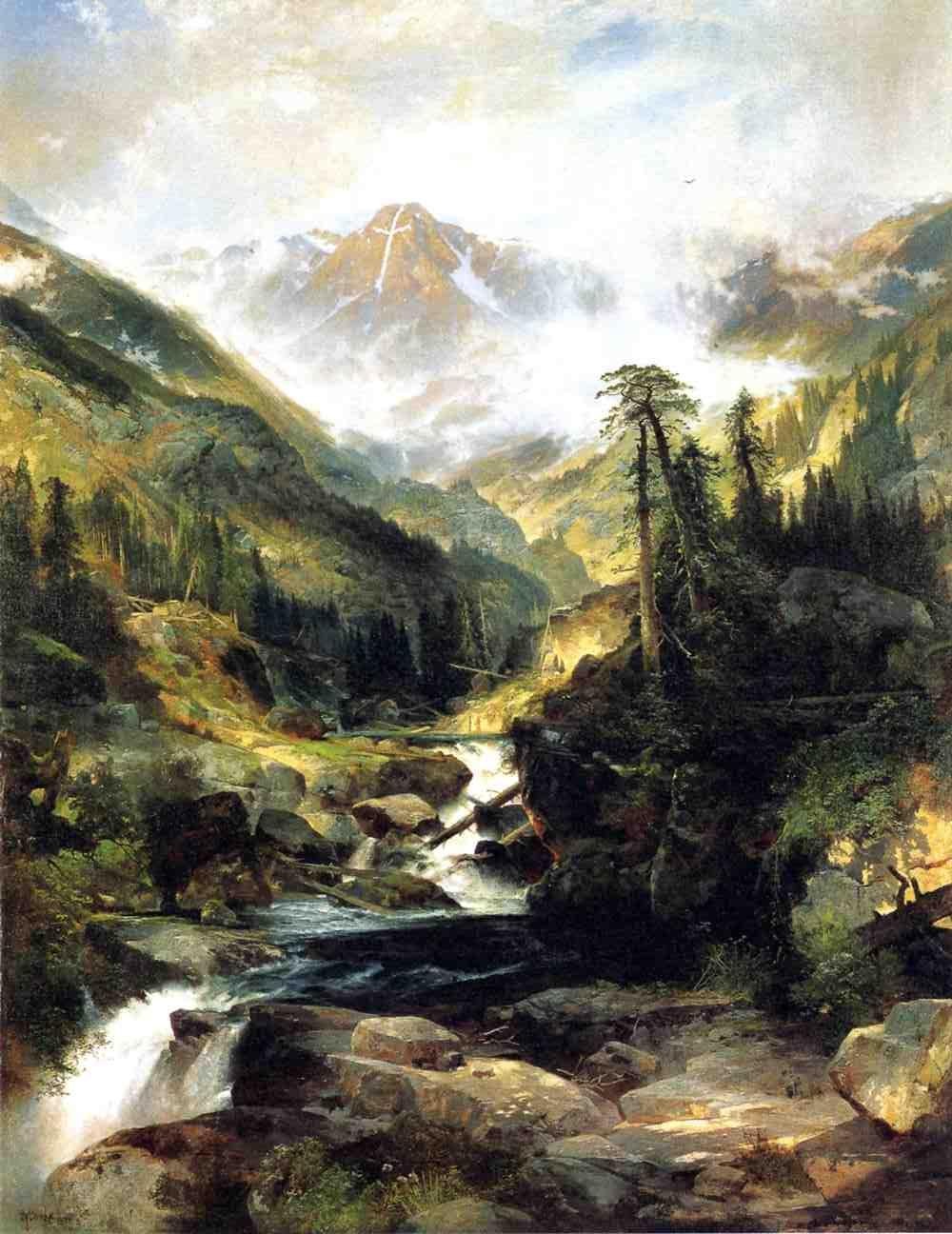
Mountain of the Holy Cross, 1875. Autry Museum of the American West; faithful reproduction via Wikimedia Commons. Image source. Public Domain Mark; faithful two-dimensional reproduction. Resized only; complete source image retained.
- Splash image source.
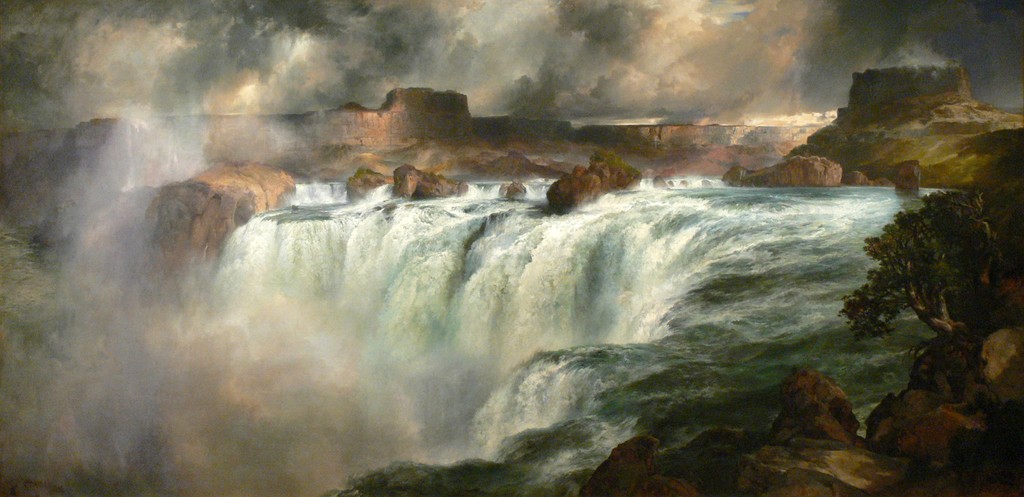
Shoshone Falls on the Snake River, 1900. Wolfgang Sauber / Wikimedia Commons, CC BY-SA 3.0; Gilcrease Museum painting. Image source. CC BY-SA 3.0; also marked PD-Art. Resized only; complete source image retained. This image derivative is available under the same licence.
- Splash image source.
Green River Cliffs, Wyoming, 1881. National Gallery of Art, Gift of the Milligan and Thomson Families. Image source. Public domain; NGA Open Access. Resized only; complete source image retained.
- Splash image source.
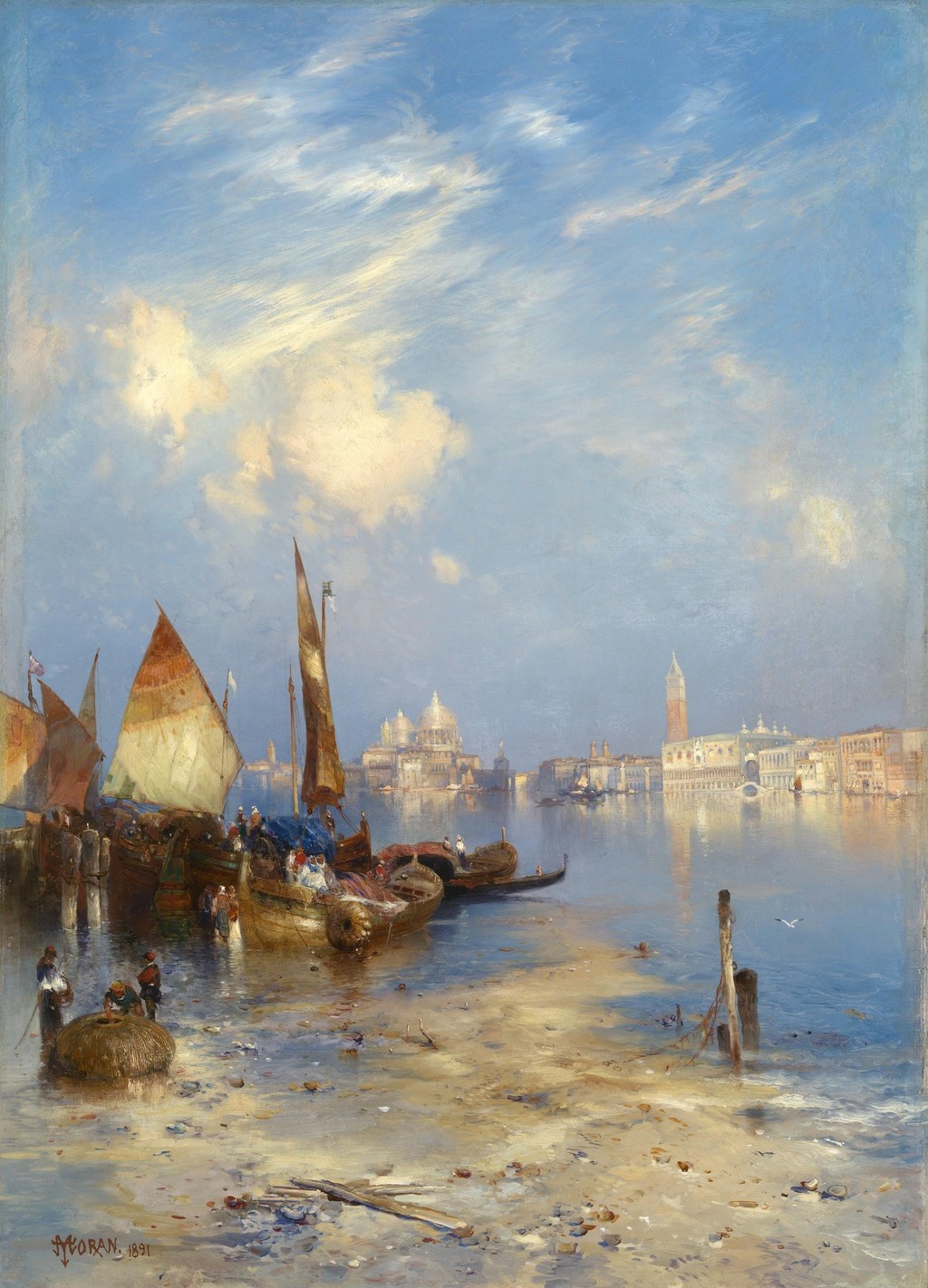
A View of Venice, 1891. Smithsonian American Art Museum, Transfer from the U.S. Department of the Interior, National Park Service, 1968.120.1. Image source. Free to use; Smithsonian Open Access. Resized only; complete source image retained.
- Splash image source.
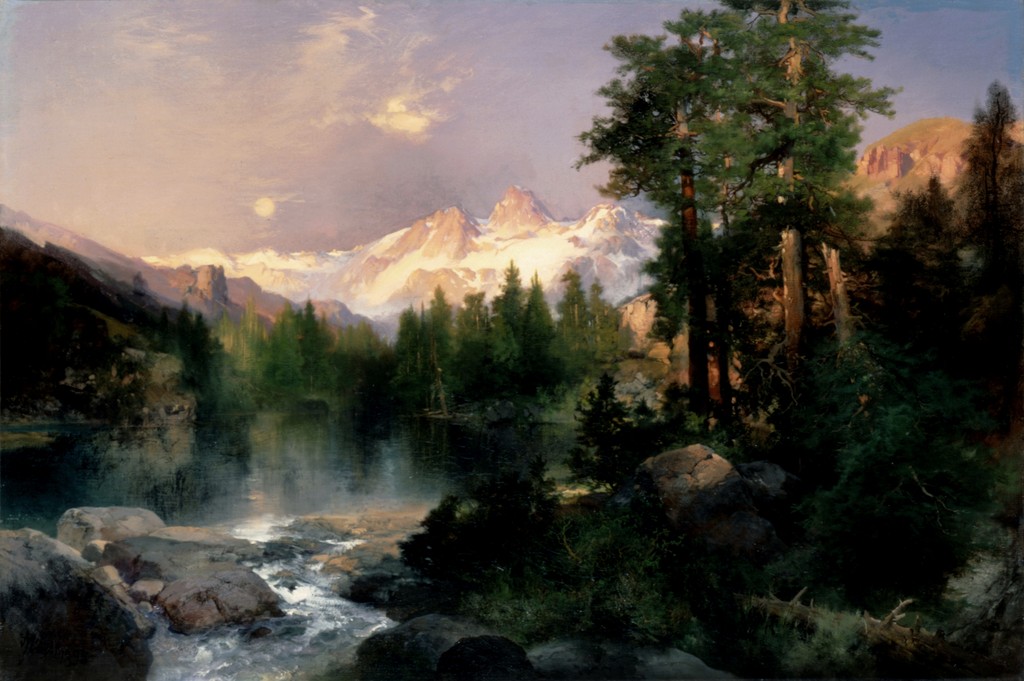
The Three Tetons, 1895. The White House Collection, Gift of C. R. Smith; faithful reproduction via Wikimedia Commons. Image source. Public Domain Mark; faithful reproduction of a two-dimensional public-domain work. Resized only; complete source image retained.