 by Tom Gurney
Tom Gurney BSc (Hons) is an art history expert with over 20 years experience
Published on June 19, 2020 / Updated on October 27, 2026
Email: tomgurney1@gmail.com / Phone: +44 7429 011000
East Hampton, Long Island by Thomas Moran: Introduction
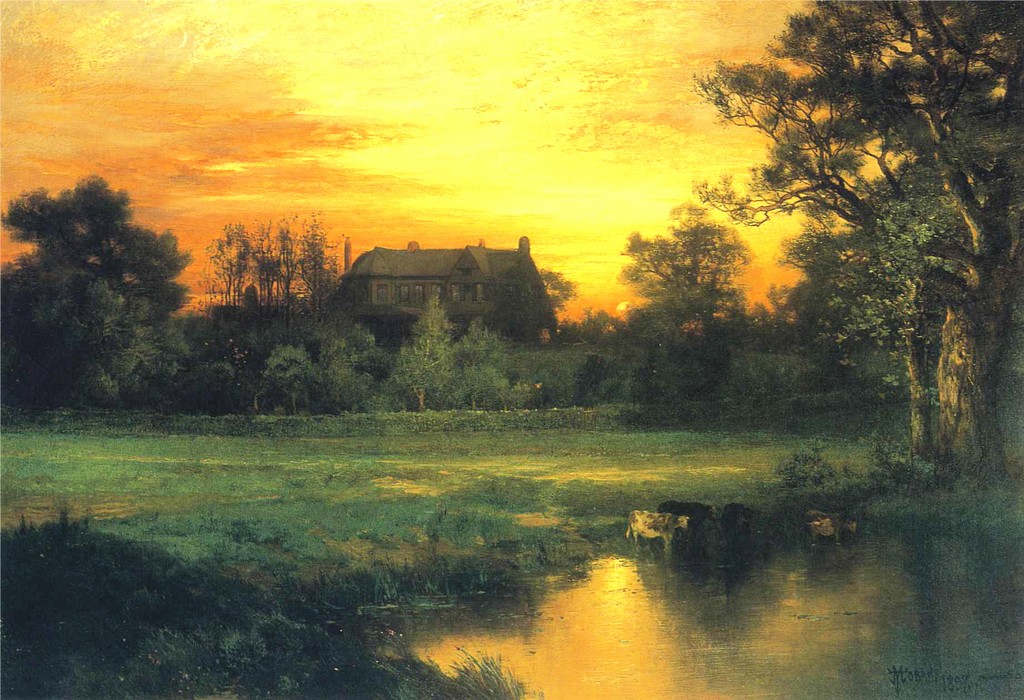
Thomas Moran’s East Hampton, Long Island brings a brilliant evening sky into a familiar pastoral setting. A house stands among dark trees, cattle gather beside water, and a warm reflection breaks across the foreground. The 1897 painting was reproduced as Easthampton, L.I. in a report on Phyllis Braff’s 2013 Guild Hall retrospective, where its caption identified a private collection and dimensions of 18⅛ × 26 inches. [1]
The faithful reproduction record describes the medium as oil on canvas laid on board. Neither that record nor the exhibition caption supplies a complete ownership history. Their matching image, date and dimensions identify the particular work, which should be distinguished from Moran’s other paintings of the Long Island area. [2]
At a Glance
- ArtistThomas Moran.
- TitleEast Hampton, Long Island, also captioned Easthampton, L.I.
- Date1897.
- MediumOil on canvas laid on board, according to the reproduction record.
- Dimensions18⅛ × 26 inches in the 2013 exhibition caption.
- CollectionPrivately owned in that caption; no present owner identified.
- SubjectA pastoral Long Island landscape with a house, cattle and water.
Where this work sits in Moran’s career
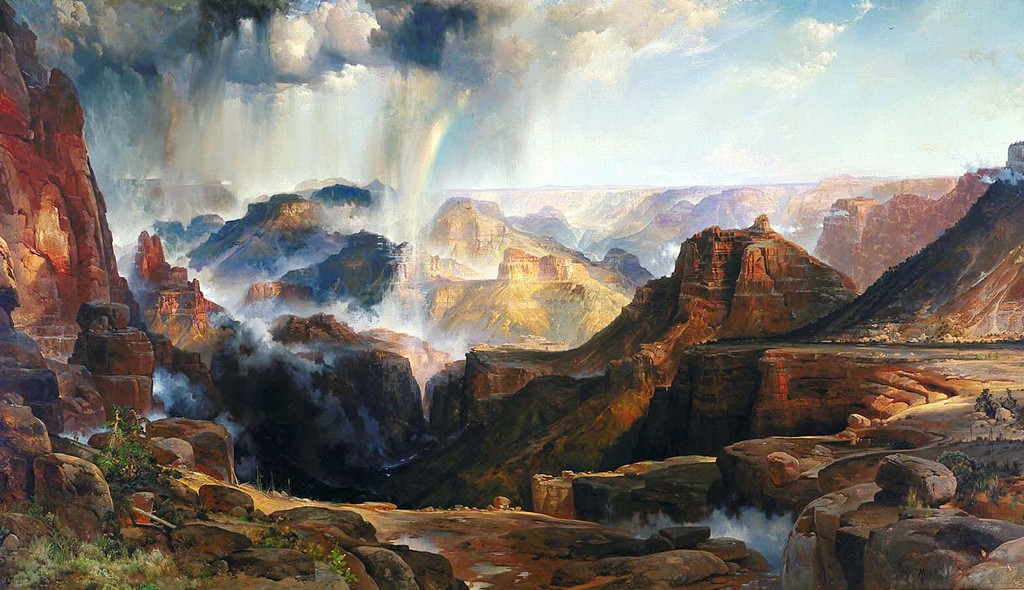
The Chasm of the Colorado
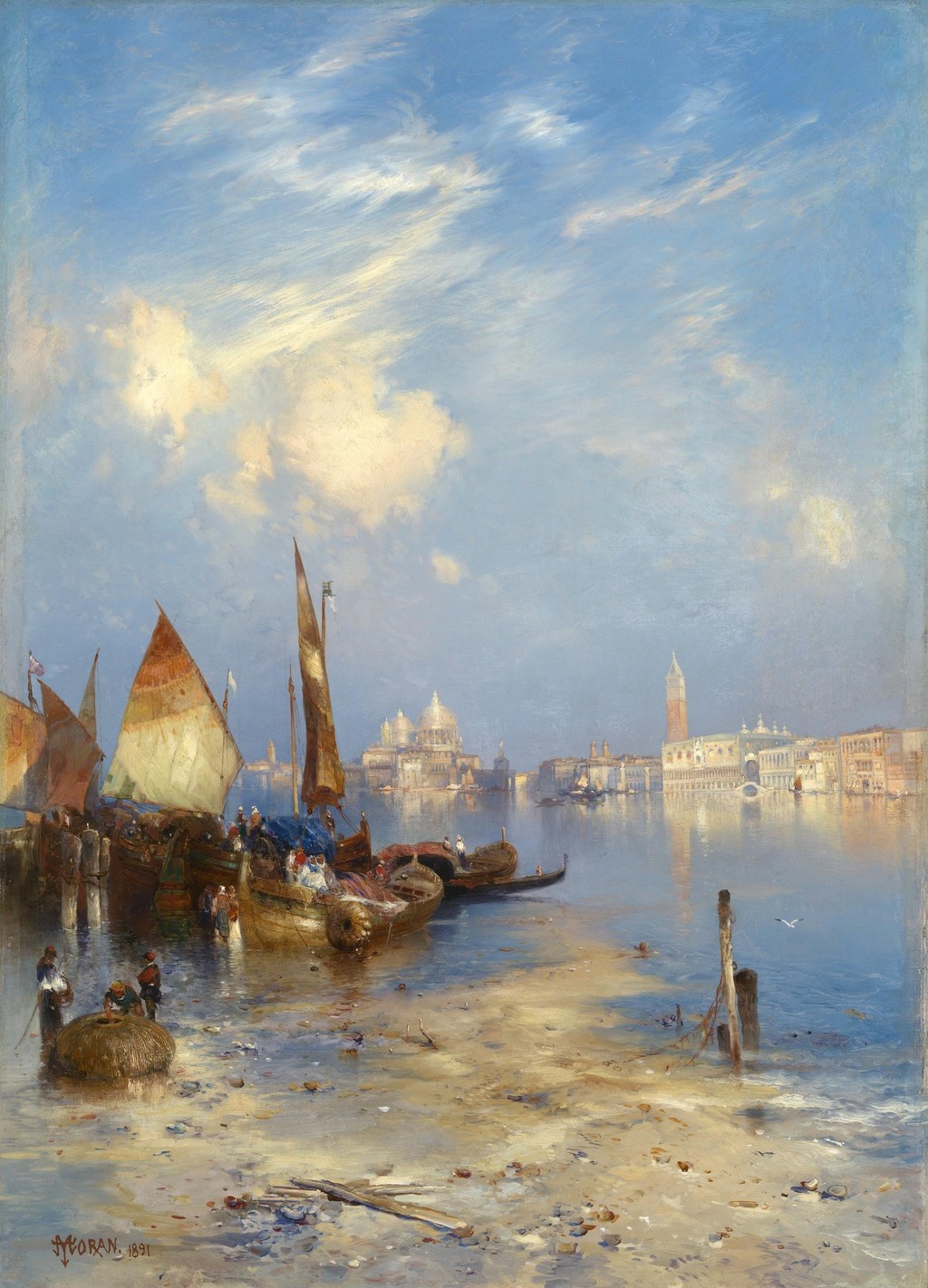
1873–1874; completed in 1874A View of Venice
1891Point Lobos, Monterey, California
1912, signed and datedContents
- A familiar landscape under an expansive sky
- Trees as a frame and a boundary
- Cattle, water and reflected colour
- East Hampton as a place to live and work
- A local subject within a wider career
A familiar landscape under an expansive sky
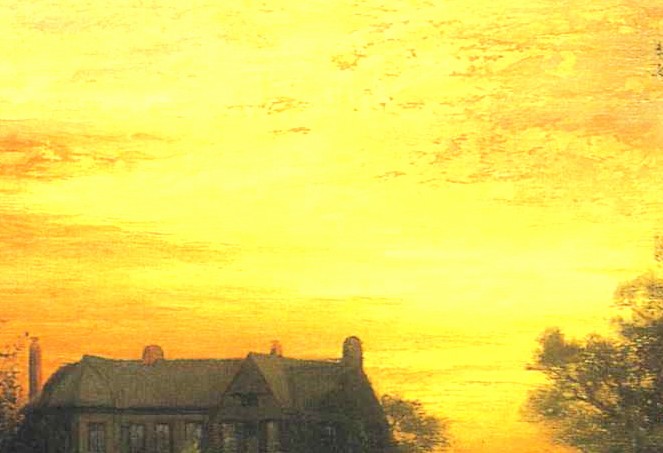
The sky occupies a substantial area above the house and trees. Yellow and orange passages extend across its width, becoming particularly bright towards the centre-right. A pale crescent is visible high on the left. These luminous forms give the evening a larger visual presence than any single object on the ground.
The lower landscape is organised differently. A broad green interval separates the house from the foreground water, while trees form a darker band behind and around it. Small variations in the greens and scattered brighter passages prevent the open ground from appearing entirely flat. The sky remains the dominant source of brightness, but its colour is also echoed below.
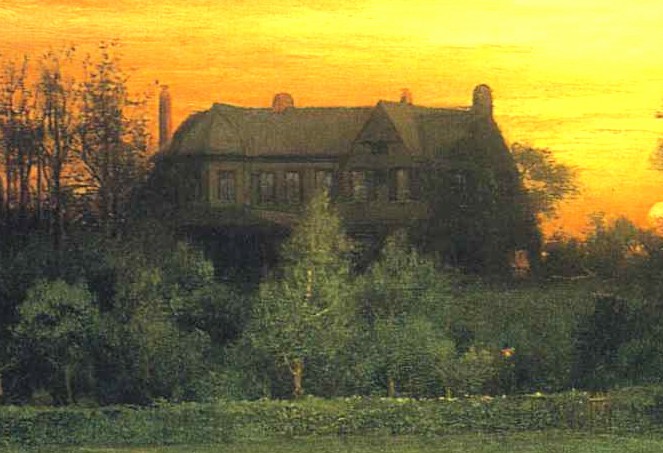
The house stands slightly left of centre, with a long roof and more than one projecting chimney. Its shape can be recognised readily, though much of its surface is shadowed. The building therefore supplies a stable, inhabited centre without competing with the sky’s strongest illumination.
Its geometry gives the eye a useful point of comparison with the trees. The long roof, vertical chimneys and darker window divisions form a more regular pattern than the surrounding foliage. Some of those boundaries are obscured by growth, so the building remains part of the landscape rather than standing wholly apart from it. Architecture introduces order without making the setting rigid.
This balance makes the scene both local and expansive. The house, trees and cattle offer familiar measures of scale. Above them, light changes the apparent reach of the landscape, stretching beyond the particular cluster of buildings and vegetation. Moran gives a relatively ordinary setting the kind of atmospheric emphasis that also distinguishes his more distant subjects.
Annotated Details from East Hampton, Long Island
Compare these details with the full composition. The numbered overview and crops come from the same original image.
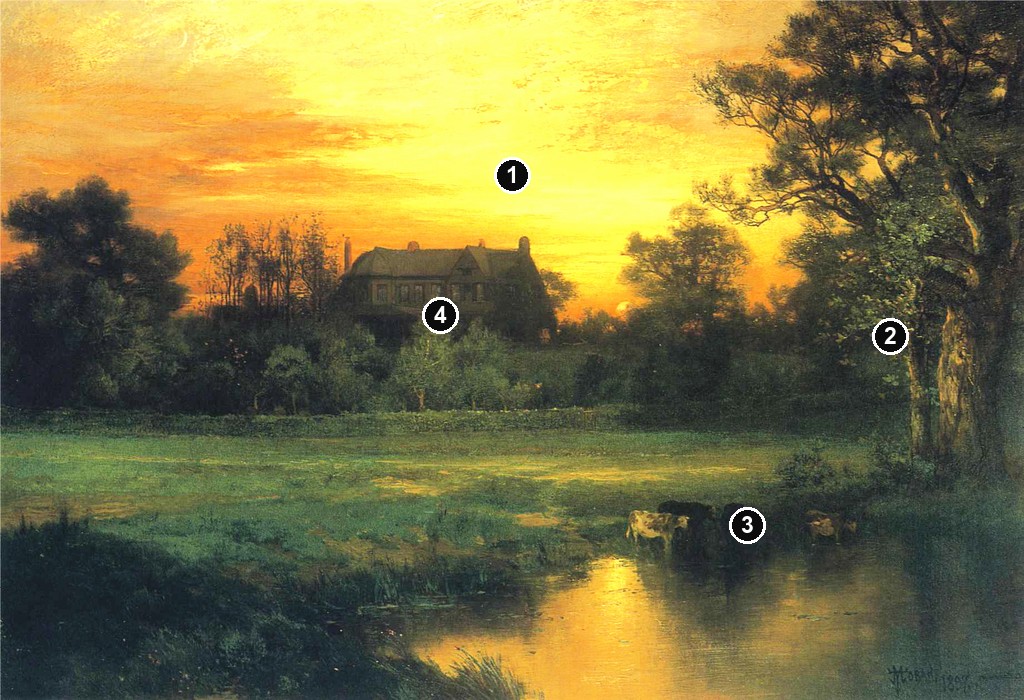
Details from EAST HAMPTON, LONG ISLAND
Open a detail to see it more closely.
A familiar landscape under an expansive sky
The sky occupies a substantial area above the house and trees. Yellow and orange passages extend across its width, becoming particularly bright towards the centre-right. A pale crescent is visible high on the left. These luminous forms give the evening a larger visual presence than any single object on the ground.
Trees as a frame and a boundary
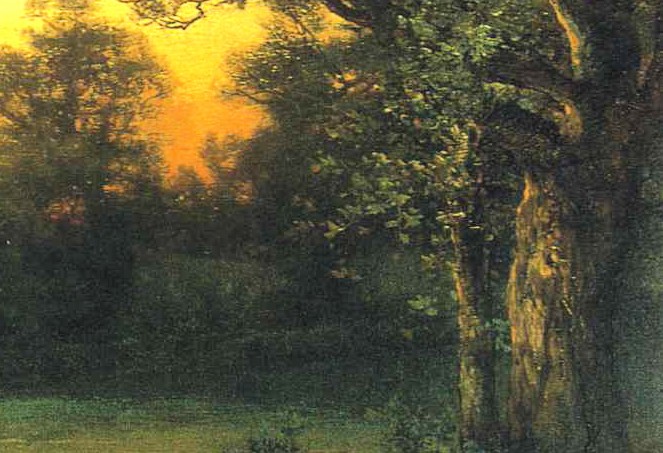
The largest tree stands on the right. Its trunk rises close to the picture’s edge, and its canopy spreads over part of the sky. Because it is much nearer than the house, it reinforces the separation between the viewer’s position and the inhabited middle distance.
Cattle, water and reflected colour
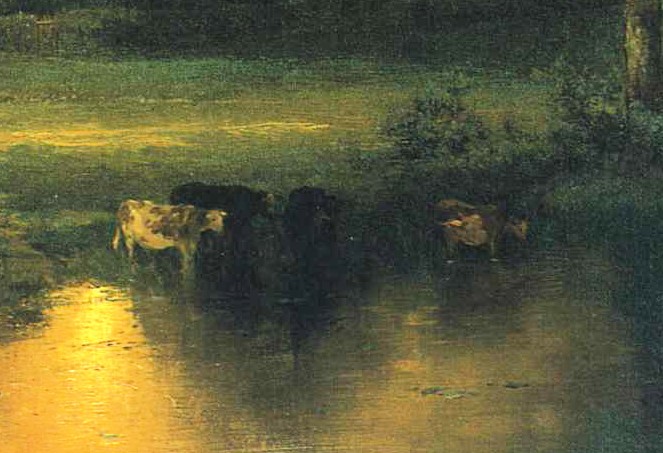
The cattle occupy a relatively small area near the water on the right. Their contrasting light and dark bodies distinguish them from the surrounding vegetation. Rather than forming a separate narrative scene, they help establish the setting as a worked, inhabited landscape.
The house beyond the trees
A dark house stands behind the low vegetation and in front of the bright sky. Its location within an East Hampton landscape does not establish that it depicts Moran’s own studio. [3]
Trees as a frame and a boundary
The largest tree stands on the right. Its trunk rises close to the picture’s edge, and its canopy spreads over part of the sky. Because it is much nearer than the house, it reinforces the separation between the viewer’s position and the inhabited middle distance.
On the left, another dark group of trees performs a related task without matching that foreground tree’s exact form. Between the two sides, thinner trunks and lighter foliage allow parts of the building and sky to remain visible. The scene is framed by vegetation, but the frame is irregular and porous.
The alternation matters to the impression of depth. Some trees are strongly silhouetted; others are more lightly separated from what lies behind them. The viewer can recognise the broad arrangement without being able to count or identify every plant. Moran uses foliage to both reveal and partly conceal the setting.
These wooded edges also prevent the bright sky from becoming a detached strip across the top. Branches enter it at different heights, connecting upper and lower parts of the canvas. The right-hand tree is especially important because its trunk and canopy make that connection across much of the painting’s height.
Cattle, water and reflected colour
The cattle occupy a relatively small area near the water on the right. Their contrasting light and dark bodies distinguish them from the surrounding vegetation. Rather than forming a separate narrative scene, they help establish the setting as a worked, inhabited landscape.
The water gives the evening light a second location. A warm yellow reflection rises through the foreground and is interrupted by darker shapes and changes of surface. It is not a precise duplicate of the sky. Its broken appearance connects illumination to the uneven edges of the bank and the darker water beside them.
The relationship between sky and reflection carries attention diagonally through the picture. Brightness above the distant trees is echoed nearer the viewer, while the house and green ground lie between those two areas. The cattle sit close to that lower interval of light, making their modest scale especially noticeable.
There is consequently more structure here than an uncomplicated sunset view might suggest. The sky spreads horizontally, the large tree holds the right side upright, and the reflected light provides a route across the lower half. Each has a different direction and scale, but their relationships give the scene its coherence.
Watch: Thomas Moran
Choose a film to explore the artist’s work, its interpretation and its wider setting.
The painting that inspired a National Park
A close discussion of Moran’s landscape and its relationship to the idea of Yellowstone.
Watch on YouTubeEast Hampton as a place to live and work
East Hampton had become central to Moran’s life well before this painting. He built his studio house in 1884, and the family moved into it in 1885. Robert Hefner’s historic-structure report, researched with Rosanne Barons, describes a building organised around a large working studio, with family rooms above and a comparatively modest service wing. [3]
That history explains the significance of a local landscape without identifying the house in this particular picture as Moran’s studio. His Long Island surroundings offered more than temporary relief from western travel. They were an environment in which painting, printmaking, domestic life and the collecting of objects became closely connected.
The report also gives considerable attention to Mary Nimmo Moran’s work. Her garden, the neighbouring orchard and nearby places such as Hook Pond and the Gardiner Windmill were important to her painting and etching. It describes the grounds and the studio’s interior decoration as parts of an artistic environment the couple created together. [3]
This context broadens the meaning of “East Hampton” within Moran’s career. The place was not simply a backdrop to a famous artist’s summer residence. It was a setting for sustained artistic activity by both Thomas and Mary, whose professional work should be recognised separately even when their lives and subjects overlapped.
A local subject within a wider career
Moran is particularly associated with Yellowstone and the Grand Canyon, but his local scenes make that familiar account less complete. The historic-structure report records the extent of his East Hampton work and the importance that local remembrance attached to it. Its account places pastoral subjects alongside his western, European and marine paintings. [3]
In The Much Resounding Sea, the water has a much more forceful role, with broad waves occupying the long canvas. Here it becomes a quieter surface for reflection beside cattle and pasture. The change is one of pictorial organisation as much as geographical subject: the sea expands the movement across the painting, while the smaller body of water draws attention back into a settled landscape.
Forest Scene provides another comparison. Its trees enclose the viewer within the wood. In East Hampton, Long Island, vegetation frames a more open prospect and an inhabited middle distance. Both paintings depend on differences between dark growth and illuminated openings, but the later landscape offers a wider, more continuous stretch of sky.
The evening light does not erase the particulars of the place. Roofs, tree silhouettes, cattle and the water’s edge remain legible. Their presence makes the colour more effective: the spectacular sky is experienced above forms that belong to ordinary life, giving the scene an intimacy different from Moran’s monumental canyon pictures.
Artworks directory
Selected documented works and distinct versions. This directory is not a comprehensive catalogue raisonné. Dates and media retain the distinctions explained in the articles and museum records.
| Name | Date | Medium |
|---|---|---|
| An Arizona Sunset near the Grand Canyon | Date not securely established | Oil painting |
| Autumn Afternoon, the Wissahickon by Thomas Moran | 1864 | Oil on canvas |
| Cascade Falls, Yosemite | Commonly catalogued as 1905 | Catalogued as oil on canvas |
| The Chasm of the Colorado | 1873–1874; completed in 1874 | Oil on canvas, currently mounted on aluminium |
| Children of the Mountain | 1866 in the current museum title; 1867 in the 1997 National Gallery catalogue | Oil on canvas |
| Cliffs of Green River | 1874 | Oil on canvas |
| Cliffs of the Upper Colorado River, Wyoming Territory | 1882 | Oil on canvas |
| East Hampton, Long Island , also captioned Easthampton, L.I | 1897 | Oil on canvas laid on board, according to the reproduction record |
| Fiercely the red sun descending, Burned his way along the heavens | 1875–76 | Oil on canvas |
| Forest Scene | 1870 | Oil on canvas |
| Grand Canyon of the Colorado River | 1892 and 1908 | Oil on canvas |
| Green River Cliffs, Wyoming | 1881 | Oil on canvas |
| Green River, Wyoming | 1878 | Oil on panel |
| The Juniata, Evening | 1864 | Oil on canvas |
| Mosquito Trail, Rocky Mountains of Colorado | 1875 in the 1997 National Gallery exhibition catalogue | Watercolour |
| Mountain of the Holy Cross | 1875 | Oil on canvas |
| The Much Resounding Sea | 1884 | Oil on canvas |
| Point Lobos, Monterey, California | 1912, signed and dated | Oil on canvas |
| Shoshone Falls on the Snake River | 1900 | Oil on canvas |
| Summit of the Sierras | 1872/75, as catalogued by the Art Institute of Chicago | Gouache over graphite on cream laid paper |
| The Teton Range | 1897 | Oil on canvas |
| The Three Tetons | 1895 | Oil on canvas |
| Tower Falls, Yellowstone | 1872 | Watercolour and gouache over graphite on blue laid paper |
| A View of Venice | 1891 | Oil on canvas |
| The Grand Canyon of the Yellowstone | 1872 | Oil on canvas, currently recorded as mounted on aluminium |
| Mountain of the Holy Cross, Colorado (etching) | 1888 | Etching, roulette and aquatint |
| The Resounding Sea (etching) | 1880 | Etching |
| The Much Resounding Sea (later etching) | 1886 in heading; 1888 on plate | Etching, drypoint and roulette |
| Tower Falls (Prang print) | c. 1875; portfolio issued 1876 | Chromolithograph |
| Shoshone Falls (early watercolour) | 1874 | Watercolour |
| Venice (watercolour) | 1888 | Watercolour over graphite |
Frequently Asked Questions
The painting’s title and the reviewed exhibition caption do not securely identify the building as his studio. The history of his East Hampton home provides context rather than proof of that identification.
The studio was built in 1884, and the historic-structure report places the family’s move into the house in 1885. [3]
The selected work is the 1897 composition identified by its image and exhibition caption. Similar Long Island titles must be checked individually; they do not establish that different dated canvases are the same object.
Discussion
Which gives the painting its strongest sense of place: the house, the cattle, the trees or the reflected light? Compare its water with The Much Resounding Sea. How does each painting make water direct your attention?
Reader Insights
Editorial prompts for close looking and discussion.
- Which gives the painting its strongest sense of place: the house, the cattle, the trees or the reflected light?
- Compare its water with The Much Resounding Sea . How does each painting make water direct your attention?
How does this page compare with the related works linked above?
Join the Conversation
Share your reading of this page below.
References
- Pat Rogers, “Sneak Peek: Tracing Moran’s Romanticism and Symbolism,” Hamptons Art Hub, 25 October 2013; caption for Easthampton, L.I., 1897, in the report on Phyllis Braff’s Guild Hall retrospective. Exhibition report.
- East Hampton, Long Island, faithful public-domain reproduction and object metadata preserved by Wikimedia Commons. Image record.
- Robert Hefner, with research by Rosanne Barons, The Studio: The Home and Workshop of Thomas Moran and Mary Nimmo Moran, historic-structure report for the Incorporated Village of East Hampton, April 2009; selected excerpts published by Art and Architecture Quarterly. Report excerpts.
- Splash image source.
East Hampton, Long Island, 1897. Private collection; faithful reproduction via Wikimedia Commons. Image source. Public Domain Mark; faithful two-dimensional reproduction. Resized only; complete source image retained.
- Splash image source.
East Hampton, Long Island, 1897. Private collection; faithful reproduction via Wikimedia Commons. Image source. Public Domain Mark; faithful two-dimensional reproduction. Numbered circles added to the overview; details cropped from the original reproduction. No colour adjustment or sharpening.
- Splash image source.
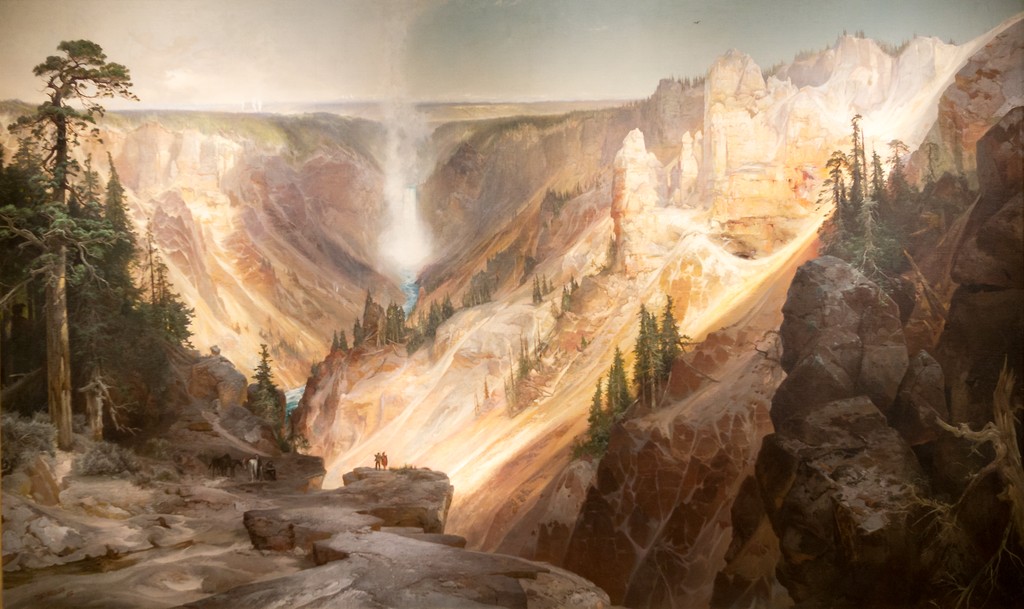
The Grand Canyon of the Yellowstone, 1872. Wuselig / Wikimedia Commons, CC BY-SA 4.0; U.S. Department of the Interior Museum painting. Image source. CC BY-SA 4.0; also marked PD-Art. Outer museum frame cropped; resized. Painted composition retained; photographic perspective unchanged. This image derivative is available under the same licence.
- Splash image source.
The Chasm of the Colorado, 1873–1874. U.S. Department of the Interior Museum; faithful reproduction via Smithsonian American Art Museum / Wikimedia Commons. Image source. Public Domain Mark; faithful two-dimensional reproduction. Resized only; complete source image retained.
- Splash image source.
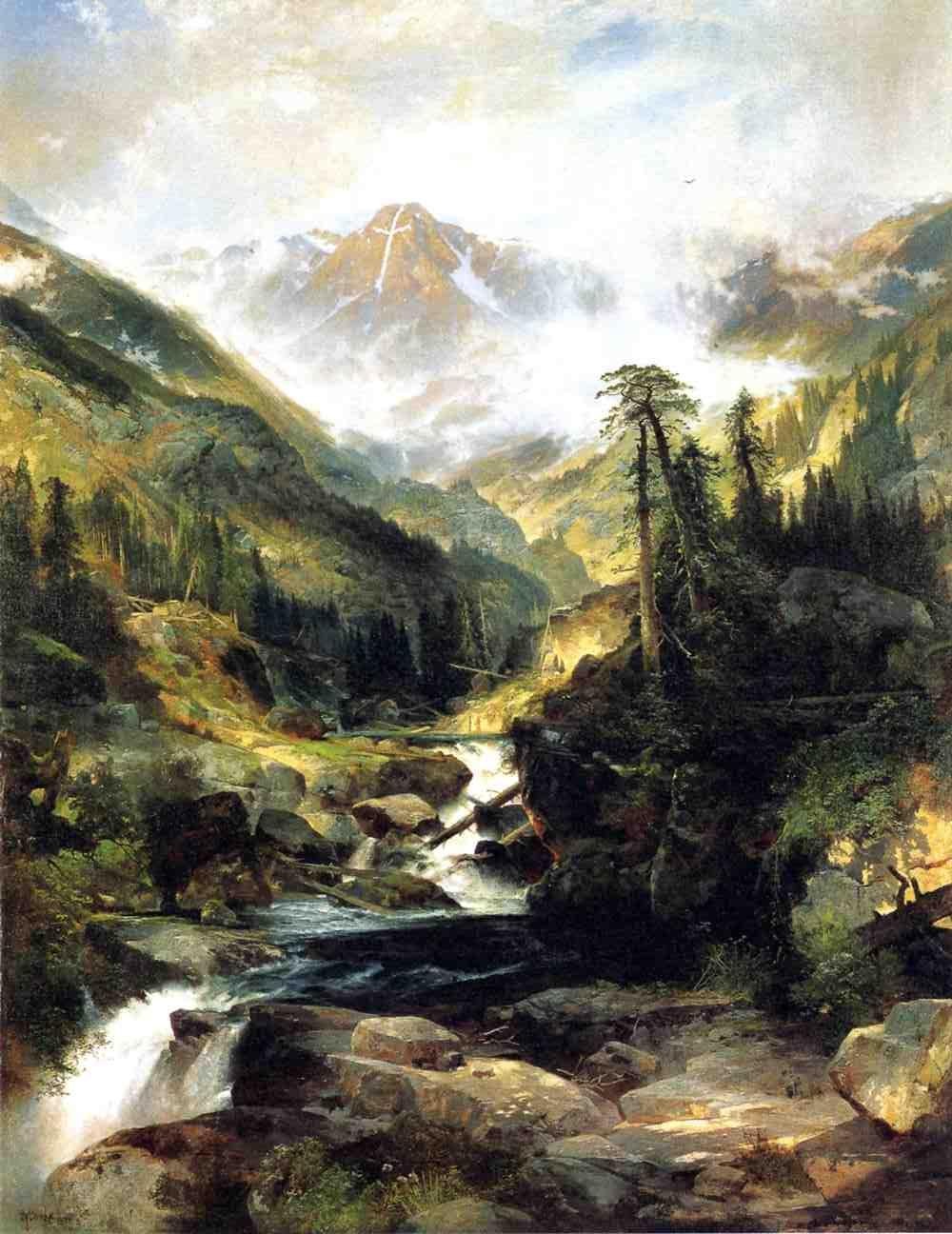
Mountain of the Holy Cross, 1875. Autry Museum of the American West; faithful reproduction via Wikimedia Commons. Image source. Public Domain Mark; faithful two-dimensional reproduction. Resized only; complete source image retained.
- Splash image source.
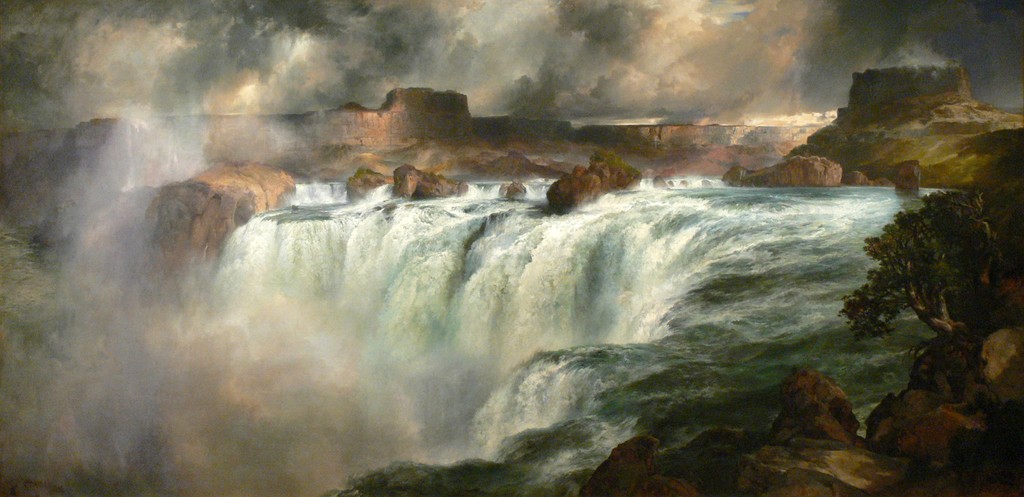
Shoshone Falls on the Snake River, 1900. Wolfgang Sauber / Wikimedia Commons, CC BY-SA 3.0; Gilcrease Museum painting. Image source. CC BY-SA 3.0; also marked PD-Art. Resized only; complete source image retained. This image derivative is available under the same licence.
- Splash image source.
Green River Cliffs, Wyoming, 1881. National Gallery of Art, Gift of the Milligan and Thomson Families. Image source. Public domain; NGA Open Access. Resized only; complete source image retained.
- Splash image source.
A View of Venice, 1891. Smithsonian American Art Museum, Transfer from the U.S. Department of the Interior, National Park Service, 1968.120.1. Image source. Free to use; Smithsonian Open Access. Resized only; complete source image retained.
- Splash image source.
The Three Tetons, 1895. The White House Collection, Gift of C. R. Smith; faithful reproduction via Wikimedia Commons. Image source. Public Domain Mark; faithful reproduction of a two-dimensional public-domain work. Resized only; complete source image retained.