 by Tom Gurney
Tom Gurney BSc (Hons) is an art history expert with over 20 years experience
Published on June 19, 2020 / Updated on October 27, 2026
Email: tomgurney1@gmail.com / Phone: +44 7429 011000
The Much Resounding Sea: Introduction
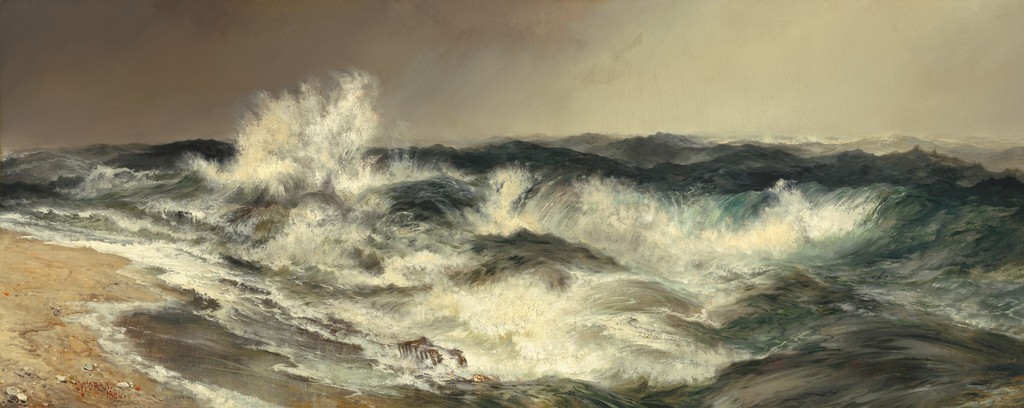
Thomas Moran's The Much Resounding Sea, dated 1884, is a wide oil painting in the National Gallery of Art. Waves occupy most of the canvas, breaking against a narrow shore beneath a strip of stormy sky. The picture replaces the immense rocks of his western landscapes with a surface that rises, curls and disperses before the viewer. [1]
Its power comes from differences within that movement. Dark water gives the waves weight; pale foam breaks their edges; spray briefly conceals what lies behind. The beach offers a small stable foothold, but the sea controls the experience. Moran creates grandeur through motion rather than through a distant mountain or canyon.
At a Glance
- ArtistThomas Moran
- TitleThe Much Resounding Sea
- Date1884
- MediumOil on canvas
- Dimensions63.9 × 158.2 cm
- CollectionNational Gallery of Art
- Accession1967.9.1
- CreditGift of the Avalon Foundation
- Related printsThe Resounding Sea (1880) and the later Much Resounding Sea print
Where this work sits in Moran’s career
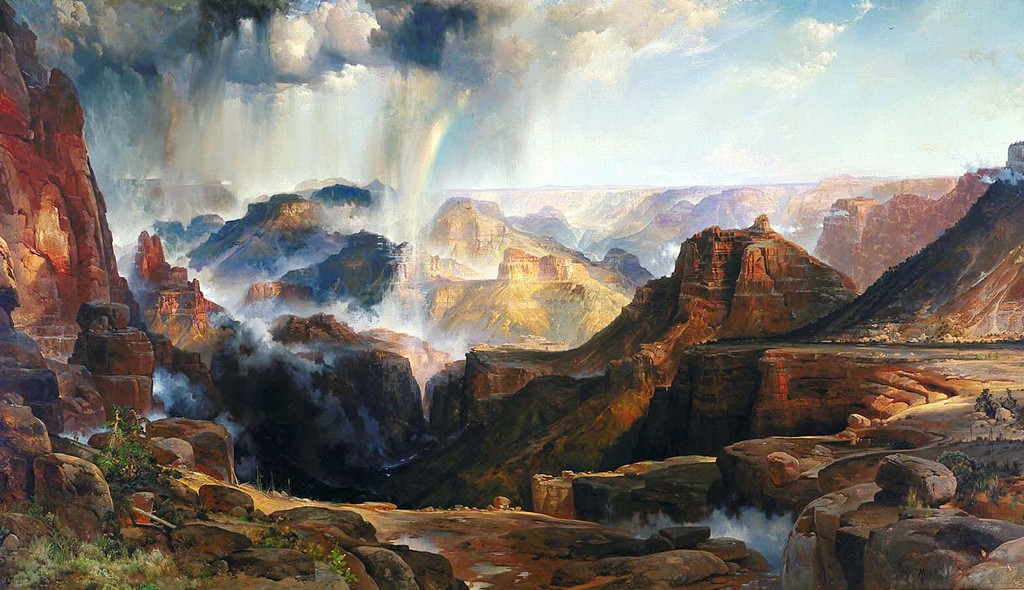
The Chasm of the Colorado
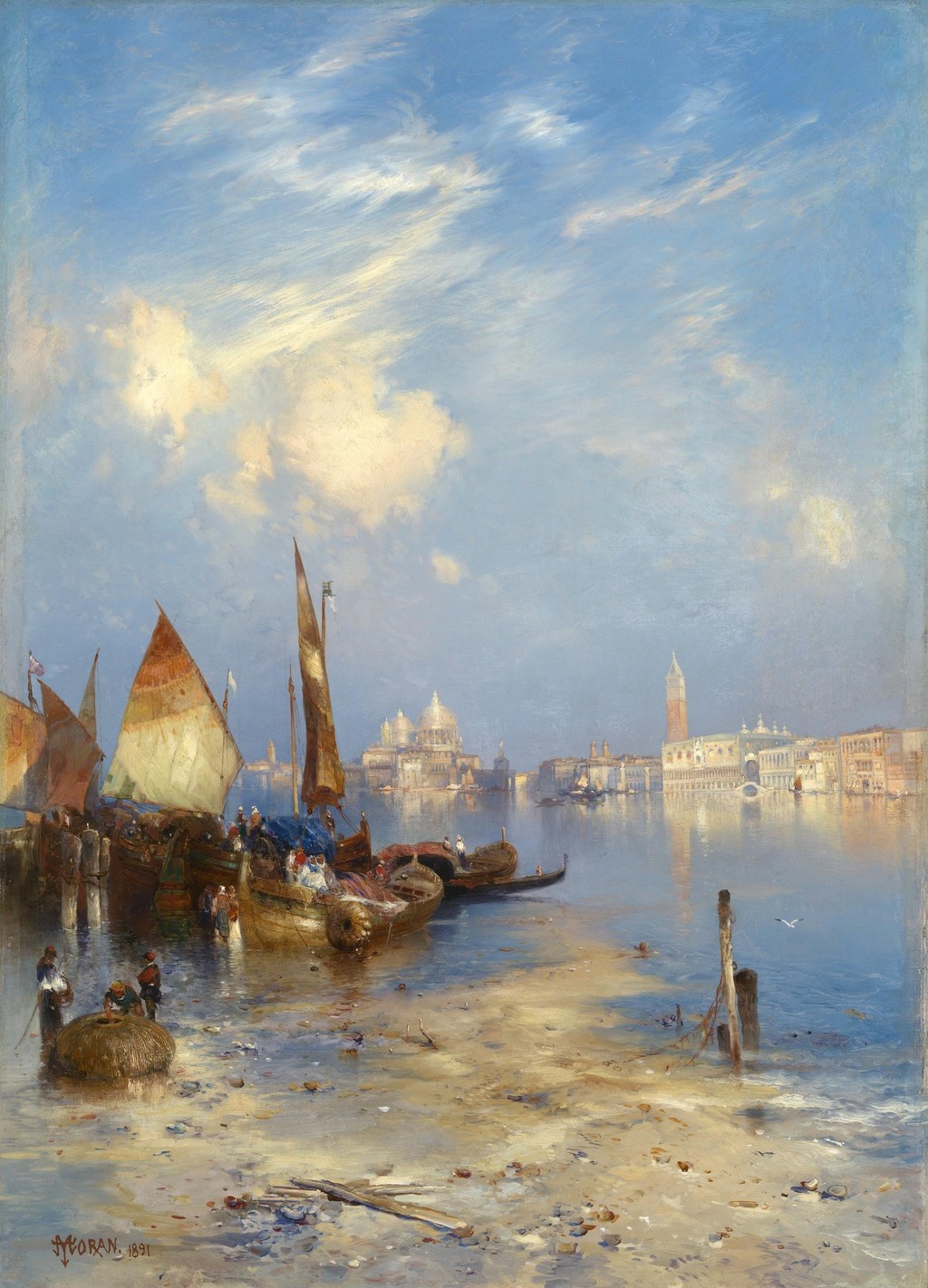
1873–1874; completed in 1874A View of Venice
1891Point Lobos, Monterey, California
1912, signed and datedContents
- A low format filled with water
- The breaking wave and its changing edges
- Colour gives the sea its depth
- A shore with traces of human activity
- Storm light and the limits of a named location
- A literary title heard through the picture
- An earlier etching and a later narrative print
- Ruskin's response belongs to the print's history
- What published technical notes add
- Water beside rock and coastal trees
A low format filled with water
The canvas is much wider than it is high. That proportion allows several waves to appear across one sustained field, while the sky remains relatively shallow. The spectator encounters the sea as an extensive surface before concentrating on its individual crests. Breadth and proximity operate together.
The shoreline enters from the lower left and slopes towards the breaking water. It is not a broad platform from which the whole scene can be comfortably surveyed. Its narrowness places the spectator near the edge of the action. The nearest wave seems close enough for its foam and changing surface to demand immediate attention.
Across the upper portion, a distant line separates sea and sky. The horizon is less commanding than the nearer waves, whose curves interrupt the regular horizontal structure. Moran provides a sense of distance, but does not allow the view to settle into a quiet sequence of parallel bands. Movement repeatedly disturbs that order.
This makes the format work differently from a panoramic cliff painting. Rock can hold one position while the eye travels along it; here, successive crests create new beginnings across the surface. The spectator follows a rhythm of lifting and falling forms rather than an uninterrupted skyline.
Annotated Details from The Much Resounding Sea
Compare these details with the full composition. The numbered overview and crops come from the same original image.
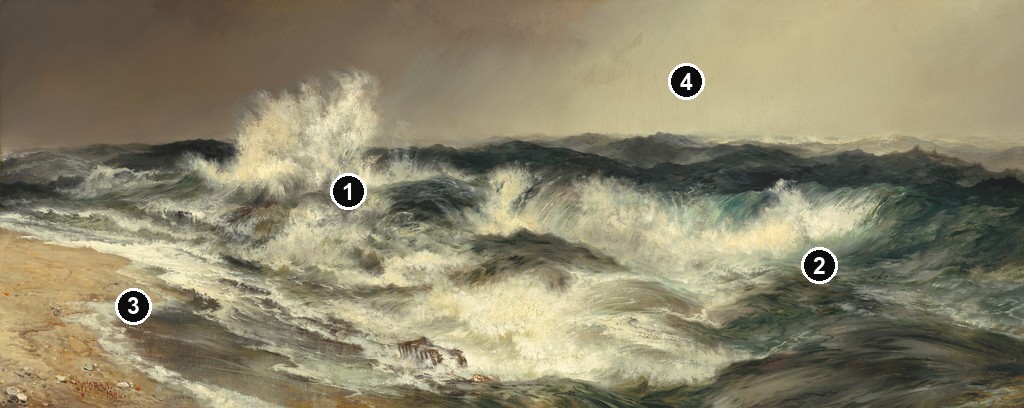
Details from THE MUCH RESOUNDING SEA
Open a detail to see it more closely.
The breaking wave and its changing edges
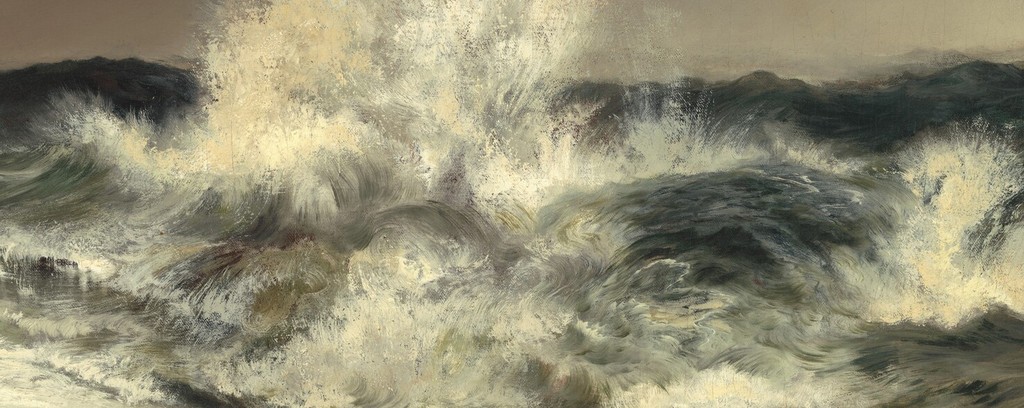
A rising wave near the centre turns over into pale foam. Its darker body gives the crest a substantial base, while spray makes the upper edge less definite. The distinction matters: a wave represented only by a white outline would have little weight. Moran shows both the mass of water and the point at which it loses its shape.
Colour gives the sea its depth
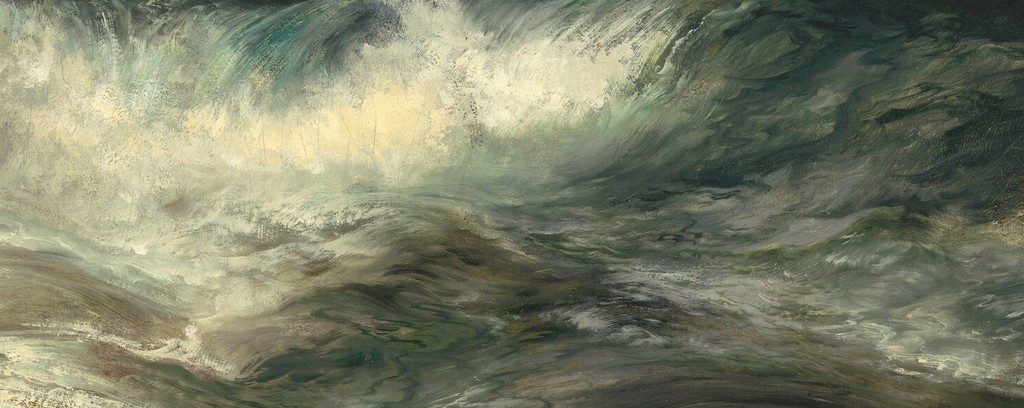
Cool blue and green passages lie beside near-black hollows and warm, pale foam. The contrasts make the sea appear deeper in some areas and thinner where it spreads towards the shore. Colour is part of the description of form, rather than a uniform coating applied to the whole body of water.
A shore with traces of human activity
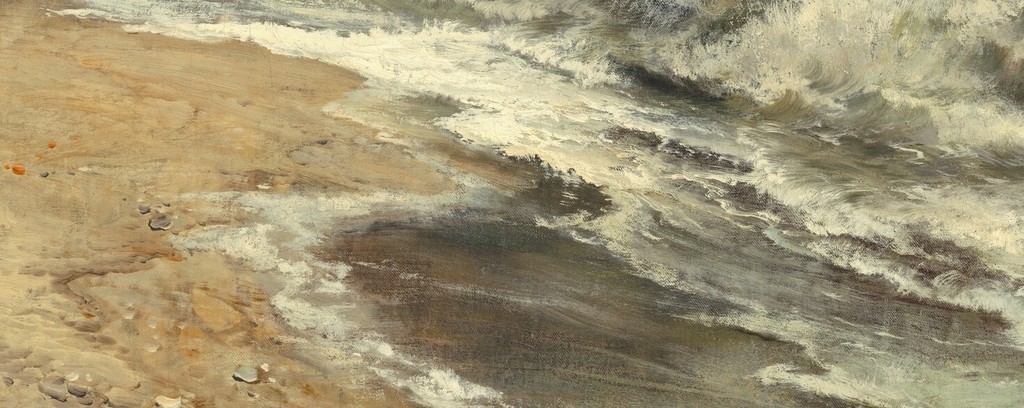
The beach contains small scattered objects and a damaged-looking wooden framework near the water. These details bring a human world close to the scene without introducing a central human figure. Their scale is modest beside the waves, and their precise identities should not be forced beyond what the image establishes.
Storm light and the limits of a named location
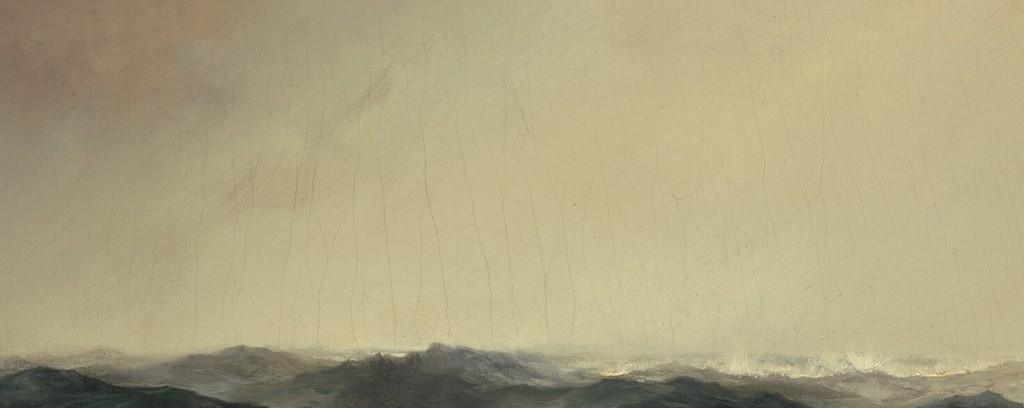
The sky is darker towards the left and lighter towards the right. This changing illumination supports the wave pattern below, where bright foam emerges from darker water. The upper strip is small, but its variation affects the mood of the entire canvas.
The breaking wave and its changing edges
A rising wave near the centre turns over into pale foam. Its darker body gives the crest a substantial base, while spray makes the upper edge less definite. The distinction matters: a wave represented only by a white outline would have little weight. Moran shows both the mass of water and the point at which it loses its shape.
The curl is not perfectly regular. Smaller ridges and interruptions divide it, and surrounding water pushes in several directions. The breaking passage therefore belongs to a broader disturbance. It does not read as one isolated ornamental curve placed on an otherwise calm surface.
On the right, another raised passage carries a band of foam across darker water. The different angle extends the movement beyond the central break. Nearer ripples and returning water offer smaller versions of the same contrast between a darker base and a lighter edge. Repetition connects the large wave with the surrounding surface.
Some foam appears opaque and strongly lit; other passages are thin, fragmented or partly lost in spray. These differences help distinguish water at several stages of breaking. The eye can follow the transformation from a coherent rising body to a less stable mixture of froth and air.
The picture cannot show actual movement, yet the arrangement suggests a sequence. A spectator sees the wave before it turns, the crest as it breaks and the disturbed water below it in one still image. Moran places evidence of successive states beside one another, allowing the viewer to imagine what happens next.
Colour gives the sea its depth
Cool blue and green passages lie beside near-black hollows and warm, pale foam. The contrasts make the sea appear deeper in some areas and thinner where it spreads towards the shore. Colour is part of the description of form, rather than a uniform coating applied to the whole body of water.
The darkest intervals are particularly important. They separate crests and make lighter passages advance. Without them, the white surf could become a continuous decorative pattern. Moran gives the spectator enough variation to distinguish one raised mass from another, even when their edges are partly obscured.
At the shore, reflected light smooths the water into a different kind of surface. The shallow passage catches tones from above and lies close to the sand. It contrasts with the more turbulent sea beyond. The same substance appears as both a reflective film and a rising physical force.
Those changes are visible in the image. They do not identify an exact pigment mixture or establish how much a digital reproduction matches the original's colour. The useful comparison concerns relationships within the painting: darker and lighter, cooler and warmer, thicker-looking and more transparent passages.
A shore with traces of human activity
The beach contains small scattered objects and a damaged-looking wooden framework near the water. These details bring a human world close to the scene without introducing a central human figure. Their scale is modest beside the waves, and their precise identities should not be forced beyond what the image establishes.
The framework is caught near the point where water reaches the sloping shore. Its straight edges contrast with the curves of surf. That difference gives it visibility even though it occupies little space. A manufactured form looks vulnerable within a surface that does not respect its geometry.
The painting does not develop an explicit rescue episode. There is no comparable foreground group directing the action or standing as the picture's main emotional focus. The sea remains the subject. Traces on the shore suggest consequences of its force while leaving those consequences largely outside the frame.
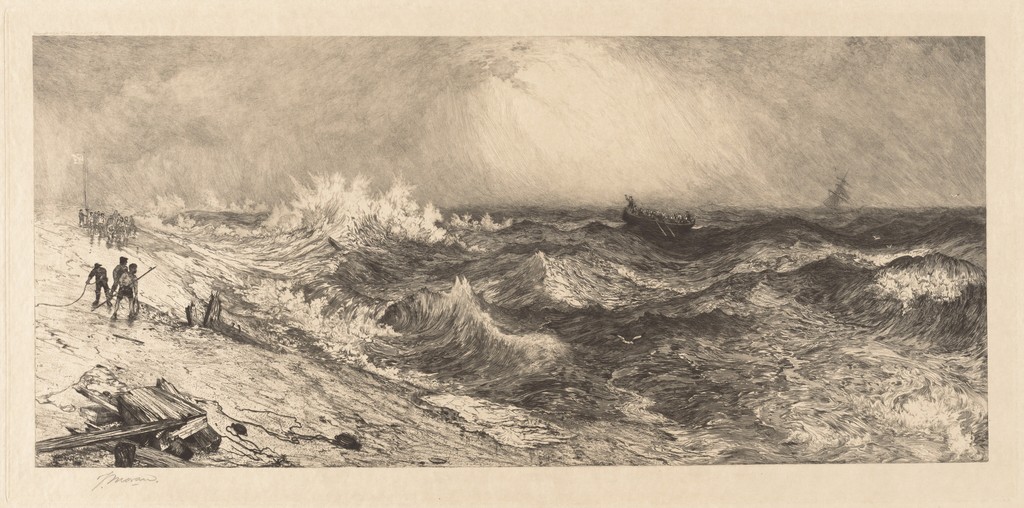
The distinction becomes clearer beside the later large print, where people, equipment and boats create a more explicit narrative. The oil's relative absence of human action is a particular artistic choice, rather than evidence that Moran never represented maritime danger through figures.
Storm light and the limits of a named location
The sky is darker towards the left and lighter towards the right. This changing illumination supports the wave pattern below, where bright foam emerges from darker water. The upper strip is small, but its variation affects the mood of the entire canvas.
The National Gallery connects the picture with Moran's observation of the Long Island shore and describes a storm moving away. That is a useful interpretation of its weather. It does not establish an exact beach, a recorded storm date or the minute at which the view was seen. [1]
A place can supply repeated experiences rather than one definitive instant. Walking by the sea allows an artist to observe changes in light, water and shore over time. A finished picture can bring those observations into a concentrated arrangement, with the studio providing the setting in which their relationships are decided.
The resulting scene feels immediate because it places the spectator close to the water. That immediacy should not be confused with proof that the whole canvas was painted outside during a storm. The finished work's physical scale and organised forms belong to a different task from a portable field note.
A literary title heard through the picture
Nancy Anderson's systematic catalogue entry identifies a likely source in Theodore Alois Buckley's nineteenth-century translation of Homer's Iliad. The phrase occurs within descriptions of turbulent water. The connection remains an interpretation of the title; no cited statement by Moran confirms the exact passage he chose. [2]
The 1997 Moran catalogue also places a Buckley passage beside this painting. Its language brings wind, swelling billows and foam together. Read in that context, the title invites the spectator to imagine sound as well as appearance. It does not turn the scene into a documented episode from the ancient poem. [3]
Sound is absent from an oil painting, but visual rhythm can make it imaginable. Repeated crests, disrupted edges and dispersed spray suggest successive impacts. The title encourages that sensory response without requiring a figure to act out a story. The sea can acquire poetic force through the experience of looking.
Watch: Thomas Moran
Choose a film to explore the artist’s work, its interpretation and its wider setting.
The painting that inspired a National Park
A close discussion of Moran’s landscape and its relationship to the idea of Yellowstone.
Watch on YouTubeAn earlier etching and a later narrative print
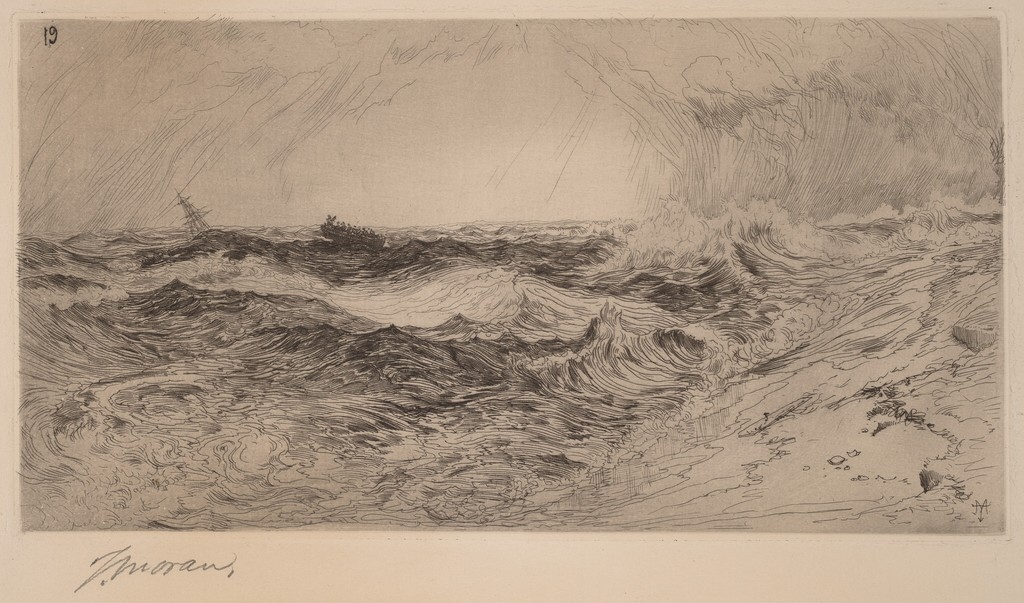
Moran had explored the breaking sea before making the oil. The National Gallery records The Resounding Sea as an 1880 etching in black, accession 2008.115.3594. The specific impression illustrated here contains a large breaking wave on the right, a small boat further off and a distant vessel. These are features of this image, not details to transfer automatically to every related impression. [4]
Its marks follow the curves of water in a different way from the coloured canvas. Closely spaced lines darken the lower waves, while relatively open areas leave foam and spray lighter. The eye reads changing density as changing substance. Printed line supplies a sea that remains recognisable without the oil's blue, green and warm reflected passages.
The shoreline is also on the opposite side in this print. That visible difference makes the comparison more useful than a claim that one image is a mechanically identical copy of the other. Subject and wave motif connect them, while composition and medium require their own descriptions.
The later large Much Resounding Sea print is catalogued by the National Gallery as 1886, with an 1888 inscription in the plate. Its record identifies etching, drypoint and roulette on Japanese paper. Those two dates should be preserved rather than silently reduced to the 1884 date of the oil. [5]
In the illustrated impression, figures stand on the left shore, a boat rises among the waves, and a larger vessel appears beyond. Debris and equipment extend the activity across the beach. The image turns the sea's force into a scene with more explicit human stakes. It is a related work with its own narrative, not simply the oil reproduced without colour.
Ruskin's response belongs to the print's history
The catalogue records praise for a breaking-wave etching during Moran's meeting with John Ruskin in 1882. That response preceded the 1884 canvas and has been proposed as a possible encouragement for the oil. It concerns the earlier print; it should not be quoted as a judgement made directly about this painting. [2] [3]
The episode links artistic reception with subsequent making, while leaving Moran's precise motivation uncertain. A successful image could prompt further work in another medium. Approval from an influential critic could also affect how an artist presented his achievements to audiences and purchasers.
The exact impression Ruskin saw is not identified here with the National Gallery sheet. A shared title or subject does not establish that two physical prints have identical states or histories. The secure comparison is among recorded objects, while the historic reception remains attached to the evidence through which it is known.
What published technical notes add
The 1998 catalogue records a twill-weave support, a tan ground and dark reddish-brown underpainting in the waves. It describes wet-into-wet work in the sky, low impasto in the surf and a lining treatment in 1967. These are published technical findings, rather than deductions from the reproduction. [2]
The report gives material substance to the visible contrast between water and foam. Its historical date matters: it is not a statement that the picture's condition today has been newly examined. It also does not justify assigning an undocumented pigment recipe to every blue or pale passage.
Water beside rock and coastal trees
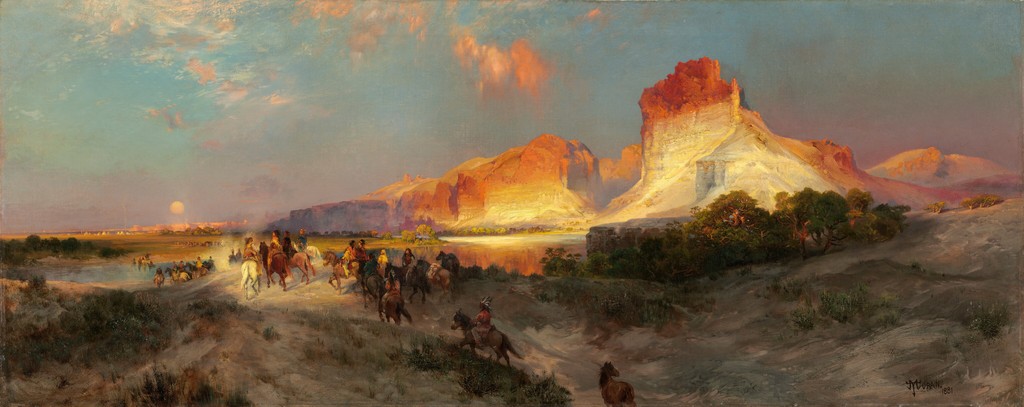
The sea offers a useful comparison with Moran's western panoramas. In Green River Cliffs, Wyoming, a brilliant rock formation holds attention above smaller figures and quieter water. Here, the largest forms are themselves unstable. The spectator encounters grandeur through a sequence of breaks rather than a fixed mass.
His later Point Lobos, Monterey, California, dated 1912, brings trees and coastal rock into the foreground. Those solid forms partly shelter and frame the view of water. The 1884 seascape exposes the spectator more directly to the surf, with much less intervening land. [6]
These comparisons show how different subjects required different arrangements. Moran's water could reflect, cascade, churn or provide distance. The repeated interest was not one identical shape but the possibility of organising a landscape through the relation between light, mass and atmosphere.
The canvas as an individual object
The National Gallery's record identifies the oil through its 1884 inscription, dimensions and accession 1967.9.1. The Avalon Foundation credit belongs to this painting. It should not be assigned to the 1880 or later print, whose collection records identify different sheets and gifts. [1]
Those distinctions allow the works to illuminate one another without losing their identities. Colour and reflected light give the oil its particular presence; etched marks and narrative figures give the prints other effects. Across them, Moran repeatedly returns to a subject that seems momentary and makes it available for prolonged attention.
Artworks directory
Selected documented works and distinct versions. This directory is not a comprehensive catalogue raisonné. Dates and media retain the distinctions explained in the articles and museum records.
| Name | Date | Medium |
|---|---|---|
| An Arizona Sunset near the Grand Canyon | Date not securely established | Oil painting |
| Autumn Afternoon, the Wissahickon by Thomas Moran | 1864 | Oil on canvas |
| Cascade Falls, Yosemite | Commonly catalogued as 1905 | Catalogued as oil on canvas |
| The Chasm of the Colorado | 1873–1874; completed in 1874 | Oil on canvas, currently mounted on aluminium |
| Children of the Mountain | 1866 in the current museum title; 1867 in the 1997 National Gallery catalogue | Oil on canvas |
| Cliffs of Green River | 1874 | Oil on canvas |
| Cliffs of the Upper Colorado River, Wyoming Territory | 1882 | Oil on canvas |
| East Hampton, Long Island , also captioned Easthampton, L.I | 1897 | Oil on canvas laid on board, according to the reproduction record |
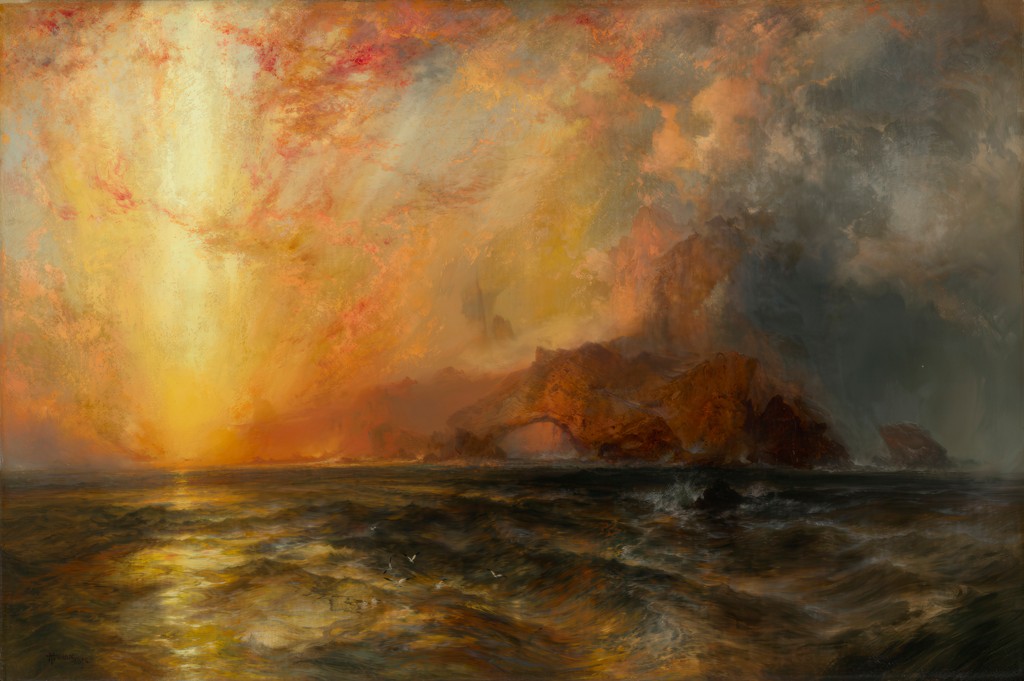
| Fiercely the red sun descending, Burned his way along the heavens | 1875–76 | Oil on canvas |
| Forest Scene | 1870 | Oil on canvas |
| Grand Canyon of the Colorado River | 1892 and 1908 | Oil on canvas |
| Green River Cliffs, Wyoming | 1881 | Oil on canvas |
| Green River, Wyoming | 1878 | Oil on panel |
| The Juniata, Evening | 1864 | Oil on canvas |
| Mosquito Trail, Rocky Mountains of Colorado | 1875 in the 1997 National Gallery exhibition catalogue | Watercolour |
| Mountain of the Holy Cross | 1875 | Oil on canvas |
| The Much Resounding Sea | 1884 | Oil on canvas |
| Point Lobos, Monterey, California | 1912, signed and dated | Oil on canvas |
| Shoshone Falls on the Snake River | 1900 | Oil on canvas |
| Summit of the Sierras | 1872/75, as catalogued by the Art Institute of Chicago | Gouache over graphite on cream laid paper |
| The Teton Range | 1897 | Oil on canvas |
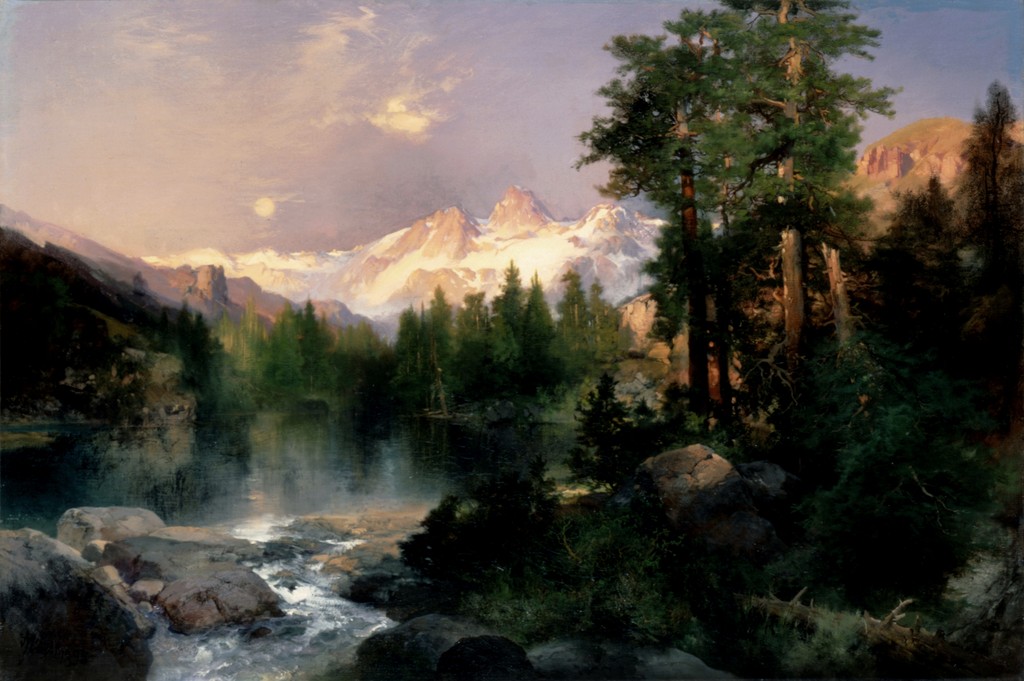
| The Three Tetons | 1895 | Oil on canvas |
| Tower Falls, Yellowstone | 1872 | Watercolour and gouache over graphite on blue laid paper |
| A View of Venice | 1891 | Oil on canvas |
| The Grand Canyon of the Yellowstone | 1872 | Oil on canvas, currently recorded as mounted on aluminium |
| Mountain of the Holy Cross, Colorado (etching) | 1888 | Etching, roulette and aquatint |
| The Resounding Sea (etching) | 1880 | Etching |
| The Much Resounding Sea (later etching) | 1886 in heading; 1888 on plate | Etching, drypoint and roulette |
| Tower Falls (Prang print) | c. 1875; portfolio issued 1876 | Chromolithograph |
| Shoshone Falls (early watercolour) | 1874 | Watercolour |
| Venice (watercolour) | 1888 | Watercolour over graphite |
Frequently Asked Questions
The National Gallery dates The Much Resounding Sea to 1884, matching the recorded inscription.
It belongs to the National Gallery of Art, accession 1967.9.1, with the credit Gift of the Avalon Foundation.
The catalogue instead proposes a connection with Buckley's translation of Homer's Iliad. The precise passage chosen by Moran is not confirmed by an artist statement.
No. It is a work on paper in a different medium. The later large print is separately catalogued as 1886, with an 1888 plate inscription in the illustrated NGA impression.
They come from the published 1998 catalogue entry. They should not be presented as a new examination of the picture today.
Discussion
Compare the 1884 oil with the illustrated prints. How does coloured foam change the experience of water, and what happens when figures and boats make danger more explicit?
Reader Insights
Editorial prompts for close looking and discussion.
Compare the 1884 oil with the illustrated prints. How does coloured foam change the experience of water, and what happens when figures and boats make danger more explicit?
Which source or image helps you assess the interpretation?
How does this page compare with the related works linked above?
Join the Conversation
Share your reading of this page below.
References
- National Gallery of Art, The Much Resounding Sea, 1884, object record.
- Nancy Anderson, Thomas Moran and The Much Resounding Sea entries in American Paintings of the Nineteenth Century, Part II, National Gallery of Art, 1998, pp. 11–14.
- Nancy K. Anderson and contributors, Thomas Moran, 1997, selected marine discussion, p. 136 and printmaking discussion, p. 295.
- National Gallery of Art, The Resounding Sea, 1880, etching, 2008.115.3594.
- National Gallery of Art, The Much Resounding Sea, print catalogued as 1886, 2002.98.166.
- Wikimedia Commons, Point Lobos, Monterey, California, signed and dated 1912, faithful reproduction record.
- Splash image source.
The Much Resounding Sea, 1884. National Gallery of Art, Gift of the Avalon Foundation. Image source. Public domain; NGA Open Access. Resized only; complete source image retained.
- Splash image source.
The Resounding Sea, catalogued1880. Etching inblack. National Gallery of Art,2008.115.3594. National Gallery of Art / Reba and Dave Williams Collection, Gift of Reba and Dave Williams. Image source. Public domain; NGA Open Access, exactobjectmedia declaration. Resized only; complete source image retained.
- Splash image source.
The Much Resounding Sea, printcatalogued1886, with1888plateinscription recordedbymuseum. Etching,drypoint androulette onJapanese paper. NGA,2002.98.166. National Gallery of Art / Gift of Jacob Kainen. Image source. Public domain; NGA Open Access, exactobjectmedia declaration. Resized only; complete source image retained.
- Splash image source.
The Much Resounding Sea, 1884. National Gallery of Art, Gift of the Avalon Foundation. Image source. Public domain; NGA Open Access. Numbered circles added to the overview; details cropped from the original reproduction. No colour adjustment or sharpening.
- Splash image source.
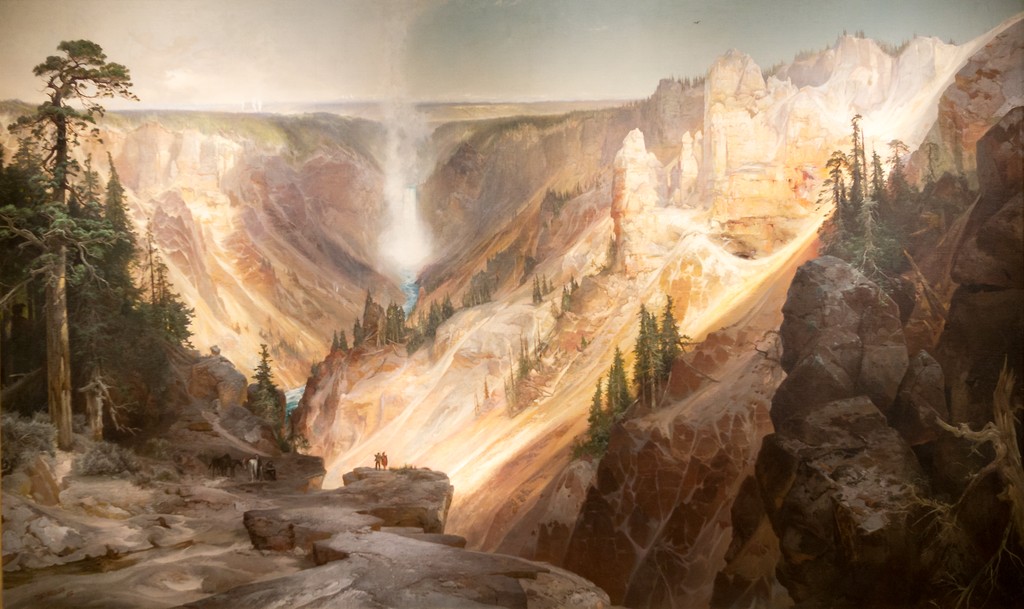
The Grand Canyon of the Yellowstone, 1872. Wuselig / Wikimedia Commons, CC BY-SA 4.0; U.S. Department of the Interior Museum painting. Image source. CC BY-SA 4.0; also marked PD-Art. Outer museum frame cropped; resized. Painted composition retained; photographic perspective unchanged. This image derivative is available under the same licence.
- Splash image source.
The Chasm of the Colorado, 1873–1874. U.S. Department of the Interior Museum; faithful reproduction via Smithsonian American Art Museum / Wikimedia Commons. Image source. Public Domain Mark; faithful two-dimensional reproduction. Resized only; complete source image retained.
- Splash image source.
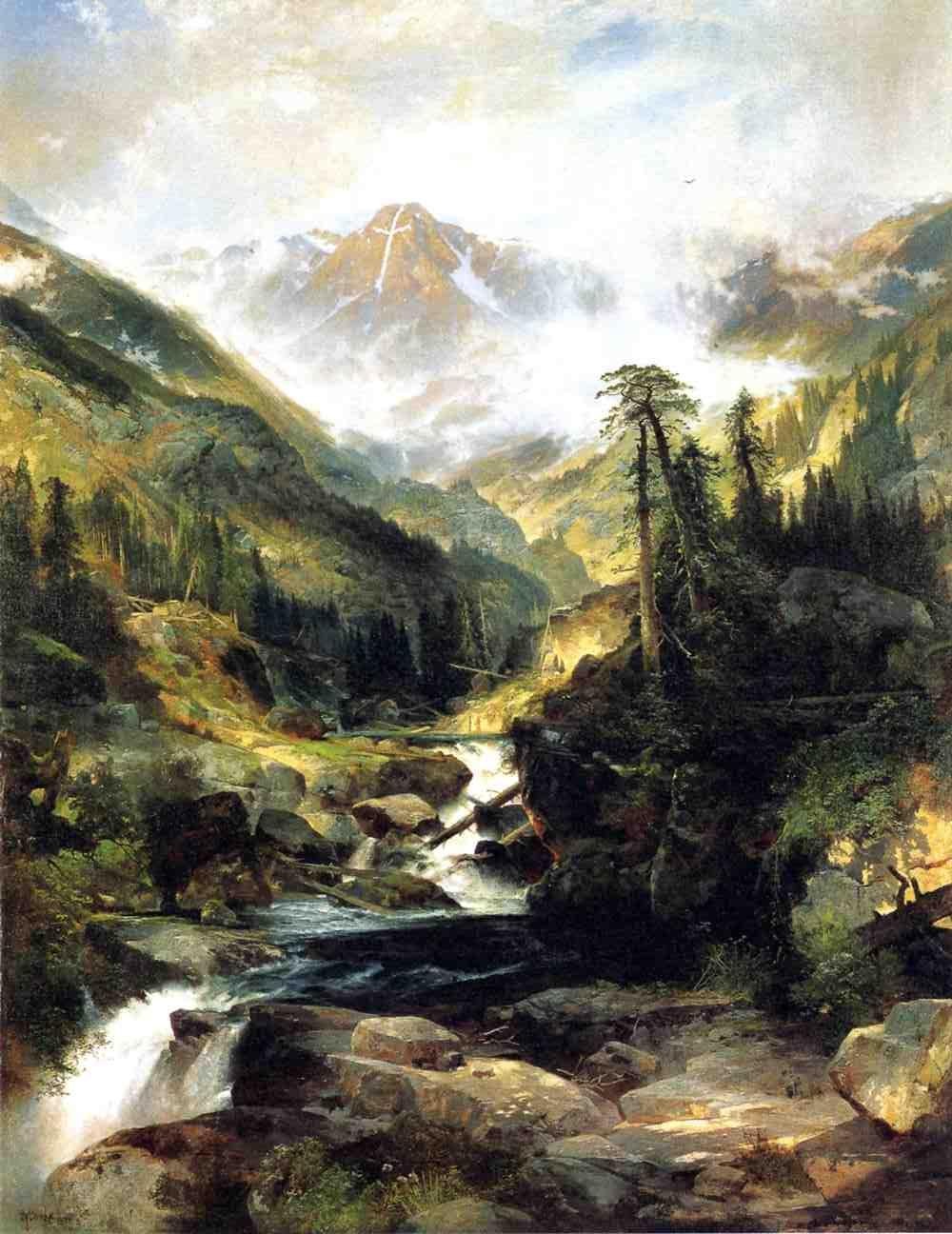
Mountain of the Holy Cross, 1875. Autry Museum of the American West; faithful reproduction via Wikimedia Commons. Image source. Public Domain Mark; faithful two-dimensional reproduction. Resized only; complete source image retained.
- Splash image source.
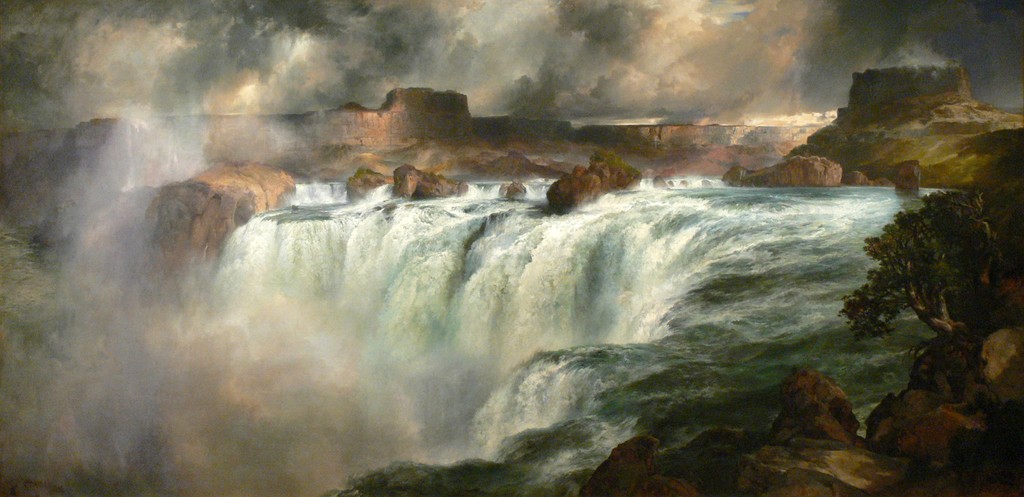
Shoshone Falls on the Snake River, 1900. Wolfgang Sauber / Wikimedia Commons, CC BY-SA 3.0; Gilcrease Museum painting. Image source. CC BY-SA 3.0; also marked PD-Art. Resized only; complete source image retained. This image derivative is available under the same licence.
- Splash image source.
Green River Cliffs, Wyoming, 1881. National Gallery of Art, Gift of the Milligan and Thomson Families. Image source. Public domain; NGA Open Access. Resized only; complete source image retained.
- Splash image source.
A View of Venice, 1891. Smithsonian American Art Museum, Transfer from the U.S. Department of the Interior, National Park Service, 1968.120.1. Image source. Free to use; Smithsonian Open Access. Resized only; complete source image retained.
- Splash image source.
The Three Tetons, 1895. The White House Collection, Gift of C. R. Smith; faithful reproduction via Wikimedia Commons. Image source. Public Domain Mark; faithful reproduction of a two-dimensional public-domain work. Resized only; complete source image retained.