 by Tom Gurney
Tom Gurney BSc (Hons) is an art history expert with over 20 years experience
Published on June 19, 2020 / Updated on October 27, 2026
Email: tomgurney1@gmail.com / Phone: +44 7429 011000
The Juniata, Evening: Introduction
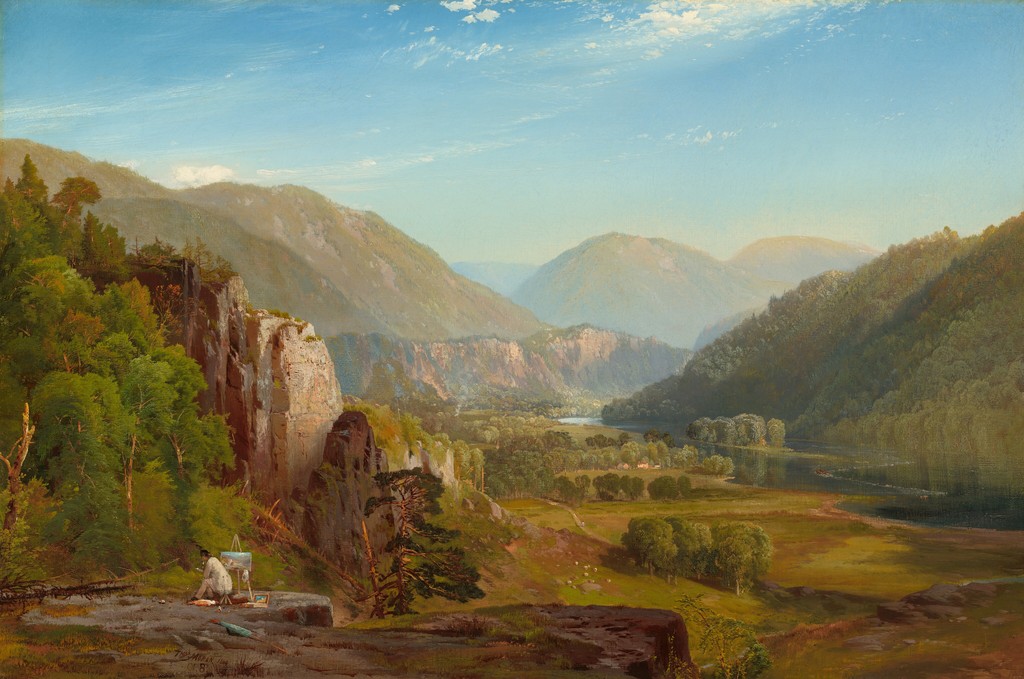
Thomas Moran's The Juniata, Evening, dated 1864, is an oil on canvas in the National Gallery of Art. It looks over a Pennsylvania river valley from a rocky foreground occupied by a painter and his equipment. The broad landscape combines cliffs, fields, trees, buildings and water beneath an open evening sky. [1]
The artist within the picture is a particularly engaging detail. His easel carries a miniature landscape, allowing the painting to include an image of its own subject. Around that small act of picture-making, the valley extends through several levels of distance. Moran makes a recognisable landscape and the experience of looking at it part of the same composition.
At a Glance
- ArtistThomas Moran
- TitleThe Juniata, Evening
- Date1864
- MediumOil on canvas
- Dimensions50.8 × 76.2 cm
- CollectionNational Gallery of Art
- Object number2010.107.1
- CreditGift of Max and Heidi Berry and Ann and Mark Kington/The Kington Foundation
- Opus number8
- Foreground artistPossibly a self-portrait; not a confirmed identification
Where this work sits in Moran’s career
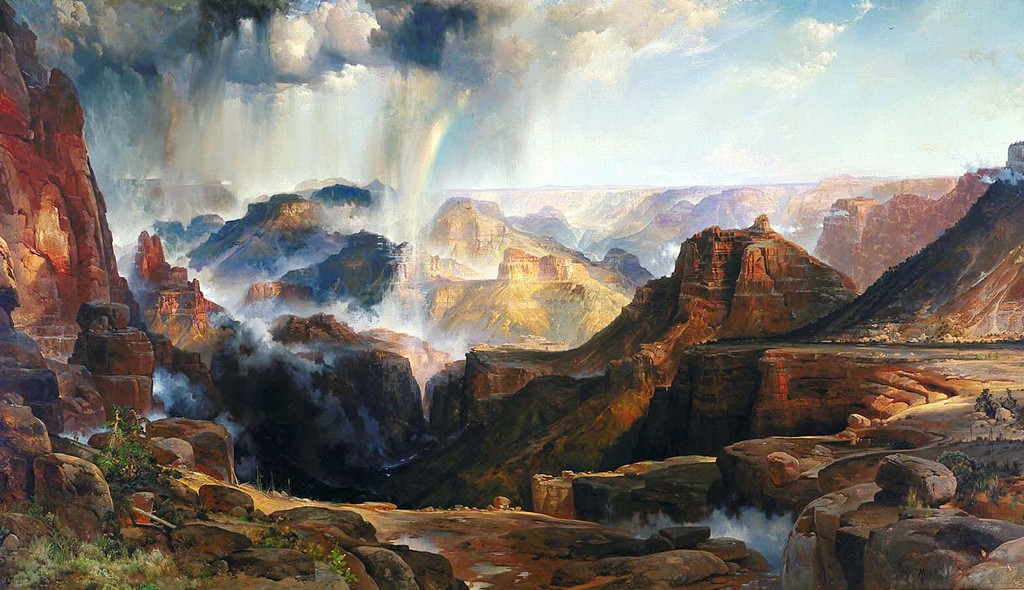
The Chasm of the Colorado
1873–1874; completed in 1874A View of Venice
1891Point Lobos, Monterey, California
1912, signed and datedContents
- A viewpoint above the valley
- The river's path
- A painter within the painting
- Equipment, rest and attention
- Fields and signs of occupation
- Evening without a dominant sunset
- An early painting with a recorded purchaser
- Pennsylvania before Yellowstone
A viewpoint above the valley
The foreground is an uneven shelf of rock. Its long, low surfaces run across the bottom of the painting, giving the spectator a position above the fields and river. This height makes several layers of the landscape visible at once. We can look down into the valley while also seeing the mountain slopes beyond it.
On the left, trees gather around exposed cliffs. Their foliage softens parts of the rock without concealing its height. Light catches pale stone faces, while narrow dark divisions make those faces appear broken into separate planes. The cliff is both a strong mass and a collection of smaller surfaces to explore.
The right side rises more continuously from the river. Trees cover much of the slope, creating a darker, comparatively unified area. The contrast with the pale left-hand cliff gives the valley a varied enclosure. Its sides belong together spatially while behaving differently in light and texture.
Between them, the distance opens towards overlapping mountains. Their colours become paler and their edges less emphatic as they recede. This sequence extends the view beyond the most immediately recognisable features. The landscape feels deep because it changes gradually, rather than presenting foreground and horizon as two disconnected zones.
Annotated Details from The Juniata, Evening
Compare these details with the full composition. The numbered overview and crops come from the same original image.
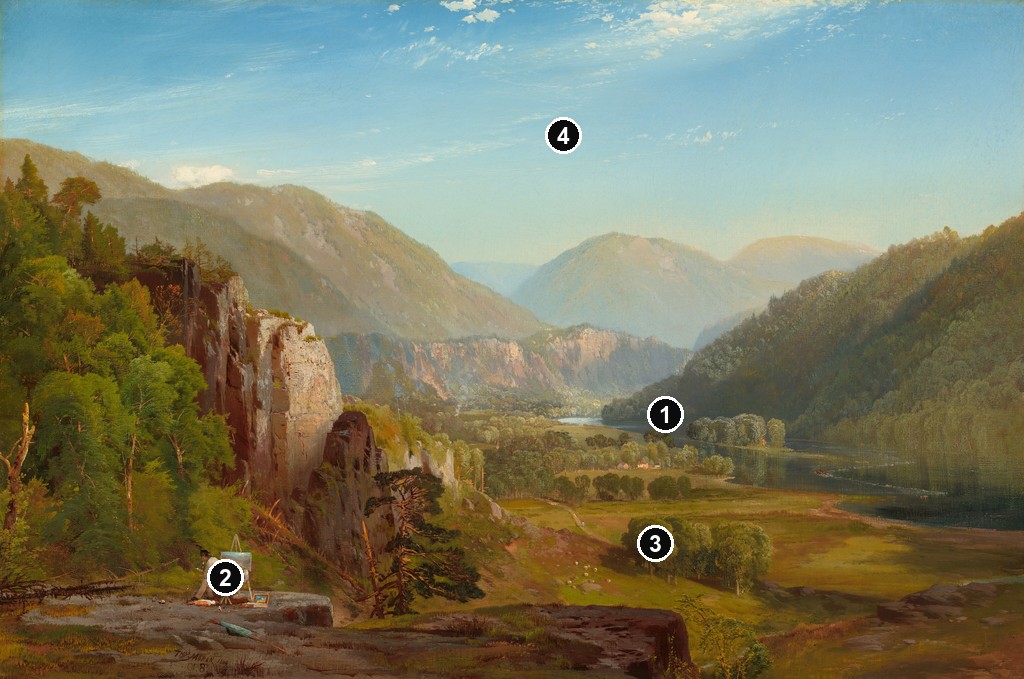
Details from THE JUNIATA, EVENING
Open a detail to see it more closely.
The river's path
The river occupies the right side of the nearer valley, then narrows as it moves towards the centre. Its curved course supplies a continuous route through a composition full of separate trees, rocks and fields. Following the water is one way to understand how those scattered elements belong to a larger space.
A painter within the painting
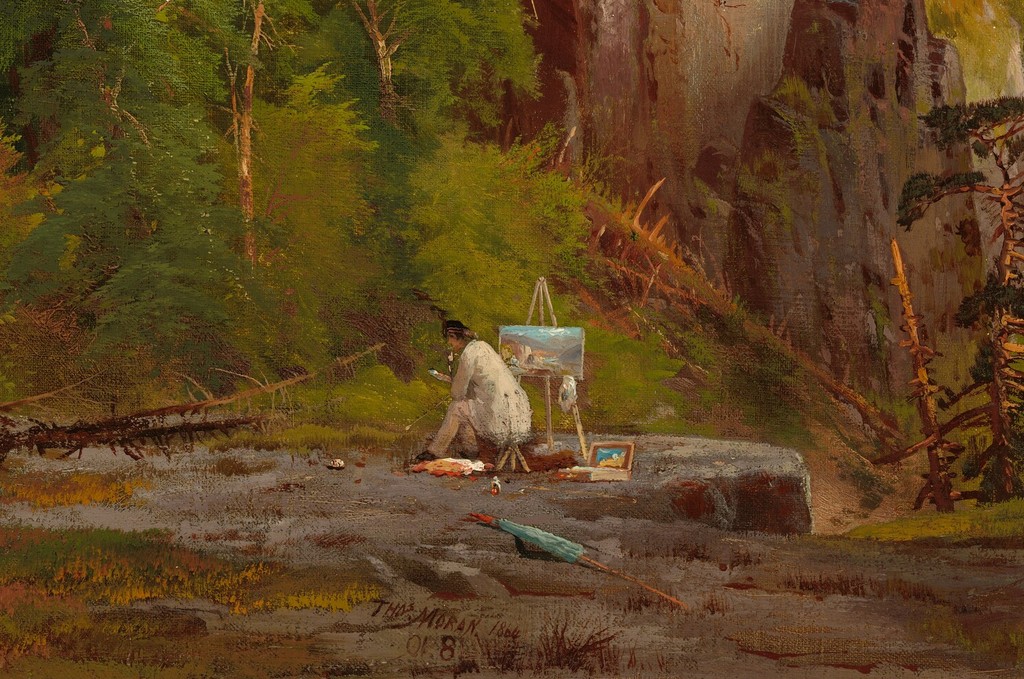
The small artist sits near the lower left, beside an easel and an open box. His light clothing distinguishes him from the darker ground and trees around him. The equipment occupies only a little of the canvas, but its arrangement makes the activity recognisable. A viewer who notices it can then follow the relationship between the miniature picture and the surrounding valley.
Fields and signs of occupation
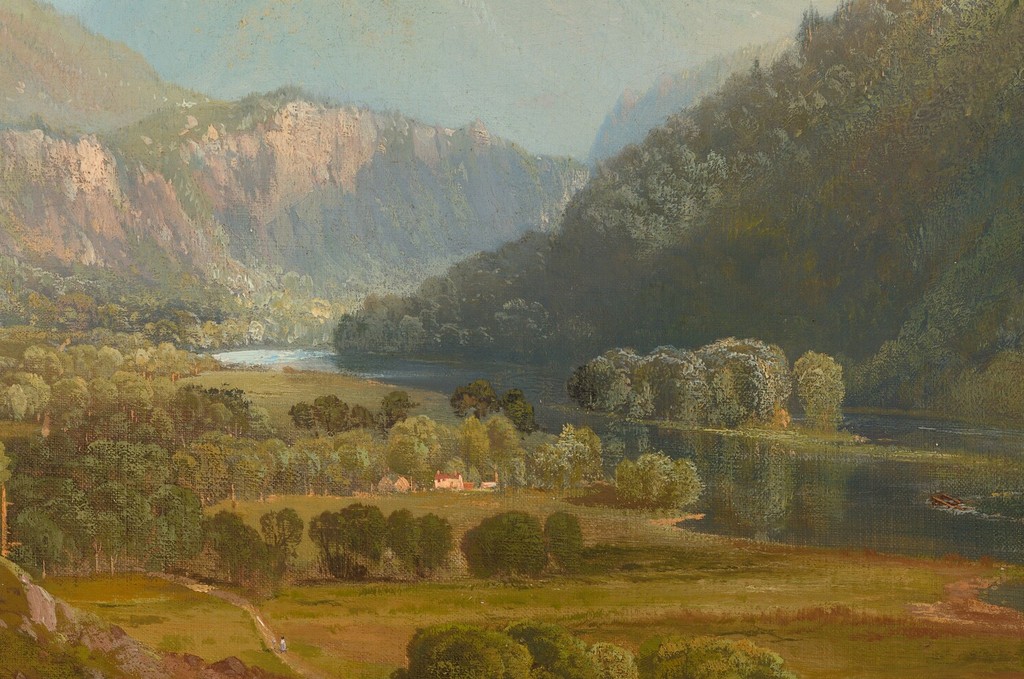
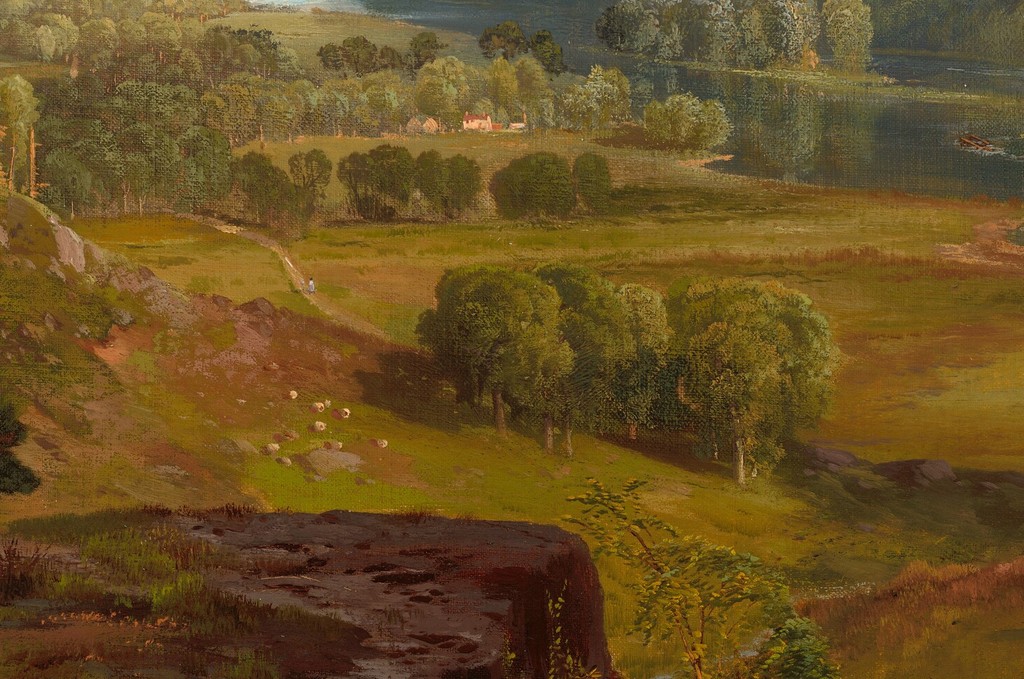
The valley floor contains open fields, small buildings, paths and pale grazing animals. These details bring human occupation into the middle distance. They are modest in size, yet distributed across the view. The landscape is not presented as entirely untouched terrain.
Evening without a dominant sunset
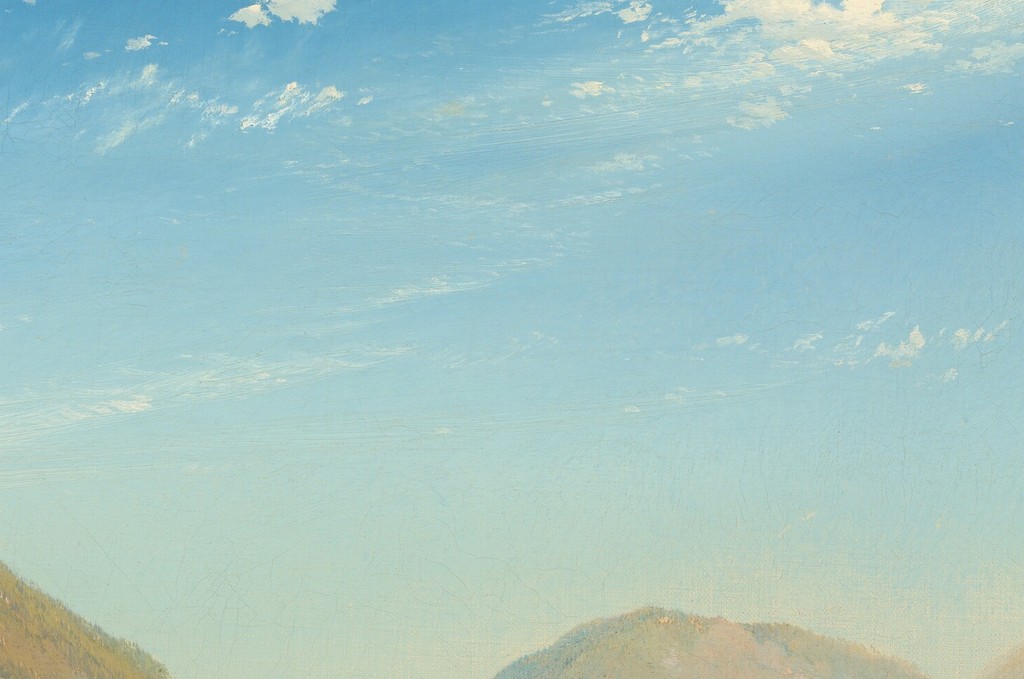
Much of the sky remains pale blue, with light clouds crossing it. The evening effect is not concentrated in a huge red sun. It develops through warmer cliff faces, softened mountains and the relative darkness of trees and the right-hand slope.
The river's path
The river occupies the right side of the nearer valley, then narrows as it moves towards the centre. Its curved course supplies a continuous route through a composition full of separate trees, rocks and fields. Following the water is one way to understand how those scattered elements belong to a larger space.
Near the right edge, the water is dark and relatively broad. Further away, it receives lighter passages and becomes harder to distinguish from its surroundings. Its changing visibility reinforces the movement into depth. Moran does not need to describe every bend with equal strength for the course to remain legible.
Trees along the bank introduce rounded forms between the water and open ground. Some are grouped, while others stand apart. Their shadows and changing sizes help articulate the valley floor. The space becomes more than an undifferentiated green strip between two mountain sides.
The river also changes the balance of the picture. The foreground painter and pale cliff make the left side visually active; the water gives the right side an answering movement. Its curve draws the eye back towards the middle distance, where the composition opens most clearly towards the mountains.
A painter within the painting
The small artist sits near the lower left, beside an easel and an open box. His light clothing distinguishes him from the darker ground and trees around him. The equipment occupies only a little of the canvas, but its arrangement makes the activity recognisable. A viewer who notices it can then follow the relationship between the miniature picture and the surrounding valley.
The National Gallery describes the figure as possibly a self-portrait. That possibility is suggestive, but remains an interpretation rather than a securely identified sitter. The scene works pictorially either way: it places a maker of landscapes inside the landscape being represented. [1]
The painted image on the easel is small enough to require close attention. Its light sky and lower coloured passages echo the broad division of the larger canvas. We see a second frame within the first. This makes the valley something encountered by a person who selects and organises it into a picture.
The figure also supplies scale. The rock shelf becomes substantial beside his seated body, and the surrounding trees rise well above him. He is close to us yet still very small within the whole view. That relationship makes the valley's breadth intelligible without requiring a dramatic event in the foreground.
Equipment, rest and attention
The artist's posture does not show a brush held prominently against the canvas. His body is turned somewhat away from the easel, giving the vignette a less formal appearance than an image of uninterrupted work. The moment allows for looking, pausing and considering as well as painting.
Objects on the ground make that pause more tangible. The open box and folded parasol indicate materials brought to the viewpoint. They bring an element of ordinary preparation into the broad landscape. The painter has a practical presence, with belongings placed on a surface that is uneven but usable.
The arrangement is also carefully balanced in colour. The light clothing catches attention, while the easel's small blue and pale areas connect with the sky and distance. Darker nearby trees prevent the little group from becoming detached from its setting. It remains a detail within the landscape rather than a separate portrait added to it.
This inclusion gives the spectator a companion in the act of looking. We can see the valley around the artist and imagine the view he has chosen. At the same time, Moran has chosen the place of that figure within a larger design. The painting invites attention to landscape and to the choices through which a landscape becomes art.
Watch: Thomas Moran
Choose a film to explore the artist’s work, its interpretation and its wider setting.
The painting that inspired a National Park
A close discussion of Moran’s landscape and its relationship to the idea of Yellowstone.
Watch on YouTubeFields and signs of occupation
The valley floor contains open fields, small buildings, paths and pale grazing animals. These details bring human occupation into the middle distance. They are modest in size, yet distributed across the view. The landscape is not presented as entirely untouched terrain.
A narrow path descends through the fields, and a tiny figure can be found along it. Compared with the foreground artist, this traveller is much further away. The difference in size establishes another level of depth. It also suggests that the valley can be crossed and inhabited, rather than only admired from above.
The buildings are small enough to remain part of the overall pattern of light and dark. Their roofs and walls create accents among the trees. They do not compete with the cliffs for attention, but help make the open ground more specific. The view combines large natural structures with quieter signs of everyday use.
Those signs complicate a purely solitary reading of the artist. He occupies an elevated, relatively secluded place, while the valley below contains activity and settlement. The distance between the two gives the painting different kinds of space: a place for looking and picture-making above, and a landscape of movement and occupation below.
Evening without a dominant sunset
Much of the sky remains pale blue, with light clouds crossing it. The evening effect is not concentrated in a huge red sun. It develops through warmer cliff faces, softened mountains and the relative darkness of trees and the right-hand slope.
The light is unevenly distributed. The exposed left cliff receives warm brightness, while the river and wooded slope contain deeper tones. These differences make the valley's surfaces respond differently to the same atmosphere. The landscape has a coherent time of day without all its parts being coloured identically.
The mountains become less strongly separated as they move away. Their softened colours join them to the sky, giving distance a gentler character than the nearer stone. Moran balances the specificity of the foreground with the openness of the horizon. Evening becomes a relationship among forms, rather than a single effect imposed on them.
An early painting with a recorded purchaser
Moran's surviving opus list, transcribed in the National Gallery's 1997 catalogue, identifies this as number 8. It records September 1864, George Frederick Tyler and a price of $200. The entry supplies unusually concrete information about a picture that might otherwise be discussed chiefly through its appearance. [2]
The museum treats an original commission as possible. Its distinction between purchase and possible commission should be retained: a named first owner does not resolve every circumstance of the transaction. The surviving record establishes useful particulars without providing a complete account of negotiations or the artist's intentions.
The lower-left inscription joins Moran's name and the year with the opus notation. Such numbering connects the picture with his effort to record valued studio works. It is also an identifying feature of this canvas, helping distinguish it from works carrying similar landscape subjects or later alternative titles.
The painting was acquired by the National Gallery in 2010. Its record gives the full gift credit to Max and Heidi Berry and Ann and Mark Kington/The Kington Foundation. That collection history belongs to the canvas now discussed here. The presence of an artist vignette does not establish the identity of every figure in other Moran landscapes. [1]
Pennsylvania before Yellowstone
The painting predates Moran's first western journey. The museum places it after his 1862 return to Britain to study Turner. That sequence helps restore the importance of his eastern landscapes within a career often introduced through canyons and western mountains. [1]
Autumn Afternoon, the Wissahickon, also dated 1864, offers a useful comparison. Its current title and opus number 9 distinguish it from the earlier autumn Wissahickon picture numbered 2. The Juniata canvas opens a much more extensive view across river and mountain slopes. [3]
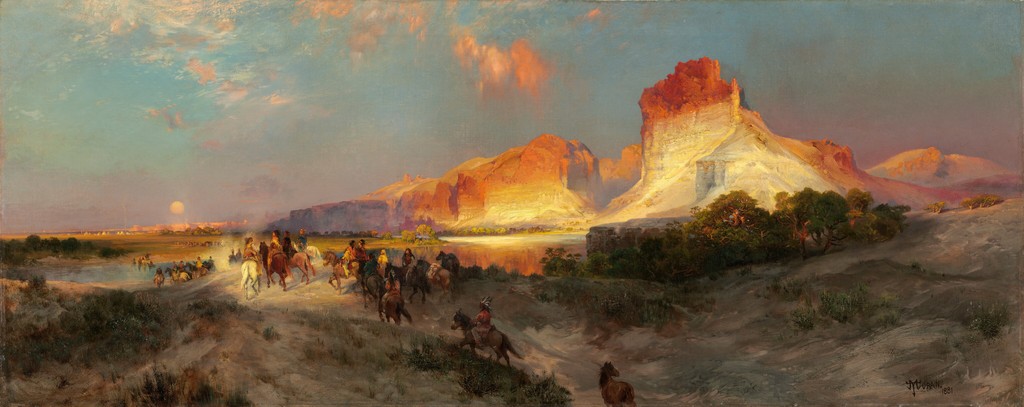
The later Green River Cliffs, Wyoming similarly rewards attention to light, cliffs and the activity of smaller figures. Its setting and scale differ, but the comparison reveals interests already present in the Pennsylvania painting. Moran's western reputation developed from an artist who had practised arranging inhabited landscapes long before Yellowstone.
Artworks directory
Selected documented works and distinct versions. This directory is not a comprehensive catalogue raisonné. Dates and media retain the distinctions explained in the articles and museum records.
| Name | Date | Medium |
|---|---|---|
| An Arizona Sunset near the Grand Canyon | Date not securely established | Oil painting |
| Autumn Afternoon, the Wissahickon by Thomas Moran | 1864 | Oil on canvas |
| Cascade Falls, Yosemite | Commonly catalogued as 1905 | Catalogued as oil on canvas |
| The Chasm of the Colorado | 1873–1874; completed in 1874 | Oil on canvas, currently mounted on aluminium |
| Children of the Mountain | 1866 in the current museum title; 1867 in the 1997 National Gallery catalogue | Oil on canvas |
| Cliffs of Green River | 1874 | Oil on canvas |
| Cliffs of the Upper Colorado River, Wyoming Territory | 1882 | Oil on canvas |
| East Hampton, Long Island , also captioned Easthampton, L.I | 1897 | Oil on canvas laid on board, according to the reproduction record |
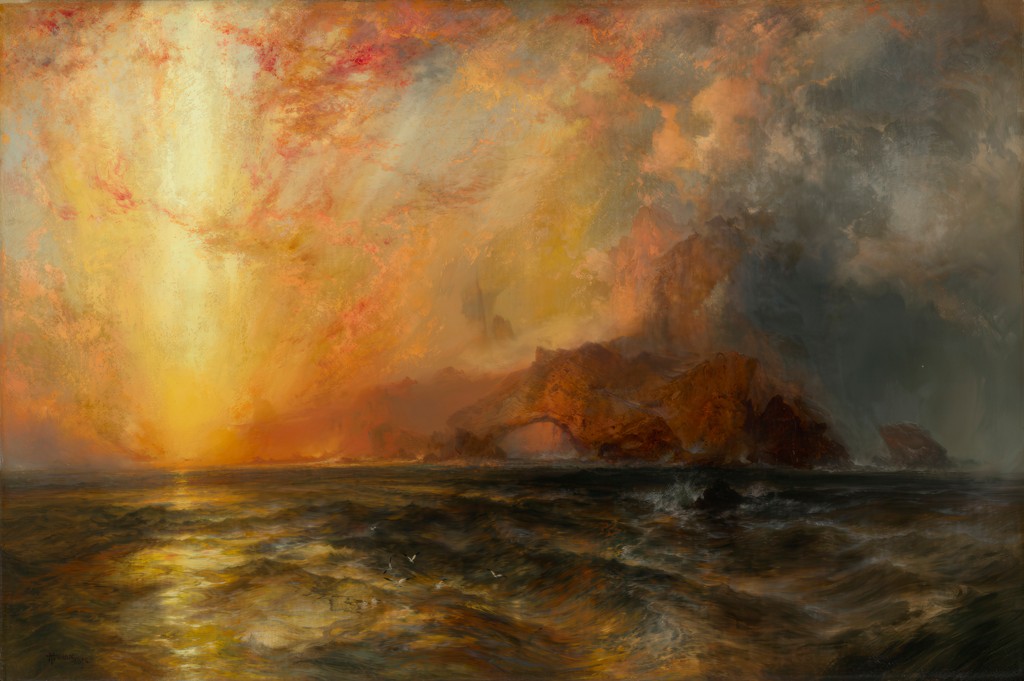
| Fiercely the red sun descending, Burned his way along the heavens | 1875–76 | Oil on canvas |
| Forest Scene | 1870 | Oil on canvas |
| Grand Canyon of the Colorado River | 1892 and 1908 | Oil on canvas |
| Green River Cliffs, Wyoming | 1881 | Oil on canvas |
| Green River, Wyoming | 1878 | Oil on panel |
| The Juniata, Evening | 1864 | Oil on canvas |
| Mosquito Trail, Rocky Mountains of Colorado | 1875 in the 1997 National Gallery exhibition catalogue | Watercolour |
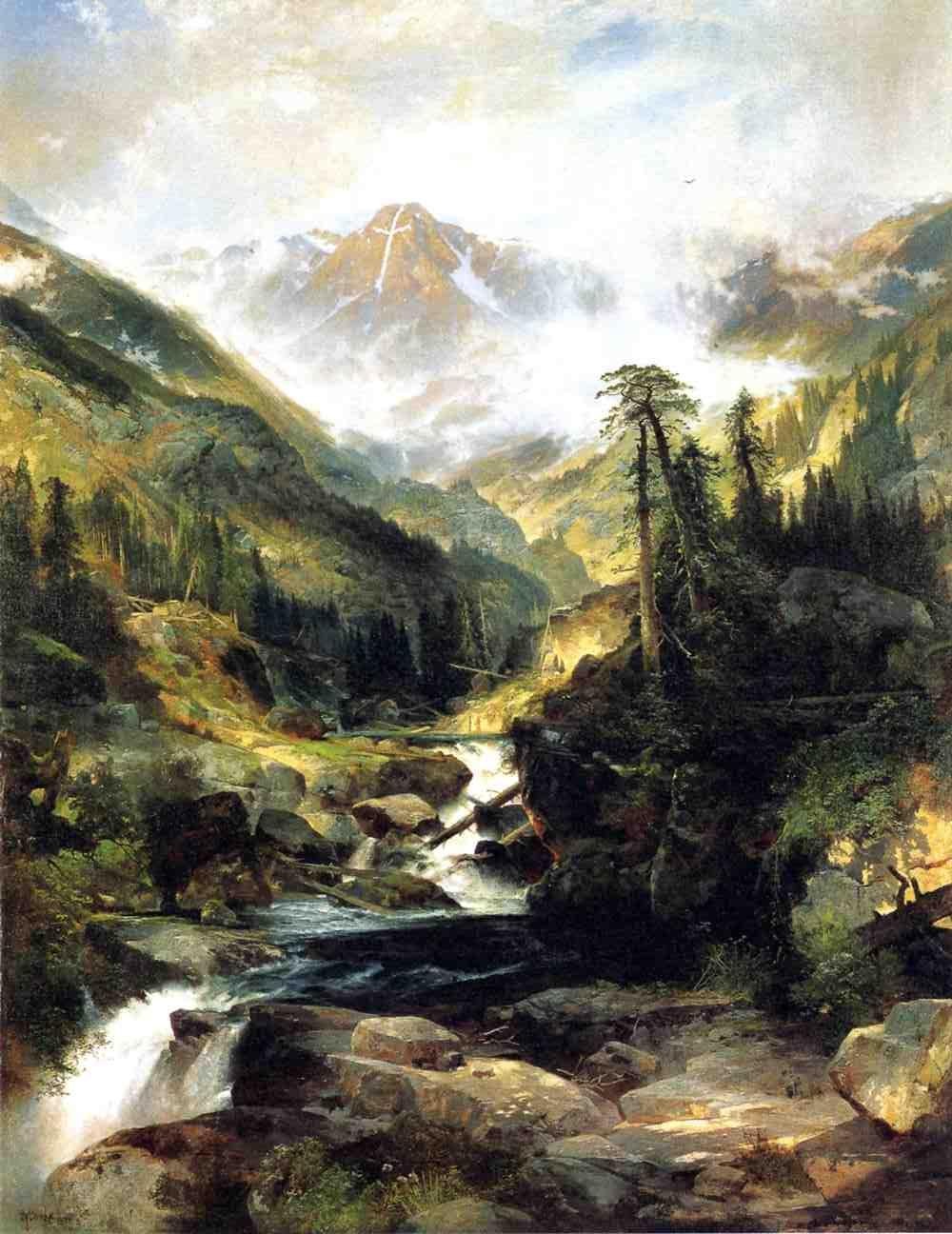
| Mountain of the Holy Cross | 1875 | Oil on canvas |
| The Much Resounding Sea | 1884 | Oil on canvas |
| Point Lobos, Monterey, California | 1912, signed and dated | Oil on canvas |
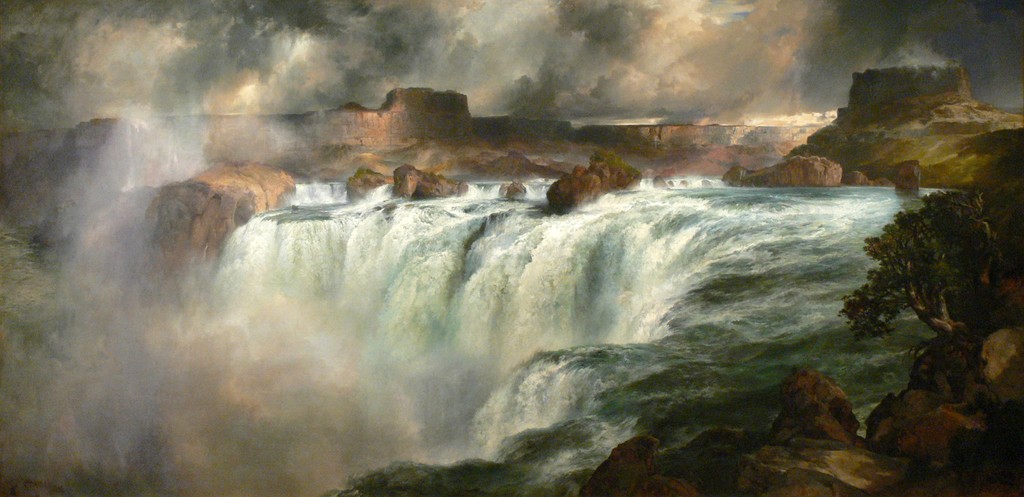
| Shoshone Falls on the Snake River | 1900 | Oil on canvas |
| Summit of the Sierras | 1872/75, as catalogued by the Art Institute of Chicago | Gouache over graphite on cream laid paper |
| The Teton Range | 1897 | Oil on canvas |
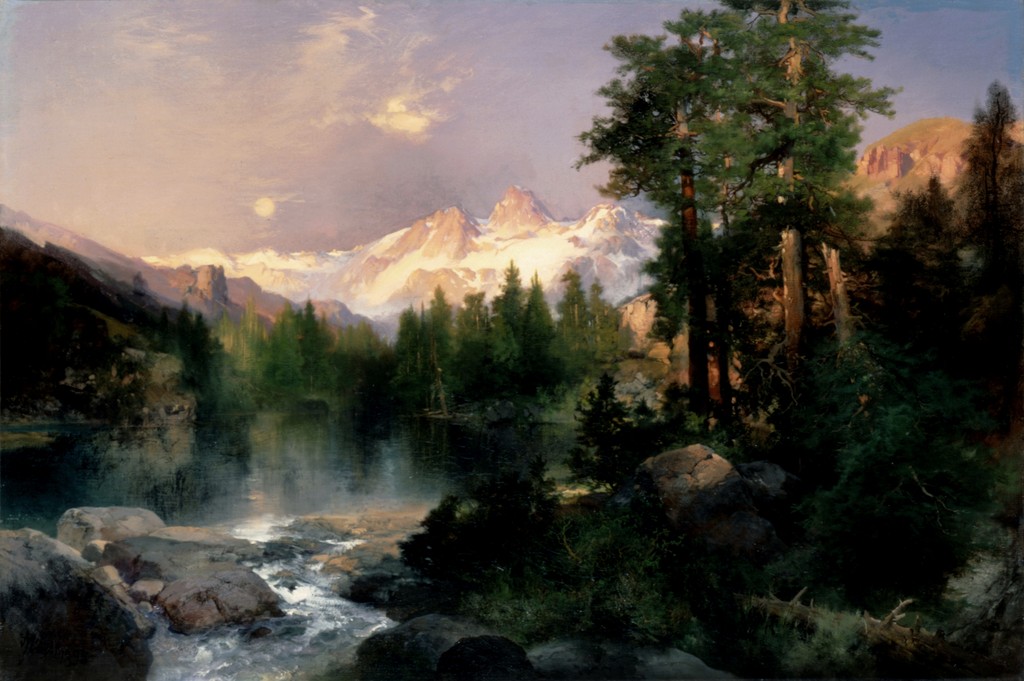
| The Three Tetons | 1895 | Oil on canvas |
| Tower Falls, Yellowstone | 1872 | Watercolour and gouache over graphite on blue laid paper |
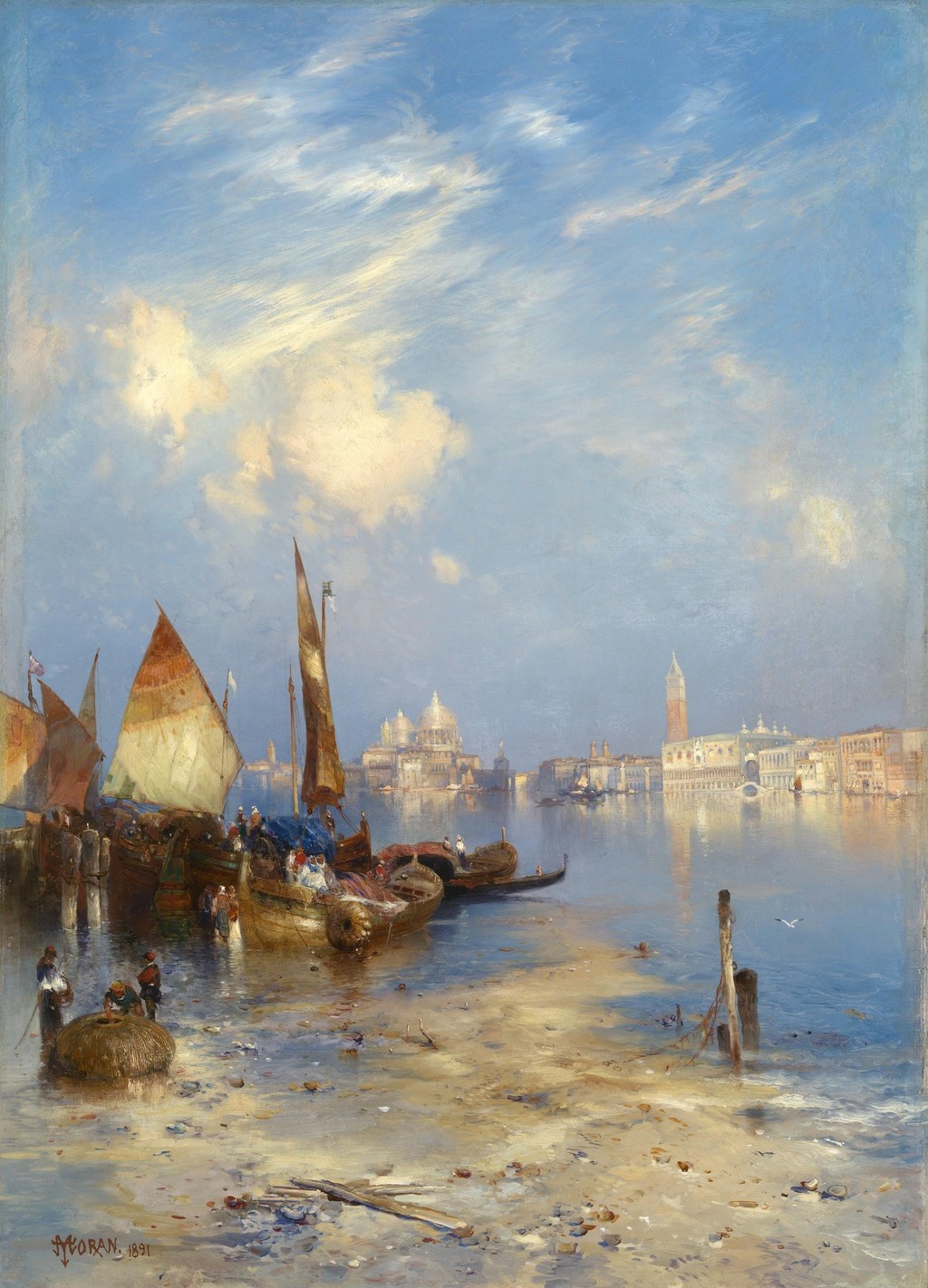
| A View of Venice | 1891 | Oil on canvas |
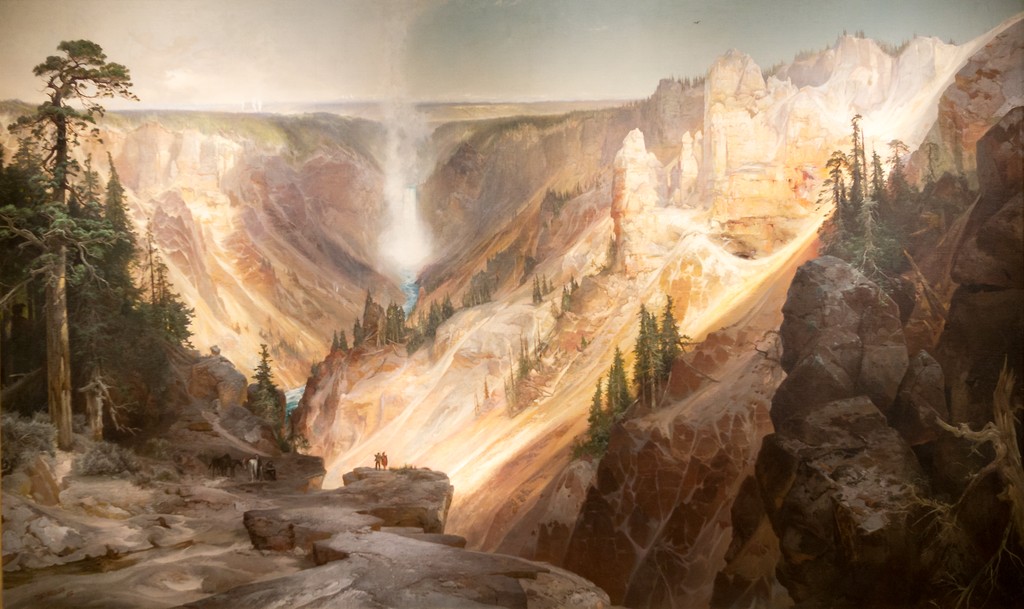
| The Grand Canyon of the Yellowstone | 1872 | Oil on canvas, currently recorded as mounted on aluminium |
| Mountain of the Holy Cross, Colorado (etching) | 1888 | Etching, roulette and aquatint |
| The Resounding Sea (etching) | 1880 | Etching |
| The Much Resounding Sea (later etching) | 1886 in heading; 1888 on plate | Etching, drypoint and roulette |
| Tower Falls (Prang print) | c. 1875; portfolio issued 1876 | Chromolithograph |
| Shoshone Falls (early watercolour) | 1874 | Watercolour |
| Venice (watercolour) | 1888 | Watercolour over graphite |
Frequently Asked Questions
It is dated 1864; the opus-list entry records September.
The National Gallery describes a self-portrait as possible, not confirmed.
It identifies the painting as number 8 in Moran's opus list.
George Frederick Tyler. The recorded price was $200; a commission remains possible.
The National Gallery of Art, accession 2010.107.1.
Discussion
Compare the artist's small easel picture with the landscape around it. Which parts of the larger view can you recognise in miniature, and how does that detail change your experience of the foreground?
Reader Insights
Editorial prompts for close looking and discussion.
Compare the artist's small easel picture with the landscape around it. Which parts of the larger view can you recognise in miniature, and how does that detail change your experience of the foreground?
Which source or image helps you assess the interpretation?
How does this page compare with the related works linked above?
Join the Conversation
Share your reading of this page below.
References
- National Gallery of Art, The Juniata, Evening, 1864, object record and interpretation, 2010.107.1.
- Nancy K. Anderson and contributors, Thomas Moran, 1997, appendix transcription of Moran's opus list, no. 8, p. 352.
- Terra Foundation for American Art, Autumn Afternoon, the Wissahickon, 1864, object record; Anderson and contributors, opus-list transcription, no. 9, p. 352.
- Splash image source.
The Juniata, Evening, 1864. National Gallery of Art, Gift of Max and Heidi Berry and Ann and Mark Kington/The Kington Foundation. Image source. Public domain; NGA Open Access. Resized only; complete source image retained.
- Splash image source.
The Juniata, Evening, 1864. National Gallery of Art, Gift of Max and Heidi Berry and Ann and Mark Kington/The Kington Foundation. Image source. Public domain; NGA Open Access. Numbered circles added to the overview; details cropped from the original reproduction. No colour adjustment or sharpening.
- Splash image source.
The Grand Canyon of the Yellowstone, 1872. Wuselig / Wikimedia Commons, CC BY-SA 4.0; U.S. Department of the Interior Museum painting. Image source. CC BY-SA 4.0; also marked PD-Art. Outer museum frame cropped; resized. Painted composition retained; photographic perspective unchanged. This image derivative is available under the same licence.
- Splash image source.
The Chasm of the Colorado, 1873–1874. U.S. Department of the Interior Museum; faithful reproduction via Smithsonian American Art Museum / Wikimedia Commons. Image source. Public Domain Mark; faithful two-dimensional reproduction. Resized only; complete source image retained.
- Splash image source.
Mountain of the Holy Cross, 1875. Autry Museum of the American West; faithful reproduction via Wikimedia Commons. Image source. Public Domain Mark; faithful two-dimensional reproduction. Resized only; complete source image retained.
- Splash image source.
Shoshone Falls on the Snake River, 1900. Wolfgang Sauber / Wikimedia Commons, CC BY-SA 3.0; Gilcrease Museum painting. Image source. CC BY-SA 3.0; also marked PD-Art. Resized only; complete source image retained. This image derivative is available under the same licence.
- Splash image source.
Green River Cliffs, Wyoming, 1881. National Gallery of Art, Gift of the Milligan and Thomson Families. Image source. Public domain; NGA Open Access. Resized only; complete source image retained.
- Splash image source.
A View of Venice, 1891. Smithsonian American Art Museum, Transfer from the U.S. Department of the Interior, National Park Service, 1968.120.1. Image source. Free to use; Smithsonian Open Access. Resized only; complete source image retained.
- Splash image source.
The Three Tetons, 1895. The White House Collection, Gift of C. R. Smith; faithful reproduction via Wikimedia Commons. Image source. Public Domain Mark; faithful reproduction of a two-dimensional public-domain work. Resized only; complete source image retained.