


 by Tom Gurney
Tom Gurney BSc (Hons) is an art history expert with over 20 years experience
Published on June 19, 2020 / Updated on September 25, 2026
Email: tomgurney1@gmail.com / Phone: +44 7429 011000
A life in two eras
Tsukioka Yoshitoshi was born in Edo in 1839 and died in Tokyo in 1892. The different city names mark more than a change in vocabulary. During his working life, the Tokugawa shogunate fell, the imperial government recast public institutions, newspapers found new audiences, trains entered the city and printed pictures had to compete with other ways of seeing events. Yoshitoshi's career crossed that transition without abandoning the colour woodblock print. His life is best understood through the dated things he made, the people who taught and published him, and the occasions for which a print could still matter. [1] [2]
Explore One Hundred Aspects of the Moon
Contents
- A life in two eras
- Entering Kuniyoshi's workshop
- Reputation, collaboration and the 1860s
- Edo becomes Tokyo
- The pressure of current events
- Drawing women and designing a series
- A late career in several directions
- Reading a life through surviving sheets
- The person and the workshop
- Books on Japanese Art and Prints
Explore Yoshitoshi’s works and major series.
The National Diet Library gives his birth as the seventeenth day of the third month of Tenpō 10, equivalent on its record to 30 April 1839, and his death as 9 June 1892. That dual dating needs its labels: an old-calendar date cannot simply be read as 17 March in the modern calendar. The NDL lists his personal name as Yoshioka Kinzaburō (吉岡金三郎), the familiar name Yonejirō (米次郎), and several art names including Gyokuōrō, Ikkai-sai and Taiso. Institutional records differ: Yamanashi Prefectural Museum calls Yonejirō his real name, while Kitakyushu City Museum of Art gives Yoshioka Yonejirō. The present evidence does not reconcile these accounts or establish a precise sequence for every art name. “Tsukioka Yoshitoshi” is the name most useful for readers; a signature on a particular sheet deserves its own identification. [1] [26] [27]
Yoshitoshi at a glance
- PeriodLate Edo through Meiji, 1839–1892
- TeacherUtagawa Kuniyoshi, from around 1850
- FormsSingle sheets, diptychs, triptychs, illustration and painting
- Major seriesOne Hundred Aspects of the Moon; Thirty-Two Aspects of Customs; New Forms of the Thirty-Six Ghosts
Entering Kuniyoshi's workshop
The NDL says Yoshitoshi entered Utagawa Kuniyoshi's school around 1850; the British Museum similarly phrases the connection as something reported for that year. Since he was then a child, the artist's early training was not a private encounter with a solitary master. A commercial print studio supplied models, drawing practice, knowledge of stories and the practical discipline of making pictures that publishers could sell. Kuniyoshi's repertoire included warriors, legends, actors, animals and visual jokes. The young Yoshitoshi inherited a set of subjects and a way into the profession, not a fixed style that he would merely repeat. [1] [4] [2]
The British Museum calls a triptych of Heike Warriors Falling into the Sea from 1853 apparently his earliest work. “Apparently” matters: neither the exact first design nor every attribution in an early commercial oeuvre is settled by a brief artist biography. That record does, however, place historical and martial stories at the beginning of his public work. As a pupil of Kuniyoshi he could draw on an established appetite for such pictures, but his later career shows how many other uses he found for the medium. We should not infer that his childhood was dominated by violence simply because a surviving early title contains warriors. [4]
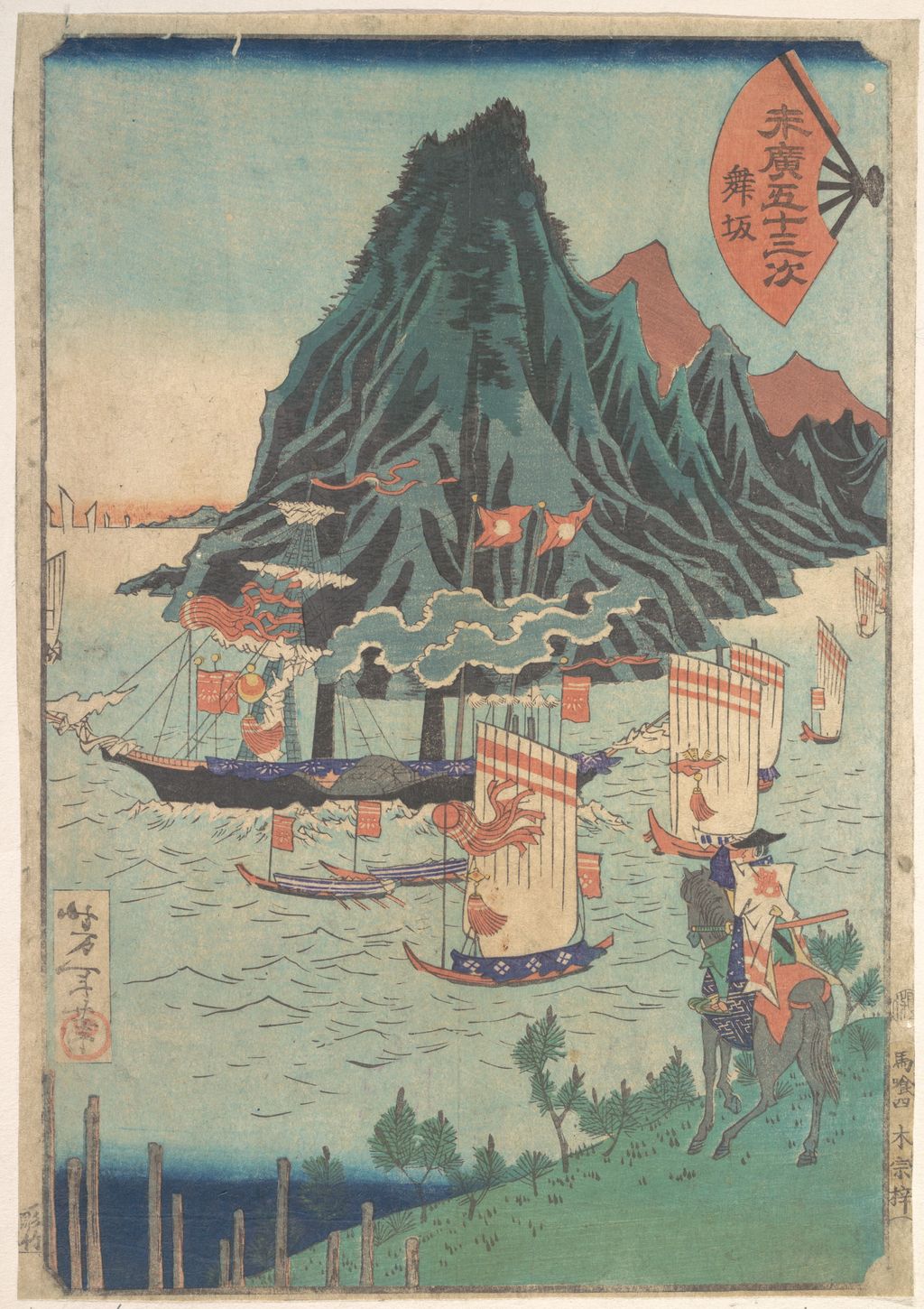
Kuniyoshi died in 1861. That date made the younger designer's next decade a test of independence as well as continuity. Looking backwards from famous late moon prints can make the earlier years seem a preface. They were substantial working years in their own right, with named impressions, historical commissions and experiments with contemporary subject matter. The Met's circa-1865 sheet from Fifty-Three Stations of Suehiro shows a warrior near a passing steamship. The train had not yet taken over the image. Instead, an older journey format accommodates a new machine. The sheet provides a more precise account of Yoshitoshi's early response to change than a broad claim that he “became modern” only after the Restoration. [5] [4]
The British Museum also records a remarkable change of scale in 1865: a roughly nine-metre festival curtain on the Battle of Shizugatake. Its account suggests that Yoshitoshi worked across media and audiences, far beyond sheets bought for domestic viewing. We have not yet located a reusable photograph or inspected the curtain itself. It belongs in the biography as a documented commission, but its appearance should not be reconstructed from the title, nor should the print on the facing page be made to stand in for it. [4]
Reputation, collaboration and the 1860s
In 1866 Yoshitoshi collaborated with Ochiai Yoshiiku, another Kuniyoshi pupil, on Twenty-Eight Famous Murders with Verse (英名二十八衆句). The National Diet Library describes the series as a rapid source of popularity. Ōta Memorial Museum's exhibition on Yoshiiku states that the two artists made 14 sheets each. This division is a much firmer starting point than attributing all 28 designs to Yoshitoshi, although the signature and object record should still be checked for a particular sheet. The graphic reputation of the series is real; it is not a record of one person's psychology. Publishers, stories, texts and an audience for arresting images all shaped what was made. [1] [28]
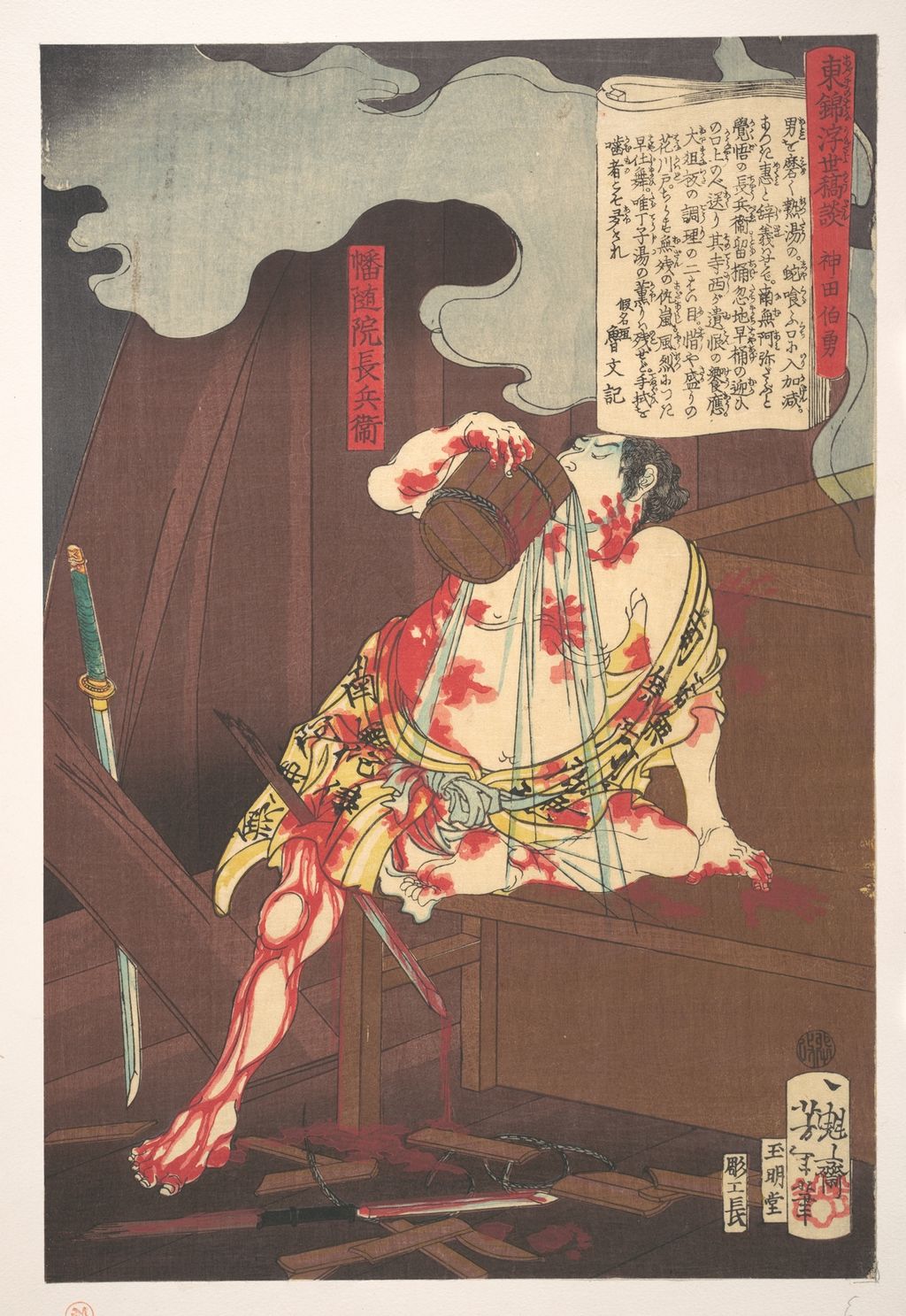
The year after that collaboration is represented by quite different works. The Met dates its Banzuiin Chōbei sheet to October 1867, and its triptych Plum Blossoms in the Forest of Ikuta to 1867. Both draw on recognisable narrative worlds rather than simply report the day's politics. Together with the steamship sheet, they show a designer sustaining historical and dramatic subjects while new technology became visually available. The biography should not be arranged as a series of substitutions, with one genre disappearing the instant another arrives. Yoshitoshi sold images into overlapping markets. [7] [8] [5]
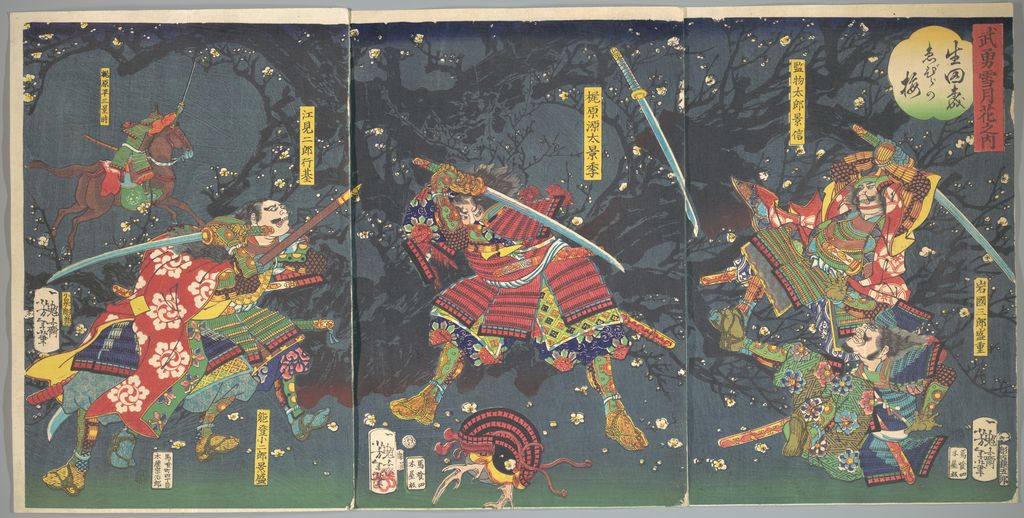
The late shogunate and Restoration years have often encouraged biographical writing in which every warrior design becomes a comment on a particular political event. Ōta Memorial Museum provides a more specific example of historical analogy: it explains that figures in the Kaikadai hyakusen sō series could be viewed in relation to the Shōgitai fighters of the Ueno War. That is the museum's contextual reading of a named series; it does not license a claim that Yoshitoshi secretly encoded the same conflict into all historical prints. The more useful biographical point is that a historical subject could carry contemporary resonance for an audience living through conflict. [6]
Edo becomes Tokyo
The change of government in 1868 altered the world of the print buyer as well as that of the artist. The Fitzwilliam Museum describes Yoshitoshi as a witness to conflict around the transition and as a maker of contemporary-event images. That formulation should be treated with ordinary evidential care: living in Tokyo during upheaval does not mean that he saw every event he pictured. A print of a battle or a newly built railway might be assembled from reports, established pictorial conventions and the publisher's sense of what could sell. It can still tell us much about public interest, even where it cannot tell us exactly what the artist observed firsthand. [2]
The railway triptych of Takanawa crystallises the problem. The Met dates its impression 1872. A National Diet Library catalogue names the Japanese title, 東京名勝高輪蒸気車鉄道之全図, and records a 1871 publication; Tokyo Museum Collection dates another object September 1871. It would be tempting to “correct” one source and supply an easy chronology. We cannot yet say whether the difference concerns a design date, issue, impression or catalogue convention. The biography can say that the work belongs to the early 1870s and keep the specific dates attached to their institutions. As a visual event, the train turns the three-sheet format into a horizontal path for a new form of transport. [9] [10] [11]
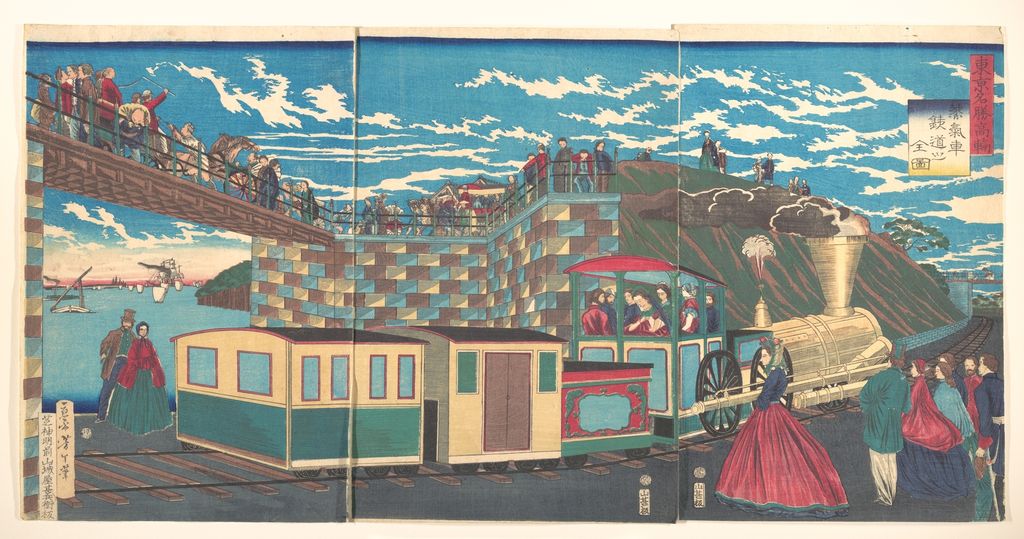
Reports of illness in 1872–73 need equal care. The British Museum refers to mental illness; the Fitzwilliam Museum says that depression and a scarcity of commissions marked the early 1870s. These are museum biographical accounts, not medical files inspected for this article. They support a qualified statement that Yoshitoshi experienced a difficult period and that his work was affected, but they do not establish a retrospective clinical diagnosis or a simple causal explanation for the appearance of particular prints. The dated Takanawa impression itself is a reminder that a phrase such as “he stopped working” would be too blunt. [4] [2] [9]
Around 1874, according to the British Museum, colour woodblock newspaper work and novel illustration became more important to his livelihood. The National Diet Library names the Yūbin Hōchi Shimbun, Eiri Jiyū Shimbun and Yamato Shimbun in its summary of work after the Restoration. A newspaper illustration is still a made image, with choices of framing and narrative emphasis. Its relationship to current events differs from the historical story sheet, but it is no more a transparent photograph of an event. The identity of a newspaper, the date of a particular number and the form of its printed sheet should be checked on each future object page. [4] [1]
The pressure of current events
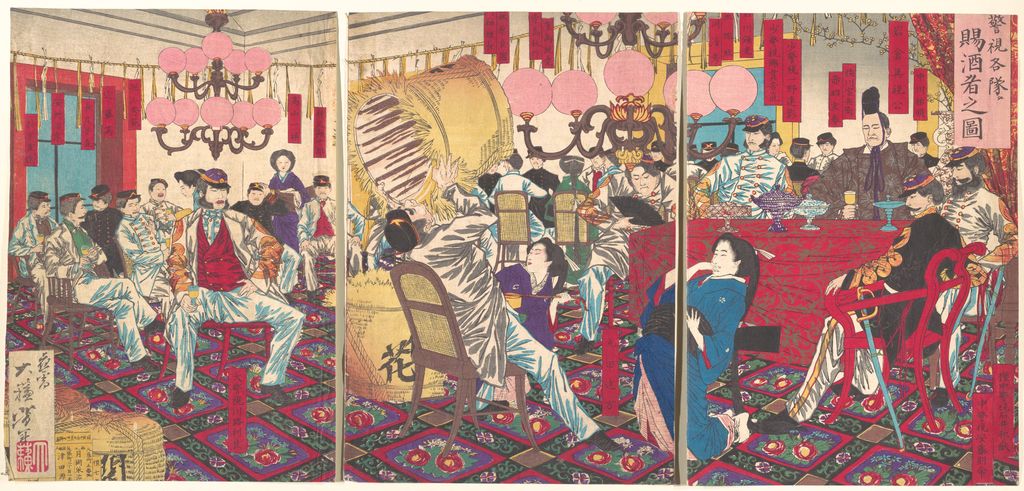
The Satsuma Rebellion in 1877 provided subjects for printmakers. The British Museum's Samurai guide identifies a Yoshitoshi campaign image, while the Met holds a September 1877 print of a police superintendent's party receiving food and drink. These are distinct works. Their presence in catalogues demonstrates the breadth of current-affairs imagery around the conflict; neither sheet alone tells us what Yoshitoshi privately thought about the combatants. Publishing a scene related to a war was a professional choice within a market for visual news. [12] [13]
In the Met's group scene, the event occupies two sheets rather than the full three of the Takanawa railway. The smaller spread still provides room for participants, service and setting. The article's caption should follow the Met's identified subject and date. It should not assign names to figures from clothing or appearance alone. A biographical use of this object is to show the work of a mature designer moving between present-day public episodes and the dramatic stories with which he had first made his reputation. The recurring thread is a capacity to organise events for viewers, not a single genre. [13]
Yoshitoshi's identity as a Meiji artist is sometimes flattened into a struggle between “traditional” and “Western” subjects. The steamship, train and newspaper were part of his working world, but so were legend, theatre, poetry and history. The Fitzwilliam Museum says he later joined a preservation-minded circle associated with actor Ichikawa Danjūrō IX. The checked summary does not supply a documentary date or complete membership record, so that account belongs here as an attributed institutional claim, not as a sharply dated conversion. His dated objects provide firmer evidence that modern media and older stories continued to coexist in his work. [2] [5] [13]
Two Japanese museum catalogues help fill the years between a general statement about newspapers and the better-known late series. Kitakyushu City Museum of Art dates Yoshitoshi's entry into work for the Yūbin Hōchi Shimbun to 1875 and lists two number-identified newspaper prints from that year in its collection. Those object entries give the biographer firmer evidence than a vague statement that he “turned to journalism.” They do not, by themselves, prove the exact terms of his employment or the starting dates of every newspaper project. The NDL's three named papers and Kitakyushu's dated examples can therefore be read together: one describes the range of his later activity, the other places surviving instances within a particular year. [1] [27]
Yamanashi Prefectural Museum's collection makes the same point through different genres. It dates a print of Kondō Isami at Kōshū-Katsunuma and another historical narrative sheet to 1874, a figure of Murasaki Shikibu to 1876, and named warriors and court figures to later years. A reader following those dates sees literary and historical figures running alongside new-media work. Yoshitoshi's career did not have a moment when newspaper illustration replaced every other subject. These museum entries are also a reminder to keep a story's depicted century separate from the publication year of its print: Murasaki Shikibu belongs to an earlier past, but this Yamanashi object is catalogued as a work of 1876. [26]
The same Yamanashi artist record says Yoshitoshi was ranked first in an 1885 popularity listing of print designers, the Tokyo Ryūkō Saikenki. Kitakyushu City Museum also mentions a first-place position in an artist ranking around that time. This evidence belongs in a biography because it shows that the years of major late series were also years of contemporary recognition. Its limits matter: a ranking created in a particular place and publishing culture cannot establish that he was the most widely sold artist in every part of Japan or that all critics judged his work best. The listing itself, its criteria and its readership would need direct examination to make such claims. The museums' more modest statement is sufficient to show that his mature work had a visible public standing. [26] [27]
Drawing women and designing a series
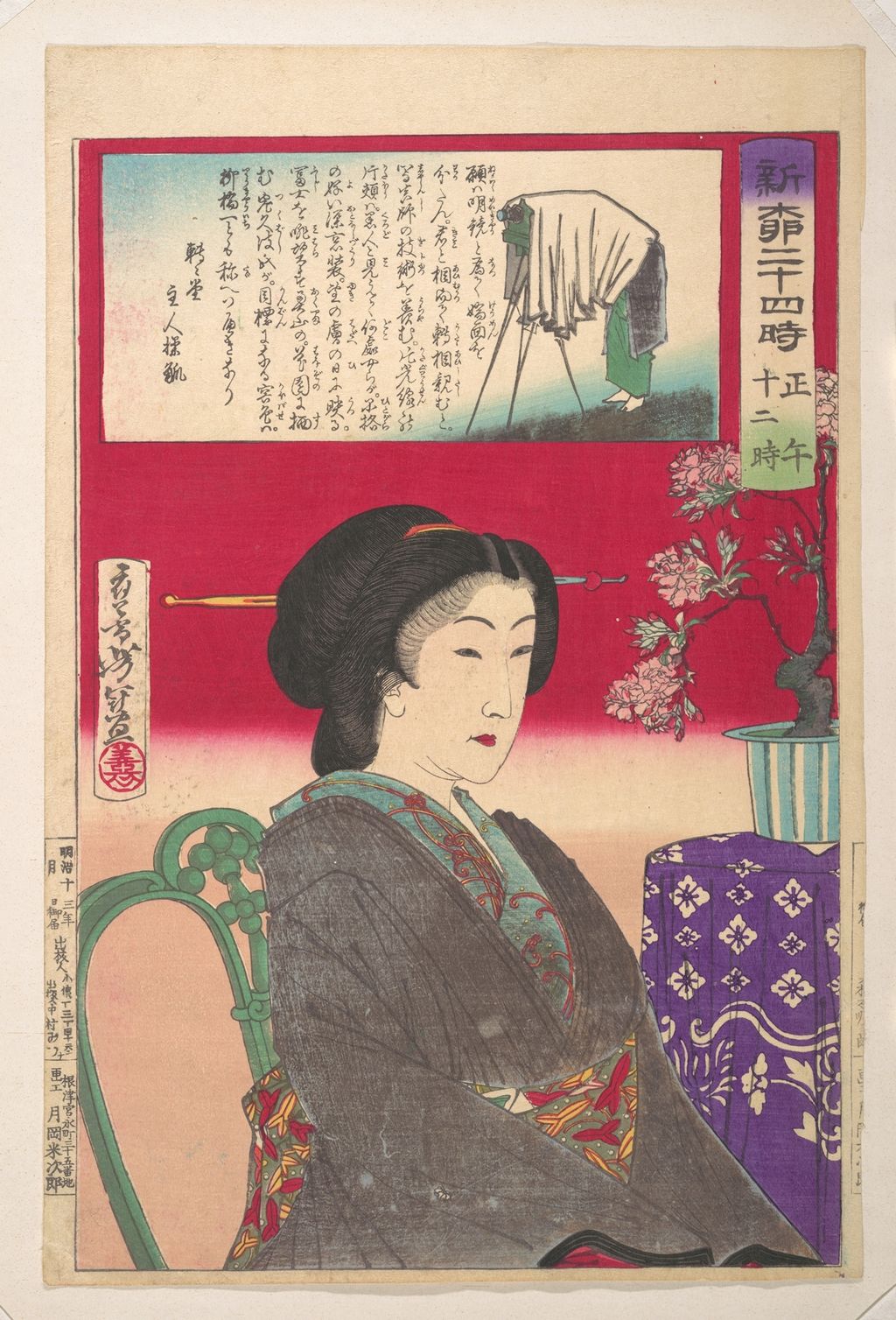
By 1880 a series such as Twenty-Four Hours at Shinbashi and Yanagibashi offered a different kind of continuing project. The Met's noon print concentrates a particular hour in a single upright sheet. The Fitzwilliam Museum preserves a preparatory drawing for the one-o'clock design from the same series. Black brushwork over red underdrawing makes visible a stage of revision before the cutter translated an image into blocks. These two objects must not be presented as “sketch and finished print” of one design: they concern different hours. Together they show how a serial theme could be planned, drawn and issued one image at a time. [14] [15]
The working process matters in a biography because it corrects the impression that the named artist completed a print alone. Yoshitoshi conceived and drew designs. Publishers funded and organised an edition, cutters turned drawings into separate blocks, and printers decided through pigments, pressure and registration how a sheet would appear. Fitzwilliam's technical account describes dry embossing, cloth texture, graded shading, mica and burnished black on high-quality late impressions. It also notes that some effects vary between impressions. The artistic achievement belongs to a collaborative production system, even when the design itself is unmistakably Yoshitoshi's. [16]
His later women are not simply an escape from war imagery. A portrait with an hour or a “seeming” is an observation shaped by title, dress, pose and social assumptions. Thirty-Two Aspects of Customs (風俗三十二相), published from November 1887 through November 1888 according to Kanagawa Prefectural Museum, uses 32 designs plus a list sheet in a complete group. The named era in a subject's title is different from the publication date of the print. The series stages women associated with earlier and contemporary fashions for a Meiji audience. Its popularity and complexity deserve a separate page; here it indicates the mature artist's interest in expression, social type and time. [17] [6]
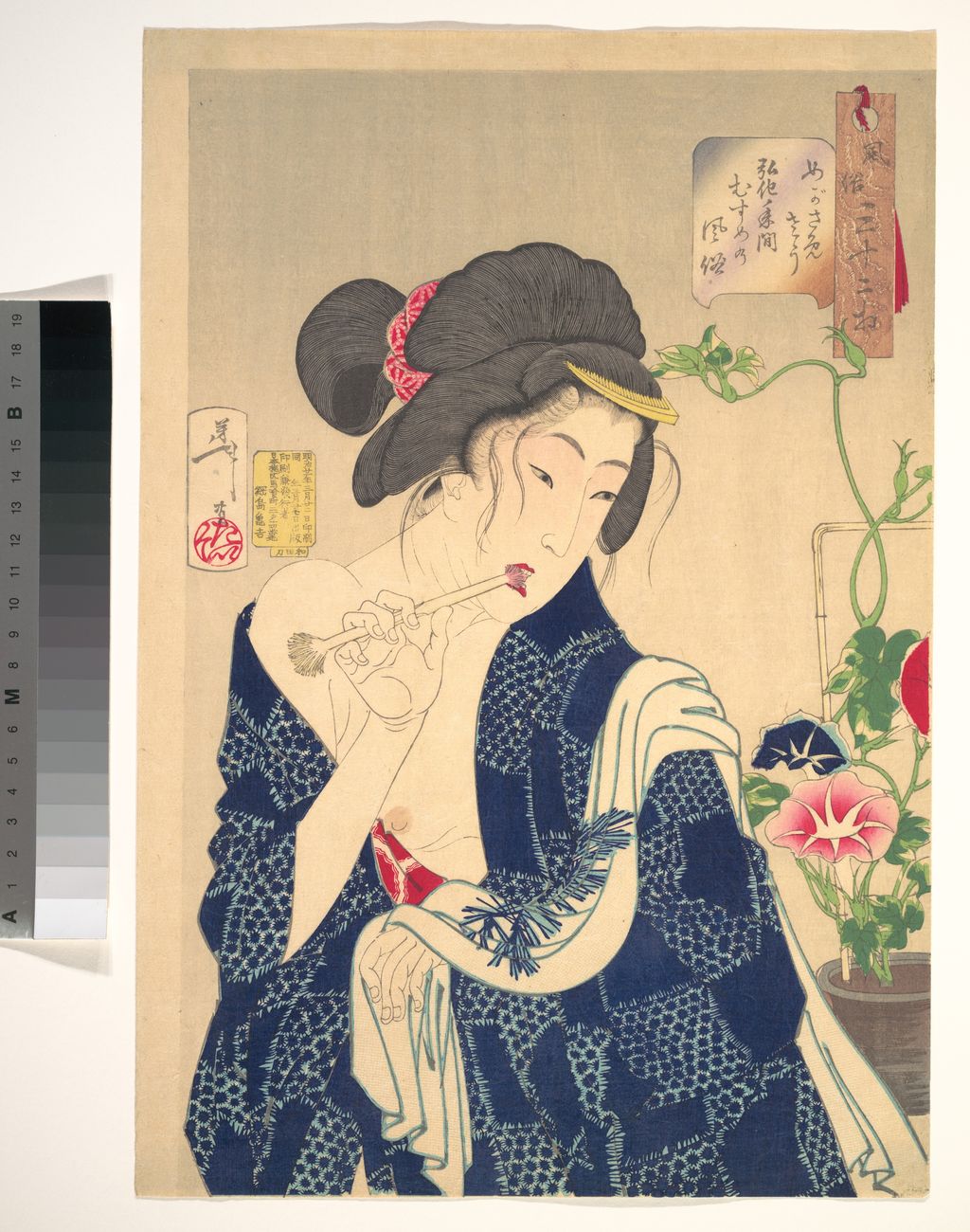
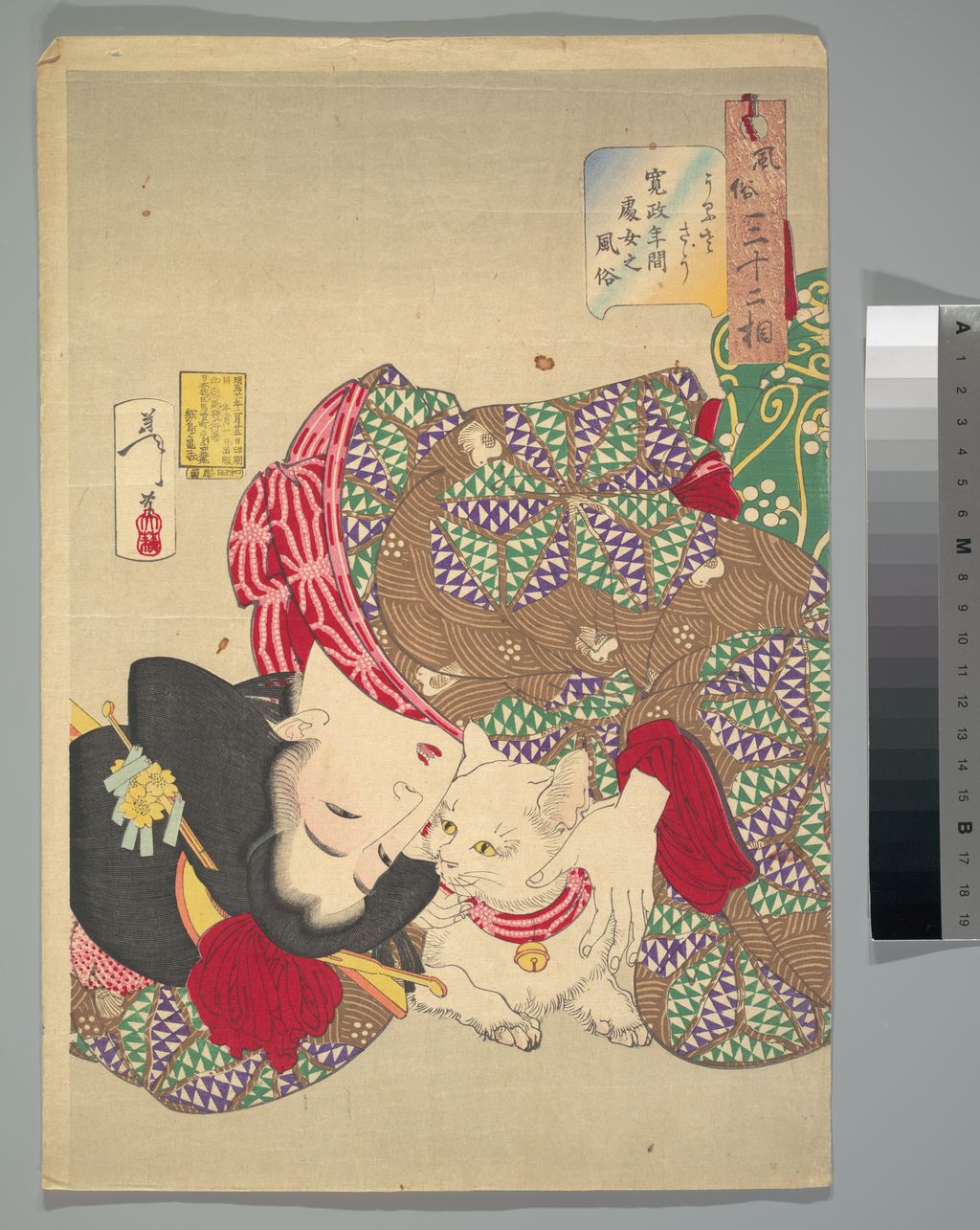
The Met's Waking Up: A Girl of the Kōka Era dates to 1888. Her open mouth and hand gesture depict an interval rather than a formal, static portrait. The Ōta Memorial Museum's Japanese series list gives the original design title めがさめさう. Its historical spelling is evidence of the print's language and should be preserved on a Japanese page. Another Met print of 1888, Teasing the Cat, displays everyday intimacy, but should not be inserted into Thirty-Two Aspects without a supporting series attribution from its own record. Such distinctions are small editorial choices that prevent a biography from turning catalogue neighbours into a false set. [18] [19] [6]
A late career in several directions
The 1880s were not a single “moon period.” An 1885 Met triptych, Fudō Myōō Threatening a Novice, demonstrates continuing interest in crowded religious or legendary drama. The Fitzwilliam Museum treats One Hundred Aspects of the Moon as a long project issued from 1885 to 1892 and names Akiyama Buemon as publisher. The NDL describes its range of Japanese and Chinese historical and literary subjects. One recurring moon provides a frame, but the hundred images do not tell a single continuous story. Their design and printing dates must be established sheet by sheet, especially because the Ōta Memorial Museum gives 1885–91 as a shorter overall range while its later work list includes a sheet published in April 1892. [20] [21] [22] [23]
The Met's February 1886 Moon in the Flame shows how a single sheet can connect an ordinary city occupation with a grand series title. A fireman holding a brigade standard appears before flame and smoke, while the moon's pale disc steadies the composition. Fitzwilliam's account of its own impression identifies technical and occupational details, including the block-cutter Yamamoto Shinji and spattered pigment. The illustration here reproduces the Met's separate impression. The two records can inform the biography, but details about one surviving impression must not be silently transferred to another. [3] [24]
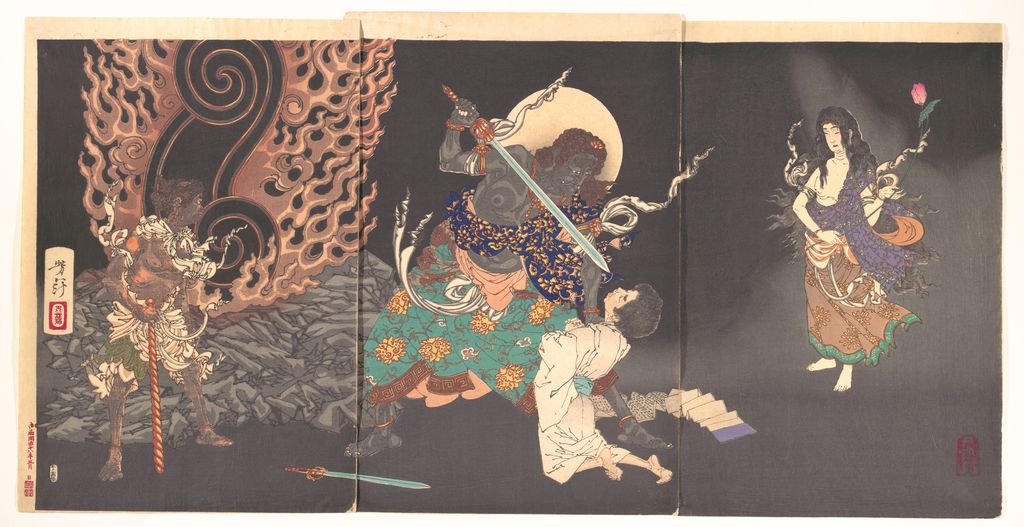
The other major late supernatural project, New Forms of the Thirty-Six Ghosts (新形三十六怪撰), came out under publisher Sasaki Toyokichi in 1889–92. The Fitzwilliam Museum explains that kai in the title encompasses uncanny beings and events beyond ghosts in the narrow sense. It also says that pupils helped with later designs and that three sheets appeared after Yoshitoshi's death. For a biography, this is a reminder that “Yoshitoshi's late prints” is a category with internal differences. A posthumously issued sheet has a publication history partly separate from his life, and the exact degree of his involvement should be resolved for an individual work before making it a centrepiece. [25]
Reading a life through surviving sheets
Prints offer unusually abundant evidence for Yoshitoshi's professional activity, but they are not a diary. A date printed on a sheet may identify its issue rather than the first moment Yoshitoshi drew it. A museum's year may describe its particular impression or reflect the best date its cataloguers could assign. A title may be supplied or translated long after the sheet appeared. The Takanawa records show why those distinctions matter: two Japanese institutions record 1871 while the Met dates its three-sheet object 1872. The difference does not make any of the objects disposable evidence. It asks the biographer to keep the relationship between design, publisher, surviving impression and catalogue statement visible. [9] [10] [11]
The appearance of a print can also shift across copies. Fitzwilliam's account of the late printing techniques describes effects dependent on pressure, paper and the application of pigment. A gradated sky or gloss-black surface is therefore evidence of skilled printing as well as design. When one museum identifies a spattered material on its Moon in the Flame impression, that observation must be checked against the Met image used on this site before a caption says “the Met sheet contains” it. A catalogue can identify the design across collections; it does not turn all impressions into one physical object. This matters to biography because it prevents a story about Yoshitoshi's personal brushwork from swallowing the contribution of cutters and printers. [16] [24] [3]
The fit between an individual image and a serial title needs similar attention. An hour of the day, a woman's “aspect,” a moon or an uncanny encounter could be advertised as a recognisable series while each sheet asked for its own scene. The series title helps buyers find a continuing project and gives later museums a way to assemble sets. It can also conceal differences among designs or the dates at which they reached an audience. Kanagawa Prefectural Museum's exact count for Thirty-Two Aspects includes a list sheet in addition to the 32 portraits. A gallery labelled simply “33 women” would be wrong. The Fitzwilliam's warning about posthumous sheets in New Forms poses an even more direct question: what does the signature of a late series tell us when publication carried on after the artist died? [17] [25]
Yoshitoshi's art names supply a final check on easy life stories. The NDL identifies several names, and individual catalogues may index the same artist in more than one way. A change of signature can be meaningful, but it needs a dated group of objects before we describe it as a personal rebirth. Illness, recovery and late success make a compelling narrative arc; the surviving source record here supports only parts of it. The life should not be made tidier than the evidence. A reader can still see a remarkable career in the dated images: early experiments with new machines, collaborative dramatic projects, visual news, intimate portraits and long literary series. The gaps in personal testimony make the objects more important, not less. [1] [2]
The person and the workshop
What can we say of Yoshitoshi away from the prints? Far less than a dramatic retelling might suggest. His various names are documented, and museum histories report a period of illness. Fitzwilliam records his association with the actor Danjūrō IX's preservation circle; the NDL identifies pupils Yamanaka Kodō and Mizuno Toshikata. These are meaningful relationships, but the checked public summaries do not give a diary-like account of daily studio life or a date for every personal connection. Rather than fill those gaps with inventions, this biography follows dated objects and states where its sources stop. [1] [2] [4]
The pupils matter especially at the end of the story. Ōta Memorial Museum reports that newly found preparatory drawings for late triptychs had belonged to Mizuno Toshikata. Such drawings permit more than an anecdote about a famous apprentice: they make the passage of working materials between generations visible. They also document choices in Yoshitoshi's own preparation before the carved block. The museum's exhibition account offers a rare glimpse of how working materials were preserved after the artist's death. [6]
Toshikata's later work and the posthumous issue of some ghost-series prints keep this biography from ending with the misleading phrase “the last ukiyo-e artist.” Print publishing continued. So did the study and adaptation of its techniques. Yoshitoshi's particular achievement was to turn inherited, collaborative woodblock practice towards the crises, entertainments and memories of his own decades. The early warrior beside a steamship, the railway crowd, the illustrated news, the woman at noon and the fireman beneath the moon each set a different task for the viewer. Their chronological sequence shows a career, not an inevitable march from “old” imagery to “new.” [1] [2] [25]
Yoshitoshi died on 9 June 1892. The art did not end with that date, and neither did the publication of every design associated with him. His biography needs that final distinction between a person's lifetime and the life of printed objects. It lets the reader appreciate both the artist's choices and the work of publishers, pupils, cutters and printers who shaped the sheets through which those choices survive. [1] [25]
Frequently Asked Questions
The National Diet Library lists 吉岡金三郎, Yoshioka Kinzaburō, as his personal name and 米次郎, Yonejirō, as a familiar name. It also lists several art names. The sequence and use of each signature should be checked on individual works. [1]
The NDL says around 1850. It is safer to retain “around” than turn this into a precise date for a formal contract or first lesson. [1]
No. The 1866 Twenty-Eight Famous Murders collaboration is prominent, but dated works also show trains, illustrated news, women at different hours, historical drama, deities, animals and the moon. The Ōta Memorial Museum's retrospective deliberately presented this breadth. [6] [5] [14]
That familiar description conveys his late place in a major nineteenth-century print tradition, but other artists and print workshops continued after 1892. His pupils and the posthumous issue of some ghost-series sheets make the literal claim untenable. [1] [25]
No. The Fitzwilliam Museum says three sheets in the ghost series were issued after he died, with pupils involved in later designs. Publication after a death should not be confused with the artist personally working after it. Each sheet needs its own production history. [25]
Discussion
Compare identified prints from different parts of Yoshitoshi’s career, then share what you notice.
Reader Insights
What changes when two museums hold different impressions of one design?
How does the Takanawa railway move your eye across the triptych?
Which part of Moon in the Flame first attracts your eye, and why?
Join the Conversation
Share a documented example or a reliable source below, keeping observation separate from inference.
References
- National Diet Library, “月岡芳年” (portrait authority). Dates, names, apprenticeship, collaboration, newspapers and pupils.
- Fitzwilliam Museum, “About Tsukioka Yoshitoshi”. Institutional account of the career and its historical setting.
- The Met, *Moon in the Flame*, accession 2007.49.310. Exact object and date.
- British Museum, Yoshitoshi artist record. Early work, 1865 curtain, illness and newspaper work. Page access was restricted in this research environment; details were checked against the museum search excerpt and corroborating sources where possible.
- The Met, *Fifty-Three Stations of Suehiro* steamship design, accession JP3178.
- Ōta Memorial Museum of Art, 2012 Yoshitoshi retrospective. Career scope, historical subjects and preparatory drawings.
- The Met, *Banzuiin Chōbei*, accession 2007.49.308.
- The Met, *Plum Blossoms in the Forest of Ikuta*, accession 2005.348a–c.
- The Met, Takanawa railway triptych, accession 2007.49.260a–c.
- National Diet Library, catalogue for 東京名勝高輪蒸気車鉄道之全図. Japanese title and 1871 publication context.
- Tokyo Museum Collection, Takanawa railway object. September 1871 date for its record.
- British Museum, *Samurai* exhibition large-print guide. 1877 Yoshitoshi conflict imagery.
- The Met, 1877 police-superintendent party, accession JP3387.
- The Met, noon from *Twenty-Four Hours at Shinbashi and Yanagibashi*, accession 2007.49.316.
- Fitzwilliam Museum, preparatory drawing for the one-o'clock design. Different hour from the Met noon sheet.
- Fitzwilliam Museum, “Techniques & Special Effects”. Printing methods and impression variation.
- Kanagawa Prefectural Museum of Cultural History, 風俗三十二相. Publication span and 32-plus-list sheet count.
- The Met, *Waking Up: A Girl of the Kōka Era*, accession 2005.349.
- The Met, *Teasing the Cat*, accession JP3687b.
- The Met, *Fudō Myōō Threatening a Novice*, accession 2005.350a–c.
- Fitzwilliam Museum, *One Hundred Aspects of the Moon* series. Publisher and broad 1885–92 range.
- National Diet Library Image Bank, 月百姿. Series scope and subjects.
- Ōta Memorial Museum, *One Hundred Aspects of the Moon* exhibition; work list. Catalogue range and 1892 issue example.
- Fitzwilliam Museum, *Moon and Smoke*. A different impression of the fireman design with technical notes.
- Fitzwilliam Museum, *New Forms of the Thirty-Six Ghosts*. Publisher, date range, pupils and posthumous issue.
- Yamanashi Prefectural Museum of Art, Yoshitoshi artist record. Alternative name account and 1885 ranking.
- Kitakyushu City Museum of Art, Yoshitoshi artist record. Alternative name account and dated newspaper objects.
- Ōta Memorial Museum, Yoshiiku exhibition. Fourteen designs by each collaborator in the 1866 series.