


 by Tom Gurney
Tom Gurney BSc (Hons) is an art history expert with over 20 years experience
Published on June 19, 2020 / Updated on September 25, 2026
Email: tomgurney1@gmail.com / Phone: +44 7429 011000
A hundred stories held together by the moon
One Hundred Aspects of the Moon (月百姿, Tsuki hyakushi) is among the most ambitious projects of Tsukioka Yoshitoshi's last years. The hundred colour woodblock designs appeared across 1885–92 under publisher Akiyama Buemon. Their subjects range from Japanese and Chinese historical figures to poetry, theatre, legends, everyday work and supernatural encounters. A reader expecting a hundred landscape views will find something more varied: sometimes the moon is large and unmistakable, sometimes it is partly hidden, and sometimes it seems less important than a figure's anticipation of it. The moon connects separate stories without making them a single narrative. [1] [2] [3]
Explore Yoshitoshi’s works · Read Yoshitoshi’s biography
Contents
The series belongs to the Meiji period, but many scenes recall an older literary and visual world. That coexistence is part of its appeal. Yoshitoshi did not simply preserve the past on paper: he made a fresh commercial series for viewers who recognised old stories while living amid new publishing and urban conditions. The Fitzwilliam Museum describes buyers waiting before dawn for new designs, and calls it the artist's best-known and most successful print series. That account helps explain its contemporary reach, but the present article follows what can be established from surviving objects and museum catalogues rather than turning demand into an undocumented sales figure. [3] [4]
The moon series at a glance
- Designs100 prints; index separate
- Publication1885–1892
- PublisherAkiyama Buemon
- SubjectsHistory, literature, legend, theatre and city life
The ten NDL designs selected for close looking resist a simple account of the artist gradually moving from action to quiet contemplation. The 1885 group includes an almost stationary woman, a figure on horseback, a boat-bound commander and a seated warrior. In 1888 a pair of figures disappear into reeds while a bridge scene cuts a forceful diagonal through open paper. The 1889 Red Cliff Moon grants the landscape almost everything, but its contemporary Ishiyama still centres a named writer. The 1890 Yokobue returns to a single person and a landscape that seems to answer her loss. Differences of subject and pictorial tension coexist within years, so the dates should be a reading aid rather than a tidy story of stylistic replacement. [1] [7]
How the series was made and issued
A hundred is an artistic number and a publishing commitment. The complete NDL album record dates the project 1885–92 and names Akiyama Buemon as publisher. The Ōta Memorial Museum also identifies him as the publisher of Yoshitoshi's celebrated series. A woodblock print moved from an artist's design through block cutting and printing before a buyer encountered the sheet. A publisher financed and circulated the work. The impressive variety of One Hundred Aspects depended on that shared system, not only on one person's inspiration. [2] [6]
The date beside a print needs a verb. A catalogue may give a month when a design was reported to the authorities (御届), a day when it was printed, another day when it was issued, or a broad year for an individual museum object. Ōta's 2024 checklist records Gojō Bridge Moon as printed on 5 April 1888 and published on 13 April. Moon at Ishiyama was printed on 10 October 1889 and issued later in that month. Several early sheets have only a notification month: Takao and Cao Cao in October 1885, the Shi Jin design in November and the Saitō Toshimitsu scout in December. These are useful fixed points, but a notification is not proof of the date on which each surviving copy came off the blocks. [7]
Nor should the last year of the series be confused with the last year in which the artist drew. Some catalogues summarise the project as 1885–91, while the NDL and Fitzwilliam give 1885–92. Ōta's checklist includes sheets printed earlier but issued in April 1892. Yoshitoshi died in June of that year. A final publication date may therefore tell us about the publisher's timetable, not the day the artist last held a brush. The safest account names the kind of date whenever the underlying record makes it clear. [2] [3] [7] [8]
The National Diet Library has a bibliographic record for an album containing 100 sheets. That album is a surviving grouping, not evidence that all buyers originally purchased one bound, complete book. The Image Bank separately displays scans of individual prints with their own persistent identifiers. Distinguishing an album, a design and a particular scanned impression matters before any comparison of colour, margins or technique. It also prevents an attractive online montage from becoming a false catalogue of exactly what a nineteenth-century customer saw. [1] [2]
The hundred printed scenes were accompanied by other paper. Ōta's earlier complete-series checklist lists a two-sheet 《月百姿もくろく》, or index, dated May 1892. Its exhibition list then names a Yoshitoshi portrait by Kanaki Toshikage issued in June. Neither item should quietly be counted as one of the hundred scenes. The index is particularly revealing: it suggests that readers could encounter the designs as a named, ordered body of work, even though the images had appeared over years. An article can offer a concise chronological map without asserting that all one hundred pictures arrived together. [16]
Four ways to enter the hundred scenes
The Ōta Memorial Museum organised an exhibition around four broad groups: women; gods, spirits and supernatural beings; heroic men; and scenes of taste, nostalgia or pathos. These are useful reading routes, not four compartments into which every print fits neatly. A warrior may be a literary character. A woman may be linked to a poem as well as to a named place. A ghost can make a scene about memory. Yoshitoshi drew on the flexibility of the moon to move among such registers. Its position can set a time of night, give a subject a motive to look upward, or make the empty part of a composition feel occupied. [4] [1]
This is why a guide to the series should do more than rank famous pictures or reproduce one hundred small thumbnails. A title, a person, a date and the moon's position provide separate clues. The ten identified NDL prints used for this page span 1885 to 1890; they are a selected route through a much larger project. A reader can follow their differences, then consult the museum's full checklist and the NDL collection for further designs. [1] [7]
The wording of a title matters as much as the appearance of the celestial body. Some titles give a place and a named figure, as in Hōrin Temple Moon: Yokobue or Moon over the Moor: Yasumasa. Others are already pieces of writing: Takao's verse addresses someone who may be near Komagata, and Red Cliff Moon invokes a Chinese literary place. A title can therefore point to what is absent from the sheet: a person longed for, a poem being remembered or a larger story whose critical moment sits outside the frame. This is an unusually productive relationship between image and text. The NDL gallery preserves the Japanese strings; Ōta's English checklist offers useful translations, but an English line alone can conceal a pun or a change in historical spelling. Both belong in detailed captions. [1] [19]
The exhibition themes also help prevent a false opposition between “traditional” stories and the Meiji city. The Fitzwilliam places contemporary Tokyo among the series' subjects, while its Moon and Smoke print shows a fire brigade worker as an everyday hero. A portrait of Takao may draw on an older poem but was made as a late nineteenth-century sheet. Yūgao belongs to an eleventh-century novel, yet the printed surface, cutter's decisions and commercial issue date belong to 1886. The scene's historical setting and the object's production moment must be held in view together. That principle allows readers to appreciate the historical imagination of the series without calling every pictured place an eyewitness record of the past. [3] [11] [14]
Women, poetry and a scene beyond the sheet
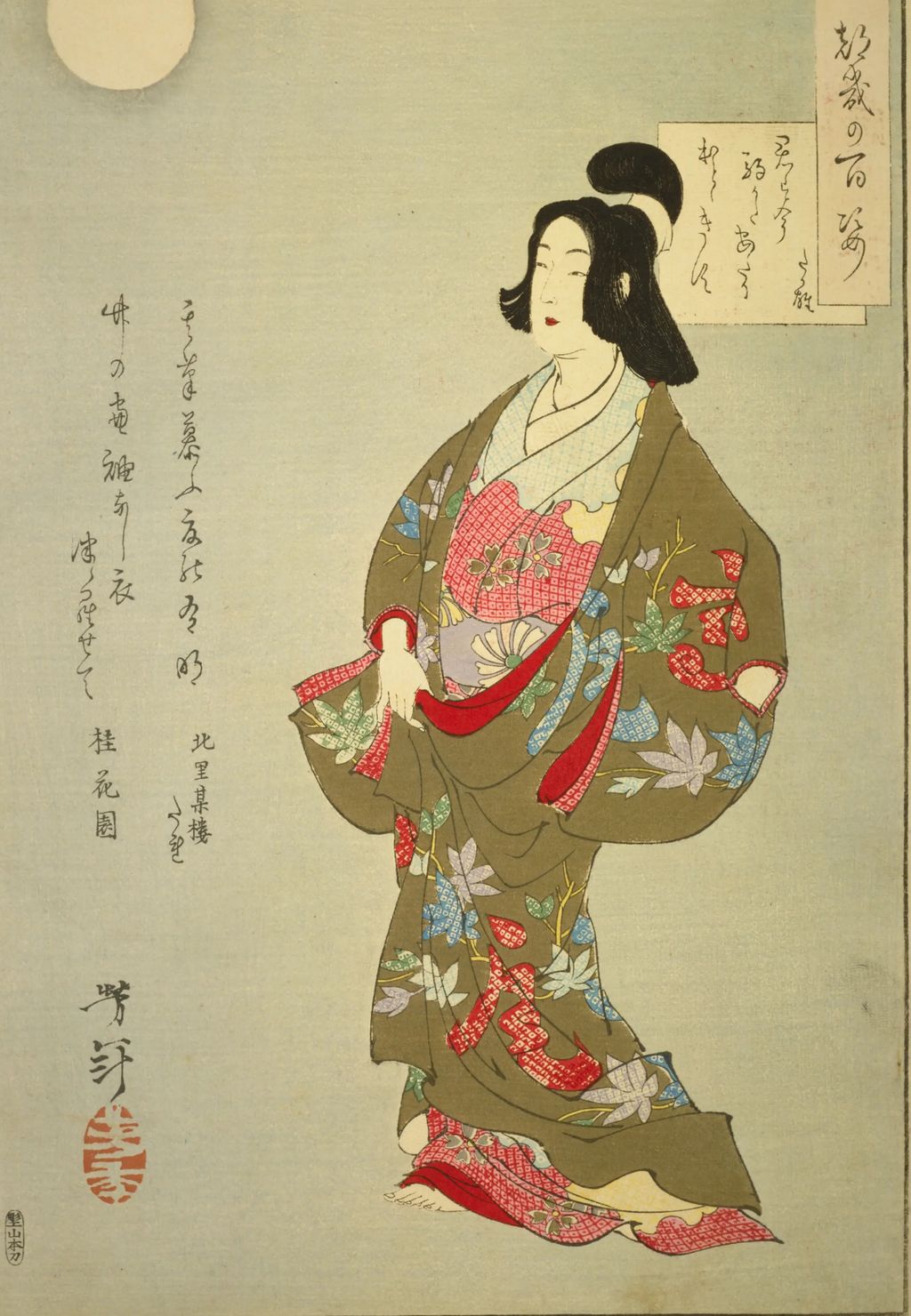
In 《君は今駒かたあたりほとゝきす たか雄》, the NDL scan shows a standing woman beneath an open area of pale sky and moon. Her patterned robe and poised figure hold the eye, while the writing at the top and along the side makes the image more than a portrait. The poem in the title and the name Takao draw the viewer towards a voice and a place beyond the paper. No second figure or landscape panorama supplies a neat ending. The visual pause is the subject: a person is present, but the words suggest another time or location being imagined. Ōta's checklist records an October 1885 notification for the design. The NDL gallery writes 駒かた, while the Ōta checklist writes 駒がた; retain the source's spelling in each citation rather than silently treating one as an error. [1] [7]
Moon at Ishiyama makes a different kind of literary connection. The NDL print, PID 1306365, places a figure by a temple building against distant hills and a small moon. The Met identifies the scene with Murasaki Shikibu at Ishiyamadera Temple, traditionally linked to the making of The Tale of Genji. Its approximately 1892 hanging scroll is based on this series print, yet remains a separate painting. In the museum's reading, Yoshitoshi chose the rocks of Ishiyamadera rather than the familiar vista of Lake Biwa. The temple view should not be mistaken for a faithful photograph of the main hall's outlook: the Met explicitly notes that the depicted craggy vantage is not available there. [9] [1]
Seen as a print, Ishiyama makes literature a matter of place, light and anticipation. The writer's figure is partially framed by the architecture, with moon and hills beyond. Viewers who know Murasaki's association with the novel can supply a story that the print does not narrate page by page. A side-by-side module with the Met painting would show how Yoshitoshi reworked a print subject in another medium, provided the Met's exact public-domain source file is retained and the two objects are captioned separately. The painting is not a 101st sheet of the print series. Ōta records the print as printed on 10 October 1889 and issued that October; the painting has a museum date of approximately 1892. [7] [9]
The Ōta museum's English 2024 checklist gives the Ishiyama design a broad 1888 date, whereas its Japanese 2017 and 2024 lists give 10 October 1889 as the printing date. The detailed Japanese records are used here, but the discrepancy should remain in the editorial evidence rather than vanish from the production notes. The painting's approximate 1892 date is a separate museum judgement and cannot settle the print's issue history. [7] [16] [19] [9]
Warriors, action and what the moon witnesses
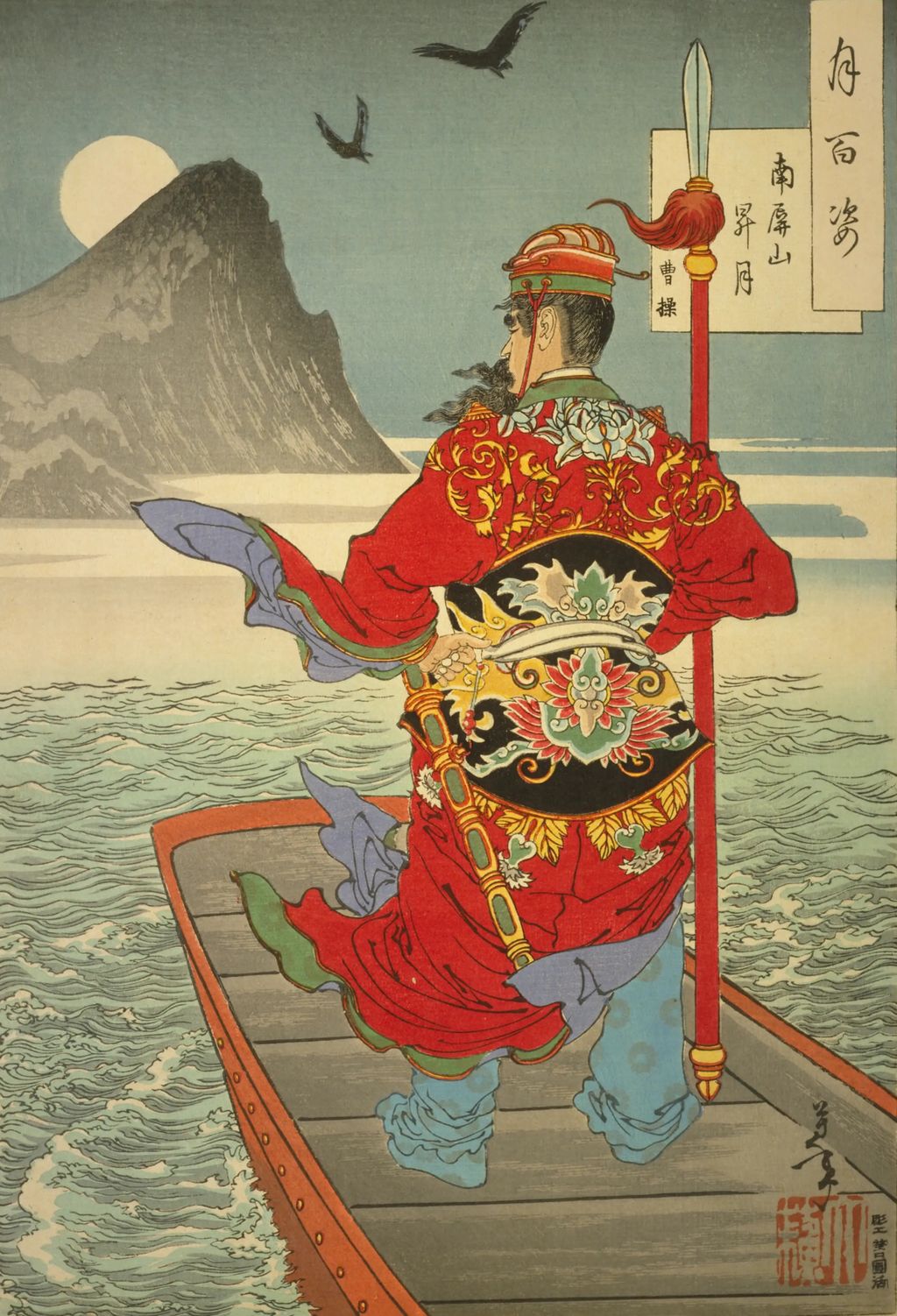
Several of the early sheets set powerful figures against a broad, quiet moon. The NDL's Cao Cao and the Moon Rising over Mount Nanping (《南屏山昇月 曹操》), PID 1306349, presents a red-robed figure on a boat. A round moon stands above a far shore. Without claiming that the image documents a real journey, we can see how its dramatic power depends on opposed scales: figure and deck in the foreground, water and mountain farther out, the luminous disc above both. The title brings a Chinese historical and literary subject into the series, matching the NDL's account that Yoshitoshi sought stories beyond Japan. The Ōta checklist gives an October 1885 notification, one of the earliest dated entries in this selected group. [1] [7]
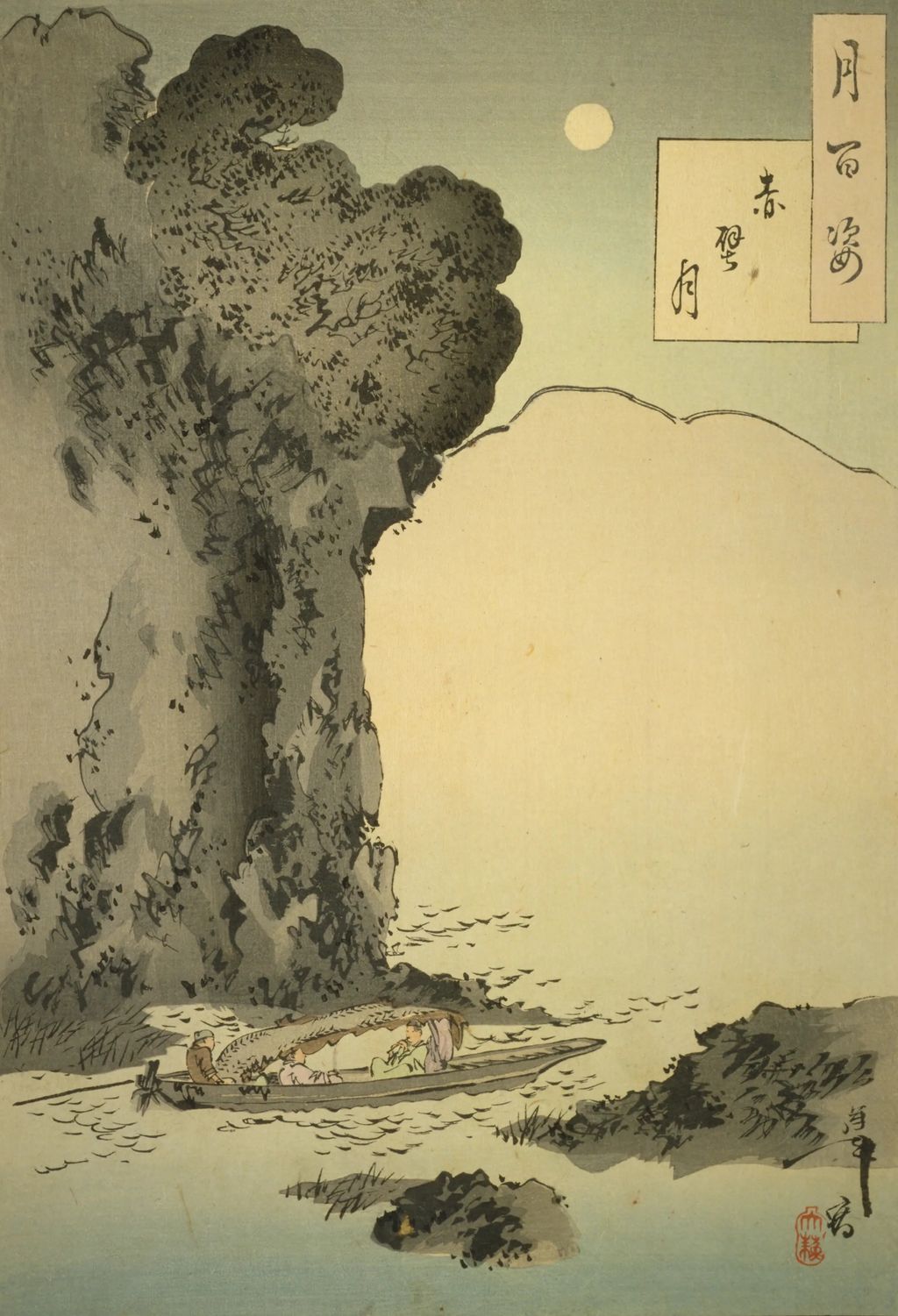
Eight or nine years of a series also permit Yoshitoshi to make very different pictorial answers to related Chinese material. The NDL's 《赤壁月》, Moon above the Red Cliffs, is dated by Ōta as printed and published in 1889. Unlike the vivid foreground figure in Cao Cao, this sheet gives most of its surface to a river, cliff and sky. A small boat travels near the bottom, with the moon far above the dark rock. The British Museum's Chinese-language account connects Red Cliff Moon with the writer Su Shi. The source does not require us to identify the precise words of his poem in the image. It is enough to observe how a known literary place is reduced to a wide area of air and water: the person's scale gives the landscape its magnitude. [1] [7] [17]
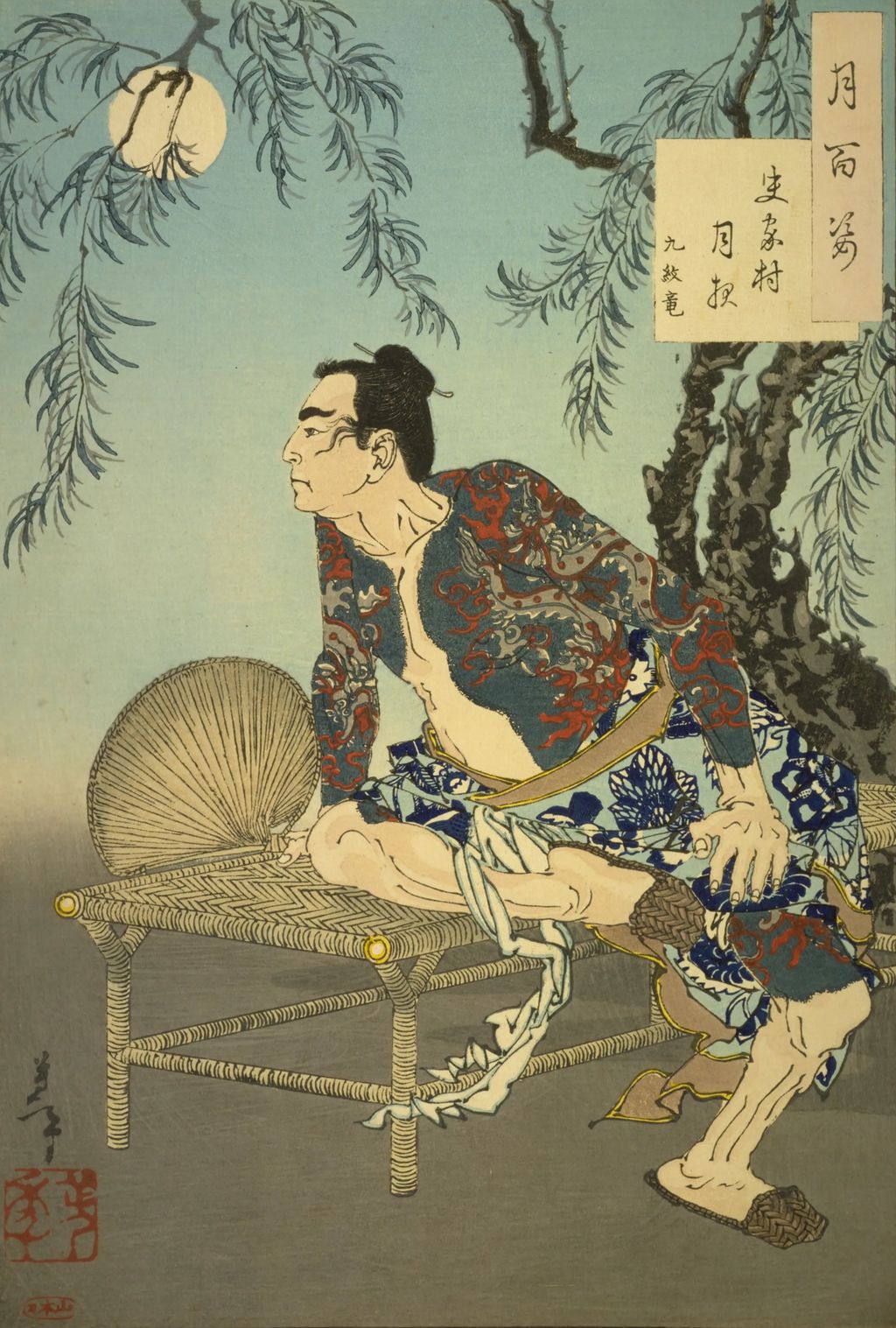
The Shi Jin print, 《史家村月夜 九紋竜》, is also from the 1885 group. In the NDL scan, a tattooed figure sits beside a low seat beneath foliage and a nearly full moon. His posture is alert rather than triumphant. The scene's stillness asks what has just happened or is about to happen, but the scan alone cannot prove a particular episode or dialogue. The exact Japanese title names Nine-Dragon Shi Jin, and the moonlit village setting belongs to that named story-world. Ōta dates the notification to November 1885. An institutional collection record in Japan independently uses the same title and artist attribution. Those anchors are enough for a close reading of what is visible without adding an unsupported synopsis from a modern retelling. [1] [7] [10]
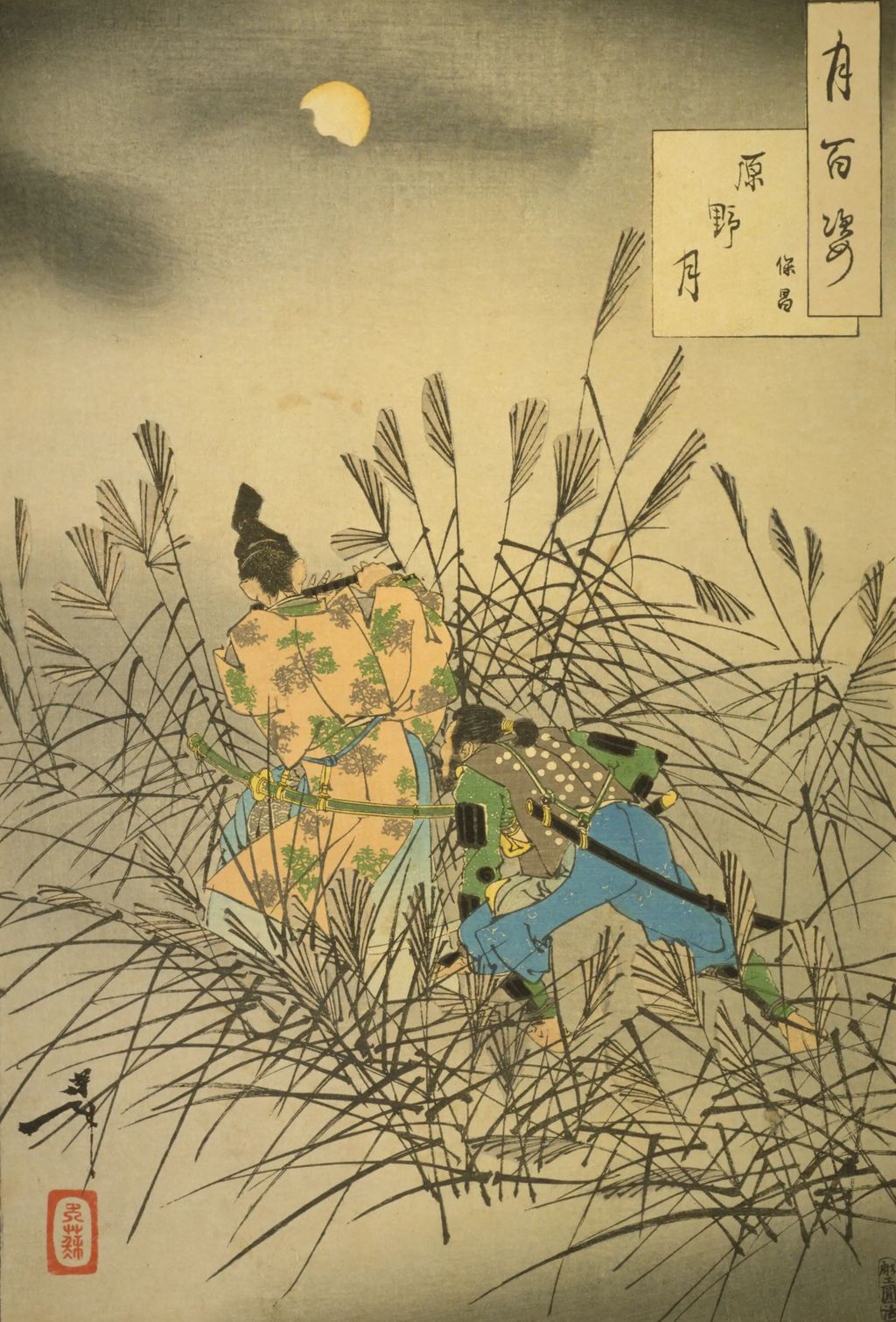
Moon over the Moor: Yasumasa finds suspense without a chase or a visible adversary. Two figures are almost swallowed by reeds beneath a partly veiled moon. One stands while the other is lower among the plants; the diagonal stems make movement through the space uncertain. The NDL title names Yasumasa, and the Smithsonian's National Museum of Asian Art catalogues another impression as a May 20, 1888 print with music and flute among its indexed subjects. Ōta's Japanese checklist calls 20 May the printing date, but does not provide a separate issue date. We should not add an imagined encounter to explain why the figures have paused. Instead, the viewer can follow the distance between moon, reeds and people, and notice how much of the scene is concealed. [1] [18] [7]
The adjacent 1885 Reconnaissance under the Moon: Saitō Toshimitsu is more overtly alert. The NDL scan shows an armoured rider turned against a pale ground, the horse's darker body marking a strong vertical near the centre. The moon is above the rider, but the title tells us to consider scouting rather than moon-viewing. Its mood grows from the possibility of unseen movement outside the sheet. Ōta's English checklist supplies “reconnaissance”, while its Japanese checklist and the NDL gallery both name Saitō Toshimitsu and record an 1885 date. Unlike a history illustration that narrates a battle's outcome, this image holds a single uncertain interval. It is a good comparison with Shi Jin's pause and Yasumasa's obscured figures: all three make waiting visually compelling in different ways. [1] [7] [19]
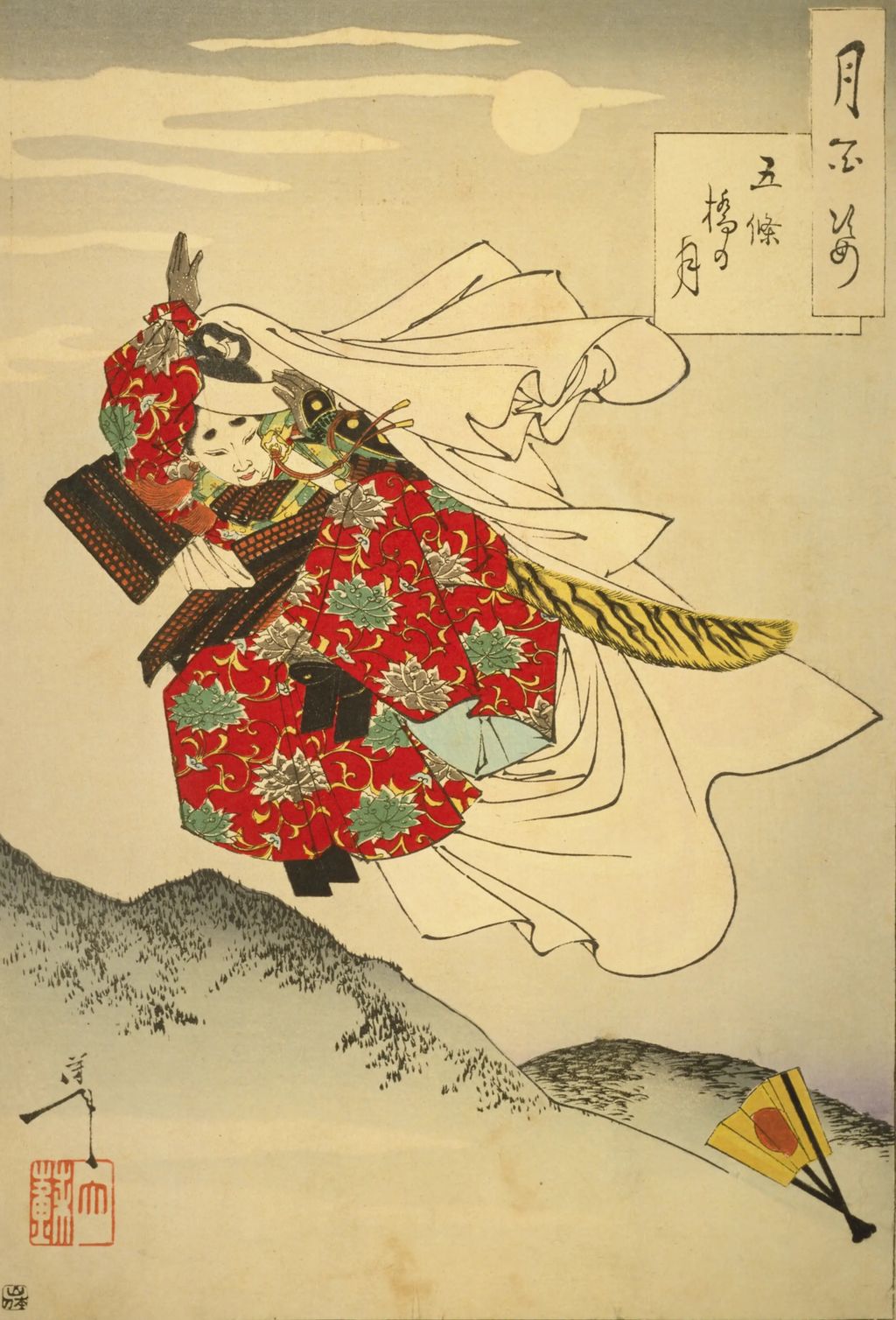
The Gojō Bridge Moon design from 1888 switches the energy from waiting to movement. Its NDL sheet shows a red-clad figure sweeping across the lower part of the paper, pale fabric and a long implement cutting through the open space. The moon is far above the action. Japanese audiences would know the bridge as the stage for stories of Ushiwakamaru and Benkei; the museum title itself, however, does not identify every person visible in this scan. A caption should therefore anchor the place, date and action while a future object-level source establishes precise figure labels. The printing and issue dates are unusually exact: 5 and 13 April 1888. [7] [1]
Longing, theatre and atmosphere
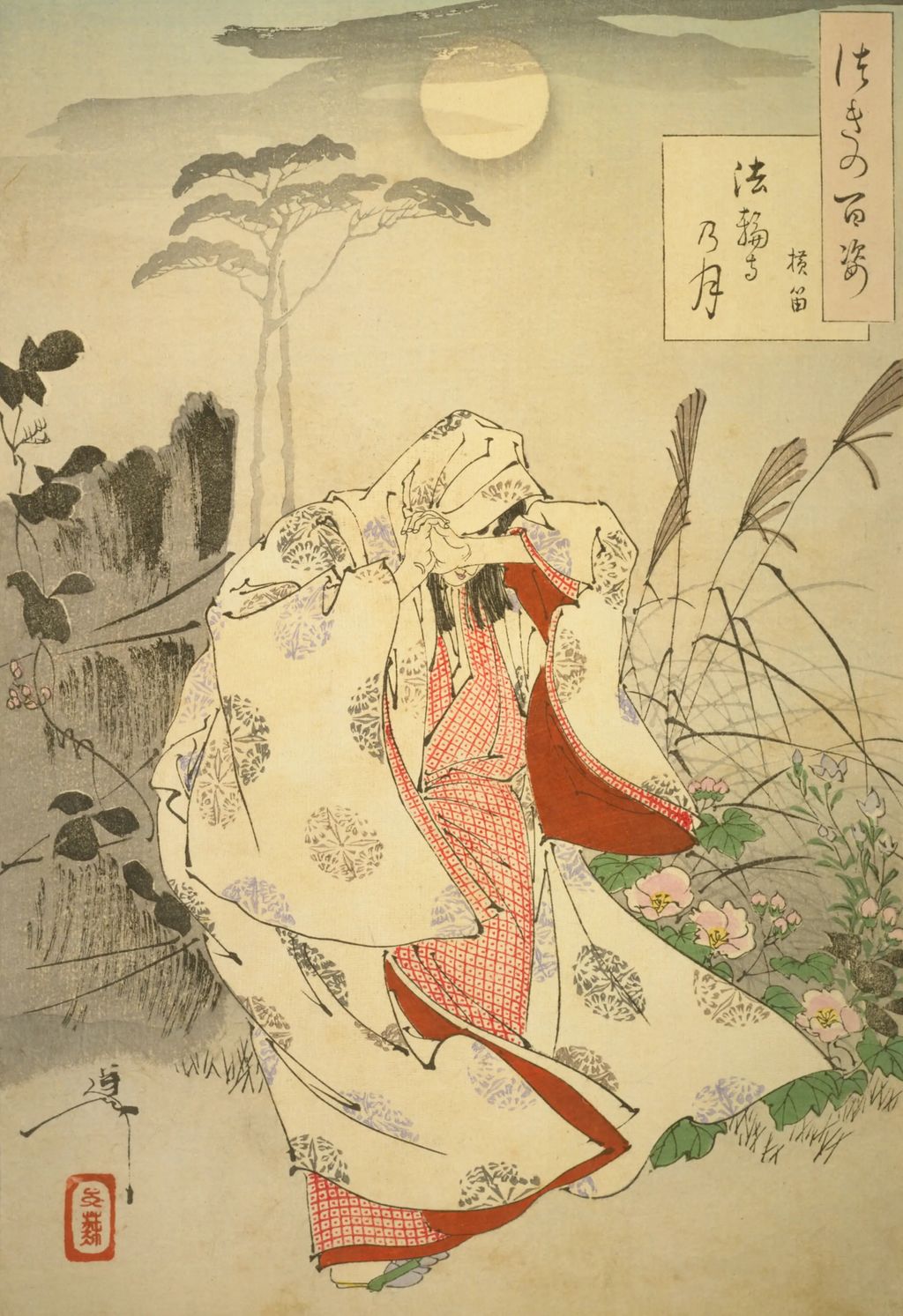
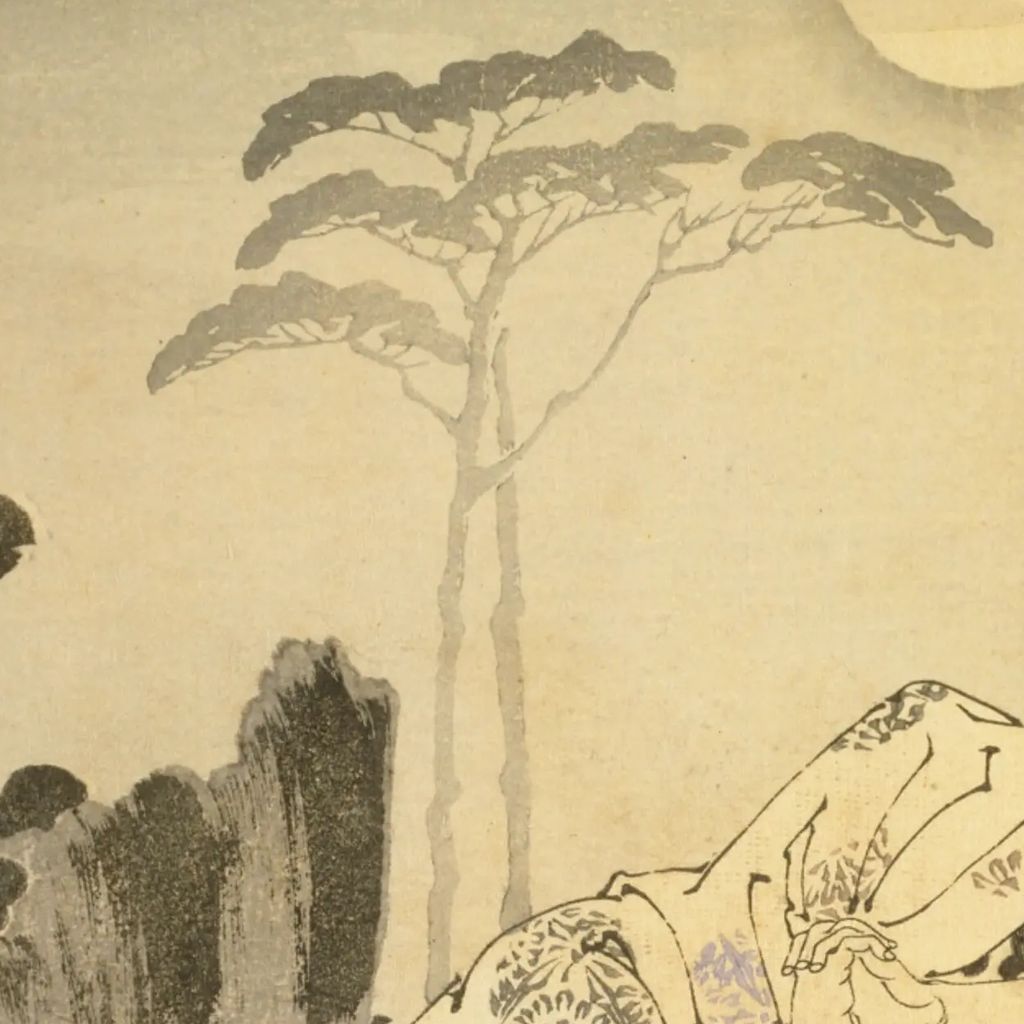
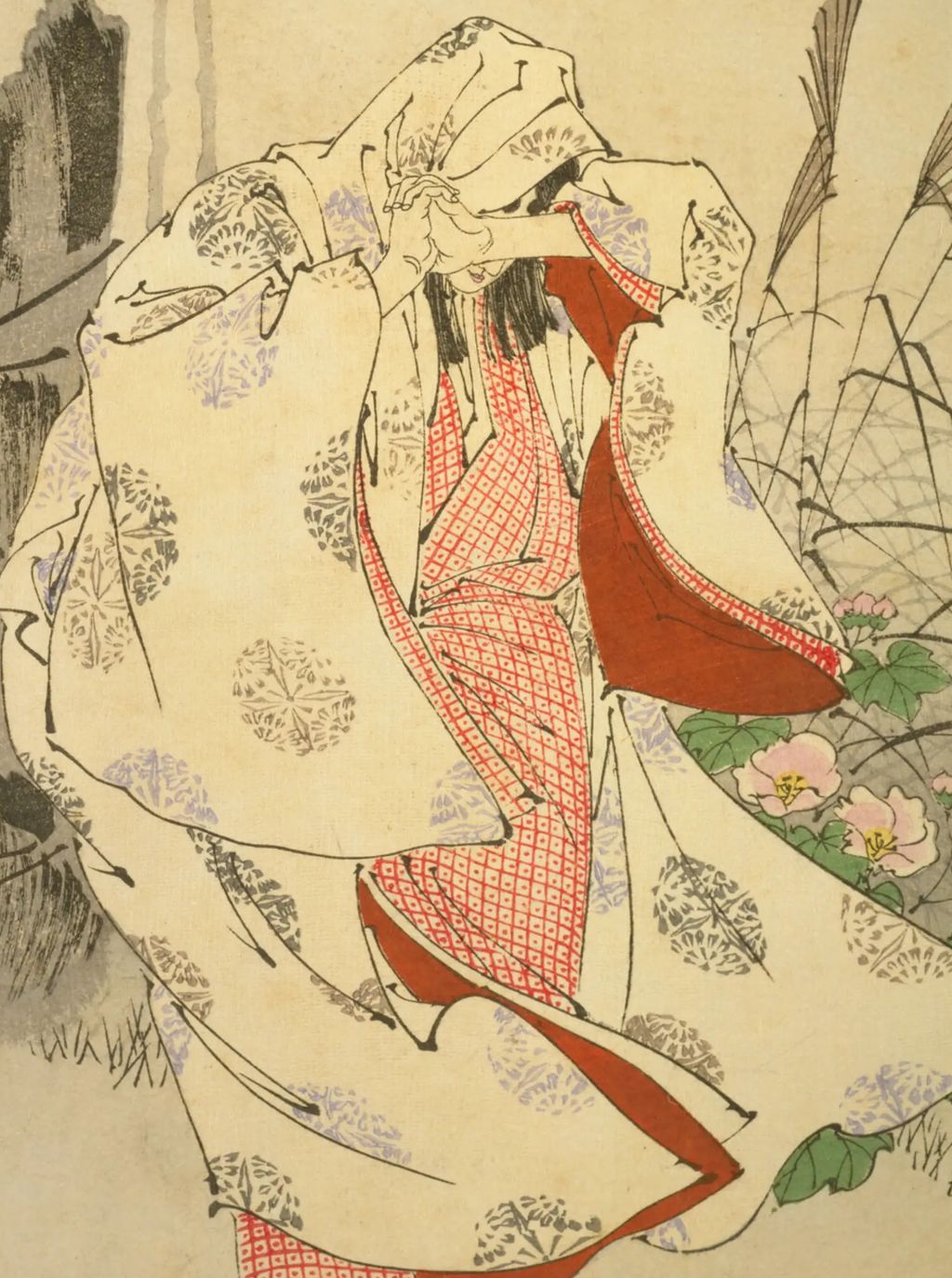
Yokobue's Hōrin Temple Moon is a strong choice for an annotated image because the details carry the emotion. The NDL print shows the woman turning away beneath a veiled moon; fence, trees and hillside organise the route she is leaving. The Fitzwilliam Museum's separate impression provides the story: Yokobue seeks the young guard who has become a monk, but he refuses to see her. Its curatorial reading connects the wind, fence, obscured moon and disappearing pines to separation. These are useful interpretive clues for the design, while its notes about blackened red lead, blind embossing and textile printing describe the Fitzwilliam impression and cannot be transferred automatically to the NDL scan. Both Fitzwilliam and Ōta place the design's first edition or printing on 20 December 1890. [5] [7]
Look closely at Yokobue
Open a numbered detail to examine a crop from the retained high-resolution source. The explanations also appear below.
Annotated image details
Moon Through Cloud
The upper cloud band crosses the disc of the moon.
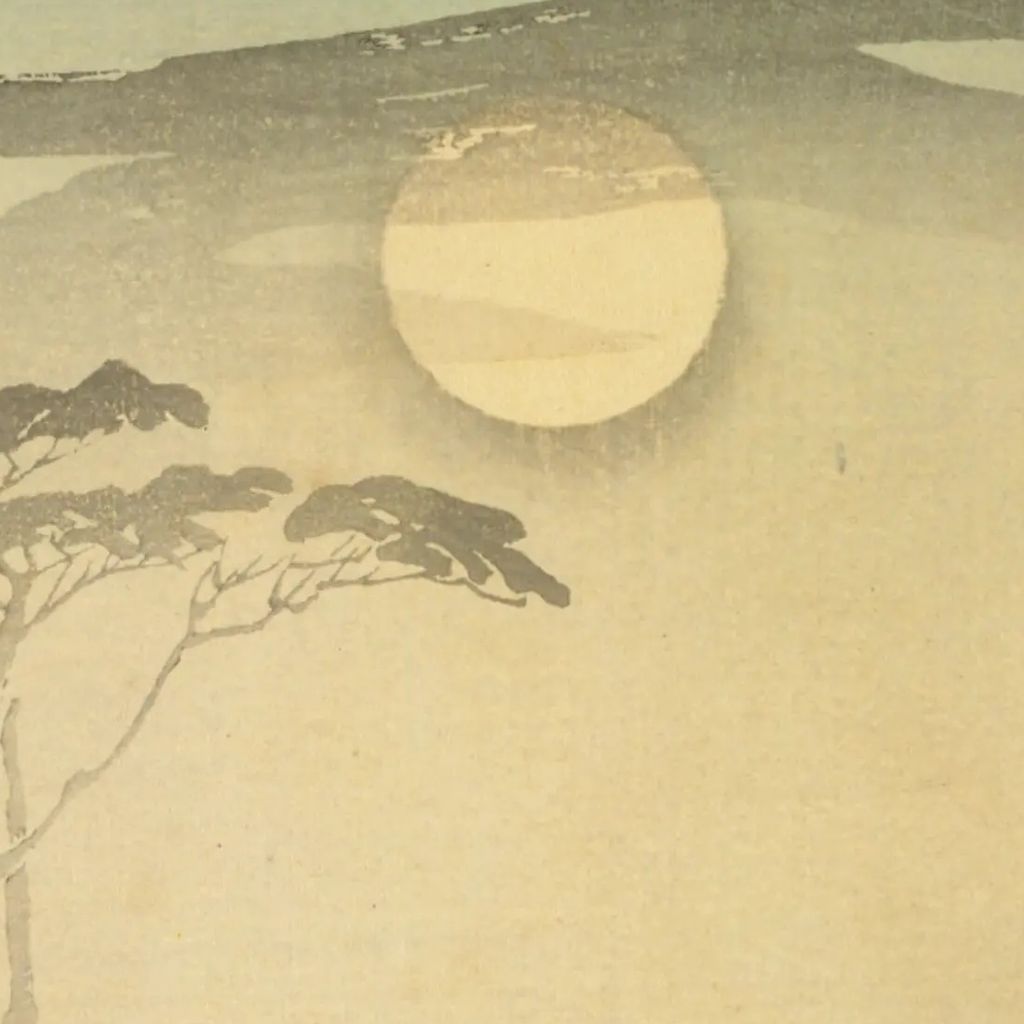
Pine And Distance
Pine and mist make depth between Yokobue and the moon.
Yokobue Cloak
The turned figure and moving cloak carry the moment of departure.
Flowers And Grass
Flowers and grasses occupy the path in front of the departing figure.
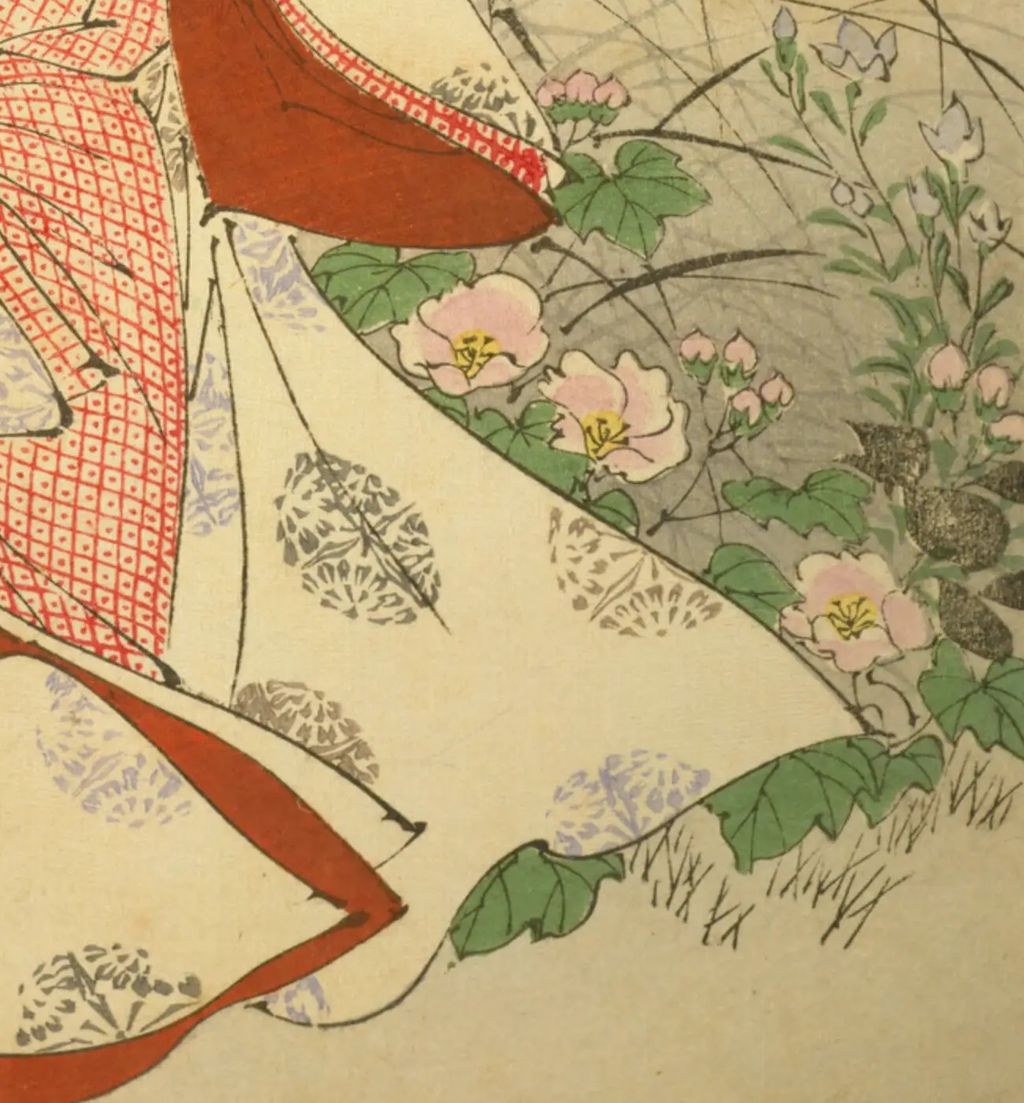
Yoshitoshi, Hōrin Temple Moon: Yokobue, National Diet Library PID 1306325. Editorial markers and crops.
Another 1890 print, Kazan-ji Moon, arranges a largely dark standing figure and smaller companions beneath an overhanging pine. The moon sits apart in the open sky. Its NDL title and the Ōta checklist establish the identification and 20 December 1890 print-and-publication date. A tree and steep diagonal landscape divide the scene; figures appear at different scales; the moon offers no literal speech, yet turns the space into a moment of attention. [1] [7]
The series extends beyond the prints pictured here. The Fitzwilliam's Yūgao Chapter gives a supernatural moment from The Tale of Genji: the moonlit ghost and the flower associated with her name. A separate Fitzwilliam Daimotsu Bay Moon shows Benkei confronting the invisible presence of slain warriors. Its curator notes that Kuniyoshi had rendered the ghosts visibly, whereas Yoshitoshi lets black clouds imply them. The same moon can belong to radically different storytelling methods: a veiled figure, an apparently empty sky or the charged surface of sea and cloud. [11] [12] [3]
A moon over contemporary life
Moon in the Flame or 《煙中月》 is a reminder that the series was not confined to vanished rulers and literary characters. The Met's public-domain impression, accession 2007.49.310, is dated February 1886. The Fitzwilliam describes a Tokyo firefighter, his brigade standard and a city where buildings of wood and paper made fires an everyday danger. In the print, the moon glows through smoke above a worker moving toward the flames. The subject is a present-day form of courage set beside legendary warriors elsewhere in the series. [13] [14]
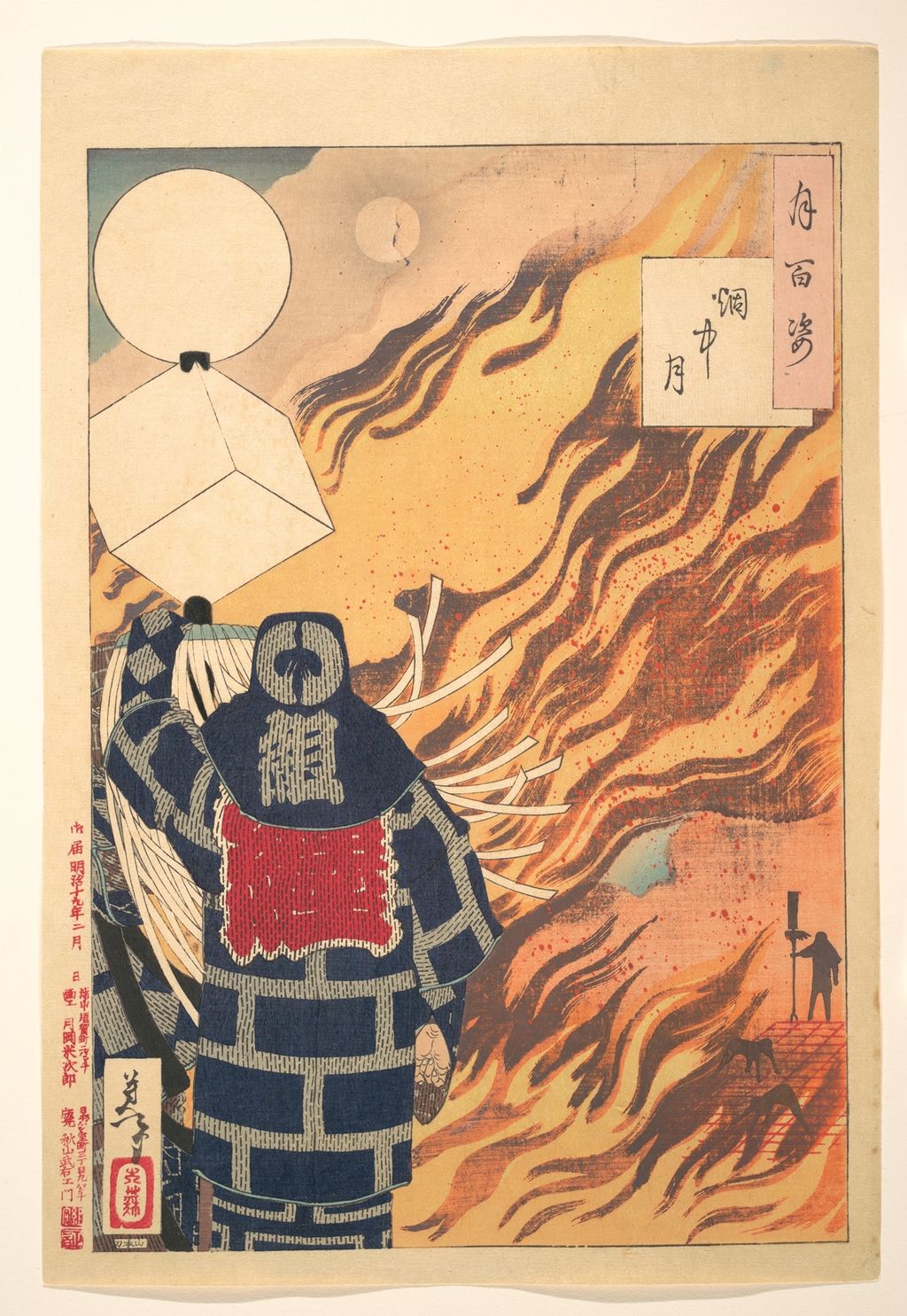
The Fitzwilliam names Yamamoto Shinji as cutter and describes spattered red lead and borderless shading in its own Moon and Smoke sheet. That information makes the printmaking team and changing material surface visible, but a web reproduction cannot establish whether the Met sheet retains precisely the same pigment state. When inspecting either file, the reader should ask whether a flat-looking area is originally plain, softly graded or changed by age. The print's story is partly told by colour and printing, not only by its figures and caption. [14]
Reading an impression, not just a design
Museum websites often offer two very different kinds of information. The series title and named subject describe a design, a composition that could be printed more than once. A holding museum's accession, paper, borders, colour and condition describe an object, an individual impression. Yoshitoshi's moon series makes this distinction especially important because it survives in collections across the world. A design can be compared between institutions, but a material feature recorded on one sheet is evidence about that sheet unless another is inspected. The NDL images used here are tied to their own persistent identifiers; the Fitzwilliam and Met examples are identified by their collection records. [1] [3] [13]
Some effects are almost impossible to judge from a reduced screen image. The Fitzwilliam records blind embossing and textile printing in its Yokobue sheet, and mica in its Benkei sheet. In person, raised paper, a fabric pattern or reflective mineral changes when the print is tilted. A JPEG can show the broad design and some colour relationships but may flatten those surfaces. Conversely, magnifying a high-resolution scan can reveal registration edges, carved lines and later damage that a small exhibition view hides. Both kinds of looking are useful, provided the viewer knows what the reproduction can show and what it cannot. [5] [12]
Surface evidence also changes how confidently we should use words such as “original”. An early printing may have a particular brilliance or texture, but a later impression can still be an authentic product of the blocks. A photographed copy may have been trimmed, mounted or affected by pigment change. The Fitzwilliam's note that the red lead in its Moon and Smoke has blackened is a concrete reminder that today's visible colour is not automatically identical to a buyer's in 1886. The page should neither promise to reconstruct a lost first appearance from JPEGs nor flatten all impressions into one supposedly definitive picture. Accession numbers, dates and the museum's technical observations give the reader a way to ask better questions. [14] [13]
A later museum painting based on Moon at Ishiyama shows another boundary. It is not simply a second impression of the print: its silk support, hanging-scroll format, brushwork and approximate 1892 date make it another object and medium. The Met's description of the rocks around Ishiyamadera helps connect the two compositions while resisting a claim that either is a measured topographical record. A feature comparing the NDL print and Met painting should let the reader examine how one subject changes as it moves between reproducible print and singular painting. [9]
Translations create a second, quieter kind of difference. Ōta's English work list calls the series One Hundred Views of the Moon and gives such descriptive titles as Reconnaissance under the Moon: Saitō Toshimitsu, while the Fitzwilliam uses One Hundred Aspects of the Moon. Both refer to 月百姿. An English caption can use a readable translation, but it should retain the Japanese title and identify the museum whose wording it follows. A translated title is editorial guidance to a reader, not a new accession or proof that two catalogues photographed the same sheet. For the Saitō print, the Japanese Ōta checklist and NDL Image Bank both use 斥候; one PDF text extraction corrupted that character, which is why visual or second-catalogue confirmation matters even when a search result seems precise. [19] [1] [7]
A way through the complete hundred
Begin with a title and an object record, not just a picture. Identify the named person or place, then locate the moon: does it illuminate the action, set the time, act as the object of someone's attention, or withdraw behind cloud? Note whether the catalogue gives a notification, printing or issue date. Finally, ask whose physical impression is being shown. These steps make the series legible across languages without pretending that every story can be decoded from an image alone. They also explain why two copies of the same design may warrant different captions. [1] [7]
The selected prints here are not a ranked top ten. They move from a woman's poem and a Chinese commander through warriors, literature, separation and a Meiji firefighter. They leave many of the hundred designs untouched. Ōta's exhibition grouping provides a way to continue; its dated checklist supports deeper object research. The NDL album gives the full numerical extent while its Image Bank supplies a small set of directly reusable scans. Use those resources together and the scale of Yoshitoshi's project becomes clearer: one repeated celestial form, many different experiences of time, and a sustained collaboration that continued into the final year of his life. [4] [1] [2]
The moon itself is a test of how viewers read an image. In Cao Cao, its broad circle stands apart from the bright figure and dark water; in Red Cliff Moon, the tiny boat makes an open sky feel enormous. It hangs above the 1885 Shi Jin print while the figure's attention stays at ground level. In Yokobue, cloud and trees interrupt a clear view of it. In Gojō Bridge Moon, the low action and high moon stretch the picture vertically. These differences are visible before the reader knows every tale. Knowledge of the story then changes what the light means. A title, poem and catalogue can deepen that reading, but the visual relation between earthbound figure and distant moon is already working on the paper. [1] [5]
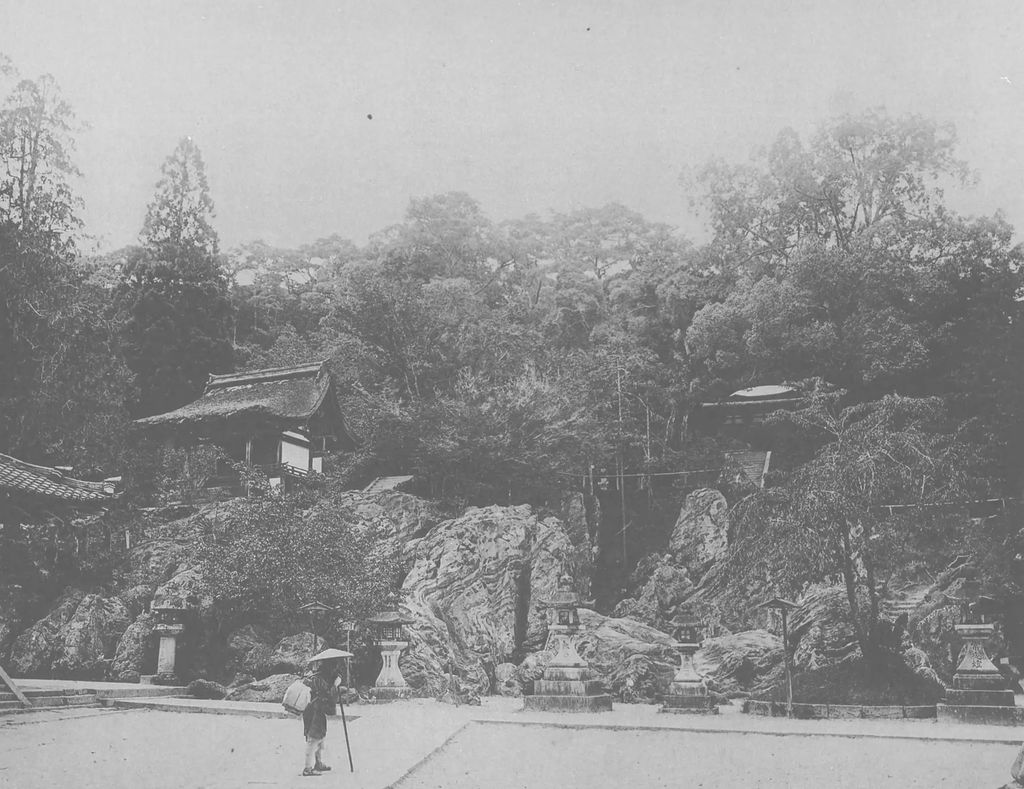
The historical places in the titles also need careful handling. Ishiyamadera is a real temple, but the Met cautions that Yoshitoshi's craggy temple view does not reproduce an actual vista from its main hall. The National Diet Library's landmark exhibition preserves a photograph of Ishiyamadera in Nihon meishō shashin zufu ryakusetsu, published in July 1901. In that later photograph, buildings and large rocks sit among trees. It offers a view of the place after the print was issued, not proof of where Yoshitoshi stood or how the moon appeared on a particular night. Shown beside the 1889 print, it can help readers separate a site's material setting from the pictorial choices that turn it into a scene of literary memory. [9] [20]
Frequently Asked Questions
Yes. The National Diet Library's complete album record describes 100 sheets and Ōta Memorial Museum has presented the full series. The Image Bank's online gallery features a smaller selection; do not mistake its visible count for the size of the series. [2] [4] [1]
No. These were published colour woodblock prints made through a team, with Akiyama Buemon as publisher and cutters and printers translating Yoshitoshi's designs to paper. Individual museum records sometimes name a cutter or describe printing effects. [6] [14]
They summarise different aspects of a prolonged publishing project. The NDL album and Fitzwilliam series page give 1885–92; a British Museum artist summary gives 1885–91. Ōta's checklist documents sheets printed earlier and issued in 1892. Date a specific design using the type of date in its underlying record. [2] [3] [7] [8]
Usually not. One design may survive in multiple impressions and perhaps later printings. The NDL, Met and Fitzwilliam items discussed here are separately held objects, so material claims about one copy should not automatically be applied to another. [1] [13] [5]
The NDL images shown here come from its Image Bank, which says its displayed images are out of copyright and can be reused commercially without application, with source attribution requested. The Met labels its Moon in the Flame file Public Domain. Check the particular holding institution and object record for any other image. [15] [13]
Discussion
Compare how Yoshitoshi places the moon and how different impressions preserve the design.
Reader Insights
How does the cloud change the mood of Yokobue?
Where do you see differences in printing or pigment?
What changes when you compare Ishiyama with the later temple photograph?
Join the Conversation
Share a documented example or a reliable source below, keeping observation separate from inference.
References
- National Diet Library Image Bank, 月百姿 gallery. Series description, Japanese titles and individual image identifiers.
- National Diet Library Search, complete 月百姿 album, bibliographic ID 023973160, persistent ID 1304807. Hundred-sheet album, publisher and date range.
- Fitzwilliam Museum, One Hundred Aspects of the Moon. Series scope, publisher, date range and reception.
- Ōta Memorial Museum, 2017 月百姿 exhibition. Full-series exhibition and four curatorial themes.
- Fitzwilliam Museum, Hōrin Temple Moon: Yokobue. A distinct impression, first-edition date, story and material notes.
- Ōta Memorial Museum, publishers exhibition. Akiyama Buemon's role in the moon series.
- Ōta Memorial Museum, 2024 月百姿 work checklist. Exact Japanese print titles and notification, print and publication dates.
- British Museum, Tsukioka Yoshitoshi artist record. Alternative broad 1885–91 dating.
- Metropolitan Museum of Art, Murasaki Shikibu at Ishiyamadera Temple, 2019.41. Painting based on the series print, object description and public-domain status.
- Otaru Art Base collection record, 月百姿 史家村月夜 九紋竜. Japanese title and artist attribution.
- Fitzwilliam Museum, The Yūgao Chapter. Story, cutter and technical account of its own impression.
- Fitzwilliam Museum, Daimotsu Bay Moon: Benkei. Story, cutter, mica and visual comparison with Kuniyoshi.
- Metropolitan Museum of Art, Moon in the Flame, 2007.49.310. February 1886 public-domain print.
- Fitzwilliam Museum, Moon and Smoke. Separate impression, fire brigade interpretation and printing description.
- National Diet Library Image Bank, reuse terms. Expired protection, commercial reuse and requested credit.
- Ōta Memorial Museum, 2017 complete-series checklist. May 1892 two-sheet index and June 1892 portrait listed separately.
- British Museum Chinese-language essay on Yoshitoshi's moon series. Identifies Su Shi with Red Cliff Moon; used only for that interpretive connection.
- Smithsonian National Museum of Asian Art, The moon of the moor: Yasumasa, S2003.8.3040. Separate impression, date and subject tags; image reuse not assumed.
- Ōta Memorial Museum, 2024 English exhibition checklist. Institutional English title variants and broad object dates; use the Japanese list for event-specific dates.
- National Diet Library, Ishiyamadera Temple in Exploring Japanese Landmarks. Early photographs of the site, including *Nihon meishō shashin zufu ryakusetsu*. Its IIIF record gives publisher Gahōsha, July 1901 and NDL PID 762837; the exhibition reuse terms allow commercial use with attribution.