 by Tom Gurney
Tom Gurney BSc (Hons) is an art history expert with over 20 years experience
Published on June 19, 2020 / Updated on October 14, 2023
Email: tomgurney1@gmail.com / Phone: +44 7429 011000
Autumn Landscape with Boats by Wassily Kandinsky: Introduction
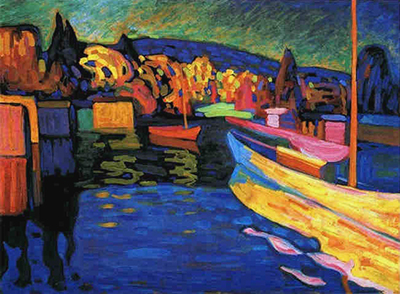
A yellow boat enters from the right edge of Wassily Kandinsky's Autumn Landscape with Boats, its hull cutting across an expanse of deep blue water. Behind it, short strokes of orange, green, rose and blue turn a shore into a dense band of colour. The scene remains recognisable, but its reflections and landforms are built from marks that can be enjoyed independently of the place depicted. Kunsthaus Zürich records the work under its German title Herbstlandschaft mit Booten: 1908, oil on cardboard, 71 × 96.5 cm. It belongs to the Gabriele and Werner Merzbacher Collection and is on permanent loan to the Kunsthaus. [1].
The inherited account gave the picture's measurements as “651 by 478 centimetres,” described it as oil on canvas and offered broad claims about boats, housing and weather. Those dimensions resemble the pixel size of a small online reproduction, not the physical painting. The owner's record gives the support and size precisely. It also identifies the catalogue raisonné entry, no. 245, which helps keep this finished landscape separate from Kandinsky's smaller Study for Autumn Landscape with Boats, no. 244. [1]; [3].
Watch: Wassily Kandinsky
Five museum videos about Kandinsky’s art, sources of inspiration and the relationship between colour and music.
Vasily Kandinsky: Around the Circle
Curator Megan Fontanella introduces Kandinsky and the Guggenheim collection.
Watch on YouTubeAt a Glance
- Artist and date:Wassily Kandinsky, 1908.
- Original title:Herbstlandschaft mit Booten; English Autumn Landscape with Boats.
- Medium and size:Oil on cardboard, 71 × 96.5 cm.
- Collection:Gabriele and Werner Merzbacher Collection, on permanent loan at Kunsthaus Zürich.
- Inventory and catalogue:Kunsthaus MB 0078; Roethel/Benjamin oil-painting catalogue no. 245.
- Related work:A separate 1908 study, Roethel/Benjamin no. 244, measures 30.5 × 39 cm.
- Image:Existing site reproduction retained; no newly licensed photograph added.
Where this work sits in Kandinsky’s career
The Blue Rider
1903Composition VII
1913Composition VIII
1923Several Circles
1926Sky Blue
1940Contents
- Boats, shore and reflections
- Oil paint on cardboard
- Painting around Murnau in 1908
- The separate study
- Frequently asked questions
- References
Boats, shore and reflections
The foreground boat dominates by colour and direction. Its yellow side is edged with warm red and pink, while a narrower dark band along its upper edge draws the eye back toward the bank. The hull points diagonally into the picture. That diagonal interrupts the mostly horizontal division between water and land, giving a simple lakeside subject a strong internal movement. In the left half, darker upright structures and their reflections set a second rhythm of verticals against the vessel. [1]; [2].
The water is not uniformly blue. Small flecks of yellow, green and violet appear among the darker marks, suggesting both broken reflection and the visible activity of paint. Along the distant shore, Kandinsky compresses vegetation and buildings into short, emphatic strokes. The eye can still separate boats and banks, but it no longer needs meticulously drawn leaves or roofs to understand the scene. Christie's earlier catalogue essay drew attention to the intensity of the boat's coloured reflection. The description of colour is also visible in the reproduction; it should not be expanded into an unsupported claim about a particular light level or meteorological condition. [2].
The upper band is green-blue, with darker hills or trees pressing over the shore. The strongest contrast, though, is near the right foreground, where the luminous boat meets the dense water. Autumn enters through the title and the shore's warm oranges and yellows. The image does not establish frost, a precise time of day or an economic account of the boats. Those details in the old article went beyond the cited object evidence. The painting is more compelling when its particular arrangement of hull, water and coloured shore is allowed to do the descriptive work. [1]; [2].
Oil paint on cardboard
Kunsthaus Zürich specifies oil on cardboard and an image measuring 71 × 96.5 cm. The cardboard support places this landscape among Kandinsky's rapidly changing works around Murnau, but the material alone cannot prove that it was painted in a single sitting or outdoors. A web image gives little reliable evidence of the reverse, mounting history or the thickness of each stroke. What can be seen is a surface organised through robust, discrete passages of colour. [1].
Christie's catalogued the same painting as oil on board at 71 × 96.5 cm and cited the same Roethel/Benjamin no. 245. “Board” is a broader English description; the current collection's “cardboard” is the more specific wording adopted here. The auction essay reports the artist's handlist entry from 1909 and a sale from Adolf Erbslöh's studio in Munich in March 1911. These records help establish the painting's early documented life, although the Kunsthaus online record states that its full provenance research is still in progress. It would be unsound to fill every later ownership gap by inference. [2]; [1].
The current inventory number MB 0078 belongs to the painting on permanent loan from the Merzbacher Collection. A permanent loan is a collection arrangement, not a statement that the Kunsthaus owns the work or that it will hang in the same gallery on every visit. The record's 2021 accession year marks its entry in the museum's catalogue under this arrangement. Visitors should consult current display information separately. [1].
Painting around Murnau in 1908
Kandinsky's 1908 work with Gabriele Münter, Alexej von Jawlensky and Marianne von Werefkin around Murnau provides useful context for the high colour and simplified shapes here. A Lenbachhaus account of a different 1908 Kandinsky view describes the group working in the area and the move toward broad strokes and strong colour. That context explains why a lake and shore can remain visible even as each patch becomes unusually forceful. It does not identify the exact place from which Kandinsky painted this particular boat scene. [4]; [1].
Christie's auction essay places the picture in autumn 1908 and associates it with the Lake Starnberg area, discussing a jetty and shore. That is more specific than the present Kunsthaus record, which supplies the title and physical facts but no detailed topographical description. The association may inform the painting's history, yet it should be attributed to the auction analysis rather than presented as an independently mapped viewpoint. In the picture itself, the boathouse-like structures, water and shore are enough to anchor the scene without pretending to name every building. [2]; [1].
This is often called a transitional work, but the word can flatten what is already distinctive. The subject is still a landscape: boats float beside a shore, with darker land behind. At the same time, the hot hull and patchwork of colour disrupt conventional recession. The eye moves between identifying objects and following the paint as colour. Those two experiences are present together rather than neatly arranged as a before-and-after story of abstraction. The documented 1908 date situates the painting before the later large non-objective compositions; it does not reduce its worth to being a step toward them. [2]; [1].
The separate study
Sotheby's catalogued Studie für Herbstlandschaft mit Booten as a distinct 1908 oil on board measuring 30.5 × 39 cm, Roethel/Benjamin no. 244. It is roughly half the height and well under half the width of the finished MB 0078 picture. The study's catalogue discusses an alternate title, Starnberger See – Tutzing, and a separate provenance involving the Costakis collection. Neither its dimensions nor its collecting history should be assigned to the finished painting. [3]; [1].
The existence of a study is useful evidence of Kandinsky's sustained attention to the motif. It should not be treated as proof that every shape in the finished work had a fixed symbolic meaning. Without a direct side-by-side technical study, claims about exact transfer from one support to the other would exceed the available sources. The securely documented distinction is enough: two objects, related titles, different sizes, consecutive catalogue numbers and different provenance. [3]; [1].
The existing image on this page already depicts the finished landscape and remains suitable for this local article. A clearer museum or auction photograph would be a welcome improvement only if its reuse rights are plain; no such licence is established by the cited object records. The planned artist guide can describe the boat, coloured shore, 1908 date and collection accurately without taking a new photograph from an ambiguously credited source. [1].
Kandinsky artworks directory
Frequently Asked Questions
Kunsthaus Zürich dates the finished painting to 1908. Christie's earlier catalogue places it in autumn of that year. [1]; [2].
It is oil on cardboard, with an image measuring 71 × 96.5 cm. The inherited 651 × 478 centimetre claim was not an object measurement. [1].
It is in the Gabriele and Werner Merzbacher Collection and on permanent loan at Kunsthaus Zürich, where it has inventory number MB 0078. [1].
Christie's essay associates the finished painting with the Lake Starnberg area. A Sotheby's catalogue discusses Starnberger See – Tutzing as an alternate title for a separate study. The current Kunsthaus object record does not give an exact viewpoint for the finished painting. [2]; [3]; [1].
No. The study is a 1908 oil on board, 30.5 × 39 cm, catalogue no. 244. The finished painting is 71 × 96.5 cm, no. 245. [3]; [1].
Discussion
What do you notice first in Autumn Landscape with Boats? Share a close observation or a question about the evidence for this work.
Comments are for comparing what we see and what the cited sources establish.
Reader Insights
How does the yellow boat change the weight of the dark blue water?
Where do reflections become colour marks rather than clear mirror images?
What evidence keeps the finished painting distinct from Kandinsky’s smaller study?
Join the Conversation
Add your observation below and tell us which part of the artwork led you to it.
References
- Kunsthaus Zürich, Herbstlandschaft mit Booten, MB 0078. View source.
- Christie's, Herbstlandschaft mit Booten, object and lot essay. View source.
- Sotheby's, Studie für Herbstlandschaft mit Booten, lot 51, 2013. View source.
- Lenbachhaus, Kandinsky's 1908 View from the Griesbräu Window. View source.