by Tom Gurney
Tom Gurney BSc (Hons) is an art history expert with over 20 years experience
Published on June 19, 2020 / Updated on October 14, 2023
Email: tomgurney1@gmail.com / Phone: +44 7429 011000
Merry Structure by Wassily Kandinsky: Introduction
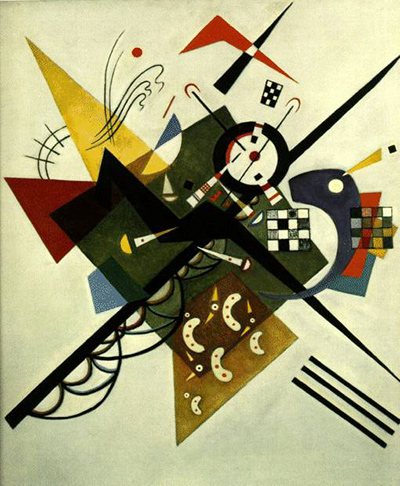
Two tall pointed forms, a red middle and small stepped marks give the inherited image of Wassily Kandinsky's Merry Structure a lively, assembled character. The title also circulates as Heitere Konstruktion and Structure joyeuse, usually with the date 1926. A published teaching PDF reproduces a visually matching work under the English title and date. Yet no dependable museum record or catalogue number has been found that establishes the original picture's medium, dimensions or present owner. This page therefore treats 1926 as a conventional attribution and concentrates on what the image shows. [1]; [2].
Watch: Wassily Kandinsky
Five museum videos about Kandinsky’s art, sources of inspiration and the relationship between colour and music.
Vasily Kandinsky: Around the Circle
Curator Megan Fontanella introduces Kandinsky and the Guggenheim collection.
Watch on YouTubeAt a Glance
- Inherited title:Merry Structure, also circulated as Heitere Konstruktion or Structure joyeuse.
- Conventional date:1926, repeated in reproductions including an illustrated teaching publication; direct object documentation remains missing.
- Visible design:Upright composition, two pointed forms, red centre, stepped red accents and several blocks of contrasting colour.
- Medium, size and owner:Not verified from an authoritative object record. Claims made by print sellers or image aggregators should not be treated as a catalogue caption.
- Different title:Fröhlicher Aufbau appears in a 1926–27 exhibition catalogue among 1924 watercolours. The similar meaning is insufficient to identify it as this image.
- Image:The existing local splash is retained; no replacement with a newly licensed reproduction has been established.
Where this work sits in Kandinsky’s career
The Blue Rider
1903Composition VII
1913Composition VIII
1923Several Circles
1926Sky Blue
1940Contents
- A structure with movement
- Why the title matters
- Kandinsky and the Bauhaus context
- A similar catalogue title is not an identification
- What remains to be documented
- Frequently asked questions
- References
A structure with movement
The word structure suggests an arrangement that can be taken apart in the mind: one shape beside another, points answering blocks, open spaces balancing dense ones. The composition here seems to rise. Two pointed, tower-like figures establish a vertical beat, and the red centre becomes an anchor against cooler surrounding colours. At first glance it may resemble an abstract building. A closer look shows that its pieces do not line up into a consistent architectural perspective. They are assembled as a painterly rhythm rather than a blueprint. [2].
Red carries much of that rhythm. A stronger red passage near the middle is echoed by smaller, stepped marks lower in the picture. The repetitions help the eye move down and back up. Between them, narrow lines and angular edges change direction. An apparent stability is continually disturbed by a new accent. The result justifies a viewer's sense of cheerfulness without requiring a claim that Kandinsky encoded a fixed emotion into every colour. [1].
The picture is taller than it is wide in the inherited reproduction. That format gives the pointed forms room to climb. Empty or quieter areas prevent the image from becoming a solid stack. The eye can read one shape as a foreground piece and another as a background piece, then lose that division as their edges meet. This uncertain depth is part of the work's interest. It turns a set of apparently simple elements into a visual puzzle. [2].
Because this reading depends on a digital reproduction, colour and crop must be handled cautiously. We can discuss the visible relationships between red, dark contours and pointed shapes. We cannot infer the original surface texture, support or actual scale from a website image. Those are physical-object facts that need a collection record. [1].
Why the title matters
Heitere Konstruktion can be translated roughly as “cheerful” or “merry construction.” The English Merry Structure and French Structure joyeuse are variants that circulate with the image. The title draws attention to the tension between an ordered arrangement and a buoyant feeling. A structure can be carefully planned while the result feels light and improvisatory. The painting's pointed verticals, red repetitions and changing angles make that tension visible. [2]; [1].
The translation does not turn the composition into a scene of literal happiness. Kandinsky's abstract titles often guide perception without assigning one definitive story. A visitor might find the central red forceful rather than merry, or the tall pointed forms unstable rather than celebratory. Asking how the forms produce those responses is more useful than treating the title as a command about how to feel. The image is open enough to support different readings. [2].
The date 1926 is plausible within Kandinsky's Bauhaus period, but a date repeated across reproductions is a weaker kind of evidence than an owner record or signed object. A teaching book captions the work with that year, so the date is worth reporting as conventional. It should not be used as a foundation for detailed stories about where Kandinsky painted the original or how he exhibited it. [1].
Kandinsky and the Bauhaus context
Kandinsky joined the Bauhaus in 1922 and remained associated with the school until it closed in 1933. In the 1920s he explored relations among geometry, colour and surface in teaching as well as painting. A picture conventionally dated 1926 can be read against this broad context: its sharp points and repeated blocks invite attention to organisation, while its uneven spacing and changing colours keep the composition from becoming a mechanical exercise. [4]; [5].
Bauhaus context is not a substitute for the object's own history. It does not prove the material or the place where this particular work was made. It helps explain why geometrical elements might be used for more than the depiction of a building or machine. In Kandinsky's work, a point, line or plane could be studied for its relation to every other part of a surface. Merry Structure offers a compact way to test this: remove the central red in imagination and the picture's balance changes; flatten the pointed forms and its upward pull weakens. [4].
There is a tendency to make Kandinsky's Bauhaus years sound wholly rigid. This image works against that shorthand. Its structure is legible, but its small disturbances and off-centre accents create play. The forms seem poised between assembly and motion. Whether the viewer sees a city, a figure or only shapes is less important than noticing how the image prompts and then frustrates a literal reading. [2].
A similar catalogue title is not an identification
A digitised 1926–27 exhibition catalogue includes Fröhlicher Aufbau among works listed as 1924 watercolours. The German words can also suggest a cheerful construction, but the title, date and stated medium differ from the circulating Heitere Konstruktion image labelled 1926. The catalogue entry supplies no image on that page to establish visual identity. It cannot be borrowed to furnish this page with a medium or exhibition history. [3].
This matters because several Kandinsky works have translated or similar abstract titles. A quick web search can merge them. Here, the fair distinction is simple: Merry Structure is a title attached to the image shown on this site; Fröhlicher Aufbau is a separate catalogue entry until stronger evidence connects them. Treating the two as one would create a false precision around date and materials. [3]; [2].
What remains to be documented
The most useful next record would reproduce this exact composition and provide an owner, inventory number, title in the institution's catalogue, medium, dimensions and provenance. A catalogue raisonné entry with an illustration could also establish those facts. Until one is available, the page's close reading can stand, while its object caption remains intentionally narrow. The existing image gives readers a way to discuss colour, balance and movement without pretending to solve an unresolved attribution chain. [1].
Kandinsky artworks directory
Frequently Asked Questions
Matching reproductions conventionally date it 1926. This page reports that date as an attribution because a direct museum or catalogue object record for the original has not been verified. [1].
The image is commonly circulated as Heitere Konstruktion. Merry Structure is an English rendering and Structure joyeuse a French rendering found with reproductions. [2].
A reliable current owner and inventory record for this exact image have not been found. Some sellers name collections without an object number or primary citation; those claims are not used here.
The original medium is unverified on the available object evidence. A digital reproduction cannot establish whether the work is oil, watercolour or another medium.
No identification has been established. A historic catalogue lists Fröhlicher Aufbau as a 1924 watercolour, while Merry Structure circulates with 1926; a similar translated title is not enough to merge them. [3].
Pointed uprights, rectangular pieces and repeated stepped marks suggest assembly. Their uneven spacing and shifting colours also make the design feel active and playful. This is a visual interpretation of the image. [2].
Discussion
What do you notice first in Merry Structure (Heitere Konstruktion)? Share a close observation or a question about the evidence for this work.
Comments are for comparing what we see and what the cited sources establish.
Reader Insights
Which shapes give this arrangement its upward pull?
How do the repeated red accents guide the eye?
What evidence would establish the original medium and current owner?
Join the Conversation
Add your observation below and tell us which part of the artwork led you to it.
References
- Stanford House, illustrated Kandinsky teaching PDF, Merry Structure caption. View source.
- WassilyKandinsky.net, matching reproduction and conventional title/date. View source.
- Universitätsbibliothek Heidelberg, 1926–27 catalogue listing separate Fröhlicher Aufbau. View source.
- MoMA, Bauhaus exhibition overview. View source.
- MoMA, Kandinsky artist overview. View source.