 by Tom Gurney
Tom Gurney BSc (Hons) is an art history expert with over 20 years experience
Published on June 19, 2020 / Updated on October 14, 2023
Email: tomgurney1@gmail.com / Phone: +44 7429 011000
Colourful Life by Wassily Kandinsky: Introduction
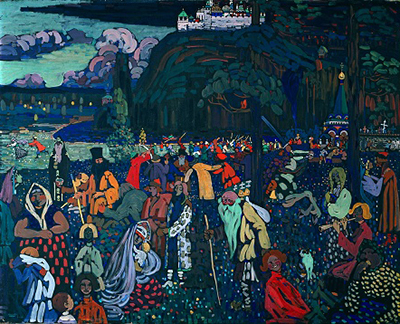
People in patterned clothes crowd a broad landscape: some play music or sit together, others appear to travel, quarrel or fight. A town crowns a distant hill. Kandinsky's Das bunte Leben, usually translated as The Colourful Life, brings many kinds of human activity into one 1907 scene. It is figurative, despite the intense colours and simplified forms that point toward his later experiments with abstraction. Christie's current description identifies the medium as tempera and gouache on canvas, measuring 130.5 × 162.6 cm. The German restitution commission used rounded dimensions of 130 × 163 cm and described the medium more generally as tempera. [1]; [3].
This painting's location needs a date attached. It spent decades on loan at Munich's Lenbachhaus, but it was restituted to heirs of the Lewenstein family in June 2023. As of 28 September 2026, Christie's has announced that it will offer the work at a London evening sale on 14 October 2026. The outcome of that future sale cannot be stated here. An inherited claim that the Lenbachhaus currently holds the painting is therefore out of date, as is an account that treats restitution as merely an allegation still awaiting resolution. [2]; [3].
Watch: Wassily Kandinsky
Five museum videos about Kandinsky’s art, sources of inspiration and the relationship between colour and music.
Vasily Kandinsky: Around the Circle
Curator Megan Fontanella introduces Kandinsky and the Guggenheim collection.
Watch on YouTubeAt a Glance
- Artist and date:Wassily Kandinsky, 1907.
- Original and English titles:Das bunte Leben; The Colourful Life (site route: Colourful Life).
- Medium and dimensions:Tempera and gouache on canvas, 130.5 × 162.6 cm, according to Christie's 2026 catalogue description.
- Subject:A large, recognisable gathering of figures in an imaginative landscape, without a single documented narrative.
- Early exhibition:Paris Salon d'Automne, 1907; Galerie Der Sturm, Berlin, 1912, according to Christie's.
- Ownership:Lewenstein family from 1927; restituted to the family's heirs in June 2023 after an advisory commission recommendation.
- Current status at 28 September 2026:Announced for Christie's London sale on 14 October 2026; future result unknown.
- Image:Existing site reproduction retained; no new clearly reusable photograph established.
Where this work sits in Kandinsky’s career
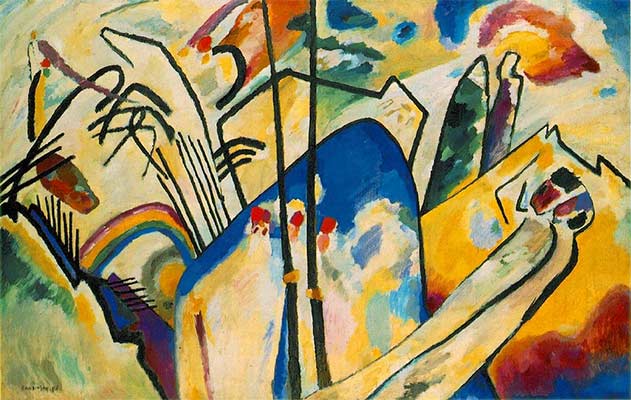
The Blue Rider
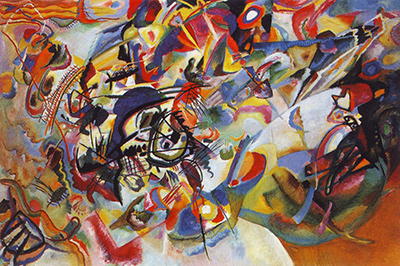
1903Composition VII
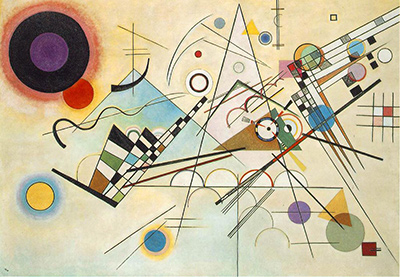
1913Composition VIII
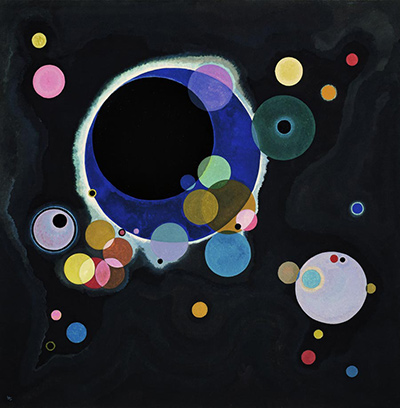
1923Several Circles
1926Sky Blue
1940Contents
- A panorama with no single story
- Paris and an imagined Russian world
- The Lewenstein collection and the 1940 loss
- Where the painting stands in September 2026
- Frequently asked questions
- References
A panorama with no single story
Kandinsky spreads the figures across several bands. The nearest people are large enough to show faces, clothes and gestures. Farther back, smaller groups cluster near trees and an open area, while the hill carries the eye up toward a walled town. This arrangement allows many events to happen at once. A viewer can begin with a seated figure or a bright patch of clothing and move toward a completely different episode. Christie's describes musicians, pilgrims, peasants, lovers, a mother with a child and a distant funeral procession, alongside conflict and armed figures. Its reading makes the title richer than a simple celebration: life here includes joy and disturbance together. [1].
The painting does not require all of these people to be characters in one recoverable folktale. Christie’s calls the landscape mysterious and the action a set of vignettes without a clear narrative thread. Russian stories, religious imagery and folk traditions inform its figures, but the source does not identify a single text that Kandinsky illustrated. The mounted rider among the trees can be compared with his later rider imagery; calling it a direct portrait of a specific hero would need stronger evidence. A reading of the scene as human life in many registers remains closer to what the title and visible crowd support. [2]; [1].
Colour separates and connects these episodes. Deep blue-green and black areas make the bright reds, yellows, whites and oranges stand out. Some figures almost merge into the surrounding dark ground until a sleeve, face or headdress catches the eye. Christie’s notes, for example, the traveller's unusually luminous mint-green beard. Such colour is not just a local description of what a material object would look like in ordinary daylight. It can focus attention and give an area an emotional charge. The older page called this an abstract painting, but the people, town, trees and actions remain legible; the unusual colour changes how representation works rather than abolishing it. [1].
The broad size matters. At over 1.6 metres wide, the canvas lets figures and tiny incidents accumulate across a field that a viewer could explore at different distances. From far away, the dark setting and bright patches make a striking pattern. Nearer, individual faces and episodes emerge. Christie's quotes Kandinsky speaking of works around this time as inviting viewers to take a walk through the picture. That is useful for this panorama, but it should not be presented as a documented instruction written specifically for Das bunte Leben. [1].
Paris and an imagined Russian world
Kandinsky and Gabriele Münter were living in Paris during 1906–07. Christie's places the making of Das bunte Leben in that period and points to contemporary Parisian interest in ambitious scenes of human life, including work by Matisse and Derain. It also traces Kandinsky's lasting interest in Russian folk culture to earlier experiences, including Vologda. These influences can coexist. The painted town and figures should not be treated as a map of an actual Russian village simply because some clothing or architecture recalls Russian tradition. The site is better described as an imaginative setting assembled for the painting. [1].
Christie's records that the picture appeared at the Salon d'Automne in Paris in October 1907. It later entered the orbit of Herwarth Walden's Galerie Der Sturm and was shown there in 1912. Those exhibitions matter because they establish that Kandinsky presented this large work to contemporary audiences, rather than leaving it as a private studio experiment. They do not prove that every visitor read the crowd in the same way. The 1907 date is also before the Blue Rider group's formation and years before Composition VII; it is a step in a changing career, not an example of Kandinsky's fully nonobjective art. [1].
The materials deserve accurate wording. Christie’s specifies tempera and gouache on canvas; the commission's legal description says tempera on canvas and rounds the size to 130 × 163 × 2.2 cm. That is a difference in descriptive detail, not evidence of two paintings. Neither source calls it an oil painting. The small inherited JPEG is useful for the composition but cannot settle fine questions about pigment, ground or later restoration. The Lenbachhaus records that Das bunte Leben was extensively restored in 2008–09 and illustrates its historic frame in its account of exhibition preparation. [1]; [3]; [4].
The Lewenstein collection and the 1940 loss
The painting belonged to Emanuel Albert and Hedwig Lewenstein in Amsterdam from 1927. Emanuel died in 1930 and Hedwig in 1937. The German Advisory Commission found that after Germany occupied the Netherlands, the painting was removed from the Stedelijk Museum, where it had been on loan, and sold at Frederik Muller & Co in Amsterdam on 9 October 1940 as part of a larger auction of works from the Lewenstein estate. Salomon B. Slijper bought it. The commission could not conclusively determine who arranged that auction or who received its proceeds. Those gaps are important and should not be filled with a confident story about one family member's intentions. [3].
The commission nevertheless concluded that the painting should be returned to the heirs of Hedwig Lewenstein Weyermann and Irma Lewenstein Klein. Its recommendation considered the family's persecution, the timing and context of the 1940 sale, the disputed account of any voluntary disposal, and later family attempts to trace the work. It stated that the available sources did not support the claim that Irma Lewenstein Klein had voluntarily sold it in connection with her divorce. This is the commission's documented assessment, rather than a claim that every detail of the 1940 transaction has been recovered. [3].
After Slijper, Bayerische Landesbank acquired the painting in 1972 and placed it on long-term loan at the Städtische Galerie im Lenbachhaus in Munich. Its many years on the museum wall explain why older articles and image files call it a Lenbachhaus picture. That was a display and loan history, not a permanent Lenbachhaus ownership claim. Christie’s states that the work was restituted to the Lewenstein heirs in June 2023, after the commission recommended its return. A current article needs both the historic Lenbachhaus connection and the subsequent change in possession. [3]; [2].
Where the painting stands in September 2026
On 1 September 2026, Christie’s announced that it would offer Das bunte Leben at its 14 October 2026 London evening sale. Its later essay of 24 September supplies the object description and a detailed visual reading. As this page is updated on 28 September, the announced sale is still ahead; a price, buyer or permanent new home cannot responsibly be named. The artwork's public viewing schedule and ownership may change after the auction, so those facts will need a fresh check when the page is next updated. [2]; [1].
The site's existing reproduction stays in place. Its file carries a Lenbachhaus credit, while current Christie's photographs are presented through rights-managed material. No clearly usable larger image has been identified for this site's replacement or the planned free guide, and seeking permission is outside the image-sourcing rule for this project. The guide can carry a text entry that identifies the painting, its visual structure and the restitution history without adding a new photograph. [1].
The Colourful Life is striking because its vivid pattern and readable human incidents work at the same time. Looking closely reveals a crowd with many ages, actions and moods; stepping back turns that crowd into a weave of bright marks against dark terrain. Its 1907 exhibition history and its later restitution each add a different part of the object's story. Neither requires the picture to be mislabelled as abstract or its present ownership to be frozen in its former museum loan. [1]; [3].
Kandinsky artworks directory
Frequently Asked Questions
Kandinsky painted Das bunte Leben in 1907, during his Paris period with Gabriele Münter. It appeared at the Paris Salon d'Automne that October. [1].
No. Figures, buildings, trees and actions remain recognisable, though Kandinsky uses vivid and sometimes unexpected colours. The painting anticipates later changes in his art without being fully nonobjective. [1].
Christie's describes tempera and gouache on canvas, 130.5 × 162.6 cm. The 2023 advisory recommendation uses the rounded description “tempera on canvas, 130 × 163 cm.” [1]; [3].
Christie's relates figures to Russian folklore and religious traditions, but says the episodes have no clear single narrative thread. A specific source story for the entire canvas is not established by the cited records. [2]; [1].
It was on long-term loan there for decades, but Christie’s says it was restituted to the Lewenstein heirs in June 2023. The Lenbachhaus association is historical, not its current holding. [2]; [3].
The painting was sold at Frederik Muller & Co in Amsterdam on 9 October 1940 under Nazi occupation. The commission could not establish who directed the sale or received the proceeds, but recommended restitution; Christie’s reports the return in 2023. As of this page's 28 September 2026 update, a Christie’s London sale is announced for 14 October 2026, with no result yet. [3]; [2].
Discussion
What do you notice first in Colourful Life? Share a close observation or a question about the evidence for this work.
Comments are for comparing what we see and what the cited sources establish.
Reader Insights
Which small episode first emerges from the crowded landscape for you?
How do the darker ground and bright clothing change the balance between joy and conflict?
Which detail in the 1940 sale history remains unresolved in the commission record?
Join the Conversation
Add your observation below and tell us which part of the artwork led you to it.
References
- Christie's, “Das bunte Leben (1907): a monumental turning point,” 24 September 2026. View source.
- Christie's, sale announcement, 1 September 2026. View source.
- German Advisory Commission, recommendation on Das bunte Leben, June 2023. View source.
- Lenbachhaus, conservation and exhibition preparation account. View source.