by Tom Gurney
Tom Gurney BSc (Hons) is an art history expert with over 20 years experience
Published on June 19, 2020 / Updated on October 14, 2023
Email: tomgurney1@gmail.com / Phone: +44 7429 011000
Cossacks by Wassily Kandinsky: Introduction
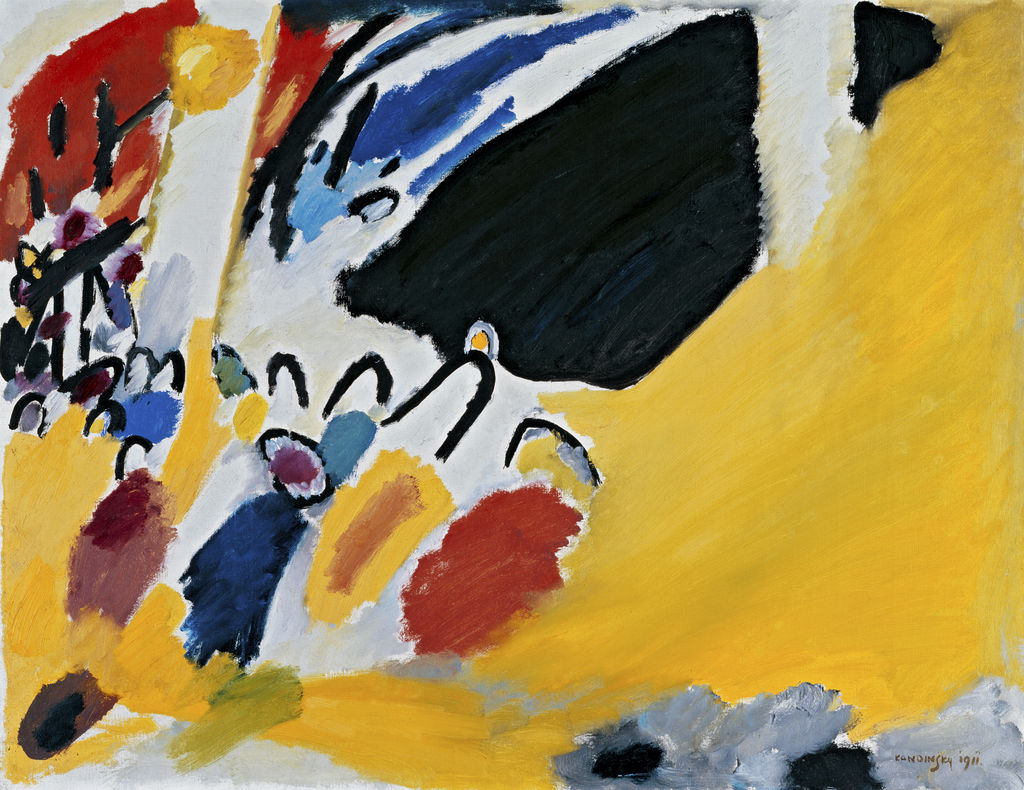
Two riders meet near the upper left of a wide, pale field. A bright arc crosses the centre; farther right, long dark strokes rise past small red-orange marks. At first the painting may look like an arrangement of lines and colour alone. Tate's description helps locate the people and setting: two mounted Cossacks with sabres at upper left, three more Cossacks toward the lower right, a castle on a hill and birds in flight. Kandinsky's Cossacks (Cosaques) is dated 1910–11. Tate catalogues the original as oil on canvas, 94.6 × 130.2 cm, accession N04948. [1]; [2].
Those recognisable details do not make the work a conventional battle illustration. Tate describes it as a transitional painting moving toward abstraction, where the expressive arrangement of colours and lines matters more than a complete narrative scene. An older version of this page guessed that one rider was a commander and tied the painting to Napoleon's invasion of Russia. The owner record identifies neither rank nor a particular historical battle. Looking closely at what survives of the riders and landscape gives a stronger account than assigning them an unsupported story. [2].
Watch: Wassily Kandinsky
Five museum videos about Kandinsky’s art, sources of inspiration and the relationship between colour and music.
Vasily Kandinsky: Around the Circle
Curator Megan Fontanella introduces Kandinsky and the Guggenheim collection.
Watch on YouTubeAt a Glance
- Artist and date:Wassily Kandinsky, 1910–11.
- Titles:Cossacks; French Cosaques in the Tate record.
- Medium and dimensions:Oil paint on canvas, 94.6 × 130.2 cm.
- Collection:Tate, accession N04948.
- Visible motifs identified by Tate:Two mounted Cossacks with sabres at upper left, three Cossacks at lower right, a castle on a hill and birds in flight.
- Artistic context:A work from the shift toward abstraction, before Kandinsky's fully nonobjective canvases.
- Image:Existing site reproduction retained. A larger Tate-derived Commons file has conflicting photograph-rights metadata and was not adopted.
Where this work sits in Kandinsky’s career
The Blue Rider
1903Composition VII
1913Composition VIII
1923Several Circles
1926Sky Blue
1940Contents
- Finding figures in the lines
- Colour across the battle
- At the threshold of the Blue Rider years
- Tate ownership and the image
- Frequently asked questions
- References
Finding figures in the lines
At the upper left, dark sweeping lines make a pair of rearing horses and their riders hard to see at first. Their forms do not have the solid outlines of a historical painting. Instead, a curve may serve as a horse's neck and a quick dark stroke as a raised sabre, while small warm-coloured hats give the riders a point of recognition. Once identified, the two figures alter the way the surrounding marks appear. Lines that initially seemed independent become part of a tense encounter, even though the action never resolves into a detailed account of who attacks whom. [2].
The other three Cossacks are set farther across the picture. Tate locates them at lower right. They are easier to distinguish by small red-orange hats and two long dark lances than by facial features. A third figure is present, but the owner's description does not make that rider a commander. A raised arm or difference in equipment cannot establish military rank in this highly abbreviated image. The old page's confident inference turned a visual uncertainty into a fact; the revised description keeps the figures visible without pretending to know their hierarchy. [2].
The Tate account also identifies a castle on a hill and birds in flight. These clues create a setting, but they are scattered across the canvas rather than organised into a convincing view from one place. The building at the upper right is a small cluster of rising forms. Thin, repeated strokes suggest birds against the light ground. Between the figures and the hill, the eye meets a large multicoloured arc that reads as a rainbow. The arc can connect parts of the scene while acting as a strong strip of colour in its own right. [2]; [3].
Colour across the battle
The pale areas give the painting room to breathe. They separate the two upper riders from the lower cluster and make narrow dark lines legible. Yellow, violet, blue and red-orange marks concentrate into distinct areas without being locked inside conventional objects. The rainbow makes colour unmistakable as a large structural element. Other patches resist a simple label: a blue-violet area can suggest land or shadow, but it is also a broad painted mass that changes the balance of the whole picture. [2].
Peter Vergo's Art UK essay links Cossacks to Kandinsky's discussion of battle, castle and lances in a larger composition, and notes that the artist also wrote about emotional effects of colours and forms. The point is not that an identified person or weapon becomes irrelevant. Rather, the remaining objects coexist with shapes that can be felt as rhythm, tension and movement even before they are named. Vergo notes the rainbow in the smaller Cossacks picture while distinguishing what Kandinsky specifically identified in the larger work. That distinction matters: a comparison can illuminate a motif without making the two canvases identical. [3].
The long black lances are particularly effective because they can be read both ways. Once the riders are found, they belong to the scene; before that, they are strong diagonals crossing open space. The curved sabres and horse lines similarly pull the eye across the wide canvas. This double function explains why a first glance may register an abstract design and a second reveal a group of Cossacks. Tate describes this as a transition rather than calling the picture fully nonobjective. [2].
At the threshold of the Blue Rider years
The 1910–11 date places Cossacks during Kandinsky's Munich years, before the outbreak of the First World War and near the emergence of the Blue Rider circle in 1911. Tate's artist account says Kandinsky had co-founded the Neue Künstlervereinigung München in 1909 and, after meeting Franz Marc in 1911, concentrated on the Blue Rider group and publication. Art UK's overview dates the Blue Rider movement to 1911–14. These points locate the work in a period of experimentation without requiring a claim that it was painted for a specific Blue Rider exhibition. [2]; [4].
Rider imagery had already mattered in Kandinsky's art. The Blue Rider of 1903 gives a small mounted figure a much more recognisable slope and landscape. Cossacks gives mounted figures fewer descriptive details and lets the surrounding lines and colours compete more forcefully for attention. Later works such as Composition IV continue to compress figure and battle motifs into complex arrangements. These connections are comparisons of visible imagery and chronology, not a claim that the earlier picture directly rehearsed every later one. [2]; [3].
Art UK's Vergo essay also discusses Kandinsky's interest in how painting might affect a viewer as music does. It uses Cossacks to ask how recognisable motifs and expressive form can work together. That is more useful than claiming the picture depicts a specific piece of music. Nor does the title prove a literal Napoleonic episode. The word “Cossacks” identifies the riders in a general way; the owner's published description does not supply a location, named regiment or dated event. The painting's force lies in how little information the lines need to suggest a charged encounter. [3]; [2].
Tate ownership and the image
Tate identifies the work as part of its collection, with inventory N04948. That ownership should be distinguished from where the canvas hangs today. The older page named a particular floor at Tate Liverpool, but a historic display location is not a reliable current one. A visitor should use Tate's present display information before making a trip. The object's date, medium and size do not depend on a current gallery room. [1]; [2].
The existing 400 × 290 reproduction remains on this page. A larger Tate-derived file on Wikimedia Commons has a public-domain page label but embedded metadata naming Tate's photograph and a CC BY-NC-ND licence. Because those rights statements conflict, it is not a straightforward source for an upgrade or the planned free artist guide. The guide entry can explain where to look for riders, lances and rainbow in words. No permission request or uncertain replacement is necessary. [5].
Cossacks rewards an alternating view. Seek the five riders, the hill and the birds, then step back and follow the rainbow and crossing dark lines without naming them. Tate's transition account is persuasive because both experiences remain available. The subjects have not vanished, but the painting makes line and colour do much of the work that a narrative image would usually give to bodies and scenery. [2].
Kandinsky artworks directory
Frequently Asked Questions
Tate dates it 1910–11, during Kandinsky's Munich period and near the formation of the Blue Rider circle. [1]; [2].
The original is oil paint on canvas, 94.6 × 130.2 cm. These figures describe the painting, not a Tate shop print. [2].
Tate identifies two mounted Cossacks at upper left and three more toward the lower right. Their recognisable details coexist with abstracting colour and line. [2].
The cited Tate account does not assign a rank to any rider. Difference in pose or equipment is insufficient to identify a commander in this abbreviated image. [2].
No specific historical battle or Napoleonic event is established by the Tate record. The title names Cossacks, while the museum emphasises the painting's transition toward abstraction. [2].
It belongs to Tate, accession N04948. A current display room should be checked on Tate's website; the old page's Tate Liverpool room claim is not a stable location. [1].
Discussion
What do you notice first in Cossacks? Share a close observation or a question about the evidence for this work.
Comments are for comparing what we see and what the cited sources establish.
Reader Insights
Where do you first find the five Cossacks among the lines?
How does the rainbow connect the riders and the hill without making a conventional landscape?
What evidence would be needed to identify a specific battle or a rider’s rank?
Join the Conversation
Add your observation below and tell us which part of the artwork led you to it.
References
- Tate, Cossacks collection page, N04948. View source.
- Tate Shop, original artwork description attached to custom print. View source.
- Art UK, Peter Vergo, “Music and abstract painting: the case of Kandinsky and Wagner”. View source.
- Art UK, Der Blaue Reiter overview. View source.
- Wikimedia Commons, Tate-derived file with conflicting photograph metadata, cited only for the rights decision. View source.