by Tom Gurney
Tom Gurney BSc (Hons) is an art history expert with over 20 years experience
Published on June 19, 2020 / Updated on October 14, 2023
Email: tomgurney1@gmail.com / Phone: +44 7429 011000
Couple Riding by Wassily Kandinsky: Introduction
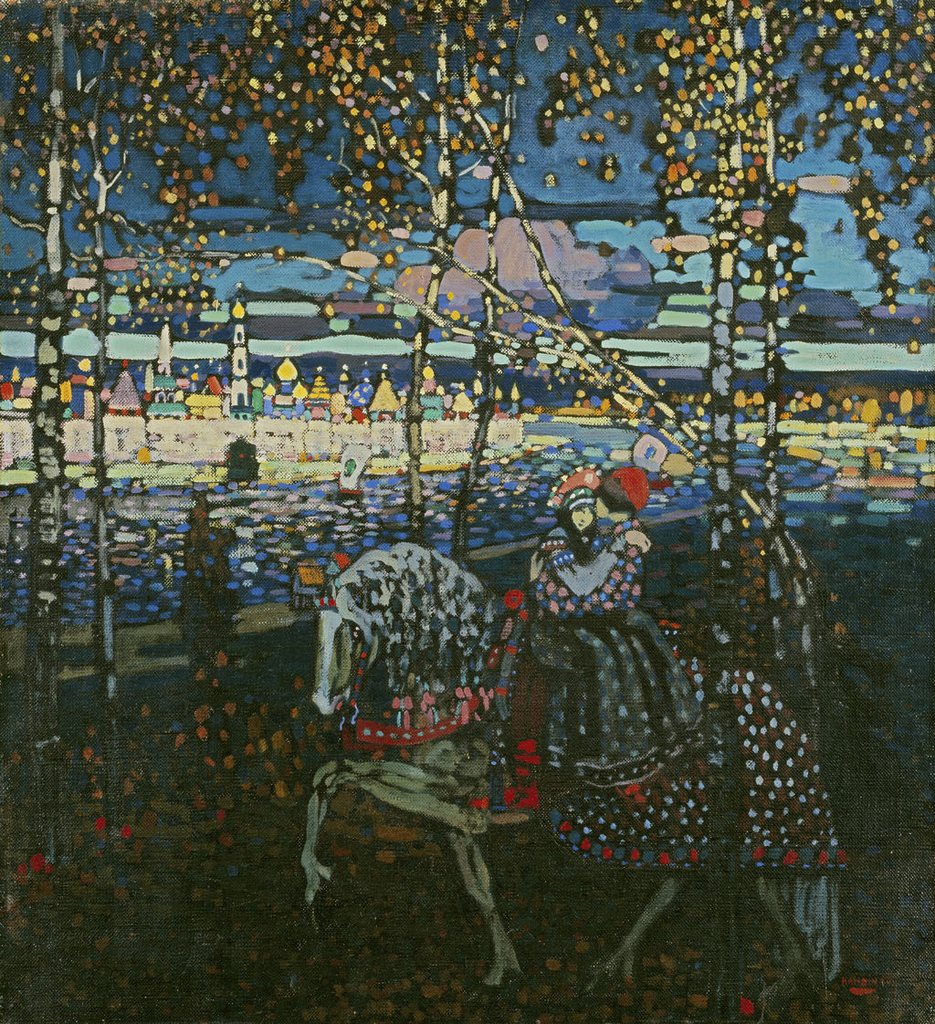
In Couple Riding (Reitendes Paar), two people huddle together on a horse beneath pale birch trunks. Across a river, domes and towers shine through a dark, patterned landscape. Wassily Kandinsky painted this imagined scene in 1906–07 while staying near Paris, yet its costume and city belong to the old-Russian world of his early pictures. The painting is an oil on canvas in Munich's Lenbachhaus, not an illustration of a documented journey or a portrait of named riders. [1].
The colour makes looking slower and more rewarding. Bright dots and short marks bring out leaves, water, clothing and architecture, but they also keep forms from settling into simple outlines. Lenbachhaus's account places this effect among Kandinsky's responses to Symbolism, Jugendstil, Russian fairy-tale imagery and the separated colour of Neo-Impressionism. Those are curatorial comparisons, not a claim that one identifiable print or painting supplied the whole composition. The work shows how closely story and colour experiment could coexist before Kandinsky's celebrated abstract paintings. [1].
Annotated details in Couple Riding
Select a numbered point to examine three close views of the work.
 123
Select a number to reach its detail.
Details from COUPLE RIDING
Three close views of the work.
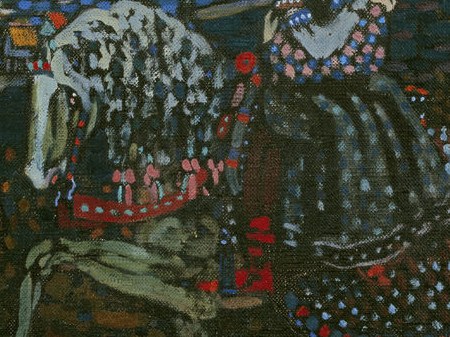
Riding pair
The mounted figures gather in the darker lower half of the scene.
Bright shore
A horizontal strip of light separates the riders from the distant shore.
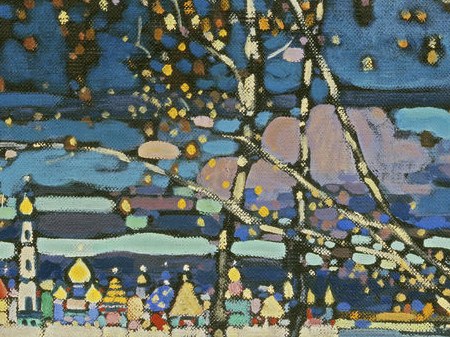
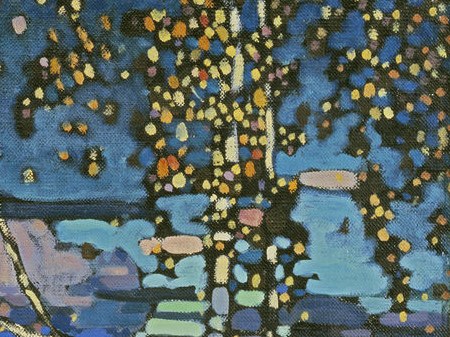
Tree pattern
Small repeated marks fill the upper right with foliage and light.
Reproduction from the linked collection record, CC0 1.0. View image source and terms.
Watch: Wassily Kandinsky
Five museum videos about Kandinsky’s art, sources of inspiration and the relationship between colour and music.
Vasily Kandinsky: Around the Circle
Curator Megan Fontanella introduces Kandinsky and the Guggenheim collection.
Watch on YouTubeAt a Glance
- Artist and date:Wassily Kandinsky, 1906–07.
- Owner's title:Reitendes Paar; English Couple Riding.
- Medium and size:Oil on canvas, 55.4 × 50.7 × 1.7 cm.
- Collection:Lenbachhaus, Munich, GMS 26; Gabriele Münter Stiftung gift, 1957.
- Place of making:The museum locates the painting in Kandinsky's winter 1906–07 stay at Sèvres near Paris.
- Image:The existing page image comes from the Lenbachhaus record, which labels its reproduction CC0 1.0.
Where this work sits in Kandinsky’s career
The Blue Rider
1903Composition VII
1913Composition VIII
1923Several Circles
1926Sky Blue
1940Contents
- Annotated details
- An imagined scene made near Paris
- The riders, birches and river
- Colour both reveals and conceals
- Symbolism, ornament and Russian sources
- Studies and the finished oil
- A rider before the Blue Rider group
- From Münter to the Lenbachhaus
- Frequently asked questions
- References
An imagined scene made near Paris
The Lenbachhaus dates the work 1906–07. Its fuller essay narrows the making to the winter of those years, when Kandinsky stayed at Sèvres. A museum wall-text chronology places Kandinsky and Gabriele Münter in the Paris area from May 1906 to June 1907. The scene therefore need not have been painted in Russia to draw on Russian themes. A place of production and a picture's imagined setting are different facts. [1]; [2].
Kandinsky's early subjects often evoke a remote or legendary past. The owner describes medieval figures and old-Russian motifs recurring among these works. Couple Riding belongs to that imaginative group. Its people wear Russian-style costume, but the museum does not identify them as historical figures, friends or the artist and Münter. The tempting idea that an embracing couple must stand for a real relationship would need evidence beyond the painted embrace. [1].
The setting is similarly suggestive rather than geographical. A river divides foreground and distance. An old-Russian-looking city glows beyond it, while unusual boats help displace the scene into an indefinite past. The Lenbachhaus describes a fairy-tale atmosphere and a Kremlin-like silhouette; it does not name a particular city skyline that a visitor could find from this viewpoint. This is an invented world assembled from familiar kinds of forms. [1].
The riders, birches and river
The pair sits low and close together near the bottom of the composition. Their bodies overlap so much that at first they can read as one dark, ornamented shape. The horse faces left, giving the picture a gentle direction of travel, but its pace is not forceful. Thin trunks and branches stand in front of the distant water. Their vertical strokes create a screen through which the scene is viewed. The heavy foreground and glimmering background give the riders both shelter and mystery. [1].
Gold and light-coloured spots among the birch leaves catch the eye above the pair. The specks do not simply describe foliage. They repeat in water, clothing, horse tack and buildings, letting the near and far parts of the picture answer each other. The river appears as a curved band of blue and lighter reflections. On it, two white sails belong to boats that the owner essay calls Viking ships. This detail adds to the picture's deliberately indefinite historical time; it need not be read as a literal record of river traffic. [1].
Across the water, domes and towers form a small luminous settlement. Some roofs are clearly distinct; others dissolve into coloured points. The city's scale in relation to the riders is not straightforward, because distance is conveyed more by layers of colour and overlap than by measured perspective. The picture asks us to move between the pair's intimacy and the distant spectacle. One can follow a narrative of arrival or departure, but no owner document supplies an exact story or destination for the riders. [1].
Colour both reveals and conceals
The Lenbachhaus links the jewel-like particles of colour to Neo-Impressionist methods of separating hues into small marks. Kandinsky's result is not simply a technical imitation of another artist's optical theory. Against the dark ground, individual colours flicker and merge, making the subjects less immediately legible. The horse's decoration, the pair's garments, the trees and the sky share this treatment. It draws attention to the picture's surface while inviting viewers to search for the story within it. [1].
The museum cites an early Kandinsky note about rich colour attracting the viewer while partly hiding a deeper content. That idea is useful here because the ornate marks compete with the recognisable riders and city. It is an artist's reflection on a broader approach, not a caption written specifically to decode each dot in this painting. We can observe what colour does without claiming that blue means one emotion or that every gold point is a symbol with a fixed translation. [1].
The same tension helps distinguish Couple Riding from a straightforward book illustration. Its motifs can be named, yet their borders and distances remain unstable. The blue and gold accents in the distance invite the eye past the pair; the patterned dark foreground brings it back. The picture's pleasure lies partly in how these routes of attention keep crossing. Kandinsky later worked with much less recognisable imagery, but the colour organisation in this early work already had more to do than fill in a tale. [1].
Symbolism, ornament and Russian sources
Lenbachhaus's curators place the scene in conversation with Symbolism and Jugendstil. The first comparison concerns the suggestion that a visible scene might carry a less directly stated imaginative or spiritual content. The second concerns decorative line, pattern and the careful shaping of the picture's surface. The museum also points to contemporary Russian fairy-tale illustration as a related visual world. These connections are best read as interpretive context rather than a proven list of individual source images Kandinsky copied. [1].
The old-Russian elements matter precisely because they are combined so freely. The costumes, birches, boats and domed city do not yield a single historic date. The Viking ships and Kremlin-like silhouette coexist in one dreamlike place. A demand that they form an accurate archaeological scene would miss how the painter brought different associations together. The Lenbachhaus describes this as a poetic, invented world. That is a more secure way to discuss its cultural references than naming a specific legend without documentation. [1].
This context also prevents an easy division between Kandinsky's “Russian” and “European” influences. He made the painting while living near Paris. Its treatment of small, bright strokes recalls Neo-Impressionist colour, while its subject evokes Russian visual traditions and its patterned surface invites comparison with Jugendstil. These interests could operate together in one work. The owner account presents the mixture as part of Kandinsky's early development rather than as a contradiction to solve. [1]; [2].
Studies and the finished oil
The Lenbachhaus reports that a horizontal tempera study and several pencil sketches preceded the final canvas. The mention is useful evidence of planning, especially because the resulting oil is nearly square rather than horizontal. It does not by itself identify an exact extant study by accession number or show which motif Kandinsky revised first. A cautious account can say the work was prepared without pretending to reconstruct every step from the short catalogue description. [1].
The finished painting is oil on canvas, 55.4 cm high by 50.7 cm wide, with a recorded depth of 1.7 cm. The owner notes a red Kandinsky signature low on the right. Those details identify a particular physical object rather than the broader rider motif. They also distinguish the oil from a study in another medium and format. A reproduction can show the arrangement and many colours, but it cannot fully convey the scale, surface or relation of red signature to the painted texture. [1].
The museum's online image is explicitly marked CC0 1.0. The current page uses the image already sourced from that record, so a new acquisition would add little. The licence attaches to this reproduced image as the museum presents it, not automatically to every photograph, study or contemporary object linked from its website. For the future artist guide, this work has a clear image option that can be credited and documented alongside its object facts. [1].
A rider before the Blue Rider group
Kandinsky returned to the rider motif in more than one medium and year. His 1903 oil The Blue Rider places a small rider in a landscape. Lenbachhaus also catalogues a separate woodcut called Rider, probably made in 1906. Couple Riding differs from both: the intimate double figure, dark birch screen and distant city give it its own atmosphere. A recurring motif is evidence of continuing interest, not proof that all rider pictures form a single series or depict the same imaginary person. [3]; [1].
The Blue Rider group and its almanac belong to 1911–12, several years after this painting. The name makes it tempting to treat every earlier rider as an illustration made for that project. Chronology rules that out. Earlier riders can help explain why the motif was available and meaningful to Kandinsky, but Couple Riding should be approached in its 1906–07 circumstances. The Der Blaue Reiter guide distinguishes the artist's 1903 painting, the later exhibitions and the publication. [1]; [4].
Nor does the later move toward abstraction make this painting merely an immature draft. Its colour particles, partial concealment and invented geography are specific accomplishments of an early pictorial language. A viewer can see why those experiments became relevant to Kandinsky's later interests without claiming that he knew his eventual abstract canvases in advance. The painting's own problem—how an evocative story can emerge from dazzling colour—remains worth examining on its own terms. [1].
From Münter to the Lenbachhaus
The owner's provenance begins with Kandinsky's making of the work in 1906–07. It records Gabriele Münter's possession in Murnau from 1926 to 1957, acquired through transfer from the artist. In 1957 she gave it to Munich's Lenbachhaus as part of the Gabriele Münter Stiftung gift. The record does not invite us to invent every movement of the canvas between making and the dated transfer. Its secure later history is enough to locate the work in the collection today. [1].
Münter's gift was important to the public preservation of Kandinsky's early art. Lenbachhaus's Blue Rider collection account describes a gift of more than a thousand works from the circle in 1957. This particular object has its own inventory, GMS 26. That number is helpful when a translated title such as Couple Riding appears in a book or online: matching it to the owner's Reitendes Paar prevents confusion with another rider work. [4]; [1].
The collection record currently marks the work as not on display. Such a status can change, so this article gives the owning museum and object link without promising a gallery location. What remains available through the record is the painting's identity, a rights-clear reproduction and a curatorial reading that connects its visual details to Kandinsky's early interests. [1].
Kandinsky artworks directory
Frequently Asked Questions
The Lenbachhaus dates Reitendes Paar to 1906–07 and places the finished work in Kandinsky's winter stay at Sèvres near Paris. The short catalogue heading says 1906, but the fuller object date and essay support the range. [1].
It belongs to the Lenbachhaus in Munich, inventory GMS 26, through Gabriele Münter's 1957 gift. The owner's current display status should be checked before planning a visit. [1].
The owner describes a young couple in Russian-style costume but does not identify named sitters. Reading the pair as Kandinsky and Münter would therefore be speculation. [1].
The museum describes an imagined old-Russian, Kremlin-like city. It does not identify a particular topographical view, so the picture should not be labelled as a documented Moscow landscape. [1].
No. The Blue Rider is a separate 1903 oil. Couple Riding is the 1906–07 oil GMS 26 with two closely grouped figures, birches and a river cityscape. The later Blue Rider group was formed years afterward. [1]; [4].
The Lenbachhaus labels the image on this specific object record CC0 1.0. The current page already uses a reproduction from that record. The CC0 statement should be documented for any guide reuse, and it should not be assumed to cover other objects' photographs. [1].
Discussion
What do you notice first in Couple Riding? Share a close observation or a question about the evidence for this work.
Comments are for comparing what we see and what the cited sources establish.
Reader Insights
Which colour marks first bring the embracing riders into focus?
How does the distant city affect your reading of the dark foreground?
What changes when you keep this 1906–07 painting distinct from the later Blue Rider group?
Join the Conversation
Add your observation below and tell us which part of the artwork led you to it.
References
- Lenbachhaus, Reitendes Paar. Owner facts, provenance, CC0 image and 2007 curatorial essay. View source.
- Lenbachhaus, Münter and Kandinsky 2020 wall texts. Paris-area chronology and colour context. View source.
- Lenbachhaus, Rider woodcut. A distinct probable-1906 rider image. View source.
- Lenbachhaus, Blue Rider collection album. 1957 gift context and later group distinction. View source.