 by Tom Gurney
Tom Gurney BSc (Hons) is an art history expert with over 20 years experience
Published on June 19, 2020 / Updated on October 14, 2023
Email: tomgurney1@gmail.com / Phone: +44 7429 011000
Gabriele Münter Painting by Wassily Kandinsky: Introduction
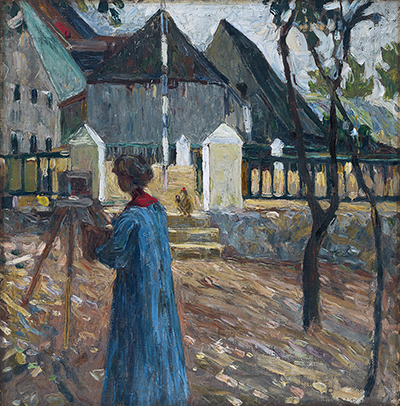
A woman in a long blue garment stands before an easel, with her back turned partly toward us. The easel points toward a group of high-roofed houses beyond a low wall and steps. Kandinsky makes us see both the painter and a little of the place she has chosen to paint, but he does not show us the surface of her canvas clearly enough to identify her subject. The woman is Gabriele Münter, an artist working alongside him in the Bavarian town of Kallmünz. Lenbachhaus identifies this near-square picture as Kallmünz – Gabriele Münter beim Malen II, made in summer 1903. The site's shorter English title, Gabriele Münter Painting, describes its subject but leaves out the place and the distinguishing II. [1].
The museum's identification matters because Kandinsky made another painting of Münter working at Kallmünz. Version I is a much smaller, horizontal oil on canvas board; the painting here is almost square and is oil on jute. A viewer looking for the river, bridge or umbrella associated with the first work would therefore be looking for details of the wrong picture. In version II, the painter in blue stands in front of houses and a spare foreground tree. The two works share a title and season, not an identical composition. [1]; [2].
Watch: Wassily Kandinsky
Five museum videos about Kandinsky’s art, sources of inspiration and the relationship between colour and music.
Vasily Kandinsky: Around the Circle
Curator Megan Fontanella introduces Kandinsky and the Guggenheim collection.
Watch on YouTubeAt a Glance
- Artist and date:Wassily Kandinsky, summer 1903.
- Owner's title:Kallmünz – Gabriele Münter beim Malen II; English descriptive title Gabriele Münter Painting.
- Medium and dimensions:Oil on jute, 58.2 × 58.5 × 2.5 cm.
- Collection:Städtische Galerie im Lenbachhaus und Kunstbau München, inventory GMS 14; gift from Gabriele Münter in 1957.
- Reverse inscription:Münter wrote “Kandinsky – M in Kallmünz 1903” on the back, according to the owner record.
- Subject:Münter at an easel in Kallmünz; the exact contents of her canvas are not established by this view.
- Image:Existing site image retained. Lenbachhaus explicitly labels its larger image CC0 1.0; a separate copy is reserved as an optional guide illustration.
Where this work sits in Kandinsky’s career
The Blue Rider
1903Composition VII
1913Composition VIII
1923Several Circles
1926Sky Blue
1940Contents
- A painter seen painting
- Kallmünz and the two artists
- Paint, surface and early style
- Two versions, one productive summer
- Frequently asked questions
- References
A painter seen painting
Münter occupies the lower half of the canvas. Her dark hair and small red collar interrupt the large blue shape of her clothing. The shoulders and arms angle toward the easel at the left. Her face is mostly withheld, so gesture and placement carry the description of her activity. The old page imagined that she was “concentrating hard,” that she wore a cloak to protect better clothes and that she was comparing each stroke with a particular scene. None of those thoughts is visible or recorded in the cited object account. What can be seen is a working artist at an easel, with Kandinsky choosing a position that includes both her and the surrounding architecture. [1].
The back of the easel is a set of diagonals against the rough earth. Kandinsky gives the foreground short brown, grey and pale yellow strokes. These marks do not specify every stone or patch of soil. They give the ground an uneven, walked-on texture and let the blue figure stand out. The setting is open to the air, but the architecture is prominent: a white pair of gateposts, steps, walls and dark, steep roofs rise behind Münter. A thin tree at the right edge frames the scene without enclosing it. The contrast between the light posts and the dark roofs makes the buildings legible even where their details are simplified. [1].
It is tempting to look over Münter's shoulder and call this a record of what she painted. That would go beyond the evidence. Kandinsky's composition brings the place and the painter into one view; it does not give a readable image on her canvas. Nor does the museum record name a particular house in the picture. The exact vantage point could be researched through contemporary photographs and sketchbooks, but the painting alone supports the broader Kallmünz setting recorded in its title and inscription. [1].
Kallmünz and the two artists
Lenbachhaus's account of the 1902–03 painting trips gives the portrait a more specific context than a general story about artists observing one another. Münter entered Kandinsky's Phalanx art school, whose classes were open to women and men. She joined a summer painting trip to Kochel in 1902 and another to Kallmünz in 1903. The museum describes the Kallmünz period as a productive, collaborative way of working, documented by paintings, photographs and sketchbooks. Their personal relationship was developing too, but neither fact makes Münter a passive subject here. She is presented in the act of making her own picture. [3].
The exchange ran in both directions. Münter made an oil sketch of Kandinsky painting a landscape on the castle hill at Kallmünz; the museum also notes a photograph of a related view. Kandinsky drew local impressions in sketchbooks, while Münter photographed the town and landscape. These works offer evidence of artists repeatedly looking at shared places and at each other at work. Münter's Kandinsky Painting a Landscape, however, is a distinct object by a different artist. Its ownership record helps establish the exchange; its photograph has its own rights notice and is not used as an illustration here. [3]; [4].
The phrase “Gabriele Münter painting” can also hide a second meaning in English: it may look like the name of a painting by Münter. Here the artist is Kandinsky and Münter is the depicted painter. The owner's German title names her action, beim Malen (“while painting”), and appends II to distinguish the version. An accurate caption needs both artists in their proper roles. Münter's work deserves its own record rather than being folded into Kandinsky's career as biography alone. [1]; [4].
Paint, surface and early style
Lenbachhaus catalogues the support as jute, a coarse woven material, rather than the generic canvas named by some secondary captions. The painting measures 58.2 cm high by 58.5 cm wide, with a depth of 2.5 cm in the museum record. Its almost square proportions help hold the standing figure against the large roofs. The upper half has a more stable architectural structure; the lower half has freer, broken marks. That difference can be read directly from the image without claiming a documented sequence of brushstrokes or an exact time spent outdoors. [1].
This is an early representational Kandinsky, made before the Blue Rider circle and long before his later geometric paintings. The picture still has a recognisable person, place and depth. At the same time, much of its energy comes from the handling of colour and paint: broad blue clothing, compressed dark roofs and restless small touches on the ground. It is useful to observe those choices in this work rather than treat the portrait merely as an imperfect preview of abstraction. Its subject is an artist working, and the painting gives visible weight to the encounter between painter, place and another painter looking on. [1]; [3].
The owner records a reverse inscription made by Münter: “Kandinsky – M in Kallmünz 1903.” That material note corroborates the place, maker and date after the fact. It is not the same as an inscription by Kandinsky signed on the painted face. The museum's provenance says Kandinsky transferred the work to Münter, who held it from 1926 until her 1957 gift to Lenbachhaus. The present credit line names the Gabriele Münter Foundation. The owner currently marks the work as not on display, a status that can change; it should not be turned into a permanent gallery-room claim. [1].
Two versions, one productive summer
Version I, inventory GMS 5, is a 24 × 33 cm oil on canvas board. Its horizontal format and the owner's river, bridge and umbrella descriptors distinguish it from the near-square version II, GMS 14. A comparison might show Kandinsky trying different ways to include Münter in a working landscape, but the records do not establish that one version was an immediate study for the other. The Roman numerals distinguish two catalogued works; they should not by themselves be made into a production timetable. [2]; [1].
The retained site image is small but sufficient to show the arrangement. Lenbachhaus places a CC0 1.0 notice beside its own reproduction of version II, and an 800 × 812 copy has been reserved as a possible guide image. A larger image is useful here for seeing the fast, separate marks on the ground and the shifts of paint in the blue garment. No larger image is needed to establish the object identity or support the article's account. [1].
The picture is most revealing when the painter is treated as its active centre. Münter stands between the viewer and the buildings, facing her own task. Kandinsky records that relation with firm architectural masses, an open patch of rough ground and a small figure whose blue clothing carries across the lower half. The record of collaboration from Kallmünz keeps this from becoming a simple scene of one famous artist watching another. It is a painting about working in a shared place, made by one member of a two-artist exchange. [3].
Kandinsky artworks directory
Frequently Asked Questions
Wassily Kandinsky painted the image shown here. Gabriele Münter is the painter depicted at the easel. She made separate artworks of Kandinsky at work during the same Kallmünz period. [1]; [3].
Lenbachhaus dates version II to summer 1903 and identifies the place in the title as Kallmünz, Bavaria. A reverse inscription by Münter also names Kallmünz and 1903. [1].
It is oil on jute, measuring 58.2 × 58.5 × 2.5 cm according to Lenbachhaus. The museum's medium should take precedence over generic online descriptions that call it oil on canvas. [1].
Version II is almost square and shows Münter in blue before houses. Version I is a smaller horizontal oil on canvas board; Lenbachhaus associates its image with a river, bridge and umbrella. The two have separate inventory numbers, GMS 14 and GMS 5. [1]; [2].
The image establishes that she is at an easel with Kallmünz architecture around her. It does not provide a sufficiently clear view of her canvas to identify its exact subject. [1].
It belongs to the Lenbachhaus in Munich, inventory GMS 14, following Münter's 1957 gift. The owner currently lists it as not on display; check the collection record for future display changes. [1].
Discussion
What do you notice first in Gabriele Münter Painting? Share a close observation or a question about the evidence for this work.
Comments are for comparing what we see and what the cited sources establish.
Reader Insights
How do the blue figure and dark roofs change each other’s weight?
What does Münter’s own Kallmünz painting add to the story of this shared summer?
What evidence might reveal more about the exact scene on her canvas?
Join the Conversation
Add your observation below and tell us which part of the artwork led you to it.
References
- Lenbachhaus, Kallmünz – Gabriele Münter beim Malen II, GMS 14. View source.
- Lenbachhaus, Kallmünz – Gabriele Münter beim Malen I, GMS 5. View source.
- Lenbachhaus, Under the Open Sky Kochel/Kallmünz exhibition wall text. View source.
- Lenbachhaus, Gabriele Münter, Kandinsky Painting a Landscape, GMS 649. View source.