 by Tom Gurney
Tom Gurney BSc (Hons) is an art history expert with over 20 years experience
Published on June 19, 2020 / Updated on October 14, 2023
Email: tomgurney1@gmail.com / Phone: +44 7429 011000
In Grey by Wassily Kandinsky: Introduction
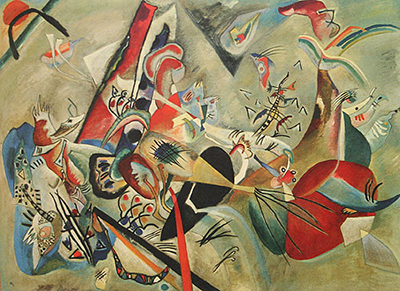
Wassily Kandinsky painted In Grey (Im Grau) in 1919, during his return to Russia after the First World War began. It is a substantial oil on canvas, 129 × 176 cm, now in the Centre Pompidou's Musée national d'art moderne. Across a muted ground, curved, pointed and fragmented forms appear to press together or drift apart. The canvas belongs to a period in which Kandinsky made pictures while also taking on major educational and museum responsibilities in Moscow. Calling those years a pause between Munich and the Bauhaus would overlook both the work and its public history. [1]; [6].
The existing image above reproduces the 1919 painting. A black, bow-like curve near the upper left is important to the title's history, but it is only one part of a crowded field. Shapes suggest architecture, landscape, boats or figures in some of Kandinsky's studies; in the finished oil those associations become less stable. The museum's owner record, the surviving watercolour and a separate pencil preparation let us distinguish documented evidence from a viewer's possible reading of a mark. [1]; [2].
Watch: Wassily Kandinsky
Five museum videos about Kandinsky’s art, sources of inspiration and the relationship between colour and music.
Vasily Kandinsky: Around the Circle
Curator Megan Fontanella introduces Kandinsky and the Guggenheim collection.
Watch on YouTubeAt a Glance
- Artist and date:Wassily Kandinsky, 1919.
- Owner title:Im Grau (Dans le gris); English In Grey.
- Medium and dimensions:Oil on canvas, 129 × 176 cm.
- Collection:Centre Pompidou, Musée national d'art moderne, Paris, AM 81-65-43.
- Acquisition:Nina Kandinsky's 1981 bequest.
- Earlier title:A crossed-out Russian title meaning Painting with the Black Bow/Arch; this is not the separate 1912 painting With the Black Arch.
Where this work sits in Kandinsky’s career
The Blue Rider
1903Composition VII
1913Composition VIII
1923Several Circles
1926Sky Blue
1940Contents
- A large canvas in the Moscow years
- Looking across the grey field
- What the studies show
- The black bow and two different paintings
- Kandinsky's later “dramatic period” remark
- Acquisition and a careful comparison
- Frequently asked questions
- References
A large canvas in the Moscow years
Kandinsky returned to Russia in 1914 after leaving Germany at the start of the war. The following years changed the conditions of his art: materials, household resources and institutions all shifted. He made watercolours, drawings, reverse-glass pictures, city views and oils. In Grey shows that the Moscow period was not confined to small paper experiments. Centre Pompidou's teaching guide identifies it among six paintings made in 1919 and documents its unusually large scale. [4]; [1].
The year was also full of organisational work. Kandinsky became the first director of the Museums of Painterly Culture in Moscow, contributing to a network intended to collect and show new art. These duties do not explain every formal decision in the canvas, but they place the painting alongside a wider effort to reconsider how art was produced, discussed and made public after the revolution. An artist's time in an institution can coexist with sustained painting. [4]; [6].
Centre Pompidou records that In Grey was given a prominent place at Kandinsky's Moscow retrospective in October 1920, in rooms at Dmitrovka. Nearby was Flottements aigus, another large work that the owner essay says is now lost. That exhibition evidence tells us In Grey mattered in the public presentation of his recent work. It also makes the surviving canvas particularly valuable for understanding a period from which not every important object remains available for direct comparison. [1].
Looking across the grey field
The title draws attention to grey, but the painting is not monochrome. Browns, reds, blues, greenish areas and pale marks appear against the subdued field. A strong red and black thrust near the upper centre meets looser forms below it. Dark lines cross coloured areas without always containing them. On the right, a large red shape and smaller curves help pull the eye outward; on the left, several compact clusters compete for attention. Describing these relationships is more reliable than naming every form as a specific object. [1].
The Centre Pompidou guide characterises the late Russian paintings as cooler and more austere than some pre-war Munich work. That is a comparative interpretation, not a rule that every colour here is cold or that Kandinsky abandoned expressive contrasts. A muted ground can make a small bright passage unusually forceful. The canvas's large scale also changes how the dense forms are seen: from a distance they can read as a turbulent overall arrangement; at closer range, individual strokes and intervals become more prominent. [4]; [1].
The grey ground has invited symbolic readings. A Centre Pompidou teaching essay relates Kandinsky's ideas about grey to arrested movement and considers the painting in the context of war and revolution. Such ideas can be useful if attributed as interpretation. They do not prove that every grey passage encodes a single feeling or a specific political position. One can see stillness in a colour while also noticing how many marks seem to rotate, collide or separate across it. The painting gives the viewer both restraint and activity. [5].
What the studies show
Centre Pompidou owns a 1919 watercolour and ink study for In Grey, 25.6 × 34.4 cm, catalogued as AM 81-65-110. The owner explicitly identifies it as a study for the painting. It has its own medium, dimensions and accession; it is not a smaller oil or a copy of the final canvas. The painting record also mentions a separate pencil preparation. Keeping these objects apart lets them provide evidence of development rather than treating “the study” as one vague source. [2]; [1].
The museum's account says motifs such as mountains, a sun, boats with rowers and other figures can be recognised more clearly in several preparatory works. In the oil, individual signs are transformed, compressed or left ambiguous. It would be too neat to draw a line from each legible study motif to a precisely matching patch of colour on the canvas. The studies help establish that Kandinsky planned and revised, while the finished work remains a distinct visual problem. [4]; [2].
One small difference is especially instructive. The owner essay says the bow-like douga form is visible in the watercolour but absent from an earlier pencil drawing. Its appearance in one stage and not another shows a change in emphasis during preparation. The exact order of every mark in the final oil cannot be reconstructed from that observation alone. It does show that an important title-bearing motif was not fixed across all surviving stages. [1].
The black bow and two different paintings
The owner essay reports a Russian title that Kandinsky wrote and then crossed out, meaning Painting with the Black Bow or Painting with the Black Arch. The phrase refers to the curved douga motif. It is an earlier name for the 1919 canvas, not the current museum title. Because the phrase resembles the name of Kandinsky's 1912 Mit dem schwarzen Bogen (With the Black Arch), readers can easily merge two distinct paintings. Their dates, sizes and object numbers disprove that identification. [1]; [3].
The 1912 work was painted in Munich and is also held by Centre Pompidou, but it is a separate oil, 189 × 198 cm, inventory AM 1976-852. In Grey is a 1919 Moscow-period oil, 129 × 176 cm, inventory AM 81-65-43. A related curved form may recur in an artist's vocabulary; it does not make two canvases versions of the same object. The route Picture with a Black Arch concerns the earlier painting. [3]; [1].
The former title is still useful evidence. It shows Kandinsky considered foregrounding the bow before choosing Im Grau. A title can guide attention without supplying a complete key to the image. The current title invites a reading of the whole muted atmosphere; the crossed-out title points to one salient curve. Neither can alone settle the meaning of every fragmented form. This is why the museum's title history belongs beside close looking rather than being reduced to a trivia note. [1].
Kandinsky's later “dramatic period” remark
In a 1936 letter to Hilla Rebay, Kandinsky called In Grey the conclusion of a “dramatic period” in which he accumulated many forms, as quoted by Centre Pompidou. The statement is important because it records how he looked back on the painting seventeen years after making it. It should not be presented as a diary entry from 1919 or as the only possible interpretation of the work. Memory and later artistic priorities can shape a retrospective description. [1].
The same museum's teaching essay connects the period to upheaval, loss and uncertainty. Those conditions were real, but a direct psychological explanation for each sign would need stronger evidence. The artist's later phrase supports a description of dense accumulation and a felt break in his own career. It does not establish that all the painting's red, black and grey forms represent particular events of revolution. The studies, 1920 display and visible organisation offer additional evidence to set alongside the letter. [5]; [1].
The language of “conclusion” also risks making 1919 a clean dividing line. Kandinsky's Russian-period works vary by medium and subject, and a later turn toward clearer geometry did not happen in one instant. In Grey can be a key work in a broad change without being the final example of a sealed-off style. Its ambiguous signs and planned density make more sense when compared with other dated Russian works, including city views, paper studies and oils, than when assigned a rigid position on a simple abstract-to-geometric ladder. [4]; [6].
Acquisition and a careful comparison
The canvas entered Centre Pompidou's collection through Nina Kandinsky's 1981 bequest. The watercolour study entered with the same bequest under a different accession number. The museum's current record identifies the work and its owner even when its display or loan location changes. This article therefore does not promise that a visitor can see it in a particular gallery on a particular day. It gives the collection and source link so that current exhibition information can be checked separately. [1]; [2].
In Grey stands between several different kinds of evidence: the oil itself, preparatory paper works, the crossed-out earlier title, a Moscow exhibition and Kandinsky's later letter. Each answers a different question. The canvas shows how colours and marks interact; the studies document stages of thinking; the title and exhibition place it in a public history; the letter records a later self-interpretation. None should silently replace the others. Reading across them helps recover the active, varied nature of Kandinsky's Moscow years. [1]; [2].
Kandinsky artworks directory
Frequently Asked Questions
Centre Pompidou dates the oil to 1919, during Kandinsky's Moscow years. It was later shown prominently in his October 1920 Moscow retrospective. [1].
It belongs to the Centre Pompidou's Musée national d'art moderne, inventory AM 81-65-43, and entered through Nina Kandinsky's 1981 bequest. Display and loans can change; consult the owner's live record for a visit. [1].
No. In Grey is a 1919 oil, 129 × 176 cm, with an early crossed-out black-arch title. With the Black Arch is a separate Munich painting of 1912, 189 × 198 cm, in a different Pompidou accession. [1]; [3].
Yes. Centre Pompidou owns a 1919 watercolour and ink study, AM 81-65-110, and its painting essay mentions another pencil preparation. The watercolour is a distinct work on paper, not a smaller oil. [2]; [1].
The grey is a major visual ground, and a Centre Pompidou teaching essay connects it to Kandinsky's colour ideas and to possible feelings of halted movement. Those are interpretations, not a proven single code for every mark in the picture. [5]; [1].
He used that phrase in a 1936 letter to Hilla Rebay to describe the dense accumulation of forms in In Grey. It is a later reflection on the 1919 painting, not a contemporaneous statement made while completing it. [1].
Discussion
What do you notice first in In Grey? Share a close observation or a question about the evidence for this work.
Comments are for comparing what we see and what the cited sources establish.
Reader Insights
Which bright passage most strongly resists the muted grey ground?
What changes when you compare the watercolour study with the 1919 oil?
How can the crossed-out black-arch title be distinguished from the separate 1912 painting?
Join the Conversation
Add your observation below and tell us which part of the artwork led you to it.
References
- Centre Pompidou, Im Grau (Dans le gris). Owner record, object facts, title history, 1920 exhibition and 1936 letter. View source.
- Centre Pompidou, study for Im Grau. Watercolour and ink study, AM 81-65-110. View source.
- Centre Pompidou, Mit dem schwarzen Bogen. Distinct 1912 painting. View source.
- Centre Pompidou, 2009 Kandinsky teaching guide. 1919 production and preparatory imagery. View source.
- Centre Pompidou, Kandinsky teaching essay. Grey and historical interpretation. View source.
- MoMA, Kandinsky: Compositions chronology. Moscow institutions and broader dating. View source.