 by Tom Gurney
Tom Gurney BSc (Hons) is an art history expert with over 20 years experience
Published on June 19, 2020 / Updated on October 14, 2023
Email: tomgurney1@gmail.com / Phone: +44 7429 011000
An Intimate Party (Une Fête intime) by Wassily Kandinsky: Introduction
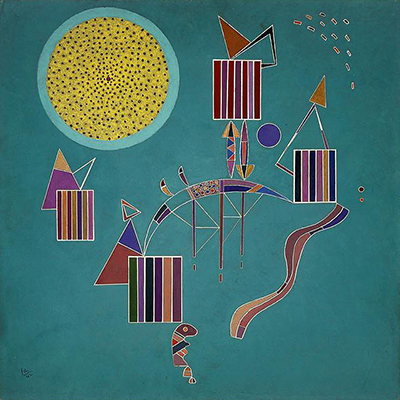
A large yellow disc hovers at the upper left of Une Fête intime, its surface crowded with tiny dark marks. Around it, striped blocks, triangles, loops and short lines seem to meet on a blue-green ground. The forms suggest an occasion without depicting a conventional gathering of people. Kandinsky made this compact painting in 1942. The Centre Pompidou identifies it as oil and tempera on cardboard, 49.2 × 49.6 cm, inventory AM 81-65-70. Its French title can be translated as An Intimate Party or An Intimate Celebration. [1].
This page keeps its longstanding “Intime Message” web address, but the picture reproduced here is not the owner's Intime Mitteilung (Message intime). That is a separate, 1925 oval painting in the same collection. The two works have different dates, formats, materials, dimensions and inventory numbers. Correctly naming the 1942 square matters because a title can lead a viewer to the wrong artwork before the looking has begun. [1]; [3].
Watch: Wassily Kandinsky
Five museum videos about Kandinsky’s art, sources of inspiration and the relationship between colour and music.
Vasily Kandinsky: Around the Circle
Curator Megan Fontanella introduces Kandinsky and the Guggenheim collection.
Watch on YouTubeAt a Glance
- Artist and owner title:Vassily Kandinsky, Une Fête intime (An Intimate Party).
- Date:1942, on the owner record and in an inscription on the painting.
- Medium and size:Oil and tempera on cardboard, 49.2 × 49.6 cm.
- Collection:Centre Pompidou, Musée national d'art moderne, Paris, inventory AM 81-65-70; acquired through Nina Kandinsky's 1981 bequest.
- Visual structure:A densely dotted yellow circle at upper left, striped uprights, small triangles and arcs set on an open blue-green field.
- Related work on paper:A [1942] graphite study for Une Fête intime, Centre Pompidou AM 81-65-606 (V), is a distinct object.
- Title distinction:Intime Mitteilung (Message intime) is a different 1925 oval oil, Centre Pompidou AM 81-65-46.
Where this work sits in Kandinsky’s career
The Blue Rider
1903Composition VII
1913Composition VIII
1923Several Circles
1926Sky Blue
1940Contents
- A gathering of shapes
- How the small painting holds together
- A study and a finished work
- Why “Intimate Message” points elsewhere
- Frequently asked questions
- References
A gathering of shapes
The blue-green ground stretches to the edges without the deep space of a room or landscape. Against it, the large disc occupies much of the upper left. Its pale blue ring separates the yellow interior from the surrounding field, and the many little marks within make it look unusually active. It could call to mind a light, a planet or a decorated object, but the owner does not fix it as any of these. What can be seen securely is a strong circular centre of attention, balanced against a group of smaller, sharper forms. [1].
Several upright structures have vertical stripes in dark red, violet, cream and black. Triangles sit above or beside some of them; thin rods and lines cross between them. Near the middle, a pale arch curves over a delicate arrangement of smaller marks. Lower down, a twisting band changes colour as it descends toward the right. Those features create a sense of movement from one group to another. They do not need to be assigned roles as tables, guests or musical instruments for the painting to feel animated. [1].
The title introduces a social word, fête, into an image made mostly of abstract elements. It invites a viewer to notice how shapes cluster, separate and appear to respond to one another. The circle can seem like an energetic presence; the striped units may read as a gathering below it. Yet this is a reading prompted by title and composition, not proof of a hidden scene. Kandinsky leaves enough space between the groups for each to keep its own character. The “party” takes place in relationships among forms. [1].
How the small painting holds together
At 49.2 × 49.6 cm, the work is almost square and modest in size. Its forms vary greatly in scale. The yellow disc is broad and dense; the smallest coloured dashes on the right are tiny and isolated. The striped verticals sit between these extremes. Moving from large to small makes the eye cross the quiet blue-green intervals, so empty ground becomes a working part of the arrangement. This is observable in the owner's reproduction; it does not require a claim about Kandinsky's private intention. [1].
Colour also keeps the composition from flattening into one repeated pattern. Yellow glows inside the upper-left circle. Reds and purples deepen the blocks below, while pale blue outlines and white segments give some forms a crisp edge. A coloured ribbon to the right of centre bends down through the field, interrupting the grid-like effect of the uprights. Curves and straight lines thus answer one another, and the bright disc does not monopolise attention indefinitely. [1].
The owner lists the medium as oil and tempera on cardboard. That combination is part of the object's identity, not a reason to assume a particular order of paint layers from a screen image. Small marks may look precise, and broad colour areas may appear smooth, but the reproduction cannot establish every technique by which they were laid down. The entry's reliable physical facts are the support, media and measurements supplied by the museum. [1].
A study and a finished work
The Centre Pompidou also holds an Étude pour Une Fête intime, inventory AM 81-65-606 (V). Its record dates the sheet [1942], identifies it as graphite on paper and gives dimensions of 16 × 16.4 cm. The museum describes it as being on the verso of a sheet. The study's title directly connects it to the finished painting; its different size and medium make clear that it is a separate object. It entered through the same 1981 Nina Kandinsky bequest. [2].
A preparatory drawing shows that the painting's arrangement had a life in another medium. It does not tell us exactly when every element was settled, or whether Kandinsky followed the drawing without change. The museum dates the study within brackets, indicating an assigned rather than explicitly inscribed year in its public record. The secure point is the owner's identification of a related graphite sheet and the finished 1942 oil-and-tempera work. Any fuller account of how one became the other would call for comparing the objects directly. [2]; [1].
The finished painting carries inscriptions recorded by the museum, including “VK 42” and a further mark with a number and the year 1942. The owner also identifies it as number 1139 in Hans Konrad Roethel and Jean K. Benjamin's catalogue raisonné of the painted work. These identifiers give a check on the object beyond the resemblance of a small online image. They matter especially where titles have been mixed up on other sites. [1].
Why “Intimate Message” points elsewhere
The Centre Pompidou's Intime Mitteilung (Message intime) was made in 1925, seventeen years before Une Fête intime. It is an oil on oval cardboard, measuring 36.7 × 31.4 cm, with inventory number AM 81-65-46. Even without an image comparison, the oval support and much smaller dimensions distinguish it from the almost square, blue-green 1942 painting. The matching word “intime” can easily lead to confusion when titles are translated or shortened. [3]; [1].
The error is more than a matter of wording. A reader seeking Message intime should arrive at the 1925 oval, while a reader looking at the yellow dotted disc and striped shapes is looking at Une Fête intime. This page's older URL remains for continuity, but its visible title, facts and analysis follow the image and the owning museum's 1942 object record. It would be misleading to transfer the 1925 title or medium to this painting simply because the phrases sound similar in English. [1]; [3].
The museum records Nina Kandinsky's 1981 bequest as the 1942 painting's acquisition. Its catalogue and related study locate the work in a documented group of Kandinsky material rather than in an anonymous succession of copies. The present display or loan location can change; the Centre Pompidou's collection record is the sound place to check it before a visit. The enduring facts here are the object's identity, material, date and collection history. [1]; [2].
Une Fête intime draws much of its life from the contrast between one crowded disc and the more widely spaced structures beneath it. Its name encourages a sense of encounter, but no invented cast of characters is needed. The forms themselves create the occasion. Keeping the owner title attached to this particular 1942 picture lets a viewer explore that effect without confusing it with Kandinsky's separate oval Message intime. [1]; [3].
Kandinsky artworks directory
Frequently Asked Questions
The Centre Pompidou calls the pictured 1942 work Une Fête intime, rendered here as An Intimate Party. “Intime Message” is the legacy wording of this page's address. [1].
No. The museum's Intime Mitteilung (Message intime) is a 1925 oil on oval cardboard, AM 81-65-46. The painting shown here is an almost square 1942 oil and tempera on cardboard, AM 81-65-70. [3]; [1].
Its owner title suggests a celebration, but the museum record does not identify literal guests or a particular event. Visible elements include a dotted yellow disc, striped uprights, arcs, triangles and small coloured marks on a blue-green ground. [1].
The Centre Pompidou records oil and tempera on cardboard, 49.2 × 49.6 cm. [1].
The museum owns a related [1942] graphite study, 16 × 16.4 cm, inventory AM 81-65-606 (V). It is a separate work on paper. [2].
It was acquired through Nina Kandinsky's bequest in 1981, according to the owner's record. Its inventory number is AM 81-65-70. [1].
Discussion
What do you notice first in An Intimate Party (Une Fête intime)? Share a close observation or a question about the evidence for this work.
Comments are for comparing what we see and what the cited sources establish.
Reader Insights
How does the dotted yellow disc balance the striped upright forms?
What does the title invite you to see without establishing literal guests?
Why is the owner’s 1925 Message intime a separate object?
Join the Conversation
Add your observation below and tell us which part of the artwork led you to it.
References
- Centre Pompidou, Une Fête intime, 1942, AM 81-65-70. View source.
- Centre Pompidou, Étude pour Une Fête intime, [1942], AM 81-65-606 (V). View source.
- Centre Pompidou, distinct Intime Mitteilung (Message intime), 1925, AM 81-65-46. View source.