 by Tom Gurney
Tom Gurney BSc (Hons) is an art history expert with over 20 years experience
Published on June 19, 2020 / Updated on October 14, 2023
Email: tomgurney1@gmail.com / Phone: +44 7429 011000
Painting on Light Ground by Wassily Kandinsky: Introduction
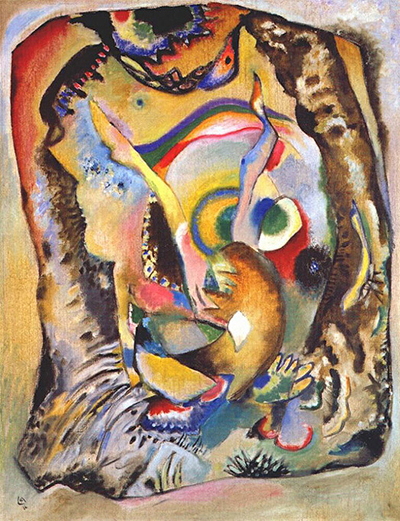
Against a pale surrounding field, an irregular cluster of colour seems to gather and turn inward. Curved bands, dark borders and bright fragments overlap so closely that no single shape can be separated without immediately meeting another. Wassily Kandinsky called the work Bild auf hellem Grund, usually rendered in English as Painting on Light Ground. The Centre Pompidou records it as a 1916 oil painting on canvas, 100 × 78 cm, inventory AM 1976-854. Crucially, its record says it was painted in Sweden. [1].
The picture belongs to a period that can disappear between stories of Kandinsky's Munich breakthrough and his later Bauhaus geometry. The First World War had forced the Russian artist to leave Germany. Malmö Konsthall records a Swedish visit from December 1915 to March 1916, during which he exhibited, made contacts and created works. The owner record's Swedish place of production makes this canvas part of that specific episode. The painting does not disclose a Swedish landscape or event; its title points instead to the contrast between a light field and the dense forms it holds. [2]; [1].
Watch: Wassily Kandinsky
Five museum videos about Kandinsky’s art, sources of inspiration and the relationship between colour and music.
Vasily Kandinsky: Around the Circle
Curator Megan Fontanella introduces Kandinsky and the Guggenheim collection.
Watch on YouTubeAt a Glance
- Artist and owner title:Vassily Kandinsky, Bild auf hellem Grund (Tableau sur fond clair); English: Painting on Light Ground.
- Date:1916, supported by the owner catalogue and an inscription VK / 16.
- Medium and size:Oil on canvas, 100 × 78 cm.
- Collection:Centre Pompidou, Musée national d'art moderne, Paris, AM 1976-854; gift from Nina Kandinsky in 1976.
- Place of production:The museum states Sweden.
- Visible design:A compact, multicoloured central field, curved bands, dark rough contours and a pale surrounding ground.
- Reading limit:The owner classifies it as an abstract composition; its record does not identify literal figures or a detailed symbolic programme.
Where this work sits in Kandinsky’s career
The Blue Rider
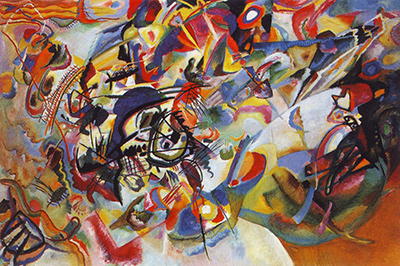
1903Composition VII
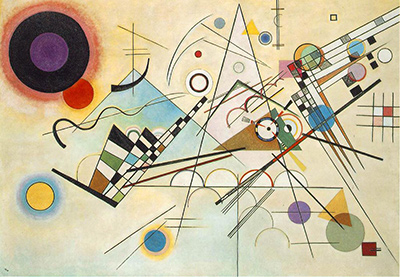
1913Composition VIII
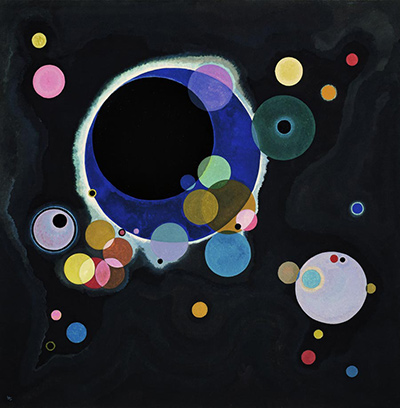
1923Several Circles
1926Sky Blue
1940Contents
- The light ground and the crowded centre
- An oil painting made in Sweden
- The evidence in the museum record
- Abstraction without a prescribed subject
- Frequently asked questions
- References
The light ground and the crowded centre
The title is a useful first instruction for looking. Much of the activity is gathered inside an uneven dark-edged zone, while the lighter outer area lets the complex centre stand apart. That distinction is not perfectly clean. Parts of the coloured cluster press towards the top and sides, and pale colour also appears within it. The work's effect comes from the negotiation between enclosure and opening, rather than a simple figure pasted on a white sheet. [1].
Near the middle, arcs of red, yellow, green and blue run alongside one another. They may first seem like a rainbow, but they do not resolve into a natural sky. Around them, dark and ochre shapes make a rough frame; smaller patches of pink, blue and green break up the interior. Some edges are firm, while others appear rubbed, feathered or interrupted. The eye can follow a curve for a moment, then lose it in a more complicated crossing. These are visible relationships, not evidence that the artist assigned a definite name to each form. [1].
The painting is upright, a fact the Centre Pompidou includes in its subject tags. Its vertical format encourages a movement from lower dark marks toward the arches and upper colour, but the central forms do not form a tidy upward path. A broad warm shape bends through the lower half. Fine black marks push in from several directions. The pale border gives the whole an almost contained appearance, while the internal lines remain unsettled. [1].
Kandinsky's decision to leave so much pale ground visible changes the weight of each coloured section. A red accent becomes more intense beside near-white; a dark contour feels heavier where it cuts across a light opening. The picture's title foregrounds that relationship, rather than proposing a landscape, a character or an event. A viewer may imagine organic or architectural echoes, but the museum's catalogue does not offer a key that would make those associations certain. [1].
An oil painting made in Sweden
The owner gives the place of production as Sweden, a particularly valuable piece of information because the picture itself is abstract. Malmö Konsthall's account places Kandinsky in the country for a short period spanning late 1915 and early 1916. He came to exhibit, build contacts and make art. Those facts locate Painting on Light Ground in a real working situation without requiring the canvas to depict where he stayed or what he saw. [1]; [2].
The First World War had interrupted Kandinsky's Munich life and artistic network. His Swedish stay was short, between longer periods elsewhere, but the canvas shows that his abstract painting did not simply pause after 1914. It also complicates a very neat division between an expressive early phase and a geometric later one. The forms here are neither the sharply separated Bauhaus circles of the 1920s nor an identifiable scene from his early landscapes. They are compressed, shifting and thoroughly painterly. [2]; [1].
The canvas is substantial: one metre high, with a width of 78 cm. It is also explicitly oil on canvas, not a watercolour. The colour layering and rough boundaries belong to a physical painted surface. Online reproductions help identify its arrangement, but the owner's measurements keep the viewer aware of the painting's real scale. The museum's catalogue number AM 1976-854 identifies this specific object even when its title is translated differently. [1].
The evidence in the museum record
The Centre Pompidou gives the German title Bild auf hellem Grund and the French Tableau sur fond clair. Both foreground the light ground. Its bibliography also notes a Russian title, Na svetlom fone, used in a later exhibition catalogue. These variants are useful for finding the same painting across languages; they do not indicate three different works. The owner's inventory number, medium, size and image provide the stronger identity check. [1].
The record transcribes VK / 16 on the painting and a further notation giving Kandinsky's name or initials, a number and the title Auf hellem Grund. Such inscriptions support the 1916 date and link the work to the artist's own title. The museum also records a 1976 donation by Nina Kandinsky, through which the painting entered its collection. These details show how a present museum identification is built from the object as well as later cataloguing. [1].
The Centre Pompidou's bibliography cites the Kandinsky oil-painting catalogue raisonné and several exhibition catalogues, including studies of the Russian years and of Kandinsky's work in Sweden. The online object record does not reproduce their arguments. For this page, the secure claims are the owner's date, material, place of production, dimensions, inscriptions and acquisition, plus cautious description of what the image shows. More elaborate claims about particular motifs would need a directly checked scholarly argument. [1].
The painting's collection location and display location are also different questions. The Pompidou owns AM 1976-854, but works may travel on loan or move between galleries. The owner record is the appropriate source for current display information. The enduring facts of the canvas are its 1916 date, Swedish production, oil medium and the vivid central structure set against light ground. [1].
Abstraction without a prescribed subject
It is tempting to turn the dense central mass into a creature, a landscape or a hidden story. The record calls the work an abstract composition and supplies no official identification of such a subject. That does not make the image empty. Its red arcs, blue and green passages, rough dark frame and pale surround give the viewer many concrete things to observe. Kandinsky's abstraction asks the eye to work among those relationships without requiring them to become a single named scene. [1].
The contrast of compact centre and open ground can also be felt at different distances. Close attention reveals small black marks and changes of texture. From farther back, the painting reads as a large organic cluster almost held by its dark edges. A digital image makes this shift less physical, but its structure is still visible. The title helps steer attention to the surrounding light that makes the centre so forceful. [1].
Painting on Light Ground is therefore a distinctive 1916 canvas, not a generic example of Kandinsky's later geometric manner. Its owner documentation roots it in a brief Swedish visit, and its inscribed title points to the visual contrast that organises it. The painting holds a great deal of internal movement inside a pale field, inviting sustained looking without pretending that every shape has a fixed meaning. [1]; [2].
Kandinsky artworks directory
Frequently Asked Questions
The Centre Pompidou dates it 1916, and its detailed record transcribes the signature VK / 16. [1].
The owner states that it was painted in Sweden. Malmö Konsthall records Kandinsky's Swedish stay from December 1915 to March 1916. [1]; [2].
It is oil on canvas, 100 × 78 cm. The portrait-format picture belongs to the Centre Pompidou. [1].
The German Bild auf hellem Grund means a picture or painting on a light ground. The museum's French title, Tableau sur fond clair, expresses the same contrast. [1].
The museum classifies it as an abstract composition and does not identify a literal subject. Viewers may find associations in the dense forms, but those should remain interpretations. [1].
It belongs to the Centre Pompidou, Musée national d'art moderne, Paris, inventory AM 1976-854. Nina Kandinsky donated it in 1976; check the museum for current display or loan information. [1].
Discussion
What do you notice first in Painting on Light Ground? Share a close observation or a question about the evidence for this work.
Comments are for comparing what we see and what the cited sources establish.
Reader Insights
How does the pale surrounding field change the weight of the central forms?
Which coloured arcs or small marks keep your eye moving within the cluster?
What does the recorded Swedish place of production add to your understanding of this abstract work?
Join the Conversation
Add your observation below and tell us which part of the artwork led you to it.
References
- Centre Pompidou, Bild auf hellem Grund, AM 1976-854. View source.
- Malmö Konsthall, Kandinsky och Sverige: Malmö 1914 – Stockholm 1916. View source.