by Tom Gurney
Tom Gurney BSc (Hons) is an art history expert with over 20 years experience
Published on June 19, 2020 / Updated on October 14, 2023
Email: tomgurney1@gmail.com / Phone: +44 7429 011000
Small Worlds X by Wassily Kandinsky: Introduction
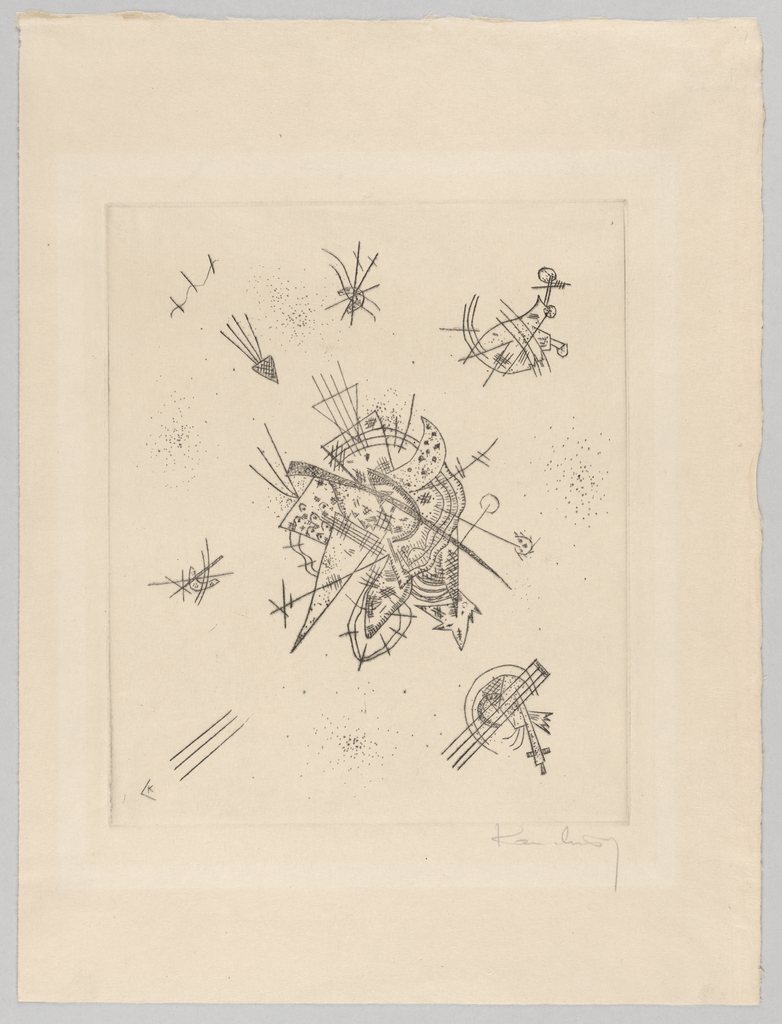
A compact storm of lines occupies the centre of Wassily Kandinsky's Small Worlds X. Thin arcs, sharp diagonals, crossed hatching and pinprick dots form a dense cluster, while smaller marks float around it across a broad field of bare paper. The image has no painted colour; the variety comes from how differently black lines can be made to press, scrape and gather. The Museum of Modern Art identifies this 1922 print as a drypoint from Kandinsky's twelve-part portfolio Kleine Welten, or Small Worlds. MoMA's example is 399.1941.1. A separate impression in the Lenbachhaus, G 13131-13, provides the image shown here. [1]; [2].
The title invites a large idea into a small sheet. MoMA's gallery text proposes that each print in the portfolio works as an independent microcosm. On this plate, one concentrated gathering of forms seems to have satellites: short slashes, loose crosses, dots and arc-like fragments spread out but do not break the composition apart. This is a print about the expressive force of marks and their relationships, not an early landscape in black and white. [1].
Annotated details in Small Worlds X
Select a numbered point to examine three close views of the work.
 123
Select a number to reach its detail.
Details from SMALL WORLDS X
Three close views of the work.
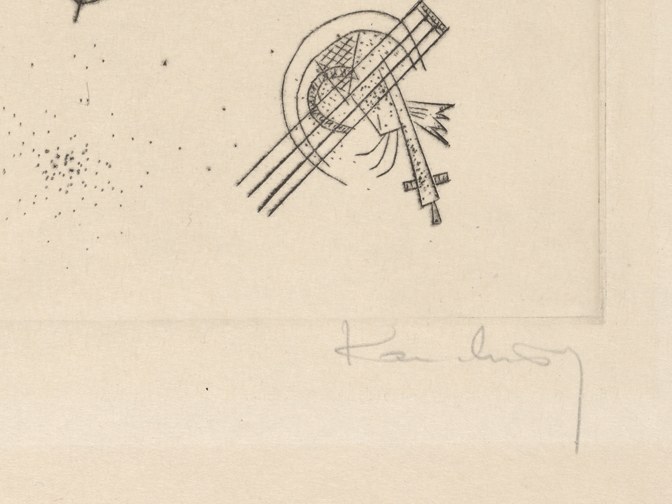
Central cluster
Fine marks and small shapes gather at the centre of the printed image.
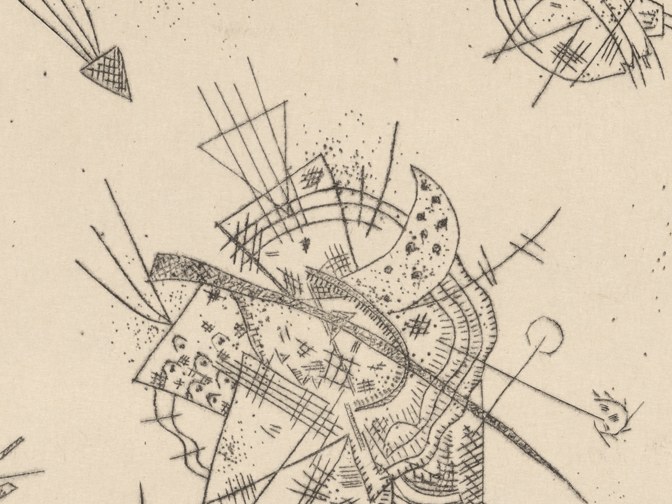
Lower marks
A compact group of strokes sits below the main cluster.
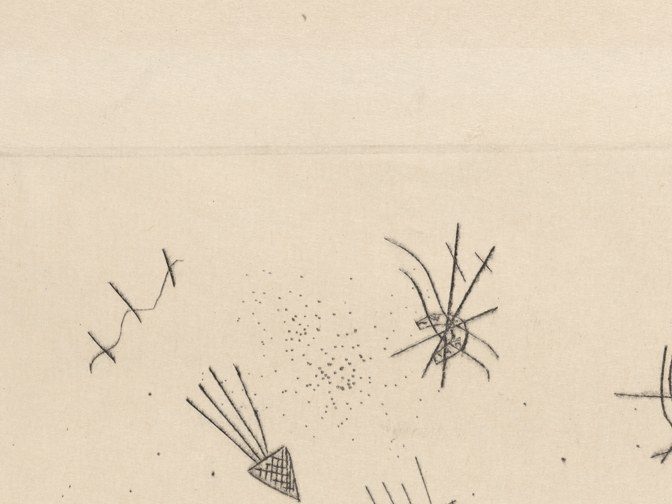
Open upper field
Isolated marks leave generous blank paper around them.
Lenbachhaus image, CC0 1.0; this is the Lenbachhaus impression. View image source and terms.
Watch: Wassily Kandinsky
Five museum videos about Kandinsky’s art, sources of inspiration and the relationship between colour and music.
Vasily Kandinsky: Around the Circle
Curator Megan Fontanella introduces Kandinsky and the Guggenheim collection.
Watch on YouTubeAt a Glance
- Artist and title:Wassily Kandinsky, Small Worlds X (Kleine Welten X), plate X in the Small Worlds portfolio.
- Date and technique:1922, drypoint print.
- Portfolio:Twelve abstract prints made using several printmaking methods, published by Propyläen-Verlag, Berlin and printed at the Staatliches Bauhaus, Weimar, according to MoMA's record.
- MoMA impression:399.1941.1; plate 23.9 × 19.8 cm, sheet 30 × 26.8 cm.
- Illustrated impression:Lenbachhaus G 13131-13, acquired in 1957; its catalogue records 37.8 × 28.3 cm overall and provides the full-sheet image.
- Visible design:A dense central assemblage of arcs, pointed shapes, hatching and dots, with smaller linear clusters in ample unprinted paper.
- Different from a painting:The work is an intaglio print made from a metal plate, not a canvas or a landscape study.
Where this work sits in Kandinsky’s career
The Blue Rider
1903Composition VII
1913Composition VIII
1923Several Circles
1926Sky Blue
1940Contents
- Annotated details
- An image assembled from lines
- What drypoint adds
- One of twelve small worlds
- Different impressions, stable identity
- Frequently asked questions
- References
An image assembled from lines
Most of the page remains open. At the centre, narrow straight lines cross curved ones, and a long point drives down and left. Short repeated strokes make some patches almost dark, while a more delicate spray of dots appears between and beyond them. Several shapes seem to overlap without becoming a stable building, body or object. The eye moves from the central knot to the smaller formations above and to either side, then returns to see how much variety Kandinsky achieves with only printed black. [2].
The blank paper is a working part of the design. A small group of marks at the lower right is separated from the centre by a broad interval; three parallel strokes at the lower left lead the eye inward without touching the main form. Dots scatter into spaces that would otherwise appear still. These breaks give the print a sense of distance and movement while offering no conventional horizon. The overall arrangement can suggest a constellation, but the image itself does not label stars or planets. [2]; [1].
Crosshatching supplies another rhythm. Lines lean across one another, tightening some zones while leaving others nearly transparent. In a painting, colour and brushwork could separate forms; here pressure, density and direction do that work. The pointed diagonal near the centre looks forceful partly because finer strokes surround it. A small arc may read as a boundary until another line passes through. Kandinsky makes uncertainty useful: each fragment participates in the whole without settling into a named object. [2].
What drypoint adds
Drypoint is an intaglio method. Lines are cut directly into a metal plate, and ink held in those marks transfers to damp paper under pressure. The raised burr at the edge of a drypoint line can produce a softer, darker effect than a cleanly etched groove. This general process helps explain why seemingly similar strokes can have different weight, although a screen image cannot reveal the exact burr or pressure of every mark in a particular impression. MoMA and the Centre Pompidou both identify Small Worlds X specifically as drypoint; the Lenbachhaus uses the broader German classification Radierung. [1]; [4]; [3]; [2].
In a MoMA publication excerpt, curator Heather Hess pays particular attention to the print's dots. She notes how the constellation around the centre cuts deeply into the paper's surface. That description reminds us that the image is not simply a thin drawing laid on top of a white field. The plate and press leave a physical event in the sheet. The Lenbachhaus photograph shows the wider paper and faint rectangular plate impression, giving more sense of this physical object than a tightly cropped reproduction. [1]; [2].
MoMA's catalogue gives its own impression's plate as 23.9 × 19.8 cm and sheet as 30 × 26.8 cm. The Lenbachhaus records 37.8 × 28.3 cm for its impression. Those are measurements supplied by two different institutions for two different holdings. They should not be compressed into a single universal size for every impression in the portfolio. The image here comes from the Lenbachhaus copy, which also lets the viewer see the full sheet and Kandinsky's mark at the lower margin. [1]; [2].
One of twelve small worlds
Kandinsky's portfolio contains twelve prints. The museum records show that he used drypoint, woodcut and lithography within the set, exploiting their different ways of making line, plane and texture. For this plate, the specific technique is secure: X is a drypoint. It belongs to a deliberately varied print experiment rather than a series made in just one method. [1].
MoMA's record names Propyläen-Verlag in Berlin as publisher and the Staatliches Bauhaus in Weimar as printer. It gives an edition of 230, with thirty deluxe and two hundred regular copies on different papers. These details place the image within a published project intended to exist in multiple impressions. A museum may own one sheet or a full portfolio; neither object is the unique original in the way a single oil canvas can be. Comparing impressions can reveal differences in paper, inking or wear. [1].
The portfolio appeared in 1922, shortly after Kandinsky began teaching at the Bauhaus, according to MoMA's gallery label. It is tempting to read the print's crossed lines and arcs as a direct illustration of later Bauhaus theory. The museum's account is more grounded: Kandinsky chose the print techniques for their different expressive possibilities and later developed his ideas about point and line further. Small Worlds X is an early and concrete printmaking test of those concerns, not a diagram copied from a later textbook. [1].
MoMA suggests that each plate can be viewed as an autonomous world. That idea does not require an astronomical picture. The central cluster, isolated surrounding marks and untouched paper create a self-contained space of relations. Their effect depends on scale: the work is small enough to invite close inspection, yet the intervals around its centre can feel expansive. The title gives permission to imagine a “world” without prescribing a literal scene. [1].
Different impressions, stable identity
Prints often appear online as if every photograph showed the same individual sheet. Here the institutional records keep the copies separate. The Lenbachhaus holds G 13131-13, acquired in 1957. MoMA owns 399.1941.1, recorded as a purchase, and the Centre Pompidou catalogues another example within a portfolio bequeathed by Nina Kandinsky in 1981. All identify plate X and the 1922 portfolio, but their inventory numbers and measurements belong to their own holdings. [2]; [1]; [3].
The Lenbachhaus catalogue calls its technique Radierung, a general German term for this family of intaglio prints. MoMA and the Pompidou specify drypoint. Using the more precise English term, while noting the broader German classification, keeps the page from becoming a vague description of a “drawing” or an incorrect account of a woodcut. The numbered title is also important: Small Worlds X is only one plate among twelve, not the entire portfolio. [1]; [2]; [3].
At first glance, the print's open paper can make it look light and quick. Longer looking reveals how carefully the marks are spaced and varied. A firm diagonal, delicate punctures and scattered satellites create energy without painted colour. That economy is the particular strength of Small Worlds X: Kandinsky makes a small sheet feel internally active and broad enough for a world of its own. [1]; [2].
Kandinsky artworks directory
Frequently Asked Questions
It is plate X in Kandinsky's twelve-print Small Worlds (Kleine Welten) portfolio, published in 1922. This plate is a drypoint. [1].
No. It is an abstract intaglio print made from a metal plate. Its lines and dots form an independent composition without a conventional landscape horizon. [1]; [2].
In drypoint, a pointed tool cuts the design into a metal plate. Ink held in the lines is pressed onto paper; the burr of cut metal can give a line a soft, dark edge. MoMA identifies this particular plate as drypoint. [4]; [1].
No. The portfolio uses drypoint, woodcut and lithography, allowing Kandinsky to test the expressive properties of different print methods. [1].
MoMA gives dimensions for its plate and sheet, while the Lenbachhaus gives measurements for its own impression. These are distinct holdings, and museums may measure different parts of the print. [1]; [2].
Discussion
What do you notice first in Small Worlds X? Share a close observation or a question about the evidence for this work.
Comments are for comparing what we see and what the cited sources establish.
Reader Insights
Which cluster of lines first pulls your eye away from the centre?
How does the drypoint’s wide unprinted paper change its sense of space?
What could a close comparison of two museum impressions reveal about the print?
Join the Conversation
Add your observation below and tell us which part of the artwork led you to it.
References
- Museum of Modern Art, Small Worlds X, 399.1941.1. View source.
- Lenbachhaus, Kleine Welten X, G 13131-13. View source.
- Centre Pompidou, Kleine Welten X, AM 81-65-723 (6). View source.
- The Metropolitan Museum of Art, drypoint technique. View source.