 by Tom Gurney
Tom Gurney BSc (Hons) is an art history expert with over 20 years experience
Published on June 19, 2020 / Updated on October 14, 2023
Email: tomgurney1@gmail.com / Phone: +44 7429 011000
Tempered Élan by Wassily Kandinsky: Introduction
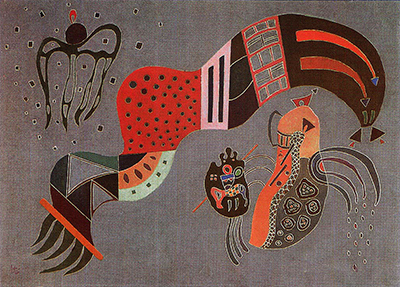
Across a soft grey field, Wassily Kandinsky sets a strange procession of dotted, striped and curling forms. A red-spotted band reaches from the left toward a dark arc at the upper right; below it, smaller shapes seem to float, sway or trail delicate lines. This is L'Élan tempéré, often translated Tempered Élan, a painting of 1944. The Centre Pompidou records it as oil on cardboard, 42 × 58 cm, signed and dated “VK 44”. Its inventory number is AM 81-65-75. [1].
Watch: Wassily Kandinsky
Five museum videos about Kandinsky’s art, sources of inspiration and the relationship between colour and music.
Vasily Kandinsky: Around the Circle
Curator Megan Fontanella introduces Kandinsky and the Guggenheim collection.
Watch on YouTubeAt a Glance
- Artist and owner title:Wassily Kandinsky, L'Élan tempéré (Tempered Élan).
- Date:1944, confirmed in the Centre Pompidou collection record and the artist's “VK 44” inscription.
- Medium and size:Oil on cardboard, 42 × 58 cm.
- Collection:Musée national d'art moderne, Centre Pompidou, AM 81-65-75.
- Acquisition:Bequest of Nina Kandinsky, 1981.
- Visible design:A broad spotted red passage, a sweeping dark and orange arc, smaller mask-like and seed-like forms, and fine descending lines on grey.
- Period:Kandinsky's late work in France, made in the year of his death.
Where this work sits in Kandinsky’s career
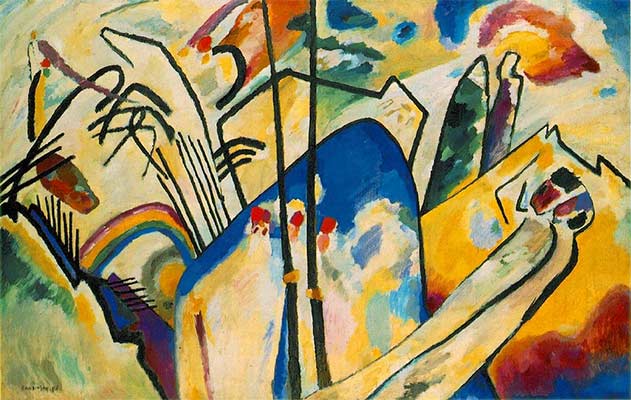
The Blue Rider
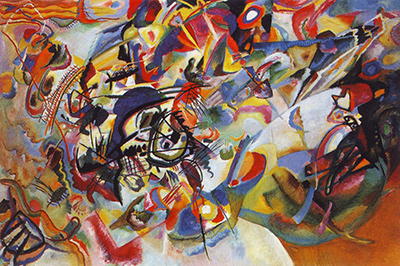
1903Composition VII
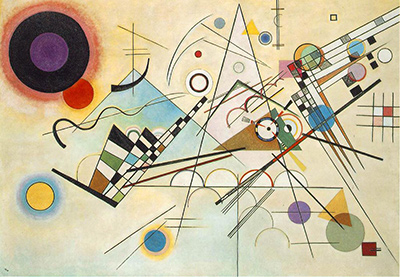
1913Composition VIII
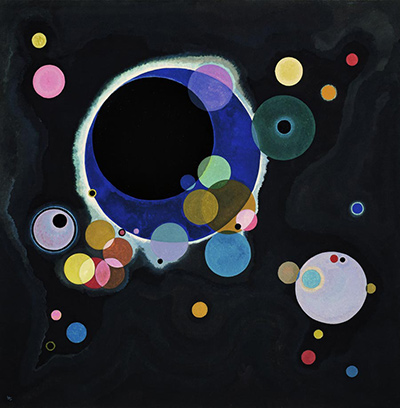
1923Several Circles
1926Sky Blue
1940Contents
- A picture that moves without telling a story
- Organic forms in Kandinsky's late years
- Colour, spacing and rhythm
- The date, collection and a careful claim about “last”
- Frequently asked questions
- References
A picture that moves without telling a story
The French title combines élan, an impulse or surge, with tempéré, something moderated. The painting's visual movement is lively but held within a carefully spaced field. A large form stretches horizontally through the upper half. Red and black spots make one portion active, while its pale underside and the darker arc at the right change its apparent weight. It might recall a living creature, a ribbon or a structure, but the owner record does not name it as any one of these. The ambiguity is part of what gives the arrangement life. [1].
On the left, a dark, rounded head-like cluster sends thin projections downward. A long set of strokes at the lower left seems to swing under a red diagonal. The forms do not share a single scale: the large upper band dominates the composition, but the small dark shape at the centre holds the eye through dense dots of colour. That little form has its own vertical trails, like a counter-gesture to the wider movement above it. These descriptions follow the visible image rather than claim definite creatures or instruments. [1].
At the right, a peach-coloured upright shape bends near a patterned dark cluster. Beside it, several fine grey curves descend in parallel, their tips dropping toward the lower edge. The broad arc above them ends in a tapered direction, giving the eye a path from the painting's centre outward. Kandinsky balances the scene by contrasting thick bodies with thin lines, flat colour with small repeated marks. The grey background creates room around each element, so the forms seem suspended rather than compressed into a single mass. [1].
The support is modest in scale, 42 × 58 cm. It is a horizontal piece of cardboard, not a monumental canvas. That physical fact changes how we imagine its detail. Tiny dots and curved traces can be inspected at close range; their delicate patterning would be easy to lose if the work were described only as a late abstract painting. A reproduction makes the whole arrangement visible at once, but the original's size asks for attention to the small decisions by which its forms are joined and separated. [1].
Organic forms in Kandinsky's late years
The Centre Pompidou tags the work with abstraction, biomorphism and organic form. Those terms fit its shapes, which feel neither like a conventional landscape nor like a strict diagram. Several parts suggest bodies, appendages, seeds or microscopic structures, yet their positions and colours prevent them from resolving into a single species or object. The forms appear invented and observed at once. “Biomorphic” usefully describes their resemblance to living shapes; it does not assert that the painter copied a particular organism. [1].
A 2026 French Ministry of Culture account of an exhibition co-organised with the Centre Pompidou places Kandinsky's later organic forms alongside his interest in scientific and biological imagery. It identifies L'Élan tempéré by its inventory number among the works shown. The article describes broader visual research in the late period, including forms sometimes compared with myographic or microscopic images. This contextual evidence enriches a reading of the painting, but it does not decode each spotted band or dangling line. [2].
The contrast with Kandinsky's better-known 1920s geometry is striking. Here the circle is not simply a perfect disk, and a line may droop or sprout a small mark. The painting still has structure: the upper arc, central cluster and lower trails keep distinct roles. But their organisation feels closer to a mobile ecology than to a chart. This is a visual comparison, not a claim that Kandinsky abandoned all geometric thinking. His shapes remain deliberate, and the large curved band gives them a strong direction. [1].
Colour, spacing and rhythm
The main red passage looks warm against the grey ground. Black spots make its surface pulse, while pale green, peach, white and orange passages interrupt it. At the upper right, the dark arc contains red-orange stripes and a sequence of small rectangular blue marks. Kandinsky repeats contrasting patterns rather than repeating identical shapes. Dots, grids, stripes and parallel lines generate different tempos across the card. [1].
The grey field is not empty in the sense of neglected space. It separates the large upper movement from the smaller forms below and leaves room for the fine curved lines to register. Tiny dark marks scattered near the upper left make that area feel active too. The painted elements therefore do not sit on a blank stage; they appear in a space whose subtle tone and scattered punctuation help set their pace. The title's sense of moderated momentum can be felt in this balance between a sweeping arc and small, controlled marks. That reading comes from the image and the title, not from a quoted statement by Kandinsky about this exact work. [1].
One might be tempted to tell a detailed story from the forms: an animal moving, a figure reaching or a mechanism turning. The painting supports impressions of movement but does not require one narrative. Its patterns are richer when allowed to remain multiple. A dark, face-like centre can be read as a face at one moment and as a concentrated group of coloured marks at another. The same uncertainty gives the red-spotted form its energy. [1].
The date, collection and a careful claim about “last”
Kandinsky painted L'Élan tempéré in 1944, the year he died. The collection record notes the artist's small inscription “VK 44” and the painting's later acquisition as part of Nina Kandinsky's 1981 bequest. Those facts are enough to place it securely in his final period. They do not, on their own, prove that it was his final mark, final work of any medium or the last thing he completed. Older commentary has called it his last painting, but a cautious description is preferable unless a documented chronology specifies exactly what “last” means. [1].
The Centre Pompidou has published extensive bibliography for the object, including a catalogue of its Kandinsky holdings and later exhibitions of his Paris years. The French Ministry of Culture also identifies the painting in a 2026 exhibition. Its presence in these records shows that the work continues to be interpreted and displayed in changing contexts. No single past loan or exhibition should be turned into a permanent gallery location. The stable collection identification is Centre Pompidou, AM 81-65-75. [1]; [2].
That documented identity helps keep the painting distinct from other late Kandinsky works with floating organic forms. Many share dotted passages, fine tendrils and pale backgrounds. The title, 1944 inscription, 42 × 58 cm cardboard support and inventory together identify this particular arrangement. Its “tempered” motion belongs to a precise small painting, rather than being a generic label for his final style. [1].
Kandinsky artworks directory
Frequently Asked Questions
The Centre Pompidou dates L'Élan tempéré to 1944 and records Kandinsky's inscription “VK 44”. [1].
It is oil on cardboard, 42 × 58 cm. [1].
It belongs to the Musée national d'art moderne, Centre Pompidou, inventory AM 81-65-75, through Nina Kandinsky's 1981 bequest. [1].
The museum classifies the work as abstract and biomorphic. Its forms can suggest living things, but the record does not assign a fixed identity to each one. The dotted bands and curling lines are best read first as parts of its visual rhythm. [1].
It is securely a 1944 late painting. The owner record does not certify a “final painting” claim, and that phrase should not be extended to all media. [1].
The French title suggests a surge held in check. A broad, lively upper movement is balanced by spaced smaller forms and fine lines. That is a reading of the title and image, rather than a documented explanation from Kandinsky. [1].
Discussion
What do you notice first in Tempered Élan (L’Élan tempéré)? Share a close observation or a question about the evidence for this work.
Comments are for comparing what we see and what the cited sources establish.
Reader Insights
How do the large dotted form and smaller shapes balance?
Where does movement seem to speed up or slow down?
How does the grey ground shape the painting’s rhythm?
Join the Conversation
Add your observation below and tell us which part of the artwork led you to it.
References
- Centre Pompidou, L'Élan tempéré, AM 81-65-75: object, collection and bibliography. View source.
- French Ministry of Culture, 2026 Kandinsky exhibition account identifying L'Élan tempéré and discussing the artist's late organic forms. View source.