


 by Tom Gurney
Tom Gurney BSc (Hons) is an art history expert with over 20 years experience
Published on June 19, 2020 / Updated on October 19, 2026
Email: tomgurney1@gmail.com / Phone: +44 7429 011000
Amaryllis
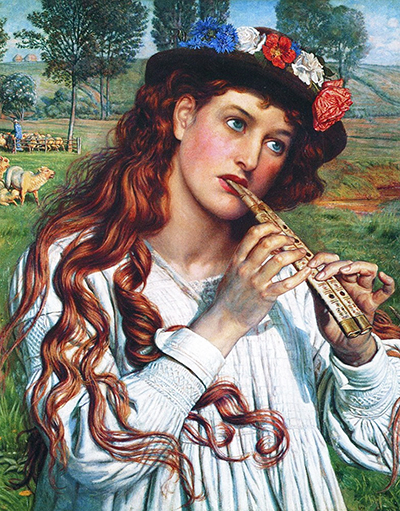
A red-haired young woman plays a pair of pipes in a green landscape. A wreath of flowers brightens her dark hat, and sheep graze far behind her. William Holman Hunt called this pastoral figure Amaryllis. He showed the painting at London's Grosvenor Gallery in 1887, although the version known through later reproductions was not necessarily its final state at that exhibition. A specialist history of Hunt's frames dates his work on the picture across about 1883–93 and describes repeated repainting. This extended history is more informative than the single 1884 date often attached to online copies. [1] [2] [3]
The player and the flock
The woman's face and hands dominate the foreground. Her fingers meet the two narrow pipes near the centre of the image; one pipe touches her lips. Hunt uses the white of her loose blouse to hold the figure against the green land, then follows the movement of her long curls down across the fabric. The wreath brings red, white and blue flowers into the upper part of the composition. Her eyes turn away from the viewer as if her attention is with the music. The careful detail of hair, fabric and flowers gives the small pastoral scene the intensity of a close portrait.
At a Glance
- ArtistWilliam Holman Hunt (1827–1910)
- TraditionBritish Pre-Raphaelite art
- Work or subjectAmaryllis
- ContextIllustrated paintings guide
- Further readingArtist biography
The sheep are easy to miss in the reduced reproduction. They appear at the left, well behind Amaryllis, with a human figure near the flock. Trees and a low horizon make an open rural setting rather than a blank portrait ground. These background details matter because the title and pipes invite us to read the woman as a shepherdess. Hunt does not make her a straightforward record of farm work: the flowered hat, white blouse and foreground pose arrange her for a pastoral image. The sheep supply a setting and a possible responsibility, while the music takes the place of an action such as gathering or tending them.
The name Amaryllis has a long pastoral association. In Virgil's Eclogues, shepherds sing and speak of an Amaryllis. It is a literary name with several later uses, not evidence that Hunt illustrated one specified passage of Virgil. The painting's alternate title, The Shepherdess, makes its broader subject plain. This is a nineteenth-century artist's imagined country figure, built from a live-looking face and closely observed details but shaped by the older convention of shepherds and music. [4] [3]
Showing and changing the painting
Hunt names Amaryllis among the works he exhibited at the Grosvenor Gallery in his memoir. A period monograph also places it there in 1887, beside his portrait Master Hilary, the Tracer. That exhibition pairing brought a pastoral young woman and a carefully posed child into the same gallery. A later Christie's essay for Master Hilary cites a Times review that treated the two works together and criticised what the reviewer saw as overelaborate execution. That is evidence of contemporary reception, rather than a judgment the viewer has to accept. Hunt's intense clarity could be admired for observation and rejected for the same visual insistence. [1] [5] [6]
Watch: William Holman Hunt
Begin with Hunt’s paintings, then place his work alongside two fellow Pre-Raphaelite founders.
William Holman Hunt Paintings
An overview of Hunt’s paintings from TheHistoryOfArt video archive.
Watch on YouTubeThe painting did not stop changing after that show. Frame historian Lynn Roberts notes that Hunt repainted it over roughly a decade. She describes an early, more impish expression and a later, more polished face, while tracing a first frame whose form also changed. Her account and the National Portrait Gallery's framemakers directory both use a broad 1883–93 span. The reproduced face therefore should not automatically be treated as exactly what a visitor saw in 1887. It is a reminder that a dated exhibition marks a public appearance, not always the end of an artist's work on an object. [3] [2]
Hunt's revised memoir illustrates Amaryllis and identifies Mrs George Lillie Craik as its owner at the time of publication. Earlier writing placed it in Hunt's own possession. These are historical ownership statements, not evidence that the painting is now in a named public gallery. Modern specialist captions describe it as in a private collection. Without a current collection catalogue or sale record establishing more, the present owner should be left unnamed. [1] [3] [5]
A different Hunt pastoral
Shepherds appear elsewhere in Hunt's art, but Amaryllis uses them differently. In The Hireling Shepherd, the couple's distraction and the wandering flock drive a pointed story about neglected care. In Amaryllis, the pipe-player's music is the central event and the sheep sit at a distance. It is tempting to turn their separation into the same warning. The available records identify this as a pastoral picture, however, and do not document that Hunt intended a second version of the earlier moral argument. The comparison is useful because it reveals what he kept—sheep, bright land, close observation—and what he changed: the woman stands alone, with her own activity and gaze. [5] [7]
The painting can also be set beside Hunt's Bianca. Both pictures draw attention to a female musician through hands, instrument and elaborate costume. Bianca invokes a named Shakespeare character indoors; Amaryllis opens into an ideal country setting and a more general pastoral tradition. In each, the person is close enough that the literary or genre label does not swallow her expression. The detail invites close looking, while the background gives the viewer a reason to ask what lies beyond the moment of performance.
The local image preserves the characteristic flowered hat, red hair, pipes and distant flock, but its 400-pixel width limits close study of the painted surface. The reported repainting and lost first frame make photographic reproductions especially partial evidence. The useful starting point is therefore the image itself, followed by the documented 1887 exhibition and longer period of revision. Together they show Amaryllis as a developing work, not a single fixed design made in one year. [1] [3]
Discussion
Look closely at Amaryllis, then compare your reading with the documented history.
Reader Insights
Which detail in Amaryllis most affects your reading?
How do the date, medium and collection records shape that interpretation?
What remains uncertain about this work or its history?
Join the Conversation
Share a close observation or a source-backed question about Amaryllis. The prompts above are starting points for discussion.
References
- Hunt's memoir. View source.
- National Portrait Gallery, British framemakers directory. View source.
- The Frame Blog, Pre-Raphaelite frames. View source.
- Virgil, Eclogues , Perseus Digital Library. View source.
- Christie's, Master Hilary, the Tracer essay and 1887 review. View source.
- early monograph on Hunt. View source.
- Victorian Web, comparison with The Hireling Shepherd. View source.







