 by Tom Gurney
Tom Gurney BSc (Hons) is an art history expert with over 20 years experience
Published on June 19, 2020 / Updated on October 19, 2026
Email: tomgurney1@gmail.com / Phone: +44 7429 011000
Cyril Benoni Holman Hunt
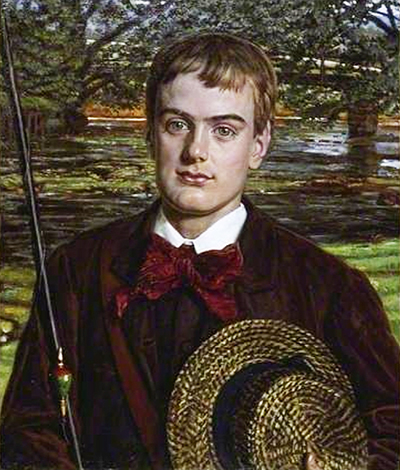
A boy stands before trees and water with a fishing rod upright beside him. He holds a broad straw hat across his chest, its woven rings echoing the dark curves of his jacket. The boy is Cyril Benoni Holman Hunt, the painter William Holman Hunt's son. Hunt painted the portrait in 1880, when Cyril was about thirteen, and showed it at the Grosvenor Gallery that summer under the title Portrait of Cyril B. Holman Hunt. It is now at the Fitzwilliam Museum, Cambridge, accession 1760. The museum records an oil painting on canvas measuring 60.9 × 50.8 cm. [1] [2]
A young fisherman before the water
Cyril faces out of the painting with an even expression. The rod rises along the left side of the canvas, almost parallel to its edge. A bright float near the lower part of the rod interrupts that dark vertical. Hunt set his WHH monogram and the date 1880 on the float, according to the Fitzwilliam record. An object of leisure thus carries the picture's signature and helps join sitter, painter and activity in one small detail. [1]
At a Glance
- ArtistWilliam Holman Hunt (1827–1910)
- TraditionBritish Pre-Raphaelite art
- Work or subjectCyril Benoni Holman Hunt
- ContextIllustrated paintings guide
- Further readingArtist biography
The foreground is carefully controlled. Cyril's jacket is deep brown, its shape broad around his shoulders. A red bow at his collar adds a concentrated colour accent. The straw hat in his hands is large enough to become a second focal point, and its rougher material contrasts with the smooth face and dark cloth. Hunt painted him as a child entering adolescence: he has the straightforward gaze of a family portrait but carries the equipment of an activity he can pursue on his own. The rod and hat suggest a day outdoors without requiring us to imagine a particular catch.
Behind him, horizontal bands of water, grass and shadow place the pose beside a natural setting. The broken light is different from the flat background of a formal studio portrait. The boy remains sharply seen; the trees and reflections are busier, giving his stillness a setting. The Fitzwilliam's subject tags include a fishing rod, hat, fruit, flowers, vines and landscape. Not all of these lie within the painted area in the small reproduction: some belong to the elaborate frame that surrounded and extended the image. [1] [3]
The painted frame as part of the portrait
The portrait's frame is a significant part of Hunt's design. Specialist frame research describes a broad gilded border with raised apple branches, blossoms and fruit, including a cut apple. The Fitzwilliam records Cyril's name and his father's on its inner slip. A surviving drawing for the frame is held by the Ashmolean Museum. This is more than decorative packaging: it enlarges the natural world around the fishing portrait and gives a viewer the sitter's and painter's names as part of the encounter with the work. The inherited local image crops to the painting, so its full effect cannot be judged from the lead alone. [3] [1]
Watch: William Holman Hunt
Begin with Hunt’s paintings, then place his work alongside two fellow Pre-Raphaelite founders.
William Holman Hunt Paintings
An overview of Hunt’s paintings from TheHistoryOfArt video archive.
Watch on YouTubePeople noticed the frame when the portrait appeared in 1880. The frame historian cites Lady Lindsay, a founder of the Grosvenor Gallery, admiring it, while a later critic, Lewis Day, regarded its coloured fruit and even the apple's visible core as excessive. Their different responses show how unusual the object looked to some viewers. A cut apple can suggest the loss of innocence in Hunt's religious art, but the frame record does not establish a single compulsory meaning for every fruit around his son's face. The safer observation is that Hunt deliberately brought close natural detail and an unusually assertive frame into an intimate portrait. [3]
Cyril and the family history
Cyril was born in Florence in December 1866 to Hunt and his first wife, Fanny Waugh. Fanny died soon after childbirth. Bridport Museum's account of Cyril's life explains that he spent periods away from his father during childhood and later attended school and university. This 1880 image therefore records a specific meeting of family and art rather than a continuous account of their domestic life. Its fishing gear and outdoor setting make Cyril appear self-possessed, but they cannot tell us what he felt about his mother or his father. [2]
The Fitzwilliam record contains a useful dating conflict. Its front inscription says 1880, and a verso label records the Grosvenor Gallery Summer Exhibition of 1880, no. 89. A handwritten note on a later 1904 Bradford exhibition label says “Painted in 1882.” Because the painting was already exhibited in 1880, that later note cannot date its first completion as 1882 without some further explanation. The museum adopts 1880. The discrepancy is worth recording rather than silently replacing stronger contemporary evidence with the later label. [1]
Cyril kept the picture. Bridport Museum says he lent it, along with a portrait of Fanny, to the museum's opening display in 1932. After his death in 1934, he bequeathed his own portrait to the Fitzwilliam. The Fitzwilliam confirms that bequest and also lists its earlier exhibitions, including the Grosvenor in 1880 and Hunt's 1907 Walker Art Gallery show. The sitter's ownership joins the painted boy to the adult who later chose where the picture would go. [2] [1]
Hunt painted and drew several family members. His portrait of Fanny Holman Hunt offers an especially close companion to Cyril's portrait because the two works were brought together at Bridport in the 1930s. The paintings guide places Cyril among Hunt's other portraits and narrative scenes. Here the story is concentrated in a single figure and a few objects: a boy, his fishing rod, his hat, the water behind him and the natural imagery around the original frame. Their combination makes the portrait both a record of a named son and an image of youth on the edge of greater independence.
Discussion
Look closely at Cyril Benoni Holman Hunt, then compare your reading with the documented history.
Reader Insights
Which detail in Cyril Benoni Holman Hunt most affects your reading?
How do the date, medium and collection records shape that interpretation?
What remains uncertain about this work or its history?
Join the Conversation
Share a close observation or a source-backed question about Cyril Benoni Holman Hunt. The prompts above are starting points for discussion.
References
- Fitzwilliam Museum object record. View source.
- Bridport Museum on Cyril. View source.
- The Frame Blog, portrait and frame. View source.