 by Tom Gurney
Tom Gurney BSc (Hons) is an art history expert with over 20 years experience
Published on June 19, 2020 / Updated on October 19, 2026
Email: tomgurney1@gmail.com / Phone: +44 7429 011000
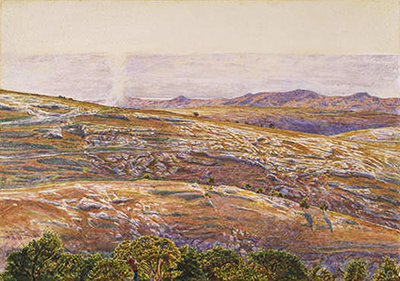
The Dead Sea from Siloam
William Holman Hunt's The Dead Sea from Siloam looks past trees and bare hills towards the Dead Sea and the mountains of Moab. Warm morning light gives the distant land a pale, hazy edge, while darker growth in the foreground anchors the viewpoint. The original watercolour belongs to Birmingham Museum and Art Gallery as 1948P13. It is a landscape with a specific geographical subject, not a smaller painted version of The Scapegoat, although both belong to Hunt's sustained interest in the terrain of the Holy Land. [1] [2]
Image: Birmingham Museums Trust image-bank preview[3], accession 1948P13. Photo by Birmingham Museums Trust, licensed under CC0[4]. Source JPEG 1035 × 731 pixels, unaltered.
At a Glance
- ArtistWilliam Holman Hunt (1827–1910)
- TraditionBritish Pre-Raphaelite art
- Work or subjectThe Dead Sea from Siloam
- ContextIllustrated paintings guide
- Further readingArtist biography
What the watercolour shows
The Art Fund[1] identifies the viewpoint as the Mount of Offence, looking towards the Dead Sea and Moab in the morning. The name refers to the southern, lower part of the Mount of Olives southeast of Jerusalem. Seen from that elevation, the distant mountains are separated from the nearer slopes by atmosphere as much as by contour. The reproduced image shows a gradual passage from the warmer foreground to faint, cooler distance. Hunt's attention moves between a particular place and the changing visibility of that place in sunlight.
There is no biblical figure in the picture and no single dramatic action. The empty stretches of land can still resonate with the scriptural geography that drew Hunt to the region. That resonance is an interpretation of his choice of subject; the picture itself should first be looked at as a carefully observed landscape. The Birmingham-sourced image description[2] notes green trees in the foreground, barren hills and a soft sky. Those three zones give the small sheet depth without turning it into a panoramic map.
Hunt's first journey to Egypt and the Holy Land in 1854–56 brought him into direct contact with settings he had known through scripture and literature. The observations made during that travel fed several kinds of work: large religious canvases, drawings and independent watercolours. The Dead Sea view is useful evidence of the distinction. Its topography matters, but so does the sensory effect of morning haze. The watercolours guide compares it with river, coastal and night scenes from other journeys.
When was it made?
The watercolour has been given different dates in published records. The Art Fund quotes a letter from Hunt to his patron and friend Thomas Combe about returning at sunrise to a sketch begun on the Mount of Offence around September 1854. The Fund therefore says Hunt appears to have begun this work then. Birmingham Museums Trust’s own image-bank record[3], however, gives 1861 as the object date. A specialist essay on Hunt's frames calls the watercolour 1854–55 and says his Near Eastern watercolours were largely framed in 1861. These records are not necessarily describing the same stage of work: one may date the outdoor sketch, another the finished or framed object. The consulted sources do not settle the precise completion date. [1] [2] [5]
Watch: William Holman Hunt
Begin with Hunt’s paintings, then place his work alongside two fellow Pre-Raphaelite founders.
William Holman Hunt Paintings
An overview of Hunt’s paintings from TheHistoryOfArt video archive.
Watch on YouTubeThat uncertainty is more informative than a falsely exact label. The early letter places the observation within Hunt's first eastern journey, while the later catalogue date warns that the finished object may have a longer history. It would be misleading to treat 1948, the year associated with its support for Birmingham, as a date of painting. The Art Fund's “1827–1910” line is Hunt's lifespan and likewise cannot date the sheet. [1]
Watercolour, paper and frame
The Birmingham-sourced record identifies the medium as watercolour on paper. In the reproduction, the colour is built from contrasts between darker near forms and a luminous distance. A photograph cannot show every wash or correction on the original sheet, so exact claims about brushwork should be checked against the work itself or conservation records. It is safer to describe the visible arrangement than to invent a technical process from the digital image. [2]
The frame is part of the object's later presentation. A specialist study of Pre-Raphaelite frames[5] relates its scrolling ornament and interlocking circles to patterns in Owen Jones's Grammar of Ornament (1856). This does not prove Hunt copied those motifs while standing at Siloam; the study explicitly places much of the framing of his eastern watercolours in 1861. The landscape's earlier observation and its decorative setting therefore belong to different moments in the work's history. The local reproduction concentrates on the picture surface, so the frame should be studied through the cited record rather than imagined from this crop.
Published measurements also disagree: the archival Art Fund entry gives 25 × 29 cm, whereas the frame specialist gives 24.8 × 34.8 cm. The latter matches the shape of the reproduced image more closely, but image aspect alone cannot establish which part of the sheet each catalogue measured. This page leaves the exact dimension open until the museum's catalogue can be consulted directly. [1] [5]
Collection and related works
The Art Fund records the work as a 1948 gift associated with Esmond Morse to Birmingham Museum and Art Gallery. Judith Bronkhurst's Christie's essay on Asparagus Island[6] says Sydney Morse had owned the Dead Sea watercolour, linking it to a collection that also held Hunt's Cornish view. The two objects trace different journeys but share a history of being valued as works on paper. Their collection histories should not be collapsed: The Dead Sea from Siloam has Birmingham's accession number; the present ownership of Asparagus Island is not established by the consulted sale record.
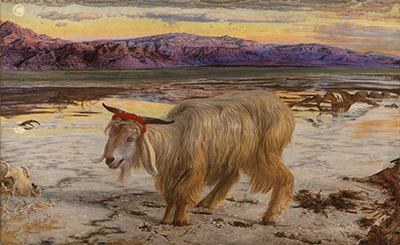
Compare this morning view with The Nile, another eastern watercolour whose long horizontal sheet gives water a different compositional role. For Hunt's symbolic use of the Dead Sea's shore in a figure painting, turn to The Scapegoat. The two subjects overlap geographically, but the goat and its biblical type belong to a different visual and narrative problem.
Discussion
Look closely at The Dead Sea from Siloam, then compare your reading with the documented history.
Reader Insights
Which detail in The Dead Sea from Siloam most affects your reading?
How do the date, medium and collection records shape that interpretation?
What remains uncertain about this work or its history?
Join the Conversation
Share a close observation or a source-backed question about The Dead Sea from Siloam. The prompts above are starting points for discussion.
References
- Art Fund object account. View source.
- Birmingham-sourced image record. View source.
- Birmingham Museums Trust image-bank preview. View source.
- CC0. View source.
- specialist frame research. View source.
- Christie's essay on Asparagus Island. View source.