 by Tom Gurney
Tom Gurney BSc (Hons) is an art history expert with over 20 years experience
Published on June 19, 2020 / Updated on October 19, 2026
Email: tomgurney1@gmail.com / Phone: +44 7429 011000
The Nile
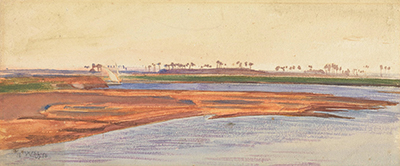
William Holman Hunt's The Nile is a narrow watercolour that turns a vast river into a sequence of horizontal bands. A broad stretch of water crosses the lower part of the sheet; warm sandbanks and fields lie beyond it, with a thin fringe of trees and buildings against a pale sky. The work belongs to the Yale Center for British Art as B2010.6.13. Yale's object record[1] dates it 1854 and identifies watercolour on thick cream wove paper, measuring 10.6 × 25.4 cm. The lead image is courtesy of the Yale Center for British Art; its object record marks the image Public Domain (CC0).
A river in a long, low format
The sheet is more than twice as wide as it is high. Hunt uses that shape to make the eye travel along the course of the river rather than settle on a single foreground monument or person. At the bottom, close ripples mark the water's surface. Farther away, exposed banks make a restless edge between river and land. A dark, nearly level line of trees holds the far horizon, interrupted by small vertical marks that suggest palms, buildings and possibly boats. The sky occupies a shallower band, but its warm light affects the colour below. These observations can be made from the reproduction; identifying every distant mark would require examination of the original sheet. [1]
At a Glance
- ArtistWilliam Holman Hunt (1827–1910)
- TraditionBritish Pre-Raphaelite art
- Work or subjectThe Nile
- ContextIllustrated paintings guide
- Further readingArtist biography
The banks are not just empty space between the river and the trees. Their orange and brown colour pushes forward against the cooler blue-grey water. The shifts in value give the viewer a route from immediate surface to distant settlement. A small watercolour can therefore convey the breadth of a landscape without imitating the scale of a large oil. The calm, extended view differs from the forceful surf and cliff angle in Asparagus Island, Kynance, Cornwall.
The slight interruptions along the horizon become more important because so much of the picture is nearly level. A tree, mast or building occupies little space, yet each breaks the long line just enough to suggest activity beyond the near bank. Hunt leaves the viewer to move across the scene rather than pointing to one privileged detail. The modest height of the sheet makes this slow sideways reading feel natural.
Date and travel context
The 1854 date places this work at the beginning of Hunt's first journey to Egypt and the Holy Land. The collection record identifies the object and its year, but the consulted metadata does not give a specific Nile bank, day, or hour of painting. Nor does it establish that every wash was applied outdoors. Hunt travelled and made observations across the region, then could revise or frame sheets later. This page therefore treats the watercolour as evidence of how he pictured the Nile, without inventing a diary entry for its making. Yale [1] [2]
The Egyptian setting matters in Hunt's career. He was a founder of the Pre-Raphaelite Brotherhood and valued first-hand observation, yet a real location did not force one kind of picture. He made biblical subjects, figure studies and landscapes during or after eastern journeys. The Nile has no central dramatic figure or recognisable scriptural episode. Its subject is the visual span of river, bank and distant life. That distinction keeps the watercolour from being treated automatically as preparatory material for a religious painting. The watercolours guide follows several of Hunt's works on paper across travel and time of day.
Watch: William Holman Hunt
Begin with Hunt’s paintings, then place his work alongside two fellow Pre-Raphaelite founders.
William Holman Hunt Paintings
An overview of Hunt’s paintings from TheHistoryOfArt video archive.
Watch on YouTubeWatercolour and paper
The Yale object record names thick, moderately textured cream wove paper. “Wove” describes a relatively even paper structure, while the cream tone gives the unpainted support its own warmth. The reproduced image shows pale areas of sky and bank, but a screen cannot tell precisely which patches are paper and which have a light wash. For that reason this page does not assign a particular effect to untouched paper without a close technical study of the original. [1]
The aspect ratio is easier to verify. At 25.4 cm wide and 10.6 cm high, the sheet sets a narrow viewing field. Its horizon stays low enough for the sky to register but high enough to allow the foreground water to lead the picture. Hunt can divide the image into tonal zones while still giving each a different surface: softly varied sky, narrow vegetation, dry land and horizontal water. The restrained structure rewards a slower look at small changes in colour rather than a search for an incident.
The paper's recorded thickness is significant for how the object is catalogued, but it does not tell us on its own how many passes Hunt made with the brush. It is tempting to imagine the watercolour completed rapidly as a traveller passed along the river. No source consulted here describes that episode. The visible precision could come from a concentrated sitting, later adjustment, or both. Separating what can be seen from how it was made keeps the sheet open to future technical evidence.
Comparing eastern landscapes
The Dead Sea from Siloam also belongs to Hunt's eastern landscape work, but it handles distance differently. There the vantage point is high and the view reaches across hills towards a pale sea and mountains; in The Nile, the viewer is closer to a river's level and reads a long lateral stretch of terrain. The first has a documented Mount of Offence viewpoint from the Art Fund[3]; the second's specific spot has not been established in the consulted Yale-linked metadata. Similar travel dates should not be used to fill that gap.
Hunt's Fishing-Boats by Moonlight provides another comparison in reflected light. Its dark water, boats and dramatic sky compress the scene around a different time of day, and its museum record identifies bodycolour as well as watercolour. The Nile is quieter, but it too asks how far a small sheet can carry an experience of place. For the wider career, the biography traces Hunt's journeys and the paintings that followed them.
Its Yale accession fixes the identity of the object even when digital reproductions circulate under a very short title. A print offered as “The Nile” elsewhere is not automatically evidence of another original or of a different size. The collection number, recorded support and distinctive horizontal format give a more reliable combination of identifiers than the title alone. Those details are especially useful when comparing this image with other nineteenth-century Nile views.
Discussion
Look closely at The Nile, then compare your reading with the documented history.
Reader Insights
Which detail in The Nile most affects your reading?
How do the date, medium and collection records shape that interpretation?
What remains uncertain about this work or its history?
Join the Conversation
Share a close observation or a source-backed question about The Nile. The prompts above are starting points for discussion.
References
- object record. View source.
- Christie's specialist account of Hunt's travel watercolours. View source.
- Art Fund. View source.