 by Tom Gurney
Tom Gurney BSc (Hons) is an art history expert with over 20 years experience
Published on June 19, 2020 / Updated on October 19, 2026
Email: tomgurney1@gmail.com / Phone: +44 7429 011000
Asparagus Island, Kynance, Cornwall
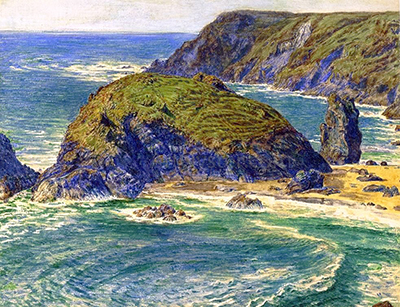
William Holman Hunt's Asparagus Island, Kynance, Cornwall concentrates the colour and movement of an entire cove into a sheet only 20 × 26 cm. He looked towards the rocky island from above, letting the deep blue and green water press against pale surf and the variegated cliffs. The image has the observational detail expected of a Pre-Raphaelite painter, yet its interest is as much in an unstable moment of weather and tide as in the fixed outline of a place. The Christie's object record and essay by Judith Bronkhurst[1] document its medium, making and subsequent history.
The view from the cliff
The island sits near the centre of Hunt's view, with further headlands rising behind it. The immediate foreground includes a small glimpse of the cliff edge. That detail fixes the viewer's elevated position: we look down at waves breaking around the rocks rather than from the beach. The broken line of surf carries the eye across the sheet, while the more solid landforms hold it in place. This is an interpretation of the reproduced composition, not an independent topographic survey.
At a Glance
- ArtistWilliam Holman Hunt (1827–1910)
- TraditionBritish Pre-Raphaelite art
- Work or subjectAsparagus Island, Kynance, Cornwall
- ContextIllustrated paintings guide
- Further readingArtist biography
Hunt made the picture during a 1860 journey through Cornwall and Devon in the company of the poet Alfred Tennyson, fellow painter Val Prinsep and writer Francis Turner Palgrave. Palgrave's later account places Hunt and Prinsep at Kynance Cove on 17 September. Bronkhurst describes their position on the cliffs as looking north-west towards Asparagus Island. The cove's serpentine rocks and mixed geology supplied unusually varied colour. Hunt's view records those changes rather than flattening the headland to a single brown or grey. [1]
The trip was not simply a picturesque holiday after a productive studio season. Hunt stayed to work while his companions moved on. Tennyson wrote to his wife that he and Palgrave left the two painters sketching at the Lizard. In Hunt's later recollection, a gust carried his nearly completed sheet out over the cliff; another gust brought it to the brink, where he and Prinsep retrieved it. The story comes through Hunt's account to his daughter Gladys as reported by Bronkhurst. It records how the painter remembered working outdoors, but it is not a contemporaneous note that verifies every movement of the flying paper. [1]
How Hunt made the water move
The catalogue describes pencil and watercolour heightened with white, with scratching out. Faint pencil marks established parts of the composition. Watercolour washes gave the sea its transparent shifts, but Hunt did not rely on wash alone. Around the smaller middle-ground rocks he scratched through applied colour to create points of white spray. Elsewhere he reserved bare paper for eddies. These are distinct actions: one removes colour and the other preserves the support before colour is applied. Both turn the sheet itself into a source of light. [1]
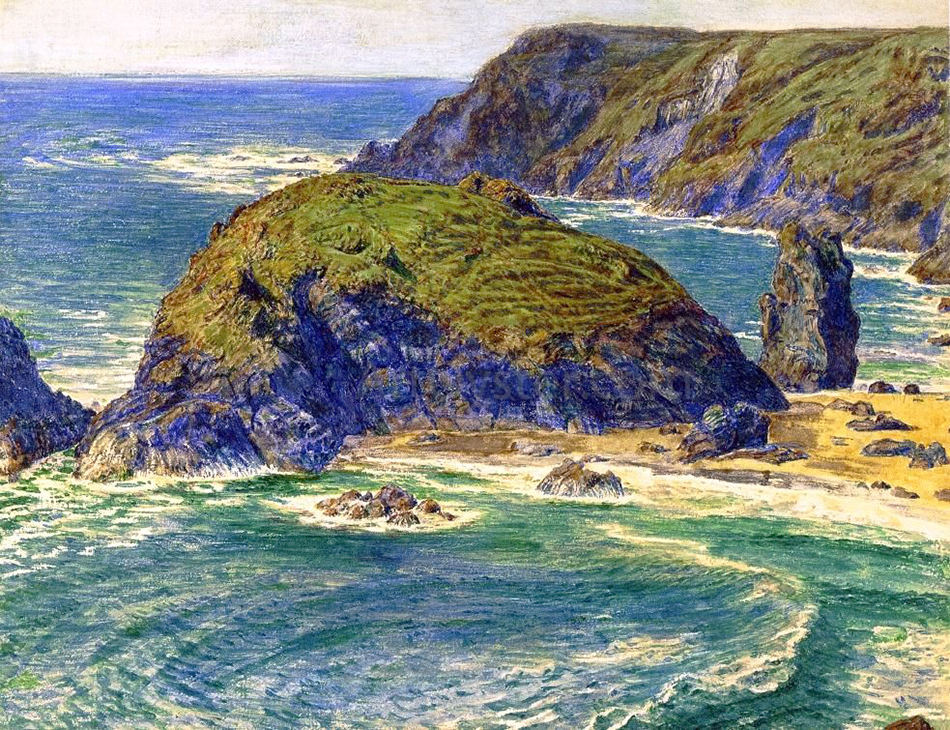
Bronkhurst identifies the only touches of bodycolour near the horizon and considers them probably added in 1862. Bodycolour is opaque colour that can sit over a previous passage; it differs from the white of untouched paper. The distinction matters because the picture was not necessarily completed exactly as it now appears during the few days at Kynance. Hunt could bring an outdoor observation back into his working process. The likely later horizon touches are a specialist judgment, and their precise date is not recorded directly on the paper. [1]
Watch: William Holman Hunt
Begin with Hunt’s paintings, then place his work alongside two fellow Pre-Raphaelite founders.
William Holman Hunt Paintings
An overview of Hunt’s paintings from TheHistoryOfArt video archive.
Watch on YouTubeFrom travel study to finished work
Hunt's letters to his solicitor friend Henry Virtue Tebbs show the watercolour's transition into a saleable work. In March 1862, Hunt asked to keep the Kynance drawing a little longer to adjust it; Tebbs then paid 60 guineas for it. The original was thus valued and handled as a finished work on paper, even while the artist wanted further refinements. The documented transaction is stronger evidence for its finished status than an assumption based on its precise appearance. [1]
The title changed in public records. A backing-board inscription refers to the place near Lizard Point and gives October 1860; Bronkhurst regards that month as a likely lapse in memory given the September travel evidence. Hunt's 1886 solo exhibition called the work Asparagus Island. Later exhibition and sale catalogues also used Asparagus Island, near Lizard Point and Kynance Cove, Cornwall. These labels describe the same object in the Christie's provenance, not three separate Hunt views. A title should therefore be checked against its date, medium and ownership trail before declaring a new version. [1]
Tebbs's executors' sale in 1900 placed the sheet with collector Sydney Morse. It passed through later Morse family ownership, a 1981 Sotheby's sale and the subsequent provenance listed in the Christie's catalogue. That record does not identify a present public collection. A past exhibition at Tate in 1984 means it was shown there, not that Tate owns it. [1]
A landscape within Hunt's career
The work complicates the idea that Hunt's pictures must always carry a separately decoded moral lesson. In an 1865 pamphlet discussed by Bronkhurst, Hunt argued that a painting's first task included delight in what it represented, even if no special moral could be extracted. Asparagus Island certainly involves the patient looking associated with his larger religious and narrative works, but its immediate subject is sunlight, rock and moving sea. Its technical decisions make that experience vivid. That is a reading supported by the object and Hunt's stated attitude to nature, not a claim that the landscape is devoid of all possible symbolic associations. [1]
Compare its compact coastal composition with the wider river format of The Nile and the arid morning view of The Dead Sea from Siloam. The watercolours guide considers their different materials and times of day. For more about Hunt's travel, patrons and studio practice, see the biography.
The Christie's specialist essay identifies at least three other Lizard peninsula drawings associated with Hunt: Cornish Coast, The Lizard, Cornwall and an unlocated Sea Mist – The Lizard, Cornwall. This group makes the Kynance sheet part of a wider coastal investigation rather than a single isolated view. The catalogue singles out Asparagus Island for its brilliant sunlight on the water and compares that concern with the earlier oil panel Fairlight Downs – Sunlight on the Sea. The relation is one of looking and light, not a claim that the two works share a medium, exact viewpoint or owner. Keeping the other Lizard titles visible also helps prevent a later sale reference to a neighbouring coast scene from being attached to this sheet without checking its image and provenance. [1]
Discussion
Look closely at Asparagus Island, Kynance, Cornwall, then compare your reading with the documented history.
Reader Insights
Which detail in Asparagus Island, Kynance, Cornwall most affects your reading?
How do the date, medium and collection records shape that interpretation?
What remains uncertain about this work or its history?
Join the Conversation
Share a close observation or a source-backed question about Asparagus Island, Kynance, Cornwall. The prompts above are starting points for discussion.
References
- Christie's object record and essay by Judith Bronkhurst. View source.