


 by Tom Gurney
Tom Gurney BSc (Hons) is an art history expert with over 20 years experience
Published on June 19, 2020 / Updated on October 19, 2026
Email: tomgurney1@gmail.com / Phone: +44 7429 011000
Fishing-Boats by Moonlight
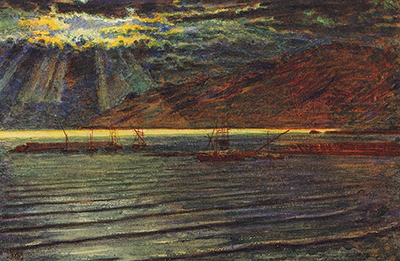
In Fishing-Boats by Moonlight, William Holman Hunt sets a thin line of boats against an expanse of dark water and a sky broken by bright cloud. The image is small — only 10.1 × 15.2 cm — but the contrast of heavy darkness and sudden light gives it an imposing scale. The work belongs to The Higgins Bedford, where it is catalogued as P.351 and dated about 1869. The museum records watercolour, bodycolour and pencil on paper and a WHH monogram. [1]
The boats within a large night sky
The boats occupy a narrow band near the horizon. Slender masts and low hulls interrupt the line between sea and land, while repeated horizontal marks bring the water forward. Above them, a warm, dark bank of cloud meets a brighter area that sends shafts of light down towards the distance. The viewer's attention moves between the fragile verticals of the boats and the broad, changing forms overhead. These are observations from the surviving reproduction; it is too small to identify the exact kind or number of vessels with confidence.
At a Glance
- ArtistWilliam Holman Hunt (1827–1910)
- TraditionBritish Pre-Raphaelite art
- Work or subjectFishing-Boats by Moonlight
- ContextIllustrated paintings guide
- Further readingArtist biography
The title makes moonlight the defining condition, but the moon itself is not a simple white disc at the centre of the scene. Hunt makes the atmosphere — cloud, glow, and the muted response of the water — carry the idea of night. The dark shore or cloud bank behind the boats also stops them from disappearing into the water. The image works through relationships of tone rather than a detailed narrative about the people on board. The museum's object record does not name a particular harbour or coast, and this page does not invent one. [1]
From the foreground, successive pale strokes cross the water at different intervals. They are not a chart of individual waves, but they give the near surface movement and make the stiller band around the boats feel farther away. Their direction also helps the eye find the narrow lit horizon. In a picture this small, those repeated marks carry much of the impression of open space.
Transparent and opaque colour
The materials help explain why the scene looks different from a transparent daylight wash. Watercolour can allow the paper to contribute brightness through thin layers. Bodycolour is more opaque and can put a light or solid colour over a darker passage. Pencil remains available for an edge or fine structure. The Higgins specifically lists all three media for this sheet, so the picture should not be described simply as a spontaneous watercolour sketch. The reproduced surface cannot show exactly where every opaque touch lies; a conservation examination would be needed for a mark-by-mark account. [1]
The museum's account makes a useful broader point with an exception built in. It says Hunt's watercolours rarely use bodycolour and often depend on transparent colour and bright paper, then cites this work as a counterexample. “Rarely” is different from “never.” A dark nocturne gave the painter reasons to combine methods. The material label also distinguishes this sheet from The Nile, whose Yale-linked record specifies watercolour on cream wove paper, and from Asparagus Island, where scratching out helps make surf visible.
Watch: William Holman Hunt
Begin with Hunt’s paintings, then place his work alongside two fellow Pre-Raphaelite founders.
William Holman Hunt Paintings
An overview of Hunt’s paintings from TheHistoryOfArt video archive.
Watch on YouTubePlace in Hunt's watercolour practice
Hunt is often introduced through large religious paintings such as The Light of the World and The Scapegoat. This small scene has neither a scriptural figure nor a declared moral event. It does share his interest in how light changes what can be seen. Boats close to the horizon can be almost lost; the bright break in the sky gives them their setting. The contrast is enough to hold the composition without a densely described foreground.
The Higgins notes that Hunt's output in watercolour was small compared with his oil work. Drawing on Martin Hardie, it says he exhibited 39 works with the Royal Watercolour Society between 1869 and 1903 and suggests these represented much of his work in the medium. That is a historical estimate, not an inventory proving that exactly 39 watercolours exist today. The date about 1869 for Fishing-Boats by Moonlight puts this sheet near the beginning of that reported exhibiting span; the consulted museum account does not say that this particular sheet was shown in a particular RWS exhibition. [1]
Its small dimensions are another reason to resist treating all Hunt watercolours alike. The Terrace, Berne is a later, much larger night landscape with a river and a view from a hotel terrace. Both use darkness, but one is organized around boats and a low horizon while the other opens a landscape behind a foreground vantage point. The watercolours guide places them alongside Hunt's coastal and Near Eastern sheets.
Looking closely and reading cautiously
The first question here is what carries the light. In a daylight view it might be the white paper itself; in this image, bright sky breaks through a field of dark colour and is echoed more faintly across the water. Next look at scale: the masts are tiny against the weather, yet their repeated lines keep the human presence legible. Finally, follow the horizontal strokes of the near water towards the boats. The design makes a short passage across the sheet feel like a large distance.
The record's c.1869 is an approximate date, not a precisely documented night. A location and circumstances of making remain unconfirmed by the consulted collection text. Keeping those limits visible lets the object, its medium and its observed light do the work. For more on Hunt's life and travels, see the biography; for related works on paper, see the drawings guide.
The Higgins introduced the sheet in a collection feature that also noted works by all three founders of the Pre-Raphaelite Brotherhood in Bedford. This does not turn the nocturne into an early Brotherhood manifesto: its approximate 1869 date is two decades after the group's founding. It does give readers a way to compare how painters associated with the circle handled different media and subjects once their careers diverged. Hunt's small paper scene asks for an especially close encounter, in which monogram, fine pencil structure and the contrast between transparent and opaque colour matter as much as the familiar name on the label. [2]
Discussion
Look closely at Fishing-Boats by Moonlight, then compare your reading with the documented history.
Reader Insights
Which detail in Fishing-Boats by Moonlight most affects your reading?
How do the date, medium and collection records shape that interpretation?
What remains uncertain about this work or its history?
Join the Conversation
Share a close observation or a source-backed question about Fishing-Boats by Moonlight. The prompts above are starting points for discussion.
References
- The Higgins Bedford collection account. View source.
- The Higgins Bedford, collection feature. View source.







