


 by Tom Gurney
Tom Gurney BSc (Hons) is an art history expert with over 20 years experience
Published on June 19, 2020 / Updated on October 19, 2026
Email: tomgurney1@gmail.com / Phone: +44 7429 011000
The Terrace, Berne
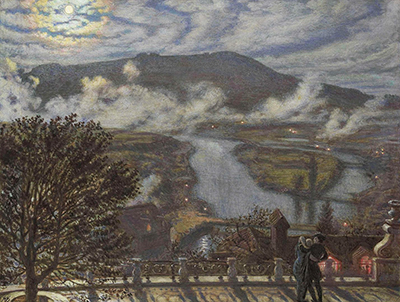
William Holman Hunt's The Terrace, Berne is a moonlit landscape seen from above a river. A foreground terrace, trees and small figures frame a view that opens across the water towards distant hills beneath a moving sky. The Rijksmuseum[1] dates the work 1875, identifies watercolour and opaque colour on paper, and records it as RP-T-1953-114. At 33.5 × 44.3 cm, it is much larger than Hunt's tiny Fishing-Boats by Moonlight, even though both study light after dark.
Lead image: The Terrace, Berne, 1875, Rijksmuseum, Amsterdam, RP-T-1953-114. Public domain. [1].
At a Glance
- ArtistWilliam Holman Hunt (1827–1910)
- TraditionBritish Pre-Raphaelite art
- Work or subjectThe Terrace, Berne
- ContextIllustrated paintings guide
- Further readingArtist biography
Two titles for one object
The title most closely tied to Hunt is written on the sheet: The Terrace, Berne. The Rijksmuseum also catalogues it in Dutch as Gezicht vanaf terras op rivierlandschap bij nacht, meaning a view from a terrace over a river landscape at night. The inherited URL on this site translates that descriptive title as “View from Terrace of River Landscape at Night.” These are different labels for the same Rijksmuseum object, RP-T-1953-114, not evidence of three separate watercolours. The museum's record makes the distinction between an inscribed title and a catalogue description clear. [1]
Hunt's inscription adds a personal detail: the scene is from the hotel terrace where he and his wife first stayed on their wedding journey. The National Portrait Gallery[2] identifies his second wife as Marion Edith Waugh and says they married in Switzerland in 1875. These two records support the association between the picture and their journey. They do not identify the small people visible in the foreground as the couple, nor do they prove that the whole watercolour was completed in a single evening at the hotel. The inscription establishes a remembered viewpoint and occasion, not a full diary of its execution.
Looking across the river
The composition moves in stages. Darker vegetation and the terrace's built edge occupy the near field. Beyond them the river curves through the centre, making a pale path into the landscape. A distant ridge draws a firm horizontal line, while cloud and moonlight disturb the sky above it. Small lights or pale accents along the banks give scale to the sweep of water. The setting is recognisable as a place experienced from a terrace, but the scene does not behave like a measured topographical diagram. Hunt chooses a vantage point that lets human space, river and weather all remain visible.
The moon appears high towards the left in the reproduction, while light also gathers around patches of cloud. This uneven illumination is the subject's visual challenge. Foreground forms remain readable without flattening the night into daylight; the river holds a broad, paler tone; the hills stay largely dark. What appears in a small digital image as one grey or blue area may contain subtler work in the original. A close technical claim about individual brushstrokes would require the museum's high-resolution image or examination of the sheet itself. [1]
Watch: William Holman Hunt
Begin with Hunt’s paintings, then place his work alongside two fellow Pre-Raphaelite founders.
William Holman Hunt Paintings
An overview of Hunt’s paintings from TheHistoryOfArt video archive.
Watch on YouTubeThe terrace also changes how the landscape is experienced. We do not look from an empty hillside. A railing, built structures and vegetation imply a place where a traveller could pause, then look outward. The moonlit valley beyond is expansive, while the lower edge of the picture stays close to human activity. That pairing gives the inscribed memory of a hotel stay a visual setting without identifying any individual in the foreground.
Watercolour, gouache and a catalogue category
The Rijksmuseum lists the object type as a drawing, but its physical description gives brushwork in watercolour and opaque colour on paper. Museum drawing collections often hold watercolours as works on paper; the catalogue category does not turn this into a graphite or chalk sketch. Opaque colour, often called gouache or bodycolour, can give a more solid accent among transparent washes. The record supports naming the mixture, though the reproduction alone does not let us assign each visible highlight to one particular medium. [1]
This distinction matters across Hunt's work. In Asparagus Island the documented scratching out and reserved paper make white water. In Fishing-Boats by Moonlight The Higgins Bedford records bodycolour as part of a much smaller nocturne. Here, opaque and transparent colour help articulate a spacious river valley and its night sky. Shared material terms do not mean the same technique was used in exactly the same places or for the same visual effect.
Later collection history and significance
The Rijksmuseum records a 1953 purchase of the work. The accession number RP-T-1953-114 helps separate it from similarly titled views and ties the museum's image, measurements and inscription to one physical sheet. The museum labels this object public domain, and its published information policy allows commercial reuse of public-domain collection images; the lead on this page now comes directly from that image service. [1] [3]
The picture offers a later counterpoint to Hunt's Near Eastern landscapes of the 1850s. It records another journey, another kind of light and a place connected with his own family life. The inscription gives more certainty about the occasion than many of his travel sheets provide, while the composition still asks to be viewed as an independent landscape. The watercolours guide traces this range across several works; the biography places Edith Waugh and the 1875 journey in the longer story of Hunt's career.
The naming history is itself useful to a reader searching for the work. A search under the site's descriptive English URL, the Dutch museum title, or the shorter inscription should lead back to the same accession. None of those wordings changes the visible subject: a night view from a terrace. Connecting the names to a single physical sheet avoids accidentally multiplying the work into versions that the museum does not record.
Because the scene has both a personal inscription and a precise museum date, it can seem unusually transparent as evidence of Hunt's life. The inscription does tell us what he wanted attached to the view. It cannot tell us exactly when he began the watercolour, whether it was altered later, or how Edith responded to it. The work is therefore best read alongside documentary biography while its light, scale and composition remain objects of study in their own right.
Discussion
Look closely at The Terrace, Berne, then compare your reading with the documented history.
Reader Insights
Which detail in The Terrace, Berne most affects your reading?
How do the date, medium and collection records shape that interpretation?
What remains uncertain about this work or its history?
Join the Conversation
Share a close observation or a source-backed question about The Terrace, Berne. The prompts above are starting points for discussion.
References
- Rijksmuseum. View source.
- National Portrait Gallery. View source.
- Rijksmuseum information and data policy. View source.







