


 by Tom Gurney
Tom Gurney BSc (Hons) is an art history expert with over 20 years experience
Published on June 19, 2020 / Updated on October 19, 2026
Email: tomgurney1@gmail.com / Phone: +44 7429 011000
Fairlight Downs, Sunlight on the Sea
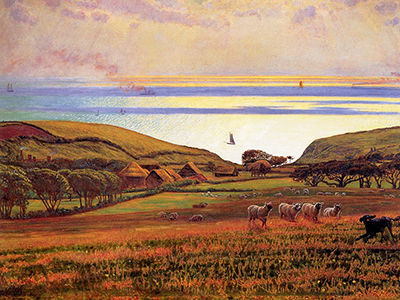
Sheep graze in the fields above a bright line of water. Low huts and trees fill the nearer valley; a tiny sail crosses the sea; overhead, the sky holds warm cloud and a broad band of light. William Holman Hunt's Fairlight Downs, Sunlight on the Sea is a small oil on panel, begun in 1852 and finished in 1858. The 1897 Christie's sale catalogue, lot 69[1] records the panel support, while a later Christie's specialist account[2] reconstructs its extended making. The picture offers an unusually patient view of how sunlight changes land and sea.
The Fairlight landscape
Fairlight lies on the Sussex coast near Hastings. The slope in the foreground falls toward a gap between higher ground, opening a view to the Channel. Hunt does not ask the eye to rush directly to the sea. It moves through the warm field, the grazing animals, darker trees and buildings, then reaches the dazzling water beyond. This layered route gives the distant light its force. The brightness is strongest because the land in front of it remains varied and comparatively subdued.
At a Glance
- ArtistWilliam Holman Hunt (1827–1910)
- TraditionBritish Pre-Raphaelite art
- Work or subjectFairlight Downs, Sunlight on the Sea
- ContextIllustrated paintings guide
- Further readingArtist biography
The sea is not painted as one flat white band. Near the horizon a narrow line separates water and sky; below it, pale blue, yellow and white shift across successive horizontal areas. The sunlight seems to widen as it approaches the gap in the hills. Small dark marks—boats or sails—help establish the water's scale without turning the view into a maritime story. The rural foreground is equally specific: sheep are spaced across uneven grass, and the huts sit among trees at the edge of the slope.
A dark dog stands at the right edge of the inherited reproduction. It gives the foreground a sharp counterpoint to the pale sea, but no secure source assigns it a fixed allegorical meaning. That restraint suits the work. Christie's essay on Hunt's later Asparagus Island[3] treats Fairlight Downs as a landscape in which the observed effects of light can be central without a narrative symbol being required. Viewers can attend to the dog, the animals and the sail as parts of the place rather than clues to a hidden plot.
Begun in 1852, finished in 1858
Hunt started the picture while working along the Sussex coast in 1852, a period that also produced Our English Coasts. The Christie's specialist study of The Silver Lining[2] says Fairlight Downs remained unfinished when Hunt left for the East; he may have worked on it again during a Fairlight visit in 1856 and completed it in September 1858. “May” matters here, because the intermediate session is suggested rather than firmly documented. The article's date range therefore describes a process, not six continuous years of painting.
Art historian Christopher Newall describes Hunt and Edward Lear spending summer and autumn 1852 at Fairlight and connects that period with the two coastal works. In Newall's essay[4], Lear's interest in Hunt's attention to colour and clear light becomes part of their artistic exchange. The works are not copies of one another. The coastal setting, however, gave both artists a demanding test: how to keep detailed land legible beside a sky and sea that could overwhelm it with brightness.
Watch: William Holman Hunt
Begin with Hunt’s paintings, then place his work alongside two fellow Pre-Raphaelite founders.
William Holman Hunt Paintings
An overview of Hunt’s paintings from TheHistoryOfArt video archive.
Watch on YouTubeThe difference between Hunt's Fairlight views is useful. Our English Coasts puts a group of sheep close to a cliff edge and later acquired the alternate title Strayed Sheep. Fairlight Downs offers a broader valley and sea, with animals smaller inside a wider pattern of fields. Both are anchored in close observation, yet the eye moves through them differently. One gathers attention around the sheep; the other sends it outward across several light zones toward the horizon.
Light in a period critic's eyes
The nineteenth-century writer P. G. Hamerton discussed Fairlight Downs: Sunlight on the Sea in Thoughts about Art, pages 58–59[5]. He compared Hunt's picture with a marine photograph by Gustave Le Gray, arguing that the painting could retain subtle tones in areas where the photograph sacrificed detail to capture the glittering water. This was Hamerton's judgment about the technologies and examples he knew, not a timeless rule that painting always records nature better than photography. It does show what a contemporary viewer found remarkable in Hunt's handling of brightness.
Hamerton mentions the work at Gambart's winter exhibition in 1858. The period response gives the painting a public history beyond its long spell in the studio. A viewer today can retrace his attention to the pale sea, then look back to the fields and sky to see why he valued the tonal transitions. The brightest area works with, rather than erases, the quieter colours around it.
Panel and later records
The 1897 sale listing, printed page 13, lot 69[1] names the work Sunlight on the Sea: Fairlight Downs, says it is on panel, and gives historical dimensions of 8¾ × 12 inches. These are catalogue measurements from that sale, not a newly verified measurement of the object today. The lot appears under “Different Properties,” so the catalogue does not establish that this panel belonged to James Leathart, whose collection appears earlier in the same volume. A modern Bridgeman image listing[6] explicitly calls it oil on panel. These records correct an earlier suggestion that this particular Fairlight view was a watercolour. Hunt made other coastal works in watercolour, including Asparagus Island, Kynance, Cornwall, so keeping the materials distinct prevents an easy catalogue mix-up.
Later sources describe the Fairlight panel as privately held, but its current owner and viewing access are not verified here. The local image is useful for following the composition, while the original's surface and colour would need direct examination. Begin with the patterned grass and sheep, trace the dark landforms around the opening, and then return to the thin horizon. Hunt made the brilliance of the sea depend on everything seen before it.
The long making history changes how we read its bright instant. A painting begun during Hunt's 1852 coastal work was still being resolved when it appeared at Gambart's 1858 winter exhibition. The finished surface can feel like one unbroken afternoon, but Christie's account of a possible return in 1856 and documented completion in September 1858 points to decisions made across several seasons. Hamerton's later discussion describes what a viewer could see in the exhibited picture; it cannot tell us which passage Hunt painted on which day. This distinction between an image's depicted light and its documented working time is useful when comparing it with the smaller, more rapidly handled Kynance watercolour. [2] [5]
Discussion
Look closely at Fairlight Downs, Sunlight on the Sea, then compare your reading with the documented history.
Reader Insights
Which detail in Fairlight Downs, Sunlight on the Sea most affects your reading?
How do the date, medium and collection records shape that interpretation?
What remains uncertain about this work or its history?
Join the Conversation
Share a close observation or a source-backed question about Fairlight Downs, Sunlight on the Sea. The prompts above are starting points for discussion.
References
- 1897 Christie's sale catalogue, lot 69. View source.
- later Christie's specialist account. View source.
- Christie's essay on Hunt's later Asparagus Island. View source.
- Newall's essay. View source.
- Thoughts about Art , pages 58–59. View source.
- Bridgeman image listing. View source.







