 by Tom Gurney
Tom Gurney BSc (Hons) is an art history expert with over 20 years experience
Published on June 19, 2020 / Updated on October 19, 2026
Email: tomgurney1@gmail.com / Phone: +44 7429 011000
Master Hilary – The Tracer
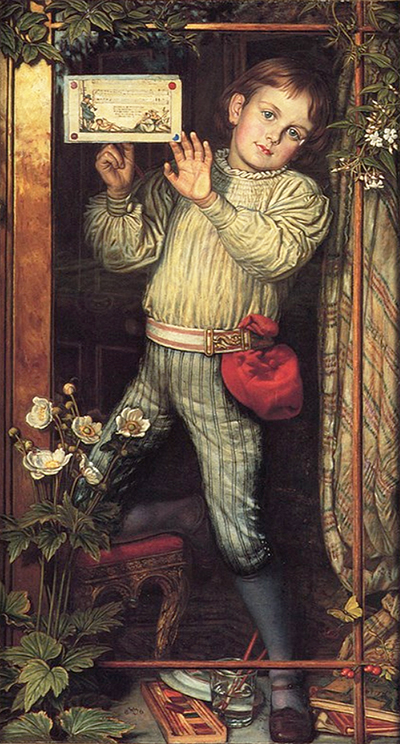
A boy holds a printed song sheet against a window and raises a stick of coloured chalk to trace its picture. He looks straight out, his other hand pressed to the glass. This is Hilary Lushington Hunt, the artist's son, in William Holman Hunt's Master Hilary – The Tracer. The specialist Christie’s catalogue[1] identifies the work as oil on canvas, 122.2 × 66 centimetres, dated 1886. Its title describes a real childhood activity while the painting turns that small action into a study of looking through a window.
Hilary at the window
Hilary, born in 1879, was about seven when the canvas was dated. He stands inside the drawing room at Draycott Lodge, Fulham. Hunt takes the viewer's position outside, in the garden. The child faces us, but a pane of glass separates his space from ours. That division is easy to miss at first because his face and clothes are so distinct. The window bars, reflections of plants, and pale pressure of his fingers reveal how the scene is constructed. [1]
At a Glance
- ArtistWilliam Holman Hunt (1827–1910)
- TraditionBritish Pre-Raphaelite art
- Work or subjectMaster Hilary – The Tracer
- ContextIllustrated paintings guide
- Further readingArtist biography
The sheet fixed to the glass is not a blank scrap. Christie's identifies its illustration as “Over the Hills & Far Away” from Walter Crane's The Baby's Opera, a book of illustrated rhymes. Hilary holds a chalk in his right hand to copy the design while daylight passes through the paper. A box of paints, brushes in a glass and an upturned china plate sit near his feet. The tools make his action specific: the child is using light and glass to draw, not simply posing with a book.
Hunt surrounds this focused task with another view for us to examine. White flowers and leaves frame the outside of the window; a curtain hangs inside to Hilary's left. Reflections on the pane partly mingle with the dark drawing room beyond. The child's fingers look lighter where they meet the glass, a small physical clue that rewards slow attention. What first appears to be a straightforward portrait becomes an image of layers, surfaces and distance.
A portrait of drawing
The boy's act of tracing was an apt subject for an artist attentive to outline and exact observation. Christie's records that the 1887 Grosvenor Gallery catalogue paired the painting with a sentence about making a correct outline before painting. The wording changed when the work was shown again in Birmingham later that year; the specialist catalogue suspects the supposed old manual may have been Hunt's own device. It is safest to treat it as part of the picture's exhibition framing, rather than as an independently identified textbook.
Hilary's image is lively but also unusually still. His turned head, raised hand and bent knee give movement to the pose, while the window fixes him behind a smooth surface. Hunt puts bright red in the cap at his belt and in smaller accents around the picture, against greens, browns and cream fabric. The printed page near the upper left is a second, small picture within the main portrait. The drawing tools below form a quiet trail from Hilary's hand to the floor.
Watch: William Holman Hunt
Begin with Hunt’s paintings, then place his work alongside two fellow Pre-Raphaelite founders.
William Holman Hunt Paintings
An overview of Hunt’s paintings from TheHistoryOfArt video archive.
Watch on YouTubeThe composition makes an everyday lesson in copying into a larger question about representation. Hilary studies Crane's printed image; Hunt studies Hilary through a pane; we study Hunt's painted account of both. The painting does not need an invented moral story to make these relationships interesting. Its specific materials and viewpoints are enough to hold attention.
An 1886 painting that changed
Hunt's monogram carries the date 1886, and the portrait appeared at the Grosvenor Gallery in 1887. Christie's reproduces correspondence indicating it was reworked before a later 1887–88 Birmingham showing. The catalogue describes possible movement of the figure and alterations to clothing, some visible as changes beneath the finished paint. These are evidence of Hunt's continued work after the first public display, rather than a reason to replace the signed date with a new one.
The image reproduced in Hunt's memoir differs from the canvas now photographed: the trousers appear plain instead of striped, and the cap sits elsewhere. Christie's reports family testimony that Edward Robert Hughes, Hunt's later studio assistant, made the changes. Its specialists judge that attribution likely from the handling, while keeping it less than certain. The inherited image on this page shows the striped trousers and red cap. It would overstate the evidence to describe every alteration as Hughes's work or to say exactly when these details were added.
This history is especially useful because the visible painting has more than one documented state. A contemporary reviewer in 1887, a memoir illustration, and a later reproduction need not show precisely the same surface. The object is still Hunt's portrait of Hilary; the chronology of revision helps explain why details seen in different records do not perfectly align.
Family, exhibition and reception
The painting remained close to its sitter. Christie records an inscription on the back: Hunt gave it to Hilary on his twenty-first birthday, 6 May 1900. It later passed through Hilary's family and was shown in Hunt retrospectives. These recorded stages explain its long family association, but the catalogue is a historical sale document and does not establish a current owner in 2026. [1]
Responses to the first exhibition were divided. Christie recounts praise for the force of the child's face and the close handling, along with criticism of an image some viewers found too sharp or excessive. The differing reactions fit a work that asks us to notice far more than a likeness: pane, reflections, flowers, coloured paper and drawing equipment all compete for attention. Hilary remains the centre, but Hunt makes the experience of seeing him part of the subject.
The family link also connects this portrait to Hunt's painting of Cyril Benoni and to other pictures featuring his children. Here, Hilary is not a biblical stand-in. He is a child at home, absorbed in a task. Hunt's complicated window lets that familiar scene become a careful portrait of a young maker looking at an image while the artist looks back at him.
Discussion
Look closely at Master Hilary – The Tracer, then compare your reading with the documented history.
Reader Insights
Which detail in Master Hilary – The Tracer most affects your reading?
How do the date, medium and collection records shape that interpretation?
What remains uncertain about this work or its history?
Join the Conversation
Share a close observation or a source-backed question about Master Hilary – The Tracer. The prompts above are starting points for discussion.
References
- specialist Christie’s catalogue. View source.