


 by Tom Gurney
Tom Gurney BSc (Hons) is an art history expert with over 20 years experience
Published on June 19, 2020 / Updated on October 19, 2026
Email: tomgurney1@gmail.com / Phone: +44 7429 011000
Miss Gladys M. Holman Hunt: The School of Nature
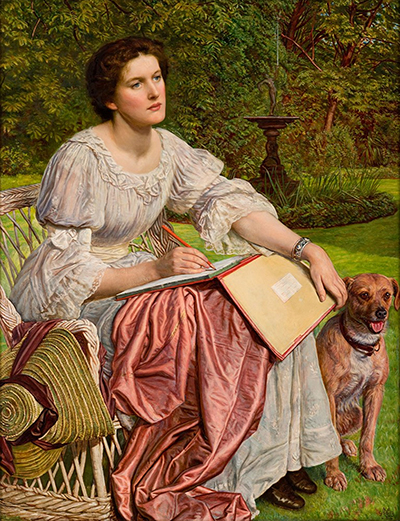
A young woman sits in a wicker chair outdoors, her pencil resting on a drawing board while a dog looks out beside her. The garden around her is dense with foliage, but the picture leaves the subject of her drawing outside our view. William Holman Hunt's Miss Gladys M. Holman Hunt (“The School of Nature”) is an oil on panel begun in 1893–94 and altered about 1904–05, according to the Museo de Arte de Ponce's object record[1]. The museum identifies it as object 64.0504, measuring 122.6 × 98.3 cm. Its collection image matches the existing reproduction on this page.
The double title matters. “Miss Gladys M. Holman Hunt” identifies the sitter as the artist's daughter. “The School of Nature” gives the activity a broader idea: learning through sustained looking at the natural world. The museum calls nature humanity's valuable instructor in its account of the work. The painting brings a family portrait and a statement about artistic practice into the same garden, then complicates both through its later alteration.
At a Glance
- ArtistWilliam Holman Hunt (1827–1910)
- TraditionBritish Pre-Raphaelite art
- Work or subjectMiss Gladys M. Holman Hunt: The School of Nature
- ContextIllustrated paintings guide
- Further readingArtist biography
A drawing lesson in a garden
Gladys holds a pencil over a board placed across her lap. The visible board seems open and pale; the thing she studies lies beyond the painted frame. Hunt therefore shows the act of observation rather than giving us a finished drawing to inspect. Her gaze is directed away from the viewer and slightly upward, as if she is comparing what she sees with what her hand is about to record. The dog, by contrast, faces out. That difference makes the viewer aware of being outside her concentrated task.
The garden fills nearly every remaining space. Dark leaves and thin branches make a patterned backdrop to the light blouse; grass and low plants surround the chair. A small raised fountain stands behind the sitter. The pale sleeves, warm pink skirt and green vegetation form large colour areas, while fine marks in the foliage and wicker invite closer inspection. The dog supplies a brown note near the lower right. Nothing in the museum record identifies its name, so the animal is best read as a visible companion rather than given an invented biography.
This is a substantial panel, more than a metre high. The near-life scale changes how we meet a quiet subject: the chair, board, figure and dog occupy a large pictorial space, not a small sketchbook scene. Hunt devotes considerable labour to a moment of looking. The title asks us to see the garden as a place of instruction, and the composition makes the sitter's attention its central action.
Gladys, the sitter
The National Portrait Gallery[2] identifies Gladys Millais Mulock Holman Hunt as Hunt's daughter and gives her life dates as 1876–1951. She was in her teens when the Ponce painting was begun. The work belongs to a family context within Hunt's later career, alongside portraits such as The Birthday, showing his wife Edith and Master Hilary – The Tracer, which shows his son at work with an image. These pictures do different things; their shared interest lies in family members presented through a distinctive activity or setting.
Watch: William Holman Hunt
Begin with Hunt’s paintings, then place his work alongside two fellow Pre-Raphaelite founders.
William Holman Hunt Paintings
An overview of Hunt’s paintings from TheHistoryOfArt video archive.
Watch on YouTubeA separate 1891 chalk drawing held by the National Trust[3] also depicts Gladys. It is a different object, made before the garden panel. That distinction helps prevent a common error when comparing portraits of the same sitter: an earlier image cannot automatically tell us exactly how the first version of this painting looked, especially because the Ponce work was changed later.
The altered portrait
The most consequential fact in the Ponce catalogue[1] is that the portrait did not remain in its first state. The museum says Gladys later asked Arthur Hughes, whom it describes as her father's assistant, to modify it. The record dates that alteration to about 1904–05 and says the result is a more generalised image of an older woman. This is the museum's account of the change; the public record does not specify every passage Hughes painted or preserve a photograph of the first version.
Consequently the current face should not be described as an untouched likeness of the teenage Gladys of 1893–94. Nor should the change erase the original sitter from the history of the object. The catalogue title keeps her name while recording a visual state made at least a decade later. The painting now carries two moments: Hunt's garden portrait and the later decision to revise how its central figure appeared. That history is part of what a viewer sees, even where the boundary between hands is not obvious in a reproduction.
The revision also changes the relation between the two halves of the title. A specific daughter remains named, but the figure may read more readily as a general student of nature. That reading follows the museum's description; it is not evidence of Gladys's private reason for requesting the change. The motive cannot be supplied from the current object record alone.
Looking at the work today
The Ponce museum's direct entry is particularly useful because older image captions contain errors. A widely copied filename misspells Gladys and gives the impossible width “982 cm”; the museum records 98.3 cm. The reliable object facts are the museum's title, two date phases, oil-on-panel medium, measurements and number 64.0504. Its image also confirms that the page's inherited lead depicts this very panel.
Begin with Gladys's hand and the blank space on her board, then look outward to the unseen view she may be studying. Return to the foliage behind her and the dog beside her. Hunt made a picture about the labour of seeing; its changed face reminds us that looking at a painting also means asking how the object came to have the appearance it has now. The exact first likeness remains beyond the evidence available here.
The museum still catalogues Hunt as the artist while openly describing the later work requested by Gladys and carried out by Arthur Hughes. Those two statements belong together. Treating every visible passage as an untouched 1890s decision by Hunt would erase the alteration; calling the entire panel a Hughes painting would erase its first making. The public object record does not map the precise boundary between their hands. The most accurate account follows both documented stages and leaves the individual brushstrokes unassigned where there is no technical examination. [1]
Discussion
Look closely at Miss Gladys M. Holman Hunt: The School of Nature, then compare your reading with the documented history.
Reader Insights
Which detail in Miss Gladys M. Holman Hunt: The School of Nature most affects your reading?
How do the date, medium and collection records shape that interpretation?
What remains uncertain about this work or its history?
Join the Conversation
Share a close observation or a source-backed question about Miss Gladys M. Holman Hunt: The School of Nature. The prompts above are starting points for discussion.
References
- Museo de Arte de Ponce's object record. View source.
- National Portrait Gallery. View source.
- separate 1891 chalk drawing held by the National Trust. View source.







