 by Tom Gurney
Tom Gurney BSc (Hons) is an art history expert with over 20 years experience
Published on June 19, 2020 / Updated on October 19, 2026
Email: tomgurney1@gmail.com / Phone: +44 7429 011000
Past and Present
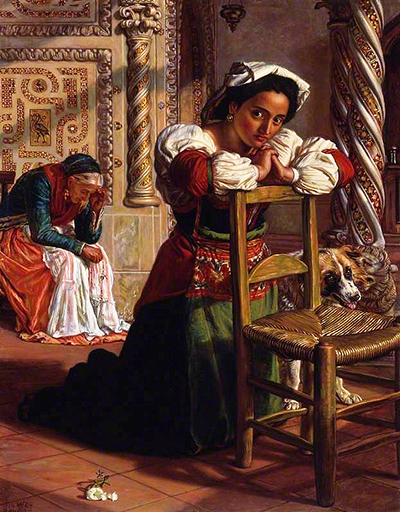
A young woman leans her folded arms over the back of a chair in an ornate church interior. A dog rests its head beside her; farther back, an older woman sits apart. Hunt's Past and Present is an 1868 painting held by Aberdeen Archives, Gallery & Museums. The owning collection's record[1] gives the date, medium and accession ABDAG002803. It also says the work is inscribed “Ravello 1868,” connecting the scene to Hunt's time in southern Italy.
Two women in a decorated interior
The young woman is closest to us and dominates the picture. Her red and green clothing, white sleeves and steady gaze stand out against rich stonework and mosaics. Hunt positions the chair between her and the viewer, then lets her arms and face reach over it. Its woven seat creates a patch of warm texture below the dog's head. The animal looks outward, a quiet companion to the woman rather than an actor in a large dramatic event.
At a Glance
- ArtistWilliam Holman Hunt (1827–1910)
- TraditionBritish Pre-Raphaelite art
- Work or subjectPast and Present
- ContextIllustrated paintings guide
- Further readingArtist biography
The older woman sits at the left in deeper space, her head lowered. Their different positions create a contrast: one figure engages the viewer, the other withdraws into the building. The title invites thought about different ages or phases of life, but the accessible museum account does not name the women or prove a family relationship. The painting can be read through the tension between these two presences without turning them into named characters in an invented story.
The architecture is unusually active. Twisted and patterned columns, carved details, a decorated wall and a glimpse of a chalice fill the space around the figures. Hunt makes the woman's smooth face and cloth visible against surfaces packed with small marks. Some details are difficult to distinguish in a small reproduction. Looking first at the positions of the two women, the chair and the dog gives the composition a clear structure before trying to read every ornament as a symbol.
Ravello and the date
Aberdeen's record dates the work to 1868 and reports the inscription “Ravello 1868.” It says that on his way towards the Holy Land that year, Hunt stopped in Florence to oversee a memorial for his first wife, Fanny Waugh Hunt, who had died there in childbirth in 1866. He then travelled through Naples, Salerno and Ravello. The museum concludes that this painting must have been started during that visit. The inscription anchors a place and year; it does not prove that every part of the painting was completed in Ravello on one occasion. [1]
The Italian setting helps explain the church's decorative richness, but the work is not simply an architectural view. Hunt has made the human contrast central: a young woman at the front, an older woman behind, and an animal close to the nearer figure. The recorded journey supplies context for where he worked. It should not be made into a claim that the women are portraits of people he met there, since the collection record gives no such identification.
Watch: William Holman Hunt
Begin with Hunt’s paintings, then place his work alongside two fellow Pre-Raphaelite founders.
William Holman Hunt Paintings
An overview of Hunt’s paintings from TheHistoryOfArt video archive.
Watch on YouTubeHunt was also working through the aftermath of Fanny's death. That biographical circumstance belongs to the journey Aberdeen describes; the visible scene does not automatically illustrate his private grief. His portrait of Fanny and Uffizi self-portrait have documented family connections through his correspondence. Past and Present can be placed near that period without assigning it the same purpose on title or mood alone.
Details and possible meanings
The Aberdeen interpretation[1] connects a crane in the mosaic with the older woman's loyalty and good life. It reads the dog beside the younger woman as a sign of fidelity, and suggests that the chalice may refer to Christian faith. These are the owning museum's readings of details within the church. The dog and the young woman's position are readily visible even in a modest reproduction; the mosaic bird needs a closer image or a view of the original to assess with the same confidence.
Those signs enrich the relationship between title and figures. The word “present” might draw attention to the young woman now before us, while “past” could suggest the older figure's life and memory. That is one plausible way to explore the title, not a documented key in which each person has a fixed role. The church's surfaces, the chalice, the dog and the mosaic crane suggest continuity and faith across time. Their exact meaning should remain open to what the picture and museum record can support.
Aberdeen catalogues the painting as oil on canvas with an integral back board, measuring 61.2 × 47 centimetres. The specified backing is a physical feature of the object, not an excuse to relabel it as a simple oil-on-panel painting. The collection records it as bequeathed by Mrs Taylor in 1941. These material and provenance details distinguish this single canvas from other works with the same title. [1]
A title shared with another artist
Past and Present is also the familiar title of a three-part work by Augustus Egg at Tate, made in 1858. Egg's sequence tells a different Victorian story across separate canvases. Hunt's 1868 Aberdeen painting is one work, with two women and a dog in a church interior. Its title is shared; its artist, date, composition and collection are different. [2]
The easiest way into Hunt's painting is through what it makes visible: the woman's gaze over the chair, the dog pressed near her, the older figure set back, and the dense Ravello church decoration. The Aberdeen record then adds a dated place, a material description and carefully framed symbolic possibilities. Together they let this quieter Italian picture stand on its own, apart from the better-known work that happens to bear its title.
Aberdeen's catalogue separates the 61.2 × 47 cm painted object from its larger 86.2 × 72 cm frame. That distinction matters when a framed photograph makes the work appear more imposing than the canvas alone. The same live record currently lists it as viewable by appointment at the Aberdeen Treasure Hub, a useful check for anyone planning to see details such as the mosaic bird in person. Display arrangements can change, and the dated catalogue information is a guide rather than a permanent promise of access. Its accession ABDAG002803 remains the stable identifier for an enquiry. [1]
Discussion
Look closely at Past and Present, then compare your reading with the documented history.
Reader Insights
Which detail in Past and Present most affects your reading?
How do the date, medium and collection records shape that interpretation?
What remains uncertain about this work or its history?
Join the Conversation
Share a close observation or a source-backed question about Past and Present. The prompts above are starting points for discussion.
References
- owning collection's record. View source.
- Tate, Egg's Past and Present, No. 1. View source.