 by Tom Gurney
Tom Gurney BSc (Hons) is an art history expert with over 20 years experience
Published on June 19, 2020 / Updated on October 19, 2026
Email: tomgurney1@gmail.com / Phone: +44 7429 011000
The School-Girl's Hymn
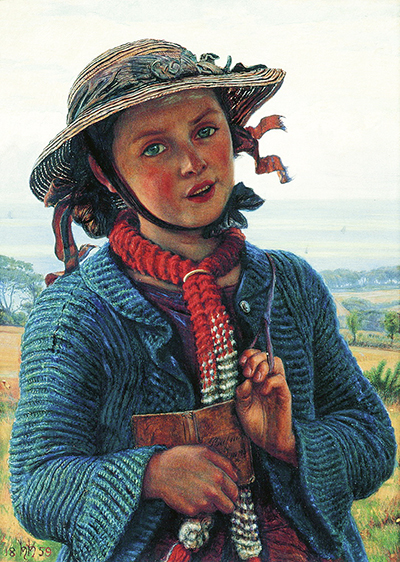
A girl turns toward us while crossing a bright landscape. Her mouth is slightly open, as though she is singing; a small book is held close to her body. A broad straw hat, a blue knitted outer garment and a vivid red scarf give her an unmistakable physical presence. William Holman Hunt called the small oil The School-Girl's Hymn, asking viewers to imagine a song as well as the person they can see. The painting was completed in 1859 and now belongs to the Ashmolean Museum, Oxford (WA1894.2). Its panel measures 35 × 25 cm, a compact size very different from Hunt's later multi-figure May Morning on Magdalen Tower. [1]
A sitter within an imagined moment
The Ashmolean-supplied Art UK account[1] identifies the model as Miriam Wilkinson, a labourer's daughter Hunt met while staying near Hastings with his friend and patron Thomas Combe in 1858. The image is therefore grounded in a named encounter, even though the action suggested by its title is constructed. The collection description imagines a girl going to Sunday school on a pleasant morning and singing as she walks. We can describe that as the picture's proposed story without claiming to know the precise route she took, the school she attended or the words she sang. [1]
At a Glance
- ArtistWilliam Holman Hunt (1827–1910)
- TraditionBritish Pre-Raphaelite art
- Work or subjectThe School-Girl's Hymn
- ContextIllustrated paintings guide
- Further readingArtist biography
Hunt gives Miriam an individual face rather than turning her into an anonymous emblem of childhood. Her cheeks are flushed, her eyes meet the viewer and her lips are parted. The slightly tilted head suggests movement, but the face stays steady enough for close observation. The hat casts a shallow shade while allowing light to reach her skin. Ribbons and small decorative elements break up its wide rim. These details make her clothes feel worn and handled, not merely selected for a colour scheme.
The title's claim that she sings is persuasive because of her parted mouth and the book, yet it remains an act of imagination by the painter. A painted mouth has no sound. Hunt has to make us supply a voice, and the pose does that work economically. He does not place a written hymn legibly before us or identify a particular tune. The viewer reads the gesture and title together, then imagines the rest.
Colour, clothing and distance
Blue and red dominate the figure. The thick blue knitting gives Hunt an opportunity to distinguish ribbed fabric from the smoother flesh of hands and face. A red scarf runs down the front, crossing the blue and drawing the eye toward the hands and book. Brown and green tones in the hat and lower clothing steady the brighter colours. It is an unusually intimate study of how a child's garments sit on a body: the scarf bunches at the neck, a sleeve folds near the wrist, and the hat's brim bends rather than forming a perfect circle.
Beyond her, the land drops toward a pale strip of water and sky. The distant view is lightly described compared with the face and clothing. That contrast keeps the girl in the foreground, while still placing her outdoors on a journey. The background is more than a flat portrait screen. Its low horizon and open light give room for the imagined walk. A viewer can sense a morning beyond the frame without inventing a specific identifiable road.
Watch: William Holman Hunt
Begin with Hunt’s paintings, then place his work alongside two fellow Pre-Raphaelite founders.
William Holman Hunt Paintings
An overview of Hunt’s paintings from TheHistoryOfArt video archive.
Watch on YouTubeThe panel's small size matters. At roughly 35 cm high, it invites close viewing of the fabric and expression. Hunt used the same broad principle of careful looking in much larger pictures, but here the subject can be grasped in one encounter. The face is central, and the landscape supports it. The small format also helps explain why the painting could be made and sold alongside Hunt's more ambitious narrative works without asking every element to carry a complex theological code. [1]
Combe, Gambart and the Ashmolean
According to the Ashmolean account, Hunt finished the painting in October 1859, and Thomas Combe bought it before an exhibition opened at Ernest Gambart's gallery. Combe had supported a number of Pre-Raphaelite artists and collected their work. Here he connects the circumstances of the sitter's discovery with the painting's early ownership. The fact that he purchased it before the show also reminds us that Hunt's modest-sized subject entered an active art market; it was not only a private study of a child he met. [1]
The Combes' collection eventually gave the picture its Oxford home. Martha Combe, Thomas's widow, left their Pre-Raphaelite works to Oxford after her death in 1893; the Ashmolean records the resulting group in its collection. A portrait of a labourer's daughter thus passed through a prominent family's collection into a university museum. That history does not change who Miriam was, but it changes how later viewers encounter her: the painting is now studied as part of Hunt's career and the broader story of Pre-Raphaelite art. [2] [1]
The Ashmolean description has called it a “pot-boiler,” a phrase suggesting a work made partly to earn money. Such a label is evidence of how the painting has been characterised, not a reason to overlook it. Its modest scale and direct appeal could make it saleable; neither tells us that Hunt stopped studying the sitter closely. The careful depiction of a particular face and knitted fabric deserves to be judged in the image itself. [1]
Singing in Hunt's pictures
The later May Morning on Magdalen Tower places a choir high above Oxford and brings many named sitters into a complicated ceremony. The School-Girl's Hymn places a single named child near a quiet landscape. Both paintings ask us to imagine music through visible gestures: a conducting arm and open mouths in the later canvas, one child's parted lips and book here. The comparison shows how flexible Hunt's interest in observed people could be. It does not imply that the 1859 portrait was a preparatory study for a painting begun nearly thirty years later.
Miriam's identity, the small panel and the simple action keep the picture distinct. Its appeal lies in the meeting of portrait and story. Hunt observed a person closely enough to preserve her features, then gave her a title and setting that invite us to hear an unheard hymn. The viewer can return from that imagined sound to the visible things: the hat's bending brim, the red scarf, the book and the attentive face.
Discussion
Look closely at The School-Girl's Hymn, then compare your reading with the documented history.
Reader Insights
Which detail in The School-Girl's Hymn most affects your reading?
How do the date, medium and collection records shape that interpretation?
What remains uncertain about this work or its history?
Join the Conversation
Share a close observation or a source-backed question about The School-Girl's Hymn. The prompts above are starting points for discussion.
References
- Art UK, Ashmolean object record. View source.
- Ashmolean Museum, Pre-Raphaelites Gallery. View source.