


 by Tom Gurney
Tom Gurney BSc (Hons) is an art history expert with over 20 years experience
Published on June 19, 2020 / Updated on October 19, 2026
Email: tomgurney1@gmail.com / Phone: +44 7429 011000
The Sphinx at Gizeh
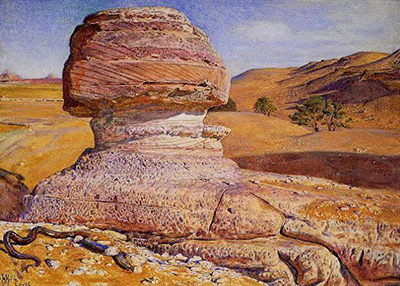
William Holman Hunt did not give the Great Sphinx the familiar face-on view. In this 1854 watercolour, we look across its battered back and partly buried body toward a wide, dry Egyptian landscape. The Sphinx fills the foreground, while distant pyramids shrink to tiny points on the horizon. A snake winds over the stones at the bottom of the picture. The work is held by The Harris in Preston, whose collection history names it The Sphinx, Gizah. A longer recorded title, The Sphinx, Gizeh, Looking towards the Pyramids of Sakhara, describes Hunt's unusual direction of view. [1] [2]
A monument seen from behind
The Sphinx's head rises at the left, its weathered layers catching pink and brown light. Seen from this angle, the celebrated human face almost disappears. Hunt gives more room to the long stone body, loose sand, scattered rock and the slope beyond. The small pyramids sit in the distant band between earth and sky. Nothing in the watercolour turns the monument into a neat silhouette for tourists. Its scale comes from its presence against the open ground and from the near viewpoint that denies us a single, complete outline.
At a Glance
- ArtistWilliam Holman Hunt (1827–1910)
- TraditionBritish Pre-Raphaelite art
- Work or subjectThe Sphinx at Gizeh
- ContextIllustrated paintings guide
- Further readingArtist biography
The serpent is easy to overlook at first because its curves repeat the broken lines of the stones. It gives the immediate foreground a living, uneasy motion. The snake may invite symbolic readings, but the image alone cannot establish one intended meaning. Hunt's close observation of the creature, ancient stone and shifting colour is enough to make this view unlike a conventional picturesque ruin. The small size of the sheet, reported as roughly 10 by 14 inches, also matters: a monumental subject is held within an intimate field of watercolour. [2]
Hunt in Egypt, 1854
Hunt travelled to Egypt in 1854, meeting fellow artist Thomas Seddon near Cairo before continuing his journey east. Both made pictures around Giza. Seddon's letters and later accounts place them working close to the Sphinx; a specialist comparison describes Seddon's more frontal, activity-filled watercolour and Hunt's rear view. Their sheets were comparable in size, but they did not make interchangeable records. Hunt pushed the monument's eroded mass into the foreground and let the pyramids remain far away. [3]
The journey belongs to Hunt's broader effort to work from places and visible particulars rather than make distant scriptural scenery wholly from imagination. The National Portrait Gallery dates his first Egypt and Syria travels to 1854–56. On this trip he also made The Great Pyramid, a separate small watercolour dated 1854 in the Morgan Library & Museum. Looking at that work alongside the Sphinx helps show the range of motifs available even within Giza: ancient architecture, water, reflected light, distant figures and the changing desert surface. [4] [5]
The 1856 Royal Academy response
John Ruskin discussed the sheet soon after Hunt returned. In his 1856 Royal Academy notes, he grouped catalogue entries 873, 885 and 1002 as Hunt studies from the East. The annotated edition identifies 1002 by the full Sphinx title, The Sphinx, Gizeh, looking towards the pyramids of Sakhara. This gives a contemporary exhibition number and confirms that the Egyptian watercolour was presented to a London public by 1856, after its 1854 making. The number belongs to that exhibition, not to The Harris collection. [6]
Watch: William Holman Hunt
Begin with Hunt’s paintings, then place his work alongside two fellow Pre-Raphaelite founders.
William Holman Hunt Paintings
An overview of Hunt’s paintings from TheHistoryOfArt video archive.
Watch on YouTubeRuskin valued the Sphinx drawing as an “invaluable record” and anticipated that viewers unfamiliar with the natural setting might find Hunt’s colouring surprising. He defended that colour by comparing the problem to the reception of Turner. His response shows what one influential critic wanted the image to do: preserve the appearance of a place with fidelity even when its colours challenged expectation. It is evidence of 1856 reception, not proof that every hue in the watercolour is a measured transcription of Egyptian light. The same short passage also praises the distant Dead Sea in another Hunt study, placing this sheet among several travel works rather than treating it as an isolated curiosity. [6]
The Harris watercolour and the later print
The Harris traces this watercolour through the collection of Richard Newsham, a Preston lawyer whose bequest helped found its fine art holdings in 1883. The museum calls Hunt's Sphinx an unusual acquisition among Newsham's Victorian pictures and identifies it as a watercolour. That provenance locates the colour image on this page in a specific public collection. The Harris source does not give a full accession history or present display status, so neither should be assumed. [1]
Hunt returned to the Sphinx in another medium. Christchurch Art Gallery owns The Desolation of Egypt (The Sphinx), an 1858 etching. Its catalogue says Hunt conceived the printed subject during the 1854 visit, then divided and reworked an earlier paired design, adding a night effect. The black-and-white print is related to the journey but is not this sunlit Preston watercolour. Its date, technique and collection must stay separate. [7]
This distinction reveals why Hunt's Egyptian work resists a single label. The Sphinx could be a closely observed place, the subject of a watercolour shown to British viewers, and later a scene transformed in etching. Here the warm colour and reverse view keep us with the first encounter: a weathered monument embedded in a real landscape. For another aspect of the same journey, compare Hunt's The Nile and his studies of Egyptian light in The Afterglow in Egypt. The Sphinx page remains about this particular Harris sheet, its angle of looking and its route into Preston's collection.
The Harris describes Newsham as a collector who usually favoured established Victorian art and sometimes avoided more experimental work. It calls Hunt's Sphinx watercolour his only acquisition by an artist associated with the Pre-Raphaelite Brotherhood. That makes the sheet an exception within the collection from which the museum's fine art holdings grew. Its survival in Preston is therefore part of the reception story: an image that Ruskin praised for challenging familiar expectations about Egyptian colour entered a collector's otherwise more conventional group. This is a comparison of two documented responses, not proof that Newsham bought it because of Ruskin's review. [1] [6]
Discussion
Look closely at The Sphinx at Gizeh, then compare your reading with the documented history.
Reader Insights
Which detail in The Sphinx at Gizeh most affects your reading?
How do the date, medium and collection records shape that interpretation?
What remains uncertain about this work or its history?
Join the Conversation
Share a close observation or a source-backed question about The Sphinx at Gizeh. The prompts above are starting points for discussion.
References
- The Harris, fine art collection. View source.
- Victorian Web, object caption. View source.
- Victorian Web, Seddon and Hunt at Giza. View source.
- National Portrait Gallery, Hunt biography. View source.
- Morgan Library & Museum, The Great Pyramid. View source.
- Ruskin, Academy Notes , 1856, pp. 70–71. View source.
- Christchurch Art Gallery, The Desolation of Egypt. View source.







