 by Tom Gurney
Tom Gurney BSc (Hons) is an art history expert with over 20 years experience
Published on June 19, 2020 / Updated on August 11, 2026
Email: tomgurney1@gmail.com / Phone: +44 7429 011000
Why Fallen Angel still feels modern
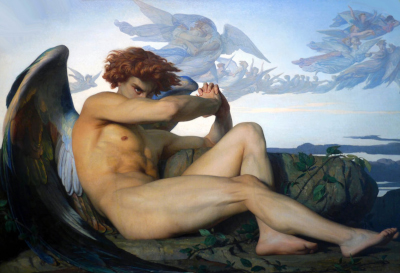
Fallen Angel, or L'Ange dechu, is Alexandre Cabanel's most searched and most emotionally immediate painting. Made in 1847 while the young French painter was in Rome, it turns Satan's fall into a close psychological drama: a beautiful body, a dark wing, a tearful stare and a heaven that remains visible but unreachable.
At a Glance
- TitleL'Ange dechu / Fallen Angel [1]
- ArtistAlexandre Cabanel
- Date1847 [1]
- MediumOil on canvas [1]
- Size121 x 189.7 cm [1]
- LocationMusee Fabre, Montpellier [1]
- ContextSecond envoi de Rome from the Villa Medici [1]
Contents
- Museum facts and provenance
- Why the painting is famous
- Close reading
- Annotated image
- Meaning and sources
- Academy response
- Study for Fallen Angel
- Where to see it
Museum facts and provenance
The Musee Fabre records the painting as L'Ange dechu, painted by Alexandre Cabanel in 1847, in oil on canvas. The museum's feature page gives the dimensions as 121 by 189.7 cm and the inventory number as 889.2.1.[1] The object record gives closely related measurements for the unframed canvas and confirms the work's place in the Montpellier collection.[2]
The painting belongs to Cabanel's Rome period. After training in Montpellier and Paris, he won the second Grand Prix de Rome in 1845 and worked at the Villa Medici. The Musee Fabre describes Fallen Angel as his second Roman submission, following the large Orestes of 1846.[1] That matters because the picture was not simply a later studio fantasy. It was made for academic assessment, by a young artist expected to prove his progress to Paris.
Its later route also matters. The Fabre feature records that the work remained with the artist, appeared in the Cabanel sale at Galerie Georges Petit in May 1889, and was then given to the Musee Fabre by Cabanel's brother Barthelemy in 1889.[1] That provenance ties the painting to Cabanel's family, his native city and the museum where it became a modern visitor favourite.
Why Fallen Angel is famous
Fallen Angel is famous because it compresses a grand religious and literary subject into a face. Viewers do not first meet an abstract doctrine of evil; they meet a body curled at the edge of the canvas, a half-hidden face and a tear that refuses to settle into a single emotion. Shame, anger, beauty and wounded pride all occupy the same image.
The Musee Fabre's own account helps explain the effect. It describes Cabanel placing a life-sized figure close to the edge of the canvas, contrasting the body with an ethereal landscape of greys and blue-lilac harmonies, and giving the wing and half-masked face a striking visual force.[1] The composition feels intimate even though the theme is cosmic.
The painting's current fame is also digital. A Montpellier city publication describes the work as an icon on TikTok and Instagram, especially among younger viewers, and points to the eyes, tears, melancholy, anger and frustration as key reasons for its recent popularity.[4] That modern reception is not a distraction from the art history. It shows that Cabanel's academic polish can still behave like emotional spectacle when viewers encounter it closely.
Il cache la honte de sa défaite cependant, toujours fier, désespéré, vindicatif.
English translation: He hides the shame of his defeat; still proud, desperate, vindictive.
Alexandre Cabanel, letter to Alfred Bruyas, quoted by Musée Fabre [1]
Cabanel's own words are unusually useful for this page. In the letter quoted by the Musee Fabre, he frames Satan as a defeated power who hides the shame of failure while remaining proud, desperate and vindictive. That is almost a verbal description of the painting's face: concealed, wounded and still dangerous.
Close reading: the face, wing and background angels
The face is the painting's magnet. Cabanel turns Satan's eye toward the viewer's right, so the gaze seems both evasive and confrontational. The arm partly hides the face, but that concealment does not soften the expression. It intensifies it, because the viewer must read feeling through a narrow band of eye, brow, cheek and tear.
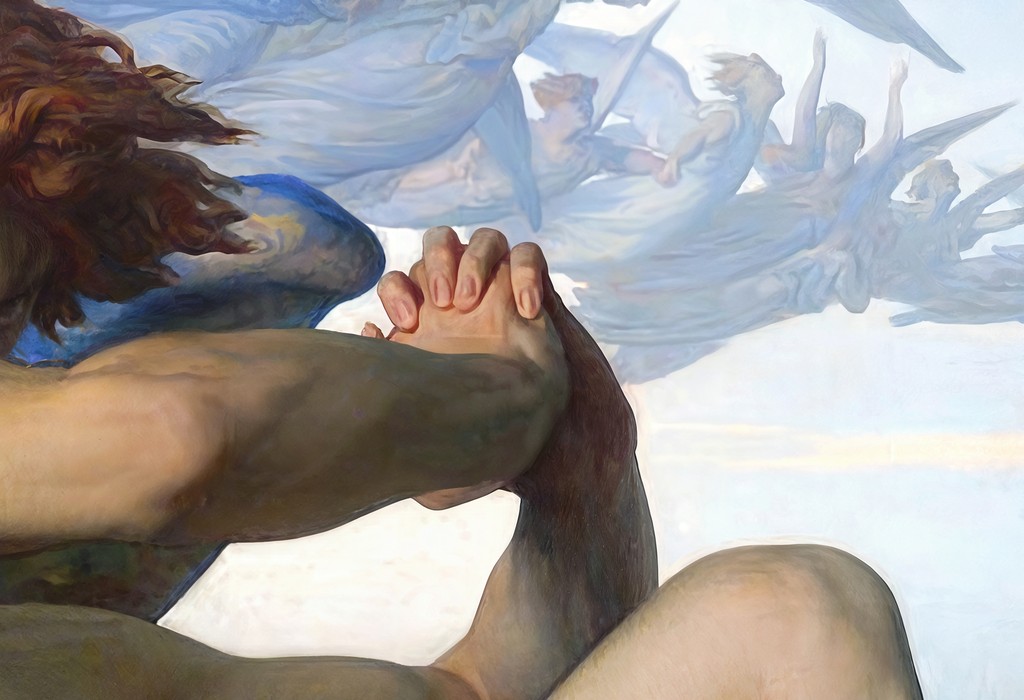
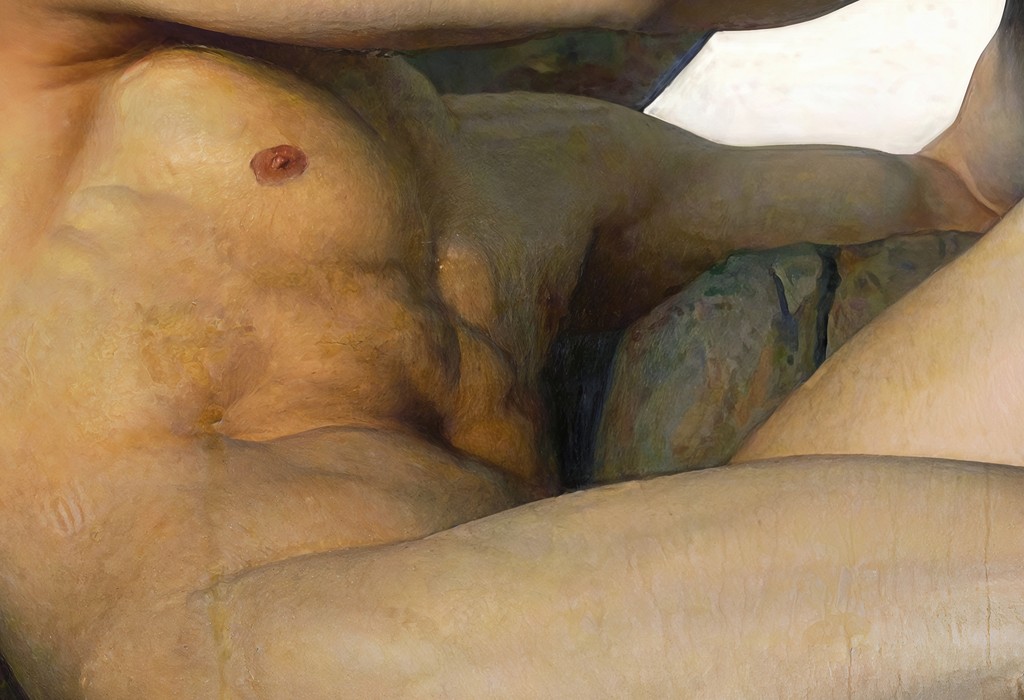
The body is equally important. The figure is not loose or collapsed. The hands interlock, the legs fold, the torso twists and the muscles hold tension. Cabanel uses academic anatomy not as a neutral display of skill, but as an emotional system: every beautiful contour seems to hold a pressure that has not yet been released.
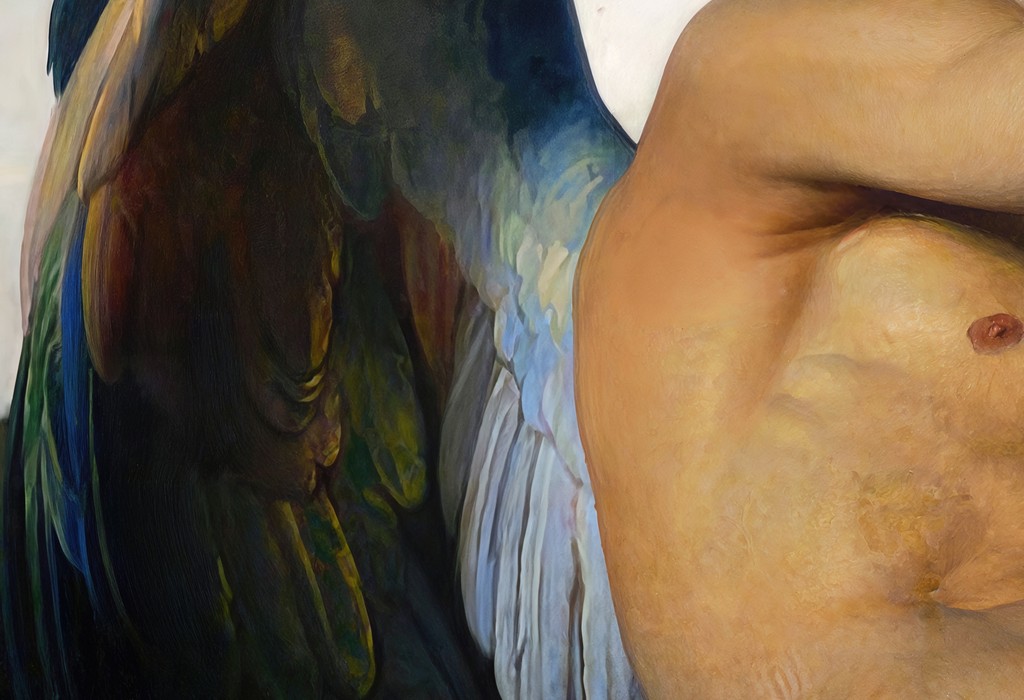
The wing darkens the left side of the picture and acts almost like a second body. It is bed, shelter, shadow and emblem at once. Above, the distant angels remain pale and airborne. Cabanel's own explanation to Alfred Bruyas opposed two natures: one destined to fall into evil and misfortune, the other rising chastely and radiantly toward God.[1] The background angels therefore make Satan's loss visible. They are not decoration; they are the memory of a community from which he has been cut off.
Annotated Details from Fallen Angel
This annotated close-reading uses the high-resolution Fallen Angel source supplied through the annotated intake folder. The markers focus on details that explain why Cabanel's 1847 Roman envoi remains unusually powerful online and in person: the tear, the locked body, the dark wing, the distant angels and the open landscape of exile.

Details from FALLEN ANGEL
Use the detail crops below to compare Cabanel's emotional drama with his academic control of anatomy, contour, light and background movement.
Tear and defiant stare
The visible eye and tear are the painting's emotional engine. Cabanel hides much of the face behind the arm, so the small exposed passage has to carry shame, fury and wounded pride at once.

Locked hands and compressed tension
The interlocked hands prevent the pose from becoming passive. They turn the figure's academic anatomy into a physical sign of pressure, restraint and unresolved revolt.
Dark wing against the body
The wing is both shelter and shadow. Its dark mass sets Satan apart from the pale airborne angels and makes the left side of the picture feel heavy, grounded and fallen.
Pale angels overhead
The upper angels are not background decoration. Their lightness and distance make visible the community, radiance and divine order from which the fallen figure has been separated.

Coiled torso and academic finish
Cabanel's smooth modelling and careful contour belong to academic training, but the coiled body gives that finish a charged psychological purpose.
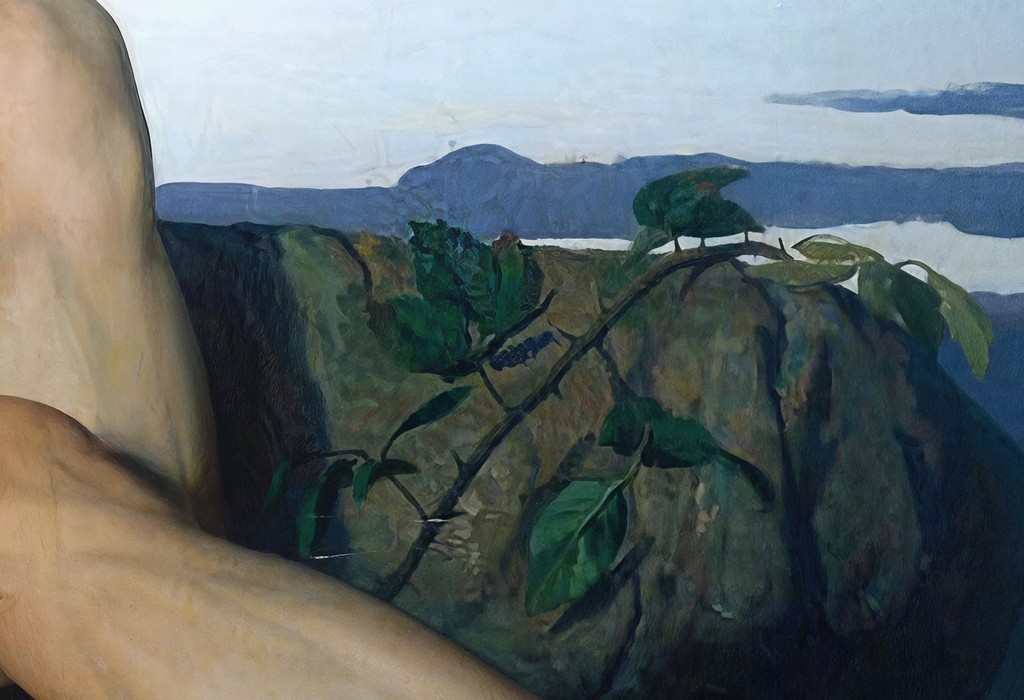
Rocky edge and open horizon
The low landscape opens into distance while the rocks hold the body at the edge. The setting turns exile into a space: heaven remains visible, but unreachable.
Meaning and sources: Satan after the fall
The subject belongs to Christian and literary traditions around Satan's fall. The Musee Fabre connects the painting to biblical books including Ezekiel, Isaiah and Revelation, and to John Milton's Paradise Lost.[1] Cabanel is not illustrating one simple narrative moment. He is translating a set of theological and literary ideas into a single figure of defeat, memory and revolt.
The painting's power comes from its refusal to make Satan ugly. Cabanel gives the fallen angel a heroic, almost classical body. That decision is risky and central. The viewer can understand why the subject might have troubled academic judges: evil is not shown as grotesque from a safe distance, but as beauty damaged by pride and exile.
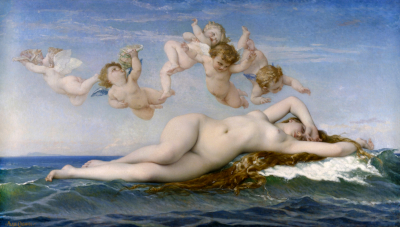
This is also where the painting differs from Cabanel's later The Birth of Venus. In Venus, smooth academic beauty serves official mythological pleasure. In Fallen Angel, similar skills become psychologically unstable. The surface is polished, but the emotion is not calm.
Academy response and artistic references
The Fabre feature notes that Cabanel's pose and originality displeased members of the Academy, who were unsettled by the young painter's independent spirit.[1] Cabanel later told Bruyas that he was, in effect, a renegade from their school. That reaction helps explain why Fallen Angel now feels more daring than many routine academic exercises.
At the same time, the picture is deeply learned. The Musee Fabre connects Cabanel's figure to antique sculpture, especially the Belvedere Torso, and to Renaissance masters including Michelangelo and Raphael.[1] The result is a productive contradiction: a rebellious subject built from the very academic sources that trained him.
Study for Fallen Angel
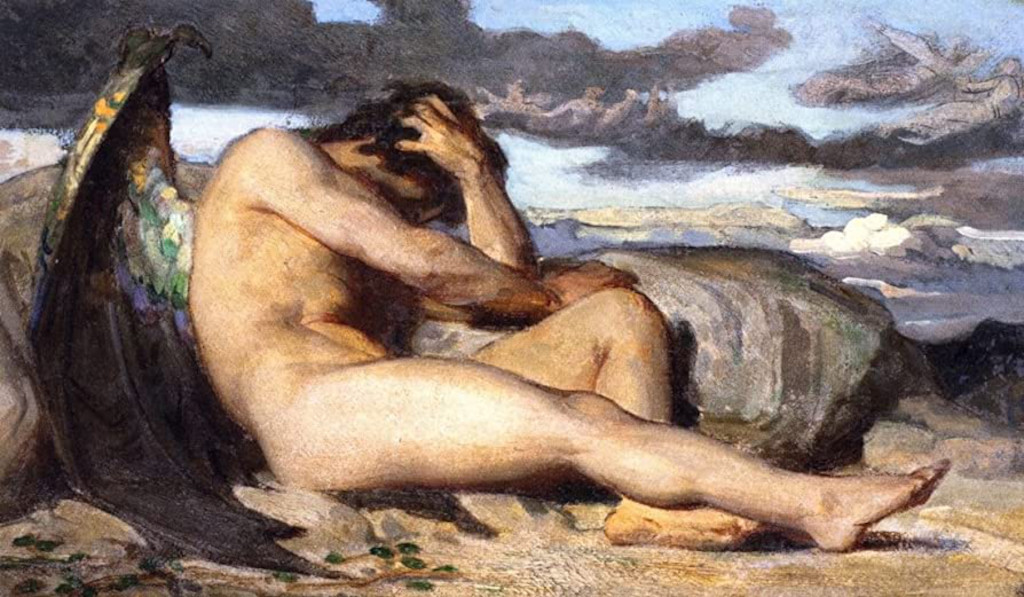
The local Cabanel cluster includes a study image connected to Fallen Angel. For readers, the study is useful because it shows that the finished painting's emotional compression was not accidental. Cabanel worked through the figure's pose, anatomy and expressive potential before bringing the full composition into its final scale.
Where to see Fallen Angel
Fallen Angel is held by the Musee Fabre in Montpellier. That location is especially apt because Cabanel was born in Montpellier, trained there before moving to Paris, and later became one of the city's most visible nineteenth-century artists.[3] The museum's recent public writing also makes clear that the painting has become one of its best-known images online and in visitor culture.[4]
For a visitor, the key is to look beyond the face without ignoring it. The face brings you in; the wing, distant angels, rocky foreground and pale horizon explain why the face hurts. Cabanel's Satan has fallen, but the picture keeps heaven close enough to make the fall continue.
FAQs
It is famous because Cabanel combines academic finish with a volatile emotional subject: Satan is beautiful, wounded, ashamed and still defiant. The Musee Fabre notes the force of the dark half-hidden face, the sensual wing and the contrast with radiant angels in the background.
Cabanel painted L'Ange dechu in 1847, while he was a young pensionnaire at the Villa Medici in Rome. The Musee Fabre describes it as his second envoi de Rome.
Fallen Angel belongs to the Musee Fabre in Montpellier, Cabanel's birth city. The museum records it under inventory number 889.2.1.
The painting shows Satan after the fall, but Cabanel makes the subject more psychological than illustrative. The fallen figure hides the shame of defeat while the distant angels make visible what he has lost.
No. The Musee Fabre records that the work unsettled members of the Academy, who disliked its mannered pose, deliberate originality and feverish pathos. Cabanel later described himself to Alfred Bruyas as a kind of renegade from their school.
The Musee Fabre connects the subject to biblical texts and to John Milton's Paradise Lost, while also noting Cabanel's debts to antique sculpture and Renaissance masters such as Michelangelo and Raphael.
Discussion
Fallen Angel is a useful flagship page because readers often arrive through the face, the tear and the drama before they know Cabanel's academic context.
Reader Insights
Look first
Does the stare read as grief, anger, shame, revenge, or all four at once?
Compare
Set this painting beside The Birth of Venus to see how Cabanel could make academic finish feel either serene or explosive.
Context
The picture was an Academy exercise, but its popularity today comes from how personal and psychologically charged it feels.
Join the Conversation
Share a thoughtful observation below, especially if a source, visual detail or related Cabanel page changed the way you read the painting.
References
- Musee Fabre feature page for L'Ange dechu, accessed 2026-07-24.
- Musee Fabre object record for L'Ange dechu, accessed 2026-07-24.
- Musee d'Orsay artist record for Alexandre Cabanel, accessed 2026-07-24.
- Montpellier En Commun article on L'Ange dechu as a social-media icon, accessed 2026-07-24.
- Wikimedia Commons media records for Cabanel's Fallen Angel images, accessed 2026-07-24.