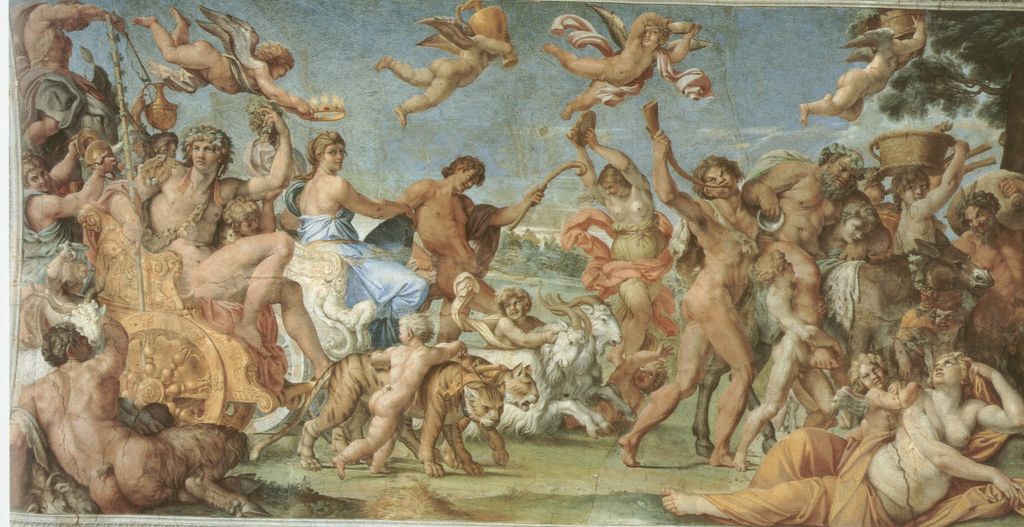
Annibale Carracci, The Triumph of Bacchus and Ariadne. Central field of the Farnese Gallery vault, Rome. Image source. Public domain.
 by Tom Gurney
Tom Gurney BSc (Hons) is an art history expert with over 20 years experience
Email: tomgurney1@gmail.com / Phone: +44 7429 011000
The Triumph of Bacchus and Ariadne: Introduction
A winged child lowers a crown towards Ariadne. Her chariot rolls alongside that of Bacchus, while a little farther ahead an old man is in danger of sliding off his mount. Annibale Carracci brings the marriage of a god and a mortal into the midst of a noisy procession. The scene occupies the largest field in the vault of the Farnese Gallery in Rome, decorated for Cardinal Odoardo Farnese. The oblong looks like a framed painting set into the ceiling. The Louvre describes it as a quadro riportato, an illusion made in fresco. The Fondazione Federico Zeri dates it to 1598–1601. Its early designs, individual figure studies and surviving full-scale cartoon give an unusually detailed account of how Carracci built the fresco, from changing Ariadne’s place in the story to choosing which lines to transfer to the plaster. [1] [2] [3]
At a Glance
- ArtistAnnibale Carracci
- DateAbout 1600
- MediumFresco
Contents
- Two chariots and a crowd
- From the island to the triumph
- Ancient models and a Renaissance design
- Ariadne changes places on paper
- Drawing the individual figures
- From joined sheets to fresh plaster
- Seeing the fresco and its studies together
- Annotated details
Two chariots and a crowd
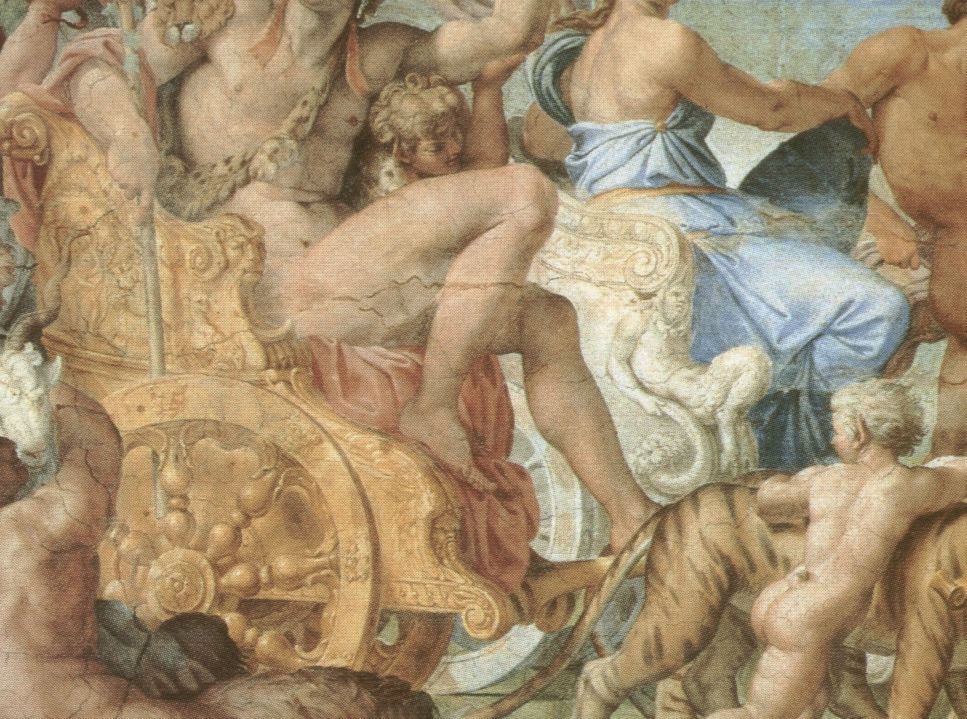
The procession moves towards the right. The first things to follow are the animals at ground level. Large striped cats pull the golden chariot of Bacchus. A child braces his feet as he leans against one of the team, close enough for the animal’s head to turn out towards us. Just beyond the cats, a pair of horned goats pulls Ariadne’s chariot. They are bunched tightly together, with a small figure low between the teams. Both chariots can be seen from the side, but their paths overlap in the painting. The wheel and ornament of Bacchus’s car occupy much of the lower left, while flesh, hide and white fur almost conceal the corresponding structure of Ariadne’s. The ground beneath the animals gives the scene a continuous path even where it gets hard to disentangle harness, legs and wheels. [2] [3]
Above that bustle are two broadly settled bodies. Bacchus reclines with one leg exposed and an arm lifted. Around him golden ornament and warm flesh form a dense cluster. Ariadne, in blue, twists at the waist. Her body follows the direction of the chariot, but she looks back over her shoulder and out. The turn allows her to remain visibly engaged with the scene on both sides of her. A nearly horizontal chain leads from her outstretched arm to the turning figure with the staff near the middle. From there the lines change direction. Across a gap of sky and distant landscape, the next dancer raises her arms, drawing the eye diagonally up and into the crowd. The child bearing the crown reaches down just far enough to suspend it above Ariadne. Farther right, the airborne children fan out above the dancers, so there is motion even where the figures below momentarily block the view of the road. [2] [3]
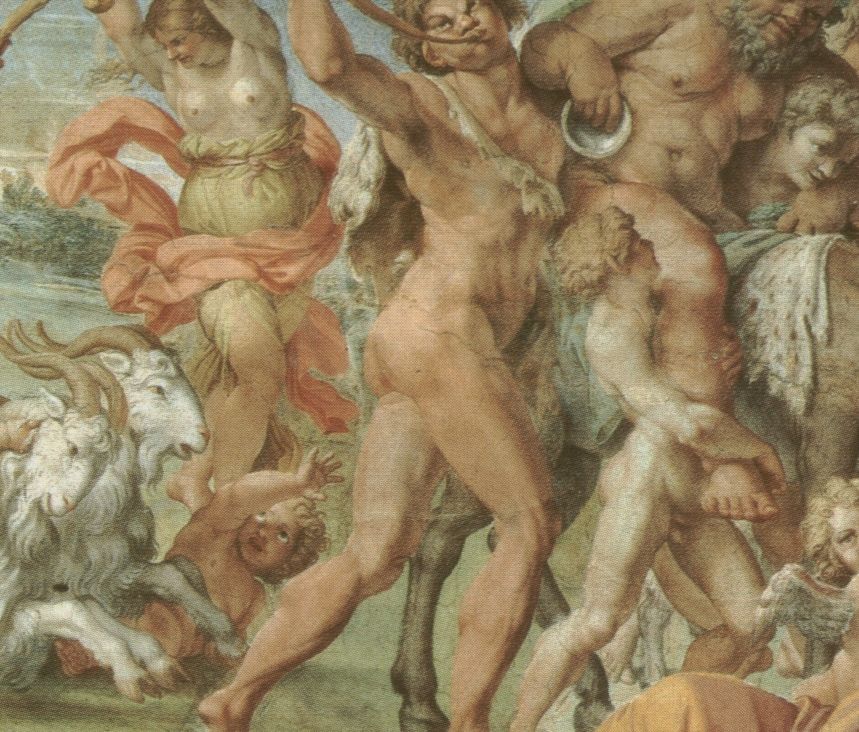
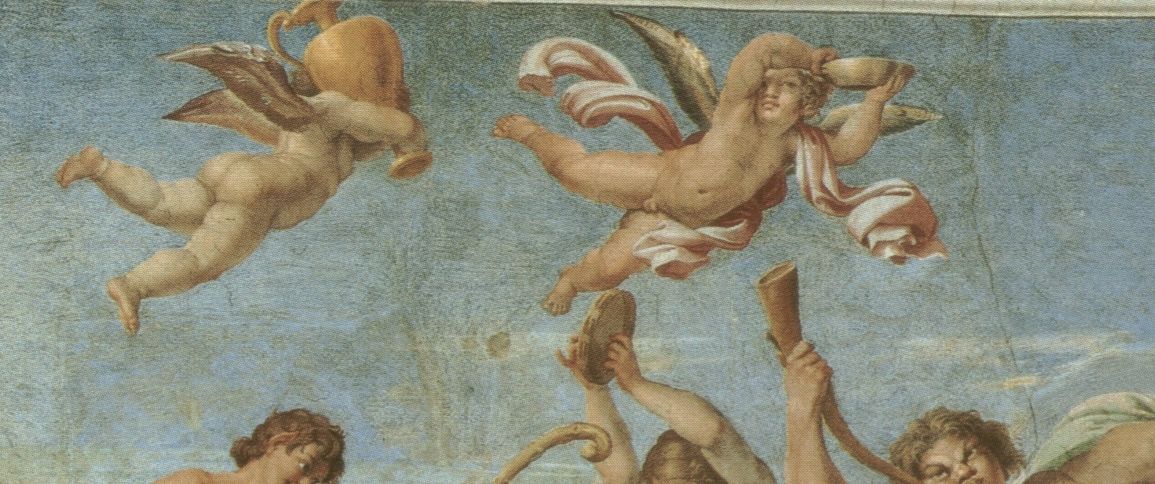
The action becomes harder to steady on the right. The dancing follower with the raised tambourine turns through the waist as her fabric opens into loops. Her elbows flare out above the goats. Farther over, a horn-blowing faun takes a wide step while Silenus slumps towards him. Silenus, the elderly companion of Bacchus, rides an ass, and the difficulty of keeping him aboard makes this part of the triumph comic. The faun’s raised horn directs attention upward while his other side is caught up in the older man’s weight. Behind the ass’s head a follower raises a basket, its rounded base seen from below. The lifts of hands, horns and vessels punctuate the turns of knees and torsos below. The eye catches the rhythm before it has sorted out what each person is doing. [2] [4] [5]
A reclining woman at the lower right creates a pause at the very point where the procession seems to spill out of the frame. Her pale torso and long spread of drapery run close to the bottom edge. Carracci sets the strongly tilted head and hand near the standing figures, while her extended body leaves room in front for the arms and legs that crowd in above. The figure is often read as the earthly Venus. The pose also recalls the sleeping Ariadne of the earlier designs. The heroine moves into the procession while the composition keeps the low, reclining pose that once distinguished her from the passing crowd. [1] [2]
Annotated Details from The Triumph of Bacchus and Ariadne
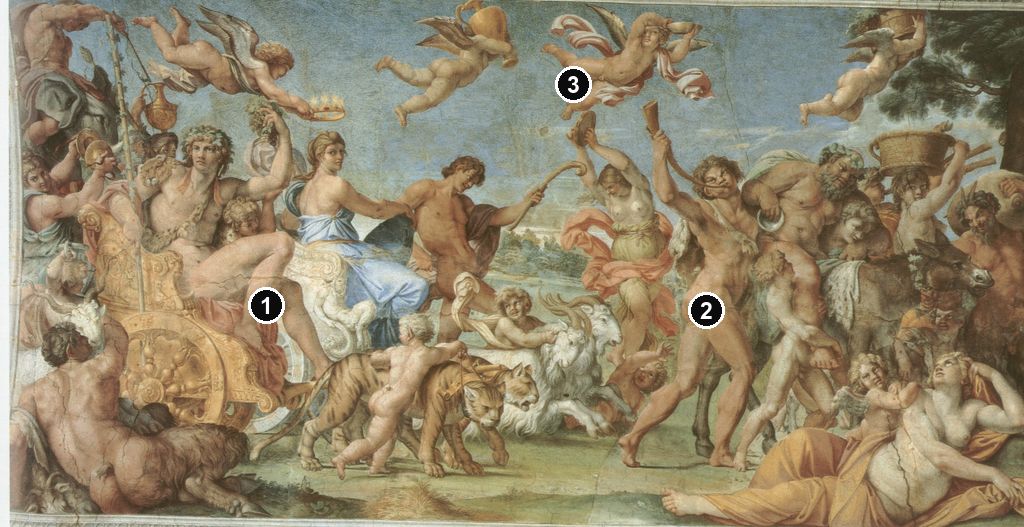
The numbered points identify visible features discussed in this article. Return from each detail to the numbered overview. Annibale Carracci, The Triumph of Bacchus and Ariadne. Central field of the Farnese Gallery vault, Rome. Image source. Public domain.
Details from THE TRIUMPH OF BACCHUS AND ARIADNE
Compare the cropped details with the source images above. Notice how their colours, shapes and positions contribute to the larger compositions.
The chariots
Wheels, reclining bodies and the rich colours of the chariot group make the left half of the fresco unusually dense. The groups continue into the open blue above them.
The dancing figures
Bodies on bent knees and lifted arms overlap as the procession continues. Their diagonals carry the eye from the chariots towards the right.
Figures in the air
Small airborne figures traverse a nearly continuous band of sky. Their spacing opens up the crowded action below and extends its motion overhead.
From the island to the triumph
Ariadne helped Theseus escape the Labyrinth and was subsequently abandoned by him. In Book 8 of Ovid’s Metamorphoses, Bacchus comes to her aid, takes the crown from her brow and sends it into the heavens. The jewels become stars while retaining the shape of the crown. The fresco gives the crown its own visible journey above Ariadne. A painted child brings it towards her, so the gesture can suggest a bridal coronation and also call to mind the constellation that preserves her name. Ovid’s telling and the action in the fresco handle the object differently. The airborne figure and the separate chariot belong to Carracci’s way of making Ariadne’s new standing visible at the height of the celebration. [2] [3] [6]
The Louvre explains the train as the company returning with Bacchus after his legendary conquest of India. The animals and the sound of the revelry matter more to the image than any display of combat. The combination of encounter, victory and marriage becomes clearer beside Titian’s Bacchus and Ariadne of 1520–23. In Titian, a ship recedes at the left and Bacchus leaps down towards the woman on shore. A cluster of stars is already visible above her. Both painters give the procession space, but Titian’s leap and Ariadne’s recoil make the first encounter the main event. Carracci’s Ariadne is already in motion beside the god, with her own vehicle and her own place in the rhythm of the figures. This was a decision made in designing the fresco, as the earlier studies that still show her discovery make clear. [2] [3] [7]
The crowns, chariots and cupids can sustain a nuptial reading. Gail Feigenbaum suggested that the shift towards a double triumph may have been made in anticipation of Ranuccio Farnese’s marriage, which was being negotiated at the time. That is a possibility for the redesign, and the preparatory sheets show why it should remain a possibility. The procession was in the plans early. An overall ceiling study discussed in the 1999 Washington catalogue puts it in a smaller part of the scheme and leaves the long central field empty. The prominence and character of the finished scene therefore emerged during planning. The painting can evoke a wedding even where the drawings leave the painter’s instructions and the patron’s intentions unresolved. [2]
Ancient models and a Renaissance design
The file of bodies and animals across a wide, shallow space recalls a carved frieze. Bellori, writing in 1672, reported that Annibale made studies after antique marbles for the scene. A particular ancient connection survives indirectly in a Louvre sheet, INV 7184, which the museum associates with the relief on a sarcophagus at the Casino dell’Aurora in Rome. The drawing shows Bacchus on an elephant. The Louvre catalogues it under Annibale’s workshop and records Catherine Loisel’s proposal that a collaborator copied a drawing by the master. The elephant is absent from the fresco, where the lower, separated animal teams leave more room to see the steps of the dancers. The sheet supplies evidence of one crowded way to stage the Indian triumph and of the workshop’s engagement with a specific ancient object. [2] [8]
A second comparison takes the story through another Farnese commission. Perino del Vaga’s Triumph of Bacchus, drawn around 1540–43 and now in the Louvre, was a design for a scene that Giovanni Bernardi carved on rock crystal for the Farnese Casket. The oval includes the supported Silenus, the basket bearer and a group of figures attending the god’s chariot. Feigenbaum traced these motifs into Carracci’s studies and saw a compositional lesson in Perino’s chariot shown in profile. A chariot facing diagonally out towards the spectator consumes depth and bunches the crowd behind it. Turning the vehicle sideways allows others to continue along the same road. In the fresco, the two teams and the sustained movement across the ceiling make that difference easy to see. Antiquity and a sixteenth-century work for the same family both helped shape the design. [2] [9] [10]
Ariadne changes places on paper
The Albertina’s Bacchic Procession, inv. 23370, lays out an early version of the story. Bacchus’s chariot comes forward at an angle. Two young figures steady the drunken god, while more attendants struggle with Silenus on the right. Ariadne lies low at the left, noticed by a member of the company. Between the two main groups is a dancing woman who turns back towards Bacchus. Brown washes and white heightening on tinted paper give the bodies a relief-like solidity, particularly where the figures are compressed around Silenus. Much of the bodily energy in the fresco is already there, even though the design has yet to find room for a second chariot. [2] [10]
A rapid pen drawing in the Royal Collection, RCIN 902155, shows how differently this story could have been presented. Annibale fits Silenus, a turning dancer and the discovery of the reclining woman into a small, framed compartment and sketches the decoration around it. The Louvre’s INV 7185 is another early idea for the procession. Its catalogue places it under an attribution to Agostino Carracci, with Victor Hundsbuckler retaining Agostino as a possibility in the 2025 exhibition catalogue. It also has studies on its back, including one for Aurora. It offers another view of the composition in progress without fixing which brother invented every motif that continued into the painting. [2] [11]
In the Louvre’s study of the left group, INV 7183, and the related designs discussed in the 1999 catalogue, the discovery makes way for a procession in which Ariadne joins Bacchus. The Albertina’s later compositional study, inv. 2144, shows her in a separate chariot. This rearrangement gives the leaders their own vehicles and makes the cupids above them part of a wider action. It also sets up a clearer opposition between the poised couple and Silenus. In the early Albertina sheet Bacchus and Silenus both need to be propped up. In Rome the god can raise his arm and recline at ease, while his companion’s supporting figures still have to earn their place. [2] [12] [13]
Drawing the individual figures
The 2025–26 Louvre exhibition brought out the process behind a dancer near Ariadne. Its study of the standing faun, INV 7187 recto, is drawn in black chalk and white on originally blue paper. In the painted version he turns just to Ariadne’s right, with a staff projecting out into the middle of the composition. The Louvre proposes that a studio support helped the model hold the gesture and that he may even have sat while posing. The painted staff gives a possible support from the studio a role in the mythological picture. The length of the hair and the face changed between paper and plaster, while corrections at the left arm remain visible in the drawing. Carracci used a body he could study at close quarters to make a turn that would read from the floor. [3] [14]
A different Louvre sheet, INV 7316 recto, prepares the horn-blowing faun alongside Silenus. The horn, the step and the steep line through the body bring him into the stronger rhythms at the right. On paper Carracci tried the legs farther forward and left more than one line around them. The upper body is worked with carefully located light and closely hatched shadows. Feigenbaum drew attention to the abrupt end of the shoulder in the study. Silenus’s arm covers that part of the faun in the final painting, so Carracci could already judge how much of the figure would be visible in the mass of overlapping bodies. In the finished design the two fauns are several figures apart. The staff bearer bridges the chariots and dancers, while the horn player helps hold the Silenus group together. [2] [4]
The study of the basket bearer, RF 610 recto, offers a comparison across three objects. In the Louvre sheet, the body turns far enough for the artist to follow its outline down to the hip, and the raised basket is only roughly stated. In the full-scale drawing at Urbino, more of that body disappears into the group. A revision to the line of the breast there already anticipates its angle in the fresco. The conservators found that the revised line was the one they pierced. In the painting the ass’s head interrupts the torso, with one ear reaching farther across the body than it did on the cartoon. Small forms reach over the rim of the basket. The Washington catalogue reads the added calf’s hooves in the basket as an echo of the punishment of Pentheus, torn apart by Bacchic followers. The main compositional effect is visible without resolving every item in the basket. Its broad underside, the foreshortened arm and the turn of the shoulders make the load legible above the crowd. [2] [5] [15] [16]
The reclining figure below the Silenus group called for a different kind of study. In INV 7372 recto, Annibale drew a man resting on his left elbow. The Louvre identifies it as a study from life for the pose used by the reclining woman. The bent arm supports the weight of the upper body, a practical problem that the artist could study independently of the figure’s identity. Another Louvre sheet, INV 7377 recto, works out the shadow around an upward-looking face in black and white. It has been compared both with the head of the reclining figure and with the ancient Niobid marbles then at the Villa Medici in Rome. Feigenbaum treats the chalk head as a related exercise in studying sculpture. The observable pose in the first sheet gives it a closer tie to the fresco than the resemblance of features in the second. [2] [17] [18]
From joined sheets to fresh plaster
The Urbino cartoon, inv. 1/D, preserves the right portion of the composition at working scale. At about 3.45 metres high and 3.32 metres wide, it is assembled from scores of overlapping paper sheets. The group includes Silenus and his ass, the dancers and basket bearer, and the reclining woman at the bottom. There are losses at the edges. Technical study by Carla Bertorello and Giovanna Martellotti after treatment in 2001 traced the arrangement of the paper, including full sheets assembled into larger units before being joined in strips. The conservators examined surviving watermarks and associated the paper with Fabriano. They also recorded charcoal, white highlights and changes in the colour of the paper, which contained a mixture of blue and brown linen fibres. Removing an old canvas backing exposed many smaller pieces of paper pasted over weak areas. Some carried old drawings. Those fragments tell a separate story about how a large and fragile working drawing was kept together long after the fresco was finished. [2] [15] [16]
Fresh plaster, or intonaco, had to be painted in areas small enough to cover while still workable. Each such area is a giornata, a day’s section. The surviving cartoon has pierced contours but lacks the cut-and-rejoined outlines of the many plaster patches required for this part of the fresco. Margaret Morgan Grasselli proposed that it was used in conjunction with a second set of transfer paper. Bertorello and Martellotti argued that the finely finished cartoon was pierced together with secondary sheets, which could be carried to the vault in sections. Powder dabbed through these holes would leave a dotted guide on the plaster. The conservators also considered how overlapping transfer sections might preserve contours around figures that cross adjoining areas. This was especially important where bodies and drapery are as tightly interlocked as they are around Silenus. [2] [16]
In transmitted light, the conservators could see remarkably fine groups of holes, tracing the eyelid, chin and nostrils of a child below the ass’s muzzle. Some holes follow dark lines added over the finished charcoal drawing. These strokes make a practical choice about which edge to use where the modelling underneath is soft. Even at this stage there was room to adjust a pose. In the fresco the child’s head is more upright and the horns of the goat he holds sit lower. Grasselli also notes the broader beard and wreath of leaves on Silenus in the painted group. The dots on the plaster were enough to relocate a child’s eyelid, yet the painter could still shift the head around it. [2] [16]
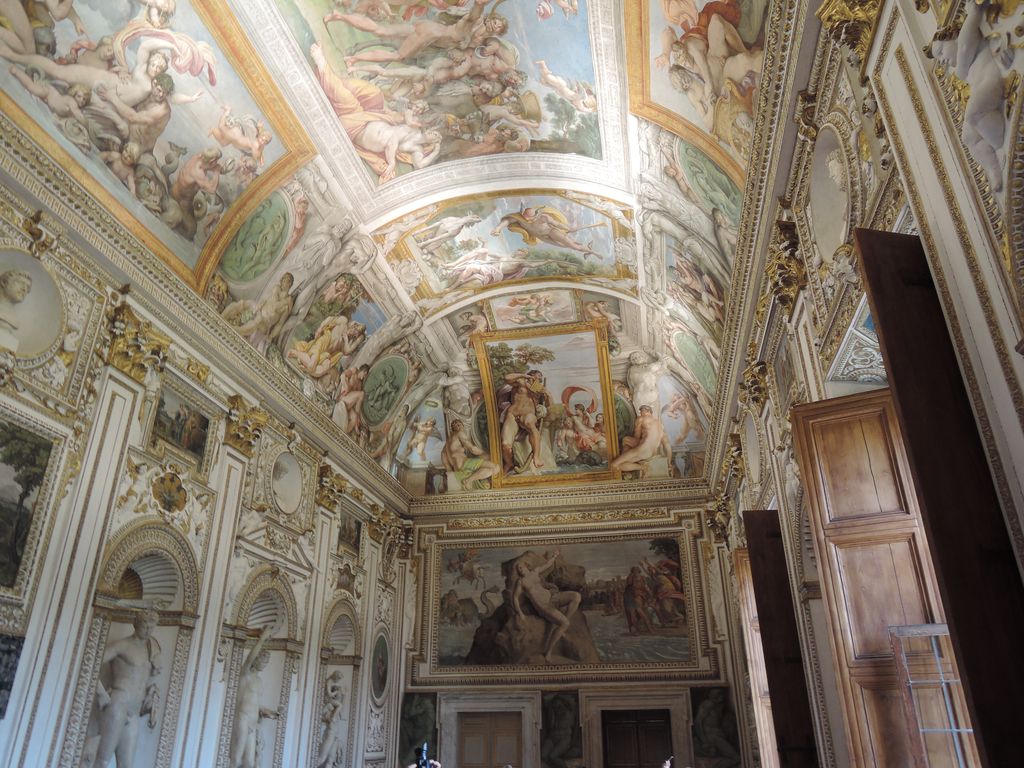
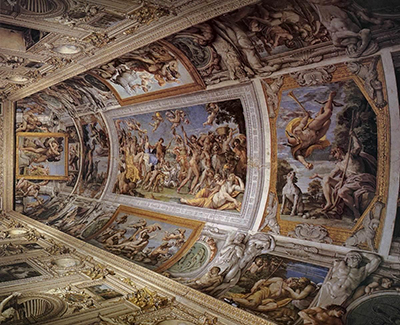
Interior of the Farnese Gallery, Palazzo Farnese, Rome. agennari. Image source. CC BY 2.0. Proportionally resized for web display.
Seeing the fresco and its studies together
The Urbino cartoon travelled to Washington for the National Gallery of Art’s exhibition of Annibale’s drawings in 1999–2000. Its scale lets a visitor examine figures at close range that were designed to be seen from a floor far below. The gallery’s restoration, completed in 2015, is a different conservation event from the work on the cartoon. A photograph depends on the lighting and angle at which it was taken, as well as on the condition of the surface at that date. An archival crop, a restored room view and a print each make different parts of the same design easy to see. Carlo Cesio’s etching after the fresco in the Rijksmuseum, dated 1656, is especially good for following the two animal teams, the alternating inclinations of the bodies and the spacing of the airborne children, all through contours and hatching. [19] [20] [21]
The full procession rewards looking in the same order in which some of its problems were solved on paper. Follow the line of the two chariots, then choose a dancer and see what surrounds the pose. The staff-bearing faun’s reach is a link from Ariadne to the next group. The horn player’s step has to serve both the music and the near fall of Silenus. Once those two figures are clear, the massed bodies read as a company moving at different speeds under the same stretch of sky.
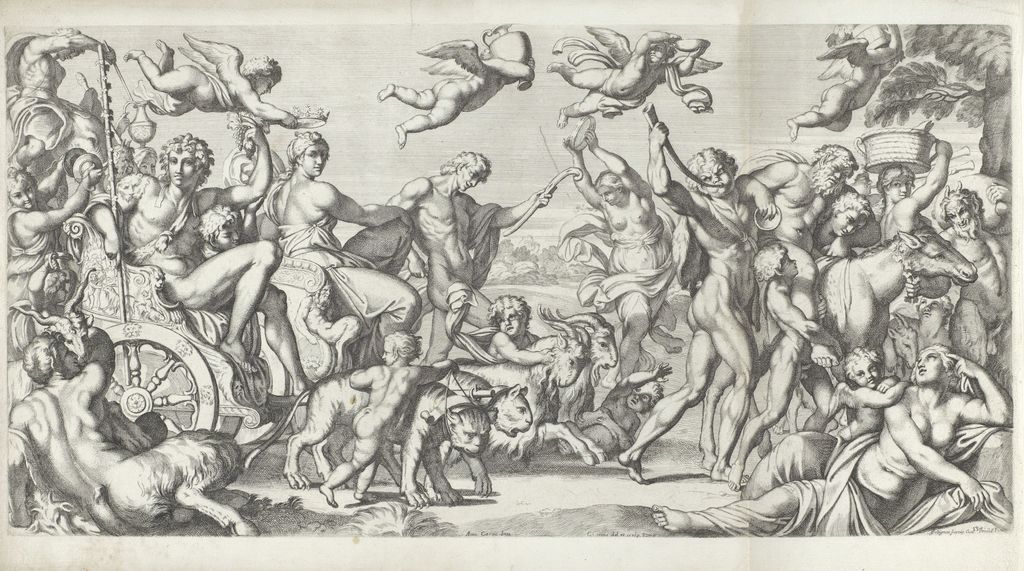
Carlo Cesio after Annibale Carracci, Triumph of Bacchus and Ariadne, 1656. Etching. Rijksmuseum, RP-P-OB-35.885. Image source. CC0 / Public domain.
Preparatory drawings for the Farnese Gallery
Dessins des Carrache. La fabrique de la Galerie Farnèse. Victor Hundsbuckler. Musée du Louvre and Lienart, 2025. In French.
The catalogue assembles known preparatory drawings and examines how they relate to the painted decoration. View the Louvre catalogue.
The Drawings of Annibale Carracci. Daniele Benati and contributors. National Gallery of Art, 1999.
The exhibition catalogue traces drawing across the artist’s career and records the life-size cartoon lent from Urbino. Read the NGA publication.
Artworks directory
Paintings, frescoes, drawings and prints, with separate entries for documented versions and collaborative projects.
Discussion
Look again at the images and ideas explored in The Triumph of Bacchus and Ariadne. These editorial prompts invite your observations.
Reader Insights
Which gesture carries the procession most clearly into the next group?
What does the Urbino cartoon make easier to see in the finished fresco?
Join the Conversation
Share a detail, comparison or question about The Triumph of Bacchus and Ariadne below.
References
- Fondazione Federico Zeri, Carracci Annibale, Trionfo di Bacco e Arianna, work record 57792. View the illustrated record. View source.
- Daniele Benati et al., The Drawings of Annibale Carracci, National Gallery of Art, 1999, cat. nos. 42–47, pp. 156–170. Entries by Gail Feigenbaum and Margaret Morgan Grasselli. Read the catalogue. View source.
- Musée du Louvre, The Carracci Drawings: The Making of the Farnese Gallery, exhibition, 5 November 2025–2 February 2026. View the exhibition. View source.
- Musée du Louvre, Faune nu dansant ou sonnant de la corne, INV 7316 recto. View the drawing. View source.
- Musée du Louvre, Bacchante portant une corbeille sur la tête, RF 610 recto. View the drawing. View source.
- Ovid, Metamorphoses, book 8, lines 176–182, translated by C. Filos. Read the passage at Harvard’s Center for Hellenic Studies. View source.
- National Gallery, London, Titian, Bacchus and Ariadne, NG35. View the painting and catalogue. View source.
- Musée du Louvre, Le Triomphe de Bacchus et Ariane, INV 7184 recto, workshop of Annibale Carracci. View the drawing. View source.
- Musée du Louvre, Perino del Vaga, Le triomphe de Bacchus, INV 593 recto. View the drawing. View source.
- Albertina, Vienna, Annibale Carracci, Bacchuszug, inv. 23370, with Achim Gnann’s commentary. View the drawing. View source.
- Musée du Louvre, Le Cortège de Bacchus et Ariane, INV 7185 recto, attributed to Agostino Carracci. View the drawing. View source.
- Musée du Louvre, Étude pour le groupe de Bacchus et Ariane, INV 7183 recto. View the drawing. View source.
- Albertina, Vienna, Triumphzug von Bacchus und Ariadne, inv. 2144. View the drawing. View source.
- Musée du Louvre, Des modèles mis en scène, exhibition study of INV 7187 recto. Compare study and fresco. View source.
- Ministero della Cultura, Trionfo di Bacco e Arianna, Urbino cartoon, Galleria Nazionale delle Marche, inv. 1/D. View national catalogue entry 1100262860. View source.
- Carla Bertorello and Giovanna Martellotti, Il restauro del cartone per la Galleria Farnese: risultati e nuove acquisizioni, pp. 105–122. Read the illustrated conservation report. View source.
- Musée du Louvre, Demi-figure d’homme couché, accoudé sur le bras gauche, INV 7372 recto. View the study from life. View source.
- Musée du Louvre, Tête de femme de trois quarts, les yeux levés vers le ciel, INV 7377 recto. View the related head study. View source.
- National Gallery of Art, The Drawings of Annibale Carracci, 1999–2000 exhibition record. View exhibition details. View source.
- World Monuments Fund, A Baroque Masterpiece Shines Again, 2015 annual report, p. 10. Read the restoration account. View source.
- Rijksmuseum, Carlo Cesio after Annibale Carracci, Triomf van Bacchus en Ariadne, RP-P-OB-35.885. View the etching. View source.