Auguste Rodin.jpg)
 by Tom Gurney
Tom Gurney BSc (Hons) is an art history expert with over 20 years experience
Published on June 19, 2020 / Updated on November 5, 2026
Email: tomgurney1@gmail.com / Phone: +44 7429 011000
The Kiss at the Musée Rodin
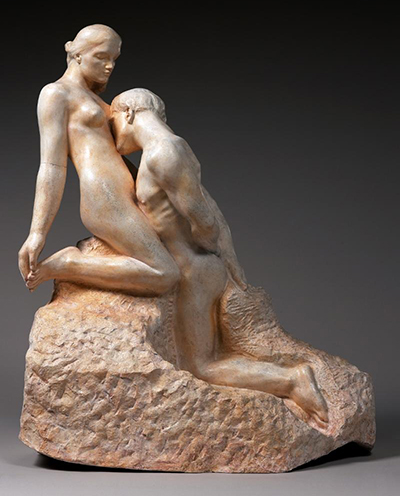
The kiss draws us towards the faces, but the hand resting on the woman’s hip may hold our attention longer. Its fingers spread across the smooth marble without seeming to press into it. Above, her arm curves around the man’s neck; below, their legs cross the uneven rock on which they sit. Auguste Rodin makes an embrace unfold through a succession of small contacts. The two bodies seem wholly absorbed in each other, yet there is much for a viewer to discover around them.
The large marble at the Musée Rodin in Paris is S.1002 / Lux.132, measuring 181.5 centimetres high, 112.5 wide and 117 deep. The composition was conceived around 1882; this particular marble was commissioned by the French state in 1888 and carved between 1888 and 1898. These dates distinguish the invention of the embrace from the making of the stone group before us. [1]
At a Glance
Two marble commissions in Rodin’s career
Contents
Looking around the embrace
Begin with the man’s seated body. His legs establish a broad support while his torso turns towards the woman. The muscles across his chest and abdomen remain clearly articulated, giving his body weight even as his head inclines. Her movement answers his through a longer, flowing curve. From the hip, her back rises and turns into the shoulder; the raised arm carries that turn around his neck. The bodies meet through different rhythms, making the embrace feel responsive.
From the view in which the woman’s back faces us, the man’s hand becomes especially conspicuous. The fingers lie almost parallel, their tips descending over the rounded hip. There is a small interval between the thumb and the rest of the hand. That opening matters: it keeps the gesture from becoming a solid patch of marble and makes the touch seem particular. The arm supporting it travels diagonally across the group, balancing the higher sweep of her arm.
The faces are comparatively difficult to inspect. Heads incline, and the surrounding arms partly shelter the meeting of their mouths. This encourages us to read the kiss through the whole body. A tilted head, an extended forearm and the turn at the waist each carry some of its meaning. The group offers no outward glance inviting the spectator into the exchange. We remain outside a space the figures have made together.
Follow the limbs downwards and the sculpture changes character. Smooth skin meets a seat covered with irregular cuts; below that, the broad base still announces the weight of the block. The contrast is readily visible, but it need not stand for a fixed symbolic opposition. It has an immediate sculptural effect: the rougher passages make the polished limbs look more supple. The same stone seems capable of resisting the body and becoming it.
Light makes these differences easier to see. In the museum’s photographs, small shadows gather between fingers and around the crossing limbs, while broader light travels over shoulders and thighs. Moving around the group would alter those relationships again. A photograph can reveal a beautiful contour, but it also conceals another contour behind it. Looking at several views restores something of the sculpture’s unfolding presence. [1]
Paolo and Francesca
The lovers are Paolo and Francesca from the fifth canto of Dante’s Inferno. The National Gallery of Art’s account of its small bronze Kiss identifies a discreet narrative clue: Paolo holds the book they have been reading together. The episode connects the reading of courtly love with their own forbidden desire. Knowledge of that story introduces a threatened future into the apparent peace of the embrace. [2]
It is useful to hold the literary identification lightly when looking. Rodin gives us two nude bodies, with little of the clothing or setting that might pin them to a historical moment. The embrace can reach us before the names do. The book supplies a route back to Dante, but the bodies do not require us to reconstruct every event in the poem in order to follow their movement.
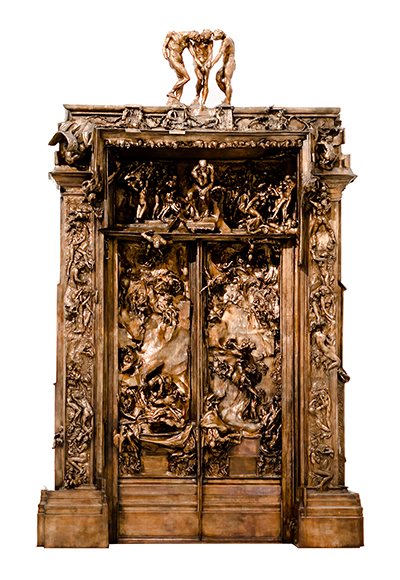
The group began within The Gates of Hell, occupying the lower left door until Rodin removed it in 1886. The Musée Rodin explains that its sensual happiness conflicted with the larger project. Exhibited independently in 1887, it acquired the public title The Kiss. [1]
That separation changes the viewer’s task. Within a crowded doorway, the couple would have been read beside other bodies and sufferings. Standing alone, they establish their own scale and atmosphere. The title names an action that almost anyone can recognise, while Paolo and Francesca remain available beneath it. Their story can deepen the encounter without entirely governing it. Pleasure and foreknowledge coexist: we see a moment of intimacy while remembering that, for these lovers, it cannot last.
From model to marble
A marble like this passed through a workshop, with trained hands translating an established form into stone. The Grand Palais’s educational record identifies Jean Turcan as a practitioner responsible for carving the Paris group. The term describes a skilled collaborator who worked from the sculptor’s model. It helps restore the labour behind an object whose finished surfaces can appear effortless. [3]
The V&A describes Rodin’s studio as a collaborative enterprise employing plaster casters, carvers, founders and assistants. Clay modelling and plaster casting allowed forms to be preserved, repeated and reconsidered before the making of a final object. In marble production, Rodin could direct specialist carvers with pencil or chalk marks. Authorship included decisions about form and finish, together with the supervision through which those decisions reached the material. [4]
The Musée Rodin explains two systems for transferring a plaster into stone. A pointing machine carries measurements at the same scale; three compasses can transfer points while allowing enlargement or reduction. These measurements tell the carver where a surface lies inside the block. Cutting then proceeds through tools suited to different tasks, from removing substantial pieces to creating striations and smoothing the surface. These are general workshop methods, rather than a surviving step-by-step record of this marble’s execution. [5]
Thinking through that sequence changes the rough seat beneath the lovers. Its unevenness can be appreciated alongside the painstaking work needed to define a finger or preserve a narrow space between limbs. Finish is distributed across the group. The bodies receive sustained attention to rounded transitions; other passages retain a more emphatic sense of material. Looking from one to the other makes us aware of how far stone has travelled towards the appearance of flesh.
Albert E. Elsen, writing in his 1963 study Rodin, distinguished extensive dependence on assistants from the claim that Rodin never carved. He found evidence of training and occasional personal intervention. More directly relevant to looking, Elsen contrasted the surfaces of bronze and marble versions of The Kiss, stressing marble’s luminosity and subtle transitions. His account encourages attention to medium: a repeated composition can offer a different visual experience when its substance changes. [6]
The Kiss beside Balzac
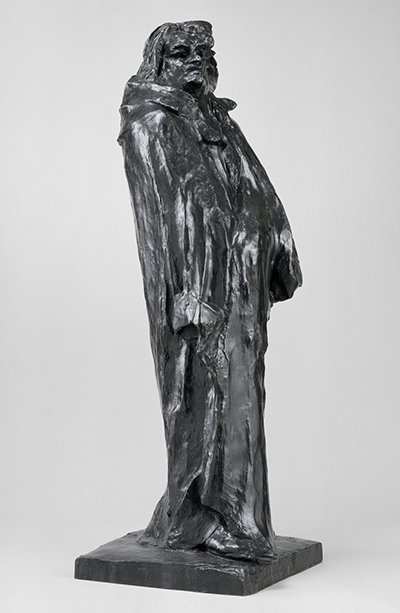
The Paris marble entered public view in 1898 alongside Rodin’s Balzac. The Musée Rodin records his dismissive description of The Kiss as his “huge knick-knack” and suggests that the pairing might have helped audiences accept the more challenging monument. [1]
Balzac had been commissioned by the Société des Gens de Lettres in 1891. Rodin eventually presented the writer wrapped in a dressing gown, after numerous studies. The final form appeared at the 1898 Salon de la Société Nationale des Beaux-Arts, where it received a hostile response; the commissioning society rejected it. [7]
The pairing is revealing even without assuming we know every calculation behind it. The lovers offer recognisable anatomy and an immediately legible action. Balzac gathers the standing figure into the great mass of a garment. One work invites us to follow individual limbs; the other asks us to accept a bodily presence whose force depends partly on concealment. Seen together, they show how widely Rodin could vary the relationship between a human figure and the material surrounding it.
His belittling phrase also complicates the easy equation of popularity with artistic satisfaction. An embrace that viewers could enter readily might occupy a different place in its maker’s ambitions. We need not adopt his judgement to find the comparison useful. It lets the familiar sculpture become unfamiliar again, measured against another solution to the problem of making a body speak.
A Paris object among many versions
The marble joined the Musée du Luxembourg in 1901 and transferred to the Musée Rodin in 1919. Its state commission and museum history belong to this object specifically. [1]
Copenhagen’s Ny Carlsberg Glyptotek owns a separate marble, M.IN.609, commissioned by Carl Jacobsen in 1900, carved in 1901–03 and delivered in 1904. At 197 by 135 by 160 centimetres, it also has different recorded dimensions. The common composition should not obscure these separate histories. [8]
Bronze versions introduce further changes in scale and surface. The National Gallery of Art’s example is less than ten inches high: a viewer encounters an intimate object where the Paris marble occupies a substantial physical space. [2] Such comparisons return us to the experience of looking. In Paris, following the hand, the curving back and the uneven seat brings the scale of the marble into the experience. The embrace becomes a study of touch, turning bodies and the patient shaping of stone.
 Auguste Rodin.jpg)
Artworks directory
Sculptures documented in the collection sources for The Kiss, with separate entries for the Paris and Copenhagen marbles and the reduced Washington bronze. These dates concern the individual objects or their presentation. A dash means that no date is supplied here; this selection is not a complete catalogue of Rodin’s work. Additional entries labelled “Tate” come from the museum’s October 2014 catalogue. They retain its historical titles, dates and attributions; newer collection records are used where available. The list brings together selected records from these sources. [9]
| Name | Date | Medium |
|---|---|---|
| The Kiss (Paris marble) | 1888–98 | Sculpture |
| The Kiss (Copenhagen marble) | 1901–03 | Sculpture |
| The Kiss (Washington bronze) | cast about 1898/1902 | Sculpture |
| Monument to Balzac (plaster) | presented 1898 | Sculpture |
| The Gates of Hell | — | Sculpture |
| Mrs Charles Hunter (Tate N04116) | 1906 | Sculpture |
| Balzac (Tate N04589) | 1892 | Sculpture |
| Lord Howard de Walden (Tate N05034) | c.1905–6 | Sculpture |
| The Fallen Caryatid Carrying her Stone (Tate N05955) | c.1880–1, cast 1950 | Sculpture |
| Woman on a Column (Tate N06070) | c.1900–3 | Sculpture |
| The Kiss (Tate N06228) | 1901–4 | Sculpture |
| Brother and Sister (Tate T00346) | 1891 | Sculpture |
Frequently Asked Questions
The Grand Palais identifies Jean Turcan as a practitioner responsible for its carving within Rodin’s workshop. [3]
Discussion
Follow the small contacts of hands and limbs, then consider how the workshop brought them into marble.
Reader Insights
Which gesture draws your attention beyond the kiss?
What do the smooth bodies and rougher stone make you notice?
How does the Paris marble compare with the Copenhagen version?
Join the Conversation
Share a detail, comparison or question about The Kiss at the Musée Rodin below.
References
- Musée Rodin. “The Kiss.” Collection record for Auguste Rodin, S.1002 / Lux.132; no publication date stated. English. Paris marble: object data, composition, state commission, exhibition and transfer history, with institutional photographs. Accessed 28 October 2026. View source.
- National Gallery of Art, Washington. “The Kiss (Le Baiser).” Collection record for 1942.5.15, model 1880–1887, cast c.1898/1902; no publication date stated. English. Dante’s lovers, the book, the independent composition and a reduced bronze. Accessed 28 October 2026. View source.
- Réunion des musées nationaux–Grand Palais. “Puzzles Rodin,” medium difficulty, educational website for Rodin. L’exposition du centenaire, 2017. French. Object identification naming Jean Turcan as marble practitioner. Accessed 28 October 2026. View source.
- Victoria and Albert Museum. “Auguste Rodin: production techniques.” Last updated 12 May 2026. English. Modelling, plaster, specialist collaborators and guidance during marble carving. Accessed 28 October 2026. View source.
- Musée Rodin. “Marble carving.” No publication date stated. English. Pointing machines, three-compasses transfer and successive carving tools. Accessed 28 October 2026. View source.
- Albert E. Elsen. Rodin. New York: The Museum of Modern Art; distributed by Doubleday, Garden City, New York, 1963, pp.133–134. English. Scholarly discussion of practitioners, Rodin’s participation and the different surfaces of marble and bronze. Accessed 28 October 2026. View source.
- Musée Rodin. “Monument to Balzac.” Collection record for the plaster S.3151; no publication date stated. English. The monument’s commission, studies, 1898 Salon and rejection. Accessed 28 October 2026. View source.
- Ny Carlsbergfondet. “Kysset” [The Kiss]. Record for the marble at Ny Carlsberg Glyptotek, museum number M.IN.609; no publication date stated. Danish. Copenhagen dimensions and separate commission, execution and delivery dates. Accessed 28 October 2026. View source.
- Tate, Tate Collection metadata, artwork_data.csv, October 2014 snapshot, released under CC0. Repository readme states that this dataset is no longer maintained. Downloaded and artist rows inspected 28 October 2026. View source.