 by Tom Gurney
Tom Gurney BSc (Hons) is an art history expert with over 20 years experience
Published on August 4, 2026 / Updated on August 4, 2026
Email: tomgurney1@gmail.com / Phone: +44 7429 011000
Carel Fabritius: Introduction
Carel Fabritius is one of the most tantalising painters of the Dutch Golden Age: an artist with a very small surviving body of work, a short documented career and an influence that has often seemed larger than the evidence left behind. Born in the Beemster region north of Amsterdam, trained in or around Rembrandt's workshop, and active in Delft before his death in 1654, he stands at a point where several major currents of seventeenth-century Dutch painting meet.
His art remembers Rembrandt's drama, but it also moves toward clearer light, spatial experiment and a strangely modern feeling for how a viewer encounters an object. [1]
That is why Fabritius matters. He is not important because dozens of famous paintings survive. They do not. He is important because the paintings that do survive are so unusual. The Goldfinch is small enough to feel almost private, yet it has become one of the most beloved pictures in the Mauritshuis. A View of Delft, with a Musical Instrument Seller's Stall turns a city scene into an optical puzzle.
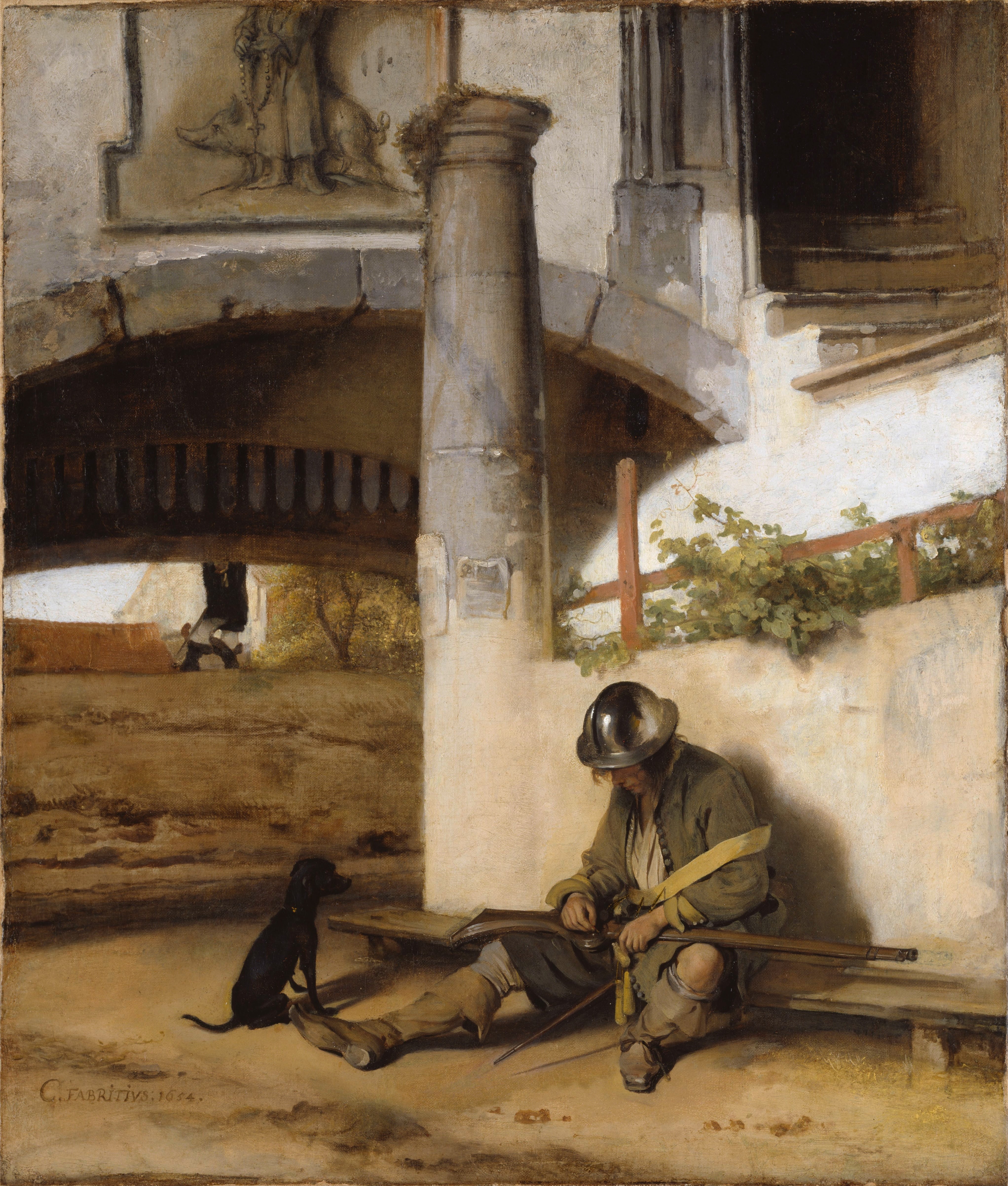
The Sentry places a soldier, a dog and a fragment of architecture in a space that feels both theatrical and uncertain. His portraits and early history paintings show how deeply he absorbed Rembrandt's example, while his late Delft works suggest a painter testing light, perspective and illusion with unusual independence. [2]
Fabritius is also a useful corrective to simple art-historical stories. He is often placed between Rembrandt and Vermeer, and the comparison is understandable: he knew Rembrandt's world, worked in Delft before Vermeer reached maturity, and shared the city's fascination with light, stillness and optical effects. But the evidence does not securely document him as Vermeer's teacher.
The stronger and safer way to approach him is as a painter whose work belongs to the same Delft context and whose surviving experiments make later comparisons with Vermeer feel compelling without turning them into a proven apprenticeship. [3]
For a fuller life story, see Carel Fabritius Biography. For a source-aware guide to the surviving and disputed works, see Carel Fabritius Paintings. [4]
At a Glance
- BornBaptised 27 February 1622, Middenbeemster
- Died12 October 1654, Delft
- Known forThe Goldfinch, A View of Delft, The Sentry
- ContextRembrandt's circle, Delft painting, optical experiment
Contents
- Carel Fabritius: Introduction
- Artist Journey Map
- Connections Engine
- Early Life and Rembrandt's World
- Delft and a New Kind of Light
- A Small Surviving Oeuvre
- The Goldfinch
- A View of Delft, The Sentry and the Late Works
- Fabritius, Vermeer and the Delft Imagination
- Where to Start
Early Life and Rembrandt's World
Fabritius was baptised in Middenbeemster on 27 February 1622. His father, Pieter Carelsz Fabritius, was a schoolteacher and sexton who also painted, and he was probably the first artistic presence in Carel's life. The family was not a courtly or metropolitan one. It belonged to the prosperous, practical culture of North Holland, where craft, education, religion and local administration could overlap. Carel's brothers Barent and Johannes also became painters, which suggests that art was not a decorative side interest in the household but part of its working identity. [1]
The name Fabritius itself is telling. It comes from the Latin word for craftsman, and it suits an artist whose best works often make the viewer conscious of making: the grain of a panel, the edge of a wall, a nail, a shadow, a distorted view, a bird's perch. His paintings do not simply show things. They ask what it means for paint to imitate, transform or compete with things in the world. [2]
By the early 1640s Fabritius was connected with Rembrandt's Amsterdam orbit. The National Gallery places his training with Rembrandt around 1641-1643, and Samuel van Hoogstraten later referred to him as a fellow pupil. This period mattered profoundly. Rembrandt's workshop was not a school in the modern sense; it was a place where younger painters learned by looking, copying, adapting and competing with a master whose art depended on dramatic light, rich surface and emotional force. [3]
Early works associated with Fabritius show that debt clearly. Mercury and Aglauros, now in the Museum of Fine Arts, Boston, belongs to the world of Rembrandt-school history painting, with a mythological subject, theatrical lighting and figures whose gestures carry narrative weight. The Raising of Lazarus, now in Warsaw and studied in recent conservation scholarship, is another important early work for understanding his formation. These paintings are not yet the Fabritius of The Goldfinch, but they show an ambitious young artist working through Rembrandt's language of darkness, revelation and physical presence. [4]
Fabritius's early adult life was marked by loss as well as training. He married Aeltge Velthuys in 1641; she died in 1643. The surviving record then becomes fragmentary. He seems to have returned north for a time before moving into the Delft phase that would define his mature reputation. Because so few documents survive, his biography cannot be told as a smooth sequence of certainties. It has to be rebuilt from archival traces, dated works, later testimony and the internal evidence of the paintings themselves. [5]
Delft and a New Kind of Light
Fabritius moved to Delft by around 1650 and entered the city's Guild of Saint Luke in 1652. Delft was smaller than Amsterdam, but it was not provincial in any simple sense. It was a city of painters, craftsmen, optical curiosity, civic patronage and carefully observed interiors and streets. Pieter de Hooch and Johannes Vermeer would become the best-known names associated with Delft painting, but Fabritius's presence there in the early 1650s gives the city's art a sharper experimental edge. [6]
The shift from Amsterdam to Delft is also visible in the paintings. Where Rembrandt's world often depends on darkness broken by strong light, Fabritius's late works tend to open the space. Figures stand against pale grounds. Edges become cleaner. Light is cooler and more even. The surface may still contain impasto and lively handling, but the overall effect is less engulfing than Rembrandt's chiaroscuro.
It is as if Fabritius learned from Rembrandt how to make paint feel alive, then asked what would happen if that vitality were placed in brighter air. [7]
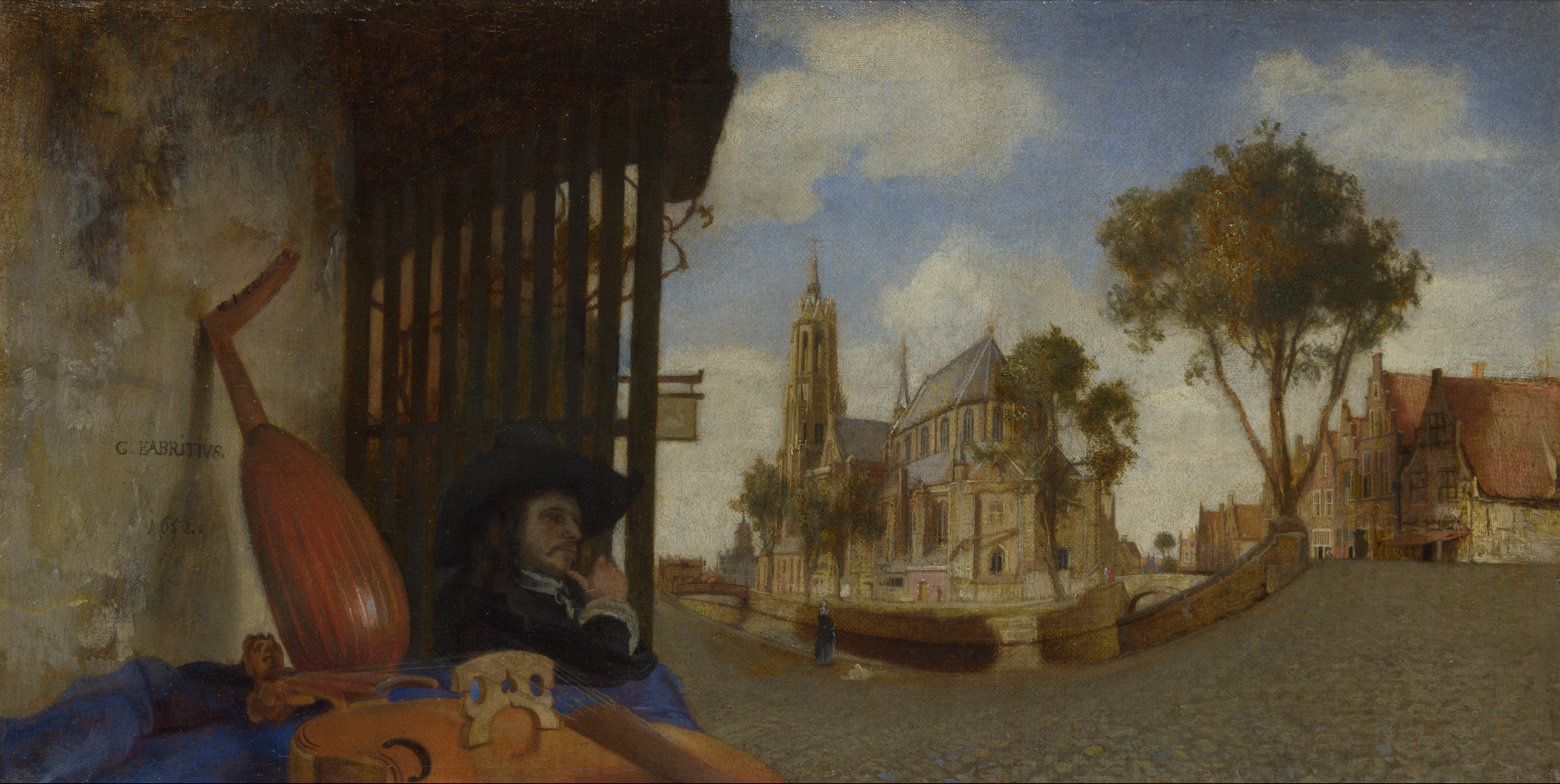
The National Gallery's summary of Fabritius rightly emphasises his interest in optics and unusual spatial effects. A View of Delft is the clearest example. It is a small canvas, only 15.5 by 31.7 centimetres, yet it seems to bend the city around the viewer. The Nieuwe Kerk appears in the background; a musical instrument seller's stall occupies the foreground; a foreshortened instrument, a lute and a curving street create the sensation of a view that has been stretched or shaped for a particular mode of looking.
Scholars have discussed whether the painting may have been intended for some kind of viewing box, lens or peephole arrangement, but the original mechanism remains uncertain. The important point is that Fabritius was not merely recording Delft. He was staging perception. [8]
That interest links him to broader seventeenth-century experiments in perspective, illusion and viewer involvement. Dutch artists loved surfaces that pretend to be other surfaces: letters pinned to boards, curtains painted over pictures, niches with objects, shadows that seem to fall into the viewer's space. Fabritius's difference is the quietness of his challenge. His best late works do not shout about illusion. They make the viewer lean in and ask why a small bird, a crooked city view or a guard in a doorway feels so spatially charged. [9]
A Small Surviving Oeuvre
Fabritius's surviving oeuvre is small, and that smallness must be handled carefully. The Delft powder-magazine explosion of 12 October 1654, often called the Delft Thunderclap, killed him at the age of thirty-two. It also destroyed part of the city, and later tradition has often connected the disaster with the loss of works from his studio. Whether every claimed loss can be documented or not, the result is clear enough: modern viewers know Fabritius through a handful of paintings rather than a broad, evenly preserved career. [10]
That makes attribution unusually important. Some works are strongly accepted; others have been debated, downgraded or connected to his circle rather than securely given to him. A Girl with a Broom, for example, is not a secure Fabritius painting. The National Gallery of Art in Washington attributes it to the Rembrandt Workshop, possibly Carel Fabritius, and that cautious wording matters.
It may help us think about Rembrandt's circle and the kind of bold handling Fabritius could have practised, but it cannot be treated as a straightforward addition to his autograph corpus. [11]
The same caution applies more broadly. A painter with few surviving works invites desire: the desire to find more, to fill gaps, to make a neat sequence from youth to maturity. Good Fabritius scholarship resists that temptation. It distinguishes between documented works, strong attributions, former attributions and useful comparisons. That does not make the art less interesting. It makes it more vivid, because every accepted painting has to carry more weight. [12]
Among the works that anchor the corpus are The Goldfinch at the Mauritshuis; A View of Delft and A Young Man in a Fur Cap and a Cuirass at the National Gallery, London; Portrait of Abraham de Potter at the Rijksmuseum; Self-Portrait at Museum Boijmans Van Beuningen; The Sentry at Schwerin; and early works such as Mercury and Aglauros and The Raising of Lazarus. Together they do not form a large career in the way Rembrandt's works do, but they form a sharply distinctive one. [13]
The Goldfinch
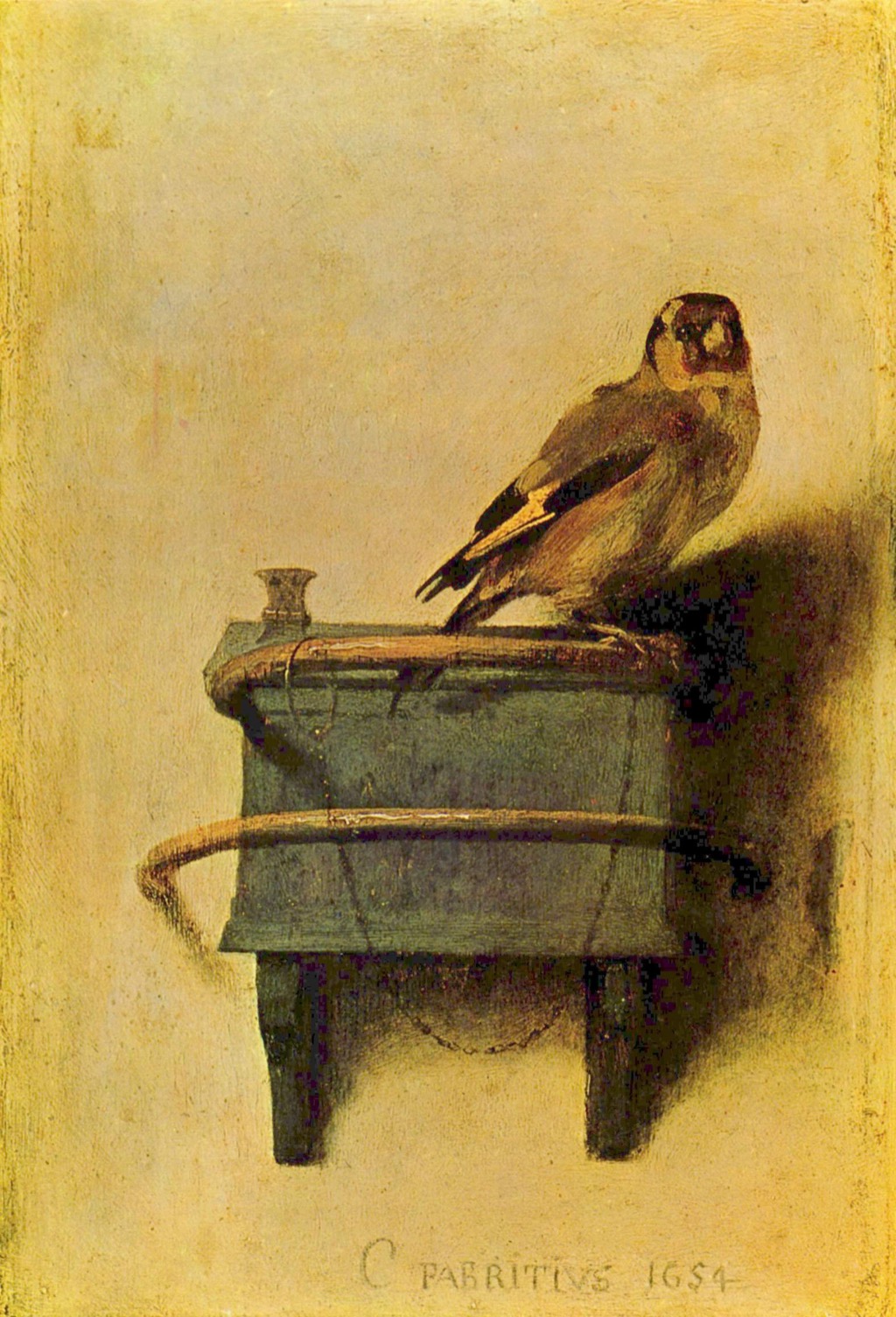
The Goldfinch is Fabritius's flagship painting for good reason. Painted in 1654, the year of his death, it shows a small bird chained to a feeder against a pale wall. The Dutch title, Het puttertje, refers to the European goldfinch as a trained pet bird, associated with drawing water in a small bucket. That social and domestic context matters, because the painting is not simply a bird study. It shows a living creature caught between affection, display and confinement. [14]
The picture is famous partly because it feels so direct. The bird is there, perched close to the viewer, with its red face, yellow wing marking, quick eye and delicate feet. Yet the painting is also elusive. The wall is spare. The shadow is decisive. The feeder and perch turn the bird into an object of looking, while the chain reminds us that this small life is controlled. Fabritius's brushwork is economical rather than minutely descriptive.
He gives enough for the bird to feel present, then lets the mind complete the encounter. [15]
Much of the painting's fascination comes from its object-like quality. Scholars have debated its original function: whether it may have been mounted near a window, set into a wall, placed in a niche, used as part of a perspective arrangement or understood as a kind of trompe-l'oeil panel. The physical evidence, including the panel and its signs of mounting, keeps those questions alive. None of the theories needs to be forced into a single answer.
The power of The Goldfinch lies partly in the way it hovers between picture, object and apparition. [15]
Its modern fame has also changed the way many people meet Fabritius. The Mauritshuis has long treated it as a treasured work, and its wider public life expanded through exhibitions, writing and Donna Tartt's novel The Goldfinch. But the painting does not need modern celebrity to justify attention. Even without that reception history, it would remain one of the most concentrated demonstrations of Fabritius's gift: a few inches of bird, wall and shadow turned into a meditation on presence. [15]
Read more about The Goldfinch by Carel Fabritius. [15]
A View of Delft, The Sentry and the Late Works
A View of Delft, with a Musical Instrument Seller's Stall is less famous than The Goldfinch, but it may be just as revealing. It is not the calm panoramic Delft later associated with Vermeer. It is a compact, distorted, almost experimental city fragment. The street seems to curve. The foreground object pushes toward the eye. The viewer is made conscious of looking from a particular position. The result is a painting about Delft and about the mechanics of seeing Delft. [15]
This makes the painting one of the strongest examples of Fabritius's optical intelligence. It also clarifies why he has so often been discussed near Vermeer. Both artists make Delft feel charged by vision rather than mere description. Yet their temperaments differ. Vermeer tends toward suspended balance, inwardness and polished order. Fabritius, at least in the works that survive, is more openly experimental. He lets the structure of seeing remain strange. [15]
The Sentry, painted in 1654 and now in Schwerin, belongs to the same final phase but has a different mood. A seated soldier, a dog and an architectural setting create a scene that has never yielded a single agreed meaning. Its provenance history is unusually interesting: scholarship has traced its movement through eighteenth-century collecting, including possible earlier associations with Rembrandt. That history is a reminder that Fabritius's name, like his corpus, was not always stable.
Paintings moved through collections, labels changed, and later scholars had to reconstruct what had been partly obscured. [15]
Other late works complicate the picture further. A Young Man in a Fur Cap and a Cuirass, probably a self-portrait, places identity inside costume and performance; the National Gallery is careful about the "probably" because no fully secure likeness of Fabritius survives. Portrait of Abraham de Potter looks at first like a sober portrait of an Amsterdam silk merchant, but its weathered wall and deceptively painted nail already show Fabritius turning portraiture into a test of illusion.
Self-Portrait at Boijmans, once believed to be by Rembrandt, shows how closely Fabritius's identity has been bound to questions of attribution and workshop inheritance. [15]
Read more about A View of Delft and The Sentry. [15]
Fabritius, Vermeer and the Delft Imagination
No discussion of Fabritius can avoid Vermeer, but the relationship needs care. Fabritius was older, connected to Rembrandt's workshop and active in Delft before his death in 1654. Vermeer was working in the same city in the same decade and developed one of the most refined languages of light in European painting. It is tempting to make Fabritius the missing teacher who explains Vermeer's achievement, but the surviving evidence does not allow that as a documented fact. [15]
What can be said is more interesting than a simple teacher-pupil story. Fabritius and Vermeer belong to a Delft environment in which painters were attentive to light, spatial construction, domestic scale and optical experience. Fabritius's pale grounds, cool illumination and experiments with perspective make him a persuasive point of comparison for Vermeer and Pieter de Hooch. His art helps us see that Delft painting was not only about quiet interiors. It was also a site of technical curiosity, perceptual play and intellectual ambition. [15]
Fabritius's death makes the comparison more poignant. Vermeer lived until 1675 and left a small but coherent group of masterpieces. Fabritius died before his mature direction could fully unfold. We are left with hints: a bird that seems to occupy our space, a city view that bends around our eye, a sentry whose setting refuses easy explanation. Those hints are enough to make him feel central, not because he explains Vermeer, but because he shows another possible path through Delft painting. [15]
Where to Start
Begin with The Goldfinch if you want to understand why Fabritius can command such affection from a single small painting. It is the most immediate route into his art: compact, technically subtle, emotionally open and still unresolved in its original purpose. [15]
Go next to A View of Delft if you are interested in perspective, optics and the Delft setting. It shows Fabritius thinking spatially, not only pictorially, and it pairs beautifully with The Goldfinch as another work about the viewer's position. [15]
Then read the biography to place those late works against his short life: Middenbeemster, Rembrandt's Amsterdam, Delft, the Guild of Saint Luke and the catastrophic explosion of 1654. The paintings page is the best guide if you want the wider corpus, including portraits, early history paintings and attribution cautions. [15]
Fabritius rewards this kind of layered reading. He is not a painter to understand through a single label: Rembrandt pupil, Delft artist, possible Vermeer precursor, trompe-l'oeil experimenter. Each label catches part of him and misses part of him. The surviving paintings are few, but they keep opening questions: how light changes a figure, how a painted object enters the viewer's world, how much can be done with a pale wall, a small bird, a curved street or a single nail. [15]
Frequently Asked Questions
Fabritius is famous because a small number of surviving paintings show an unusually inventive approach to light, perspective and illusion. The Goldfinch is his best-known work, but A View of Delft, The Sentry and his portraits also show why he is regarded as one of the most original painters to emerge from Rembrandt's circle.
Fabritius is widely connected with Rembrandt's workshop, and the National Gallery places his training with Rembrandt around 1641-1643. Samuel van Hoogstraten later referred to him as a fellow pupil. The exact details of his training are not fully documented, but Rembrandt's impact on his early work is clear.
There is no secure documentary evidence that Fabritius taught Vermeer. The two artists are best discussed through Delft context, visual affinity and later comparison. Fabritius's experiments with light and perspective help explain why he is often placed near Vermeer, but a direct teacher-pupil relationship should not be stated as fact.
Fabritius died in the Delft powder-magazine explosion on 12 October 1654. The disaster devastated part of the city and cut short his career when he was thirty-two.
Only a small group of paintings is generally accepted, and the exact corpus depends on attribution judgments. Some works once connected with Fabritius remain disputed or are now assigned to the Rembrandt workshop, circle or related hands. That uncertainty is one reason a careful paintings guide is useful.
Discussion
Share what you notice, question or want to compare after reading this page. Reader discussion works best when it stays close to the object, the evidence and the surviving Fabritius corpus.
Reader Insights
What detail in Carel Fabritius most changes how you understand Carel Fabritius?
How does this page change the relationship between Rembrandt's workshop, Delft light and Fabritius's surviving works?
Which object fact, provenance detail or attribution caution feels most important for the way the work is presented?
Join the Conversation
Join the conversation below with a source-aware observation or question.
References
- Leiden Collection, "Carel Fabritius," biography by Piet Bakker. Source
- National Gallery, London, "Carel Fabritius" artist page. Source
- National Gallery, London, "A View of Delft, with a Musical Instrument Seller's Stall." Source
- National Gallery, London, "A Young Man in a Fur Cap and a Cuirass (probably a Self Portrait)." Source
- Mauritshuis, "The Goldfinch" object record and related museum materials. Source
- Walter Liedtke, ed., *Vermeer and the Delft School*, Metropolitan Museum of Art exhibition catalogue. Source
- Linda Stone-Ferrier, Journal of Historians of Netherlandish Art, article on *The Goldfinch* and viewer/social exchange.
- Landesmuseum Mecklenburg-Vorpommern, "Carel Fabritius: The Sentry." Source
- Gero Seelig, Journal of Historians of Netherlandish Art, archival note on Gerhard Morell and the Schwerin collection. Source
- Rijksmuseum, "Portrait of Abraham de Potter, Amsterdam Silk Merchant." Source
- Museum Boijmans Van Beuningen, "Self-Portrait" by Carel Fabritius. Source
- Museum of Fine Arts, Boston, "Mercury and Aglauros." Source
- Antoni Ziemba, article on *The Raising of Lazarus*, *Rocznik Muzeum Narodowego w Warszawie*. Source
- National Gallery of Art, Washington, "A Girl with a Broom" and online catalogue entry for "Rembrandt Workshop, possibly Carel Fabritius." Source
- RKD Research / RKDartists and RKDimages records for Carel Fabritius and key works. Source