 by Tom Gurney
Tom Gurney BSc (Hons) is an art history expert with over 20 years experience
Published on August 4, 2026 / Updated on August 4, 2026
Email: tomgurney1@gmail.com / Phone: +44 7429 011000
The Sentry: Introduction
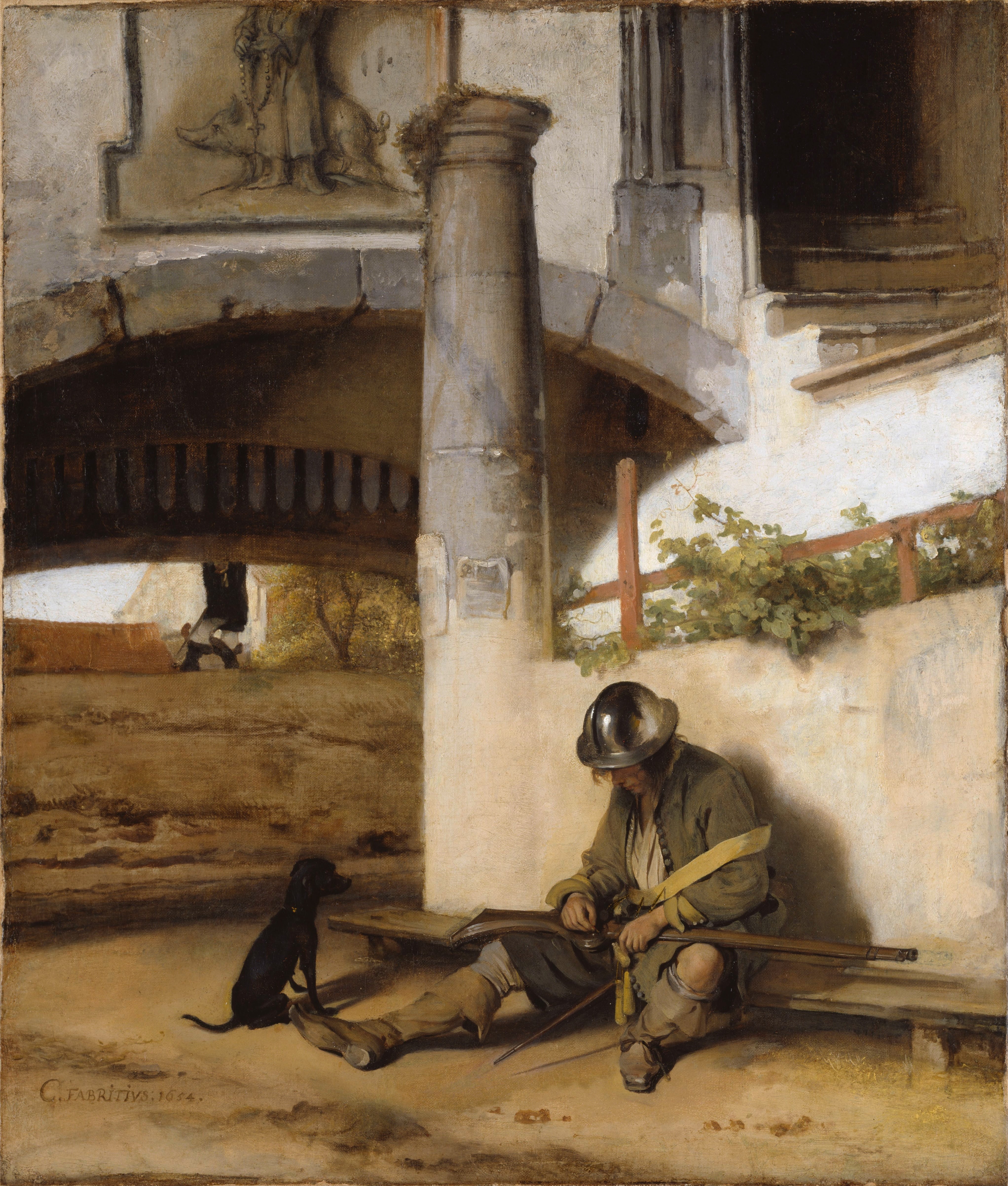
Carel Fabritius's The Sentry is one of the strangest survivors of his brief career. Painted in 1654, the year of his death in the Delft powder-magazine explosion, it shows a solitary armed man resting in a quiet architectural space. A small dark dog sits nearby. The man bends over his weapon or equipment, absorbed in a practical task rather than heroic display. The setting is not a battlefield, a guardroom or a city gate in any straightforward sense.
It feels half-real and half-staged: a white wall, a bench, a column, a shaded arch, a glimpse beyond, a strip of vegetation, a soldier whose duty has become oddly private. [1]
That uncertainty is part of the painting's power. The Sentry does not offer the immediate charm of The Goldfinch or the optical compression of A View of Delft, yet it belongs beside them as one of Fabritius's most important late works. It asks viewers to look at a modest scene until its quietness starts to feel unstable. Is this a guard at rest, a soldier cleaning his rifle, a hunter, a comic figure, a moral image, or an experiment in perspective and light?
The safest answer is that the painting invites these questions without settling them. [2]
Its later history is unusually rich. The painting entered the Schwerin collection in the eighteenth century, passed through a chain of changing attributions, was seized by French forces in the Napoleonic period, and was returned after the fall of Napoleon. In the nineteenth century, when Fabritius was being rediscovered as more than a minor Rembrandt pupil, The Sentry became one of the works through which his reputation could be reconstructed. Its subject may remain elusive, but its importance does not. [3]
The work is clearest when read alongside the Fabritius biography, the paintings guide, The Goldfinch and A View of Delft. Together they show how Fabritius moved between object illusion, Delft space and ambiguous figure scenes.
At a Glance
- ArtistCarel Fabritius
- Date1654
- MediumOil on canvas
- CollectionStaatliches Museum Schwerin
- Sizeabout 68 x 58 cm
Contents
- The Sentry: Introduction
- Object Facts
- What the Painting Shows
- The Problem of Meaning
- A Late Delft Work
- Schwerin and the Eighteenth-Century Collection
- Seizure, Recognition and Return
- Fabritius, Rembrandt and Rediscovery
- How The Sentry Relates to The Goldfinch and A View of Delft
- Why The Sentry Matters
Object Facts
The Sentry was painted by Carel Fabritius in 1654. It is an oil painting on canvas in the Staatliches Museum Schwerin, with the inventory number G 2477. The museum's online exhibit gives the support as canvas and the height as 67.5 cm; Gero Seelig's Journal of Historians of Netherlandish Art article gives the fuller measurement as 67.5 x 58 cm. [1]
The title usually appears in English as The Sentry, though older descriptions of the picture are revealing in their own right. In eighteenth-century records it was identified not as a Fabritius masterpiece but through the figure's action: a soldier cleaning his rifle. That early description matters because it shows how legible the central figure was even when the artist's name was not. [2]
The painting belongs to the final year of Fabritius's life, the same year as The Goldfinch and A Young Man in a Fur Cap and Cuirass. By then he had moved away from the dense darkness associated with Rembrandt's studio toward a cooler, brighter and more spatially experimental art. The Sentry is not as dazzlingly minimal as The Goldfinch, but it shares a fascination with how a figure or object occupies a shallow, carefully charged space. [3]
What the Painting Shows
At the centre of the composition is a seated armed man. He wears a helmet and rough clothing rather than the polished costume of a military portrait. His posture is low and absorbed. One leg stretches out, the other bends awkwardly; the long barrel of a gun lies across the front of the picture. His hands are busy, and his face is partly turned down, so the viewer is not invited into a clear exchange of glances. The image is built around attention withheld. [4]
Beside him sits a small dog, dark against the lighter ground. The dog is alert enough to register as a companion or watcher, yet it does not solve the meaning of the scene. If the man is a sentry, the animal seems almost more vigilant than he is. If he is a hunter, the dog has a practical role. If the image is a play on watchfulness, idleness or neglected duty, the dog becomes part of the joke or the moral pressure.
None of these readings is secure enough to dominate the painting. [5]
The architectural setting deepens the ambiguity. A column rises near the centre, its surface marked by age and small growths. Behind the figure, a pale wall catches the light. A bench runs across the lower part of the scene. To the left, a dark arch or bridge-like structure opens into a receding space. The proportions are peculiar, not in a clumsy way but in a way that makes the picture feel deliberately constructed.
Fabritius was praised by Samuel van Hoogstraten for "receding through-views" and large-scale perspective works in Delft, and The Sentry seems to belong to that broader interest in architecture, viewpoint and painted space. [6]
The painting's drama is quiet. Nothing is happening in the narrative sense. No command is being given, no enemy appears, no social encounter unfolds. The viewer is left with an armed man in a threshold space, close enough to inspect but not close enough to understand. Fabritius's restraint is the point: the picture has the ingredients of genre painting, military imagery and perspective experiment, but it refuses to behave as a simple example of any one of them. [7]
The Problem of Meaning
The title The Sentry encourages a particular reading. A sentry is someone placed to watch, guard or give warning. Fabritius, however, gives us a figure who seems withdrawn from the very role the title names. His attention is downward. His weapon is not raised. His body has settled into a position of rest or maintenance. The painting may therefore depend on a tension between office and behaviour: the guard is present, but his watchfulness is questionable. [7]
Older descriptions complicate this further. Seelig notes that the painting is recognizable in inventories because of its unusual iconography, typically described as a soldier or hunter cleaning his rifle. That phrase is useful because it does not force the figure into a single social category. A soldier and a hunter may both carry a long gun; both may be associated with dogs; both may pause to clean equipment. The title inherited by modern viewers may be more definite than the image itself. [7]
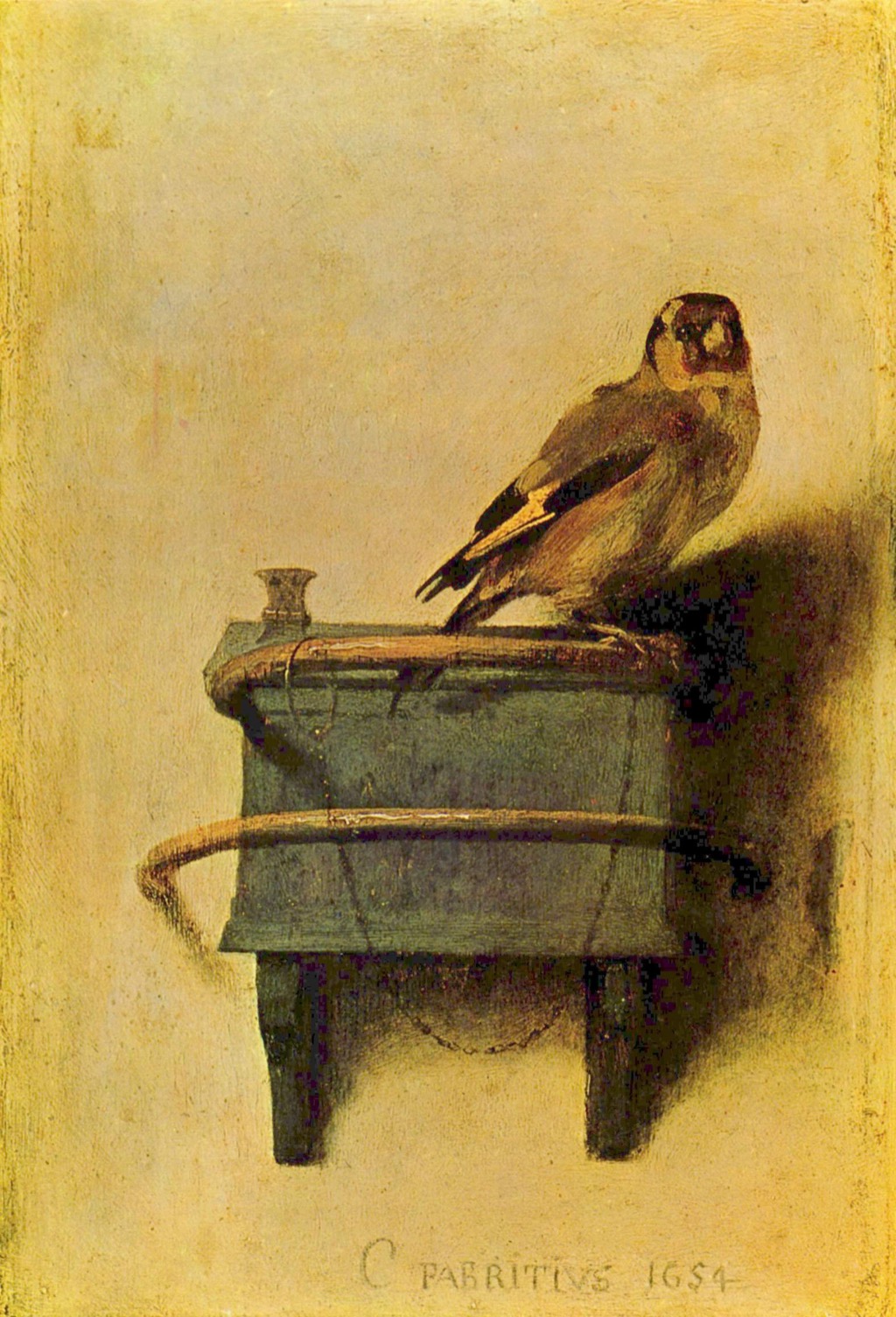
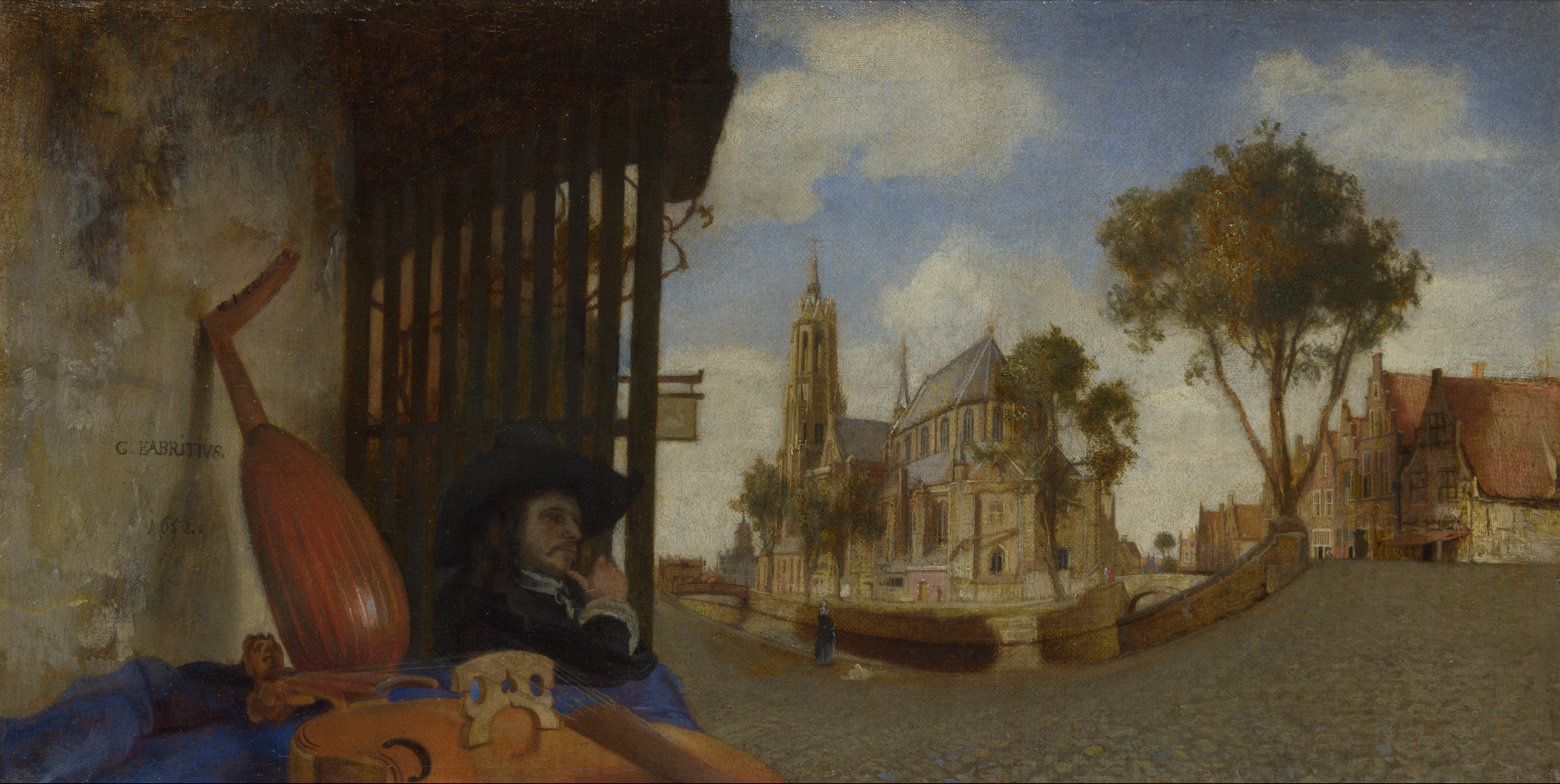
It is tempting to make the dog, the weapon, the arch and the worn architecture into a fixed symbolic code. But Fabritius's surviving work does not reward heavy-handed certainty. In The Goldfinch, a chained bird and a feeder can be explained through the culture of pet birds and trompe-l'oeil display, yet the original function of the panel remains debated. In A View of Delft, the distorted city view invites theories about viewing boxes, lenses or peepholes, but the exact viewing mechanism remains unresolved.
The Sentry should be approached with the same discipline. The clues matter; they do not equal a closed allegory. [7]
The soldier's downward focus may suggest boredom, fatigue or concentration. The dog may suggest alertness, loyalty, hunting or comic contrast. The setting may imply a gate, a yard, a bridge, a staged architectural fantasy or an exercise in perspective. The overgrown and weathered details may lend the scene an air of neglect. Each possibility sharpens the viewing experience, but none should be treated as the painting's hidden key. [7]
What can be said more firmly is that Fabritius turns a low-key subject into a study of attention. We look at a man who is not looking back. We test the space around him, because the painting makes that space feel meaningful. We notice the gap between military readiness and bodily slackness, between a guard's duty and a moment of private absorption. The mystery is not a failure of explanation. It is one reason the painting survives in memory. [7]
A Late Delft Work
The Sentry gains force when placed within Fabritius's late Delft years. Born in Middenbeemster in 1622, he trained for a short period in Rembrandt's orbit in Amsterdam before developing a style that increasingly moved toward pale light, unusual spatial construction and optical surprise. The Leiden Collection biography, written by Piet Bakker, emphasizes how small the securely attributed oeuvre is: only about thirteen paintings are firmly connected with Fabritius. That small number is not simply the result of an unproductive life.
It reflects the destruction and fragility surrounding his career, including the Delft explosion of 12 October 1654. [7]
Fabritius had moved to Delft in 1650 and joined the Guild of Saint Luke in 1652. His final works suggest a painter who was not merely repeating Rembrandt's lessons. The National Gallery describes him as a particularly innovative pupil of Rembrandt and notes the cooler lighting and interest in optics that distinguish his later art. In Delft, he seems to have explored painted space in ways that connect him to the city's wider fascination with perspective, architecture and observation. [7]
The Sentry is not an obvious optical device in the way A View of Delft appears to be. It does not distort a city street into a miniature experiment. Yet its architecture still behaves like a constructed viewing problem. The column, arch, wall and bench create a space that feels both ordinary and theatrical. The soldier's body is pushed low into the foreground, while the left side opens into recession. Light and shadow do not merely describe the setting; they organize how the viewer moves through it. [7]
That makes the painting valuable within Fabritius's corpus. It shows that his late originality was not confined to small marvels like The Goldfinch. He could apply a related intelligence to a larger figure scene: a human body, a weapon, an animal and an architectural setting, all held in a balance between narrative and perception. [7]
Schwerin and the Eighteenth-Century Collection
The Sentry also matters because of where it has lived. The Staatliches Museum Schwerin holds one of Germany's significant collections of Dutch and Flemish paintings. CODART's account of the museum describes a collection shaped above all by the dukes and grand dukes of Mecklenburg-Schwerin, with around 600 Dutch and Flemish seventeenth- and eighteenth-century paintings at the heart of its Old Master holdings. The collection does not mirror a modern textbook canon.
Rembrandt and Vermeer are absent as autograph works, but the collection preserves a vivid record of eighteenth-century aristocratic taste and of the Dutch paintings that circulated through that world. [7]
In that context The Sentry is a special case. CODART singles it out among the museum's genre paintings and notes both its quality and the rarity of Fabritius's work. This is important because Fabritius is not an artist represented in abundance anywhere. A single secure late painting can carry disproportionate weight. Schwerin's possession of The Sentry therefore gives the museum a direct place in the reconstruction of Fabritius's career. [7]
The painting's acquisition history is unusually well documented thanks to Gero Seelig's archival work. It does not appear in the Schwerin castle painting inventory of 1752. It first appears in the printed catalogue of 1792 as the work of an anonymous artist. Between those dates, Seelig identifies a more precise route into the collection. [7]
The key document is an invoice submitted on 2 August 1755 by the Hamburg dealer Gerhard Morell to Duke Christian Ludwig of Mecklenburg-Schwerin. The painting appears there not under Fabritius's name, but as a work by Gerbrand van den Eeckhout: "a soldier cleaning his rifle." Morell's invoice places the work among the duke's last acquisitions, shortly before Christian Ludwig's death in 1756. It also reveals the painting's place in a network of dealers, auctions and court collecting rather than in a neat artist-centred story. [7]
Seelig's article adds another layer. Volker Manuth identified the painting in the Amsterdam sale of Gerhard Michael Jabach's collection on 16 October 1753, where it was sold under Rembrandt's name. It was bought by "Winter" for 32 guilders and 10 stuivers, a buyer plausibly identified as the painter-dealer Hendrick de Winter. Two years later, Morell sold the picture to the duke for 60 Reichstaler.
In the space of a few years, then, the painting moved through names attached to Rembrandt, Van den Eeckhout and anonymity before modern scholarship restored it to Fabritius. [7]
That history is not a dry footnote. It tells us how Fabritius was seen, missed and recovered. The painting was strong enough to travel through serious collections, but the artist's name was unstable. For a painter with so few surviving works, that instability is central to the story. [7]
Seizure, Recognition and Return
The most dramatic episode in The Sentry's later life came during the Napoleonic period. In 1807, while Mecklenburg was under French occupation and the duke had fled to Altona, works were removed from Schwerin Castle and taken to Paris for the Musee Napoleon. The Landesmuseum Mecklenburg-Vorpommern records that The Sentry was seized along with more than 200 other paintings. [7]
The episode had a paradoxical effect. The painting was taken from Schwerin, but in Paris its signature was exposed, and Fabritius's talent began to receive new recognition in the art world. The museum's account stresses that this recognition was reflected in the contemporary art trade. In other words, displacement helped make the painting visible again, even as that visibility was born from an act of seizure. [7]
The story did not end in Paris. From 1814, after Napoleon's fall, Mecklenburg was among the European powers that reclaimed works from France. The Sentry returned, but its whereabouts became strangely obscure in the broader art world. The Landesmuseum notes that when William Thore-Burger compiled Fabritius's catalogue of works in the 1860s, he knew the picture from descriptions rather than direct access, yet still judged it one of Fabritius's principal works. [7]
This combination of fame and absence suits the painting. The image itself shows a figure present yet withheld, assigned to a role that remains hard to define. The later history repeats that pattern at the level of provenance and reception: seen, misnamed, removed, recognized, returned, then partly lost again to scholarly view until Fabritius's oeuvre was more fully reconstructed. [7]
Fabritius, Rembrandt and Rediscovery
The Sentry's old attributions are part of a larger problem in Fabritius's reputation. For a long time, he was difficult to see except through Rembrandt. That was understandable: Fabritius did train in Rembrandt's circle, and early works such as The Raising of Lazarus remain close to Rembrandt's dramatic language. But the late works are not merely Rembrandtesque. They move toward a brighter and more experimental art of surfaces, light and space. [7]
The Sentry passed through precisely the kinds of labels that could hide Fabritius from view. In the 1753 Jabach sale it was associated with Rembrandt. Morell's 1755 invoice placed it under Gerbrand van den Eeckhout. The 1792 Schwerin catalogue treated it as anonymous. Such shifts were common in the eighteenth- and nineteenth-century art market, where famous names could attach to works from a broader studio or school, and where lesser-known artists could be absorbed into the orbit of more marketable masters. [7]
Fabritius's modern reputation depends on reversing that absorption. The point is not to detach him entirely from Rembrandt, but to see what he did after Rembrandt. In The Sentry, the military subject might seem to belong to familiar Dutch genre painting, yet the handling of space and light is highly personal. The painting is not built around bravura storytelling. Its originality lies in the way the scene is suspended between the ordinary and the inexplicable. [7]
That is why the nineteenth-century rediscovery matters. Thore-Burger's interest in Fabritius formed part of a wider reevaluation of Dutch painting, including the later fame of Vermeer. Fabritius was often placed between Rembrandt and Vermeer in that story, sometimes too neatly. The safer view is that Fabritius belongs to the same Delft environment that later made Vermeer legible to modern audiences, and that his late works share a fascination with light, perspective and the psychology of looking.
The Sentry is an essential part of that evidence, even if it does not lead directly to Vermeer in any documented way. [7]
How The Sentry Relates to The Goldfinch and A View of Delft
The Sentry is sometimes overshadowed by The Goldfinch, and understandably so. The Mauritshuis panel has become one of the most beloved small paintings in Dutch art. A chained bird, a feeder, a pale wall and a brilliant economy of brushwork make it immediately memorable. The Sentry is less instant. Its subject is heavier, its mood more oblique, its architecture less cleanly explained. [7]
Yet the two paintings have more in common than their date. Both turn a modest subject into a confrontation with looking. The Goldfinch places a living creature against a wall and makes the viewer test the boundary between image, object and presence. The Sentry places a human figure in a shallow architectural setting and makes the viewer test the boundary between genre scene, guardroom image and spatial experiment. Each painting holds back a full narrative.
Each gives the eye enough information to keep thinking and not enough to finish the story. [7]
A View of Delft offers another comparison. That small National Gallery canvas is one of Fabritius's clearest experiments with optical distortion and urban space. The Sentry is less overtly technical, but its architecture still feels carefully made to puzzle the viewer. The arch, column and bench create a structure around the figure; the setting is not neutral background. Fabritius appears interested in how a painted environment can shape the viewer's sense of a body and a role. [7]
Seen together, these late works make Fabritius look less like a painter of isolated curiosities and more like an artist pursuing a consistent problem: how does a painted thing occupy the viewer's world? A bird on a perch, a distorted city view, a sentry in an uncertain architectural space - each work asks that question differently. [7]
Why The Sentry Matters
The Sentry matters first because it is rare. Fabritius died at thirty-two, and only a small group of paintings can be securely attributed to him. Every convincing work therefore has unusual weight. But rarity alone is not enough. The painting matters because it shows a kind of ambition that does not announce itself loudly. [7]
It is not a grand military scene. It is not a portrait of command. It is not an easily decoded moral anecdote. Its power lies in lowered intensity: a man attending to his equipment, a dog keeping company, an architectural setting that seems both plausible and odd, a title that sharpens the viewer's awareness of the man's imperfect vigilance. The painting makes stillness feel active. [7]
Its provenance also makes it one of the best windows into Fabritius's posthumous fate. The painting was misattributed, acquired, catalogued anonymously, seized, recognized, returned and later recovered by scholarship. That chain of events reflects the larger history of Dutch painting's changing reputation. Fabritius was not always the admired bridge between Rembrandt's workshop and Delft experiment that he is today. His identity had to be pieced back together from a handful of surviving works, scattered records and patient archival research. [7]
The Sentry is therefore both an image and a document. As an image, it resists easy explanation. As a document, it preserves the movement of a Fabritius painting through the eighteenth-century art market, ducal collecting, Napoleonic seizure and modern rediscovery. Few paintings in his oeuvre carry those two forms of interest so strongly at once. [7]
Frequently Asked Questions
The Sentry is in the Staatliches Museum Schwerin in Germany. The painting is listed with the inventory number G 2477.
The painting is dated 1654, the final year of Fabritius's life. He died in the Delft powder-magazine explosion on 12 October 1654.
It shows an armed seated man, often described in older records as a soldier or hunter cleaning his rifle, with a small dog nearby in an architectural setting. The modern title identifies him as a sentry, but the painting's exact meaning remains uncertain.
Yes. Gero Seelig's provenance research records the painting in a 1753 Amsterdam sale under Rembrandt's name. It was later connected with Gerbrand van den Eeckhout, catalogued anonymously in Schwerin, and eventually recognized as a work by Fabritius.
It is one of the few securely attributed late works by Fabritius. It also has an unusually rich provenance, including eighteenth-century acquisition records, Napoleonic seizure, restitution and nineteenth-century rediscovery. Its subject remains ambiguous, but that uncertainty is central to its interest.
Discussion
Share what you notice, question or want to compare after reading this page. Reader discussion works best when it stays close to the object, the evidence and the surviving Fabritius corpus.
Reader Insights
What detail in The Sentry by Carel Fabritius most changes how you understand Carel Fabritius?
How does this page change the relationship between Rembrandt's workshop, Delft light and Fabritius's surviving works?
Which object fact, provenance detail or attribution caution feels most important for the way the work is presented?
Join the Conversation
Join the conversation below with a source-aware observation or question.
References
- Landesmuseum Mecklenburg-Vorpommern, "Carel Fabritius: The Sentry," Virtuelles Museum zur Geschichte Mecklenburgs und Vorpommerns. https://www.landesmuseum-mv.de/en/exhibit/carel-fabritius-the-sentry/
- Gero Seelig, "Archival Note: Gerhard Morell and the Last Acquisitions of Christian Ludwig of Mecklenburg-Schwerin," Journal of Historians of Netherlandish Art 4, no. 1 (2012). https://jhna.org/articles/archival-note-gerhard-morell-last-acquisitions-christian-ludwig-of-mecklenburg-schwerin/
- Gero Seelig, "The Staatliches Museum Schwerin," CODART. https://www.codart.nl/feature/curators-collection/the-staatliches-museum-schwerin/
- Piet Bakker, "Carel Fabritius," The Leiden Collection Catalogue, 4th ed., edited by Arthur K. Wheelock Jr. and Elizabeth Nogrady with Caroline Van Cauwenberge. https://www.theleidencollection.com/artists/carel-fabritius/
- National Gallery, London, "Carel Fabritius." https://www.nationalgallery.org.uk/artists/carel-fabritius
- National Gallery, London, "Carel Fabritius, A View of Delft, with a Musical Instrument Seller's Stall." https://www.nationalgallery.org.uk/paintings/carel-fabritius-a-view-of-delft
- Walter Liedtke, Michiel C. Plomp and Axel Ruger, Vermeer and the Delft School, Metropolitan Museum of Art, 2001. https://www.metmuseum.org/met-publications/vermeer-and-the-delft-school