


 by Tom Gurney
Tom Gurney BSc (Hons) is an art history expert with over 20 years experience
Published on August 4, 2026 / Updated on August 4, 2026
Email: tomgurney1@gmail.com / Phone: +44 7429 011000
Carel Fabritius Paintings and Surviving Corpus
Carel Fabritius is one of the most intriguing painters of the Dutch Golden Age because the body of work attached to his name is so small, so scattered and so unevenly preserved. A few paintings have become central to the story of 17th-century Dutch art: The Goldfinch in the Mauritshuis, A View of Delft in the National Gallery, The Sentry in Schwerin, and a handful of portraits, tronies and early history paintings that show how he moved out of Rembrandt's shadow.
Around those works lies a more difficult zone of damaged pictures, old attributions, workshop material and paintings once given to Rembrandt or his circle. [1]
That difficulty is part of the subject. Fabritius died in Delft on 12 October 1654, when the city powder magazine exploded. The disaster destroyed a large part of the city and may also have destroyed works in his studio.
Modern readers therefore meet him through fragments: a bird on a wall-mounted feeder, a tiny distorted view of Delft, a soldier in a strange courtyard, a young man in armor, a silk merchant before a plastered wall, a self-portrait that once passed as Rembrandt, and a few ambitious early works whose debt to Rembrandt's studio remains visible. [2]
This guide treats Fabritius's paintings as a source-aware corpus, not as a neat checklist. Some works are secure or broadly accepted by major museums and scholarship. Some are accepted but come with questions about identity, dating, function or condition. Others belong to the Rembrandt workshop problem, where the evidence may point toward Fabritius without making his authorship certain. The result is not a weakness in the story.
It is the clearest way to see what survives of an artist whose career was short, whose reputation was interrupted, and whose best paintings feel startlingly modern because they do not all solve the same artistic problem. [3]
For the life behind the corpus, start with the Fabritius biography; for close object studies, continue to The Goldfinch, A View of Delft and The Sentry. Those pages keep the secure works, disputed works and Delft context in view together.
At a Glance
- OeuvreSmall surviving corpus, with several attribution-sensitive works
- FlagshipThe Goldfinch, 1654, Mauritshuis
- Key museumsMauritshuis, National Gallery, Rijksmuseum, Boijmans, Schwerin
- CautionQuestioned attributions require clear reader-facing language
Contents
- Carel Fabritius Paintings and Surviving Corpus
- Why Fabritius's Surviving Corpus Is Unusual
- Evidence Tiers: Secure, Accepted, Questioned
- Early Rembrandt-School Works
- Portraits, Self-Portraits and Tronies
- Delft, Light and Optical Experiment
- The Sentry and the Problem of Meaning
- The Goldfinch as the Center of the Corpus
- A View of Delft and the Wider Delft School
- Questioned Attributions and the Rembrandt Workshop Problem
Why Fabritius's Surviving Corpus Is Unusual
Most major Dutch painters are known through a much larger field of works. Rembrandt, Frans Hals, Gerard ter Borch, Pieter de Hooch and Johannes Vermeer all raise attribution problems, but their reputations can be built across many more pictures. Fabritius is different. His surviving oeuvre is generally described as very small, and the accepted paintings sit in a few major collections rather than in one continuous group. The small number of works makes every attribution decision unusually consequential. [1]
Several factors make the corpus hard to read. The first is chronology. Fabritius was born in Middenbeemster in 1622, trained in or around a family environment that included painting, spent time in Rembrandt's Amsterdam workshop in the early 1640s, and later worked in Delft, where he entered the Guild of Saint Luke in 1652. His mature career was brief.
If a painting is dated around 1643 to 1647, it may belong to the Rembrandt orbit; if it is dated around 1652 to 1654, it may show the brighter, more experimental Delft phase for which he is now famous. [2]
The second factor is loss. The Delft explosion, often called the Delft Thunderclap, killed Fabritius at the age of 32. Because the blast damaged the area where he lived and worked, it has long shaped discussion of what may have disappeared with him. We cannot simply assume that the surviving paintings represent the full range of his output. They may instead be the remains of a much larger practice that included portraits, history paintings, civic commissions, experiments in perspective and painted illusions. [3]
The third factor is attribution history. Fabritius worked close to Rembrandt's artistic world, and several pictures now connected with him have carried other names in the past. Some works once passed as Rembrandt; others sit in the broader category of Rembrandt workshop, circle or possible authorship. This matters because Fabritius was not a minor copyist. He was a gifted painter who absorbed Rembrandt's dramatic handling of light and paint, then found a different direction.
Distinguishing his hand from that of Rembrandt's pupils and followers is therefore an art-historical problem, not a tidy label exercise. [4]
The fourth factor is variety. The best-known works do not look like a single formula repeated. The Goldfinch is a small panel that turns a chained bird into a living presence. A View of Delft compresses a city street into a warped optical puzzle. The Sentry places a soldier, dog and architectural setting in a mood that remains hard to pin down. The portraits move between psychological presence, costume study and illusionistic detail. The early history paintings carry the gravity of Rembrandt's biblical and mythological world.
Fabritius's paintings matter partly because they show an artist repeatedly testing what a picture could do. [5]
Evidence Tiers: Secure, Accepted, Questioned
For a painter like Fabritius, it helps to separate types of confidence. "Secure" does not mean every detail is settled. A secure painting may still have questions about original function, earlier appearance, interpretation or provenance. It means that the basic attribution to Fabritius is treated as sound by the holding museum and by the main scholarly tradition used here. [6]
The strongest group includes The Goldfinch at the Mauritshuis, A View of Delft, with a Musical Instrument Seller's Stall at the National Gallery in London, The Sentry at the Staatliches Museum Schwerin, A Young Man in a Fur Cap and a Cuirass at the National Gallery, Portrait of Abraham de Potter at the Rijksmuseum, and the Self-Portrait in Museum Boijmans Van Beuningen. These paintings are not identical in certainty at every point.
For example, the young man in the National Gallery picture is probably a self-portrait, but no documented likeness of Fabritius survives to settle the matter completely. Still, these works form the backbone of any responsible public account of Fabritius's paintings. [7]
Another group includes early works such as Mercury and Aglauros in the Museum of Fine Arts, Boston, and The Raising of Lazarus in the National Museum in Warsaw. These are important for understanding Fabritius's early engagement with Rembrandt's art, especially large-scale figure composition, dramatic light and close reading of narrative subjects. They do not have the instant public recognition of The Goldfinch, but they are essential if Fabritius is not to be reduced to a single late masterpiece. [8]
A third group contains questioned or historically shifting attributions. A Girl with a Broom in the National Gallery of Art, Washington, is the most important example for general readers because it is often associated with Fabritius but is not presented by the NGA as a secure Fabritius painting. Its current attribution is Rembrandt Workshop, possibly Carel Fabritius. It belongs in a careful discussion of Fabritius and Rembrandt's circle, but it should not be listed as an uncomplicated Fabritius work. [9]
This tiered approach keeps the corpus honest. It also makes the paintings easier to understand. Fabritius emerges not as a painter with one stable "look", but as an artist whose surviving works fall across a career interrupted at the point when his experiments with light, viewpoint and illusion were becoming most distinctive. [10]
Early Rembrandt-School Works
Fabritius's early paintings are best understood through his relationship to Rembrandt's Amsterdam workshop. Samuel van Hoogstraten, another artist associated with Rembrandt's circle, later referred to Fabritius as a fellow pupil. The exact boundaries of workshop training, collaboration and influence can be difficult to define, but the artistic evidence is clear enough: Fabritius's early works engage directly with Rembrandt's dramatic lighting, weighty figures and ability to make narrative feel physically present. [11]
Mercury and Aglauros, in the Museum of Fine Arts, Boston, is an important early example. The MFA dates it to about 1645-1647 and identifies the subject from Ovid's Metamorphoses. In the story, Mercury transforms Aglauros to stone after she blocks his access to her sister Herse. The picture belongs to the type of ambitious mythological painting that demanded more than decorative storytelling. It required invention, bodily drama and moral tension.
Those demands suited an artist trained near Rembrandt's example, where light and shadow could make a scene feel emotionally charged rather than merely illustrated. [12]
The painting matters because it shows Fabritius working at a scale and seriousness often forgotten by readers who know only The Goldfinch. The small bird panel is not the whole artist. Early Fabritius was also capable of mythological and biblical drama, using dark tonal structure and theatrical presentation to give old stories a modern physical immediacy. Mercury and Aglauros helps explain how he learned from Rembrandt before moving toward the brighter, stranger experiments of Delft. [13]
The Raising of Lazarus, in the National Museum in Warsaw, provides another route into this early period. Scholarship by Antoni Ziemba has connected the painting with Rembrandt, pupils of Rembrandt, conservation evidence and the concept of inventio, the artist's act of pictorial invention. Conservation and technical study have played a major role in how the picture is understood, including the removal of varnish, retouching and overpaint that altered the visible surface.
That kind of research is especially valuable for Fabritius because damaged or altered pictures can easily distort a painter's apparent style. [14]
The subject also suited the Rembrandt school. The Raising of Lazarus is a biblical scene about revelation, astonishment and the boundary between death and life. Rembrandt had treated the theme with theatrical force. A young artist close to his orbit could use it to test gesture, light and narrative emphasis. In Fabritius's case, the painting is useful not just as an early work but as evidence of ambition. It shows him engaging with large religious storytelling before the surviving late works narrow our view toward optical experiment and intimate presence. [15]
These early paintings should not be forced to look like The Goldfinch in advance. Their value lies in difference. They show a painter learning the deep shadow, narrative density and material drama of Rembrandt's world. Later, in Delft, Fabritius would loosen that darkness and build images around pale light, spatial surprise and the viewer's own position before the object. The early works give that shift a starting point. [16]
Portraits, Self-Portraits and Tronies
Fabritius's portraits and portrait-like works are among the best ways to see his transition from Rembrandt's influence toward a more independent visual language. They also show how slippery categories can be in Dutch painting. A portrait records a specific person. A self-portrait may present the artist's own face while still playing with role, costume and artistic identity. A tronie is not a conventional portrait at all, but a character head or study of expression, costume, lighting or type. Fabritius's surviving works move across these categories. [17]
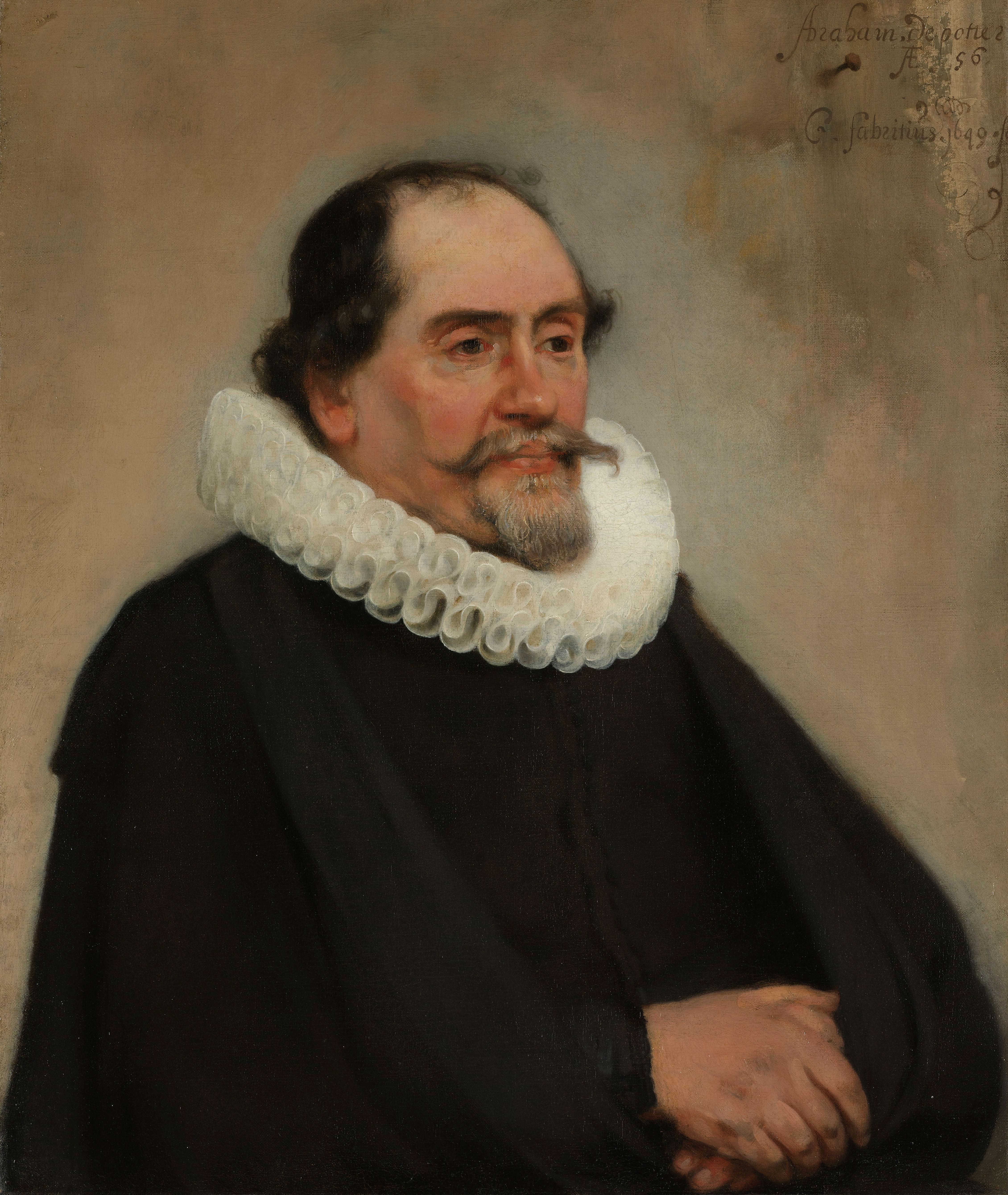
Portrait of Abraham de Potter, Amsterdam Silk Merchant, in the Rijksmuseum, is dated 1649. It shows Fabritius working in a portrait format while already experimenting with illusion. The sitter was an Amsterdam silk merchant, and the painting's object record gives the work a clear social and material setting. Yet the most memorable detail is not only the sitter's face or clothing. Above the signature is a small painted nail, made to look as if it is fixed into the wall behind the figure. The detail is modest, but it matters.
It turns a portrait into a test of perception. [17]
That nail points forward. It suggests Fabritius's later fascination with trompe-l'oeil effects, not as empty tricks but as ways to make the painted surface behave like a real object in the viewer's space. In The Goldfinch, a feeder, perch and shadow make the bird seem attached to the world beyond the panel. In A View of Delft, distortion invites the viewer to imagine a specific optical setup. In the Abraham de Potter portrait, the little nail quietly asks a similar question: where does painted space end and ordinary space begin? [17]
The Boijmans Self-Portrait, dated around 1645, belongs closer to Fabritius's Rembrandt period. The painting has its own attribution history, having once been believed to be by Rembrandt and now given to Fabritius. That history is not incidental. It reveals how close Fabritius could stand to Rembrandt's visual world, especially in the handling of the head, the inward mood and the play of costume and self-presentation.
Technical material published by Museum Boijmans Van Beuningen adds another layer: x-ray evidence indicates that Fabritius first painted himself with a white collar before choosing the open shirt visible now. Such changes remind us that self-portraiture was not simply a mirror record. It was a constructed image of the artist. [17]
A Young Man in a Fur Cap and a Cuirass (probably a Self Portrait), in the National Gallery, London, is one of the most compelling late portrait-like works. The National Gallery dates it to 1654 and describes the sitter as probably a self-portrait, while also making clear that there is no documented likeness of Fabritius that proves the identification beyond doubt. That careful language is important.
The painting may show Fabritius; it certainly shows his interest in the traditions of Rembrandt's studio, where artists often explored costume, armor, fur, shadow and expression without producing straightforward social portraits. [17]
The picture also shows the late Fabritius moving into a lighter atmosphere. The background opens toward sky, and the figure is staged with a low viewpoint and a freshness different from the heavy darkness associated with Rembrandt's earlier mode. The cuirass and fur cap may recall the theatrical dress of tronies, but the face has a directness that keeps the self-portrait question alive.
Whether or not the sitter is Fabritius, the painting sits near the center of his mature artistic identity: learned from Rembrandt, but no longer contained by Rembrandt's tonal world. [17]
Together, these portraits and tronies show that Fabritius's originality did not appear suddenly in 1654. It developed through repeated pressure on familiar forms. A merchant portrait becomes an illusionistic wall. A self-portrait becomes a record of revision and self-fashioning. A young man in costume becomes both character study and possible artist image. In each case, Fabritius seems interested in the relationship between person, surface and viewer. [17]
Delft, Light and Optical Experiment
Fabritius moved to Delft by the early 1650s, entering the city's Guild of Saint Luke in 1652. This phase produced the paintings that most sharply distinguish him from other Rembrandt pupils. The light becomes cooler and clearer. Dark figures may stand against pale grounds. Space behaves strangely. Objects appear simple at first, then reveal their dependence on angle, mounting, distance or viewer position. [17]
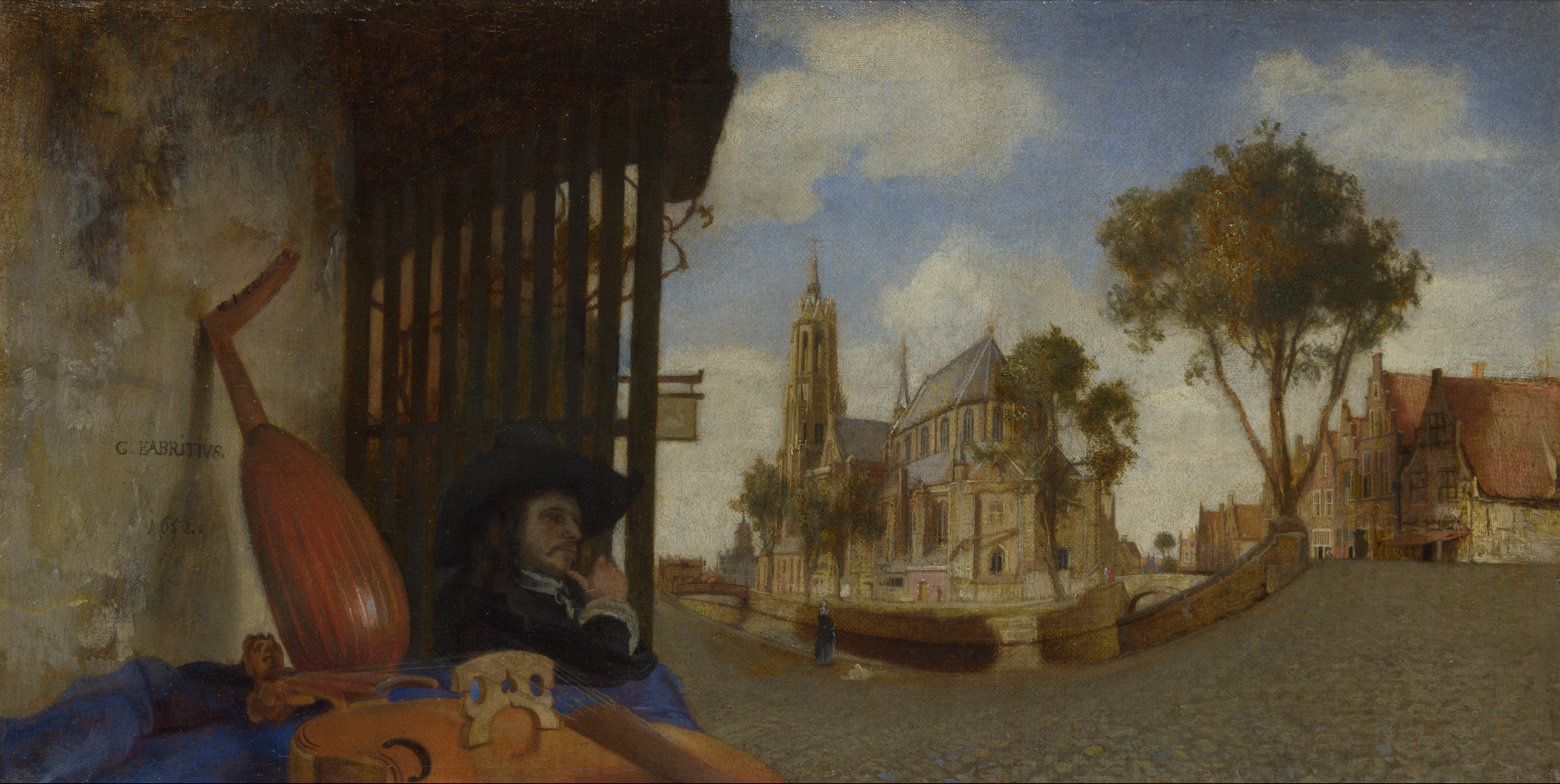
A View of Delft, with a Musical Instrument Seller's Stall, in the National Gallery, is dated 1652. It is tiny, only 15.5 by 31.7 cm, but it contains an ambitious optical problem. The scene shows a view near Delft's Nieuwe Kerk, with a musical-instrument seller's stall in the foreground. The foreground instrument is strongly foreshortened, the street seems to curve, and the whole scene appears stretched or distorted. The National Gallery discusses possible explanations involving a viewing box, lens or peephole, while keeping the original setup unresolved. [17]
That unresolved quality is the painting's fascination. It is not simply a city view. It behaves like an experiment in how a painted image meets the eye. The viewer is made aware that seeing is conditional. Stand in the wrong position, or imagine the wrong mounting, and the picture looks peculiar. Imagine a device or viewing point, and the distortion begins to make sense. Fabritius is not just representing Delft. He is asking how Delft becomes visible. [17]
The subject also matters. Delft would become central to Vermeer's art, but Fabritius's relationship to Vermeer should be phrased carefully. There is no need to turn Fabritius into Vermeer's documented teacher in order to see the importance of their shared city and related interests. Fabritius, Vermeer and Pieter de Hooch all belong to a Delft context in which light, architecture, domestic space and looking itself became unusually charged artistic problems. A View of Delft is one of the most concentrated early examples of that climate. [17]
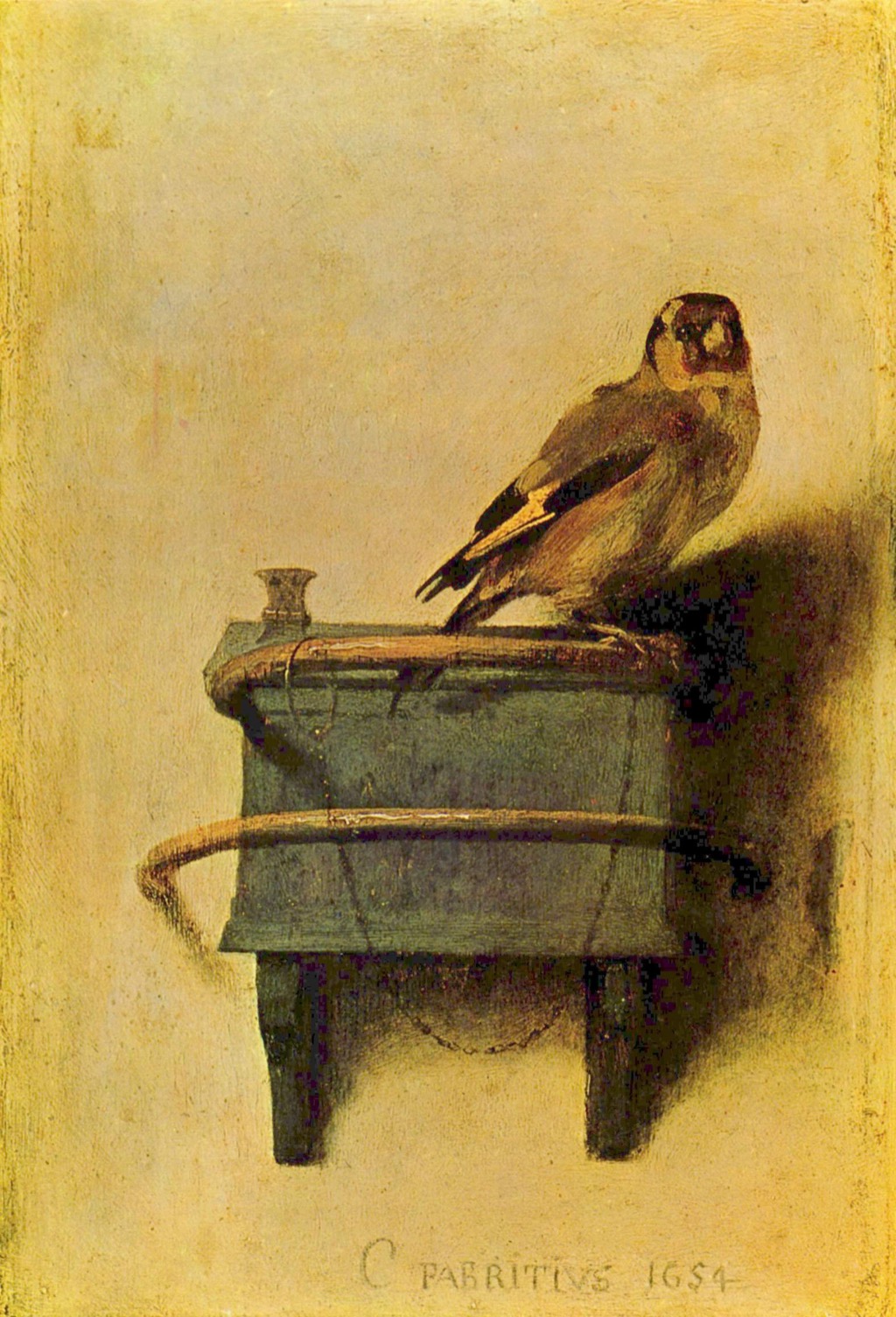
The Goldfinch, painted in 1654 and now in the Mauritshuis, is the most famous surviving work by Fabritius. It is small, direct and astonishingly alive. A chained European goldfinch perches beside its feeding box against a pale wall. The Dutch title, Het puttertje, refers to the bird as a "little water-drawer", because trained goldfinches were sometimes taught to draw water with a tiny bucket. Fabritius gives almost nothing in the way of setting, story or decorative richness.
Instead he builds presence from light, posture, shadow and the relationship between the painted panel and the viewer's world. [17]
The painting is often described in relation to trompe-l'oeil, but that term only begins to explain it. The bird is not rendered with microscopic finish. Its wing, head, eye and chain are painted with selective, economical force. The shadow on the wall gives the bird physical placement. The perch and feeder imply use.
The small panel has prompted discussion of original function: whether it may have been mounted in a particular architectural or domestic setting, whether it was meant to be seen from below, whether it belonged to a wall, case, window-like exchange or another form of illusionistic display. The strongest accounts keep these ideas as possibilities, not certainties. [17]
A View of Delft and The Goldfinch are very different subjects, but they belong together. Both are small works with large implications. Both depend on where the viewer stands. Both make ordinary sight feel active. Both move away from Rembrandt's interior darkness toward a world of pale surfaces, spatial ambiguity and optical play. They are not just evidence that Fabritius was talented. They are evidence that he was thinking unusually hard about the mechanics of looking. [17]
The Sentry and the Problem of Meaning
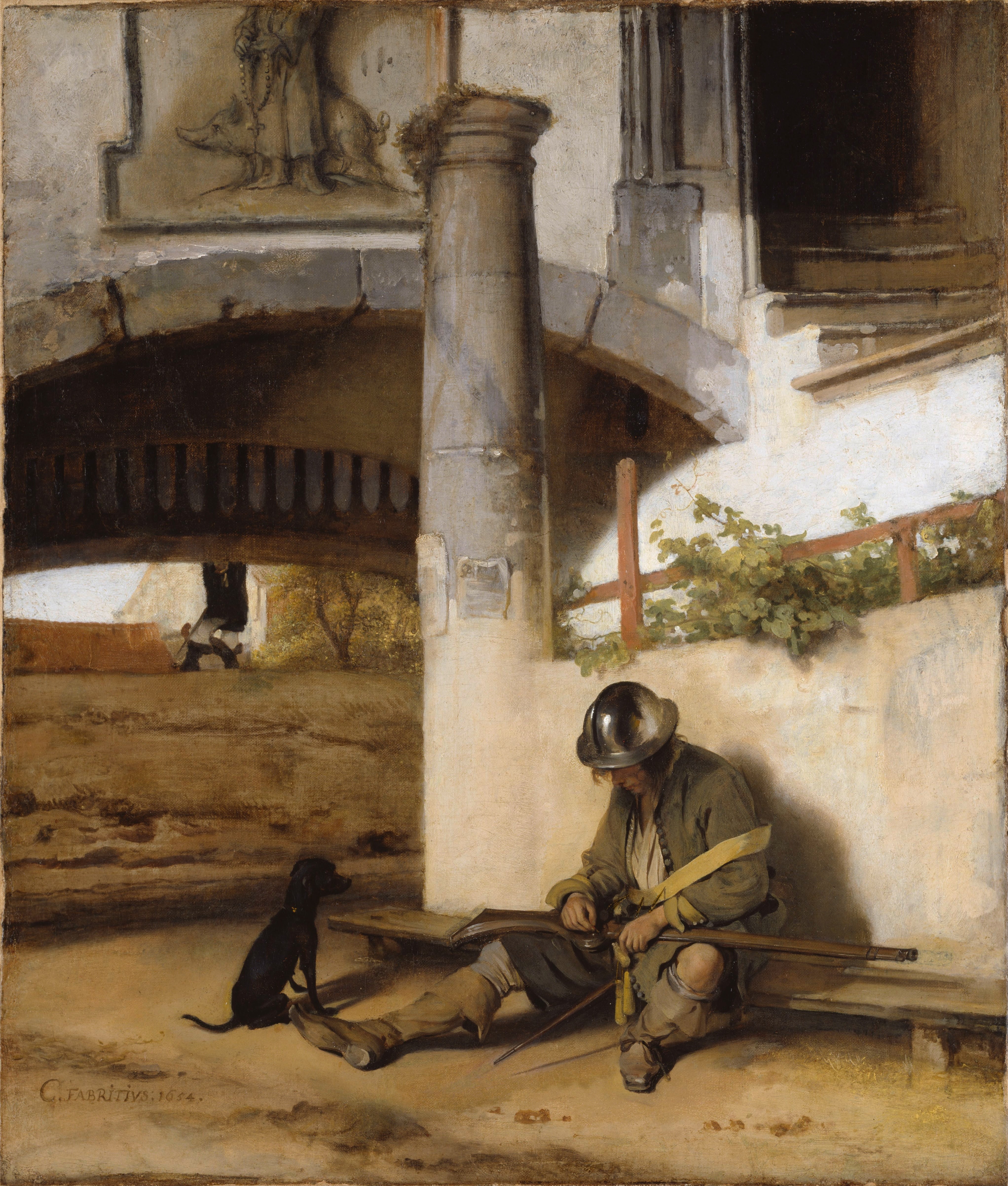
The Sentry, dated 1654 and now in the Staatliches Museum Schwerin, is one of Fabritius's strangest surviving late works. A soldier sits or rests in an architectural setting, with a dog nearby and a mood that is difficult to reduce to a single narrative. Compared with The Goldfinch, it is less immediately famous. Compared with A View of Delft, it is less obviously an optical device. Yet it is crucial to Fabritius's corpus because it shows the late Delft artist working with space, stillness and ambiguity on a larger scale. [17]
The Schwerin museum's account connects the painting with a dramatic collecting history, including Napoleonic seizure, restitution and later recognition. Gero Seelig's archival article in the Journal of Historians of Netherlandish Art adds a more detailed provenance discussion. The painting does not appear in the 1752 Schwerin inventory, appears anonymously in a 1792 catalogue, and may relate to an acquisition trail involving the Jabach sale, Hendrick de Winter and Gerhard Morell's 1755 invoice to Duke Christian Ludwig of Mecklenburg-Schwerin.
This kind of provenance work matters because Fabritius's paintings often survived under unstable names or uncertain classifications. [17]
As an image, The Sentry resists easy explanation. Is the soldier alert, idle, weary or symbolic? Does the dog sharpen the sense of guard duty or domestic quiet? Does the architecture create a military setting, a stage-like enclosure or an experiment in recession? The painting's value lies partly in refusing to collapse into anecdote. It has the physical facts of a genre scene but the suspended feeling of a riddle. [17]
The work also connects Fabritius back to Rembrandt. Military figures, shadowed recesses and expressive stillness had deep roots in Rembrandt's world. Yet The Sentry's space and light are not simply Rembrandtesque. They belong to Fabritius's late interest in placing a figure within an environment that seems at once real and unstable. If The Goldfinch is an illusion of a bird near the viewer and A View of Delft is an illusion of a city seen through a peculiar visual system, The Sentry is an illusion of narrative withheld.
We see enough to feel a situation, but not enough to close it. [17]
For that reason, The Sentry deserves to stand beside the more famous late works. It complicates the idea that Fabritius's Delft period was only about bright optical cleverness. It suggests that his experiments with space also had psychological weight. [17]
The Goldfinch as the Center of the Corpus
The Goldfinch inevitably dominates modern interest in Fabritius. It is the painting most readers know, the one most often reproduced, and the work through which many first encounter his name. Yet it should be treated as the center of the corpus, not as a substitute for the corpus. [17]
Its power comes from concentration. The bird is small. The setting is minimal. The palette is restrained. The composition seems almost casual until the illusion takes hold. The chain, feeder, perch, wall and cast shadow create a relationship between creature and surface that feels startlingly immediate. Fabritius strips away the narrative abundance of his early Rembrandt-school works and leaves a painted event that happens almost entirely through attention. [17]
The painting's material and technical history also matters. Modern conservation and technical discussion have addressed questions such as surface condition, earlier appearance, the panel as an object, nail holes, edge evidence, changes around the lower area and the possible implications of viewing angle. These details do not turn the painting into a solved puzzle, but they deepen its mystery. The Goldfinch is not only an image of a bird. It is a made thing whose physical support, mounting and surface may be part of the illusion. [17]
Because the painting is so famous, it can also distort Fabritius's reputation. Readers may expect every Fabritius to be small, pale, witty and birdlike in its intimacy. The wider corpus says otherwise. Mercury and Aglauros is mythological and dramatic. The Raising of Lazarus is religious and technically complex. The portraits explore identity and illusion. A View of Delft bends civic space into an optical test. The Sentry creates narrative uncertainty.
The Goldfinch is central because it distills Fabritius's mature interests, but those interests become richer when the painting is read beside the rest of the surviving work. [17]
A View of Delft and the Wider Delft School
A View of Delft is especially important because it opens Fabritius's work toward the broader story of Delft painting. The city is often approached through Vermeer, whose View of Delft and domestic interiors have shaped modern expectations of Delft light. Fabritius offers a different but related path. His Delft is not a serene panoramic city or a quiet room. It is a narrow, distorted, almost experimental encounter with a street, a church and a seller's stall. [17]
The painting's size is part of its ambition. It compresses a recognizable urban subject into a format that seems made for close inspection. The instrument seller and his wares occupy the foreground, with a foreshortened stringed instrument pushing toward the viewer. The Nieuwe Kerk anchors the urban identity, while the curving street and stretched forms disrupt simple description. The result is both local and artificial: Delft as seen through a constructed act of looking. [17]
This matters for understanding Fabritius's place between Rembrandt and Vermeer. From Rembrandt, he inherited the seriousness of pictorial invention and the ability to make paint carry presence. In Delft, he seems to have turned those gifts toward light, surface and the conditions of sight. Vermeer would later become the supreme painter of Delft stillness and optical poise, but Fabritius should not be reduced to a stepping stone. A View of Delft shows him pursuing a distinctive problem in his own right. [17]
Samuel van Hoogstraten is useful here because he links Rembrandt's pupil network to theories and practices of perspective illusion. Fabritius's documented association with that world makes his Delft experiments more intelligible. He was not merely painting odd small pictures. He was working within a 17th-century culture fascinated by perspective boxes, deceptive surfaces, lenses, viewing positions and the ability of art to test the eye. [17]
Questioned Attributions and the Rembrandt Workshop Problem
Fabritius's connection to Rembrandt makes attribution both tempting and dangerous. Tempting, because a strong Rembrandt-school painting with unusual bravura, nuanced modeling or experimental handling may seem to fit what we want Fabritius to be. Dangerous, because Rembrandt's workshop included multiple talented artists, and later collectors, dealers and scholars often shifted works between Rembrandt, pupils, followers and named alternatives. [17]
A Girl with a Broom is the clearest example for readers. The National Gallery of Art in Washington attributes the painting to Rembrandt Workshop, possibly Carel Fabritius. Its catalogue entry discusses why Fabritius has been considered a likely candidate: the work appears to come from Rembrandt's immediate circle, and Fabritius may best explain its combination of subtle modeling and bold brushwork. That is significant evidence, but it is not the same as a secure attribution. [17]
The painting should therefore be discussed as part of the Fabritius problem, not as a settled Fabritius painting. It helps readers understand the workshop environment in which he developed. It shows why some pictures near Rembrandt can invite his name. It also demonstrates why careful museum language matters. "Possibly Carel Fabritius" is not a decorative qualifier. It is the core fact. [17]
Questioned attributions are not failures of scholarship. They are part of how scholarship works when evidence is partial. A painting may have persuasive stylistic features but weak documentation. It may have a complicated conservation history. It may have passed through collections under a famous name such as Rembrandt, then been reconsidered as the field became more precise. It may contain passages that seem close to Fabritius and others that remain harder to explain. [17]
For Fabritius, this caution is especially important because the secure corpus is so small. Adding uncertain works too confidently can create a false artist, one padded out by wishful thinking. Excluding every difficult work can create another false artist, one cut off from the workshop and attribution history that shaped his reputation. The better approach is to keep the degrees of evidence visible. [17]
Secure and High-Consensus Collection Highlights
The Mauritshuis in The Hague holds The Goldfinch, the painting that has become Fabritius's public emblem. Its date, 1654, places it in the final year of his life. The museum's object record and related interpretive material make it the anchor for discussions of Fabritius's illusionism, technique, original-function debate and modern reception. [17]
The National Gallery in London holds two crucial works. A View of Delft, with a Musical Instrument Seller's Stall, dated 1652, is one of the strongest records of Fabritius's optical experimentation. A Young Man in a Fur Cap and a Cuirass (probably a Self Portrait), dated 1654, is central to his late portrait-like work and to the question of artistic identity. Together they allow readers to see Fabritius as both experimenter and figure painter. [17]
The Rijksmuseum holds Portrait of Abraham de Potter, Amsterdam Silk Merchant, dated 1649. It is a vital bridge between conventional portraiture and illusionistic invention. The painted nail above the signature makes the picture especially important for understanding Fabritius's interest in the boundary between image and object. [17]
Museum Boijmans Van Beuningen holds the Self-Portrait of about 1645. Its earlier Rembrandt attribution and technical evidence make it important for both biography and attribution history. It shows Fabritius near Rembrandt's visual language while already shaping an image of the artist as a constructed presence. [17]
The Staatliches Museum Schwerin holds The Sentry, dated 1654. Its provenance history, late date and enigmatic subject make it one of the indispensable Fabritius paintings, even if it is less familiar to general audiences than The Goldfinch. [17]
The Museum of Fine Arts, Boston holds Mercury and Aglauros, dated about 1645-1647. It gives the corpus a mythological early work and keeps Fabritius connected to larger Rembrandt-school narrative painting. [17]
The National Museum in Warsaw preserves The Raising of Lazarus, a painting strengthened by recent conservation-focused scholarship. It is one of the best ways to understand Fabritius's early ambition, his biblical subject matter and the technical complexity that can lie beneath a changed surface. [17]
The National Gallery of Art in Washington holds A Girl with a Broom, but with the crucial current attribution Rembrandt Workshop, possibly Carel Fabritius. It belongs near the corpus as an attribution problem, not inside the secure list. [17]
How to Look at Fabritius's Paintings
A useful way to look at Fabritius is to ask what problem each painting sets for the viewer. In the early history paintings, the problem is dramatic invention: how to make myth or scripture feel embodied, emotional and immediate. In the portraits, the problem is identity: how a sitter, costume, surface and illusionistic detail create a presence that is more than likeness.
In the Delft works, the problem is perception itself: how a bird, wall, city view, soldier or courtyard changes when the viewer becomes aware of position, light and painted surface. [17]
This is why Fabritius often feels like more than a brilliant Rembrandt pupil. Rembrandt's impact is real and should not be minimized. The early works, the self-portrait tradition and the handling of figure and shadow all make that debt visible. But Fabritius's mature paintings turn toward a different kind of drama. They are less interested in overwhelming the viewer with darkness and revelation than in making the act of seeing feel uncertain, intimate and alive. [17]
The paintings also reward attention to scale. The Goldfinch and A View of Delft are small, but their effects are not small. Their compactness pulls the viewer close. The Abraham de Potter portrait uses a tiny nail to disturb the relation between painted wall and real wall. The young man in armor uses costume and viewpoint to make portraiture hover near theatrical self-invention. The Sentry uses a larger format to create not clarity but suspense. [17]
Fabritius's best works also depend on restraint. He does not explain everything. The Goldfinch does not tell us exactly where it hung or how it functioned. A View of Delft does not preserve its original viewing arrangement. The Sentry does not disclose its narrative. The young man in the fur cap does not prove his identity. These gaps are frustrating only if we demand the wrong kind of certainty. They are also where Fabritius's art lives. [17]
Where to Go Next
Readers new to Fabritius should begin with The Goldfinch, because it is the clearest introduction to his mature originality. It shows his interest in illusion, light, surface, objecthood and the viewer's position in a form that is immediately accessible. [17]
A View of Delft is the natural second step. It expands the same concerns into urban space and optical experiment, while connecting Fabritius to Delft's larger artistic culture. The painting also helps prevent a narrow reading of The Goldfinch as only a charming bird picture. [17]
The Sentry is the best next work for readers interested in ambiguity. It shows Fabritius's late painting as psychologically and spatially complex, not merely clever. Its provenance history also gives a strong example of how paintings move through collections, wars, catalogues and changing names. [17]
The portraits and tronies then fill out the artist's development. Portrait of Abraham de Potter shows illusion entering portraiture. The Boijmans Self-Portrait shows the Rembrandt connection and the constructed nature of artistic identity. A Young Man in a Fur Cap and a Cuirass brings the portrait-like tradition into Fabritius's final year. [17]
Finally, the early works such as Mercury and Aglauros and The Raising of Lazarus should be read backward from the famous Delft pictures. They show where Fabritius came from: Rembrandt's dramatic world of bodies, stories, light and invention. Without them, the late works risk looking like isolated miracles. With them, Fabritius becomes something more interesting: a painter who moved from narrative darkness toward lucid uncertainty, and whose surviving paintings still feel larger than their number. [17]
Frequently Asked Questions
Only a small number of paintings are securely or broadly accepted as works by Carel Fabritius, and the exact count depends on how strictly questioned attributions are handled. The safest approach is to discuss the secure and high-consensus works separately from paintings attributed to the Rembrandt workshop, possible Fabritius works, or historically shifting attributions.
The Goldfinch, painted in 1654 and now in the Mauritshuis, is Fabritius's most famous painting. Its modern reputation rests on its startling illusion of a chained bird, its small scale, its pale wall, its unresolved original function and its later cultural reception.
Fabritius is strongly associated with Rembrandt's workshop and is described in the sources as one of Rembrandt's most innovative pupils. His early works show clear Rembrandt-school qualities, especially in dramatic light, figure painting and narrative ambition. His mature Delft works move toward a cooler, brighter and more experimental style.
There is no need to state that Fabritius was Vermeer's documented teacher. The safer and more accurate framing is that Fabritius worked in Delft shortly before Vermeer's mature career and that later viewers have noticed affinities between Fabritius's experiments with light and optics and the wider Delft environment in which Vermeer also worked.
The National Gallery of Art, Washington, currently attributes A Girl with a Broom to Rembrandt Workshop, possibly Carel Fabritius. That means it is important for understanding the Rembrandt workshop and the Fabritius attribution problem, but it should not be presented as a secure painting by Fabritius.
The difficulty comes from his short life, the probable loss of works in the Delft explosion, his close relationship to Rembrandt's workshop, later changes in attribution and the varied character of the surviving paintings. His corpus includes history paintings, portraits, tronies, optical experiments and ambiguous late works rather than one repeated formula.
Selected Fabritius Paintings
Portrait of Abraham de Potter
1649, Rijksmuseum
Secure portrait route for future expansion if search demand supports it.
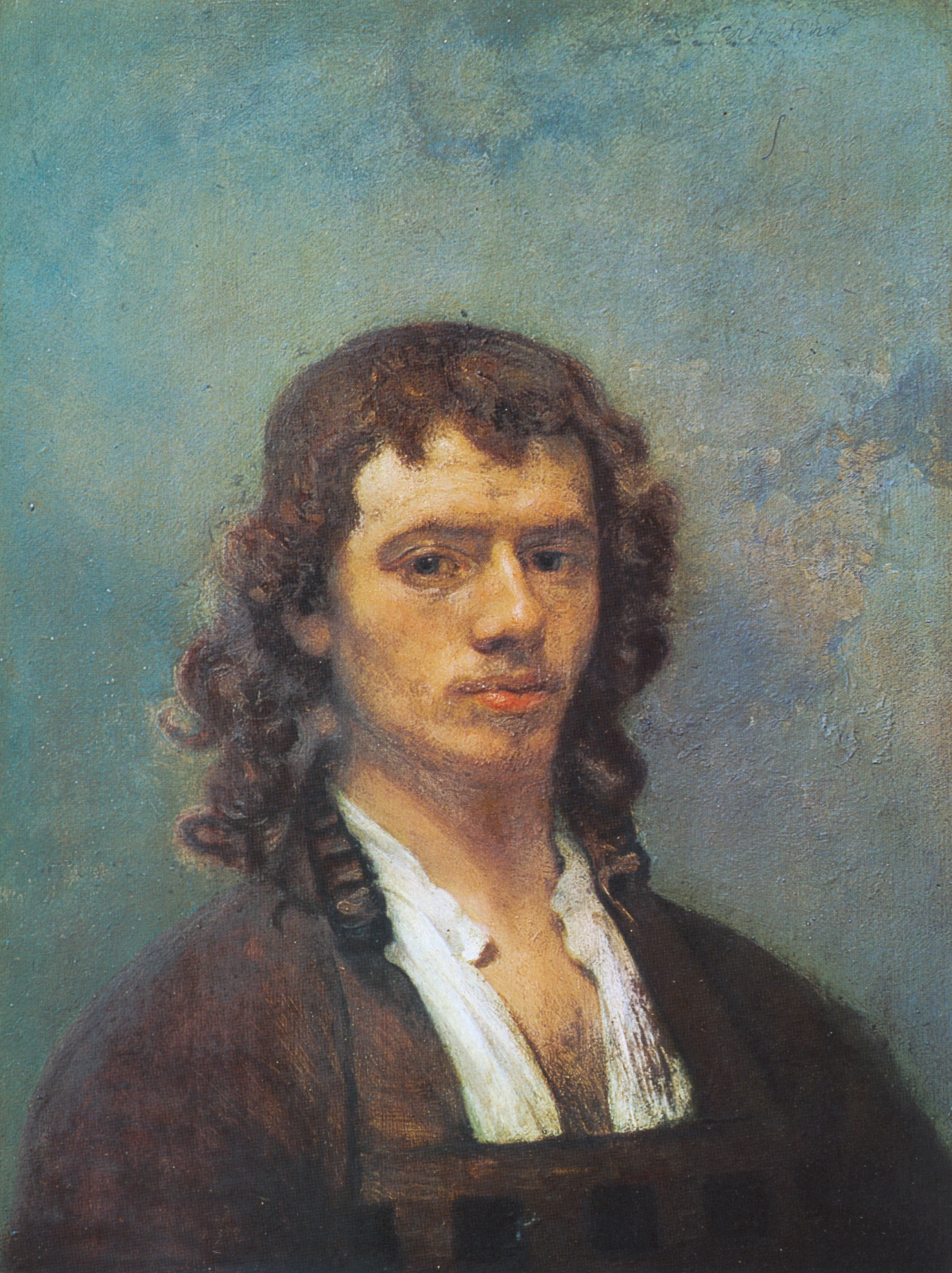
Self-Portrait
c. 1645, Museum Boijmans Van Beuningen
Useful biography image and Rembrandt-school comparison.
Discussion
Share what you notice, question or want to compare after reading this page. Reader discussion works best when it stays close to the object, the evidence and the surviving Fabritius corpus.
Reader Insights
What detail in Carel Fabritius Paintings most changes how you understand Carel Fabritius?
How does this page change the relationship between Rembrandt's workshop, Delft light and Fabritius's surviving works?
Which object fact, provenance detail or attribution caution feels most important for the way the work is presented?
Join the Conversation
Join the conversation below with a source-aware observation or question.
References
- Mauritshuis, The Goldfinch by Carel Fabritius, object record and related museum material. Source
- National Gallery, London, Carel Fabritius artist page. Source
- National Gallery, London, A View of Delft, with a Musical Instrument Seller's Stall by Carel Fabritius, object record and extended discussion. Source
- National Gallery, London, A Young Man in a Fur Cap and a Cuirass (probably a Self Portrait) by Carel Fabritius, object record and extended discussion. Source
- Rijksmuseum, Portrait of Abraham de Potter, Amsterdam Silk Merchant by Carel Fabritius, object record. Source
- Museum Boijmans Van Beuningen, Self-Portrait by Carel Fabritius, object record and technical imaging material. Source
- Staatliches Museum Schwerin / Landesmuseum Mecklenburg-Vorpommern, Carel Fabritius, The Sentry, object material. Source
- Gero Seelig, "Archival Note: Gerhard Morell and the Last Acquisitions of Christian Ludwig of Mecklenburg-Schwerin," Journal of Historians of Netherlandish Art. Source
- Museum of Fine Arts, Boston, Mercury and Aglauros by Carel Fabritius, object record. Source
- Antoni Ziemba, scholarship on The Raising of Lazarus by Carel Fabritius, Rocznik Muzeum Narodowego w Warszawie / National Museum in Warsaw. Source
- National Gallery of Art, Washington, A Girl with a Broom, object record. Source
- National Gallery of Art, Washington, Rembrandt Workshop, possibly Carel Fabritius, A Girl with a Broom, Dutch Paintings of the Seventeenth Century online catalogue entry. Source
- The Leiden Collection, Carel Fabritius biography by Piet Bakker. Source
- The Metropolitan Museum of Art, Vermeer and the Delft School exhibition catalogue. Source
- Linda Stone-Ferrier, Journal of Historians of Netherlandish Art scholarship on The Goldfinch and its possible social or window-related setting.
- CODART, Fabritius exhibition, restoration and collection-context material. Source
- RKD Research / RKDartists and RKDimages records for Carel Fabritius and selected works. Source