 by Tom Gurney
Tom Gurney BSc (Hons) is an art history expert with over 20 years experience
Published on August 4, 2026 / Updated on August 4, 2026
Email: tomgurney1@gmail.com / Phone: +44 7429 011000
A View of Delft: Introduction
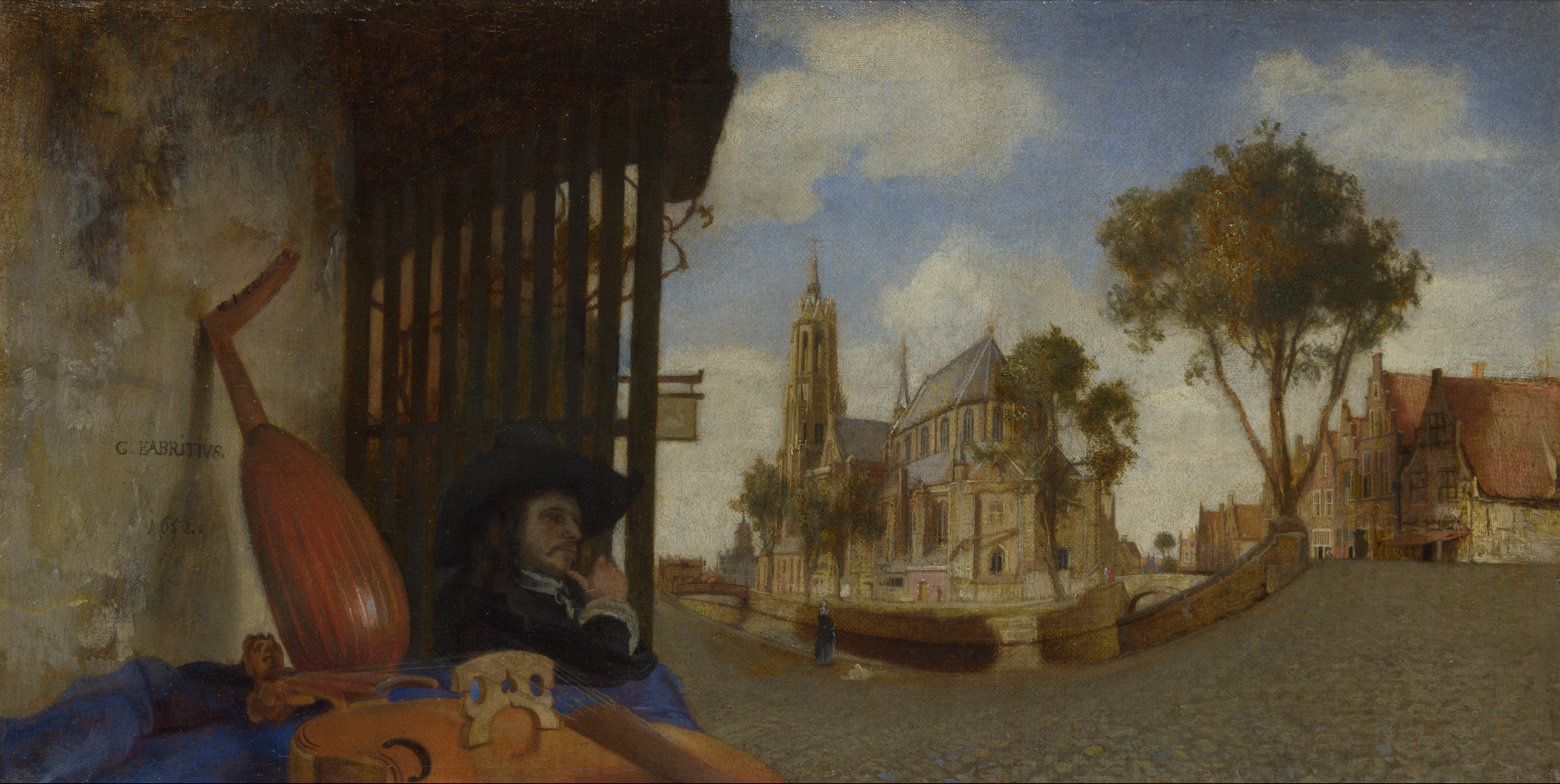
Carel Fabritius's A View of Delft is one of the strangest small paintings in seventeenth-century Dutch art. It measures only 15.5 x 31.7 cm, yet it asks the eye to behave as if it has stepped into a carefully engineered optical device. A street bends. A church swells forward. A musical instrument seems to thrust out from the picture surface. A man sits in shadow beside his stall, surrounded by objects that are ordinary enough to identify but distorted enough to make the whole scene feel unstable. [1]
The painting is not a calm city view in the familiar sense. It is a Delft view under pressure. Fabritius shows a recognizable urban site, with the Nieuwe Kerk rising in the middle ground, but he reshapes the space so strongly that recognition becomes only part of the experience. The viewer is not simply looking at Delft. The viewer is being asked to test how looking works. [2]
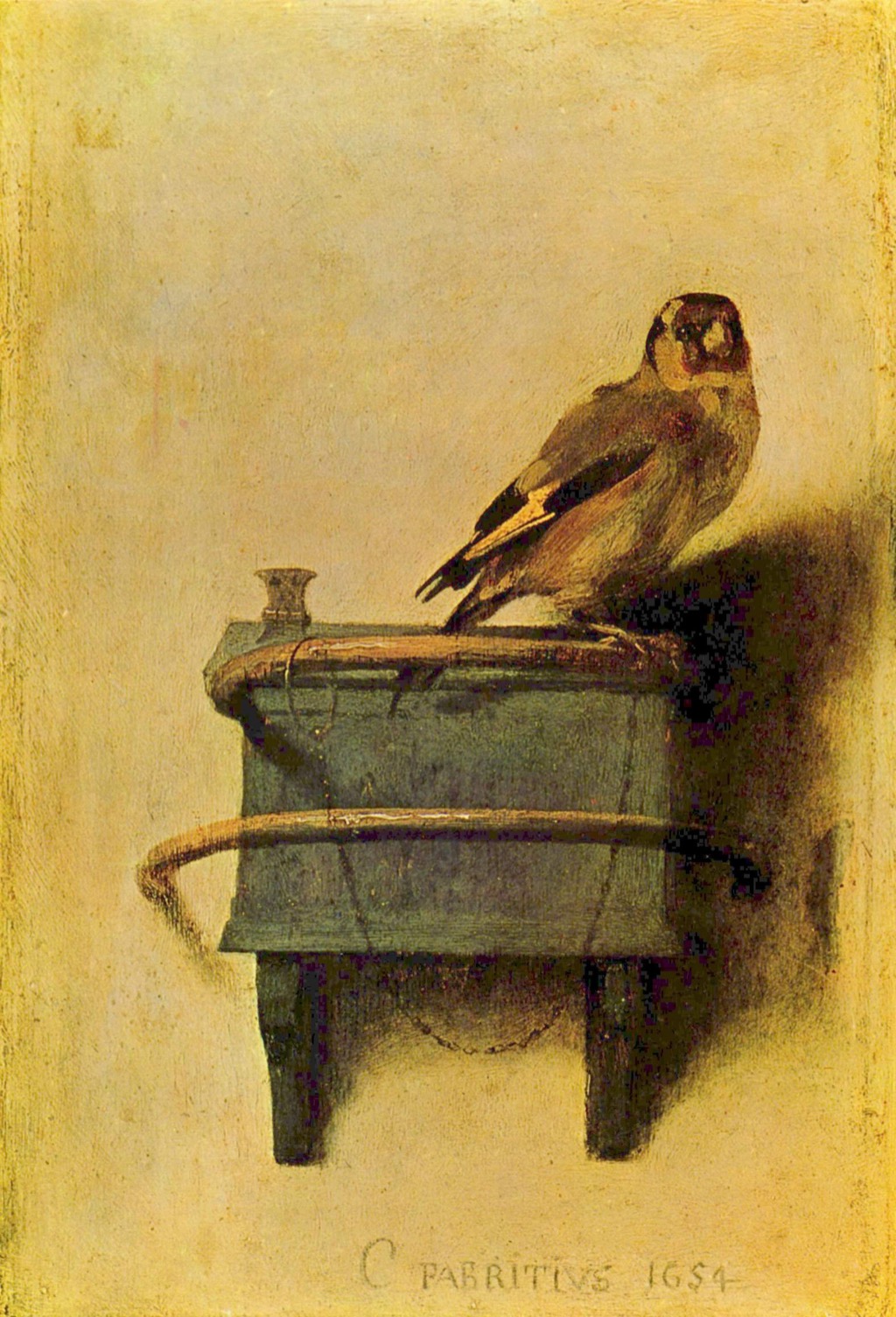
That makes A View of Delft a natural companion to The Goldfinch, Fabritius's more famous small masterpiece. Both works are modest in size, signed and dated, and bound up with questions of illusion, placement and viewing distance. Yet A View of Delft is not just a supporting example for The Goldfinch. It is a major work in its own right: a compressed experiment in cityscape, perspective, trade, music and optical curiosity, painted two years before Fabritius was killed in the Delft gunpowder explosion of 1654. [3]
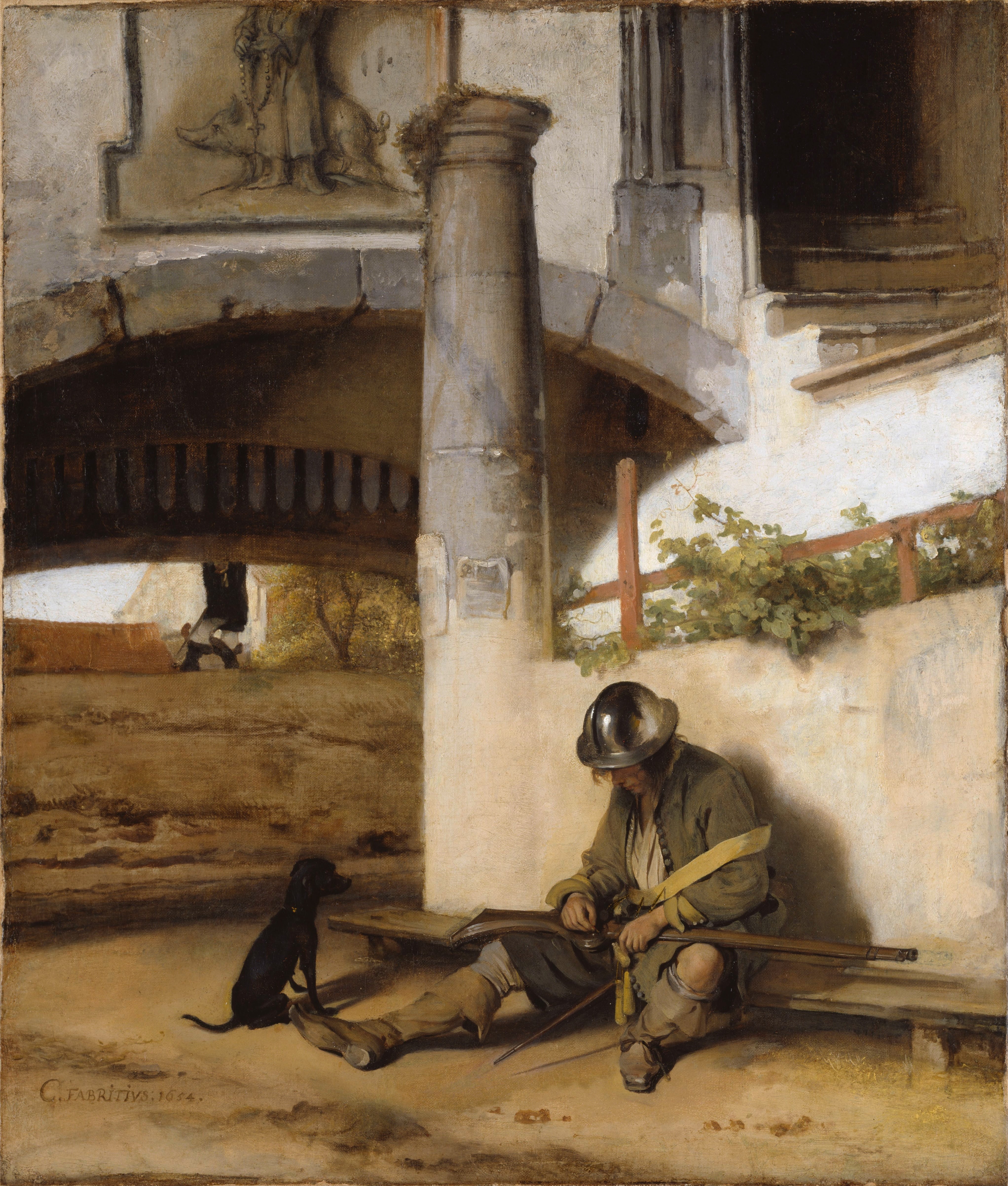
For the broader artist context, read the Fabritius biography and the paintings guide. This optical city view also belongs beside The Goldfinch and The Sentry as evidence of Fabritius's late experiments with light, space and attention.
At a Glance
- ArtistCarel Fabritius
- Date1652
- MediumOil on canvas
- CollectionNational Gallery, London
- Size15.5 x 31.7 cm
Contents
- A View of Delft: Introduction
- Object Facts
- What The Viewer Sees
- Distortion And Viewpoint
- A Viewing Box, A Lens, Or A Peephole?
- Delft And Optical Experiment
- The Instrument Seller
- Relationship To The Goldfinch
- Fabritius, Vermeer And The Two Views Of Delft
- Provenance And Acquisition
Object Facts
The painting's full title is A View of Delft, with a Musical Instrument Seller's Stall. It was made in 1652 and is painted in oil on canvas. The National Gallery in London owns the work, where it carries the inventory number NG3714. The museum records it as signed and dated. It was presented by the Art Fund in 1922, after a provenance that includes purchase in Naples in 1836 and later ownership in the Eden family. [1]
The size matters. At a little over thirty-one centimetres wide, the painting is closer to an intimate object than to a conventional cityscape. A viewer expecting a broad topographical panorama may be surprised by its narrow, warped, almost private intensity. Fabritius gives us a fragment of Delft, not the whole city. He takes a corner, a church, a stall, a few instruments, a seated tradesman and a curve of street, then turns them into a visual problem. [2]
The National Gallery identifies the viewpoint as looking roughly north-west over a canal from the corner of the Oude Langendijk and Oosteinde. The Nieuwe Kerk, or New Church, dominates the middle distance. Just to the left of it is the grey shape of the town hall. The site has changed: the canal has been filled in, and the houses to the right no longer stand. Even so, the picture is tied to a real Delft location. Its strangeness does not come from fantasy architecture.
It comes from the way a real place has been made to pass through an unusual optical imagination. [3]
What The Viewer Sees
At first glance the painting seems to offer a small street scene. The church rises beyond the foreground, recognisable by its tower and its place within Delft's civic and religious geography. The street bends away. On one side a man sits in shade, probably a maker or dealer of musical instruments. On the table or stall before him lie instruments that immediately complicate the space. [3]
The most forceful of them is a stringed instrument, described by the National Gallery as a violin or possibly a viola da gamba. It is seen in dramatic foreshortening, along the strings and fingerboard, so that it appears much closer to the viewer than the rest of the scene. A lute leans farther back against the wall. Fabritius's signature is treated as if it were scratched or carved into the wall, like a piece of street graffiti rather than a discreet inscription placed outside the fiction of the picture. [3]
These details create a strange double response. The picture is full of things that feel touchable: wood, strings, masonry, cobbles, shade, the hollow body of a lute. But the more carefully one looks, the less stable the space becomes. The instrument at the front seems to invade the viewer's own space, while the church in the middle ground pushes forward in a way that feels larger than the street could naturally allow.
The lines of sight run away on either side, pulling the eye outward and backward, even as the foreground object presses toward us. [3]
Fabritius's man is important because he slows the drama down. He is not a theatrical protagonist. He sits watchfully, partly absorbed into the shade of his stall. His trade also matters. Musical instruments were crafted things, objects of measurement, tuning, touch and resonance. A painter interested in optical exactness could hardly have chosen a better foreground subject: the instrument is at once a commodity, a shape, a measuring device for perspective and a sign of cultivated leisure. [3]
Distortion And Viewpoint
The first puzzle in A View of Delft is not what it represents, but where the viewer is supposed to stand. The painting behaves as if ordinary linear perspective has been stretched, curved or adapted for a special viewing condition. The street seems to bend; the church appears to loom; the foreground instrument is enlarged by its proximity. The effect resembles a wide-angle lens, though Fabritius was working in a seventeenth-century visual culture rather than in the photographic terms that phrase now evokes. [3]
Foreshortening is central to the effect. In ordinary painting, foreshortening allows a form to recede convincingly into pictorial depth. Fabritius pushes that effect until the instrument almost announces the mechanics of recession. The strings and fingerboard become a visual track. The viewer's eye runs along them, then follows the line into the street and toward the lute. The painting makes depth feel both persuasive and artificial. [3]
This is why the work is so different from a straightforward Dutch city view. Seventeenth-century viewers enjoyed recognisable streets, churches and civic landmarks, especially in a city such as Delft, whose artists had a strong interest in architectural space. But Fabritius does not simply record a building or celebrate a town. He makes the act of seeing itself feel oddly physical. Looking becomes a matter of angle, distance and bodily position. [3]
The small format intensifies this experience. A large painting can surround a viewer by scale. A tiny painting has to pull the viewer close. Fabritius seems to exploit that closeness. The viewer is invited to approach, then confronted with a spatial arrangement that may not make full sense from a normal viewing position. The painting therefore sits somewhere between cityscape, still life, and optical demonstration. [3]
A Viewing Box, A Lens, Or A Peephole?
The most famous question around A View of Delft is whether it was designed for a viewing box or another optical apparatus. The National Gallery states that many art historians have concluded Fabritius intended the painting to create a particular illusion. The museum also says it was probably made to be fitted into a viewing box and looked at through a lens or peephole, so that viewers would feel they were seeing a three-dimensional scene. [3]
That is a strong and useful interpretation, but it is not the same as a fully solved reconstruction. The National Gallery is careful on this point: exactly how the painting was intended to be mounted and viewed has not been definitively proven. It may have been pasted onto a curved surface inside a box, or it may have depended on a lens that altered the apparent distortion. The surviving canvas gives powerful evidence of optical intention, but it does not preserve the whole apparatus, if such an apparatus existed. [3]
This uncertainty is part of the painting's appeal. If the work belonged to a viewing box, it would have occupied a hybrid world between painting, device and performance. The viewer would have approached it not as a framed picture on a wall, but as something to be activated by looking through a controlled opening. The peephole would have forced one position on the eye. The lens, if used, might have corrected or transformed the distortions visible when the picture is seen unaided. [3]
Yet even without a surviving box, the painting makes its ambition clear. Fabritius is not hiding the fact that vision is being manipulated. He shows the manipulation in the foreground instrument, the curved street and the bulging prominence of the church. The picture offers illusion, but it also exposes the conditions of illusion. It asks the viewer to feel the pleasure of deception and the strangeness of knowing that deception is taking place. [3]
That balance is crucial. A View of Delft is not merely a trick picture. It is a picture about the vulnerability of vision. It makes ordinary perception feel contingent: shift the eye, change the viewing distance, alter the viewing device, and the world changes shape. [3]
Delft And Optical Experiment
Fabritius made A View of Delft during his Delft years, after his earlier connection with Rembrandt's Amsterdam workshop. The National Gallery describes him as one of Rembrandt's most innovative pupils and notes his later interest in cool lighting, dark figures against light grounds and optical effects. Those qualities help explain why his surviving paintings feel so unlike simple continuations of Rembrandt's style. [3]
Rembrandt's art had given Fabritius a deep education in paint, shadow and material presence. In Delft, however, Fabritius seems to have moved toward a different kind of pictorial question. Instead of building drama through darkness and concentrated gesture, he became increasingly interested in how light clarifies forms, how space opens around them, and how a painted surface can make the viewer conscious of distance. [3]
The wider Delft context matters here. The city was not only the later home of Vermeer and Pieter de Hooch. It also supported painters of church interiors, cityscapes, courtyards, architectural views and illusionistic spaces. The Metropolitan Museum of Art's Vermeer and the Delft School catalogue argues for Delft as a varied artistic centre, not just a quiet backdrop for domestic scenes. It places Fabritius among artists whose work explored architecture, light, space and refined visual experience. [3]
Samuel van Hoogstraten is a useful comparison because he made a surviving perspective box, A Peepshow with Views of the Interior of a Dutch House, now also in the National Gallery. The museum notes that Hoogstraten's box was probably made about five or six years after Fabritius's painting. It has two sight holes and presents an interior through controlled viewpoints. The comparison does not prove exactly how Fabritius's picture functioned, but it shows that such optical entertainments belonged to the artistic and intellectual world around him. [3]
The Delft setting also complicates later comparisons with Vermeer. Fabritius and Vermeer are often discussed together because both are associated with Delft, light, perspective and unusually charged stillness. But the evidence does not allow a simple teacher-pupil story. The safer and more interesting point is that Fabritius helps reveal the experimental atmosphere in which Delft painting developed. His work belongs near Vermeer in any account of Delft vision, but it does not need to be forced into a direct line of instruction. [3]
The Instrument Seller
The musical instrument seller gives the painting one of its most memorable human anchors. He sits beside his goods, half withdrawn, more watchful than active. His shaded position contrasts with the church and street beyond him. He belongs to the everyday economy of the city: a maker, seller or dealer whose craft depends on precision, sound and shaped wood. [3]
Fabritius may have chosen the stall partly because instruments offered beautiful forms to distort. The body of a lute, the neck of a violin, the run of strings and the flat plane of a table all give a painter opportunities to test perspective. They also make sense as objects of urban trade. Delft was not simply a picturesque city of churches and canals; it was a working place, filled with makers, sellers, craftsmen and patrons. [3]
The instrument in the foreground functions almost like a threshold. It marks the boundary between the viewer's world and the picture's world. Because it is so severely foreshortened, it seems to reach across that boundary. The seller, by contrast, remains inside the scene. He does not invite us in with a gesture. He lets the goods, the street and the optical structure do the work. [3]
Music also brings a quiet metaphor into the picture. A musical instrument must be tuned. Its proportions matter. Its sound depends on tension, distance and resonance. Fabritius's painting is similarly tuned: a small object arranged so that small shifts in position change the experience. The comparison is not an iconographic solution, but it helps explain why the foreground instruments feel so perfectly chosen for an artwork about calibrated perception. [3]
Relationship To The Goldfinch
A View of Delft and The Goldfinch are very different images. One opens onto a city corner; the other isolates a chained bird against a pale wall. One stretches space through a street and church; the other compresses attention around a perch, feeder, shadow and living body. But both works make the viewer aware of the relationship between painted object and real space. [3]
In The Goldfinch, the bird appears as if it might occupy the viewer's own world. Its perch, chain and feeder are rendered with a directness that encourages the eye to accept the painted object as present. At the same time, the visible paint handling reminds us that the illusion is made. The bird feels alive, but it remains a constructed effect. [3]
A View of Delft works on a larger spatial problem. Instead of bringing a bird forward from a wall, Fabritius tries to make a city scene behave as an illusionistic environment. The foreground instrument, the church, the curving street and the probable viewing apparatus all suggest a work designed to alter the viewer's sense of depth. Where The Goldfinch concentrates perception on a living creature, A View of Delft disperses perception through architecture and street space. [3]
The two paintings together reveal Fabritius's originality. His surviving oeuvre is small, partly because so much was lost when the Delft gunpowder magazine exploded in 1654, killing the artist at the age of thirty-two. But the surviving works are not minor survivals by a talented follower of Rembrandt. They show an artist testing how pictures occupy the world, how viewers meet them, and how illusion depends on placement as much as on descriptive skill. [3]
Fabritius, Vermeer And The Two Views Of Delft
The title A View of Delft inevitably invites comparison with Vermeer's famous View of Delft, painted several years later and now in the Mauritshuis. The comparison is useful, but only if the differences remain clear. Vermeer's painting is a broad city prospect across water, luminous and poised, with weather, reflection and civic identity held in extraordinary balance. Fabritius's painting is tiny, eccentric and concentrated, a specific street-corner view transformed by optical distortion. [3]
Both works belong to Delft's culture of looking at the city, but they do not do the same thing. Vermeer makes Delft feel stable and atmospheric. Fabritius makes Delft feel conditional, almost experimental, as if the city itself depends on the apparatus of sight. The shared place matters. The shared interest in light and perspective matters. But the relationship is best understood as proximity and affinity within a Delft context, not as a documented line from one artist to the other. [3]
This careful distinction strengthens Fabritius rather than diminishing him. He does not need to be important only because Vermeer came later. A View of Delft matters because it shows Fabritius using Delft as a laboratory for perception. It turns a real corner of the city into a test of viewpoint, objecthood and visual trust. [3]
Provenance And Acquisition
The National Gallery records that A View of Delft was bought in Naples in 1836. It later appeared on loan from Sir William Eden to the National Loan Exhibition at the Grafton Galleries in London in 1909-10. The National Art Collections Fund purchased it from Sir Thomas Eden and presented it to the National Gallery in 1922. [3]
That provenance is brief compared with the interpretive literature around the painting, but it is enough to show the work's movement from private ownership into a public collection where its optical puzzle could be studied closely. Its modern importance depends partly on that access. A small, strange painting can be overlooked in reproduction; in a museum collection, it can be examined as an object whose scale, surface and distortions all matter. [3]
The painting's exhibition history also confirms its relevance beyond Fabritius studies alone. It appeared in Pride of Place: Dutch Cityscapes of the Golden Age and in Vermeer and Music: The Art of Love and Leisure. Those contexts are telling. The work is both a cityscape and a music-related image, both a Delft picture and an optical experiment. It resists a single category because Fabritius made the categories overlap. [3]
Why The Painting Matters
A View of Delft matters because it pushes a familiar Dutch subject into unfamiliar territory. Dutch city views often reward patient looking: recognisable buildings, civic pride, weather, streets, canals, the habits of urban life. Fabritius keeps that world in sight, but he refuses to let it settle into ordinary description. He gives the viewer a city that must be looked at through questions. [3]
Is the foreground instrument an object in a stall, a perspectival demonstration, or a lure for the eye? Is the church a landmark, a bulging optical form, or both? Is the curve of the street a topographical feature, the echo of a lens, or an effect created for a viewing device that has disappeared? The best answer may be that the painting depends on the coexistence of these possibilities. [3]
Its unresolved viewing mechanism also gives it a modern freshness. We are used to images that depend on lenses, screens and fixed points of view. Fabritius's painting belongs to a much earlier world, but it already understands that vision can be mediated. It shows that seventeenth-century painting was not only about imitation. It could also be about the conditions under which imitation becomes convincing. [3]
For Fabritius, whose life and oeuvre were cut short, A View of Delft is one of the clearest signs of what was lost. It suggests an artist who had absorbed Rembrandt's lessons but was not confined by them; who worked in Delft without simply anticipating Vermeer; who could turn a sliver of city life into a disciplined experiment in perception. The painting is small, but its ambition is not. It asks the viewer to come close, then makes closeness strange. [3]
Frequently Asked Questions
The full title used by the National Gallery is A View of Delft, with a Musical Instrument Seller's Stall. The shorter title A View of Delft is commonly used.
Fabritius painted it in 1652, during his Delft period and two years before his death in the Delft gunpowder explosion of 1654.
The painting is in the National Gallery, London. Its inventory number is NG3714.
They are related by place and by later art-historical comparison, but they are very different paintings. Fabritius's work is a tiny optical experiment focused on a street corner and instrument seller, while Vermeer's later View of Delft is a broad city prospect. It is best to describe the connection cautiously, as Delft context and visual affinity rather than a documented direct influence.
It was probably intended for some kind of special viewing arrangement, possibly a viewing box with a lens or peephole. The National Gallery also notes that the exact mounting and viewing method has not been definitively proven.
Discussion
Share what you notice, question or want to compare after reading this page. Reader discussion works best when it stays close to the object, the evidence and the surviving Fabritius corpus.
Reader Insights
What detail in A View of Delft by Carel Fabritius most changes how you understand Carel Fabritius?
How does this page change the relationship between Rembrandt's workshop, Delft light and Fabritius's surviving works?
Which object fact, provenance detail or attribution caution feels most important for the way the work is presented?
Join the Conversation
Join the conversation below with a source-aware observation or question.
References
- National Gallery, London, A View of Delft, with a Musical Instrument Seller's Stall. Source
- National Gallery, London, Carel Fabritius artist record. Source
- Walter A. Liedtke, Michiel C. Plomp and Axel Ruger, Vermeer and the Delft School, Metropolitan Museum of Art, 2001. Source