 by Tom Gurney
Tom Gurney BSc (Hons) is an art history expert with over 20 years experience
Published on August 4, 2026 / Updated on August 4, 2026
Email: tomgurney1@gmail.com / Phone: +44 7429 011000
Biography: Introduction
Carel Fabritius is one of the most compelling interrupted lives in seventeenth-century Dutch art. He was born in a village north of Amsterdam, trained in or near Rembrandt's circle, moved to Delft, and died at thirty-two in the catastrophic explosion that devastated part of that city in 1654. That outline is dramatic enough, but it can also distort him. Fabritius was not only the painter who died young.
He was a serious experimenter whose surviving works suggest an artist searching for new ways to make space, light and painted surfaces behave. [1]
The difficulty is that his life has to be reconstructed from fragments. The documents are sparse, and the works that survive under his name are few. Some paintings have been lost, others are disputed, and several once passed under the names of Rembrandt or other artists. Yet the fragments are unusually revealing. They show a painter moving from the dark force of Rembrandt's Amsterdam toward a cooler, brighter and more optical kind of painting in Delft.
They also explain why later viewers have been tempted to place Fabritius between Rembrandt and Vermeer, not as a securely documented teacher of Vermeer, but as one of the crucial artists in the Delft world from which Vermeer's art emerged. [2]
This biography is best read beside the paintings guide, because Fabritius's short life is reconstructed through a small surviving corpus. The individual pages on The Goldfinch, A View of Delft and The Sentry show how that biography changes when it is tested against particular works.
At a Glance
- BornBaptised 27 February 1622, Middenbeemster
- Died12 October 1654, Delft
- TrainingAssociated with Rembrandt's Amsterdam workshop
- Late settingDelft, Guild of Saint Luke from 1652
Contents
- Biography: Introduction
- Middenbeemster and Family Background
- Marriage, Loss and Early Adulthood
- Rembrandt's Amsterdam
- Return North and the Search for Independence
- Delft and the Guild of Saint Luke
- Light, Optics and the Late Works
- The Delft Thunderclap
- Reputation After Death
- Why Fabritius Still Matters
Middenbeemster and Family Background
Carel Pietersz Fabritius was baptised at Middenbeemster on 27 February 1622. The place matters. Middenbeemster lay in the Beemster, a reclaimed polder north of Amsterdam whose ordered fields and new settlement patterns belonged to the engineered landscape of the Dutch Republic. Fabritius did not begin life in a grand artistic centre. He grew up in a family where education, craft and painting overlapped. [1]
His father, Pieter Carelsz Fabritius, was a schoolteacher and sexton, and is also described as an amateur painter. That combination offers a plausible first artistic setting for Carel and his brothers. The family produced more than one painter: Barent Fabritius and Johannes Fabritius also worked as artists. Carel's surname itself may derive from the Latinising habit of the period, with "Fabritius" connected to making or craftsmanship.
The family background does not give us a fully documented childhood studio, but it does suggest that the young Carel grew up close to drawing, discipline, literacy and practical skill. [2]
The Beemster context also helps explain why Fabritius's later art does not feel like a simple continuation of one metropolitan workshop style. His life moved between village, city and courtly or civic patronage networks. Amsterdam would give him access to Rembrandt's example; Delft would give him another visual climate. But the beginning was northern, practical and close to a family culture in which art was a learned craft rather than a detached mystery. [3]
Marriage, Loss and Early Adulthood
Fabritius's adult life began early and with severe personal loss. In 1641 he married Aeltge Velthuys. The marriage is part of the documented record, but it did not last long. Aeltge died in 1643, leaving Fabritius a widower while still in his early twenties. This period overlaps with the years usually associated with his Amsterdam training and his encounter with Rembrandt's art. [4]
It is tempting to turn these years into a psychological key for the paintings, but the evidence does not allow that with confidence. What can be said is that Fabritius entered artistic maturity during a period of upheaval. He was newly married, then bereaved; he was moving between his native region and Amsterdam; and he was absorbing one of the most powerful painting languages in Europe. In the early 1640s, Rembrandt's influence on ambitious young painters was immense.
Strong chiaroscuro, emotionally charged scenes, thick paint, theatrical light and vigorous handling all offered a model for artists who wanted to make painting feel physically and spiritually present. [5]
Several early works associated with Fabritius belong to this Rembrandt-inflected world. The Raising of Lazarus, now in Warsaw, has been studied as an early work connected to Rembrandt's circle and to the dramatic possibilities of biblical narrative. Mercury and Aglauros, in the Museum of Fine Arts, Boston, also belongs to the early phase in which mythological and history subjects could be handled with dark force and animated gesture.
These works do not yet look like the pale wall, open air and strange optical quiet of The Goldfinch or A View of Delft, but they show the scale of the change Fabritius would make. [6]
Rembrandt's Amsterdam
Fabritius is regularly described as one of Rembrandt's most innovative pupils. The chronology is not endlessly documented, but the core connection is strong. The National Gallery places his training with Rembrandt in Amsterdam around 1641 to 1643, and the Leiden Collection biography gives special importance to Samuel van Hoogstraten's later reference to Fabritius as his fellow pupil. Van Hoogstraten is a valuable witness because he himself moved through Rembrandt's artistic world and later wrote about painting, perspective and illusion. [7]
Training with Rembrandt did not mean learning a fixed formula. Rembrandt's workshop was a place where young painters absorbed dramatic lighting, expressive brushwork, historical imagination and the business of making images that could compete in a crowded market. It also gave them a problem: how to become themselves after passing through such a dominant presence. Some remained close to Rembrandt's manner. Fabritius seems to have taken from Rembrandt a seriousness about painted presence, then gradually redirected it. [8]
The early Rembrandt connection explains why some works by or associated with Fabritius have had complicated attribution histories. Paintings from Rembrandt's circle can be difficult to separate because pupils, assistants and followers shared subjects, studio habits and technical ambitions. A Girl with a Broom, in the National Gallery of Art, Washington, is a useful cautionary example. It is not a secure Fabritius work; the museum attributes it to the Rembrandt Workshop, possibly Carel Fabritius.
Such cases remind us that Fabritius's biography cannot be built by gathering every attractive Rembrandt-school painting around his name. It has to proceed from the documents and the most carefully attributed works. [9]
What distinguishes Fabritius is not simply that he learned from Rembrandt, but that he appears to have moved away from Rembrandt's enclosed darkness. Later accounts of his art stress brighter settings, unusual perspectives and dark figures or objects placed against luminous grounds. That transformation did not happen in isolation, and it did not erase Rembrandt's impact. It made Rembrandt's lessons do different work. [10]
Return North and the Search for Independence
After the Amsterdam years, Fabritius returned north for a time. The Leiden Collection biography points to a period back in Middenbeemster and to connections with patrons in the Beemster and Amsterdam. This part of his life is less visually famous than the Delft years, but it matters because it shows him working toward independence before the small group of late masterpieces appeared. [11]
The Portrait of Abraham de Potter, dated 1649 and now in the Rijksmuseum, is especially important for this transitional phase. Abraham de Potter was an Amsterdam silk merchant, and Fabritius's portrait gives him the social presence expected from a seventeenth-century likeness. Yet the painting also contains one of those details that make Fabritius feel restless within convention: a small illusionistic nail above the signature on a weathered wall. The sitter belongs to a respectable portrait format; the wall belongs to another kind of pictorial game.
It is not The Goldfinch yet, but it points toward an artist fascinated by the boundary between painted object, real object and viewing situation. [12]
Fabritius also seems to have faced financial pressure. The Leiden Collection biography notes, among other details, a debt in 1653 to Jasper de Potter. Such records are small, but they make the artist less abstract. He was not only a painter in a lineage of masters; he was a working man negotiating marriage, bereavement, patrons, guild structures, civic commissions and debts. The surviving paintings may look rarefied now, but they were made inside a practical economy. [12]
Delft and the Guild of Saint Luke
Fabritius moved to Delft around 1650 and became a member of the Guild of Saint Luke in 1652. Delft was not Amsterdam. It was smaller, but culturally alert, with its own traditions of city view, domestic interior, perspective experiment, architecture, ceramics and civic identity. For Fabritius, Delft seems to have offered a setting in which his art could open out. [12]
The move is crucial because his most famous surviving works are tied to these final Delft years. The city gave him new subjects and, perhaps more importantly, new problems of light and space. The National Gallery's account of Fabritius stresses cool lighting, optics and light grounds; these qualities separate his later work from the dense Rembrandt-school atmosphere of his early period.
Samuel van Hoogstraten's comments about Fabritius and perspective have also encouraged scholars to think of him as an artist interested in large-scale illusionistic or spatial effects, though the exact nature of some lost works remains uncertain. [12]
Fabritius's Delft activity was not limited to easel paintings. He received payments from the town council for painting city coats of arms, a reminder that seventeenth-century artists often moved between what modern viewers separate into fine art, civic decoration and skilled public work. The same painter who made one of the most haunting small bird paintings in European art could also work on heraldic commissions for the city. That practical range is part of the biography, not a distraction from it. [12]
Delft also places Fabritius near the later story of Vermeer. The comparison is natural: both artists are associated with Delft, unusual light, poised stillness and a fascination with the viewer's position. But the relationship should be kept careful. There is no secure documentary evidence that Fabritius taught Vermeer. It is more accurate to speak of shared Delft context, visual affinities and later attempts to understand how Fabritius's experiments may have belonged to the same artistic atmosphere in which Vermeer developed. [12]
Light, Optics and the Late Works
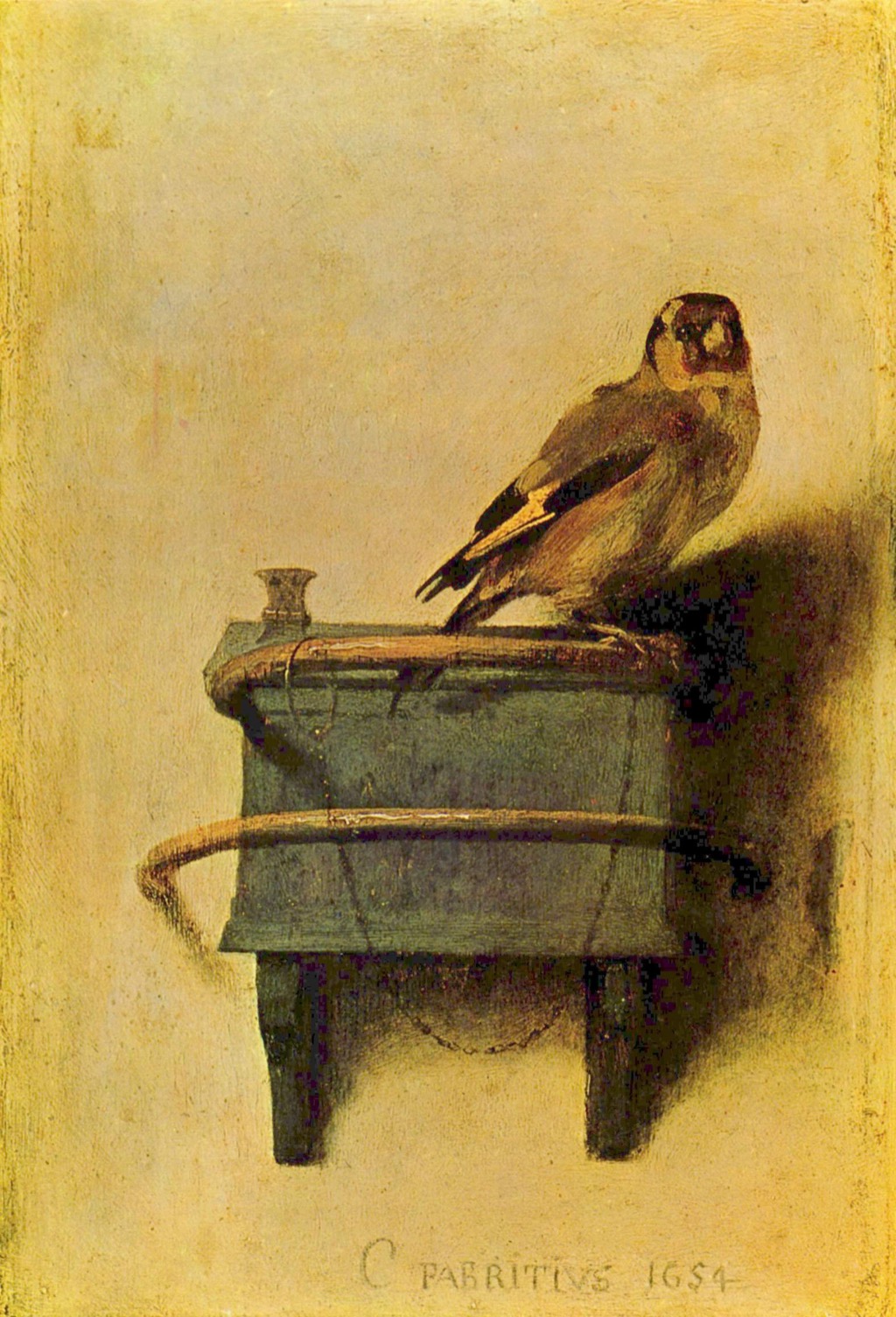
The late paintings are the heart of Fabritius's reputation because they show how far he had travelled. The Goldfinch, dated 1654 and now in the Mauritshuis, is small, direct and startlingly alive. A chained bird perches against a pale wall, with its feeder and shadows rendered so plainly that the work seems almost casual. Yet its simplicity is sophisticated. The painting plays with trompe-l'oeil, objecthood, domestic display and the viewer's sense of nearness.
Its original function remains debated: it may have been connected to a wall, niche, case, window-like setting or other display situation, but no single theory has settled the question. [12]
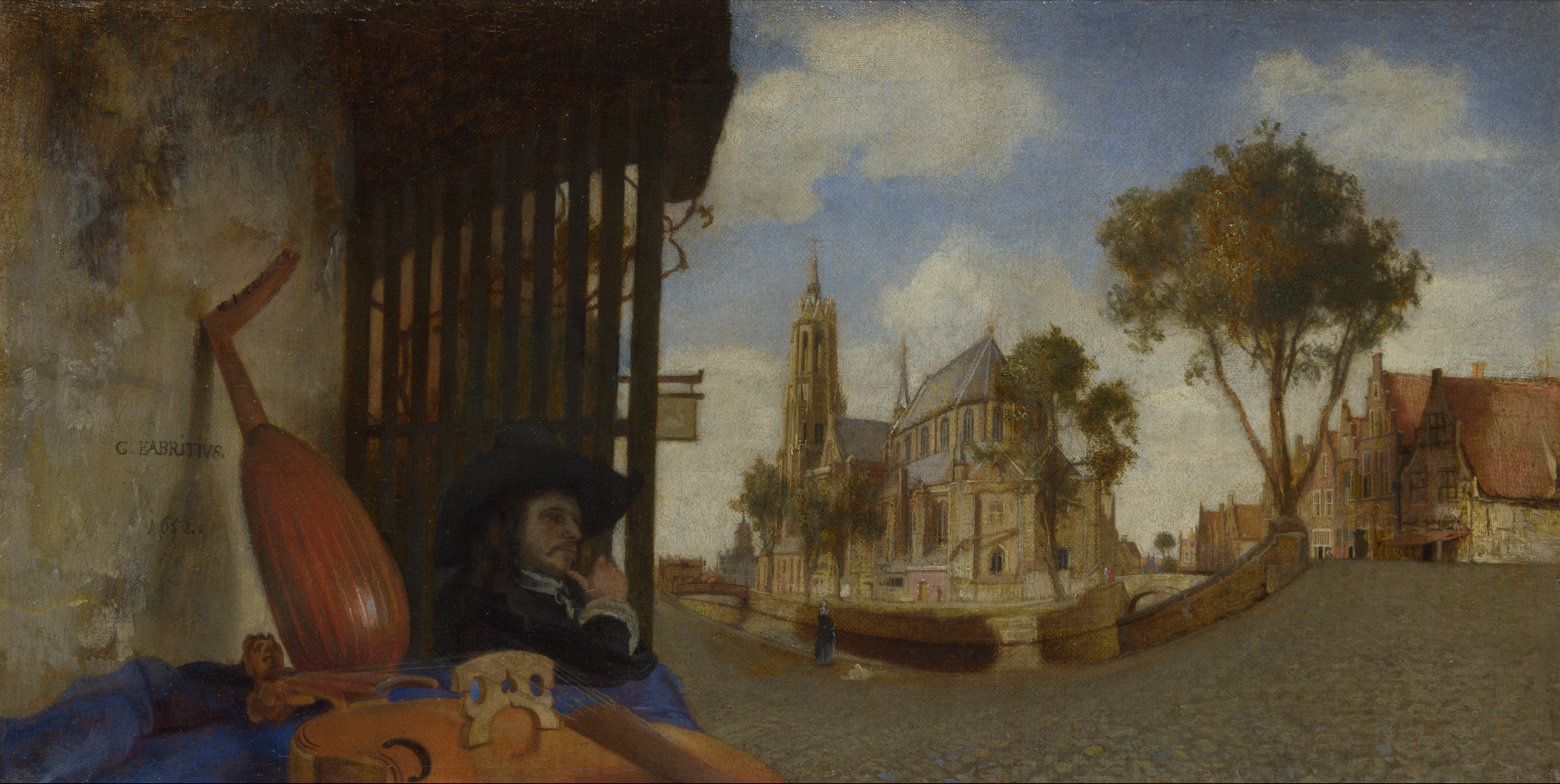
A View of Delft, with a Musical Instrument Seller's Stall, dated 1652 and now in the National Gallery, London, takes a different route into optical experiment. It shows a small city view with the Nieuwe Kerk, a street and an instrument seller's stall, but its perspective is deliberately strange. The proportions and foreshortening have led scholars to consider whether it was designed for a viewing box, lens, peephole or other controlled viewing arrangement. Here again, the important point is not to force a single answer.
Fabritius was working with the relation between image, space and spectator. [12]
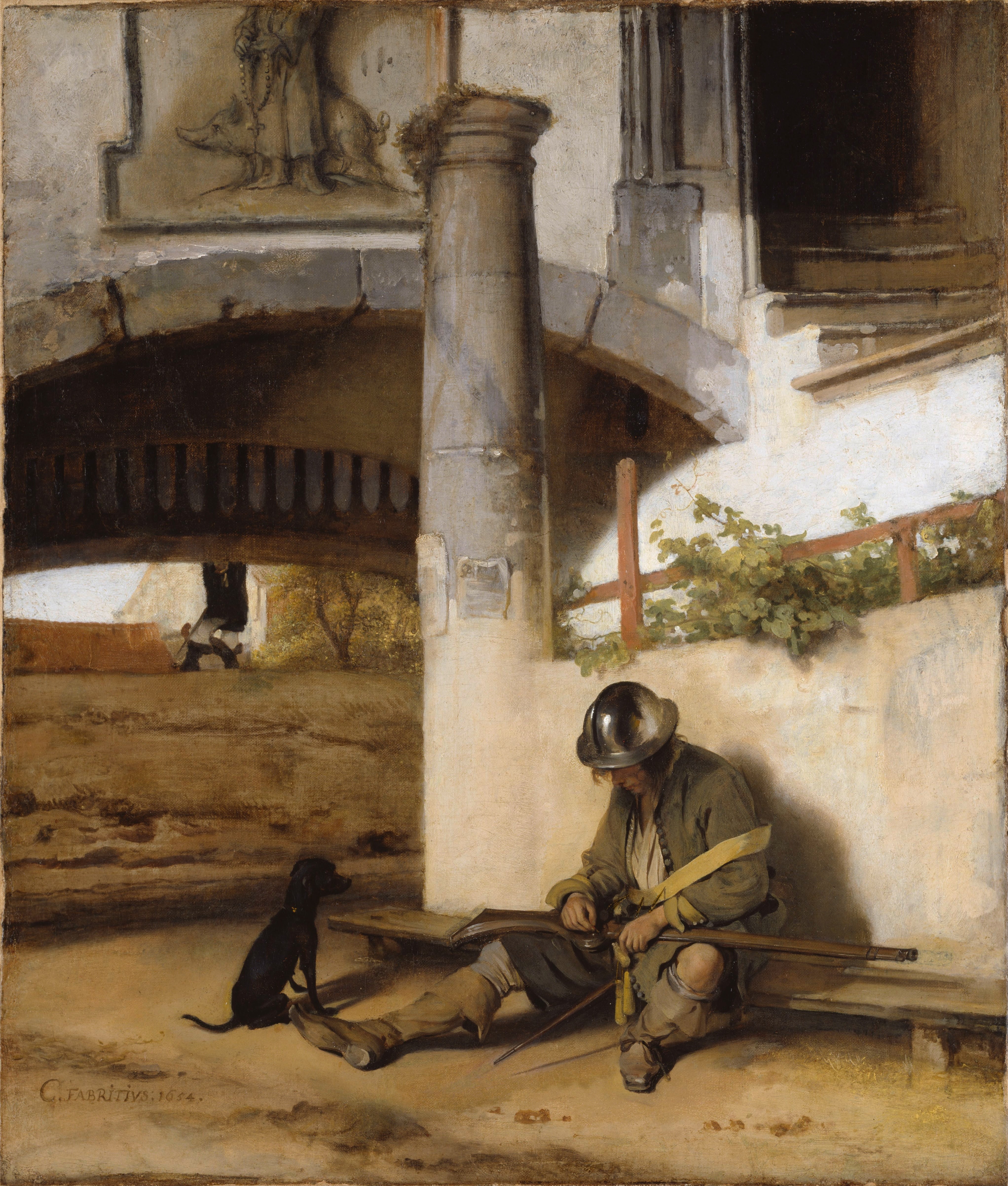
The Sentry, dated 1654 and now in Schwerin, adds another late work to the picture. Its subject and meaning have remained less straightforward than those of The Goldfinch, but its history of collection, seizure, recognition and return has made it central to Fabritius's modern reputation. Together these late works suggest an artist who had not merely softened Rembrandt's manner, but rethought it. Darkness gives way to air; theatrical narrative gives way to odd encounters with surfaces, shadows, streets, birds, guards and walls. [12]
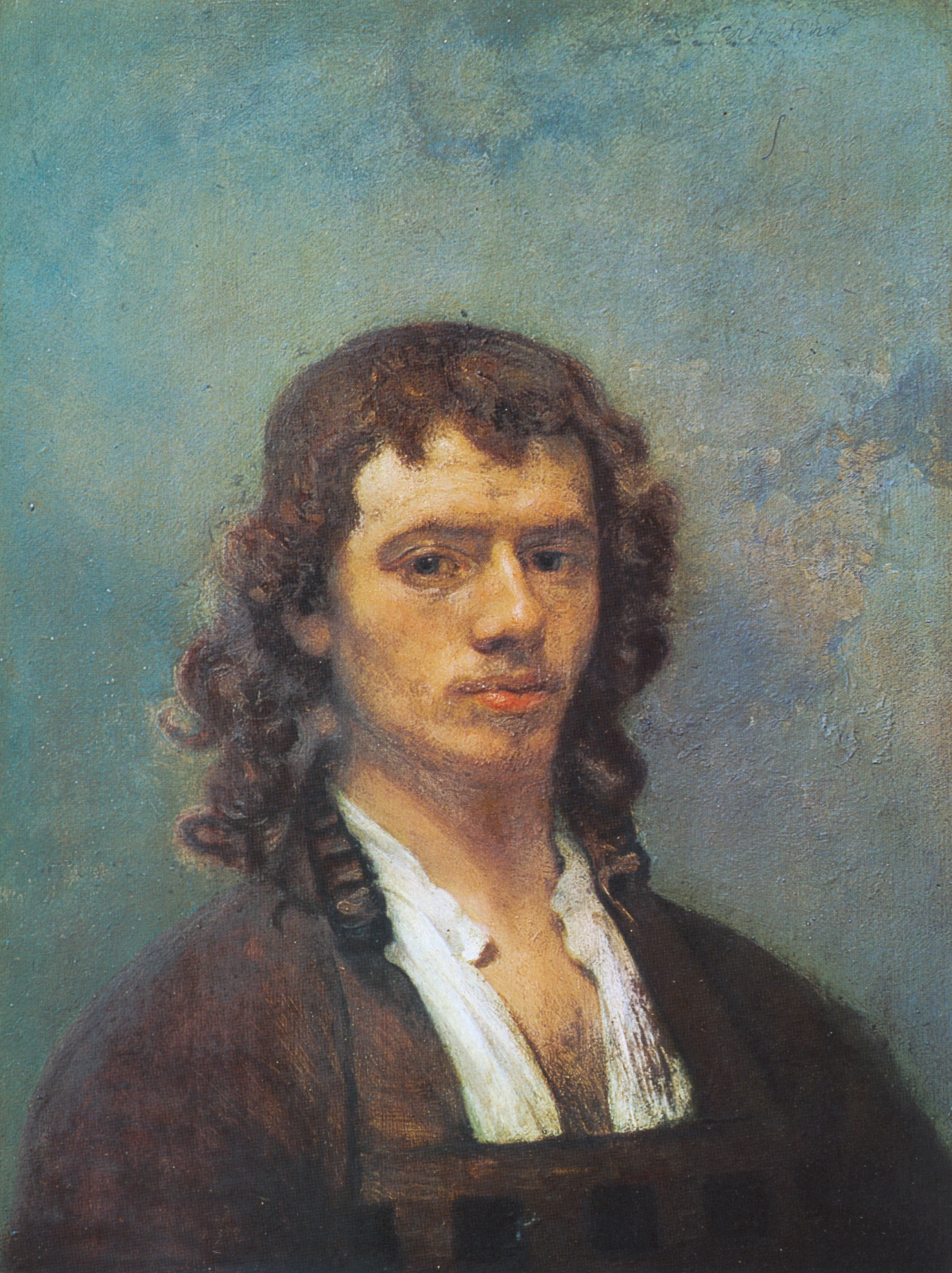
Other works deepen the biography through their uncertainties. A Young Man in a Fur Cap and a Cuirass, probably a self-portrait, belongs to the National Gallery and is dated 1654. The gallery describes it with care because no documented likeness of Fabritius survives. The painting matters because it shows how identity, costume, self-presentation and tronie-like invention could overlap. The Self-Portrait in Museum Boijmans Van Beuningen, once thought to be by Rembrandt and now given to Fabritius, also shows how his name has been recovered through later scholarship and technical examination. [12]
The Delft Thunderclap
On 12 October 1654, the Delft powder magazine exploded. The disaster, known as the Delft Thunderclap, destroyed a large part of the city and killed Fabritius. He was thirty-two. The Leiden Collection biography records his burial in the Oude Kerk. The event has become inseparable from his reputation because it ended his career and probably destroyed works that would have made his development much easier to understand. [12]
The explosion deserves its place in the biography, but it should not be allowed to consume the man. Fabritius had already passed through family training, marriage, loss, Rembrandt's orbit, a search for independent patrons and a Delft period of remarkable invention. The tragedy is devastating because it cuts across a real artistic trajectory. It is not the only reason that trajectory matters. [12]
The loss also shapes the way we look at the surviving paintings. Because the corpus is so small, each work has to carry unusual weight. The Goldfinch can seem like a complete statement, but it is also a remnant. A View of Delft looks like a clue to a broader optical practice. The Sentry, portraits and early history paintings become evidence in a biography whose missing chapters are part of its meaning. Fabritius's life is therefore both unusually vivid and unusually incomplete. [12]
Reputation After Death
Fabritius was not forgotten, but his posthumous reputation developed unevenly. Some works were attributed to Rembrandt or other artists; others entered collections with uncertain or changing identities. The modern Fabritius is partly the result of connoisseurship, archival work, conservation science and museum scholarship. That is why his biography has a different texture from the lives of artists who left large workshops, long paper trails or extensive signed oeuvres. [12]
The National Gallery's profile presents him as a particularly innovative Rembrandt pupil. The Mauritshuis has made The Goldfinch one of the best-known paintings in its collection. The Metropolitan Museum of Art's Vermeer and the Delft School catalogue placed Fabritius inside a wider Delft world of perspective, light and artistic exchange. Studies of individual works, including technical research and provenance articles, have helped make the small surviving corpus more legible. [12]
His modern fame has also been shaped by the strange charisma of The Goldfinch. The painting's later literary and popular afterlife has introduced many readers to Fabritius through one small chained bird. That popularity is not false, but it is incomplete. The bird becomes more powerful when seen beside the early Rembrandt-school works, the portraits, the Delft perspective experiments and the documentary record of a working painter's short life. [12]
Why Fabritius Still Matters
Fabritius matters because his surviving career preserves a rare moment of transition. He learned from Rembrandt's world but did not remain inside it. In Delft, he pushed toward pale light, spatial experiment and a more elusive relation between painted thing and real space. He did this in works that are few enough to fit almost in the mind at once, yet varied enough to resist easy summary. [12]
The usual art-historical temptation is to make him a bridge: Rembrandt behind him, Vermeer ahead of him. That bridge is useful only if it does not flatten him. Fabritius was not important merely because other artists were important. He was important because, in a short span, he made paintings that test how seeing works.
A bird on a wall, a distorted view of Delft, a sentry in a shadowed architectural space, a sitter before a scarred wall with a painted nail: these are not grand gestures, but they are exacting ones. [12]
His biography remains fragmentary, and it should. The gaps are part of the historical truth. What survives is enough to show a painter of unusual intelligence, trained in a powerful workshop, shaped by personal and professional instability, alert to Delft's visual culture, and lost just as his art was becoming most distinctive. [12]
Frequently Asked Questions
Carel Fabritius was baptised in Middenbeemster on 27 February 1622. His exact birth date is not securely known, so the baptism date is the firm point normally used in biographies.
Fabritius is widely described as a pupil of Rembrandt, with his Amsterdam training usually placed around 1641 to 1643. Samuel van Hoogstraten's reference to Fabritius as a fellow pupil is an important early piece of evidence for that connection.
There is no secure documentary evidence that Carel Fabritius taught Johannes Vermeer. The two artists are often discussed together because of their Delft setting, their interest in light and perspective, and the later sense that Fabritius's experiments help explain the artistic atmosphere around Vermeer.
Fabritius died in Delft on 12 October 1654, when the city's gunpowder magazine exploded. The disaster is known as the Delft Thunderclap and destroyed part of the city. It probably also destroyed paintings by Fabritius.
Fabritius died young, and the Delft explosion may have destroyed works in his studio or nearby. Attribution has also been difficult because some paintings linked to him were long associated with Rembrandt or the Rembrandt workshop. The accepted corpus is therefore small and carefully studied.
Discussion
Share what you notice, question or want to compare after reading this page. Reader discussion works best when it stays close to the object, the evidence and the surviving Fabritius corpus.
Reader Insights
What detail in Carel Fabritius Biography most changes how you understand Carel Fabritius?
How does this page change the relationship between Rembrandt's workshop, Delft light and Fabritius's surviving works?
Which object fact, provenance detail or attribution caution feels most important for the way the work is presented?
Join the Conversation
Join the conversation below with a source-aware observation or question.
References
- The Leiden Collection, "Carel Fabritius," biography by Piet Bakker. Source
- The National Gallery, London, "Carel Fabritius" artist profile. Source
- The National Gallery, London, "A View of Delft, with a Musical Instrument Seller's Stall." Source
- The National Gallery, London, "A Young Man in a Fur Cap and a Cuirass (probably a Self Portrait)." Source
- Mauritshuis, "The Goldfinch" / "Het puttertje" object record and collection material. Source
- The Metropolitan Museum of Art, *Vermeer and the Delft School*, exhibition catalogue. Source
- Rijksmuseum, "Portrait of Abraham de Potter, Amsterdam Silk Merchant." Source
- Museum Boijmans Van Beuningen, "Self-Portrait" by Carel Fabritius, including technical imaging material. Source
- Staatliches Museum Schwerin / Landesmuseum Mecklenburg-Vorpommern, "Carel Fabritius: The Sentry." Source
- Gero Seelig, "Archival Note: Gerhard Morell and the Last Acquisitions of Christian Ludwig of Mecklenburg-Schwerin," *Journal of Historians of Netherlandish Art*. Source
- Antoni Ziemba, study of Carel Fabritius's *The Raising of Lazarus*, *Rocznik Muzeum Narodowego w Warszawie*. Source
- National Gallery of Art, Washington, "A Girl with a Broom" and the online catalogue entry for "Rembrandt Workshop, possibly Carel Fabritius." Source